Overview
Rational expressions are algebraic fractions in which both the numerator and denominator are polynomials. These expressions form a critical component of GMAT Quantitative Reasoning, appearing in approximately 10-15% of algebra questions on the exam. A rational expression takes the general form P(x)/Q(x), where P(x) and Q(x) are polynomials and Q(x) ≠ 0. Mastering rational expressions requires understanding how to simplify, add, subtract, multiply, divide, and solve equations involving these algebraic fractions—skills that directly translate to solving complex GMAT problems efficiently.
The importance of gmat rational expressions extends beyond isolated algebra questions. These expressions frequently appear embedded within word problems, data sufficiency questions, and complex equation-solving scenarios. Students who develop fluency with rational expressions gain a significant advantage in tackling multi-step problems that combine multiple algebraic concepts. The ability to recognize when an expression can be simplified, identify restrictions on variables, and manipulate fractions algebraically separates high-scoring test-takers from those who struggle with medium-to-difficult quantitative questions.
Within the broader landscape of GMAT Quantitative Reasoning, rational expressions serve as a bridge between fundamental algebra and more advanced problem-solving. They build upon knowledge of polynomials, factoring, and basic fraction operations while providing essential tools for solving equations, working with functions, and analyzing relationships between variables. Understanding rational expressions also strengthens skills in recognizing patterns, identifying domain restrictions, and performing algebraic manipulations—all critical competencies for achieving a competitive GMAT score.
Learning Objectives
- [ ] Identify rational expressions in various algebraic contexts and GMAT question formats
- [ ] Explain the properties, restrictions, and behavior of rational expressions
- [ ] Apply rational expressions to solve GMAT questions efficiently and accurately
- [ ] Simplify complex rational expressions by factoring and canceling common terms
- [ ] Perform arithmetic operations (addition, subtraction, multiplication, division) with rational expressions
- [ ] Determine domain restrictions and identify values that make rational expressions undefined
- [ ] Solve equations involving rational expressions using appropriate algebraic techniques
Prerequisites
- Polynomial operations: Essential for manipulating the numerators and denominators of rational expressions
- Factoring techniques: Required to simplify rational expressions by identifying and canceling common factors
- Fraction arithmetic: The foundation for adding, subtracting, multiplying, and dividing rational expressions
- Equation solving: Necessary for solving problems where rational expressions equal specific values
- Domain and range concepts: Important for understanding when rational expressions are undefined or restricted
Why This Topic Matters
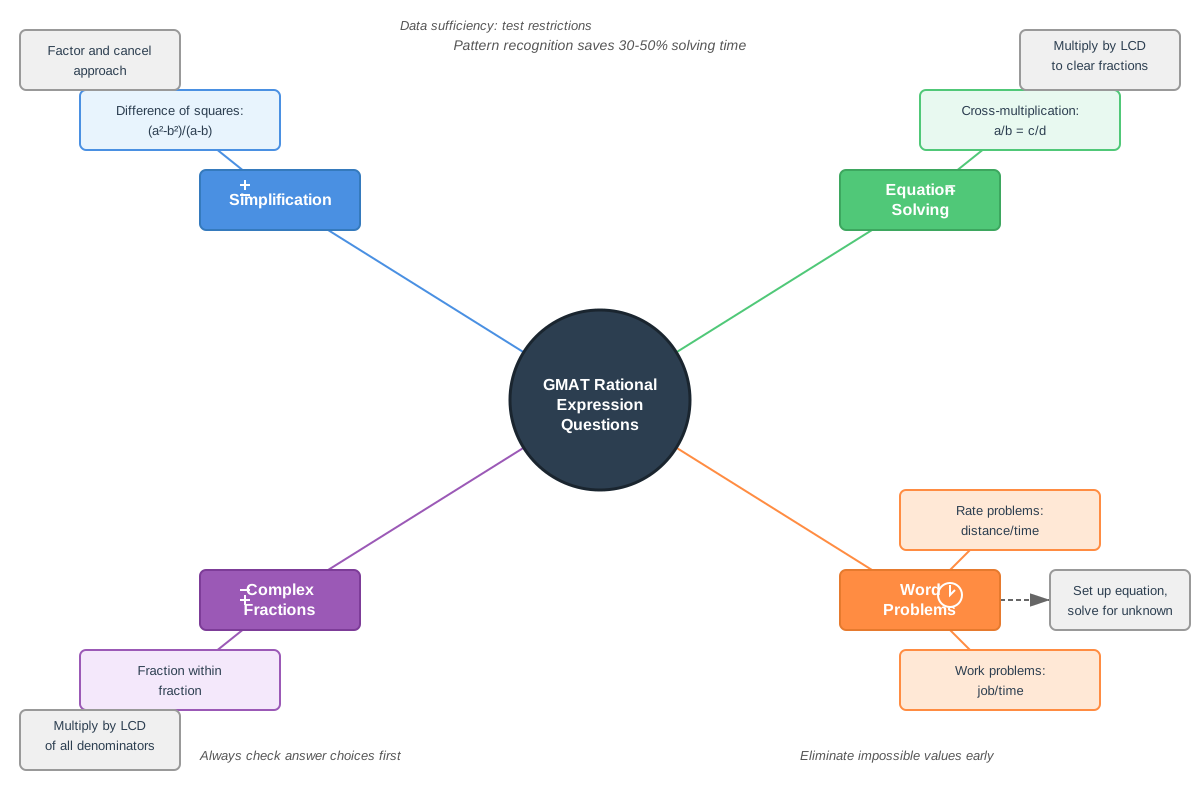
Rational expressions represent a fundamental skill set that appears throughout the GMAT Quantitative section. Beyond pure algebra questions, these expressions emerge in rate problems (distance/time), work problems (job/time), mixture problems, and optimization scenarios. The ability to manipulate rational expressions efficiently can reduce solving time by 30-50% on complex problems, making this topic essential for time management on the exam.
From a real-world perspective, rational expressions model countless practical situations: unit conversions, financial ratios, efficiency calculations, concentration problems, and rate comparisons. Business school applicants benefit from understanding these relationships, as they form the mathematical foundation for analyzing business metrics like profit margins, return on investment, and productivity ratios.
On the GMAT specifically, rational expressions appear in approximately 3-5 questions per exam across multiple question types. They commonly appear in Problem Solving questions requiring simplification or evaluation, Data Sufficiency questions testing understanding of restrictions and equivalence, and integrated reasoning scenarios involving algebraic relationships. Questions may present rational expressions directly or embed them within word problems where students must first translate the scenario into algebraic form. The GMAT particularly favors questions that test whether students recognize when expressions are undefined, can identify equivalent forms, and understand how changing one variable affects the entire expression.
Core Concepts
Definition and Structure of Rational Expressions
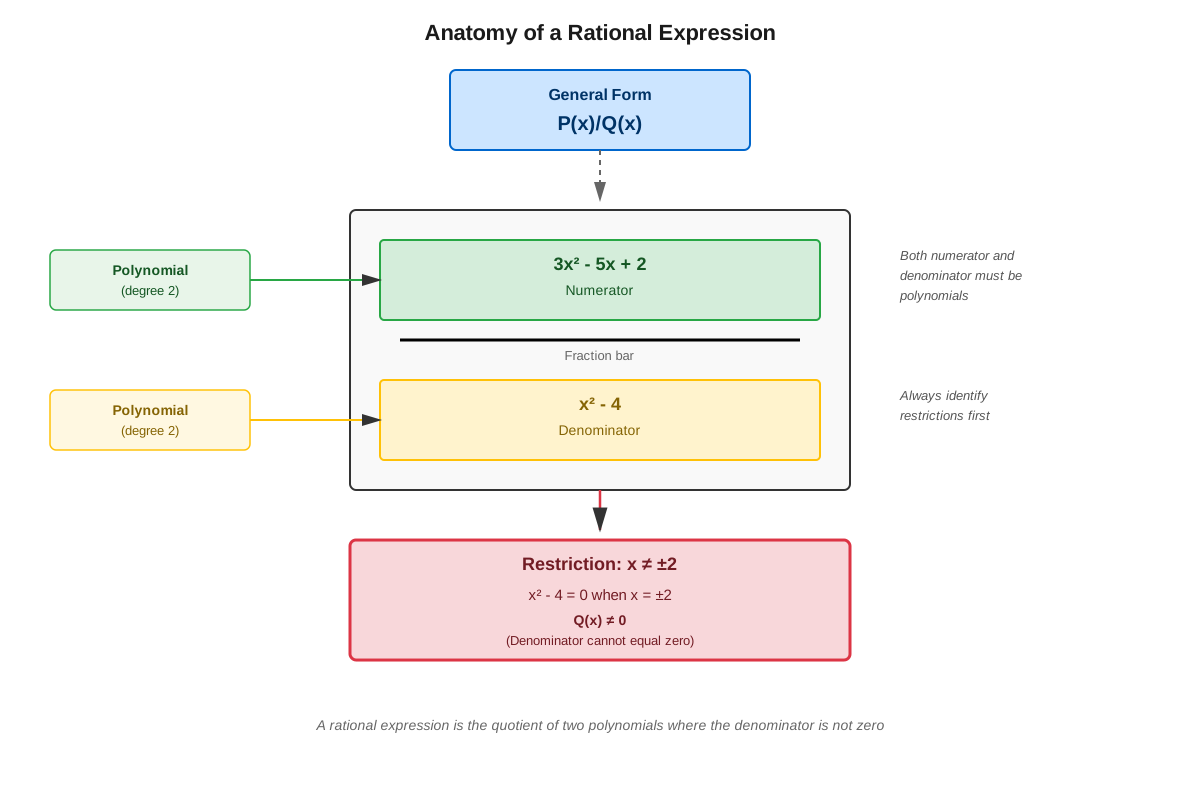
A rational expression is defined as the quotient of two polynomials, written in the form P(x)/Q(x), where both P(x) and Q(x) are polynomials and Q(x) ≠ 0. The term "rational" derives from "ratio," emphasizing that these expressions represent ratios of polynomial expressions. Just as rational numbers are ratios of integers, rational expressions are ratios of polynomials.
The numerator P(x) can be any polynomial, including constants, while the denominator Q(x) must be a non-zero polynomial. This non-zero requirement is critical: whenever Q(x) = 0, the rational expression becomes undefined. For example, in the expression (x² + 3x - 4)/(x - 2), the numerator is x² + 3x - 4 and the denominator is x - 2. This expression is undefined when x = 2 because the denominator would equal zero.
Domain Restrictions and Undefined Values
The domain of a rational expression consists of all real numbers except those values that make the denominator equal to zero. Identifying these restrictions is crucial for GMAT questions, particularly in Data Sufficiency problems where understanding what values are permissible can determine sufficiency.
To find domain restrictions:
- Set the denominator equal to zero
- Solve for the variable
- Exclude these values from the domain
For example, the expression (2x + 1)/(x² - 9) has restrictions where x² - 9 = 0, which factors to (x - 3)(x + 3) = 0. Therefore, x ≠ 3 and x ≠ -3. The domain is all real numbers except 3 and -3.
Simplifying Rational Expressions
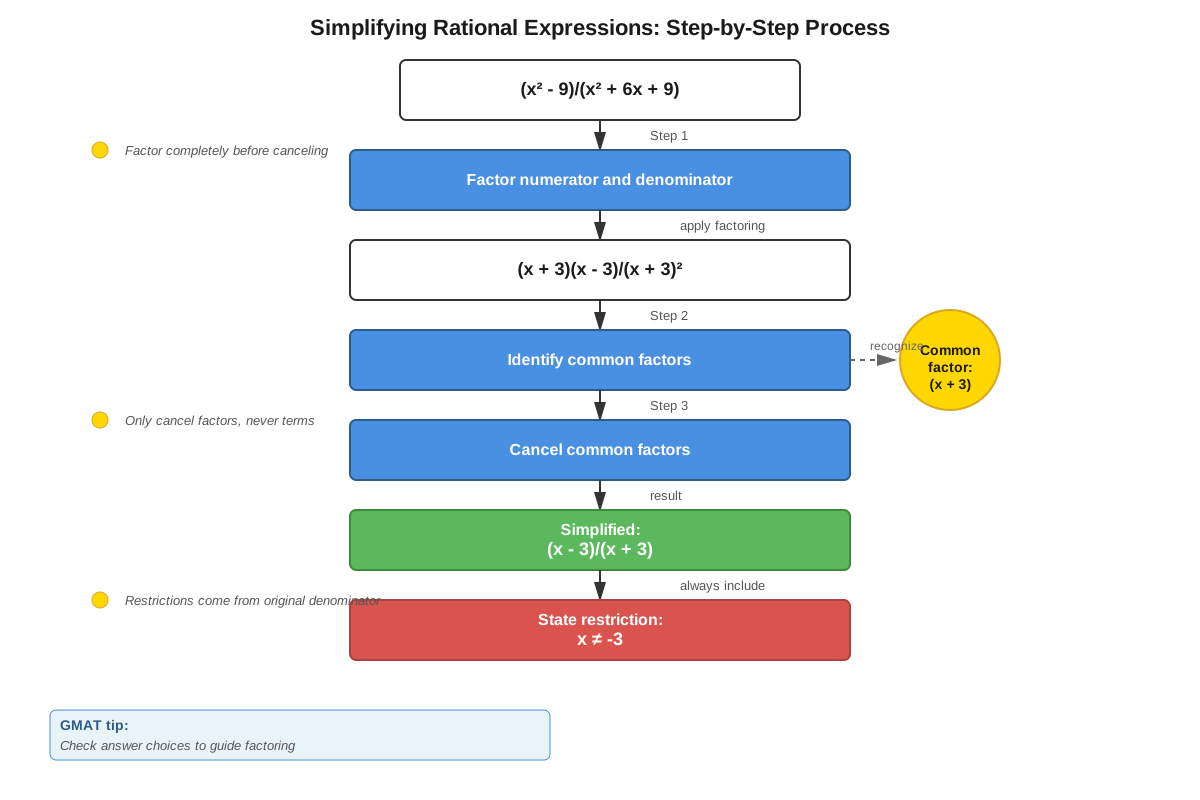
Simplification involves reducing a rational expression to its lowest terms by factoring both numerator and denominator, then canceling common factors. This process mirrors simplifying numerical fractions but requires polynomial factoring skills.
The simplification process:
- Factor the numerator completely
- Factor the denominator completely
- Identify common factors in both numerator and denominator
- Cancel common factors (divide both by the common factor)
- State any domain restrictions from the original denominator
Consider simplifying (x² - 4)/(x² + 4x + 4):
- Factor numerator: (x - 2)(x + 2)
- Factor denominator: (x + 2)(x + 2) = (x + 2)²
- Cancel common factor (x + 2): (x - 2)/(x + 2)
- Note restriction: x ≠ -2 (from original denominator)
The simplified form is (x - 2)/(x + 2), but the restriction x ≠ -2 remains from the original expression.
Multiplying Rational Expressions
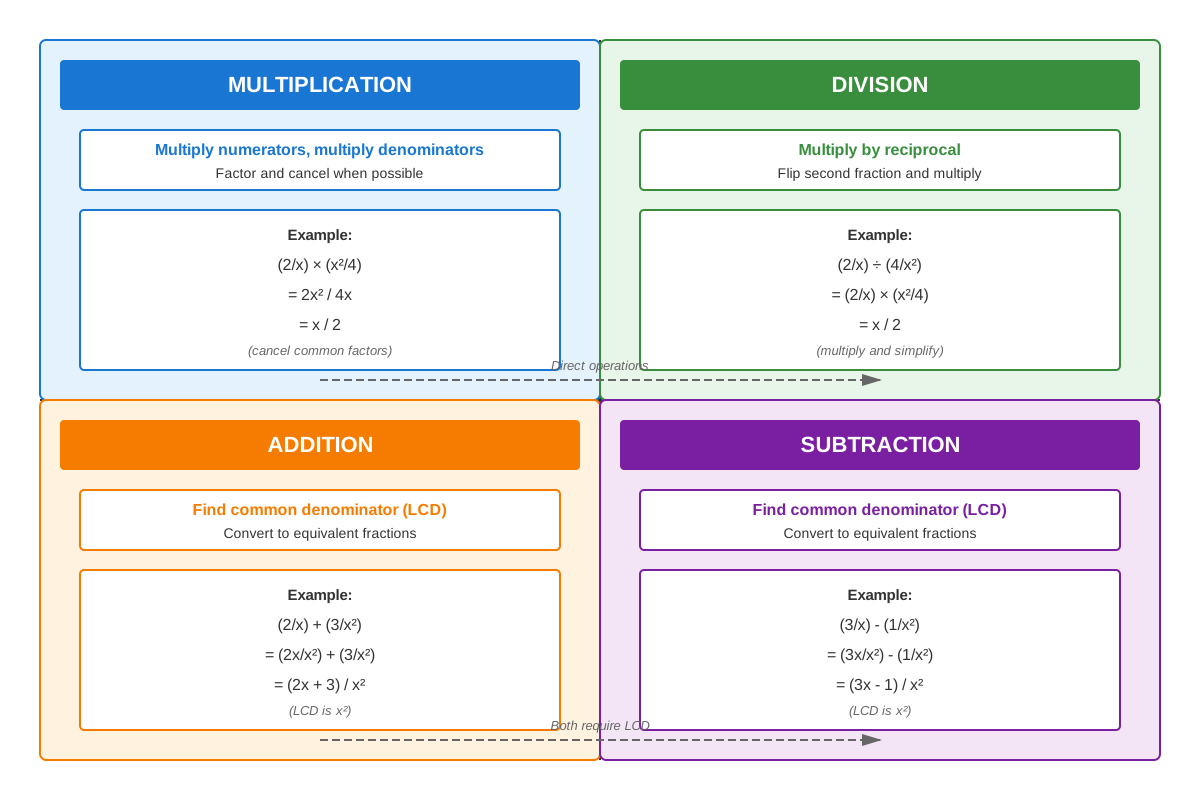
Multiplication of rational expressions follows the same principle as multiplying numerical fractions: multiply numerators together and denominators together, then simplify.
Process for multiplication:
- Factor all numerators and denominators
- Multiply numerators together
- Multiply denominators together
- Cancel common factors before multiplying (more efficient)
- State the final simplified form
Example: (x² - 1)/(x + 2) × (x + 2)/(x - 1)
- Factor: [(x - 1)(x + 1)]/(x + 2) × (x + 2)/(x - 1)
- Cancel (x + 2) and (x - 1): (x + 1)/1
- Result: x + 1, with restrictions x ≠ -2 and x ≠ 1
Dividing Rational Expressions
Division of rational expressions uses the "multiply by the reciprocal" rule: to divide by a fraction, multiply by its reciprocal (flip the second fraction).
Process for division:
- Change division to multiplication by the reciprocal
- Follow multiplication steps
- Simplify the result
Example: (2x)/(x - 3) ÷ (4x²)/(x² - 9)
- Rewrite: (2x)/(x - 3) × (x² - 9)/(4x²)
- Factor: (2x)/(x - 3) × [(x - 3)(x + 3)]/(4x²)
- Cancel: (2x)(x - 3)(x + 3)/[(x - 3)(4x²)]
- Simplify: (x + 3)/(2x)
- Restrictions: x ≠ 3, x ≠ -3, x ≠ 0
Adding and Subtracting Rational Expressions
Addition and subtraction require a common denominator, just like numerical fractions. This often involves finding the least common denominator (LCD) of the expressions.
Process for addition/subtraction:
- Factor all denominators
- Identify the LCD (product of all unique factors, each raised to its highest power)
- Convert each fraction to equivalent form with LCD
- Add or subtract numerators
- Simplify if possible
Example: 3/(x - 2) + 2/(x + 1)
- LCD: (x - 2)(x + 1)
- Convert: [3(x + 1)]/[(x - 2)(x + 1)] + [2(x - 2)]/[(x - 2)(x + 1)]
- Combine: [3(x + 1) + 2(x - 2)]/[(x - 2)(x + 1)]
- Expand: (3x + 3 + 2x - 4)/(x - 2)(x + 1)
- Simplify: (5x - 1)/[(x - 2)(x + 1)]
Complex Rational Expressions
A complex rational expression contains rational expressions in its numerator, denominator, or both. These appear frequently on the GMAT and require systematic simplification.
Two methods for simplifying complex rational expressions:
Method 1: Multiply by LCD of all internal fractions
- Identify LCD of all fractions within the complex expression
- Multiply both numerator and denominator by this LCD
- Simplify the result
Method 2: Simplify numerator and denominator separately
- Simplify the numerator to a single fraction
- Simplify the denominator to a single fraction
- Divide by multiplying by the reciprocal
Example: [(1/x) + (1/y)] / [(1/x) - (1/y)]
Using Method 1 with LCD = xy:
- Multiply top and bottom by xy
- Numerator: xy(1/x + 1/y) = y + x
- Denominator: xy(1/x - 1/y) = y - x
- Result: (x + y)/(y - x)
Concept Relationships
Rational expressions build directly upon polynomial operations and factoring techniques. The ability to factor polynomials enables simplification of rational expressions, which in turn allows efficient multiplication and division. These operations form a hierarchical relationship: Factoring → Simplification → Multiplication/Division → Addition/Subtraction, with each level depending on mastery of the previous.
Domain restrictions connect rational expressions to equation solving and inequality concepts. Understanding when expressions are undefined requires setting denominators equal to zero and solving equations, creating a bidirectional relationship: Rational Expressions ↔ Equation Solving. This relationship becomes particularly important in Data Sufficiency questions where determining valid values is essential.
The connection between rational expressions and fraction arithmetic is isomorphic—the same rules apply, but with polynomials instead of integers. This parallel structure means: Fraction Operations → Rational Expression Operations, allowing students to leverage existing knowledge of numerical fractions when working with algebraic fractions.
Complex rational expressions synthesize all simpler concepts, requiring students to apply simplification, common denominators, and factoring simultaneously. This represents the pinnacle of rational expression mastery: Simple Rational Expressions + Operations → Complex Rational Expressions.
Finally, rational expressions connect forward to function analysis, equation solving, and word problems. Many GMAT problems present scenarios that translate into rational expressions, creating the pathway: Word Problem → Algebraic Model (Rational Expression) → Solution.
Quick check — test yourself on Rational expressions so far.
Try Flashcards →High-Yield Facts
⭐ A rational expression is undefined when its denominator equals zero; always identify these restrictions
⭐ When simplifying rational expressions, factor completely before canceling common factors
⭐ Domain restrictions from the original denominator remain even after simplification
⭐ To divide rational expressions, multiply by the reciprocal of the divisor
⭐ Adding or subtracting rational expressions requires finding a common denominator first
- Canceling terms is only valid for factors (multiplication), never for terms being added or subtracted
- The LCD of rational expressions is the product of all unique factors raised to their highest powers
- Complex rational expressions can be simplified by multiplying numerator and denominator by the LCD of all internal fractions
- When solving equations with rational expressions, multiply all terms by the LCD to clear denominators
- After solving equations involving rational expressions, always check solutions against domain restrictions to eliminate extraneous solutions
- Rational expressions with the same denominator can be combined by adding/subtracting numerators directly
- The expression (a - b)/(b - a) always simplifies to -1 (when a ≠ b)
- Multiplying rational expressions is more efficient when you cancel common factors before multiplying
- A rational expression equals zero only when its numerator equals zero (and denominator doesn't)
- Factoring difference of squares, perfect square trinomials, and common patterns accelerates rational expression simplification
Common Misconceptions
Misconception: You can cancel terms that are added or subtracted in the numerator and denominator.
Correction: Canceling is only valid for factors (terms connected by multiplication). For example, in (x + 3)/(x + 5), you cannot cancel the x terms. Canceling requires factoring first: (x + 3)/(x + 5) cannot be simplified further unless there's a common factor.
Misconception: After simplifying a rational expression, the domain is the same as the simplified form's restrictions.
Correction: Domain restrictions come from the original expression's denominator. If (x² - 4)/(x - 2) simplifies to (x + 2), the restriction x ≠ 2 still applies because the original denominator was zero at x = 2, even though it's not visible in the simplified form.
Misconception: When adding rational expressions, you can add numerators and denominators separately.
Correction: Addition requires a common denominator first. The expression a/b + c/d does NOT equal (a + c)/(b + d). Instead, it equals (ad + bc)/(bd) after finding the common denominator.
Misconception: If a rational expression equals zero, both numerator and denominator must equal zero.
Correction: A rational expression equals zero only when the numerator equals zero AND the denominator does not equal zero. If both equal zero simultaneously, the expression is undefined (0/0 is indeterminate), not zero.
Misconception: The reciprocal of (x - 3)/(x + 2) is (x + 2)/(x - 3), so they're equivalent.
Correction: A reciprocal is not equivalent to the original expression; it's the multiplicative inverse. While (x - 3)/(x + 2) × (x + 2)/(x - 3) = 1, the two expressions have different values for any given x. They're reciprocals, not equivalent expressions.
Misconception: Complex rational expressions are fundamentally different from simple ones and require special rules.
Correction: Complex rational expressions follow the same rules as simple ones. They appear more complicated because they contain fractions within fractions, but the same principles of finding common denominators and simplifying apply. The key is systematic application of basic rules.
Worked Examples
Example 1: Simplifying and Identifying Domain Restrictions
Problem: Simplify the rational expression (x² + 5x + 6)/(x² - 4) and state all domain restrictions.
Solution:
Step 1: Factor the numerator
- x² + 5x + 6 = (x + 2)(x + 3)
- We need two numbers that multiply to 6 and add to 5: 2 and 3
Step 2: Factor the denominator
- x² - 4 is a difference of squares
- x² - 4 = (x - 2)(x + 2)
Step 3: Write the factored form
- [(x + 2)(x + 3)]/[(x - 2)(x + 2)]
Step 4: Identify domain restrictions from the original denominator
- Set denominator equal to zero: (x - 2)(x + 2) = 0
- x = 2 or x = -2
- Domain restrictions: x ≠ 2 and x ≠ -2
Step 5: Cancel common factors
- The factor (x + 2) appears in both numerator and denominator
- Cancel: (x + 3)/(x - 2)
Final Answer: (x + 3)/(x - 2), where x ≠ 2 and x ≠ -2
Note that even though (x + 2) was canceled, the restriction x ≠ -2 remains because it made the original denominator zero.
Connection to Learning Objectives: This example demonstrates identifying rational expressions, explaining domain restrictions, and applying simplification techniques—all essential GMAT skills.
Example 2: Complex Rational Expression with Operations
Problem: Simplify: [(2/x) - (3/y)] / [(4/x²) + (6/xy)]
Solution:
Step 1: Identify the LCD of all internal fractions
- Denominators are: x, y, x², xy
- LCD = x²y (highest power of each variable)
Step 2: Multiply both numerator and denominator by x²y
- Numerator: x²y[(2/x) - (3/y)]
- Denominator: x²y[(4/x²) + (6/xy)]
Step 3: Distribute x²y in the numerator
- x²y(2/x) = 2xy
- x²y(3/y) = 3x²
- Numerator becomes: 2xy - 3x²
Step 4: Distribute x²y in the denominator
- x²y(4/x²) = 4y
- x²y(6/xy) = 6x
- Denominator becomes: 4y + 6x
Step 5: Factor and simplify
- Numerator: 2xy - 3x² = x(2y - 3x)
- Denominator: 4y + 6x = 2(2y + 3x)
- Result: [x(2y - 3x)]/[2(2y + 3x)]
Step 6: State restrictions
- Original denominators cannot be zero: x ≠ 0, y ≠ 0
Final Answer: [x(2y - 3x)]/[2(2y + 3x)], where x ≠ 0 and y ≠ 0
Alternative Method: Simplify numerator and denominator separately first, then divide.
Connection to Learning Objectives: This problem integrates multiple skills—identifying complex rational expressions, applying operations systematically, and determining domain restrictions—representing the type of multi-step problem common on the GMAT.
Exam Strategy
When approaching GMAT questions involving rational expressions, begin by quickly scanning for domain restrictions. Many Data Sufficiency questions specifically test whether students recognize when expressions are undefined. If the question asks "for what values of x..." immediately check denominators.
Trigger words and phrases that signal rational expression problems include: "simplify," "for what values is the expression undefined," "equivalent to," "ratio of," "quotient of," and "fraction." In word problems, phrases like "rate of," "per unit," "concentration," and "combined rate" often translate into rational expressions.
For Problem Solving questions, factor before performing any operations. The GMAT rewards efficient problem-solving, and factoring first allows you to cancel common terms early, reducing computational complexity. If you find yourself multiplying large polynomials, you've likely missed an opportunity to simplify first.
Process of elimination strategies:
- Eliminate answer choices with different domain restrictions than the original expression
- Test x = 0, x = 1, and x = -1 in both the question and answer choices (if allowed by domain)
- Eliminate choices that don't match the degree of the simplified expression
- For "which is equivalent" questions, factor answer choices to compare with the factored question
Time allocation: Spend 15-20 seconds identifying the problem type and domain restrictions, 45-60 seconds on factoring and simplification, and 20-30 seconds checking your answer. If a problem requires more than 2 minutes, consider whether you've missed a simplification opportunity or should strategically guess and move on.
For complex rational expressions, decide quickly between the two methods: multiplying by the LCD (faster for most students) versus simplifying numerator and denominator separately (better when the internal fractions are already simple). Practice both methods to develop intuition for which is more efficient in different scenarios.
Memory Techniques
FACTOR - A mnemonic for approaching rational expression problems:
- Find domain restrictions first
- Analyze numerator and denominator structure
- Completely factor all polynomials
- Take out common factors (cancel)
- Operate according to the required operation
- Recheck restrictions and simplify
LCD Visualization: Picture the LCD as a "container" that must hold all denominators. Each unique factor must appear, raised to its highest power among all denominators. Visualize stacking the factors: if one denominator has x² and another has x³, the LCD needs x³ to "contain" both.
The Reciprocal Flip: For division, remember "Keep-Change-Flip" from basic fractions: Keep the first expression, Change division to multiplication, Flip the second expression. This three-word phrase prevents the common error of flipping the wrong fraction.
Domain Restriction Reminder: "Zero Below, No Go" - if the denominator (below) equals zero, the expression cannot go (is undefined). This simple rhyme reinforces checking denominators.
Canceling Rule: "Factors Yes, Terms No" - you can cancel factors (connected by multiplication) but not terms (connected by addition/subtraction). Visualize factors as separate blocks that can be removed, while terms are parts of a single connected structure.
Complex Fraction Strategy: Think "LCD Everywhere" - multiply the entire complex fraction (top and bottom) by the LCD of all small fractions inside. This "clears" all internal fractions in one step.
Summary
Rational expressions are algebraic fractions with polynomials in both numerator and denominator, forming a critical component of GMAT Quantitative Reasoning. Mastery requires understanding domain restrictions (values that make denominators zero), simplification through factoring and canceling common factors, and performing operations (multiplication, division, addition, subtraction) using principles parallel to numerical fractions. The key to success with rational expressions is systematic factoring before attempting any operations, maintaining awareness of domain restrictions throughout simplification, and recognizing that restrictions from original denominators persist even after canceling. Complex rational expressions, which contain fractions within fractions, are efficiently simplified by multiplying numerator and denominator by the LCD of all internal fractions. GMAT questions test these concepts through direct simplification problems, equivalence questions, and embedded applications in word problems involving rates, ratios, and combined work scenarios. Students who develop fluency with rational expressions gain significant advantages in time management and accuracy on medium-to-difficult quantitative questions.
Key Takeaways
- Rational expressions are quotients of polynomials; they're undefined when denominators equal zero, making domain restrictions critical to identify
- Always factor completely before simplifying, multiplying, or dividing rational expressions—this enables efficient canceling and reduces computational complexity
- Domain restrictions from the original expression remain valid even after simplification; canceled factors still impose restrictions
- Addition and subtraction require finding a common denominator first; never add numerators and denominators separately
- To divide rational expressions, multiply by the reciprocal of the divisor (flip the second fraction and multiply)
- Complex rational expressions are simplified by multiplying both numerator and denominator by the LCD of all internal fractions
- Canceling is only valid for factors (multiplication), never for terms connected by addition or subtraction—factor first to create cancelable factors
Related Topics
Polynomial Operations and Factoring: Deepening factoring skills with advanced techniques (factoring by grouping, sum/difference of cubes) directly enhances rational expression manipulation speed and accuracy.
Equation Solving with Rational Expressions: Building on this foundation, students learn to solve equations where rational expressions equal specific values, requiring clearing denominators and checking for extraneous solutions.
Functions and Rational Functions: Rational expressions extend into function notation, where f(x) = P(x)/Q(x) introduces concepts of asymptotes, discontinuities, and function behavior.
Word Problems with Rates and Ratios: Many GMAT word problems translate into rational expressions, particularly work problems, distance-rate-time problems, and mixture problems.
Inequalities with Rational Expressions: Advanced topics include solving inequalities involving rational expressions, requiring sign analysis and interval testing.
Practice CTA
Now that you've mastered the core concepts of rational expressions, it's time to solidify your understanding through active practice. Attempt the practice questions to apply these techniques to GMAT-style problems, and use the flashcards to reinforce high-yield facts and common patterns. Remember, proficiency with rational expressions comes from repeated application—each problem you solve strengthens your pattern recognition and increases your speed. The investment you make in practicing this topic will pay dividends across multiple question types on test day. Challenge yourself with increasingly complex problems, and don't hesitate to revisit the worked examples when you encounter difficulty. Your success on the GMAT depends not just on understanding concepts, but on developing the fluency to apply them quickly and accurately under time pressure. Start practicing now!
Sign up free to keep reading
Create a free AnvayaPrep account to finish this GMAT guide on Rational expressions — plus flashcards and practice questions.