Overview
Scientific notation is a standardized method of expressing very large or very small numbers in a compact, manageable form. This mathematical convention represents numbers as the product of a coefficient (a number between 1 and 10) and a power of 10. For example, the number 3,500,000 can be written as 3.5 × 10⁶, while 0.000042 becomes 4.2 × 10⁻⁵. This notation system is fundamental to efficient calculation and comparison of numbers that would otherwise be cumbersome to work with in standard decimal form.
On the GMAT Quantitative Reasoning section, gmat scientific notation questions appear regularly across multiple question types, including Problem Solving and Data Sufficiency formats. The exam tests not only the ability to convert between standard and scientific notation but also the capacity to perform arithmetic operations (multiplication, division, addition, and subtraction) with numbers expressed in this form. Mastery of scientific notation enables test-takers to work more efficiently with exponential expressions, compare magnitudes quickly, and avoid calculation errors that commonly occur when dealing with numbers containing many zeros.
Scientific notation connects directly to several core arithmetic and algebra concepts tested on the GMAT, including exponent rules, order of magnitude comparisons, and estimation strategies. Understanding this topic strengthens foundational skills in working with powers of 10, which appears throughout quantitative problems involving percentages, ratios, and data interpretation. Additionally, scientific notation serves as a bridge to more advanced topics such as exponential growth and decay, logarithmic relationships, and scientific data analysis—all of which may appear in integrated reasoning or complex problem-solving contexts.
Learning Objectives
- [ ] Identify scientific notation and distinguish it from standard decimal notation
- [ ] Explain the structure and components of numbers written in scientific notation
- [ ] Apply scientific notation to GMAT questions involving calculations and comparisons
- [ ] Convert numbers between standard form and scientific notation with accuracy
- [ ] Perform arithmetic operations (multiplication, division, addition, subtraction) using scientific notation
- [ ] Compare and order numbers expressed in scientific notation without full conversion
- [ ] Estimate answers using scientific notation to eliminate incorrect answer choices efficiently
Prerequisites
- Exponent rules and properties: Understanding how to manipulate powers of 10 is essential since scientific notation is built on exponential expressions
- Basic arithmetic operations: Proficiency with multiplication, division, addition, and subtraction forms the foundation for calculations in scientific notation
- Place value system: Knowledge of decimal place values (ones, tens, hundreds, tenths, hundredths) enables accurate conversion between notation forms
- Order of operations: Proper sequencing of mathematical operations ensures correct evaluation of expressions involving scientific notation
Why This Topic Matters
Scientific notation appears in numerous real-world contexts, from expressing astronomical distances (the Earth is approximately 1.5 × 10⁸ kilometers from the Sun) to describing microscopic measurements (a typical virus measures about 1 × 10⁻⁷ meters). In business and finance, scientific notation helps express large monetary values, population statistics, and economic indicators efficiently. Scientists, engineers, and data analysts use this notation daily to communicate measurements spanning vastly different scales, making it an essential skill for quantitative literacy.
On the GMAT, scientific notation questions appear in approximately 5-10% of Quantitative Reasoning problems, with higher frequency in the 650-750 score range. These questions typically test multiple skills simultaneously: conversion accuracy, computational fluency with exponents, and the ability to estimate and compare magnitudes. Scientific notation often appears in Data Sufficiency questions where determining relative size or order of magnitude is sufficient to answer without complete calculation. Problem Solving questions may embed scientific notation within word problems involving rates, distances, molecular quantities, or financial data.
The GMAT frequently integrates scientific notation into multi-step problems where recognizing the opportunity to use this notation can dramatically simplify calculations. Questions may present data in standard form and expect test-takers to convert to scientific notation for easier manipulation, or conversely, provide scientific notation and require conversion to standard form for interpretation. Understanding this topic also supports efficient estimation strategies, allowing test-takers to eliminate obviously incorrect answer choices and manage time effectively.
Core Concepts
Structure of Scientific Notation
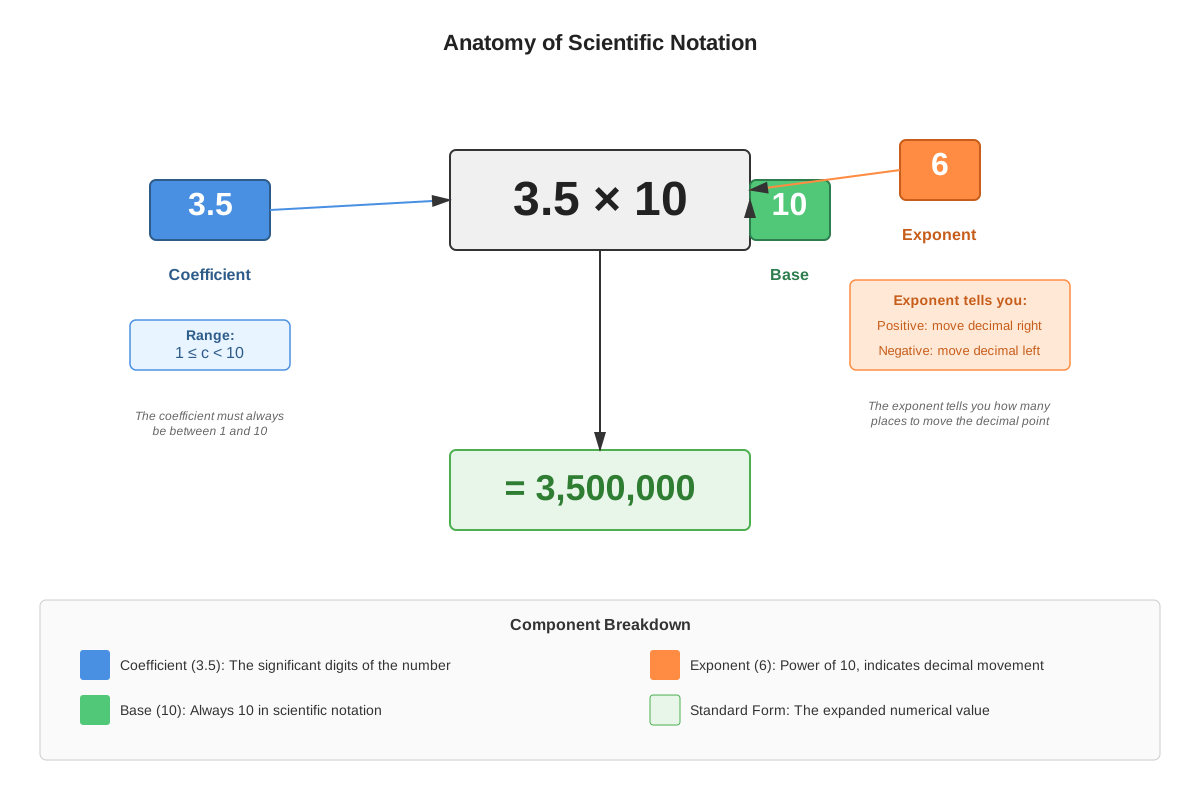
Scientific notation expresses any number as the product of two factors: a coefficient (also called the mantissa or significand) and a power of 10. The standard form is:
a × 10ⁿwhere:
- a is the coefficient, a number satisfying 1 ≤ |a| < 10
- 10 is the base (always 10 in scientific notation)
- n is the exponent, an integer (positive, negative, or zero)
The coefficient must be greater than or equal to 1 but strictly less than 10. This standardization ensures that each number has exactly one correct scientific notation representation. For example, while 35 × 10⁴ and 3.5 × 10⁵ represent the same value, only 3.5 × 10⁵ is proper scientific notation because 35 exceeds the coefficient range.
Converting from Standard to Scientific Notation
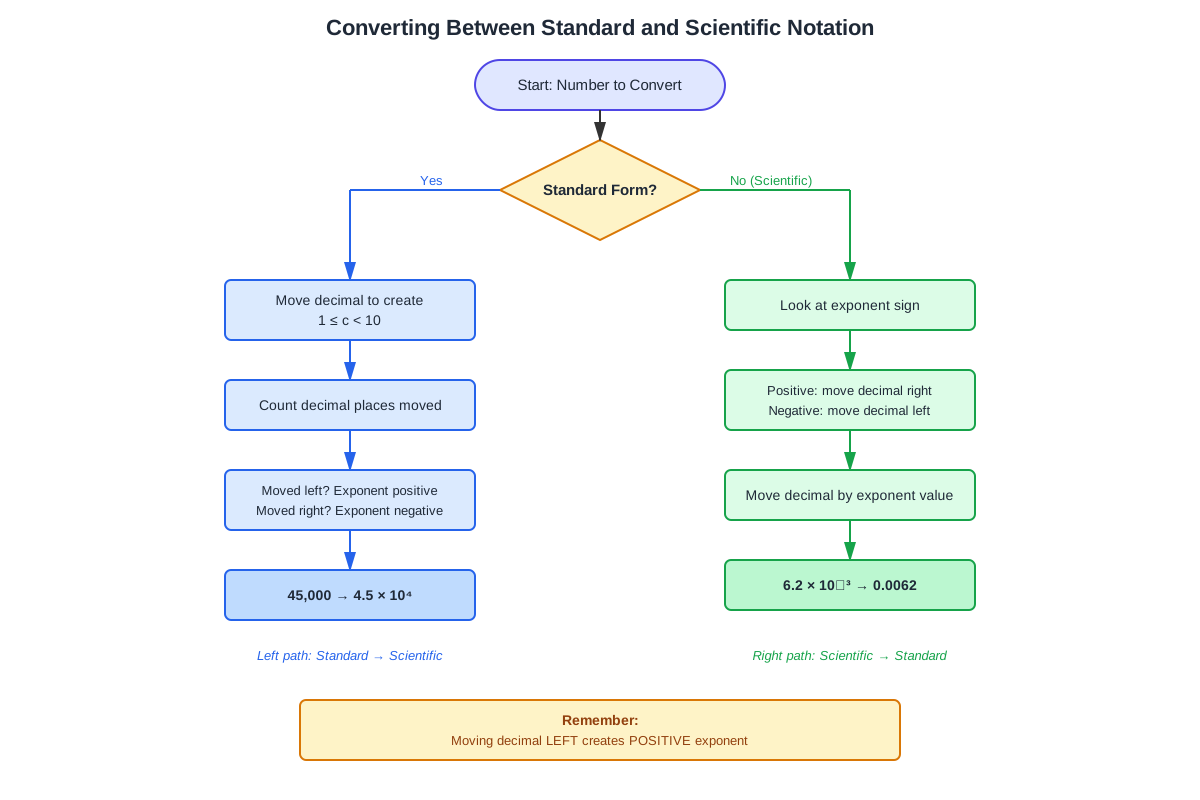
To convert a number from standard decimal form to scientific notation, follow these systematic steps:
- Identify the first non-zero digit in the number
- Place the decimal point immediately after this first non-zero digit
- Count the number of places the decimal point moved
- Determine the exponent:
- If the original number is ≥ 10, the exponent is positive
- If the original number is < 1, the exponent is negative
- If the original number is between 1 and 10, the exponent is zero
Example conversions:
| Standard Form | Scientific Notation | Explanation |
|---|---|---|
| 45,000 | 4.5 × 10⁴ | Decimal moved 4 places left; large number → positive exponent |
| 0.00067 | 6.7 × 10⁻⁴ | Decimal moved 4 places right; small number → negative exponent |
| 8.2 | 8.2 × 10⁰ | Number already between 1 and 10; no movement needed |
| 300,000,000 | 3 × 10⁸ | Decimal moved 8 places left |
| 0.0000000052 | 5.2 × 10⁻⁹ | Decimal moved 9 places right |
Converting from Scientific to Standard Notation
To convert from scientific notation back to standard form:
- Examine the exponent on the power of 10
- If the exponent is positive: Move the decimal point that many places to the right, adding zeros as needed
- If the exponent is negative: Move the decimal point that many places to the left, adding zeros as needed
- If the exponent is zero: The coefficient is already in standard form
Example conversions:
- 7.3 × 10⁵ = 730,000 (move decimal 5 places right)
- 2.8 × 10⁻³ = 0.0028 (move decimal 3 places left)
- 9.15 × 10² = 915 (move decimal 2 places right)
Multiplication in Scientific Notation
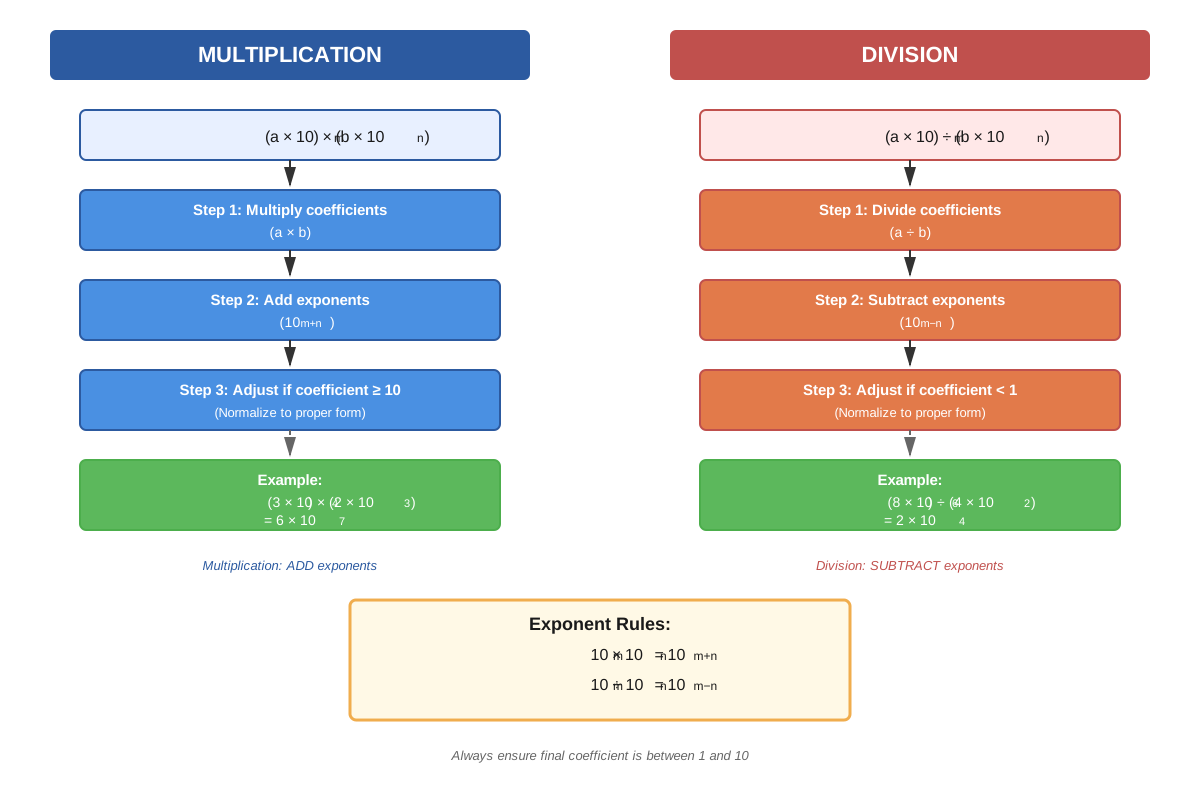
When multiplying numbers in scientific notation, apply the product rule for exponents:
(a × 10ᵐ) × (b × 10ⁿ) = (a × b) × 10⁽ᵐ⁺ⁿ⁾Process:
- Multiply the coefficients: a × b
- Add the exponents: m + n
- Adjust if necessary to maintain proper scientific notation (coefficient between 1 and 10)
Example: (3 × 10⁴) × (2 × 10⁵)
- Multiply coefficients: 3 × 2 = 6
- Add exponents: 4 + 5 = 9
- Result: 6 × 10⁹
Example requiring adjustment: (4 × 10³) × (5 × 10²)
- Multiply coefficients: 4 × 5 = 20
- Add exponents: 3 + 2 = 5
- Initial result: 20 × 10⁵
- Adjust: 20 = 2 × 10¹, so 20 × 10⁵ = 2 × 10¹ × 10⁵ = 2 × 10⁶
Division in Scientific Notation
When dividing numbers in scientific notation, apply the quotient rule for exponents:
(a × 10ᵐ) ÷ (b × 10ⁿ) = (a ÷ b) × 10⁽ᵐ⁻ⁿ⁾Process:
- Divide the coefficients: a ÷ b
- Subtract the exponents: m - n
- Adjust if necessary to maintain proper scientific notation
Example: (8 × 10⁷) ÷ (4 × 10³)
- Divide coefficients: 8 ÷ 4 = 2
- Subtract exponents: 7 - 3 = 4
- Result: 2 × 10⁴
Example requiring adjustment: (6 × 10⁵) ÷ (8 × 10²)
- Divide coefficients: 6 ÷ 8 = 0.75
- Subtract exponents: 5 - 2 = 3
- Initial result: 0.75 × 10³
- Adjust: 0.75 = 7.5 × 10⁻¹, so 0.75 × 10³ = 7.5 × 10⁻¹ × 10³ = 7.5 × 10²
Addition and Subtraction in Scientific Notation
Adding or subtracting numbers in scientific notation requires that the exponents be equal. If they differ, one or both numbers must be rewritten to have matching exponents before combining coefficients.
Process:
- Ensure both numbers have the same exponent
- Add or subtract the coefficients
- Keep the common exponent
- Adjust to proper scientific notation if needed
Example with equal exponents: (3.5 × 10⁴) + (2.1 × 10⁴)
- Exponents match (both 10⁴)
- Add coefficients: 3.5 + 2.1 = 5.6
- Result: 5.6 × 10⁴
Example with different exponents: (4.2 × 10⁵) + (3.0 × 10⁴)
- Rewrite with common exponent: 4.2 × 10⁵ = 42 × 10⁴
- Add coefficients: 42 + 3.0 = 45
- Initial result: 45 × 10⁴
- Adjust: 45 × 10⁴ = 4.5 × 10⁵
Comparing Magnitudes
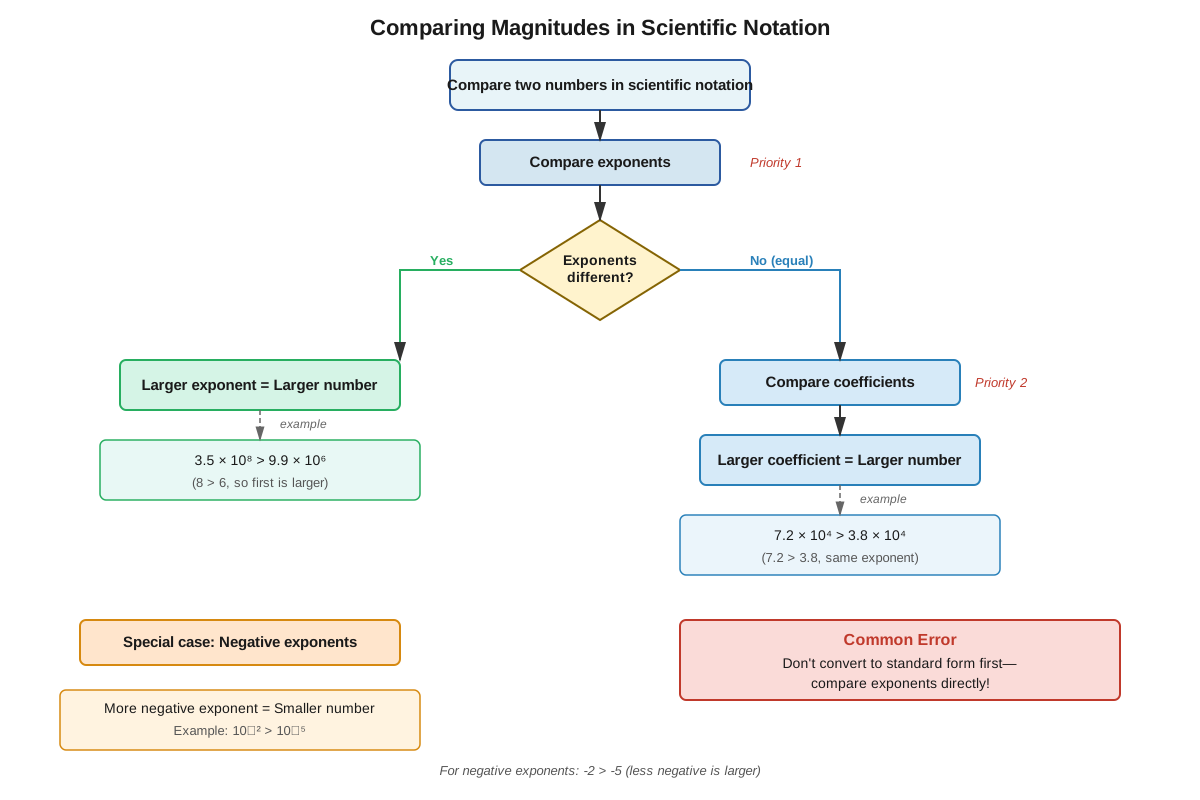
Scientific notation makes comparing the relative size of numbers straightforward:
- Compare exponents first: The number with the larger exponent is larger (assuming positive coefficients)
- If exponents are equal: Compare coefficients directly
- For negative exponents: Remember that -2 > -5, so 10⁻² > 10⁻⁵
This property enables rapid elimination of answer choices on the GMAT without performing complete calculations.
Concept Relationships
The core concepts within scientific notation form a hierarchical structure. Structure and conversion serve as the foundation—understanding how to move between standard and scientific notation is prerequisite to all other operations. From this base, multiplication and division operations build directly on exponent rules, specifically the product and quotient rules for powers with the same base. These operations are more straightforward than addition and subtraction, which require the additional step of equalizing exponents before combining terms.
Magnitude comparison connects to all other concepts, serving as both a check on calculation accuracy and a standalone skill for Data Sufficiency questions. The relationship map flows as:
Conversion skills → Understanding structure → Performing multiplication/division → Performing addition/subtraction → Comparing and estimating
Scientific notation also connects backward to prerequisite topics: exponent rules provide the mathematical foundation for all operations, while place value understanding enables accurate conversion. Looking forward, mastery of scientific notation supports advanced topics including exponential functions, logarithms, and rate problems involving very large or small quantities. The notation system also enhances estimation skills broadly applicable across GMAT quantitative questions, as recognizing orders of magnitude allows for rapid answer choice elimination.
Quick check — test yourself on Scientific notation so far.
Try Flashcards →High-Yield Facts
⭐ Scientific notation format: a × 10ⁿ where 1 ≤ |a| < 10 and n is an integer
⭐ Positive exponents indicate numbers ≥ 10; negative exponents indicate numbers < 1
⭐ To multiply in scientific notation: multiply coefficients and add exponents
⭐ To divide in scientific notation: divide coefficients and subtract exponents
⭐ To add/subtract in scientific notation: exponents must be equal before combining coefficients
- Moving the decimal point right in conversion decreases the exponent; moving left increases it
- Each increase of 1 in the exponent represents multiplication by 10
- When comparing numbers in scientific notation, the exponent determines magnitude first
- 10⁰ = 1, so any number × 10⁰ equals that number in standard form
- Negative exponents represent reciprocals: 10⁻³ = 1/10³ = 1/1000 = 0.001
⭐ Adjustment rule: If coefficient ≥ 10, increase exponent by 1 and divide coefficient by 10; if coefficient < 1, decrease exponent by 1 and multiply coefficient by 10
- Scientific notation is unique: each number has exactly one correct representation
- Powers of 10 follow the pattern: 10¹ = 10, 10² = 100, 10³ = 1,000, etc.
- For negative powers: 10⁻¹ = 0.1, 10⁻² = 0.01, 10⁻³ = 0.001, etc.
Common Misconceptions
Misconception: The coefficient in scientific notation can be any number.
Correction: The coefficient must be between 1 and 10 (inclusive of 1, exclusive of 10). While 35 × 10⁴ equals 3.5 × 10⁵ mathematically, only the latter is proper scientific notation.
Misconception: When converting 0.00045 to scientific notation, the exponent should be positive because you're moving the decimal point.
Correction: The exponent is negative (-4) because the original number is less than 1. The direction of decimal movement determines the sign: for numbers < 1, moving the decimal right produces a negative exponent.
Misconception: To add (3 × 10⁵) + (4 × 10³), simply add the coefficients (3 + 4 = 7) and add the exponents (5 + 3 = 8) to get 7 × 10⁸.
Correction: Addition and subtraction require equal exponents first. Convert to matching exponents: 3 × 10⁵ = 300 × 10³, then add: 300 + 4 = 304, giving 304 × 10³ = 3.04 × 10⁵.
Misconception: A larger exponent always means a larger number.
Correction: This is only true for positive numbers. For example, -5 × 10⁶ is less than 2 × 10², despite having a larger exponent, because the coefficient is negative.
Misconception: When dividing (6 × 10⁸) by (2 × 10³), you divide both the coefficients and the exponents: (6÷2) × (10⁸÷10³) = 3 × 10²·⁶⁶...
Correction: Divide coefficients but subtract exponents: (6÷2) × 10⁽⁸⁻³⁾ = 3 × 10⁵. The quotient rule for exponents is subtraction, not division.
Misconception: 10⁻³ is larger than 10⁻² because 3 > 2.
Correction: Negative exponents represent smaller values. 10⁻³ = 0.001 while 10⁻² = 0.01, so 10⁻² > 10⁻³. As negative exponents become more negative, the values become smaller.
Misconception: Scientific notation is only used for extremely large or extremely small numbers.
Correction: While scientific notation is most useful for such numbers, any number can be expressed in scientific notation, including numbers between 1 and 10 (using exponent 0) or moderately sized numbers like 450 (4.5 × 10²).
Worked Examples
Example 1: Multi-Step Calculation with Scientific Notation
Problem: A laboratory processes 2.4 × 10⁶ samples per day. Each sample contains approximately 5.0 × 10⁻⁴ grams of a substance. If the lab operates for 30 days, what is the total mass of the substance processed, in grams?
Solution:
Step 1: Identify what we need to find.
Total mass = (samples per day) × (grams per sample) × (number of days)
Step 2: Set up the calculation.
Total mass = (2.4 × 10⁶) × (5.0 × 10⁻⁴) × 30
Step 3: Rearrange to group coefficients and powers of 10.
Total mass = (2.4 × 5.0 × 30) × (10⁶ × 10⁻⁴)
Step 4: Calculate the coefficient portion.
2.4 × 5.0 = 12.0
12.0 × 30 = 360
Step 5: Apply exponent rules for the powers of 10.
10⁶ × 10⁻⁴ = 10⁽⁶⁺⁽⁻⁴⁾⁾ = 10²
Step 6: Combine results.
Total mass = 360 × 10²
Step 7: Adjust to proper scientific notation.
360 = 3.6 × 10²
Therefore: 360 × 10² = 3.6 × 10² × 10² = 3.6 × 10⁴
Answer: 3.6 × 10⁴ grams (or 36,000 grams)
Connection to learning objectives: This problem applies scientific notation to a realistic GMAT-style word problem, requiring multiplication of numbers in scientific notation and proper adjustment of the final answer to standard form.
Example 2: Comparison and Data Sufficiency Strategy
Problem: Is x greater than y?
(1) x = 4.7 × 10⁻³ and y = 5.2 × 10⁻⁴
(2) x/y = 9.04
Solution:
Analyzing Statement (1):
Step 1: Compare the exponents.
x has exponent -3
y has exponent -4
Step 2: Recall that for negative exponents, less negative means larger value.
-3 > -4, so 10⁻³ > 10⁻⁴
Step 3: Since x = 4.7 × 10⁻³ and y = 5.2 × 10⁻⁴, we need to compare these carefully.
Step 4: Convert to the same exponent for direct comparison.
x = 4.7 × 10⁻³ = 47 × 10⁻⁴
y = 5.2 × 10⁻⁴
Step 5: Now compare coefficients with equal exponents.
47 × 10⁻⁴ > 5.2 × 10⁻⁴
Therefore, x > y. Statement (1) is SUFFICIENT.
Analyzing Statement (2):
Step 1: Interpret the ratio.
x/y = 9.04
Step 2: Since 9.04 > 1, this means x > y (assuming both are positive).
Step 3: Consider whether both could be negative.
If both x and y were negative, x/y would still be positive, but the larger absolute value would be the smaller number. However, the statement doesn't specify signs.
Step 4: In standard GMAT convention, without additional context suggesting otherwise, and given the ratio is positive, we can conclude x > y. Statement (2) is SUFFICIENT.
Answer: D (Each statement alone is sufficient)
Connection to learning objectives: This example demonstrates how to compare numbers in scientific notation efficiently without full conversion and applies this skill to a Data Sufficiency question format common on the GMAT.
Exam Strategy
When approaching GMAT questions involving scientific notation, employ these strategic techniques:
Trigger words and phrases that signal scientific notation may be useful:
- "very large number" or "very small number"
- References to astronomical distances, molecular sizes, or population statistics
- Numbers with many zeros
- Questions asking for "order of magnitude" or "approximate value"
- Data presented with powers of 10
Process-of-elimination strategies:
- Check order of magnitude first: Before detailed calculation, determine whether the answer should be in the thousands, millions, billions, etc. Eliminate choices that don't match the expected magnitude.
- Estimate coefficients: If answer choices differ significantly in their coefficients, round to the nearest whole number for quick estimation.
- Compare exponents directly: When answer choices are all in scientific notation, sometimes comparing exponents alone eliminates most options.
- Watch for adjustment errors: GMAT test-makers often include trap answers that result from forgetting to adjust coefficients back to the 1-10 range.
Time allocation advice:
- Conversion problems (30-45 seconds): These should be quick; if taking longer, you may be overcomplicating the process.
- Single operation problems (45-60 seconds): Multiplication or division in scientific notation should be straightforward with practice.
- Multi-step problems (90-120 seconds): Allow time for careful tracking of exponents through multiple operations.
- Data Sufficiency with scientific notation (60-90 seconds): Often faster than Problem Solving because comparison without full calculation may suffice.
Approach sequence:
- Identify whether scientific notation will simplify the problem
- Convert all relevant numbers to scientific notation if not already
- Perform operations systematically (coefficients first, then exponents)
- Check that final answer is in proper scientific notation
- Convert back to standard form only if required by the question or answer choices
Exam Tip: If answer choices are in standard form but calculations are complex, convert to scientific notation for your work, then convert only your final answer back. This reduces calculation errors with large numbers.
Memory Techniques
Mnemonic for conversion direction: "Large Leaves, Small Stays"
- Large numbers (≥10) get Left movement of decimal → positive exponent
- Small numbers (<1) Stay right of decimal → negative exponent
Acronym for operations: "MADS"
- Multiply: coefficients multiply, exponents add
- Add: exponents must be same, then add coefficients
- Divide: coefficients divide, exponents subtract
- Subtract: exponents must be same, then subtract coefficients
Visualization for exponent signs:
Picture a number line with 1 at the center:
- Numbers to the right (>1) have positive exponents
- Numbers to the left (<1) have negative exponents
- The farther from 1, the larger the absolute value of the exponent
Memory aid for coefficient range: "One to Ten, Never Ten"
The coefficient must be at least 1 but never reaches 10 (1 ≤ a < 10).
Rhyme for adjustment: "If your coefficient's not between one and ten, adjust your notation and try again"
Power of 10 pattern recognition:
Positive powers: count zeros (10³ has 3 zeros: 1,000)
Negative powers: count decimal places (10⁻³ has 3 decimal places: 0.001)
Summary
Scientific notation is a standardized system for expressing numbers as the product of a coefficient (between 1 and 10) and a power of 10, written as a × 10ⁿ. This notation simplifies working with very large or very small numbers by making calculations more manageable and comparisons more transparent. Converting between standard and scientific notation requires understanding decimal place movement: moving the decimal left increases the exponent (for large numbers), while moving it right decreases the exponent (for small numbers). Arithmetic operations follow specific rules: multiplication and division involve combining coefficients while adding or subtracting exponents respectively, whereas addition and subtraction require equal exponents before combining coefficients. On the GMAT, scientific notation appears in approximately 5-10% of quantitative questions, testing conversion accuracy, computational fluency, and magnitude comparison skills. Mastery requires recognizing when scientific notation simplifies problems, executing operations systematically, and maintaining proper notation form throughout calculations. Success depends on solid understanding of exponent rules, careful attention to coefficient adjustment, and strategic use of estimation to eliminate incorrect answer choices efficiently.
Key Takeaways
- Scientific notation expresses numbers as a × 10ⁿ where the coefficient a must satisfy 1 ≤ |a| < 10
- Positive exponents represent large numbers (≥10); negative exponents represent small numbers (<1)
- Multiplication and division in scientific notation are straightforward: combine coefficients arithmetically and add/subtract exponents respectively
- Addition and subtraction require matching exponents before combining coefficients—this is the most error-prone operation
- Comparing magnitudes in scientific notation is efficient: compare exponents first, then coefficients if exponents are equal
- Always adjust final answers to proper scientific notation form (coefficient between 1 and 10)
- Scientific notation enables rapid estimation and answer elimination on the GMAT, often without complete calculation
Related Topics
Exponent Rules and Properties: Deepening understanding of exponent laws (product rule, quotient rule, power rule) enhances facility with scientific notation operations and prepares for more complex algebraic manipulations.
Logarithms: Scientific notation connects directly to logarithmic concepts, as the exponent in scientific notation relates to the base-10 logarithm of a number; mastering scientific notation provides intuition for logarithmic scales.
Percent and Percent Change: Many percent problems involving very large or small numbers benefit from scientific notation, particularly in compound growth scenarios or when calculating percentage changes across orders of magnitude.
Rate Problems: Distance-rate-time problems with astronomical distances or microscopic measurements often require scientific notation for practical calculation and error reduction.
Data Interpretation: Charts and graphs presenting scientific or economic data frequently use scientific notation; fluency enables faster, more accurate analysis of quantitative information in Integrated Reasoning sections.
Practice CTA
Now that you've mastered the fundamentals of scientific notation, it's time to solidify your understanding through active practice. Attempt the practice questions to test your ability to convert between notation forms, perform calculations, and apply strategic thinking to GMAT-style problems. Use the flashcards to reinforce key facts and rules until they become automatic. Remember: scientific notation is a high-yield topic that appears regularly on the GMAT, and consistent practice will build both speed and accuracy. Each problem you solve strengthens your quantitative reasoning skills and moves you closer to your target score. Start practicing now—your future GMAT success depends on the work you put in today!
Sign up free to keep reading
Create a free AnvayaPrep account to finish this GMAT guide on Scientific notation — plus flashcards and practice questions.