Overview
Scatterplots are graphical representations that display the relationship between two quantitative variables by plotting individual data points on a coordinate plane. Each point represents a single observation, with one variable determining the horizontal (x-axis) position and the other determining the vertical (y-axis) position. On the GMAT scatterplots appear regularly in Data Insights questions and occasionally in Problem Solving questions, testing a student's ability to interpret visual data, identify patterns, and draw conclusions about relationships between variables.
Understanding scatterplots is essential for GMAT success because these questions assess multiple competencies simultaneously: data interpretation, pattern recognition, correlation analysis, and quantitative reasoning. The GMAT frequently presents scatterplots alongside tables or text descriptions, requiring test-takers to synthesize information from multiple sources. Questions may ask about trends, outliers, correlation strength, or predictions based on observed patterns.
Within the broader Quantitative Reasoning framework, scatterplots connect directly to statistics, coordinate geometry, and data analysis. They provide visual representations of concepts like correlation, linear relationships, and data distribution. Mastery of scatterplots enhances performance on questions involving regression analysis, data sufficiency problems with graphical elements, and integrated reasoning tasks that combine numerical and visual information. This topic bridges pure mathematical computation with real-world data interpretation—a hallmark of modern GMAT testing philosophy.
Learning Objectives
- [ ] Identify scatterplots and distinguish them from other graph types
- [ ] Explain the components, structure, and purpose of scatterplots
- [ ] Apply scatterplot interpretation skills to GMAT questions
- [ ] Determine the type and strength of correlation from visual patterns
- [ ] Identify outliers and anomalous data points in scatterplot displays
- [ ] Make predictions and draw valid conclusions from scatterplot data
- [ ] Evaluate the appropriateness of conclusions drawn from scatterplot evidence
Prerequisites
- Basic coordinate geometry: Understanding x-y coordinate planes is essential for interpreting the position of data points on scatterplots
- Fundamental statistics concepts: Knowledge of mean, median, and range helps contextualize data distribution patterns
- Graph reading skills: Ability to read axes, scales, and labels ensures accurate data extraction from visual displays
- Basic algebra: Understanding variables and their relationships supports interpretation of correlations and trends
Why This Topic Matters
Scatterplots represent one of the most practical statistical tools used across business, science, and social sciences. In real-world applications, executives use scatterplots to identify relationships between marketing spend and revenue, operations managers analyze production efficiency patterns, and financial analysts examine correlations between economic indicators. The ability to quickly interpret these visualizations and draw accurate conclusions is a fundamental business skill.
On the GMAT, scatterplot questions appear in approximately 10-15% of Data Insights sections and occasionally in Quantitative Reasoning questions. These questions typically fall into several categories: identifying correlation types (positive, negative, or no correlation), determining correlation strength, identifying outliers, making predictions based on trends, and evaluating whether conclusions are supported by the data. The GMAT particularly favors questions that require synthesizing information from the scatterplot with additional data presented in tables or text.
Common question formats include: "Which of the following best describes the relationship between variables X and Y?", "How many data points fall outside the specified range?", "Based on the scatterplot, which conclusion is most strongly supported?", and "If the trend continues, what would be the approximate value of Y when X equals [value]?" These questions test not just graph-reading ability but also critical thinking and the capacity to distinguish between correlation and causation—a key analytical skill the GMAT assesses.
Core Concepts
Structure and Components of Scatterplots
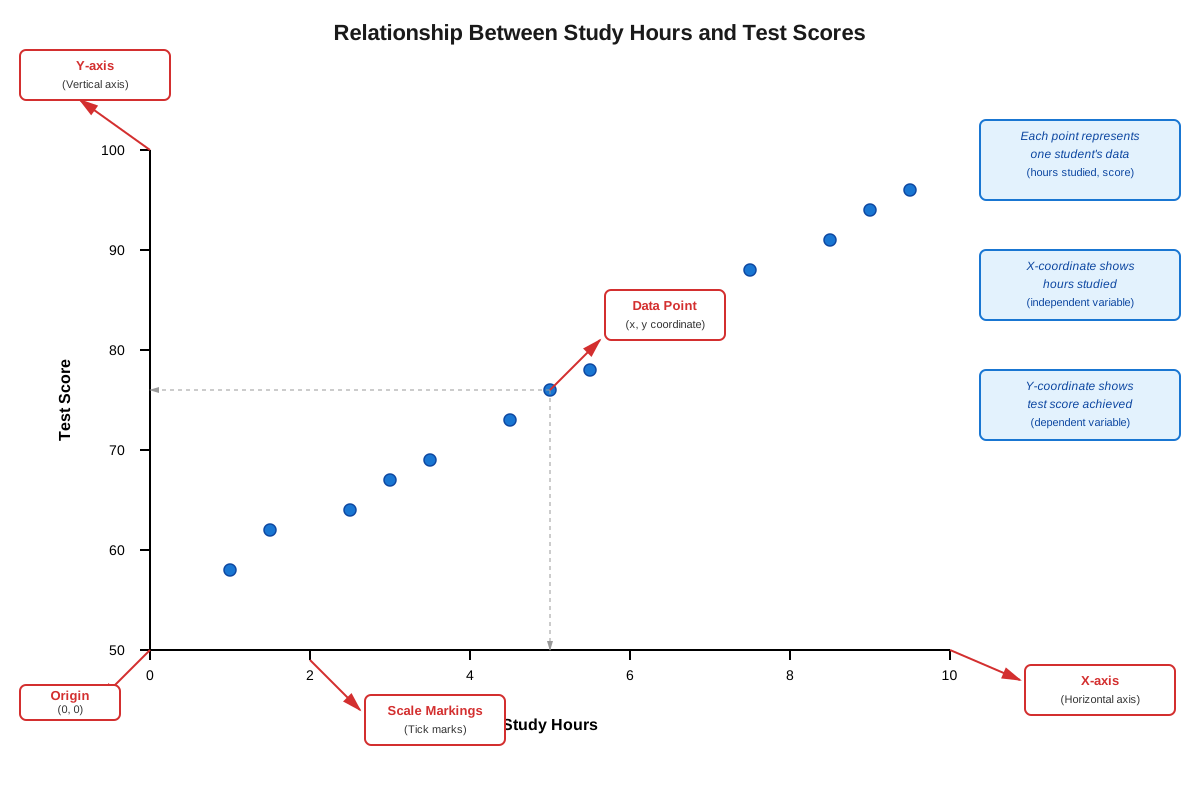
A scatterplot consists of several essential elements that must be understood for accurate interpretation. The horizontal axis (x-axis) represents the independent variable—the factor that is manipulated or chosen first. The vertical axis (y-axis) represents the dependent variable—the factor that responds to or is measured against the independent variable. Each data point appears as a dot, circle, or other marker at coordinates (x, y) corresponding to a single observation or case.
The scale of each axis determines how data values map to physical positions on the graph. GMAT questions often use non-uniform or truncated scales to test careful reading. The origin may or may not be (0, 0), and axes may not start at zero—a common source of misinterpretation. Labels identify what each axis represents, including units of measurement, which are critical for understanding the data's real-world meaning.
Types of Correlation
Correlation describes the relationship pattern between two variables displayed on a scatterplot. Understanding correlation types is fundamental to answering GMAT scatterplot questions correctly.
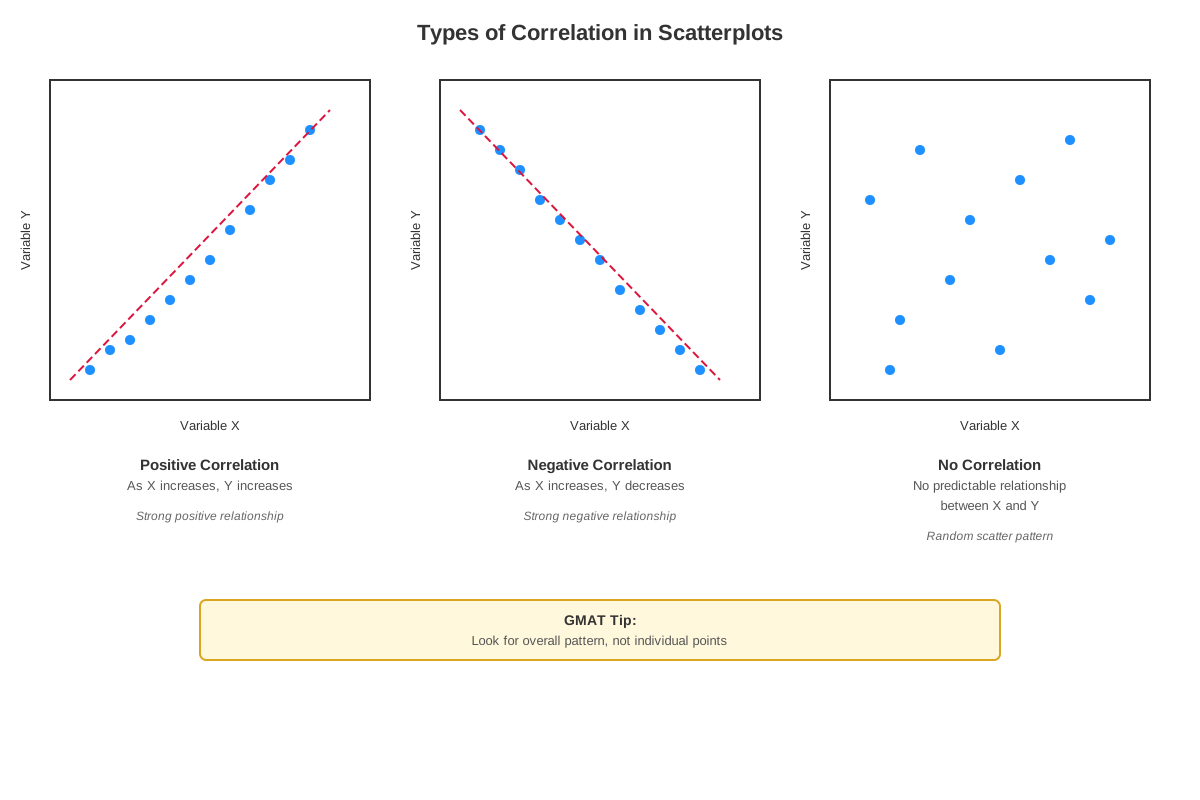
Positive correlation occurs when both variables tend to increase together. As x-values increase, y-values also increase, creating an upward-sloping pattern from left to right. Examples include the relationship between study hours and test scores, or advertising expenditure and sales revenue. The data points cluster around an imaginary line rising from lower-left to upper-right.
Negative correlation (also called inverse correlation) occurs when one variable increases as the other decreases. As x-values increase, y-values decrease, creating a downward-sloping pattern. Examples include the relationship between vehicle age and resale value, or price and quantity demanded. The data points cluster around an imaginary line falling from upper-left to lower-right.
No correlation (zero correlation) exists when the variables show no systematic relationship. Data points appear randomly scattered across the plot with no discernible pattern. Knowing one variable's value provides no information about the other variable's likely value.
Correlation Strength
Beyond identifying correlation type, the GMAT tests understanding of correlation strength—how closely data points cluster around the trend pattern.
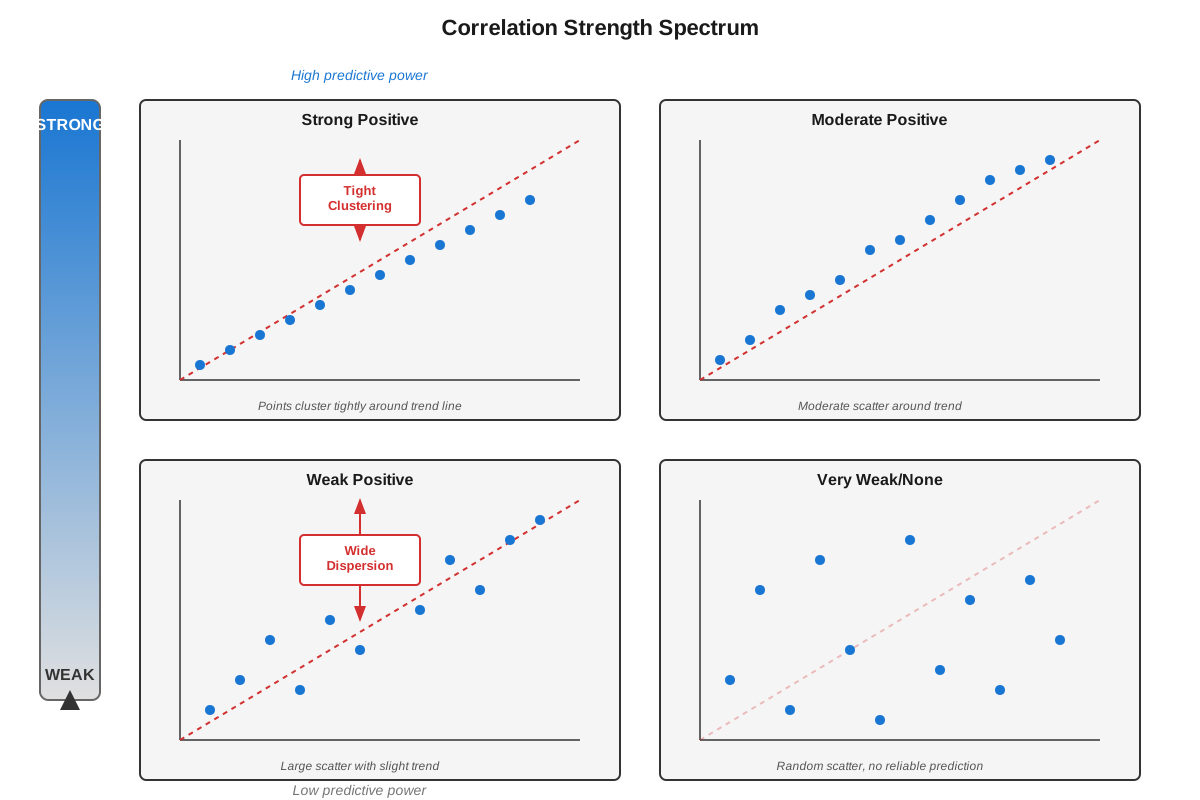
Strong correlation is indicated when data points cluster tightly around an imaginary trend line, whether that line slopes upward (positive) or downward (negative). The relationship is highly predictable, and knowing the x-value allows reasonably accurate prediction of the y-value.
Moderate correlation shows a visible trend, but with considerable scatter. Data points follow a general pattern but with substantial deviation from the trend line. Predictions based on x-values have moderate reliability.
Weak correlation displays only a slight tendency toward a pattern, with data points widely scattered. The relationship exists but is not strong enough for reliable predictions.
The GMAT may present answer choices describing correlation as "strong positive," "weak negative," "moderate positive," or "no correlation," requiring visual assessment of both direction and strength.
Outliers and Anomalies
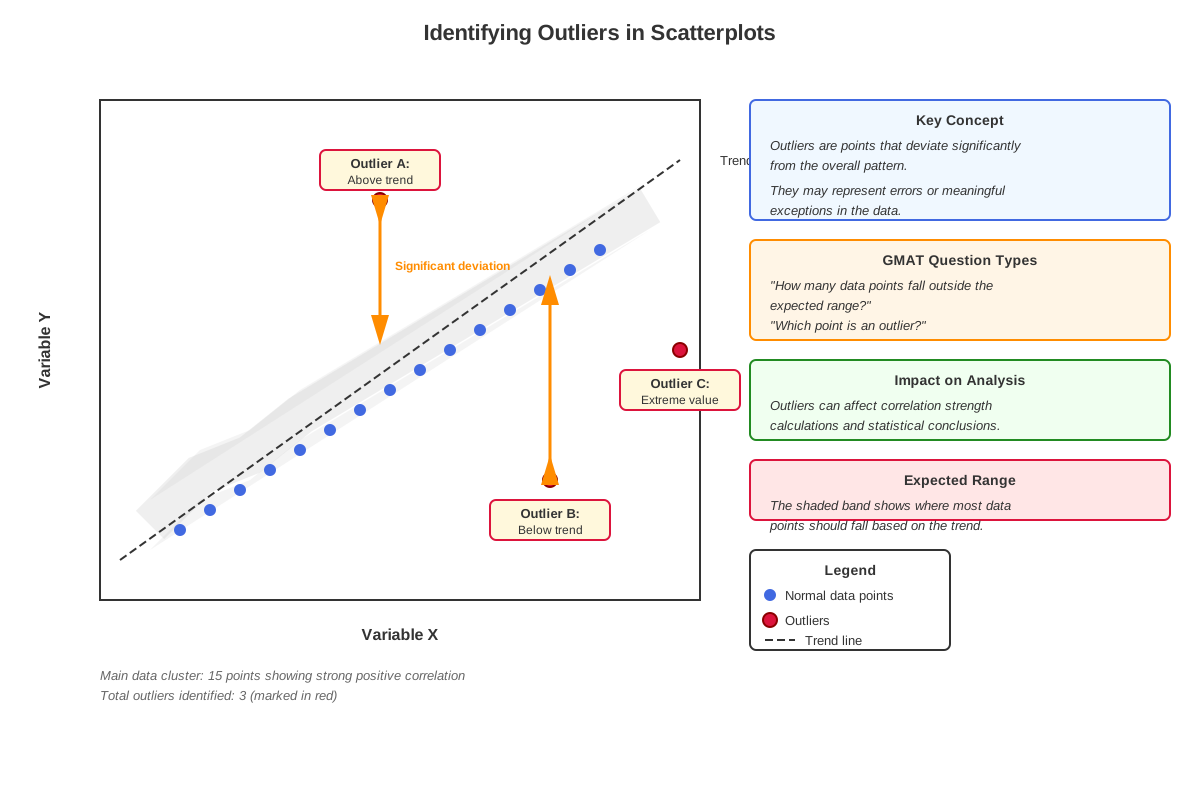
An outlier is a data point that falls far from the general pattern established by other points. Outliers are significant because they may represent measurement errors, exceptional cases, or important anomalies that warrant investigation. On the GMAT, questions may ask test-takers to identify how many outliers exist, determine which point is most anomalous, or evaluate whether conclusions remain valid when outliers are excluded.
Outliers can appear in several ways: points far above or below the trend line (vertical outliers), points far to the left or right of the data cluster (horizontal outliers), or points distant from the main cluster in both dimensions. The GMAT may test whether students recognize that a single outlier can dramatically affect calculated statistics like mean but has less impact on median values.
Clusters and Patterns
Beyond simple linear relationships, scatterplots may reveal clusters—groups of data points that form distinct subgroups. The GMAT may present scatterplots where data naturally separates into two or more clusters, suggesting that different subpopulations or categories exist within the dataset. Recognizing clusters helps identify when a single trend line inadequately describes the data.
Some scatterplots display non-linear patterns such as curved relationships, exponential growth patterns, or logarithmic relationships. While the GMAT primarily focuses on linear correlations, recognizing when a relationship is clearly non-linear (curved rather than straight) is important for avoiding incorrect conclusions.
Making Predictions and Interpolation
Interpolation involves estimating values within the range of observed data. If a scatterplot shows data points for x-values ranging from 10 to 50, interpolation would estimate the y-value when x equals 30. This is generally reliable when a clear trend exists.
Extrapolation involves predicting values outside the observed data range. This is inherently less reliable because the relationship may change beyond the measured range. GMAT questions may test whether students recognize the limitations of extrapolation or can identify when predictions extend beyond reasonable bounds.
Correlation versus Causation
A critical concept the GMAT tests is the distinction between correlation and causation. Two variables may show strong correlation without one causing the other. Both might be influenced by a third variable (confounding variable), the relationship might be coincidental, or causation might run in the opposite direction from what's assumed.
The GMAT frequently includes answer choices that incorrectly claim causation based solely on correlation evidence. Correct answers typically use careful language like "is associated with," "tends to occur with," or "shows a relationship with" rather than "causes" or "results in."
Concept Relationships
The concepts within scatterplot analysis form an interconnected framework. Scatterplot structure (axes, scales, data points) provides the foundation → enabling pattern recognition → which leads to correlation identification (type and strength) → supporting prediction and interpolation → while requiring awareness of outliers that may distort patterns → and demanding careful distinction between correlation and causation when drawing conclusions.
Scatterplots connect to prerequisite coordinate geometry knowledge by applying the x-y plane to real data visualization. They extend basic statistics concepts by providing visual representations of relationships that summary statistics alone cannot reveal. The topic relates to probability concepts through the understanding that correlation strength indicates predictability—strong correlations mean higher probability of accurate predictions.
Within the broader GMAT curriculum, scatterplot mastery supports performance on integrated reasoning questions that combine multiple data sources, data sufficiency questions that test whether graphical information is adequate for conclusions, and problem-solving questions that embed scatterplots within business scenarios. The analytical thinking required for scatterplot interpretation—identifying patterns, recognizing limitations, distinguishing valid from invalid conclusions—transfers directly to critical reasoning in the Verbal section.
High-Yield Facts
⭐ Positive correlation: both variables increase together; pattern slopes upward from left to right
⭐ Negative correlation: one variable increases as the other decreases; pattern slopes downward from left to right
⭐ Correlation strength is determined by how tightly data points cluster around the trend pattern, not by the slope steepness
⭐ Outliers are data points that fall far from the general pattern and may represent errors, exceptions, or important anomalies
⭐ Correlation does not imply causation; two variables may be strongly correlated without one causing the other
- No correlation exists when data points show no systematic pattern and appear randomly scattered
- Strong correlations enable more reliable predictions; weak correlations provide little predictive power
- Interpolation (predicting within the data range) is more reliable than extrapolation (predicting beyond the data range)
- The independent variable typically appears on the x-axis; the dependent variable on the y-axis
- Multiple clusters in a scatterplot suggest distinct subgroups within the data
- Non-linear patterns (curved relationships) cannot be accurately described by simple positive or negative correlation
- Scale manipulation can visually exaggerate or minimize apparent correlation strength
- The number of data points affects reliability—more points generally provide stronger evidence for relationships
- A single outlier can dramatically affect mean values but has minimal impact on median values
- Zero correlation means knowing one variable provides no information about predicting the other variable
Quick check — test yourself on Scatterplots so far.
Try Flashcards →Common Misconceptions
Misconception: A steep slope indicates strong correlation, while a gentle slope indicates weak correlation.
Correction: Correlation strength depends on how tightly points cluster around the trend, not the slope's steepness. A steep line with widely scattered points shows weak correlation, while a gentle slope with tightly clustered points shows strong correlation.
Misconception: If two variables are correlated, one must cause the other.
Correction: Correlation indicates association but not causation. Both variables might be influenced by a third factor, the relationship might be coincidental, or causation might run opposite to assumptions. Additional evidence beyond correlation is required to establish causation.
Misconception: All scatterplots show linear relationships that can be described as positive or negative correlation.
Correction: Some scatterplots display non-linear patterns (curved, exponential, logarithmic) that cannot be accurately characterized as simply positive or negative. Others show no pattern at all (zero correlation).
Misconception: Outliers should always be ignored when analyzing scatterplots.
Correction: Outliers may represent important information—exceptional cases, measurement errors, or significant anomalies. They should be identified and considered, not automatically dismissed. The GMAT may test whether conclusions change when outliers are included versus excluded.
Misconception: If most data points show a positive correlation, the entire dataset has positive correlation even if some points show the opposite trend.
Correction: Overall correlation describes the predominant pattern, but the presence of distinct clusters or subgroups may indicate that different relationships exist for different segments of the data. A single correlation description may inadequately represent complex data.
Misconception: Scatterplots with fewer data points are less accurate than those with more points.
Correction: While more data points generally provide stronger statistical evidence, a small dataset can still show clear, reliable patterns. Conversely, a large dataset with high scatter shows weak correlation despite having many points. The pattern clarity matters more than point quantity alone.
Worked Examples
Example 1: Identifying Correlation Type and Strength
Question: A scatterplot displays the relationship between hours of weekly exercise (x-axis, ranging from 0 to 15 hours) and resting heart rate (y-axis, ranging from 55 to 85 beats per minute) for 30 individuals. The data points show a general downward trend from upper-left to lower-right, with most points falling within a relatively narrow band around an imaginary declining line. However, three points fall noticeably far from this pattern. Which statement best describes this scatterplot?
A) Strong positive correlation with several outliers
B) Moderate negative correlation with several outliers
C) Strong negative correlation with several outliers
D) Weak positive correlation with no outliers
E) No correlation with random scatter
Solution:
Step 1: Identify the correlation direction. The description states a "downward trend from upper-left to lower-right," which indicates negative correlation (as exercise hours increase, resting heart rate decreases).
Step 2: Assess correlation strength. The description states "most points falling within a relatively narrow band around an imaginary declining line." This tight clustering indicates strong correlation, not moderate or weak.
Step 3: Identify outliers. The question explicitly mentions "three points fall noticeably far from this pattern," confirming outliers exist.
Step 4: Combine observations. The scatterplot shows strong negative correlation (tight clustering around a downward trend) with several outliers (three anomalous points).
Answer: C) Strong negative correlation with several outliers
This example demonstrates the importance of systematically analyzing direction (positive/negative), strength (strong/moderate/weak based on clustering), and anomalies (outliers). The GMAT rewards methodical evaluation rather than quick impressions.
Example 2: Evaluating Conclusions from Scatterplot Data
Question: A company's scatterplot shows the relationship between advertising expenditure (in thousands of dollars, x-axis) and monthly sales revenue (in thousands of dollars, y-axis) over 24 months. The data points show a clear upward trend with tight clustering. The advertising expenditure ranges from $10,000 to $50,000, and sales revenue ranges from $100,000 to $300,000. Based on this scatterplot, which conclusion is most strongly supported?
A) Increasing advertising expenditure causes sales revenue to increase
B) Months with higher advertising expenditure tend to have higher sales revenue
C) If advertising expenditure reaches $75,000, sales revenue will exceed $400,000
D) Reducing advertising expenditure will cause sales revenue to decrease
E) Advertising expenditure is the only factor affecting sales revenue
Solution:
Step 1: Evaluate choice A. This claims causation ("causes"), but scatterplots show correlation only. Other factors might explain both variables, or the relationship might be reversed (higher sales enabling more advertising). Eliminate A.
Step 2: Evaluate choice B. This uses careful correlation language ("tend to have") without claiming causation. The described pattern (upward trend with tight clustering) directly supports this association statement. Keep B as strong candidate.
Step 3: Evaluate choice C. This involves extrapolation beyond the observed data range ($75,000 exceeds the maximum observed $50,000). Extrapolation is unreliable because relationships may change outside measured ranges. Eliminate C.
Step 4: Evaluate choice D. Like choice A, this claims causation ("will cause") rather than correlation. Additionally, it involves prediction about reducing expenditure, which may not follow the same pattern as increasing it. Eliminate D.
Step 5: Evaluate choice E. This makes an absolute claim ("only factor") that cannot be supported by correlation evidence alone. Multiple factors always influence business outcomes. Eliminate E.
Answer: B) Months with higher advertising expenditure tend to have higher sales revenue
This example illustrates the critical distinction between correlation and causation—a frequent GMAT testing point. Correct answers use qualified language acknowledging association without claiming causation, avoid extrapolation beyond data ranges, and recognize that correlation evidence cannot establish exclusive causality.
Exam Strategy
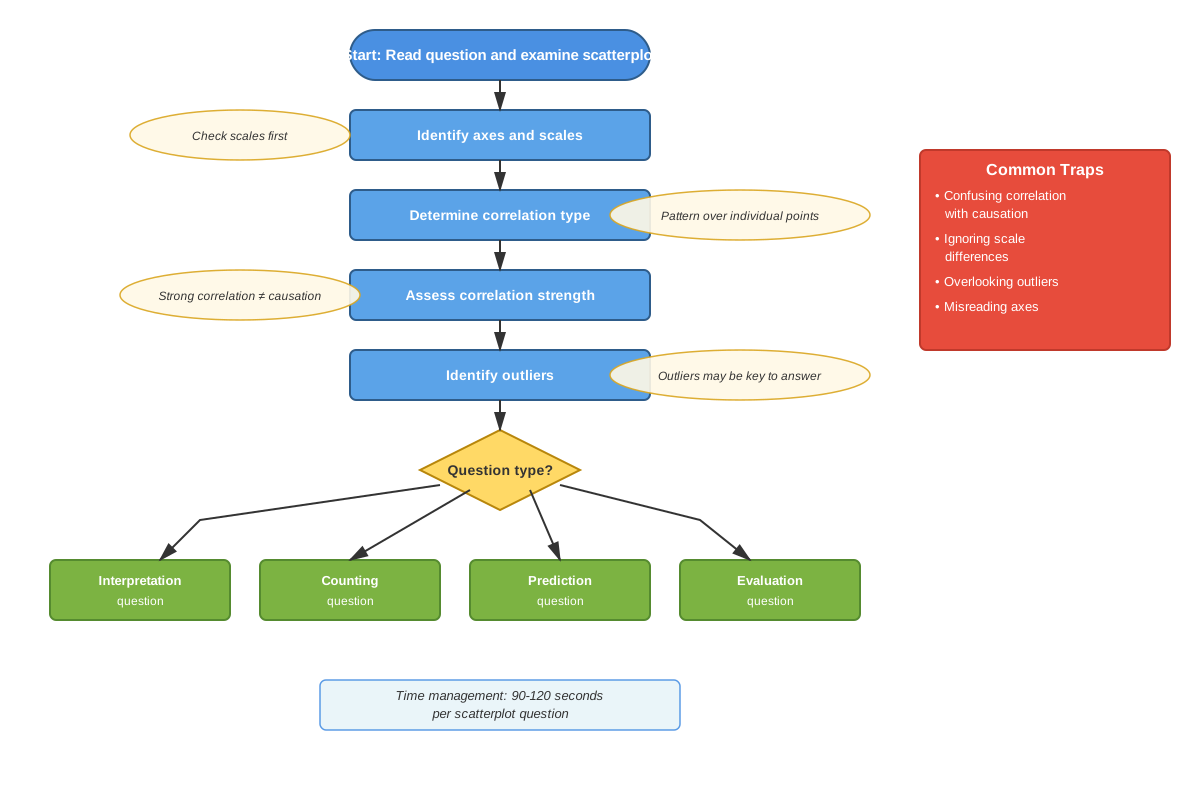
When approaching GMAT scatterplot questions, begin by carefully examining the axes: identify what each variable represents, note the units of measurement, and check the scale ranges. Many errors result from misreading axes or failing to notice non-standard scales that don't begin at zero.
Trigger phrases that signal scatterplot questions include: "the graph shows the relationship between," "based on the scatterplot," "which pattern best describes," "how many data points," and "the correlation between X and Y." When these appear, immediately activate scatterplot analysis protocols.
For correlation identification questions, first determine direction (upward = positive, downward = negative, no pattern = zero correlation), then assess strength by evaluating clustering tightness. Eliminate answer choices that misidentify direction before considering strength nuances.
Process of elimination is particularly effective for scatterplot questions. Immediately eliminate choices that claim causation when only correlation is shown, choices that extrapolate far beyond the data range, and choices that make absolute statements ("always," "never," "only") unsupported by the visual evidence. The GMAT frequently includes these trap answers to test critical thinking.
For questions asking about specific data points or counts, use systematic approaches: mentally divide the scatterplot into regions, count points methodically, and double-check boundary cases. When identifying outliers, look for points that are isolated from the main cluster in any direction—not just vertically above or below the trend.
Time allocation: Spend 15-20 seconds initially examining the scatterplot structure (axes, scale, labels) before reading the question. This investment prevents repeated back-and-forth between question and graph. For standard scatterplot questions, aim to complete analysis within 90-120 seconds total. If a question requires counting numerous individual points or complex pattern analysis, it may warrant up to 2 minutes.
When questions present multiple data sources (scatterplot plus table or text), extract information from the scatterplot first, then integrate additional data. This prevents confusion and ensures the visual pattern is clearly understood before adding complexity.
Memory Techniques
PNZS mnemonic for correlation types: Positive (both increase), Negative (one increases, other decreases), Zero (no pattern), Strength (tight clustering = strong).
"Upward = Positive, Downward = Negative": Visualize walking up a hill (positive correlation) versus walking down a hill (negative correlation) as you scan the scatterplot from left to right.
The Clustering Rule: Remember "tight cluster = strong prediction power." Visualize trying to draw a line through the points—if most points are very close to where your line would go, correlation is strong.
Correlation ≠ Causation: Create the mental image of ice cream sales and drowning incidents—both increase in summer (correlated) but ice cream doesn't cause drowning. This memorable example prevents causation errors.
Outlier = "Out-liar": Think of outliers as points that "lie" outside the truth of the pattern. This wordplay helps remember to identify points far from the main cluster.
AXIS acronym: Always eXamine Independent variable on horizontal, dependent on vertical—Scale matters. This reminds you to check axis setup and scale before analyzing patterns.
Summary
Scatterplots are fundamental data visualization tools that display relationships between two quantitative variables through plotted data points on a coordinate plane. GMAT success requires ability to identify correlation types (positive, negative, or zero), assess correlation strength through clustering patterns, recognize outliers that deviate from trends, and draw valid conclusions while avoiding the correlation-causation fallacy. The exam tests systematic analysis skills: examining axes and scales carefully, identifying patterns methodically, distinguishing between interpolation and extrapolation, and recognizing when conclusions exceed what the data supports. Mastery involves understanding that tight clustering indicates strong correlation regardless of slope steepness, that correlation shows association without proving causation, and that careful language distinguishes supported conclusions from unsupported claims. Success on scatterplot questions requires combining visual pattern recognition with critical thinking about data limitations, making this topic a high-yield area that integrates multiple quantitative reasoning competencies tested throughout the GMAT.
Key Takeaways
- Scatterplots display relationships between two variables; correlation type (positive/negative/zero) is determined by the overall pattern direction from left to right
- Correlation strength depends on clustering tightness around the trend, not slope steepness—tight clustering means strong correlation and reliable predictions
- Outliers are data points falling far from the main pattern and may represent errors, exceptions, or important anomalies requiring separate consideration
- Correlation demonstrates association between variables but never proves causation; additional evidence beyond scatterplot patterns is required to establish causal relationships
- Always examine axes carefully for variable identification, units, and scale ranges before analyzing patterns—non-standard scales are common GMAT traps
- Interpolation (predicting within the observed data range) is reliable with clear trends; extrapolation (predicting beyond the data range) is inherently unreliable
- Correct GMAT answers use qualified language ("tends to," "is associated with") rather than absolute claims ("causes," "always," "only")
Related Topics
Linear Regression and Trend Lines: Building on scatterplot interpretation, linear regression quantifies relationships through equations and enables precise predictions. Mastering scatterplots provides the visual foundation for understanding regression analysis.
Correlation Coefficients: The numerical measure of correlation strength and direction (ranging from -1 to +1) formalizes the visual patterns observed in scatterplots. Understanding scatterplot patterns makes correlation coefficients more intuitive.
Data Sufficiency with Graphical Elements: Many GMAT Data Sufficiency questions incorporate scatterplots or other graphs, requiring determination of whether visual information is adequate for answering questions. Scatterplot mastery directly improves performance on these integrated questions.
Multi-Source Reasoning: Integrated Reasoning questions often combine scatterplots with tables, text passages, and other data sources. Strong scatterplot skills enable efficient synthesis of multiple information types.
Statistical Inference and Sampling: Understanding how sample data (displayed in scatterplots) relates to population parameters connects scatterplot interpretation to broader statistical reasoning tested on the GMAT.
Practice CTA
Now that you've mastered the fundamentals of scatterplot interpretation, it's time to reinforce your learning through active practice. Attempt the practice questions to apply these concepts to GMAT-style problems, and use the flashcards to cement high-yield facts in your memory. Remember: scatterplot questions reward systematic analysis and careful reading—skills that improve rapidly with focused practice. Each question you work through strengthens your pattern recognition abilities and builds the confidence needed for test day success. Your investment in mastering this high-yield topic will pay dividends across multiple GMAT question types!
Sign up free to keep reading
Create a free AnvayaPrep account to finish this GMAT guide on Scatterplots — plus flashcards and practice questions.