Overview
Inference questions represent one of the most frequently tested question types in GMAT Critical Reasoning, appearing in approximately 20-25% of all Critical Reasoning questions. These questions assess a test-taker's ability to draw logical conclusions that must be true based solely on the information provided in a passage, without introducing outside knowledge or making unsupported assumptions. Unlike assumption or strengthen/weaken questions that require identifying gaps in reasoning, GMAT inference questions demand that students recognize what logically follows from the given premises with absolute certainty.
Mastering inference questions is essential for GMAT success because they test pure logical reasoning—the foundation of all Critical Reasoning skills. These questions require careful reading comprehension, attention to qualifying language, and the ability to distinguish between what must be true versus what could be true or is likely true. Students who excel at inference questions demonstrate the analytical precision that business schools value, as the skill directly translates to data-driven decision-making in management contexts.
Within the broader Verbal Reasoning section, inference questions bridge Reading Comprehension and Critical Reasoning by requiring both careful textual analysis and logical deduction. They connect to assumption questions (which ask what must be assumed) and strengthen/weaken questions (which test argument structure) by demanding the same rigorous attention to logical relationships. However, inference questions are unique in that they never require identifying flaws or filling gaps—only recognizing what the passage already establishes as necessarily true.
Learning Objectives
- [ ] Identify Inference questions by recognizing their characteristic question stems and structural patterns
- [ ] Explain Inference as a logical process of deriving conclusions that must be true from given premises
- [ ] Apply Inference skills to GMAT questions by systematically eliminating answers that go beyond the passage
- [ ] Distinguish between valid inferences (must be true) and invalid inferences (could be true or likely true)
- [ ] Recognize common trap answers in inference questions, including extreme statements and outside knowledge
- [ ] Evaluate answer choices using the "prove it from the passage" standard to ensure logical validity
Prerequisites
- Basic logical reasoning: Understanding of premises and conclusions is necessary because inference questions require identifying what follows logically from stated facts
- Reading comprehension fundamentals: Ability to parse complex sentences and identify main ideas enables accurate extraction of relevant information from passages
- Understanding of qualifiers: Recognition of words like "some," "all," "most," and "never" is essential because inference validity often hinges on these precise terms
- Familiarity with argument structure: Knowledge of how claims support conclusions helps distinguish between what is stated versus what is inferred
Why This Topic Matters
Inference questions appear in every GMAT exam, typically comprising 4-6 questions out of the approximately 18 Critical Reasoning questions in the Verbal section. This high frequency makes inference mastery a high-yield investment of study time. Beyond test performance, the ability to draw valid inferences is fundamental to business analysis, where executives must extract actionable insights from data, reports, and market research without overstepping what the evidence supports.
In real-world business contexts, faulty inference leads to strategic errors: assuming causation from correlation, overgeneralizing from limited data, or making decisions based on what "seems likely" rather than what is demonstrably true. The GMAT tests inference precisely because MBA programs seek students who can think rigorously about evidence and avoid logical overreach. Investment analysts, consultants, and managers constantly face situations requiring them to determine what conclusions are warranted by available information—exactly what inference questions assess.
On the exam, inference questions appear in several formats: standalone passages presenting facts or research findings, argument-based passages where the inference extends the reasoning, and paired passages requiring synthesis. Common passage topics include business scenarios (market trends, company performance), scientific studies (research findings, experimental results), and social phenomena (demographic patterns, policy effects). Recognizing these patterns helps students anticipate question types and allocate time efficiently during the exam.
Core Concepts
What Is an Inference?
An inference is a conclusion that must be true based on the information provided in a passage, without requiring any additional assumptions or outside knowledge. In formal logic, an inference represents a valid deduction—if the premises are true, the conclusion cannot be false. This distinguishes inferences from assumptions (unstated premises needed for an argument) or predictions (statements about future events that may or may not occur).
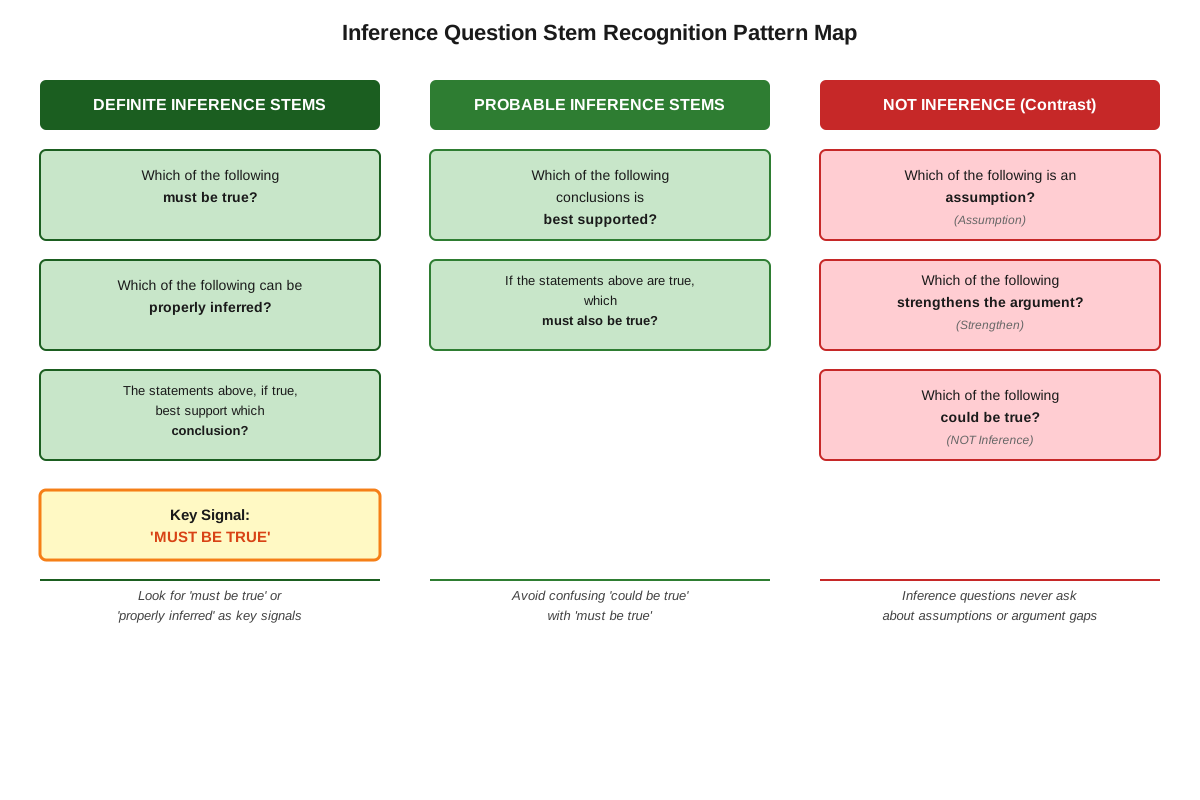
The GMAT tests inference through questions asking what "must be true," "is supported by," "can be properly inferred," or "follows logically" from the passage. These question stems signal that the correct answer will be a statement that is logically entailed by the passage—not merely consistent with it or likely given the information. The standard for correctness is absolute: if even one scenario exists where the passage is true but the answer choice is false, that choice is incorrect.
The Three Types of Valid Inferences
GMAT inference questions typically test three categories of logical deduction:
1. Combination Inferences: These require combining two or more statements from the passage to reach a conclusion that neither statement alone supports. For example, if a passage states "All managers attend the conference" and "Sarah is a manager," the valid inference is "Sarah attends the conference." The GMAT frequently tests this type by spreading relevant information across multiple sentences.
2. Contrapositive Inferences: These involve recognizing logical equivalences, particularly with conditional statements. If a passage states "If a company is profitable, it retains employees," the contrapositive—"If a company does not retain employees, it is not profitable"—is a valid inference. Understanding contrapositives prevents students from falling for reversed or negated statements that appear similar but are logically invalid.
3. Quantifier Inferences: These derive from careful attention to words indicating quantity or frequency. If a passage states "Most employees prefer remote work," valid inferences include "At least some employees prefer remote work" and "Not all employees prefer in-office work." Invalid inferences would include "All employees prefer remote work" or specific claims about what the minority prefers.
The Must-Be-True Standard
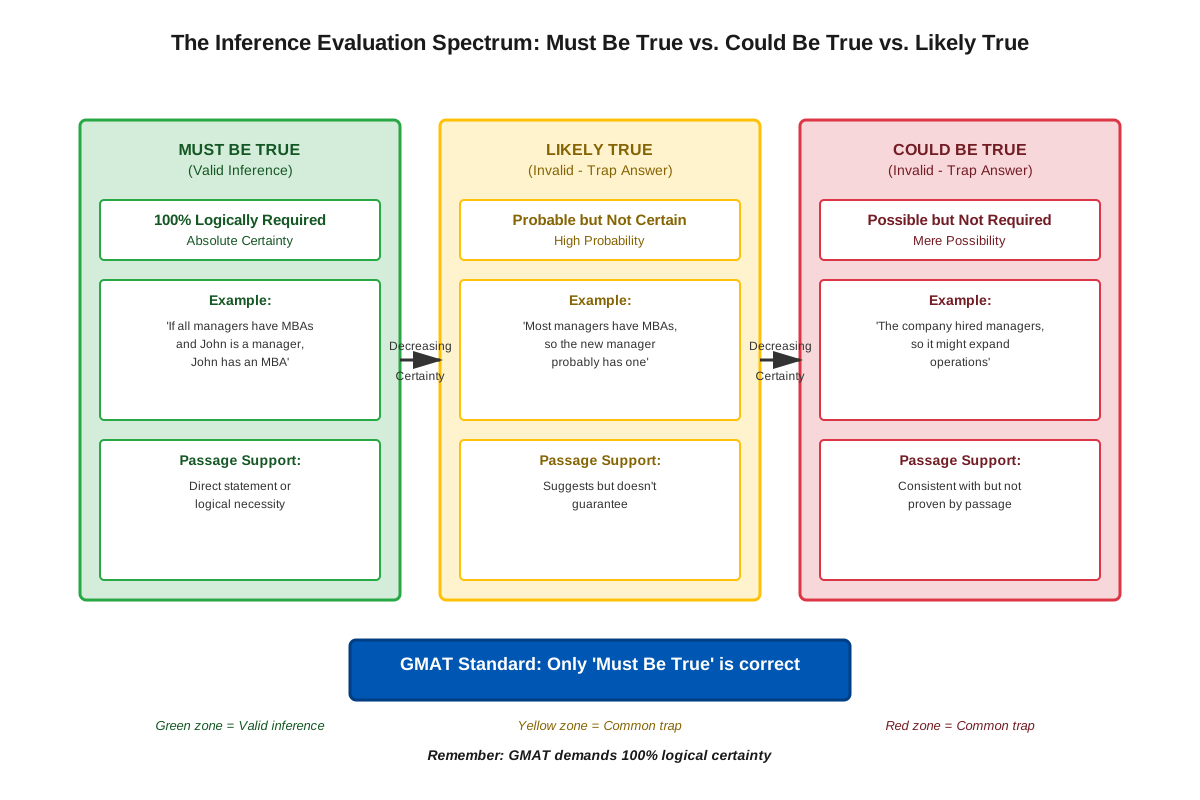
The defining characteristic of correct inference answers is that they satisfy the must-be-true standard: given the passage as true, the answer choice cannot possibly be false. This differs from "could be true" (consistent with the passage but not required) or "likely true" (probable but not certain). Students must internalize this distinction because GMAT trap answers frequently offer plausible statements that go slightly beyond what the passage guarantees.
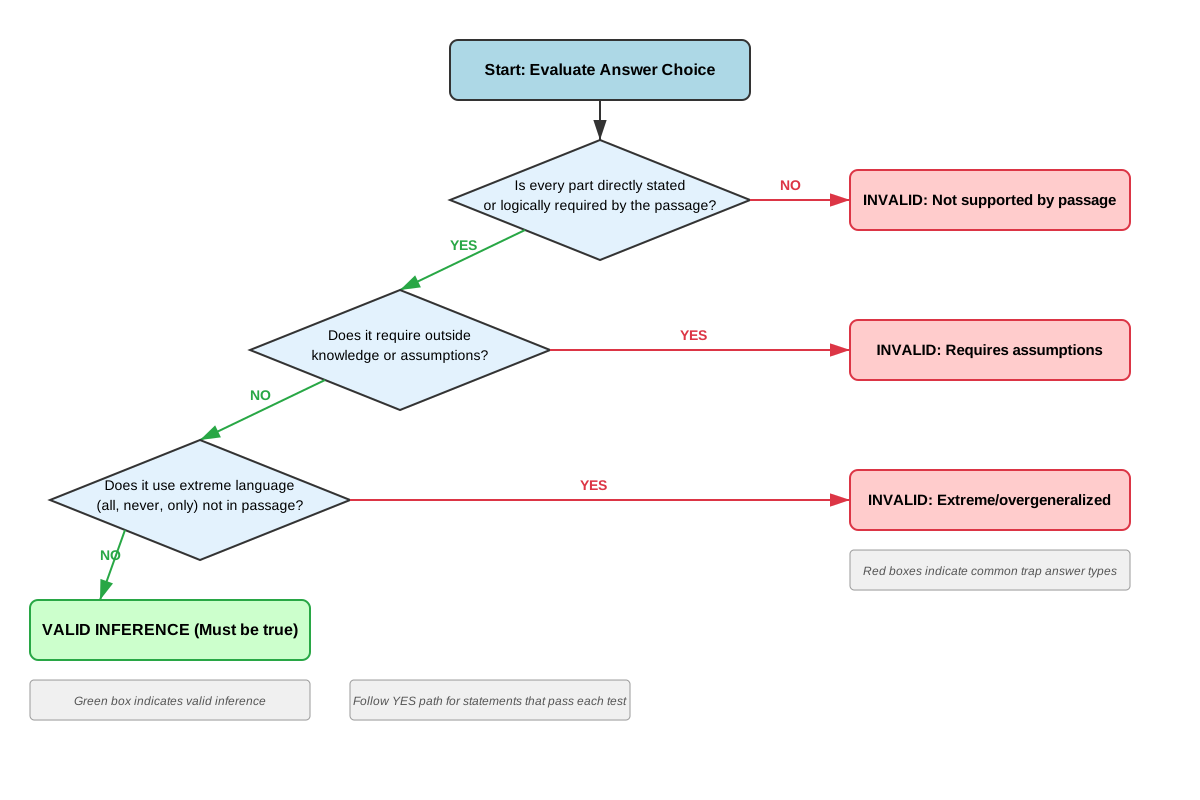
To apply this standard, students should ask: "Can I prove this answer using only the passage, without adding any assumptions?" If the answer requires assuming additional facts, making generalizations beyond the passage's scope, or relying on outside knowledge, it fails the must-be-true test. This rigorous standard explains why correct inference answers often feel conservative or limited—they cannot extend beyond what the passage definitively establishes.
Scope and Degree in Inferences
Two critical dimensions determine inference validity: scope (what the statement covers) and degree (how strong the claim is). A passage about "some technology companies" cannot support an inference about "all technology companies" (scope error) or about "the technology industry as a whole" (scope expansion). Similarly, a passage stating that a factor "contributes to" an outcome cannot support an inference that the factor "causes" or "is the primary driver of" the outcome (degree error).
The GMAT exploits these dimensions by crafting wrong answers that subtly shift scope or degree. A passage discussing "increased sales in the Northeast region" might include a trap answer about "company-wide sales growth" (scope shift) or "dramatic sales increases" when the passage only mentions "increases" (degree shift). Recognizing these shifts requires careful comparison between passage language and answer choice language.
| Passage Language | Valid Inference | Invalid Inference (Scope/Degree Error) |
|---|---|---|
| "Some employees" | "At least one employee" | "Most employees" or "All employees" |
| "May contribute to" | "Could be a factor in" | "Causes" or "Is the main reason for" |
| "In 2023" | "During that year" | "In recent years" or "Typically" |
| "Suggests" | "Provides some evidence for" | "Proves" or "Demonstrates conclusively" |
Common Inference Question Stems
Recognizing inference questions begins with identifying their characteristic question stems. While variations exist, most inference questions use language indicating logical necessity:
- "Which of the following can be properly inferred from the passage?"
- "The statements above, if true, best support which of the following conclusions?"
- "If the statements above are true, which of the following must also be true?"
- "The information above most strongly supports which of the following?"
- "Which of the following conclusions is best supported by the passage?"
The key phrases—"properly inferred," "must be true," "best supported"—signal that the correct answer will be a necessary consequence of the passage, not merely a possible or probable one. Some question stems use "most strongly supports," which might suggest degrees of support, but the correct answer will still be the one most directly entailed by the passage without requiring additional assumptions.
The Role of Qualifying Language
Inference validity often hinges on qualifying language—words and phrases that limit or specify the scope and strength of claims. Terms like "some," "many," "most," "all," "always," "never," "may," "can," "must," "likely," and "possible" dramatically affect what can be inferred. A passage stating "most customers prefer option A" allows the inference that "some customers prefer option A" (weakening the quantifier is valid) but not that "all customers prefer option A" (strengthening is invalid).
Students must pay meticulous attention to these qualifiers in both passages and answer choices. The GMAT frequently creates trap answers by changing a single qualifier: replacing "some" with "most," "may" with "will," or "suggests" with "proves." These subtle shifts invalidate the inference, making the answer incorrect despite appearing nearly identical to the passage. Developing sensitivity to qualifying language is perhaps the single most important skill for inference questions.
Concept Relationships
The concepts within inference questions form a hierarchical structure: the must-be-true standard serves as the overarching principle, determining whether any potential inference is valid. This standard depends on careful analysis of scope and degree, which in turn requires attention to qualifying language. The three types of valid inferences (combination, contrapositive, and quantifier) represent specific applications of the must-be-true standard to different logical structures.
Inference questions connect to prerequisite knowledge of argument structure because recognizing premises and conclusions helps identify what information is given versus what must be derived. They relate to assumption questions inversely: while assumptions identify unstated premises needed to make an argument work, inferences identify unstated conclusions that the premises guarantee. Both require understanding logical gaps, but inferences fill gaps that the passage already bridges, while assumptions fill gaps the passage leaves open.
The relationship map flows as follows: Passage Information → analyzed for Scope and Degree → evaluated against Must-Be-True Standard → produces Valid Inference (using Combination, Contrapositive, or Quantifier logic) → tested against Answer Choices → correct answer identified by elimination of scope/degree errors.
High-Yield Facts
⭐ The correct answer to an inference question must be true if the passage is true—no exceptions or scenarios where it could be false
⭐ Inference questions never require outside knowledge; everything needed is in the passage
⭐ Correct answers often feel conservative or limited because they cannot extend beyond what the passage guarantees
⭐ Changing qualifiers (some→most, may→will, suggests→proves) typically creates wrong answers
⭐ If you need to assume something for an answer to be true, that answer is wrong for an inference question
- Inference questions comprise approximately 20-25% of GMAT Critical Reasoning questions
- "Must be true" and "properly inferred" are functionally equivalent standards on the GMAT
- Combining two statements from different parts of the passage is a common path to the correct answer
- Extreme language (all, none, always, never) in answer choices is usually wrong unless the passage uses equally extreme language
- The contrapositive of a conditional statement is always a valid inference from that statement
- Weakening a quantifier is valid (most→some) but strengthening is not (some→most)
- Temporal scope matters: a statement about one year cannot support inferences about other years without additional information
- Correct inference answers are often restatements or close paraphrases of passage content
Quick check — test yourself on Inference so far.
Try Flashcards →Common Misconceptions
Misconception: Inference questions ask for what is likely or probably true based on the passage.
Correction: Inference questions demand what must be true with absolute certainty. Probability or likelihood is insufficient; the correct answer must be a logical necessity given the passage. An answer that is 99% likely but not guaranteed is incorrect.
Misconception: If an answer choice is consistent with the passage and doesn't contradict it, it's a valid inference.
Correction: Consistency is necessary but not sufficient for a valid inference. The answer must be entailed by the passage—the passage must prove the answer true. Many wrong answers are consistent with the passage but go beyond what it establishes.
Misconception: Longer, more detailed answer choices are more likely to be correct because they show more reasoning.
Correction: Length is irrelevant to inference validity. In fact, longer answers often introduce additional claims that go beyond the passage, making them incorrect. The correct answer might be the shortest option if it precisely captures what the passage guarantees.
Misconception: Real-world knowledge should be used to evaluate whether an inference makes sense.
Correction: Inference questions operate in a closed logical system—only the passage matters. Even if an answer contradicts real-world facts, it's correct if the passage logically entails it. Conversely, real-world plausibility doesn't make an answer correct if the passage doesn't support it.
Misconception: If the passage discusses causation, the inference can discuss correlation, and vice versa.
Correction: Causation and correlation are logically distinct. A passage establishing correlation ("X and Y occur together") cannot support an inference of causation ("X causes Y"). Similarly, causation implies correlation, but the inference must maintain the same logical relationship the passage establishes.
Misconception: Inference questions are essentially the same as "main point" or "conclusion" questions.
Correction: Main point questions ask for the author's primary claim, which is stated in the passage. Inference questions ask for something not explicitly stated but logically required by what is stated. The correct inference is a new statement derived from the passage, not a summary of it.
Worked Examples
Example 1: Business Scenario
Passage: "TechCorp's revenue increased by 15% in Q3 2023 compared to Q3 2022. The company attributes this growth primarily to strong sales of its new software product, which launched in Q2 2023. However, the company's hardware division saw a 5% decline in revenue during the same period. Overall, TechCorp's total operating costs remained stable year-over-year."
Question: Which of the following can be properly inferred from the passage above?
(A) TechCorp's software division revenue increased by more than 15% in Q3 2023 compared to Q3 2022.
(B) TechCorp's profit margin improved in Q3 2023 compared to Q3 2022.
(C) The new software product was TechCorp's most successful product launch in company history.
(D) TechCorp's hardware division will continue to decline in future quarters.
(E) Without the new software product, TechCorp's total revenue would have been lower in Q3 2023 than in Q3 2022.
Analysis:
Step 1: Identify what the passage establishes
- Total revenue: +15%
- Software division: strong sales from new product (launched Q2 2023)
- Hardware division: -5% revenue
- Operating costs: stable (no change)
Step 2: Evaluate each answer against the must-be-true standard
(A) Correct. This is a combination inference. If total revenue increased 15% but hardware declined 5%, and the passage attributes growth "primarily" to software, the software division must have increased by more than 15% to offset the hardware decline and still produce a 15% overall increase. This is mathematically necessary.
(B) Incorrect—scope error. While revenue increased and costs stayed stable, we don't know the relationship between revenue and costs (profit margin = profit/revenue). If revenue was previously below costs, the company could still be unprofitable. This requires assuming information not in the passage.
(C) Incorrect—scope error. The passage only discusses Q3 2023 performance, not the company's entire history. "Most successful...in company history" goes far beyond the passage's temporal scope.
(D) Incorrect—temporal scope error. The passage describes one quarter's performance. Inferring future trends requires assuming patterns will continue, which is not supported by a single data point.
(E) Incorrect—degree error. While the software product contributed to growth, the passage says it was the "primary" factor, not the only factor. Other elements could have contributed. We cannot definitively conclude what would have happened without the software product.
Connection to Learning Objectives: This example demonstrates applying inference skills by systematically eliminating answers that exceed passage scope (B, C, D) or degree (E), while identifying the valid combination inference (A) that must be true given the mathematical relationship between the stated facts.
Example 2: Research Study
Passage: "A recent study examined 200 adults who reported sleeping fewer than six hours per night. Researchers found that 65% of these individuals reported experiencing difficulty concentrating during work tasks. Among a control group of 200 adults who reported sleeping seven to eight hours per night, only 30% reported similar concentration difficulties. The study controlled for age, occupation, and caffeine consumption."
Question: If the information above is true, which of the following must also be true?
(A) Sleeping fewer than six hours per night causes concentration difficulties.
(B) At least some adults who sleep seven to eight hours per night experience concentration difficulties.
(C) Most adults who experience concentration difficulties sleep fewer than six hours per night.
(D) Increasing sleep duration from under six hours to seven to eight hours will improve concentration.
(E) The majority of adults sleep fewer than six hours per night.
Analysis:
Step 1: Extract quantitative information
- Short sleepers (< 6 hours): 200 people, 65% have concentration issues
- Normal sleepers (7-8 hours): 200 people, 30% have concentration issues
- Study controlled for confounding variables
Step 2: Apply the must-be-true standard
(A) Incorrect—causation vs. correlation error. The study shows correlation (short sleep is associated with concentration difficulties) but doesn't establish causation. Correlation does not imply causation, and the passage doesn't claim causal relationship.
(B) Correct. This is a quantifier inference. The passage states that 30% of the normal sleeper group reported concentration difficulties. 30% of 200 people means at least 60 people, which satisfies "at least some." This weakens the quantifier appropriately and must be true given the passage.
(C) Incorrect—reversal error. The passage tells us what percentage of short sleepers have concentration issues, not what percentage of people with concentration issues are short sleepers. These are different logical relationships. We cannot infer the reverse without additional information about the broader population.
(D) Incorrect—causation and prediction error. This assumes causation and predicts individual outcomes, neither of which the correlational study supports. The study shows group differences but doesn't establish that changing sleep duration will change concentration for any individual.
(E) Incorrect—scope error. The study examined 200 short sleepers and 200 normal sleepers, but this tells us nothing about the general adult population's sleep patterns. The study sample doesn't represent population proportions.
Connection to Learning Objectives: This example illustrates identifying inference questions (recognizing "must also be true"), explaining inference as logical deduction (distinguishing correlation from causation), and applying inference skills (using quantifier logic to identify the valid answer while eliminating common traps).
Exam Strategy
When approaching GMAT inference questions, employ a systematic four-step process:
Step 1: Confirm the Question Type (5-10 seconds)
Read the question stem carefully to verify it's asking for an inference. Look for trigger phrases: "must be true," "properly inferred," "best supported," "follows logically." This confirmation prevents applying wrong strategies from other question types.
Step 2: Map the Passage (20-30 seconds)
Read the passage actively, noting:
- Quantifiers (some, most, all, none)
- Temporal markers (dates, time periods)
- Causal vs. correlational language
- Scope limitations (specific groups, regions, contexts)
- Conditional statements (if-then relationships)
Don't try to predict the answer—inference questions rarely allow accurate prediction because the correct answer often combines information in unexpected ways.
Step 3: Evaluate Each Answer Choice (10-15 seconds per choice)
For each option, ask: "Can I prove this using only the passage?" Apply the must-be-true standard rigorously:
- Check for scope shifts (passage discusses X, answer discusses Y)
- Check for degree shifts (passage says "may," answer says "will")
- Check for temporal shifts (passage covers one period, answer generalizes)
- Check for logical shifts (passage shows correlation, answer claims causation)
Step 4: Eliminate and Select (10-20 seconds)
Use process of elimination aggressively. Wrong answers typically fail in identifiable ways:
- Too extreme: Uses "all," "none," "always," "never" without passage support
- Too broad: Expands beyond the passage's specific scope
- Requires assumptions: Needs additional facts not in the passage
- Reverses logic: Confuses sufficient and necessary conditions
- Outside knowledge: Relies on real-world facts not stated in passage
Time Management Tip: Allocate approximately 90-120 seconds total per inference question. If you're spending more than 2 minutes, you're likely overanalyzing. The correct answer should be provable from the passage without elaborate reasoning chains.
Trigger Words to Watch:
In passages:
- "Some" vs. "most" vs. "all"
- "May" vs. "will" vs. "must"
- "Suggests" vs. "proves" vs. "demonstrates"
- "If...then" (conditional statements)
- "Because," "since," "therefore" (causal language)
In answer choices (red flags):
- "Always," "never," "all," "none" (extreme claims)
- "Will," "must" (strong predictions)
- "Causes," "results in" (causal claims)
- "Most," "majority" (quantifier strengthening)
- "Typically," "generally" (temporal generalizations)
Memory Techniques
The PROVE Acronym for evaluating inference answers:
- Passage-based: Can I point to specific passage text supporting this?
- Restricted scope: Does the answer stay within the passage's boundaries?
- Objectively true: Must this be true, or just could/likely be true?
- Verifiable: Can I prove this without assumptions?
- Exact language: Do qualifiers match between passage and answer?
The Scope-Degree-Time Triangle: Visualize three dimensions that wrong answers typically violate:
- Scope: What/who the statement covers (specific → general is invalid)
- Degree: How strong the claim is (weak → strong is invalid)
- Time: When the statement applies (specific period → general pattern is invalid)
Picture a triangle with these three points. The correct answer stays within the triangle defined by the passage; wrong answers extend beyond one or more edges.
The Qualifier Hierarchy (memorize this scale):
Weakest → Strongest
"May" → "Can" → "Some" → "Many" → "Most" → "All"
"Suggests" → "Indicates" → "Shows" → "Demonstrates" → "Proves"
Valid inferences can move left (weaker) but never right (stronger) on these scales.
The "Prove It" Mantra: Before selecting an answer, literally say (mentally): "I can prove this because the passage says [specific text]." If you can't complete this sentence, the answer is wrong.
Summary
Inference questions test the ability to recognize conclusions that must be true based solely on passage information, without introducing assumptions or outside knowledge. Success requires applying the must-be-true standard rigorously: the correct answer cannot possibly be false if the passage is true. The three main types of valid inferences—combination (synthesizing multiple statements), contrapositive (recognizing logical equivalences), and quantifier (deriving from scope and degree language)—represent the primary logical patterns the GMAT tests. Students must develop sensitivity to scope, degree, and temporal boundaries, as wrong answers typically violate these dimensions by making claims that are too broad, too strong, or too generalized. Qualifying language (some, most, all, may, will, must) often determines inference validity, making careful attention to these terms essential. The systematic approach of mapping the passage, evaluating each answer against the must-be-true standard, and eliminating choices that require assumptions or extend beyond passage boundaries enables consistent success on these high-frequency, high-value questions.
Key Takeaways
- Inference questions ask for what must be true, not what could be true or is likely true—the standard is absolute logical necessity
- The correct answer is provable using only passage information; if you need to assume anything, the answer is wrong
- Pay meticulous attention to qualifiers (some/most/all, may/will/must) as they determine inference validity
- Wrong answers typically fail by shifting scope (too broad), degree (too strong), or time (overgeneralizing)
- Combination inferences (synthesizing multiple passage statements) are the most common path to correct answers
- Correlation does not imply causation—passages showing association cannot support causal inferences
- Conservative, limited-sounding answers are often correct because valid inferences cannot extend beyond what the passage guarantees
Related Topics
Assumption Questions: While inference questions ask what must be true given the passage, assumption questions ask what must be true for the passage's argument to work. Mastering inference provides the logical foundation for identifying unstated premises in assumption questions.
Strengthen/Weaken Questions: These require understanding how additional information affects argument validity. Inference skills help identify what an argument already establishes versus what it needs, enabling better evaluation of strengthening and weakening evidence.
Reading Comprehension Inference Questions: Similar logical principles apply to RC inference questions, but with longer passages and broader context. Mastering CR inference questions builds skills directly transferable to RC.
Formal Logic: Advanced study of conditional statements, contrapositives, and logical operators deepens inference abilities, particularly for complex GMAT questions involving multiple conditional relationships.
Practice CTA
Now that you understand the principles and strategies for GMAT inference questions, it's time to apply this knowledge through deliberate practice. Attempt the practice questions associated with this topic, focusing on implementing the systematic four-step approach and using the PROVE acronym to evaluate answers. Review the flashcards to reinforce recognition of qualifying language and common trap patterns. Remember: inference mastery comes from repeated application of the must-be-true standard until it becomes automatic. Each practice question is an opportunity to strengthen your logical reasoning skills and build the precision that distinguishes top GMAT performers. You've learned the framework—now make it yours through practice!
Sign up free to keep reading
Create a free AnvayaPrep account to finish this GMAT guide on Inference — plus flashcards and practice questions.