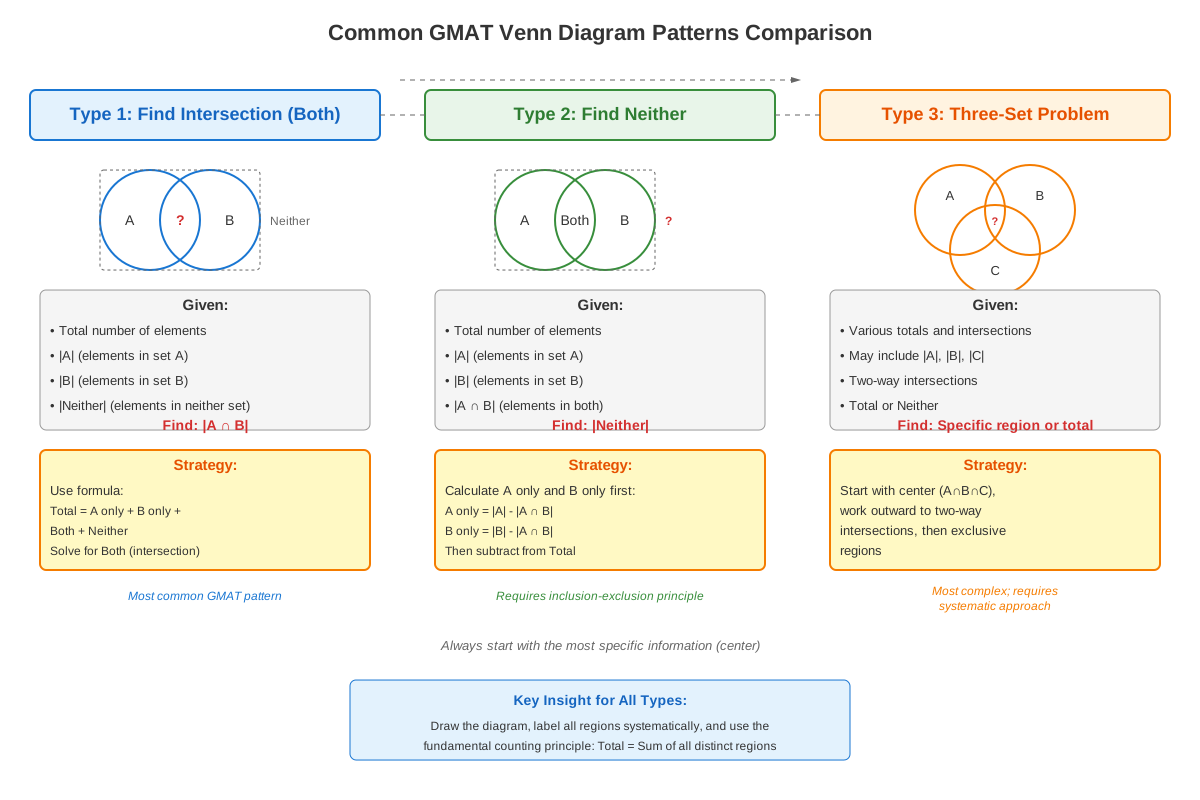
Overview
Venn diagrams are powerful visual tools used to represent relationships between different sets of data, and they constitute a critical component of GMAT Quantitative Reasoning questions. These circular diagrams illustrate how groups overlap, intersect, or remain distinct, allowing test-takers to organize complex information systematically and solve problems involving multiple categories. On the GMAT, GMAT Venn diagrams typically appear in word problems that involve counting elements across two or three sets—such as students enrolled in different courses, employees with various skill sets, or survey respondents with multiple preferences.
Understanding Venn diagrams is essential for GMAT success because these questions test both logical reasoning and arithmetic precision. The GMAT frequently presents scenarios where candidates must determine the number of elements in specific regions of overlapping sets, calculate totals, or identify elements that belong exclusively to one category. These problems require systematic thinking and the ability to translate verbal information into visual representations. Mastery of Venn diagram techniques can significantly improve accuracy and speed on test day, as the visual approach reduces cognitive load and minimizes calculation errors.
Within the broader context of Quantitative Reasoning, Venn diagrams connect directly to set theory, counting principles, and probability. They serve as foundational tools for understanding how to organize data, avoid double-counting, and apply the inclusion-exclusion principle. This topic also reinforces skills in algebraic manipulation, as many GMAT Venn diagram problems require setting up and solving equations based on the relationships between different regions of the diagram. The ability to work fluently with Venn diagrams enhances overall problem-solving capacity across multiple GMAT question types.
Learning Objectives
- [ ] Identify Venn diagrams and recognize when they are the appropriate tool for solving a problem
- [ ] Explain Venn diagrams, including the meaning of each region and how overlapping areas represent shared characteristics
- [ ] Apply Venn diagrams to GMAT questions involving two or three sets
- [ ] Construct accurate Venn diagrams from verbal problem descriptions
- [ ] Use the inclusion-exclusion principle to calculate totals and avoid double-counting
- [ ] Solve algebraic equations derived from Venn diagram relationships
- [ ] Determine the number of elements in any specific region of a Venn diagram, including intersections and exclusive areas
Prerequisites
- Basic set theory terminology: Understanding terms like "set," "element," "union," and "intersection" is fundamental to interpreting Venn diagram problems correctly
- Algebraic equation solving: Many Venn diagram problems require setting up and solving linear equations with one or more variables
- Addition and subtraction of whole numbers: Accurate arithmetic is essential for calculating totals and differences between regions
- Reading comprehension: GMAT Venn diagram questions are presented as word problems requiring careful extraction of numerical relationships
Why This Topic Matters
Venn diagrams have extensive real-world applications across business, marketing, data analysis, and decision-making contexts. Companies use Venn diagram logic to analyze customer segments, identify target markets with overlapping characteristics, and optimize resource allocation. In project management, these tools help identify team members with multiple skill sets or determine resource overlaps. Market researchers employ Venn diagram thinking to understand consumer preferences across product categories, while data scientists use set operations to filter and combine datasets.
On the GMAT, Venn diagram questions appear with moderate to high frequency, typically comprising 2-4 questions per exam administration. These questions most commonly appear in the Problem Solving format, though occasionally they surface in Data Sufficiency questions where test-takers must determine whether given information is sufficient to calculate specific values. The difficulty level ranges from medium to hard, with three-set problems generally being more challenging than two-set problems. According to GMAT test-prep data, Venn diagram questions have an average difficulty rating of 650-700 on the GMAT score scale, making them particularly important for candidates targeting scores above 700.
Common question formats include: determining the number of people with exactly one characteristic, calculating the total number surveyed, finding the number with all characteristics, identifying those with none of the characteristics, or determining the minimum or maximum possible overlap between sets. The GMAT often embeds these questions in business contexts (employees with certifications, customers purchasing products) or academic scenarios (students enrolled in courses, participants in activities).
Core Concepts
Basic Structure of Venn Diagrams
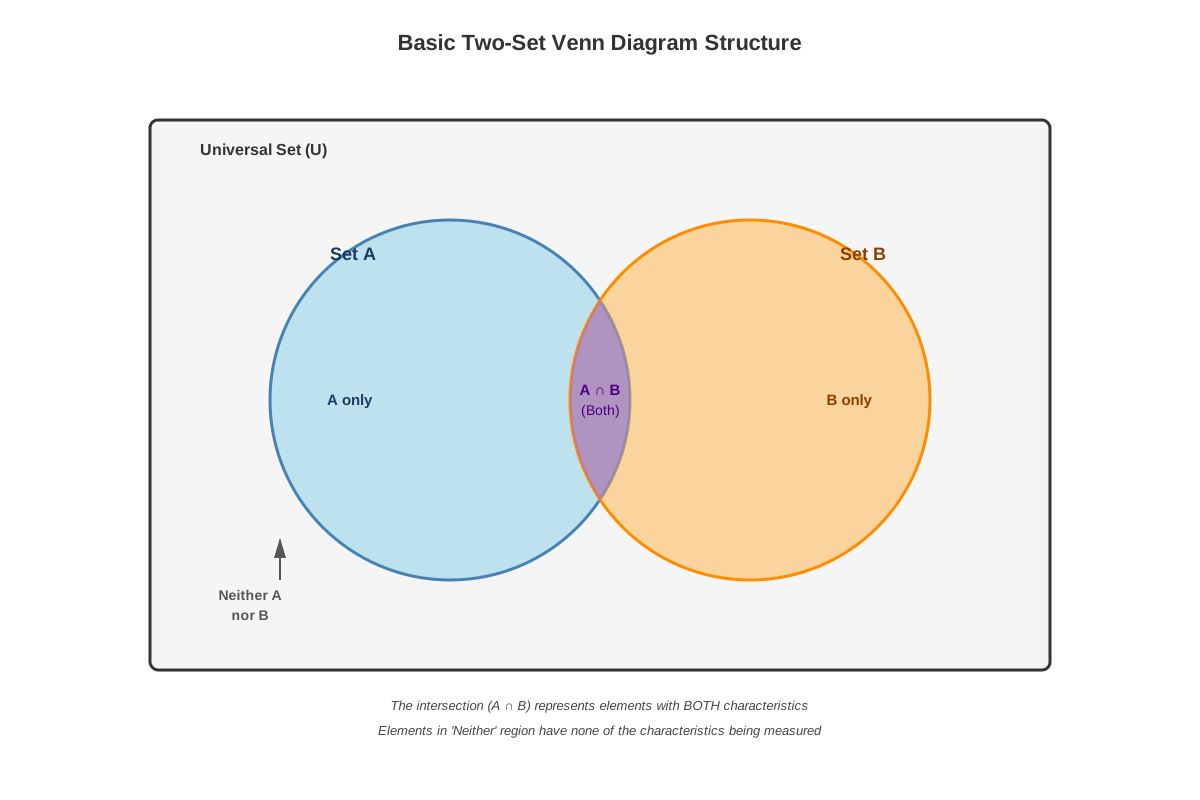
A Venn diagram consists of overlapping circles (or other closed curves) drawn within a rectangle, where each circle represents a distinct set and the rectangle represents the universal set containing all elements under consideration. The fundamental principle is that spatial relationships in the diagram correspond to logical relationships between sets. Each region in the diagram represents a unique combination of set memberships.
For a two-set Venn diagram, there are four distinct regions:
- Elements in Set A only (A but not B)
- Elements in Set B only (B but not A)
- Elements in both A and B (the intersection)
- Elements in neither A nor B (outside both circles but inside the rectangle)
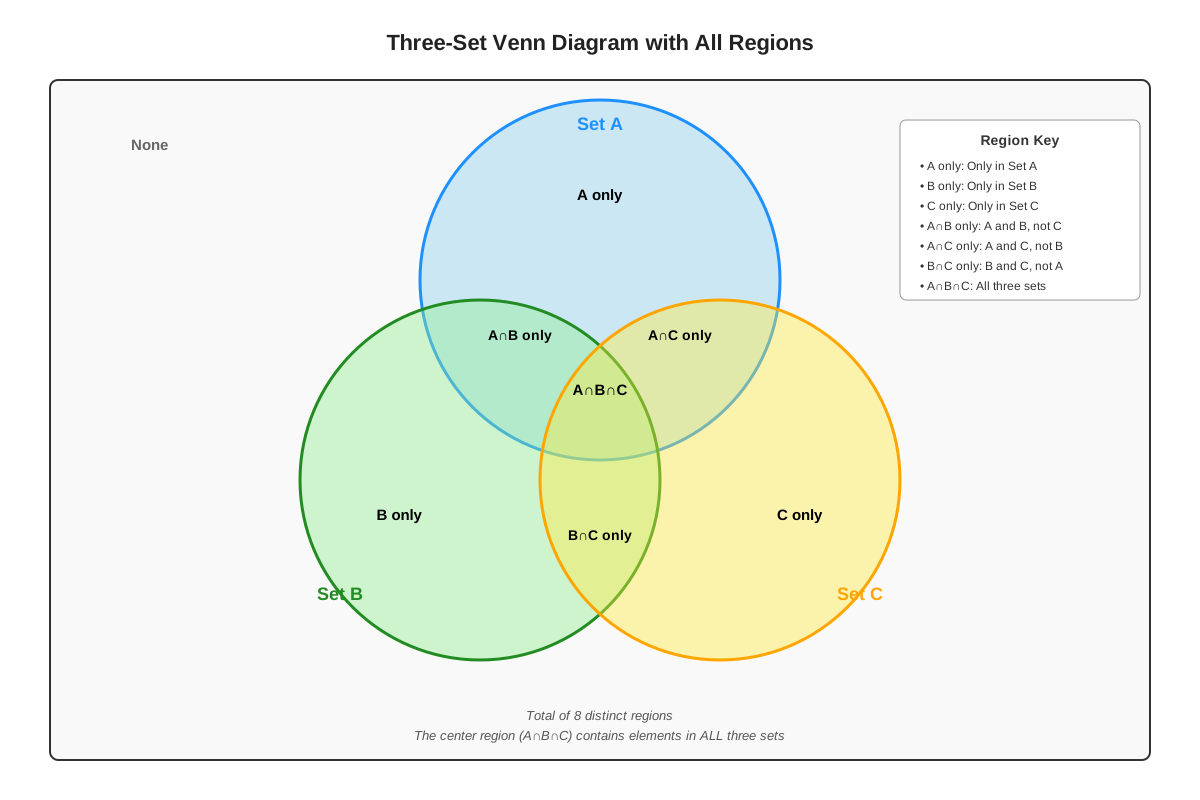
For a three-set Venn diagram, there are eight distinct regions:
- Only A
- Only B
- Only C
- A and B, but not C
- A and C, but not B
- B and C, but not A
- All three (A, B, and C)
- None of the three
The Inclusion-Exclusion Principle
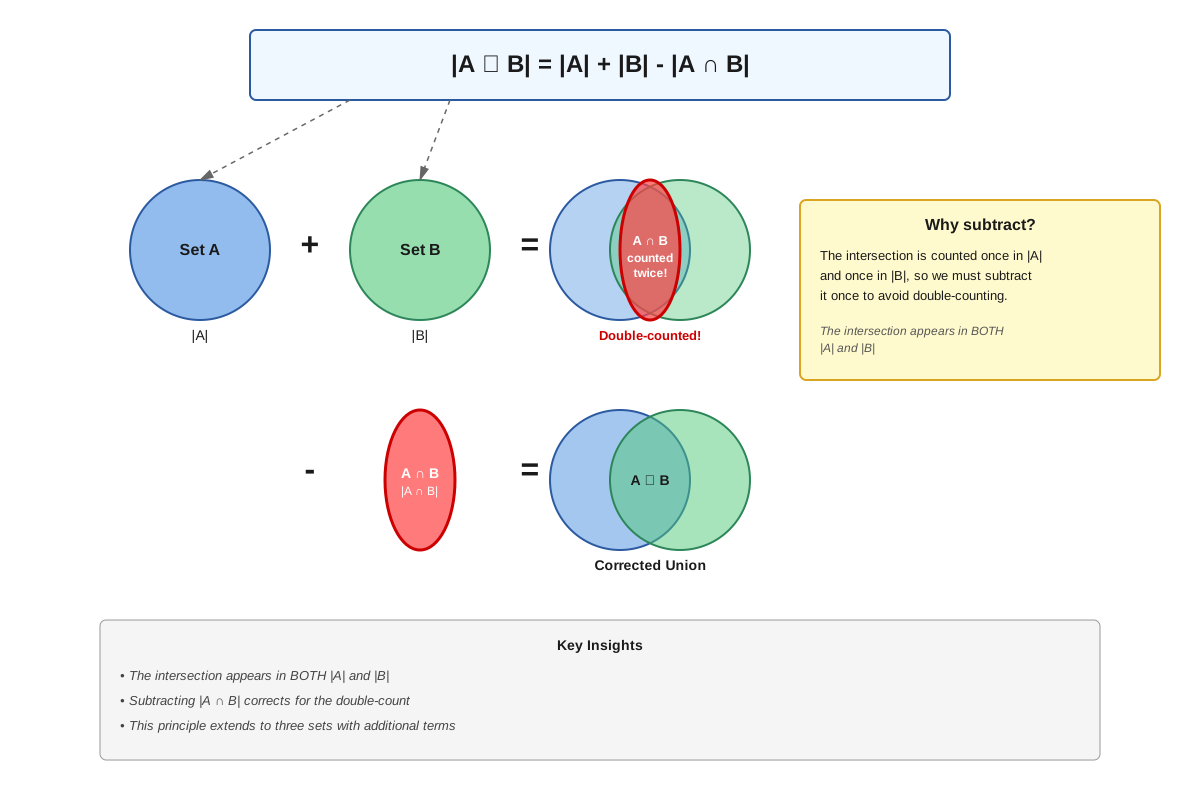
The inclusion-exclusion principle is the mathematical foundation underlying Venn diagram calculations. For two sets, this principle states:
Total = |A| + |B| - |A ∩ B| + |Neither|Where:
- |A| represents the number of elements in set A
- |B| represents the number of elements in set B
- |A ∩ B| represents the number of elements in both A and B (the intersection)
- |Neither| represents elements in neither set
The subtraction of the intersection is crucial because when we add |A| and |B|, we count the overlapping elements twice. Subtracting the intersection once corrects for this double-counting.
For three sets, the inclusion-exclusion principle becomes:
Total = |A| + |B| + |C| - |A ∩ B| - |A ∩ C| - |B ∩ C| + |A ∩ B ∩ C| + |Neither|This formula accounts for the fact that two-way intersections are counted multiple times in the individual set totals, while the three-way intersection requires addition back after being subtracted too many times.
Labeling Strategy for GMAT Problems
The most effective approach for GMAT Venn diagram problems involves labeling each distinct region with a variable or number. For two-set problems, use this systematic labeling:
- Let x = number in both A and B (the intersection)
- Let a = number in A only
- Let b = number in B only
- Let n = number in neither
This creates the relationships:
- Total in A = a + x
- Total in B = b + x
- Total overall = a + b + x + n
For three-set problems, label the seven regions inside the circles:
- g = all three (center region)
- d = A and B only (not C)
- e = A and C only (not B)
- f = B and C only (not A)
- a = A only
- b = B only
- c = C only
- n = none
Working from the Inside Out
A critical strategy for solving three-set Venn diagram problems is to work from the inside out. Always begin by determining the number in all three sets (the center region), then calculate the two-way intersections (excluding the center), then the single-set regions, and finally the "neither" category.
This approach works because:
- The center region (all three) is often given directly or can be calculated first
- Two-way intersection totals include the center, so you must subtract the center to find the "only two" regions
- Individual set totals include all overlapping regions, so you must subtract all overlaps to find the "only one" regions
- The total minus all other regions gives the "neither" category
Common Problem Types
| Problem Type | What You're Finding | Key Strategy |
|---|---|---|
| Exactly one | Elements in only one set | Add the exclusive regions; exclude all overlaps |
| At least one | Elements in one or more sets | Total minus "neither" |
| Exactly two | Elements in exactly two sets | Add the two-way-only regions; exclude three-way |
| At most one | Elements in zero or one set | "Neither" plus all exclusive regions |
| All three | Elements in every set | The center intersection region |
| None | Elements in no sets | The region outside all circles |
Concept Relationships
The concepts within Venn diagrams form a hierarchical structure where understanding basic two-set diagrams → enables comprehension of three-set diagrams → which leads to mastery of the inclusion-exclusion principle → ultimately allowing solution of complex GMAT word problems. The labeling strategy connects directly to algebraic equation-solving, as each labeled region becomes a variable in a system of equations.
Venn diagrams connect to prerequisite knowledge of set theory by providing visual representation of abstract set operations. The union of sets (A ∪ B) corresponds to all regions within either circle, while the intersection (A ∩ B) corresponds to the overlapping region. The complement of a set relates to regions outside that circle.
The inclusion-exclusion principle bridges Venn diagrams to counting principles and probability. In probability contexts, Venn diagrams help visualize the probability of compound events, where P(A or B) = P(A) + P(B) - P(A and B). This same logical structure applies whether working with counts or probabilities.
The "working from inside out" strategy connects to general problem-solving principles of starting with the most constrained information and building outward. This approach also relates to algebraic substitution methods, where solving for one variable enables solving for others in sequence.
High-Yield Facts
⭐ The intersection must be subtracted when adding individual set totals to avoid double-counting
⭐ For two sets: Total = A + B - Both + Neither
⭐ For three sets, always start by finding the center region (all three sets) first
⭐ "Exactly one" means only one set, excluding all overlaps
⭐ "At least one" equals the total minus "neither"
- The sum of all distinct regions in a Venn diagram equals the total number of elements in the universal set
- Two-way intersection totals (like "A and B") include the three-way intersection in three-set problems
- The "neither" category is often the key to solving for the total in GMAT problems
- When a problem states "only A," it explicitly excludes overlaps; when it states "A," it includes all of A
- The maximum possible overlap between two sets equals the size of the smaller set
- In three-set problems, there are exactly seven regions inside the circles and one region outside
Quick check — test yourself on Venn diagrams so far.
Try Flashcards →Common Misconceptions
Misconception: When told "50 people are in set A," this means 50 people are in A only, excluding overlaps.
Correction: Unless the problem explicitly states "only A" or "exclusively A," the total for set A includes all overlapping regions. If 50 people are in A, this includes those in A only, A and B, A and C, and A and B and C.
Misconception: The inclusion-exclusion formula for two sets is Total = A + B + Both + Neither.
Correction: The intersection (Both) must be subtracted, not added: Total = A + B - Both + Neither. Adding the intersection would count those elements three times instead of once.
Misconception: In a three-set problem, if 20 people are in "A and B," this is the region labeled "A and B only."
Correction: "A and B" typically means everyone in both A and B, including those also in C. To find "A and B only," you must subtract those in all three sets from the "A and B" total.
Misconception: "Exactly two sets" means the same as "at least two sets."
Correction: "Exactly two" excludes those in all three sets, while "at least two" includes those in all three sets. "Exactly two" = (A∩B only) + (A∩C only) + (B∩C only), whereas "at least two" also adds (A∩B∩C).
Misconception: You can solve three-set Venn diagram problems by starting with any region.
Correction: The most efficient approach is to work from the inside out, starting with the center (all three sets), because outer regions depend on knowing inner regions. Starting elsewhere often leads to complex simultaneous equations.
Misconception: If no one is in "neither" category, the sum of the individual sets equals the total.
Correction: Even when "neither" equals zero, you must still subtract overlaps when adding individual sets. The formula Total = A + B - Both still applies; the Neither term simply equals zero.
Worked Examples
Example 1: Two-Set Venn Diagram
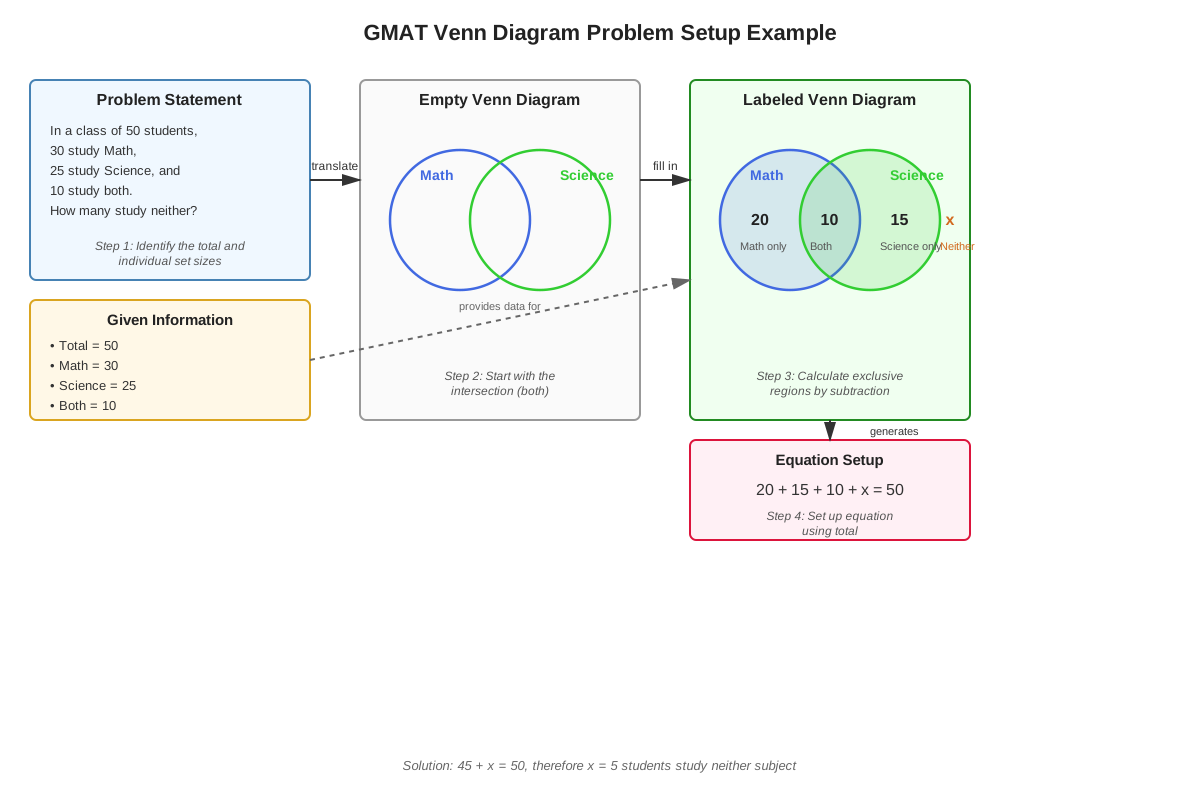
Problem: In a survey of 100 consumers, 65 purchased product A, 55 purchased product B, and 15 purchased neither product. How many consumers purchased both products?
Solution:
Step 1: Identify what we know and what we're looking for.
- Total = 100
- |A| = 65
- |B| = 55
- Neither = 15
- Find: |A ∩ B| (both products)
Step 2: Apply the inclusion-exclusion principle.
Total = |A| + |B| - |A ∩ B| + Neither
100 = 65 + 55 - |A ∩ B| + 15
Step 3: Solve for the intersection.
100 = 135 - |A ∩ B|
|A ∩ B| = 135 - 100
|A ∩ B| = 35Answer: 35 consumers purchased both products.
Verification: Let's check our answer by calculating each region:
- Both A and B: 35
- A only: 65 - 35 = 30
- B only: 55 - 35 = 20
- Neither: 15
- Total: 35 + 30 + 20 + 15 = 100 ✓
This problem directly addresses the learning objective of applying Venn diagrams to GMAT questions and demonstrates the critical importance of the inclusion-exclusion principle.
Example 2: Three-Set Venn Diagram
Problem: A business school surveyed 200 students about their undergraduate majors. The results showed: 90 studied Economics, 80 studied Mathematics, 75 studied Computer Science, 35 studied both Economics and Mathematics, 30 studied both Economics and Computer Science, 32 studied both Mathematics and Computer Science, and 15 studied all three subjects. How many students studied none of these three subjects?
Solution:
Step 1: Set up the problem using the "inside out" approach.
- Total = 200
- |E| = 90 (Economics)
- |M| = 80 (Mathematics)
- |C| = 75 (Computer Science)
- |E ∩ M| = 35 (includes those in all three)
- |E ∩ C| = 30 (includes those in all three)
- |M ∩ C| = 32 (includes those in all three)
- |E ∩ M ∩ C| = 15 (all three)
Step 2: Work from the inside out. Start with the center region.
- All three = 15
Step 3: Calculate the "only two" regions by subtracting the center from each two-way intersection.
- E and M only (not C) = 35 - 15 = 20
- E and C only (not M) = 30 - 15 = 15
- M and C only (not E) = 32 - 15 = 17
Step 4: Calculate the "only one" regions by subtracting all overlaps from each set total.
- E only = 90 - 20 - 15 - 15 = 40
- M only = 80 - 20 - 17 - 15 = 28
- C only = 75 - 15 - 17 - 15 = 28
Step 5: Calculate "neither" by subtracting all other regions from the total.
- Neither = 200 - (40 + 28 + 28 + 20 + 15 + 17 + 15)
- Neither = 200 - 163
- Neither = 37
Answer: 37 students studied none of these three subjects.
Verification using inclusion-exclusion:
Total = |E| + |M| + |C| - |E∩M| - |E∩C| - |M∩C| + |E∩M∩C| + Neither
200 = 90 + 80 + 75 - 35 - 30 - 32 + 15 + Neither
200 = 163 + Neither
Neither = 37 ✓
This example demonstrates the complete process for three-set problems and reinforces the importance of working systematically from the center outward.
Exam Strategy
When approaching GMAT Venn diagram questions, begin by quickly sketching a diagram with appropriate circles and labeling the universal set boundary. Even if the problem doesn't explicitly mention a Venn diagram, recognize trigger phrases like "both," "neither," "only," "at least one," or "exactly two" as signals that Venn diagram logic applies.
Trigger words and phrases to watch for:
- "Both A and B" → intersection region
- "Either A or B" → union of sets (may include both)
- "Only A" or "exclusively A" → A without any overlap
- "Neither A nor B" → outside both circles
- "At least one" → total minus neither
- "Exactly one" → sum of exclusive regions only
- "Exactly two" → sum of two-way-only regions (excluding three-way)
- "All three" → center intersection in three-set problems
Process-of-elimination tips: In Data Sufficiency questions involving Venn diagrams, statement (1) or (2) is often sufficient if it provides information about the intersection or the "neither" category, as these are typically the missing pieces needed to solve for all regions. If a statement only gives information about one set total without intersection data, it's usually insufficient.
Time allocation advice: Allocate 2-2.5 minutes for two-set Venn diagram problems and 2.5-3 minutes for three-set problems. Spend the first 30-45 seconds carefully reading and extracting all numerical information, as misreading a single value will cascade into an incorrect answer. If you find yourself spending more than 3 minutes on a Venn diagram question, make your best educated guess and move on—these problems can become time traps if you lose track of your labeling system.
Always write down the inclusion-exclusion formula at the start of the problem to avoid formula errors under time pressure. For three-set problems, explicitly label all seven regions inside the circles before attempting calculations. This systematic approach prevents the most common error: losing track of which regions you've already calculated.
Memory Techniques
Mnemonic for two-set inclusion-exclusion: "Add Both Sets, Subtract Overlap, Never forget Neither" (ABSSONN)
- Add set A
- Both sets (add set B)
- Subtract the intersection
- Neither (add the neither category)
Visualization strategy for three-set problems: Picture a traffic light in the center of your Venn diagram:
- Red (stop) = Start here with all three (center)
- Yellow (caution) = Proceed to two-way intersections
- Green (go) = Move outward to single-set regions
Acronym for the order of operations: CETO
- Center first (all three)
- Edges next (two-way intersections)
- Tails after (single-set regions)
- Outside last (neither)
Memory aid for "exactly" vs. "at least":
- Exactly has an X → X marks the spot, be precise, exclude extras
- At least has L → L for "Loose," includes more possibilities
Summary
Venn diagrams are essential visual tools for organizing and solving GMAT problems involving overlapping sets. The fundamental structure consists of circles representing sets within a rectangle representing the universal set, with each region corresponding to a unique combination of set memberships. The inclusion-exclusion principle provides the mathematical foundation: for two sets, Total = A + B - Both + Neither, and for three sets, the formula expands to account for all two-way and three-way intersections. Success on GMAT Venn diagram questions requires systematic labeling of all regions, working from the inside out in three-set problems, and careful attention to language distinguishing "only," "exactly," and "at least." The most common errors involve double-counting overlapping regions or misinterpreting whether given totals include or exclude intersections. By mastering the core concepts, applying the inclusion-exclusion principle correctly, and using strategic labeling, test-takers can efficiently solve even complex three-set problems within the time constraints of the GMAT.
Key Takeaways
- Venn diagrams visually represent relationships between sets, with overlapping regions showing shared elements and the inclusion-exclusion principle preventing double-counting
- For two sets, always use: Total = A + B - Both + Neither, subtracting the intersection because it's counted in both A and B
- Three-set problems require working from the inside out: start with the center (all three), then calculate two-way-only regions, then single-set regions, and finally "neither"
- "Exactly one" excludes all overlaps, "at least one" equals total minus neither, and "exactly two" excludes the three-way intersection
- Label every distinct region systematically before performing calculations to avoid confusion and errors
- Recognize trigger words like "both," "only," "neither," and "at least" as signals to apply Venn diagram logic
- Verify answers by ensuring all regions sum to the given total, catching arithmetic errors before finalizing your response
Related Topics
Set Theory Fundamentals: Understanding formal set notation, operations (union, intersection, complement), and set properties provides the theoretical foundation for Venn diagram applications. Mastering Venn diagrams makes advanced set theory concepts more intuitive.
Counting Principles and Combinatorics: Venn diagrams connect directly to fundamental counting principles, particularly the addition and multiplication rules. The inclusion-exclusion principle extends to more complex counting problems involving permutations and combinations.
Probability with Multiple Events: Venn diagram logic applies directly to probability problems involving compound events, where P(A or B) = P(A) + P(B) - P(A and B). Understanding Venn diagrams strengthens probability problem-solving skills.
Data Sufficiency Strategies: Many Data Sufficiency questions test whether given information about sets is sufficient to determine specific values. Venn diagram expertise helps quickly assess sufficiency without full calculation.
Word Problem Translation: Venn diagram problems exemplify the broader skill of translating verbal descriptions into mathematical representations, a critical competency across all GMAT Quantitative Reasoning questions.
Practice CTA
Now that you've mastered the core concepts of Venn diagrams, it's time to solidify your understanding through deliberate practice. Attempt the practice questions associated with this topic, focusing on accurately translating word problems into labeled diagrams and applying the inclusion-exclusion principle systematically. Use the flashcards to reinforce key formulas and trigger words until they become automatic. Remember: Venn diagram questions are highly learnable—with focused practice, you can achieve near-perfect accuracy on these high-yield GMAT problems. Your investment in mastering this topic will pay dividends not only in Quantitative Reasoning but also in developing the logical thinking skills that underpin GMAT success across all sections.
Sign up free to keep reading
Create a free AnvayaPrep account to finish this GMAT guide on Venn diagrams — plus flashcards and practice questions.