Overview
Boldface reasoning questions represent one of the most distinctive and challenging question types in GMAT Critical Reasoning. These questions present an argument or passage in which two portions of text are highlighted in bold, and test-takers must identify the precise role each boldfaced statement plays within the overall argumentative structure. Unlike other Critical Reasoning questions that ask students to strengthen, weaken, or find assumptions in arguments, boldface questions require a sophisticated understanding of how arguments are constructed and how different components—premises, conclusions, counterarguments, objections, and evidence—interact with one another.
The importance of mastering GMAT boldface reasoning cannot be overstated. These questions typically appear 1-3 times per GMAT exam and are considered medium-to-high difficulty by test designers. They demand that students move beyond surface-level reading comprehension to analyze the functional relationship between statements. Success requires recognizing whether a statement serves as the main conclusion, an intermediate conclusion, a premise supporting the conclusion, evidence against a position, a position being argued against, or one of several other possible roles. The ability to deconstruct arguments in this way is fundamental not only to GMAT success but also to the analytical thinking required in business school and professional contexts.
Within the broader landscape of Verbal Reasoning, boldface questions sit at the intersection of Reading Comprehension and Critical Reasoning. They require the reading comprehension skills necessary to understand complex passages while simultaneously demanding the logical analysis skills central to all Critical Reasoning questions. Mastering boldface reasoning strengthens overall argument analysis abilities, making students better equipped to handle assumption, strengthen/weaken, and evaluation questions as well.
Learning Objectives
- [ ] Identify boldface reasoning questions on the GMAT
- [ ] Explain the role and function of boldfaced statements within argumentative structures
- [ ] Apply boldface reasoning strategies to GMAT questions systematically
- [ ] Distinguish between main conclusions, intermediate conclusions, premises, and counterarguments in complex passages
- [ ] Analyze the relationship between two boldfaced statements and determine how they interact
- [ ] Eliminate incorrect answer choices by recognizing subtle distinctions in functional language
- [ ] Construct mental maps of argument structure while reading boldface passages
Prerequisites
- Basic argument structure: Understanding of premises, conclusions, and how they connect is essential because boldface questions test the ability to identify these components within complex passages
- Logical reasoning fundamentals: Familiarity with how evidence supports claims enables recognition of the functional roles statements play
- Critical Reasoning question types: Experience with standard CR questions provides context for how boldface questions differ and what skills they uniquely test
- Reading comprehension skills: Ability to parse complex sentences and understand authorial intent is necessary to grasp the nuances of argumentative structure
Why This Topic Matters
Boldface reasoning questions assess a critical skill that extends far beyond standardized testing: the ability to analyze how arguments are constructed and how different pieces of information function within a persuasive framework. In business contexts, professionals must constantly evaluate proposals, marketing claims, strategic recommendations, and competitive analyses—all of which require understanding not just what is being said, but how each component of an argument functions to support or undermine a position.
On the GMAT specifically, boldface questions appear with notable frequency. Test-takers can expect to encounter 1-3 boldface questions in the Verbal Reasoning section, representing approximately 5-10% of all Critical Reasoning questions. These questions are considered high-value because they effectively discriminate between test-takers who have developed sophisticated analytical skills and those who rely on surface-level comprehension. The GMAT uses boldface questions to assess whether candidates can think like business analysts, evaluating the structure and logic of complex arguments rather than simply understanding their content.
Boldface questions commonly appear in passages discussing business scenarios, scientific findings, policy debates, or strategic recommendations. The passages typically present a position, offer evidence or reasoning, acknowledge counterarguments or alternative perspectives, and reach a conclusion. The boldfaced portions might represent any combination of these elements, and answer choices use precise functional language to describe their roles. Success on these questions directly correlates with overall Verbal Reasoning performance and is a strong predictor of business school readiness.
Core Concepts
Understanding Boldface Question Structure
Boldface reasoning questions present a passage—typically 3-6 sentences long—in which exactly two statements are highlighted in bold. The question stem asks test-takers to identify the role each boldfaced statement plays in the argument. The standard format is: "In the argument above, the two boldfaced portions play which of the following roles?" Answer choices then describe the function of the first boldfaced statement followed by the function of the second, usually in this format: "The first is [role]; the second is [role]."
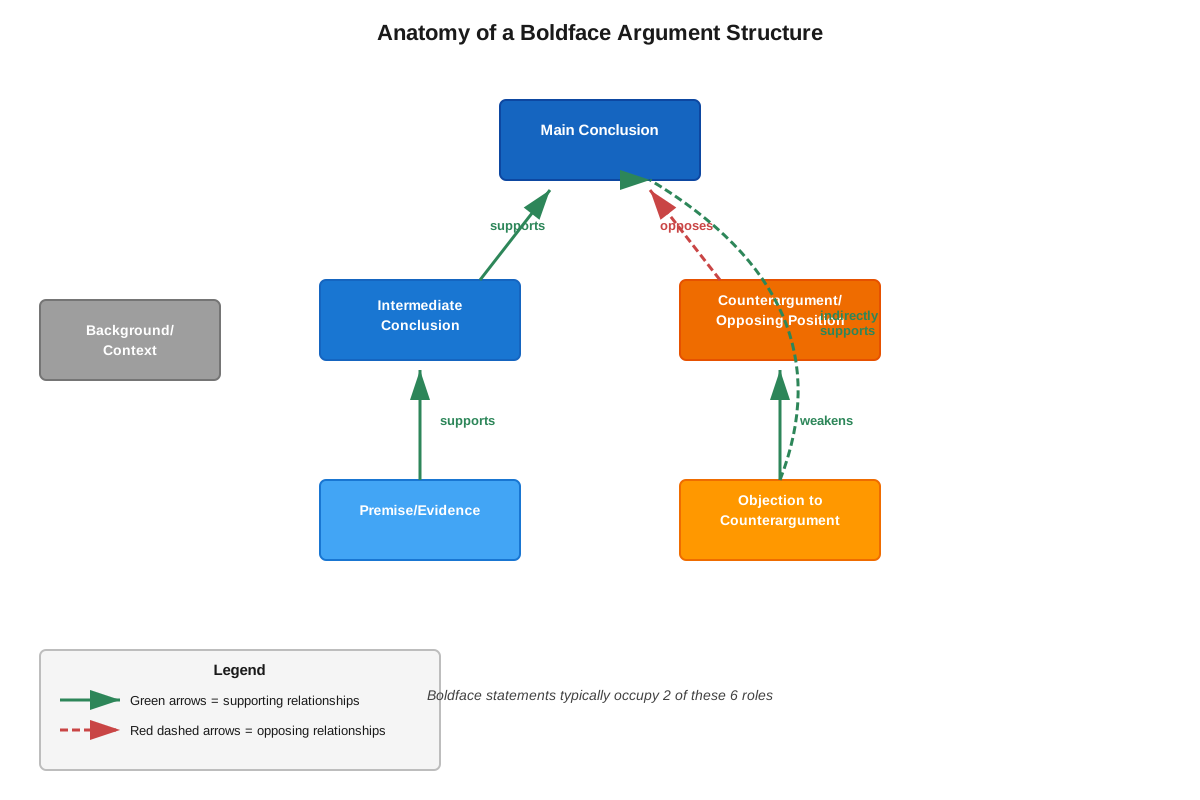
The passage itself typically contains multiple argumentative layers. There may be a main conclusion (the primary claim the author wants to establish), intermediate conclusions (claims that serve as both conclusions from some evidence and premises for further conclusions), premises (evidence or reasons supporting conclusions), counterarguments (positions the author argues against), and objections (challenges to counterarguments or alternative views). Understanding these components and how they nest within each other is fundamental to boldface mastery.
Key Functional Roles in Arguments
| Role | Definition | Example Signal Words |
|---|---|---|
| Main Conclusion | The primary claim the argument seeks to establish; the ultimate point | "Therefore," "Thus," "Consequently," "It follows that" |
| Intermediate Conclusion | A claim supported by some evidence that itself supports another claim | "This suggests," "This indicates," "From this we can see" |
| Premise/Evidence | Facts, data, or reasons offered to support a conclusion | "Because," "Since," "Given that," "The evidence shows" |
| Counterargument | A position the author opposes or argues against | "Some argue," "Critics claim," "It might be thought" |
| Objection to Counterargument | Evidence or reasoning that challenges a counterargument | "However," "But," "Yet," "This overlooks" |
| Background/Context | Information that sets up the discussion without directly supporting a conclusion | "Historically," "Currently," "In recent years" |
Analyzing Relationships Between Boldfaced Statements
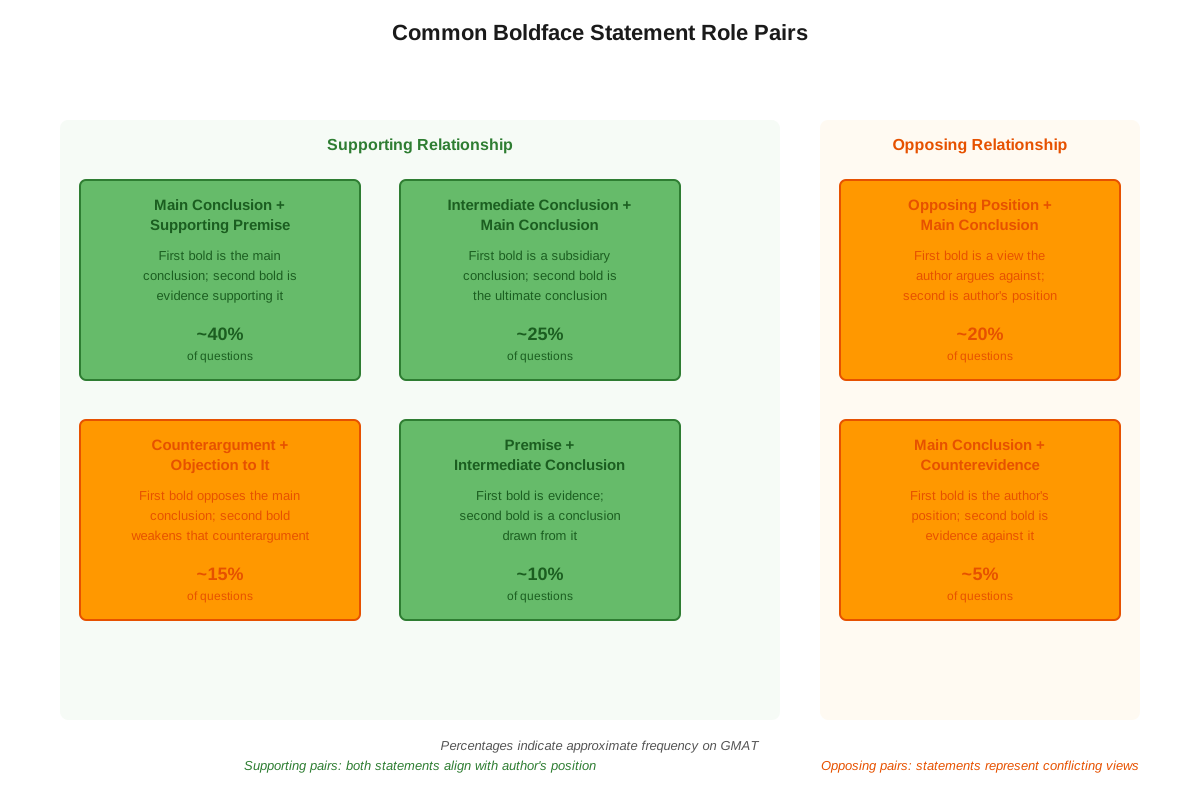
The relationship between the two boldfaced statements is crucial. They might work together (both supporting the same conclusion), work in opposition (one presenting a view the other challenges), or have a hierarchical relationship (one supporting the other). Common relationship patterns include:
- Both support the main conclusion: Two independent pieces of evidence or reasoning that together establish the author's position
- First is a position argued against; second is the main conclusion: The author presents an opposing view, then states their own conclusion
- First is evidence; second is an intermediate conclusion: Data leads to a preliminary finding that will support a further claim
- First is a counterargument; second is an objection to it: An opposing view is presented, then refuted
- First is the main conclusion; second is a premise supporting it: The order presents conclusion before evidence (less common but possible)
Decoding Answer Choice Language
Answer choices in boldface questions use precise functional language that students must interpret correctly. Understanding the subtle distinctions between similar-sounding descriptions is essential:
- "A claim that the argument seeks to establish" = Main conclusion
- "A judgment that the argument opposes" = Counterargument or opposing position
- "Evidence supporting the argument's main conclusion" = Premise
- "An intermediate conclusion supporting the main conclusion" = A claim that is both concluded from evidence and used to support the final conclusion
- "A finding that supports an intermediate conclusion" = Evidence for a subsidiary claim
- "A consideration that weighs against a position the argument opposes" = Evidence that undermines a counterargument
- "A circumstance that the argument seeks to explain" = A phenomenon that the conclusion accounts for
The distinction between "the argument's conclusion" and "a conclusion the argument opposes" is particularly important. Similarly, recognizing whether something is "evidence" (raw data or facts) versus "a conclusion drawn from evidence" (an interpretation or claim based on data) separates correct from incorrect answers.
The Argument Map Strategy
Successful boldface reasoning requires creating a mental map of the argument's structure while reading. This involves:
- Identifying the author's main conclusion: What is the ultimate claim being made?
- Locating premises: What evidence or reasons support this conclusion?
- Recognizing opposing views: Are there positions the author argues against?
- Tracking intermediate steps: Are there subsidiary conclusions that bridge evidence to the main conclusion?
- Noting the function of each boldfaced statement: How does each fit into the overall structure?
This mapping process should happen during the initial reading, before examining answer choices. Students who attempt to evaluate answer choices without first understanding the argument's structure typically struggle with boldface questions.
Common Argument Structures in Boldface Questions
Structure 1: Counterargument + Refutation
- Sentence 1: Background/context
- Sentence 2 (Bold 1): Position the author opposes
- Sentence 3: Evidence against the opposing position
- Sentence 4 (Bold 2): Author's main conclusion
Structure 2: Evidence Chain
- Sentence 1: Background
- Sentence 2 (Bold 1): Evidence/data
- Sentence 3 (Bold 2): Intermediate conclusion from that evidence
- Sentence 4: Main conclusion supported by the intermediate conclusion
Structure 3: Parallel Support
- Sentence 1: Main conclusion
- Sentence 2 (Bold 1): First piece of supporting evidence
- Sentence 3 (Bold 2): Second piece of supporting evidence
- Sentence 4: Elaboration or implication
Understanding these common patterns helps students quickly orient themselves when encountering boldface questions under timed conditions.
Concept Relationships
The concepts within boldface reasoning form an interconnected system. Argument structure understanding serves as the foundation, enabling recognition of functional roles (premises, conclusions, counterarguments). This recognition allows students to analyze relationships between statements, determining whether they support, oppose, or build upon each other. The ability to decode answer choice language depends on understanding these relationships, as answer choices describe functions using specific terminology. Finally, the argument mapping strategy integrates all these skills into a systematic approach.
Boldface reasoning connects to prerequisite topics in Critical Reasoning by requiring the same fundamental understanding of how arguments work. However, it extends beyond basic assumption or strengthen/weaken questions by demanding explicit identification of structural components rather than evaluation of logical validity. The skills developed through boldface practice—particularly the ability to distinguish between different types of conclusions and recognize argumentative structure—transfer directly to other CR question types, making students more efficient at identifying conclusions and premises in all contexts.
The relationship map flows as follows: Basic Argument Structure → Recognition of Functional Roles → Analysis of Statement Relationships → Interpretation of Answer Choice Language → Systematic Argument Mapping → Correct Answer Selection
Quick check — test yourself on Boldface reasoning so far.
Try Flashcards →High-Yield Facts
- ⭐ Boldface questions always present exactly two boldfaced statements and ask about the role each plays in the argument
- ⭐ The main conclusion is the ultimate claim the author wants to establish; everything else either supports it or is argued against
- ⭐ An intermediate conclusion is both a conclusion (from some evidence) and a premise (for a further conclusion)
- ⭐ Answer choices describe the first boldfaced statement first, then the second, typically in the format "The first is X; the second is Y"
- ⭐ A counterargument is a position the author opposes, not a position that opposes the author (subtle but crucial distinction in answer choice language)
- The relationship between boldfaced statements is as important as their individual roles
- Evidence and premises are facts or data; conclusions are claims or interpretations based on those facts
- Background information provides context but doesn't directly support the conclusion
- "The argument's conclusion" refers to the author's conclusion, not any conclusion mentioned in the passage
- Objections to counterarguments are evidence or reasoning that undermines positions the author opposes
- Some passages present the conclusion early, then provide supporting evidence (conclusion-first structure)
- The word "judgment" in answer choices typically refers to an opinion or evaluative claim rather than factual evidence
- A "consideration" is usually a piece of evidence or a factor that influences reasoning
- "A claim that the argument seeks to establish" always refers to the main conclusion, never to intermediate steps
Common Misconceptions
Misconception: The first boldfaced statement always comes before the second in the argument's logical structure.
Correction: The physical order in the passage doesn't necessarily reflect logical order. The first boldfaced statement might be the conclusion while the second is a premise supporting it, even though conclusions logically come after premises.
Misconception: If a statement is a conclusion, it must be the main conclusion.
Correction: Arguments often contain multiple conclusions at different levels. An intermediate conclusion is derived from evidence but then serves as a premise for the main conclusion. Distinguishing between main and intermediate conclusions is essential.
Misconception: Counterarguments are positions that counter the author's argument.
Correction: In GMAT terminology, a counterargument is a position the author argues against, not a position that argues against the author. This semantic distinction appears frequently in answer choices.
Misconception: All evidence directly supports the main conclusion.
Correction: Evidence might support an intermediate conclusion, which in turn supports the main conclusion. Or evidence might undermine a counterargument rather than directly supporting the author's position. The relationship can be indirect.
Misconception: The boldfaced statements always have different functional roles.
Correction: Both boldfaced statements can serve the same function (e.g., both are premises supporting the conclusion, or both are counterarguments the author opposes). The answer choices will reflect this when appropriate.
Misconception: Longer boldfaced statements are more likely to be conclusions.
Correction: Length has no correlation with function. A brief statement can be the main conclusion while a lengthy statement might be background information or evidence.
Misconception: Signal words like "therefore" always indicate the main conclusion.
Correction: Signal words indicate that a conclusion follows, but it might be an intermediate conclusion rather than the main one. The entire argument structure must be considered.
Worked Examples
Example 1: Counterargument Structure
Passage: "Company X's recent decision to expand into international markets has been criticized by some analysts who argue that the company lacks the infrastructure necessary for global operations. These critics point to Company X's limited distribution network outside North America as evidence of this deficiency. However, Company X has already secured partnerships with established distributors in fifteen countries, effectively addressing the infrastructure concern. Therefore, Company X's international expansion is likely to succeed despite the critics' reservations."
Question: In the argument above, the two boldfaced portions play which of the following roles?
Analysis:
- Identify the main conclusion: "Company X's international expansion is likely to succeed" (second boldfaced statement)
- Identify the counterargument: Critics argue the company lacks necessary infrastructure
- Analyze first boldfaced statement: This provides evidence supporting the critics' position (the counterargument)
- Analyze second boldfaced statement: This is the author's main conclusion, arguing against the critics
- Determine relationship: The first supports a position the author opposes; the second is the author's conclusion refuting that position
Correct Answer: The first is evidence supporting a position the argument opposes; the second is the argument's main conclusion.
Why other answers are wrong:
- "The first is the argument's main conclusion; the second is evidence supporting it" — Reversed; the first supports the critics, not the author
- "The first is a premise supporting the main conclusion; the second is that conclusion" — The first doesn't support the author's conclusion; it supports the opposing view
- "Both are premises supporting the argument's conclusion" — The second IS the conclusion, not a premise
Example 2: Evidence Chain Structure
Passage: "Recent studies show that employees who work remotely report 23% higher job satisfaction than office-based employees. This increased satisfaction correlates with improved productivity, as remote workers complete an average of 15% more tasks per week. Companies seeking to maximize workforce efficiency should therefore consider expanding remote work options. The productivity gains from remote work arrangements outweigh the coordination challenges they may create."
Question: In the argument above, the two boldfaced portions play which of the following roles?
Analysis:
- Identify the main conclusion: "Companies should consider expanding remote work options" (stated between the boldfaced statements)
- Analyze first boldfaced statement: This draws a conclusion from the satisfaction data (that satisfaction correlates with productivity) and provides evidence for the main conclusion—making it an intermediate conclusion
- Analyze second boldfaced statement: This is a judgment that supports the main conclusion by addressing a potential objection (coordination challenges)
- Determine relationship: Both support the main conclusion, but in different ways—one as an intermediate conclusion from data, the other as a consideration that weighs in favor of the recommendation
Correct Answer: The first is an intermediate conclusion supporting the argument's main conclusion; the second is a judgment that supports that main conclusion.
Why other answers are wrong:
- "The first is evidence; the second is the main conclusion" — The first is a conclusion drawn from evidence (about correlation), not raw evidence itself; the second isn't the ultimate recommendation
- "Both are premises providing independent support for the conclusion" — The first is itself a conclusion (from the satisfaction data), not just a premise
- "The first is the main conclusion; the second is a premise supporting it" — The main conclusion is the recommendation about expanding remote work, not the productivity correlation
Exam Strategy
When approaching boldface questions on the GMAT, follow this systematic process:
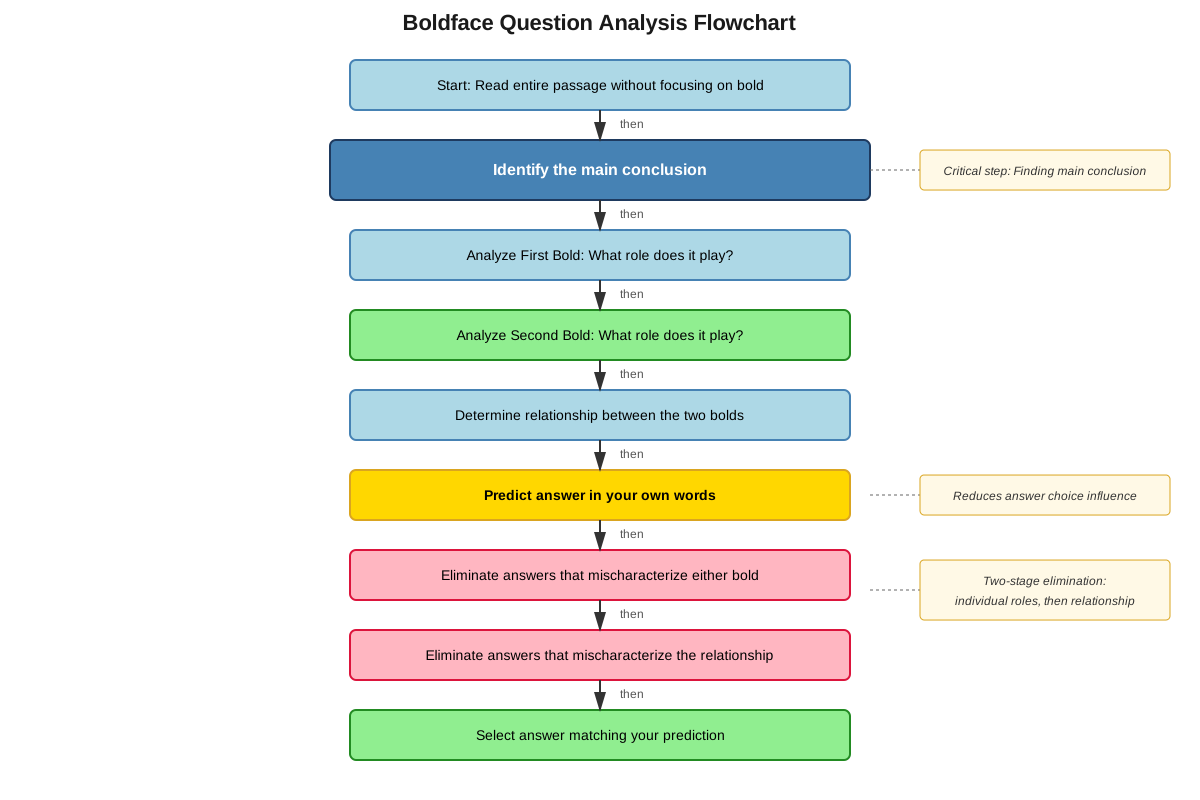
Step 1: Read the entire passage first without looking at answer choices. Resist the temptation to evaluate the boldfaced statements in isolation. Understanding the complete argument structure is essential.
Step 2: Identify the main conclusion by asking "What is the author's ultimate point?" Look for conclusion indicators like "therefore," "thus," or "should," but verify by considering what the entire argument is trying to establish.
Step 3: Map the argument structure mentally or with brief notes:
- What is the main conclusion?
- What premises support it?
- Are there any opposing views mentioned?
- Are there intermediate conclusions?
- Where do the boldfaced statements fit?
Step 4: Determine each boldfaced statement's function before looking at answers:
- Does it support the author's conclusion?
- Is it the author's conclusion?
- Does it present a view the author opposes?
- Is it evidence, or a conclusion drawn from evidence?
Step 5: Predict the answer in your own words before reading choices. This prevents answer choices from confusing your understanding.
Step 6: Eliminate wrong answers systematically:
- First, eliminate choices that misidentify the first boldfaced statement's role
- Then, eliminate remaining choices that misidentify the second statement's role
- Pay careful attention to subtle language differences
Trigger words and phrases to watch for:
- "The argument's conclusion" = the author's main conclusion (not any conclusion mentioned)
- "A position the argument opposes" = counterargument
- "Evidence supporting..." = factual data or reasons
- "A judgment/claim that..." = an evaluative statement or conclusion
- "An intermediate conclusion" = a conclusion that also serves as a premise
- "A consideration that weighs against..." = evidence undermining a position
Time allocation: Spend 60-75 seconds reading and mapping the argument, then 30-45 seconds evaluating answer choices. Boldface questions warrant slightly more time than average CR questions due to their complexity, but shouldn't exceed 2 minutes total.
Process of elimination tips:
- If a statement contains factual data or statistics, it's likely evidence rather than a conclusion
- If a statement is preceded by "some argue" or "critics claim," it's probably a counterargument
- If a statement follows "therefore" or "thus," it's some type of conclusion (determine whether main or intermediate)
- If both boldfaced statements seem to support the same point, look for answer choices where both have supporting roles
Memory Techniques
PRIME mnemonic for functional roles:
- Premise (evidence supporting a conclusion)
- Refutation (objection to a counterargument)
- Intermediate conclusion (both conclusion and premise)
- Main conclusion (ultimate claim)
- Enemy position (counterargument)
The "Author's Friend or Foe" visualization: When reading, mentally tag each statement as either supporting the author's position (friend) or opposing it (foe). Boldfaced statements that are "foes" are likely counterarguments or evidence for counterarguments; "friends" are likely premises, conclusions, or objections to counterarguments.
The Building Blocks metaphor: Visualize arguments as buildings where:
- The foundation = basic evidence/premises
- Middle floors = intermediate conclusions
- Roof = main conclusion
- Wrecking balls = counterarguments the author demolishes
The Two-Question Test: For each boldfaced statement, ask:
- "Does this support or oppose the author's main point?" (determines alignment)
- "Is this a fact/data or a claim/interpretation?" (determines whether it's evidence or conclusion)
These two questions quickly narrow down the functional role.
Acronym for answer choice evaluation: FIRST
- Function: What role does it play?
- Identify: Is it about the author's view or an opposing view?
- Relationship: How does it connect to the other boldfaced statement?
- Support: What does it support or oppose?
- Type: Is it evidence, conclusion, or counterargument?
Summary
Boldface reasoning questions test the ability to analyze argument structure by identifying the precise functional role that specific statements play within complex passages. Success requires distinguishing between main conclusions, intermediate conclusions, premises, counterarguments, and objections while understanding how these components interact. The key to mastering boldface questions lies in systematic argument mapping: reading the entire passage first, identifying the author's main conclusion, determining what supports or opposes that conclusion, and recognizing the specific function of each boldfaced statement before evaluating answer choices. The relationship between the two boldfaced statements is as important as their individual roles—they might work together to support the same conclusion, oppose each other, or have a hierarchical relationship where one supports the other. Answer choices use precise functional language that must be interpreted carefully, with particular attention to distinctions like "the argument's conclusion" versus "a conclusion the argument opposes." By developing a clear mental model of argument structure and applying a systematic approach, test-takers can consistently identify the correct answer even in complex boldface questions.
Key Takeaways
- Boldface questions assess argument structure analysis by asking test-takers to identify the role of two highlighted statements
- Always read the complete passage and identify the main conclusion before evaluating answer choices
- Intermediate conclusions are both conclusions (from evidence) and premises (for further conclusions)—recognizing this dual role is crucial
- Counterarguments are positions the author opposes, and answer choices use specific language to describe them
- The relationship between boldfaced statements (supporting, opposing, or hierarchical) is as important as their individual functions
- Answer choice language is precise: "the argument's conclusion" means the author's main conclusion, not any conclusion mentioned
- Systematic argument mapping—identifying conclusions, premises, and counterarguments—is the most reliable strategy for boldface success
Related Topics
Assumption Questions in Critical Reasoning: Mastering boldface reasoning strengthens the ability to identify conclusions and premises, which is essential for finding unstated assumptions that connect them.
Strengthen/Weaken Questions: Understanding argument structure through boldface practice makes it easier to determine what would support or undermine a conclusion.
Argument Evaluation Questions: The skills developed in analyzing how argument components function transfer directly to questions asking what information would be most useful in evaluating an argument.
Reading Comprehension - Author's Purpose: Boldface reasoning develops the ability to understand why authors include specific information, a skill that applies to RC questions about authorial intent.
Parallel Reasoning Questions: Recognizing argument structure patterns in boldface questions helps identify structurally similar arguments in parallel reasoning questions.
Practice CTA
Now that you've mastered the concepts and strategies for boldface reasoning, it's time to put your knowledge into action. Attempt the practice questions to reinforce your understanding and build the pattern recognition that leads to consistent success. Remember, boldface questions reward systematic thinking and careful analysis—skills that improve dramatically with deliberate practice. Review the flashcards to cement the key distinctions between functional roles, and return to the worked examples whenever you need to refresh your approach. Your ability to deconstruct complex arguments is a powerful skill that will serve you throughout the GMAT and beyond. Start practicing now to transform these strategies into automatic, confident performance on test day.
Sign up free to keep reading
Create a free AnvayaPrep account to finish this GMAT guide on Boldface reasoning — plus flashcards and practice questions.