Overview
Evidence is one of the most fundamental concepts tested in GMAT Verbal Reasoning, particularly within Reading Comprehension passages. Understanding how to identify, analyze, and apply evidence is crucial for success on the exam, as it forms the backbone of critical reasoning and passage analysis. Evidence refers to the specific facts, data, examples, studies, statistics, expert opinions, or observations that authors use to support their claims, arguments, or conclusions. On the GMAT, the ability to distinguish between claims and the evidence supporting them often determines whether a test-taker can correctly answer inference questions, strengthen/weaken questions, and detail questions.
The GMAT consistently tests whether students can recognize what constitutes evidence versus what constitutes a conclusion, opinion, or unsupported assertion. This distinction is critical because many wrong answer choices deliberately confuse these elements. Furthermore, understanding evidence allows test-takers to evaluate the strength of arguments, identify gaps in reasoning, and predict what additional information would strengthen or weaken a position. The concept of GMAT evidence extends beyond simple fact identification—it requires understanding the relationship between supporting details and the claims they're meant to substantiate.
Within the broader context of Verbal Reasoning, evidence serves as the connective tissue between Reading Comprehension and Critical Reasoning. While Reading Comprehension passages require identifying evidence within longer texts to answer specific questions about author intent and passage structure, Critical Reasoning questions often hinge on evaluating whether presented evidence adequately supports a conclusion. Mastering evidence recognition and analysis creates a foundation for tackling assumption questions, evaluation questions, and inference questions across both question types. This topic represents a high-yield investment of study time, as evidence-related questions appear in virtually every GMAT Verbal section.
Learning Objectives
- [ ] Identify Evidence in GMAT Reading Comprehension passages and Critical Reasoning arguments
- [ ] Explain Evidence and its relationship to claims, conclusions, and arguments
- [ ] Apply Evidence analysis to GMAT questions to eliminate wrong answers and select correct responses
- [ ] Distinguish between different types of evidence (empirical data, expert testimony, examples, analogies)
- [ ] Evaluate the strength and relevance of evidence in supporting specific claims
- [ ] Recognize when evidence is missing, insufficient, or misapplied in an argument
Prerequisites
- Basic argument structure: Understanding the difference between premises and conclusions is essential because evidence typically functions as premises supporting conclusions
- Reading comprehension fundamentals: The ability to identify main ideas and supporting details provides the foundation for distinguishing claims from evidence
- Logical reasoning basics: Recognizing cause-and-effect relationships and understanding how support works in arguments enables proper evidence evaluation
Why This Topic Matters
Evidence analysis represents a real-world skill that extends far beyond standardized testing. In business contexts, executives must evaluate evidence when making strategic decisions, assessing market research, or determining whether data supports a proposed initiative. Legal professionals constantly distinguish between admissible evidence and unsupported claims. Scientists design experiments to gather evidence that tests hypotheses. The GMAT tests this skill because graduate business programs require students to analyze case studies, evaluate business proposals, and make data-driven recommendations—all activities that depend on evidence assessment.
On the GMAT specifically, evidence-related questions appear with remarkable frequency. Approximately 35-40% of Reading Comprehension questions directly or indirectly test evidence identification and analysis. These include detail questions ("According to the passage..."), inference questions (which require understanding what evidence supports), and function questions ("The author mentions X in order to..."). In Critical Reasoning, evidence evaluation appears in strengthen questions, weaken questions, assumption questions, and evaluation questions—collectively representing over 60% of Critical Reasoning question types. This makes evidence one of the highest-yield topics in the entire Verbal section.
Evidence appears in GMAT passages in several predictable patterns. Authors frequently introduce evidence with signal phrases like "studies show," "research indicates," "for example," "data reveals," or "experts suggest." Evidence often follows a claim, providing support for what was just stated. In scientific or technical passages, evidence frequently takes the form of experimental results, statistical findings, or observed phenomena. In business passages, evidence might include market data, financial performance metrics, or case examples. In humanities passages, evidence could be historical events, textual examples, or documented observations. Recognizing these patterns accelerates evidence identification during the exam.
Core Concepts
What Constitutes Evidence
Evidence consists of verifiable information, facts, data, examples, or observations that an author presents to support a claim, argument, or conclusion. Evidence answers the question "How do we know this?" or "What supports this assertion?" On the GMAT, evidence must be distinguished from the claims it supports. A claim states what the author believes or argues; evidence provides the factual basis for that belief.
Consider this example: "Company profits increased 25% last quarter, demonstrating the success of the new marketing strategy." The evidence here is the factual statement about profit increase (25% growth). The claim is that this demonstrates marketing strategy success. The evidence is objective and measurable; the claim interprets what that evidence means.
Evidence can be explicit (directly stated in the passage) or implicit (strongly suggested by the information provided). GMAT questions most frequently test explicit evidence, asking test-takers to identify what the passage actually states rather than what might be inferred. This distinction is crucial for avoiding wrong answer choices that introduce information not present in the passage.
Types of Evidence on the GMAT
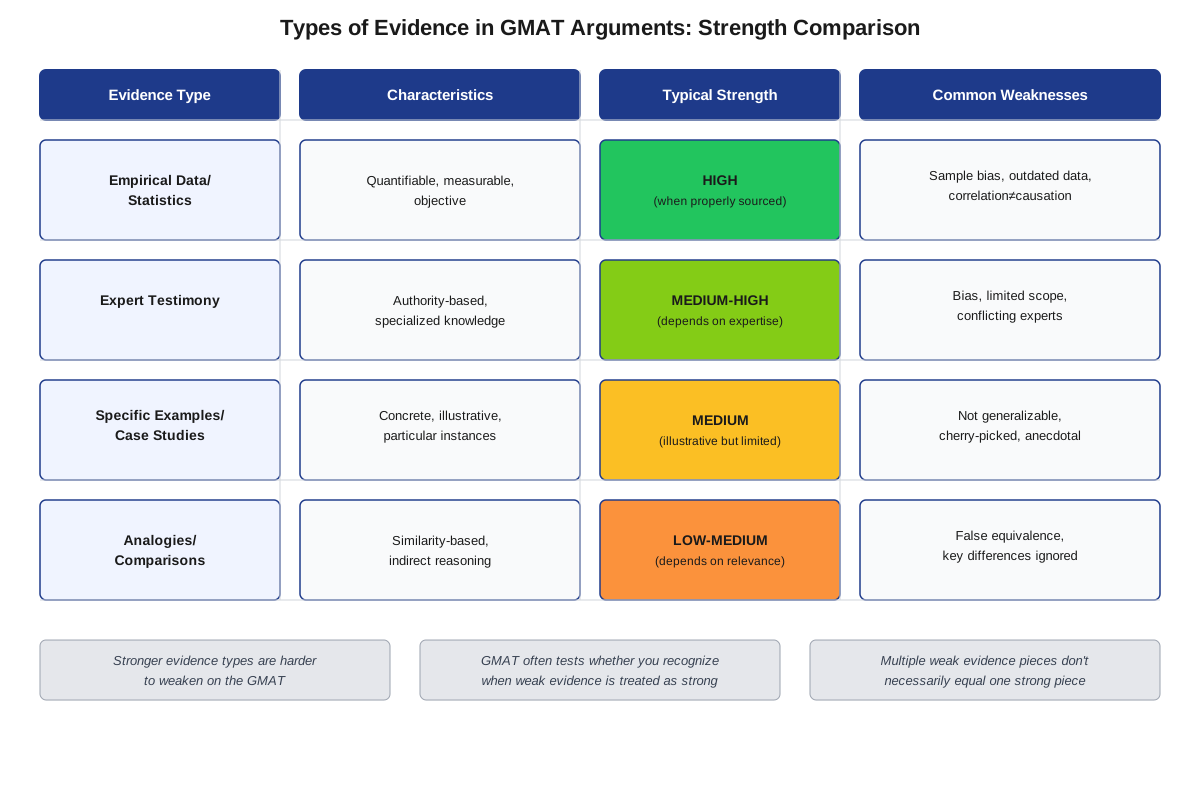
Different types of evidence carry different weights and serve different purposes in arguments. Understanding these categories helps test-takers evaluate argument strength and predict answer patterns.
| Evidence Type | Description | GMAT Example | Strength Considerations |
|---|---|---|---|
| Statistical Data | Numerical information, percentages, measurements | "Sales increased 40% in markets using the new system" | Strong when sample size is adequate and methodology is sound |
| Expert Testimony | Opinions or findings from authorities in a field | "Leading economists predict inflation will decrease" | Depends on expert credibility and consensus |
| Empirical Observations | Documented phenomena or events | "Researchers observed that plants grew faster under blue light" | Strong when observations are systematic and repeatable |
| Examples/Cases | Specific instances illustrating a general point | "Three Fortune 500 companies adopted this approach successfully" | Weaker unless examples are representative |
| Analogies | Comparisons to similar situations | "Just as exercise strengthens muscles, practice improves skills" | Weakest; depends on similarity between compared situations |
| Historical Precedent | Past events used to predict or explain | "Previous recessions followed similar patterns" | Moderate; assumes past patterns will repeat |
Evidence vs. Claims vs. Conclusions
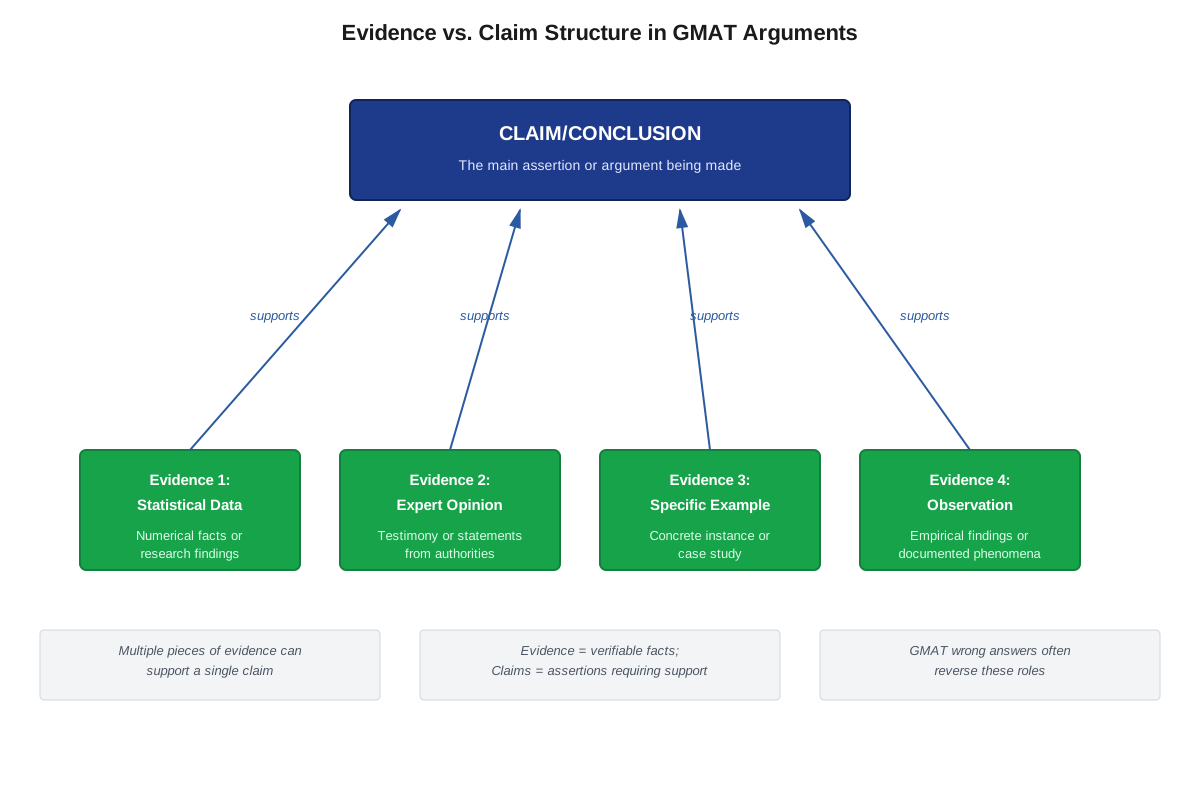
The relationship between evidence, claims, and conclusions forms the foundation of argument analysis on the GMAT. Claims are statements that require support—they represent what someone believes or asserts to be true. Evidence provides that support through facts, data, or observations. Conclusions are specific types of claims that represent the main point or final judgment of an argument.
The structure typically follows this pattern:
- Conclusion/Main Claim: The primary assertion the author wants readers to accept
- Evidence/Premises: The supporting facts, data, or observations
- Intermediate Claims: Secondary assertions that connect evidence to the main conclusion
Example breakdown:
- Conclusion: "The company should expand into Asian markets"
- Evidence: "Asian markets grew 15% annually over the past five years" (fact)
- Evidence: "Competitor revenues from Asia doubled in three years" (fact)
- Intermediate Claim: "Asian expansion represents a significant growth opportunity" (interpretation of evidence)
On the GMAT, wrong answer choices frequently present evidence as if it were the conclusion, or vice versa. Test-takers must identify which statements are factual support and which are interpretive claims.
Evidence Sufficiency and Relevance
Not all evidence equally supports a claim. GMAT questions often test whether students can evaluate if evidence is sufficient (adequate in quantity and quality) and relevant (actually related to the claim being made).
Sufficient evidence provides enough support to make a claim reasonable. Insufficient evidence might include:
- A single example used to support a universal claim
- Outdated data applied to current situations
- Small sample sizes used to make broad generalizations
- Correlation presented as if it proves causation
Relevant evidence directly relates to the specific claim being made. Irrelevant evidence might include:
- Information about a different time period than the one being discussed
- Data about a different population or context
- Facts that are true but don't address the specific claim
- Evidence that supports a related but distinct point
Example: Claim: "Remote work increases employee productivity."
- Relevant and sufficient: "A five-year study of 10,000 employees across 50 companies found productivity increased 12% on average when workers shifted to remote arrangements"
- Relevant but insufficient: "My friend works from home and gets more done"
- Irrelevant: "Remote work reduces commuting time" (true, but doesn't address productivity)
Evidence Function in Passages
Understanding why authors include specific evidence helps answer function questions and strengthens overall passage comprehension. Evidence serves several purposes:
- Supporting the main argument: Primary evidence directly backs the author's central thesis
- Refuting counterarguments: Evidence can be used to show why opposing views are incorrect
- Providing context: Background information that helps readers understand the main argument
- Illustrating abstract concepts: Concrete examples that make theoretical ideas clearer
- Establishing credibility: Evidence demonstrates the author has researched the topic thoroughly
When the GMAT asks "The author mentions X in order to..." or "The function of the second paragraph is to...", the answer typically relates to one of these evidence functions. Recognizing the purpose of evidence within the argument structure enables test-takers to predict correct answers before reading the choices.
Concept Relationships
Evidence forms the foundation of the entire argument analysis framework tested on the GMAT. The relationship flows as follows:
Evidence → Supports → Claims → Build to → Conclusions
Within this framework, evidence connects to multiple other concepts. Assumptions represent unstated evidence—the missing links between presented evidence and conclusions. When evidence alone doesn't fully support a conclusion, assumptions fill the gaps. Understanding evidence helps identify what assumptions must be true for an argument to work.
Inferences represent what must be true or is strongly suggested based on presented evidence. The relationship here is: Evidence → Enables → Valid Inferences. GMAT inference questions test whether students can determine what the evidence actually supports versus what goes beyond the evidence.
Argument evaluation depends entirely on evidence assessment. The strength of any argument correlates directly with the quality, quantity, and relevance of its evidence. This creates the relationship: Evidence Quality → Determines → Argument Strength.
Evidence also connects to passage structure in Reading Comprehension. Authors organize passages around evidence presentation patterns: claim followed by support, evidence followed by interpretation, or contrasting evidence leading to synthesis. Recognizing these patterns helps predict where evidence will appear and what function it serves.
The concept map looks like this:
- Evidence (foundation) → supports → Claims/Conclusions
- Evidence + Assumptions (unstated evidence) → complete → Arguments
- Evidence → enables → Valid Inferences
- Evidence → determines → Argument Strength
- Evidence patterns → reveal → Passage Structure
High-Yield Facts
⭐ Evidence consists of facts, data, examples, or observations that support claims—not the claims themselves
⭐ Signal phrases like "for example," "studies show," "research indicates," and "data reveals" typically introduce evidence
⭐ The GMAT frequently includes wrong answers that confuse evidence with conclusions or that cite information not actually stated in the passage
⭐ Statistical evidence is generally stronger than anecdotal evidence or single examples
⭐ Evidence must be both relevant (related to the claim) and sufficient (adequate to support the claim) to strengthen an argument effectively
- Evidence can be used to support claims, refute counterarguments, provide context, or illustrate concepts
- Expert testimony serves as evidence but is only as strong as the expert's credibility and the consensus in the field
- Historical precedent functions as evidence but assumes past patterns will continue
- Analogies represent the weakest form of evidence because they depend on similarity between compared situations
⭐ When evidence is missing or insufficient, the argument relies on assumptions to bridge the gap between evidence and conclusion
- Correlation presented in evidence does not prove causation unless the passage explicitly establishes a causal mechanism
- Evidence from unrepresentative samples or biased sources weakens arguments even if the data is accurate
- Multiple pieces of converging evidence strengthen claims more than a single piece of evidence, regardless of type
- The function of evidence in a passage determines its importance to the author's overall argument
- GMAT passages often include evidence that supports multiple claims or that can be interpreted in different ways
Quick check — test yourself on Evidence so far.
Try Flashcards →Common Misconceptions
Misconception: All facts presented in a passage serve as evidence for the main conclusion.
Correction: Facts can serve multiple purposes—some support the main conclusion, others provide background context, refute counterarguments, or support intermediate claims. Not every fact directly supports the primary thesis.
Misconception: Evidence and examples are the same thing.
Correction: While examples can function as evidence, not all evidence consists of examples. Statistical data, expert testimony, and empirical observations serve as evidence without being examples. Additionally, some examples serve illustrative purposes rather than evidentiary ones.
Misconception: If evidence is true, it automatically strengthens any related argument.
Correction: Evidence must be both relevant and sufficient to strengthen an argument. True but irrelevant evidence doesn't support a claim. For instance, "The CEO has an MBA" is true but doesn't support "The company will be profitable next quarter."
Misconception: Strong evidence proves a conclusion with certainty.
Correction: On the GMAT, evidence supports conclusions with varying degrees of strength, but rarely proves them absolutely. The exam tests whether evidence makes a conclusion more likely or reasonable, not whether it establishes certainty.
Misconception: The longest or most detailed part of a passage contains the most important evidence.
Correction: Evidence importance relates to its function in the argument, not its length. A single sentence might contain crucial evidence, while a lengthy paragraph might provide contextual background that doesn't directly support the main claim.
Misconception: If the passage mentions a study or research, that automatically makes the evidence strong.
Correction: The strength of research-based evidence depends on methodology, sample size, replicability, and whether the research actually addresses the claim being made. The GMAT includes passages where studies are cited but don't adequately support the conclusions drawn from them.
Misconception: Evidence always appears after the claim it supports.
Correction: While evidence often follows claims, passages sometimes present evidence first and then state the claim it supports. Authors might also intersperse evidence throughout a passage, with different pieces supporting different aspects of the argument.
Worked Examples
Example 1: Identifying Evidence in a Reading Comprehension Passage
Passage Excerpt:
"The decline in bee populations has alarmed agricultural experts worldwide. Over the past decade, commercial beekeepers have reported annual losses averaging 30% of their colonies. This trend coincides with increased use of neonicotinoid pesticides, which studies have shown interfere with bees' navigation abilities. Some researchers argue that the pesticides are the primary cause of colony collapse disorder, while others point to habitat loss and disease as contributing factors. Regardless of the cause, the economic implications are significant: bees pollinate crops worth an estimated $15 billion annually in the United States alone."
Question: Which of the following is presented as evidence in the passage?
A) The decline in bee populations has alarmed agricultural experts
B) Beekeepers have reported 30% annual colony losses over the past decade
C) Neonicotinoid pesticides are the primary cause of colony collapse disorder
D) The economic implications of bee decline are significant
E) Multiple factors contribute to bee population decline
Solution Process:
Step 1: Identify what constitutes evidence versus claims or conclusions. Evidence = verifiable facts, data, observations. Claims = interpretations or assertions requiring support.
Step 2: Analyze each option:
- Option A: "alarmed agricultural experts" - This is a claim about experts' reactions, not verifiable evidence
- Option B: "30% annual colony losses" - This is specific, measurable data that can be verified
- Option C: "pesticides are the primary cause" - This is a claim made by some researchers, not established fact
- Option D: "implications are significant" - This is an evaluative claim, not evidence
- Option E: "multiple factors contribute" - This is a claim about causation, not evidence itself
Step 3: Verify the correct answer. Option B presents factual, measurable data (30% losses over a decade) that serves as evidence supporting claims about bee population decline. This is explicitly stated as something beekeepers "have reported," making it documented observation.
Answer: B
Connection to Learning Objectives: This example demonstrates how to identify evidence by distinguishing factual, verifiable information from interpretive claims and conclusions. The 30% figure represents data that supports various claims in the passage but is itself evidence rather than a claim.
Example 2: Evaluating Evidence Sufficiency
Argument:
"TechStart Inc. should implement a four-day workweek. When the company piloted this schedule in its marketing department last quarter, employee satisfaction scores increased by 15 points. Additionally, the marketing team met all project deadlines during the pilot period. These results demonstrate that a four-day workweek would benefit the entire organization."
Question: Which of the following, if true, would most strengthen the argument by providing additional relevant evidence?
A) Other companies in the technology sector have implemented four-day workweeks
B) Employee satisfaction is correlated with long-term retention rates
C) The pilot study included departments with diverse functions, and all showed productivity improvements
D) Marketing employees reported feeling less stressed during the pilot
E) Four-day workweeks have become increasingly popular in recent years
Solution Process:
Step 1: Identify the conclusion and existing evidence.
- Conclusion: TechStart should implement a four-day workweek company-wide
- Evidence: Marketing department pilot showed increased satisfaction and met deadlines
- Gap: Evidence from one department may not apply to entire organization
Step 2: Determine what additional evidence would be most relevant and sufficient.
The argument's weakness is generalizing from one department to the whole company. Relevant evidence would address whether the results apply more broadly.
Step 3: Evaluate each option:
- Option A: What other companies do doesn't directly support whether it would work at TechStart
- Option B: This explains why satisfaction matters but doesn't provide additional evidence about the four-day workweek's effects
- Option C: This directly addresses the generalization gap by providing evidence from multiple departments
- Option D: This adds detail about the marketing pilot but doesn't address company-wide applicability
- Option E: Popularity doesn't constitute evidence of effectiveness
Step 4: Select the answer that provides the most relevant additional evidence. Option C provides evidence that directly addresses the argument's weakness by showing the results weren't limited to one department.
Answer: C
Connection to Learning Objectives: This example demonstrates how to evaluate evidence sufficiency and identify what additional evidence would strengthen an argument. It shows that evidence must be relevant to the specific claim (company-wide implementation) and sufficient in scope (multiple departments, not just one).
Exam Strategy
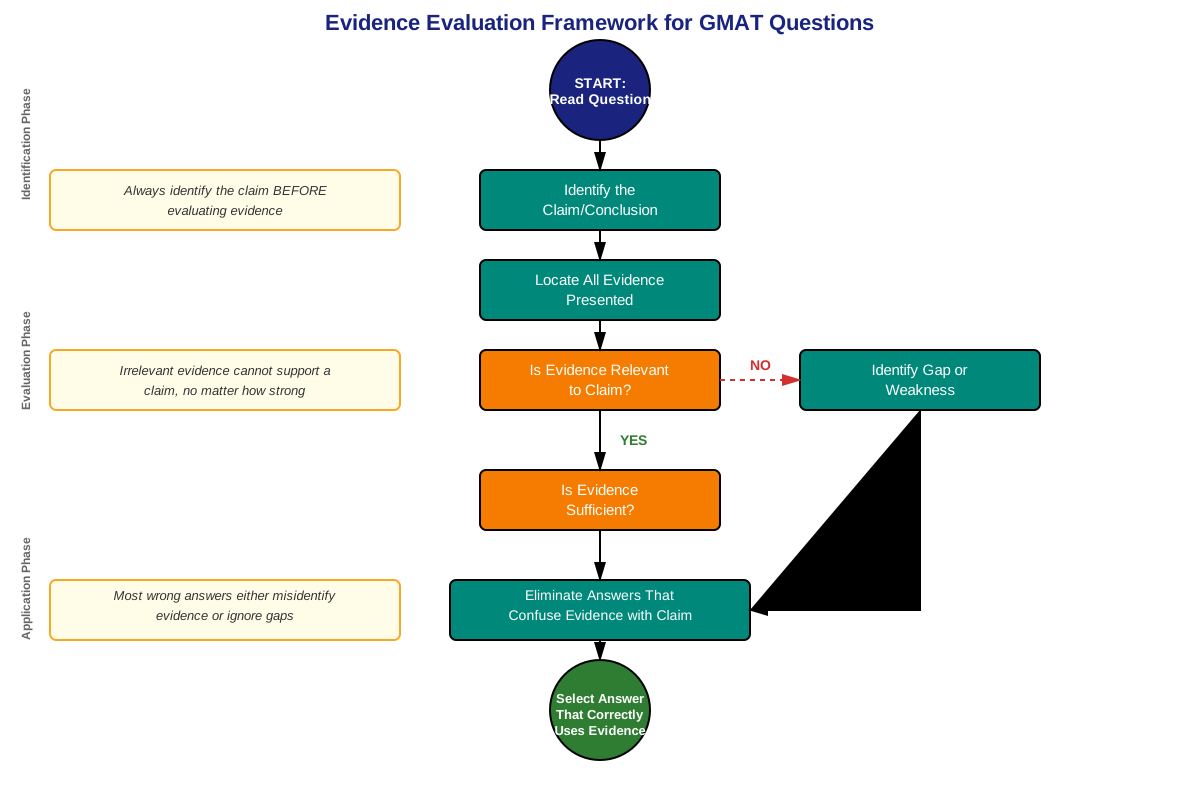
When approaching GMAT questions involving evidence, implement this systematic process:
Step 1: Identify the Question Type
Determine whether the question asks you to identify evidence, evaluate evidence, or apply evidence to support/weaken an argument. Question stems like "According to the passage," "The author cites X in order to," or "Which of the following is presented as evidence" signal evidence identification questions.
Step 2: Locate Evidence in the Passage
Use structural markers and signal phrases as guides. Evidence typically appears:
- After claims or conclusions (providing support)
- Following phrases like "for example," "studies show," "research indicates," "data reveals"
- In the form of statistics, expert citations, or specific observations
- In middle paragraphs of longer passages (first paragraphs often introduce claims; final paragraphs often conclude)
Step 3: Distinguish Evidence from Claims
Ask: "Is this a fact/observation, or is this an interpretation/assertion?" Facts can be verified; claims require support. If you can ask "How do we know this?" about a statement, it's likely a claim rather than evidence.
Step 4: Evaluate Relevance and Sufficiency
For strengthen/weaken questions, assess whether evidence:
- Directly relates to the specific claim being made (relevance)
- Provides adequate support given the scope of the claim (sufficiency)
- Comes from credible, unbiased sources (quality)
Exam Tip: Wrong answers in evidence questions often present claims as if they were evidence, or cite information that sounds familiar but wasn't actually stated in the passage. Always verify that your answer choice reflects what was explicitly presented as factual support.
Trigger Words and Phrases to Watch For:
Evidence introduction signals:
- "Studies show/indicate/reveal/demonstrate"
- "Research suggests/finds/indicates"
- "Data shows/indicates/reveals"
- "For example/for instance"
- "Specifically/in particular"
- "According to [expert/study/report]"
- "Observations indicate/show"
- "Statistics reveal/demonstrate"
Claim/conclusion signals (NOT evidence):
- "Therefore/thus/consequently"
- "This suggests/indicates/demonstrates" (interpretation)
- "Should/must/ought to" (recommendations)
- "Likely/probably/possibly" (predictions)
- "Experts believe/argue/contend" (opinions, not facts)
Process of Elimination Tips:
- Eliminate answers that confuse evidence with conclusions
- Eliminate answers that cite information not in the passage (common trap in detail questions)
- Eliminate answers where the evidence is irrelevant to the specific claim
- Eliminate answers that present opinions or interpretations as if they were factual evidence
- In strengthen/weaken questions, eliminate evidence that's true but doesn't affect the argument
Time Allocation Advice:
Evidence identification questions should take 60-75 seconds on average. These are typically more straightforward than inference or assumption questions. If you find yourself spending more than 90 seconds:
- You may be overthinking the distinction between evidence and claims
- You may be trying to infer rather than identify what's explicitly stated
- Return to the passage and look for the exact wording rather than relying on memory
For strengthen/weaken questions involving evidence evaluation, allocate 90-120 seconds. These require more analysis of how evidence relates to claims.
Memory Techniques
EVIDENCE Acronym for Evaluation:
- Explicit: Is it clearly stated, not inferred?
- Verifiable: Can it be checked or confirmed?
- Independent: Does it stand as fact, not requiring further support?
- Direct: Does it directly relate to the claim?
- Empirical: Is it based on observation, data, or documented phenomena?
- Not interpretive: Is it factual rather than opinion?
- Cited: Is it presented as established information?
- Example or data: Does it take the form of specific facts, statistics, or cases?
The "FACT" Test for Evidence:
- Factual: Is it presented as objective information?
- Actual: Is it something that happened/exists rather than a prediction or recommendation?
- Citable: Could you point to this as a source of support?
- Testable: Could this be verified or measured?
Visualization Strategy:
Picture an argument as a building. The conclusion is the roof—what the author wants you to accept. Evidence consists of the pillars supporting that roof. Claims without evidence are roofs floating in air. When reading passages, visualize which statements are pillars (evidence) and which are the roof (conclusion). This mental model helps distinguish support from what's being supported.
Signal Phrase Memory Device:
Remember "SAFE" phrases that introduce evidence:
- Studies show/suggest
- According to [source]
- For example/for instance
- Experts found/observed
The Support Test:
When uncertain whether something is evidence, ask: "Does this support something else, or does it need support?" Evidence supports; claims need support. This simple question clarifies the distinction in most cases.
Summary
Evidence represents the factual foundation of arguments on the GMAT, consisting of data, observations, examples, studies, and documented phenomena that authors use to support claims and conclusions. Mastering evidence requires three core competencies: identifying what constitutes evidence versus claims, evaluating whether evidence is relevant and sufficient, and applying evidence analysis to answer GMAT questions correctly. Evidence appears throughout Reading Comprehension passages and Critical Reasoning arguments, typically introduced by signal phrases like "studies show," "for example," or "data indicates." The GMAT tests whether students can distinguish factual support from interpretive claims, recognize when evidence adequately supports conclusions, and identify what additional evidence would strengthen or weaken arguments. Different types of evidence—statistical data, expert testimony, empirical observations, examples, and analogies—carry different weights, with statistical and empirical evidence generally providing stronger support than anecdotal examples or analogies. Success on evidence-related questions requires systematic analysis: locate evidence using structural markers, verify it's factual rather than interpretive, assess its relevance to specific claims, and evaluate its sufficiency given the scope of the argument. This skill set applies across question types, making evidence analysis one of the highest-yield topics in GMAT Verbal Reasoning.
Key Takeaways
- Evidence consists of verifiable facts, data, observations, and examples that support claims—not the claims themselves
- Signal phrases like "studies show," "for example," and "data reveals" typically introduce evidence in GMAT passages
- Strong evidence must be both relevant (directly related to the claim) and sufficient (adequate in scope and quality)
- The GMAT frequently includes wrong answers that confuse evidence with conclusions or cite information not actually in the passage
- Different evidence types (statistical data, expert testimony, examples, analogies) carry different weights, with empirical data generally strongest
- Evidence serves multiple functions: supporting arguments, refuting counterarguments, providing context, and illustrating concepts
- Systematic evidence evaluation—identifying, assessing relevance, and determining sufficiency—is essential for strengthen/weaken questions and argument analysis across Verbal Reasoning
Related Topics
Assumptions: Understanding evidence naturally leads to identifying assumptions, which represent unstated evidence that must be true for arguments to work. Assumptions fill gaps between presented evidence and conclusions.
Inferences: Evidence analysis enables valid inference-making. Inferences represent what must be true or is strongly suggested based on presented evidence, making evidence identification a prerequisite skill.
Argument Structure: Evidence forms one component of complete argument analysis. Mastering evidence identification prepares students to analyze how premises, assumptions, and conclusions interact.
Strengthen/Weaken Questions: These Critical Reasoning question types directly test evidence evaluation skills, requiring students to identify what additional evidence would support or undermine arguments.
Author's Purpose and Function: Understanding why authors include specific evidence helps answer function questions in Reading Comprehension, building on evidence identification skills.
Practice CTA
Now that you've mastered the fundamentals of evidence identification and analysis, it's time to apply these skills to actual GMAT questions. The practice questions and flashcards will reinforce your ability to distinguish evidence from claims, evaluate evidence quality, and apply systematic analysis under timed conditions. Remember: evidence analysis is a high-yield skill that appears across 35-40% of Reading Comprehension questions and over 60% of Critical Reasoning questions. Every practice question you complete strengthens your pattern recognition and speeds your analysis. Approach the practice materials with the strategies you've learned, and you'll see measurable improvement in your accuracy and confidence. You've built the foundation—now it's time to construct mastery through deliberate practice!
Sign up free to keep reading
Create a free AnvayaPrep account to finish this GMAT guide on Evidence — plus flashcards and practice questions.