Overview
Inference questions represent one of the most critical and frequently tested question types in GMAT Reading Comprehension. These questions require test-takers to draw logical conclusions based on information explicitly stated in the passage without making unsupported leaps or introducing outside knowledge. Unlike detail questions that ask what the passage directly states, GMAT inference questions demand that students identify what must be true based on the passage's content, even when not explicitly mentioned.
Mastering inference questions is essential for GMAT success because they appear in approximately 30-40% of Reading Comprehension questions and test the fundamental analytical reasoning skills that business schools value. These questions assess whether candidates can read between the lines, understand implicit meanings, and draw warranted conclusions—skills directly applicable to case analysis, strategic thinking, and data interpretation in business contexts. The ability to make sound inferences separates high scorers from average performers because it demonstrates sophisticated comprehension beyond surface-level reading.
Within the broader Verbal Reasoning framework, inference questions bridge multiple cognitive skills: they require the foundational comprehension tested in detail questions, the logical reasoning assessed throughout the Verbal section, and the critical thinking necessary for Critical Reasoning questions. Success with inference questions builds directly on understanding passage structure, identifying main ideas, and recognizing author's tone and purpose. These questions often integrate with other Reading Comprehension question types, as making accurate inferences frequently requires understanding the passage's overall argument and the relationships between different ideas presented.
Learning Objectives
- [ ] Identify inference questions by recognizing their characteristic question stems and wording patterns
- [ ] Explain the logical principles that distinguish valid inferences from unsupported assumptions
- [ ] Apply inference question strategies to GMAT questions by systematically evaluating answer choices
- [ ] Distinguish between what is explicitly stated and what can be logically inferred from passage content
- [ ] Evaluate answer choices using the "must be true" standard to eliminate incorrect options
- [ ] Recognize common trap answers that introduce outside knowledge or make excessive logical leaps
Prerequisites
- Basic Reading Comprehension skills: Understanding main ideas, supporting details, and passage structure provides the foundation for identifying what information can support valid inferences
- Logical reasoning fundamentals: Recognizing valid versus invalid logical connections enables students to distinguish warranted inferences from unsupported assumptions
- Vocabulary proficiency: Understanding nuanced language and qualifier words (such as "some," "most," "all") is essential for evaluating the precise scope of inferences
- Passage mapping techniques: The ability to track the flow of ideas and relationships between paragraphs helps locate relevant information for drawing inferences
Why This Topic Matters
Inference questions test real-world business skills that extend far beyond standardized testing. In professional contexts, executives and managers constantly draw inferences from incomplete data, market reports, financial statements, and stakeholder communications. The ability to identify what logically follows from available information—without overstepping into speculation—is fundamental to sound business decision-making, strategic planning, and risk assessment.
On the GMAT specifically, inference questions appear with high frequency across all Reading Comprehension passages. Test statistics indicate that 2-3 questions per passage (out of 3-4 total questions) often involve inference to some degree. These questions appear across all passage types—business, social science, biological science, and physical science—making them unavoidable. The GMAT tests inference through various formats: some questions ask what can be inferred about a specific detail, others about the author's perspective, and still others about relationships between concepts not explicitly connected in the passage.
Common manifestations include questions about unstated assumptions underlying an argument, logical consequences of described phenomena, characteristics of entities mentioned but not fully described, and relationships between ideas presented in different parts of the passage. The GMAT particularly favors inference questions that require synthesizing information from multiple sentences or paragraphs, testing whether students can construct a coherent understanding of complex material rather than simply locating isolated facts.
Core Concepts
Defining Inference Questions
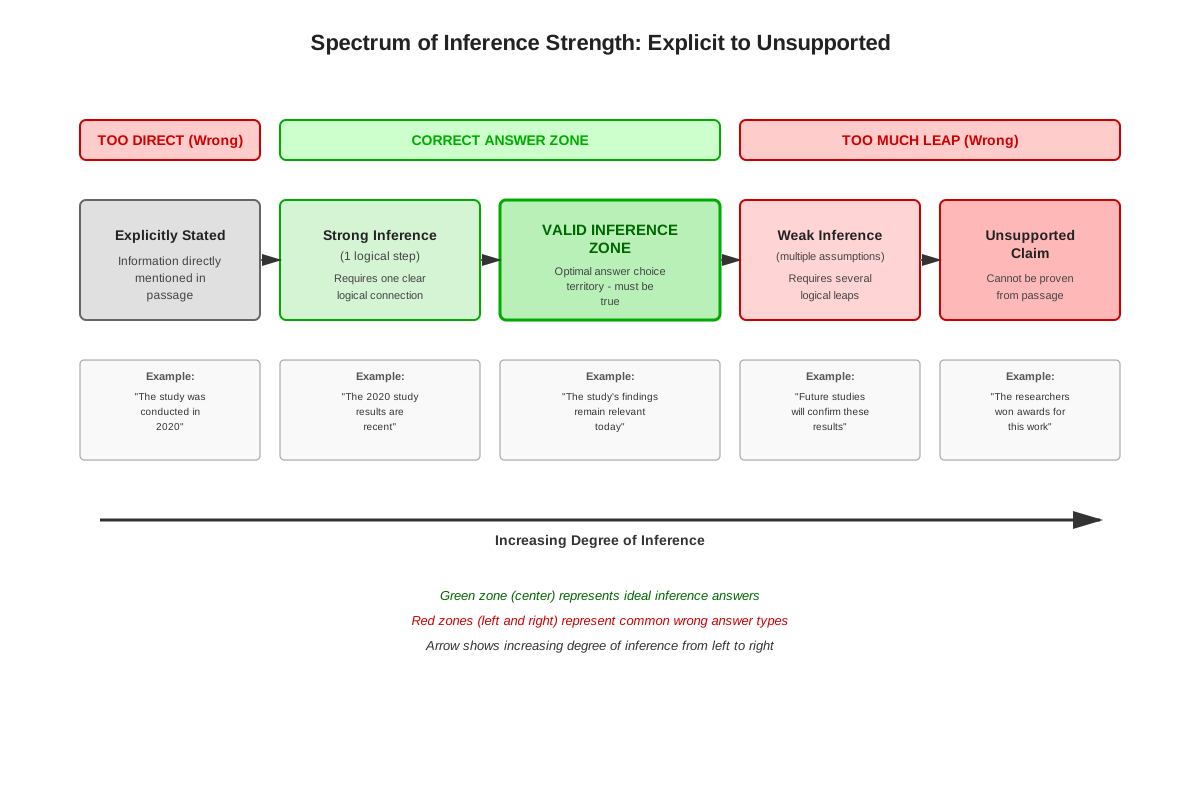
An inference is a conclusion drawn from evidence and reasoning rather than from explicit statements. In GMAT Reading Comprehension, a valid inference must be necessarily true or highly probable based solely on information provided in the passage. The key distinction is that inferences go beyond what is directly stated but remain firmly grounded in textual evidence. They represent the logical next step from explicit information rather than speculative leaps.
The GMAT tests inference through specific question formulations that signal this question type. Understanding these patterns enables rapid identification and appropriate strategic response.
Recognizing Inference Question Stems
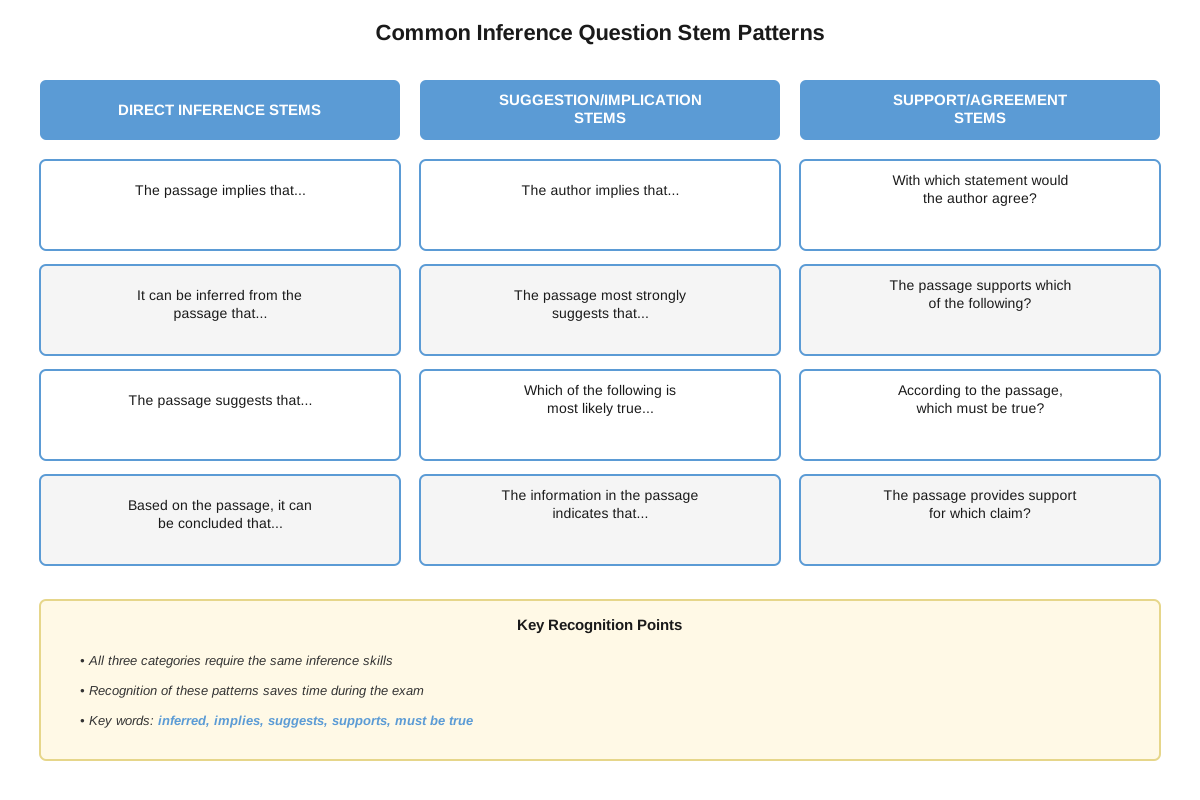
Inference questions employ characteristic language patterns that distinguish them from other question types. Common question stems include:
- "The passage suggests that..."
- "It can be inferred from the passage that..."
- "The author implies that..."
- "Which of the following can be concluded from the passage?"
- "The passage most strongly supports which of the following?"
- "Based on the passage, which of the following is most likely true?"
- "The information in the passage indicates that..."
The presence of words like "suggests," "implies," "inferred," "concluded," and "most likely" signals that the answer will not be explicitly stated but must be derived from passage content. Recognizing these stems immediately activates the appropriate problem-solving approach.
The "Must Be True" Standard
The fundamental principle governing GMAT inference questions is the "must be true" standard. A correct inference answer must be virtually certain based on passage information—it should be impossible or extremely unlikely for the inference to be false if the passage content is true. This standard distinguishes GMAT inferences from everyday speculation or educated guessing.
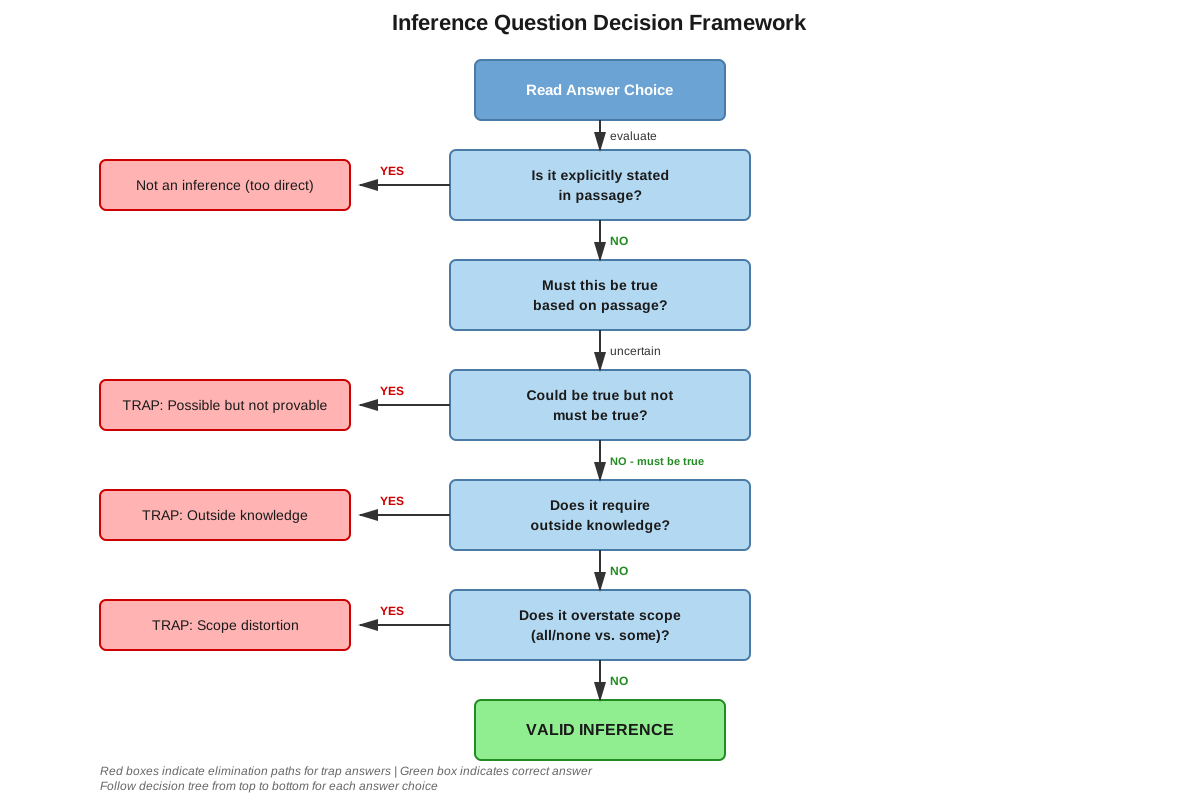
When evaluating answer choices, students should apply this test: "If everything in the passage is accurate, could this answer choice possibly be false?" If the answer is yes, the choice fails the must-be-true standard. This rigorous criterion eliminates many tempting but ultimately unsupported answer choices.
Types of Valid Inferences
GMAT passages support several categories of valid inferences:
Logical consequences: If the passage states that Company X reduced production costs by 30% through automation, a valid inference might be that Company X now spends less on production than before automation (assuming no other factors changed production volume).
Characteristic inferences: If the passage describes a species as "nocturnal" and mentions it has "highly developed auditory systems," one might infer that this species relies heavily on hearing rather than vision for navigation.
Comparative inferences: When a passage contrasts two theories, approaches, or entities, valid inferences often involve understanding what distinguishes them or what they share.
Scope and limitation inferences: If a passage describes a study's methodology and findings, valid inferences might concern what the study does or does not demonstrate, or what populations the findings do or do not apply to.
The Inference Process
Drawing valid inferences on the GMAT follows a systematic process:
- Locate relevant passage content: Identify which sentence(s) or paragraph(s) contain information pertinent to the question
- Understand explicit statements: Ensure complete comprehension of what is directly stated
- Identify logical connections: Determine what necessarily or very likely follows from the stated information
- Evaluate against the must-be-true standard: Test whether the inference is virtually certain given passage content
- Eliminate unsupported options: Remove answer choices that introduce outside information, make excessive leaps, or contradict passage content
Common Inference Traps
The GMAT systematically includes wrong answer choices that exploit common reasoning errors:
| Trap Type | Description | Example |
|---|---|---|
| Extreme language | Answer uses absolute terms (always, never, only) unsupported by passage qualifiers | Passage: "Most companies benefit from diversification" → Wrong answer: "All companies must diversify" |
| Outside knowledge | Answer relies on real-world information not in the passage | Passage discusses a 1920s economic policy → Wrong answer references 1930s events not mentioned |
| Reversal | Answer contradicts or reverses passage information | Passage: "Theory X preceded Theory Y" → Wrong answer: "Theory Y influenced Theory X" |
| Too far | Answer makes a logical leap beyond what passage supports | Passage: "Sales increased 10%" → Wrong answer: "The company will dominate the market" |
| Too narrow | Answer addresses only part of what the question asks | Question asks about "primary purpose" → Answer addresses only one paragraph's content |
Scope Management in Inferences
Understanding scope—the breadth and limitations of claims—is critical for inference questions. The GMAT frequently tests whether students recognize the difference between "some," "many," "most," and "all," or between "suggests," "demonstrates," and "proves." A passage stating that "several studies indicate a correlation" does not support an inference of causation or universal application.
Correct inferences match the scope of passage claims. If the passage discusses a phenomenon in qualified terms ("may contribute to," "appears to influence"), the correct inference will maintain similar qualification rather than asserting certainty.
Concept Relationships
The concepts within inference questions form an interconnected framework. Recognizing question stems serves as the entry point, triggering activation of the must-be-true standard as the evaluation criterion. This standard then guides the inference process, which systematically applies scope management principles to avoid common inference traps. Understanding types of valid inferences helps students recognize what kinds of logical connections the GMAT considers acceptable, which in turn sharpens application of the must-be-true standard.
Inference questions connect to prerequisite topics in multiple ways. Passage structure understanding → enables → locating relevant information for inferences. Main idea comprehension → supports → distinguishing central inferences from peripheral details. Author's tone recognition → facilitates → inferring unstated attitudes or positions.
Inference skills also connect forward to other GMAT components. Inference question mastery → strengthens → Critical Reasoning assumption questions. Scope management → transfers to → Sentence Correction logical meaning. Must-be-true evaluation → applies to → Integrated Reasoning multi-source reasoning.
High-Yield Facts
⭐ Inference questions account for 30-40% of GMAT Reading Comprehension questions, making them the most frequently tested question type alongside detail questions
⭐ The correct answer to an inference question is never explicitly stated in the passage but must be virtually certain based on passage content
⭐ Common inference question stems include "suggests," "implies," "inferred," "concluded," and "most strongly supports"
⭐ Wrong answers frequently use extreme language (always, never, only, must) that exceeds the scope of qualified passage statements
⭐ Valid inferences stay within the scope of passage claims and do not introduce outside knowledge or make excessive logical leaps
- Inference questions often require synthesizing information from multiple sentences or paragraphs rather than relying on a single statement
- The GMAT favors inference questions about logical consequences, unstated assumptions, and relationships between concepts
- Correct inference answers often use synonyms or paraphrasing rather than exact passage language
- Time-efficient inference question solving involves eliminating clearly wrong answers before deeply evaluating remaining choices
- Inference questions about the author's attitude or perspective require understanding tone markers throughout the passage, not just explicit opinion statements
Quick check — test yourself on Inference questions so far.
Try Flashcards →Common Misconceptions
Misconception: Inference questions ask for educated guesses or speculation based on passage topics → Correction: GMAT inferences must be virtually certain based on passage content, not probable guesses. The must-be-true standard requires that correct answers be logically necessary or extremely likely given passage information, not merely plausible.
Misconception: The correct answer will use similar or identical language to the passage → Correction: Correct inference answers typically paraphrase passage content using synonyms and different sentence structures. Answer choices that quote passage language verbatim are often detail question answers or traps that misapply quoted information.
Misconception: Longer, more detailed answer choices are more likely to be correct → Correction: Answer length has no correlation with correctness. The GMAT includes both concise and elaborate wrong answers. Evaluation should focus on logical validity and scope, not length or complexity.
Misconception: If an answer choice seems true based on real-world knowledge, it's likely correct → Correction: Correct inferences must be supported by passage content alone. Real-world accuracy is irrelevant if the passage doesn't provide supporting information. Many trap answers exploit test-takers' outside knowledge to seem plausible despite lacking textual support.
Misconception: Inference questions are inherently more difficult than other Reading Comprehension question types → Correction: While inference questions require careful reasoning, they follow predictable patterns and respond well to systematic approaches. Many students find them more manageable than complex main idea or purpose questions once they master the must-be-true standard and common trap patterns.
Misconception: The correct inference will always be closely related to the passage's main idea → Correction: While some inference questions address central themes, many focus on specific details, examples, or supporting points. Valid inferences can be drawn from any passage content, not just main ideas.
Worked Examples
Example 1: Scientific Passage Inference
Passage excerpt: "Recent studies of coral reef ecosystems have revealed that parrotfish play a crucial role in maintaining reef health by consuming algae that would otherwise overwhelm coral polyps. In Caribbean reefs where parrotfish populations have declined due to overfishing, researchers observed a 40% increase in algae coverage over a five-year period, coinciding with a 25% reduction in living coral coverage."
Question: The passage most strongly supports which of the following inferences about Caribbean coral reefs?
Answer Choices:
- (A) Parrotfish are the only species that consume algae on coral reefs
- (B) Overfishing is the primary threat to all coral reef ecosystems worldwide
- (C) The decline in parrotfish populations likely contributed to reduced coral coverage
- (D) Caribbean reefs will completely lose all living coral within the next decade
- (E) Algae directly kill coral polyps through toxic chemical secretion
Solution Process:
Step 1 - Identify question type: The phrase "most strongly supports which of the following inferences" clearly signals an inference question requiring the must-be-true standard.
Step 2 - Locate relevant information: The passage establishes that (1) parrotfish consume algae that threatens coral, (2) parrotfish populations declined due to overfishing, (3) algae increased 40%, and (4) living coral decreased 25% during the same period.
Step 3 - Evaluate each choice:
(A) Eliminate - Too extreme: "Only species" is unsupported. The passage states parrotfish play a "crucial role" but never claims they're the sole algae consumers. This introduces absolute language beyond passage scope.
(B) Eliminate - Outside scope: The passage discusses Caribbean reefs specifically. "All coral reef ecosystems worldwide" and "primary threat" both exceed what the passage supports. This makes an unjustified generalization.
(C) Strong candidate: The passage establishes temporal correlation (parrotfish decline coincided with coral decline) and a plausible mechanism (less algae consumption → more algae → less coral). "Likely contributed" appropriately qualifies the inference without claiming certainty. This stays within passage scope.
(D) Eliminate - Too extreme and unsupported: "Completely lose all living coral" and "within the next decade" both make specific predictions unsupported by passage data. The passage provides historical observation, not future projections.
(E) Eliminate - Outside knowledge: The passage states algae "overwhelm" coral polyps but never mentions toxic chemical secretion. This introduces a specific mechanism not discussed in the passage.
Step 4 - Confirm the answer: Choice (C) is correct because it draws a reasonable inference from the correlation and mechanism described, uses appropriate qualifying language ("likely contributed"), and stays within passage scope. It represents what must be true or highly probable given passage content.
Connection to learning objectives: This example demonstrates identifying inference questions through question stems, applying the must-be-true standard, and recognizing common traps (extreme language, outside scope, outside knowledge).
Example 2: Business Passage Inference
Passage excerpt: "Traditional retail stores have responded to e-commerce competition by emphasizing experiential shopping—creating environments where customers can interact with products before purchasing. Luxury brands, in particular, have invested heavily in flagship stores featuring personalized service, exclusive in-store events, and immersive brand experiences. Despite these investments, luxury brand flagship stores in major cities often operate at a loss when considering only direct sales revenue."
Question: It can be inferred from the passage that luxury brands view their flagship stores as:
Answer Choices:
- (A) Unsuccessful experiments that should be discontinued
- (B) Serving purposes beyond generating immediate sales revenue
- (C) More profitable than their e-commerce operations
- (D) Necessary only in cities with populations exceeding one million
- (E) The primary driver of overall brand profitability
Solution Process:
Step 1 - Identify question type: "It can be inferred" directly signals an inference question.
Step 2 - Analyze the logical structure: The passage presents an apparent paradox: luxury brands invest heavily in flagship stores that operate at a loss based on direct sales. Why would rational businesses continue losing investments? The answer must involve benefits beyond direct sales revenue.
Step 3 - Evaluate choices:
(A) Eliminate - Contradicts passage: If brands viewed stores as "unsuccessful experiments that should be discontinued," they wouldn't continue "investing heavily." The passage indicates ongoing investment, not abandonment.
(B) Strong candidate: This resolves the apparent paradox. If stores serve purposes beyond direct sales (brand building, marketing, customer experience), operating at a loss on direct sales alone could still be rational. This inference is virtually certain given the passage's logic.
(C) Eliminate - Unsupported comparison: The passage never discusses e-commerce profitability or compares it to flagship store profitability. This introduces information not present in the passage.
(D) Eliminate - Specific detail not supported: The passage mentions "major cities" but provides no population threshold. This introduces specific criteria not discussed.
(E) Eliminate - Too extreme: "Primary driver" suggests flagship stores are the most important profitability source, which contradicts the statement that they "operate at a loss." This misinterprets passage information.
Step 4 - Confirm: Choice (B) is correct because it provides the only logical explanation for the described behavior (continued investment despite losses on direct sales). The inference that stores serve additional purposes is virtually certain given the passage's content.
Connection to learning objectives: This example illustrates drawing inferences from implicit logic rather than explicit statements, recognizing that valid inferences often resolve apparent contradictions or explain described behaviors.
Exam Strategy
Systematic Approach to Inference Questions
First, identify the question as an inference type by scanning for trigger words ("suggests," "implies," "inferred," "concluded"). This activates the appropriate mental framework and evaluation criteria.
Second, return to the passage and locate relevant content. Many inference questions reference specific lines or paragraphs. Even when they don't, identifying where the relevant information appears prevents working from memory and missing crucial details.
Third, before examining answer choices, formulate a rough prediction of what can be inferred. This prediction need not be precise, but having a general sense of the logical direction helps recognize correct answers and avoid traps.
Fourth, evaluate answer choices using aggressive elimination. Remove choices that:
- Use extreme language unsupported by passage qualifiers
- Introduce information not present in the passage
- Contradict passage content
- Make logical leaps beyond what the passage supports
- Address only part of what the question asks
Fifth, apply the must-be-true test to remaining choices. Ask: "If the passage is accurate, could this answer possibly be false?" The correct answer should be virtually impossible to dispute given passage content.
Trigger Words and Phrases
Question stem triggers: "suggests," "implies," "most likely," "probably," "indicates," "most strongly supports," "can be inferred," "can be concluded"
Passage language requiring careful inference: "may," "might," "could," "appears to," "seems to," "suggests," "indicates"—these qualifiers signal that the author is not making absolute claims, and correct inferences must maintain similar qualification.
Trap answer triggers: "always," "never," "only," "must," "all," "none," "impossible," "certainly"—extreme language in answer choices often signals incorrect options that exceed passage scope.
Time Management
Allocate approximately 60-75 seconds per inference question. This breaks down as:
- 10-15 seconds: Identify question type and locate relevant passage content
- 20-30 seconds: Evaluate and eliminate clearly wrong answers
- 20-30 seconds: Apply must-be-true standard to remaining choices and select answer
If stuck between two choices after 75 seconds, select the more conservative option (the one making a smaller logical leap) and move forward. Inference questions reward careful reasoning but can become time traps if students over-analyze.
Process of Elimination Priorities
Eliminate first: Choices with extreme language or absolute claims unsupported by passage qualifiers
Eliminate second: Choices introducing outside knowledge or information not present in the passage
Eliminate third: Choices that reverse or contradict passage information
Evaluate carefully: Remaining choices that stay within passage scope and use appropriate qualifying language
Exam Tip: When two answer choices both seem possible, the correct inference is typically the one requiring a smaller logical step from passage content. The GMAT rewards conservative, well-supported inferences over creative but less certain conclusions.
Memory Techniques
SCOPE Acronym for Evaluating Inferences:
- Supported by passage content (not outside knowledge)
- Conservative logical step (not excessive leap)
- On topic (addresses what question asks)
- Properly qualified (matches passage certainty level)
- Eliminates contradictions (doesn't oppose passage)
The "Must Be True" Mantra: Before selecting an inference answer, mentally repeat: "If the passage is true, this answer must be true." This reinforces the evaluation standard and prevents selection of merely plausible but unsupported choices.
Extreme Language Red Flag: Visualize a red flag appearing whenever encountering "always," "never," "only," "all," or "none" in answer choices. This visual cue triggers heightened scrutiny and recognition that such language often signals trap answers.
The Paraphrase Principle: Remember that correct inference answers typically rephrase passage content rather than quoting it directly. When an answer choice uses identical passage language, verify it's not simply restating explicit information (which would make it a detail question answer, not an inference).
Scope Spectrum Visualization: Imagine a spectrum from "too narrow" (addresses only part of the issue) through "just right" (appropriate scope) to "too broad" (overgeneralizes). Mentally place each answer choice on this spectrum to evaluate scope appropriateness.
Summary
Inference questions constitute a high-frequency, high-importance GMAT Reading Comprehension question type that tests the ability to draw logical conclusions from passage content without making unsupported leaps. Success requires recognizing characteristic question stems, applying the must-be-true standard rigorously, and systematically eliminating common trap answers. Valid inferences stay within passage scope, maintain appropriate qualification levels, and represent logical consequences or characteristics that must be true given passage information. The GMAT tests inference through various formats including logical consequences, characteristic inferences, comparative relationships, and scope limitations. Mastery involves understanding that correct answers are never explicitly stated but must be virtually certain based on textual evidence, typically using paraphrased language rather than direct quotations. Strategic approach emphasizes aggressive elimination of extreme language, outside knowledge, contradictions, and excessive logical leaps, followed by careful evaluation of remaining choices against the must-be-true standard. Time-efficient execution requires locating relevant passage content, formulating rough predictions, and maintaining disciplined adherence to evaluation criteria rather than selecting answers that merely seem plausible.
Key Takeaways
- Inference questions appear in 30-40% of GMAT Reading Comprehension questions and are identified by stems containing "suggests," "implies," "inferred," or "concluded"
- The must-be-true standard requires that correct inferences be virtually certain based on passage content, not merely plausible or probable
- Valid inferences stay within passage scope, avoid introducing outside knowledge, and maintain qualification levels consistent with passage language
- Common trap answers use extreme language (always, never, only), introduce information not in the passage, or make logical leaps beyond what the text supports
- Systematic elimination of clearly wrong answers before deeply evaluating remaining choices maximizes time efficiency and accuracy
- Correct inference answers typically paraphrase passage content using synonyms rather than quoting text directly
- Success requires synthesizing information from multiple passage sections and recognizing logical relationships not explicitly stated
Related Topics
Critical Reasoning Assumption Questions: Mastering inference questions provides direct preparation for identifying unstated assumptions in arguments, as both require recognizing what must be true for stated information to hold.
Reading Comprehension Detail Questions: Understanding the distinction between explicit details and valid inferences sharpens overall comprehension and prevents confusion between question types.
Reading Comprehension Purpose and Function Questions: Inference skills enable deeper understanding of why authors include specific information, as recognizing implicit purposes often requires drawing inferences from content and structure.
Sentence Correction Logical Meaning: The scope management and logical reasoning developed through inference questions transfers to evaluating whether sentence constructions convey intended logical relationships.
Integrated Reasoning Multi-Source Reasoning: Synthesizing information from multiple sources to draw conclusions represents an advanced application of inference skills developed in Reading Comprehension.
Practice CTA
Now that you understand the principles and strategies for GMAT inference questions, reinforce your mastery by attempting the practice questions and reviewing the flashcards. Active practice with immediate feedback is essential for converting conceptual understanding into test-day performance. Focus on applying the must-be-true standard systematically and identifying common trap patterns. Each practice question you analyze strengthens your inference reasoning and builds the confidence needed for GMAT success. Your ability to draw valid inferences is a learnable skill that improves dramatically with deliberate practice—start building that skill now!
Sign up free to keep reading
Create a free AnvayaPrep account to finish this GMAT guide on Inference questions — plus flashcards and practice questions.