Overview
Function questions represent one of the most frequently tested question types in GMAT Reading Comprehension, appearing in approximately 25-30% of all reading passages. These questions ask test-takers to identify why an author includes specific information, examples, or rhetorical elements rather than what the passage explicitly states. Unlike detail questions that focus on content retrieval, GMAT function questions require students to analyze the author's purpose, strategy, and structural choices within the passage.
Mastering function questions is essential for GMAT success because they assess critical thinking at a higher cognitive level than simple comprehension. These questions evaluate whether students can distinguish between the surface content of a passage and the underlying rhetorical architecture—the "what" versus the "why." Function questions demand that test-takers step back from individual facts and consider how each component serves the author's broader argumentative or explanatory goals. This skill directly correlates with the analytical reasoning abilities that business schools value in prospective students.
Within the broader landscape of Verbal Reasoning, function questions bridge multiple competencies. They require the foundational reading comprehension skills needed for detail questions while simultaneously demanding the structural awareness tested in primary purpose and organization questions. Function questions also connect to Critical Reasoning, as both question types require students to analyze argumentative structure, identify supporting evidence, and recognize rhetorical strategies. Understanding function questions enhances overall passage comprehension and improves performance across all Reading Comprehension question types.
Learning Objectives
- [ ] Identify Function questions by recognizing characteristic question stems and keywords
- [ ] Explain the purpose and role of specific textual elements within a passage's structure
- [ ] Apply Function question strategies to GMAT questions to select correct answers efficiently
- [ ] Distinguish between content-based questions and function-based questions
- [ ] Analyze the relationship between specific details and the author's overall argumentative strategy
- [ ] Evaluate answer choices by matching them to the precise scope and purpose of the referenced text
Prerequisites
- Basic Reading Comprehension: Understanding main ideas, supporting details, and explicit information is necessary before analyzing why authors include specific elements
- Passage Structure Awareness: Recognizing how passages are organized (introduction, body paragraphs, conclusion) provides the framework for understanding functional relationships
- Vocabulary for Rhetorical Functions: Familiarity with terms like "support," "contrast," "illustrate," "refute," and "qualify" enables precise analysis of textual purposes
- Ability to Identify Author's Tone and Attitude: Understanding whether an author is critical, supportive, or neutral helps determine why specific information appears in the passage
Why This Topic Matters
Function questions assess a critical skill that extends far beyond standardized testing: the ability to analyze persuasive communication and understand strategic information presentation. In business contexts, professionals must constantly evaluate why information is presented, what purpose it serves, and how it supports broader objectives. Whether analyzing a competitor's marketing strategy, evaluating a consultant's recommendations, or constructing a business case, the analytical skills tested by function questions prove invaluable.
On the GMAT specifically, function questions appear with remarkable consistency. Research indicates that each Reading Comprehension passage (typically 3-4 per exam) includes at least one function question, with longer passages often containing two. These questions carry the same weight as other question types, making them responsible for approximately 6-8 points on the Verbal section. Given that GMAT scores are calculated on a precise scale where every question matters, mastering function questions significantly impacts overall performance.
Function questions appear in diverse forms across GMAT passages. They may ask about the purpose of an example in a scientific passage, the role of a counterargument in a business analysis, the function of a historical detail in a social science text, or why an author mentions a specific study in an argumentative essay. Common manifestations include questions about why authors cite specific evidence, how particular paragraphs relate to the overall passage, what role transitional statements play, and why authors include contrasting viewpoints. This versatility makes function questions both challenging and high-yield for focused preparation.
Core Concepts
Defining Function Questions
Function questions ask test-takers to identify the rhetorical purpose or structural role of specific passage elements. Rather than testing what information the passage contains, these questions assess understanding of why the author included that information and how it contributes to the passage's overall structure or argument. The fundamental distinction lies between content (the "what") and purpose (the "why").
Function questions typically reference specific portions of text—a sentence, example, paragraph, or detail—and ask students to determine its role. The correct answer describes the strategic purpose that element serves within the passage's architecture. For instance, if a passage discusses a new business theory and then mentions a failed company, a function question might ask why the author includes that company example. The answer would identify the example's purpose (perhaps to illustrate a limitation of the theory) rather than simply restating what happened to the company.
Recognizing Function Question Stems
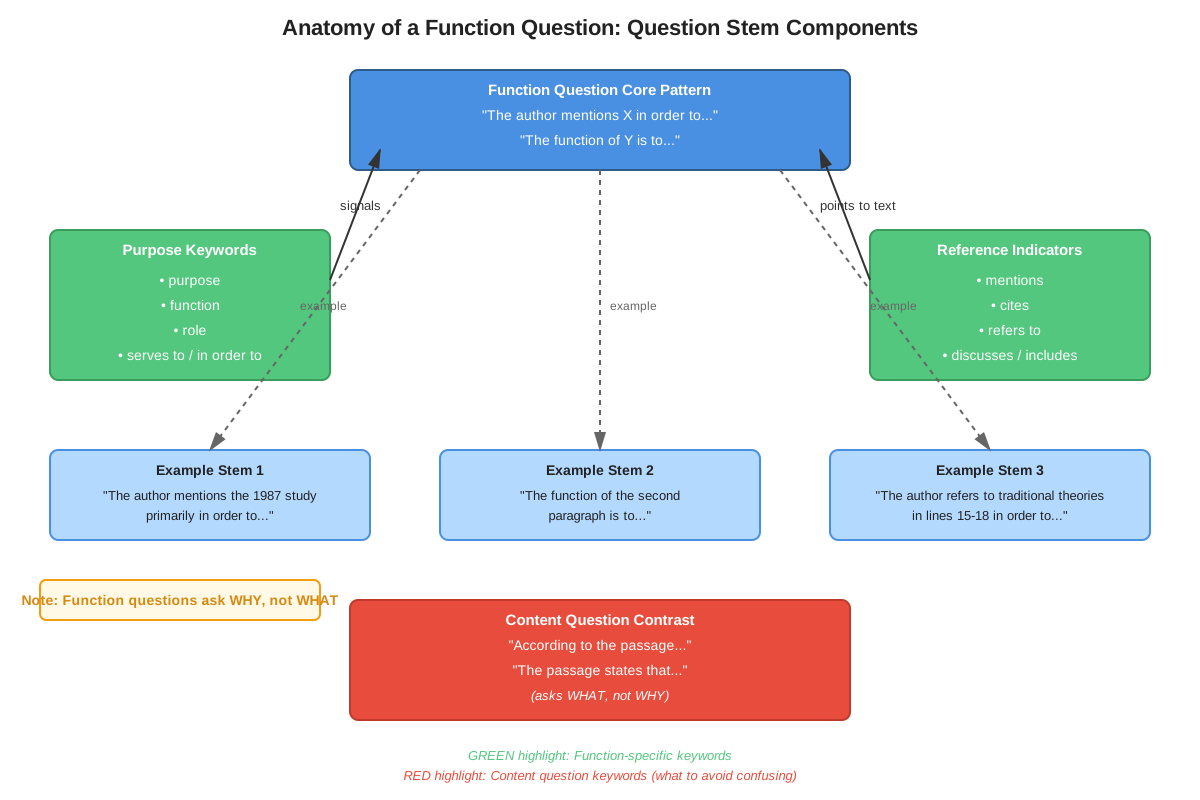
Function questions employ characteristic language patterns that signal their focus on purpose rather than content. Learning to identify these stems quickly saves valuable time and immediately activates the appropriate analytical framework. Common question stems include:
- "The author mentions X in order to..."
- "The primary purpose of the second paragraph is to..."
- "The author discusses X primarily to..."
- "Which of the following best describes the function of the highlighted sentence?"
- "The author's discussion of X serves mainly to..."
- "Why does the author include the example of Y?"
- "The reference to X in line 15 serves to..."
The key identifiers are words like "purpose," "function," "role," "in order to," "serves to," and "primarily to." These phrases explicitly signal that the question targets the strategic reason for inclusion rather than the factual content itself. Recognizing these triggers allows test-takers to immediately shift their analytical approach from content retrieval to purpose analysis.
Types of Rhetorical Functions
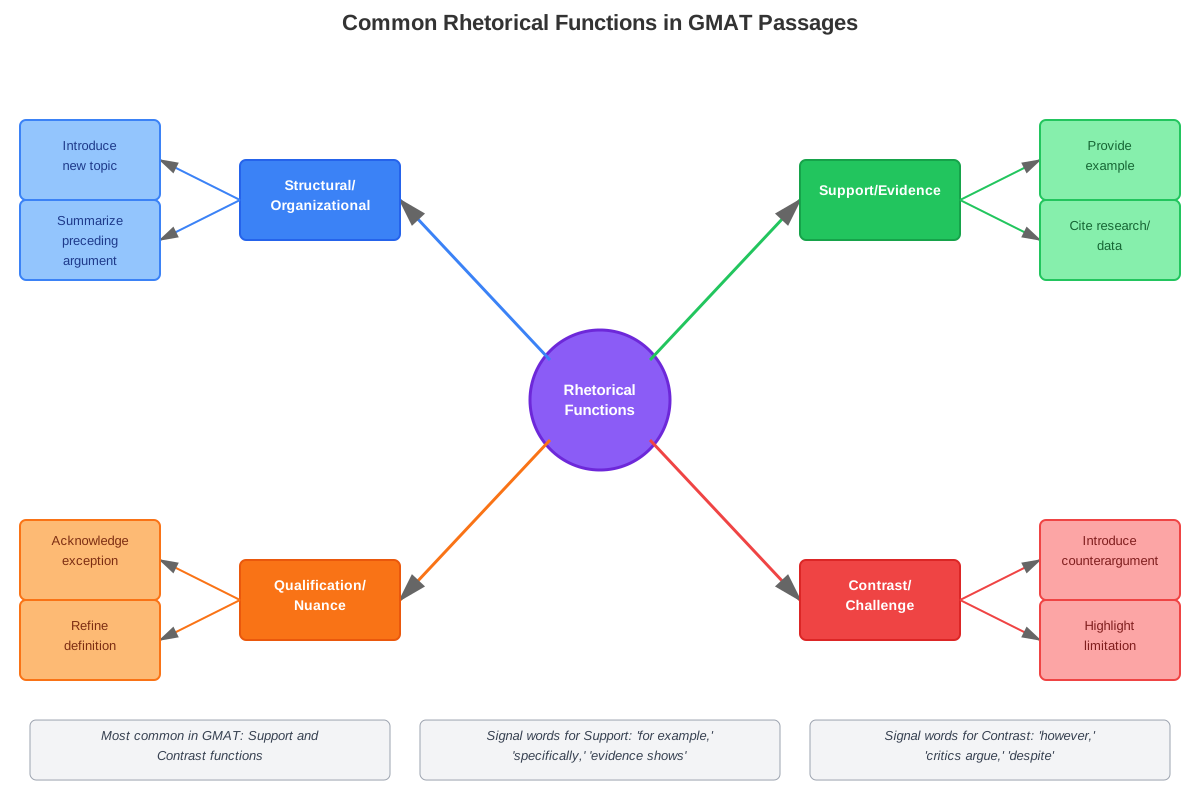
Understanding the common purposes that passage elements serve enables more efficient analysis and answer selection. GMAT passages employ a limited set of rhetorical functions repeatedly:
| Function Type | Description | Example Context |
|---|---|---|
| Support/Evidence | Provides data, examples, or reasoning that strengthens a claim | "The author cites the 2019 study to support the argument that..." |
| Illustration | Offers a concrete example that clarifies an abstract concept | "The smartphone example illustrates how network effects operate..." |
| Contrast/Counterpoint | Presents an opposing view or alternative perspective | "The author mentions the traditional theory to contrast it with..." |
| Qualification/Limitation | Acknowledges boundaries or exceptions to a claim | "The author discusses these cases to qualify the earlier generalization..." |
| Refutation | Challenges or disproves an opposing viewpoint | "The experimental results are presented to refute the hypothesis that..." |
| Background/Context | Establishes necessary information for understanding the main discussion | "The historical overview provides context for the current debate..." |
| Transition | Connects ideas or shifts the discussion to a new aspect | "This paragraph transitions from causes to potential solutions..." |
| Emphasis | Highlights the importance or significance of a point | "The repetition serves to emphasize the urgency of..." |
Analyzing Scope and Precision
Correct answers to function questions match both the scope and precision of the referenced text. Scope refers to how much text the function describes—a single example, a full paragraph, or multiple sections. Precision refers to the exactness of the functional description. Common wrong answers either describe functions that are too broad (applying to the entire passage when the question asks about one example) or too narrow (focusing on a detail when the question asks about a paragraph's overall role).
For example, if a question asks about the function of a paragraph that presents three studies supporting a theory, an answer stating "to provide evidence supporting the main hypothesis" demonstrates appropriate scope and precision. An answer stating "to discuss the 2018 Johnson study" would be too narrow, while "to explain the passage's main argument" would be too broad.
The Relationship Between Structure and Function
Every passage element exists within a hierarchical structure, and understanding this structure illuminates function. GMAT passages typically follow predictable organizational patterns:
- Introduction: Presents the topic, main idea, or central question
- Body: Develops the argument through evidence, examples, analysis, and counterarguments
- Conclusion: Synthesizes information, restates the main point, or suggests implications
Within this framework, each component serves specific structural roles. A detail in the second paragraph might support a claim made in the first paragraph, which itself introduces the passage's main argument. Recognizing these nested relationships—how smaller elements support larger ones—enables accurate function analysis.
Author's Purpose vs. Content Summary
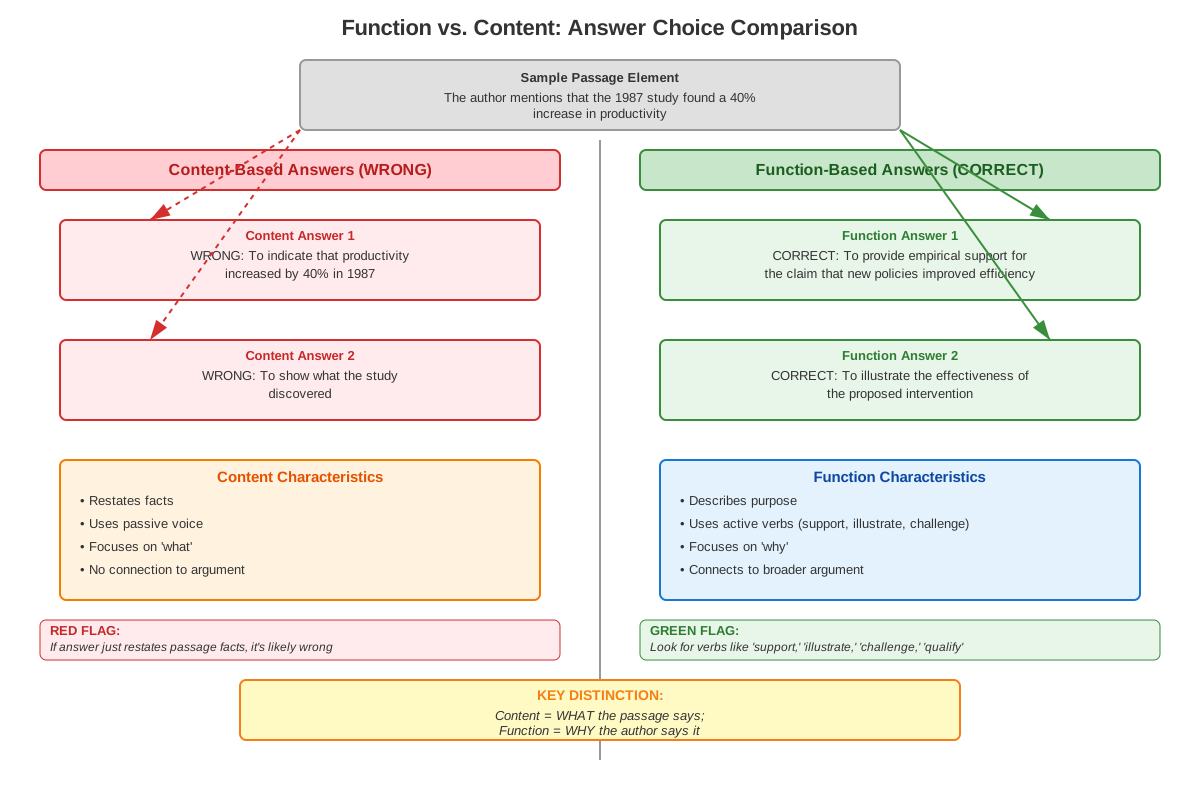
A critical distinction for function questions separates describing what the text says from explaining why the author included it. Consider this example:
Passage excerpt: "Traditional economic models assume rational actors, but behavioral economics research demonstrates that humans consistently make predictable irrational decisions. For instance, consumers often pay more for products labeled 'organic' even when chemical analysis reveals no compositional difference."
Content summary: "The passage states that consumers pay more for organic products despite no chemical difference."
Functional analysis: "The organic products example illustrates the concept of predictable irrational decision-making, supporting the author's point that behavioral economics challenges traditional models."
Function questions require the second type of analysis. Wrong answers often simply restate content, while correct answers explain the strategic purpose that content serves within the passage's argumentative structure.
Concept Relationships
Function questions integrate multiple analytical skills into a cohesive comprehension framework. At the foundation lies basic reading comprehension—understanding what the passage explicitly states. This foundational skill enables structural analysis, recognizing how the passage is organized and how components relate to each other. Structural analysis, in turn, supports purpose identification, determining why specific elements appear where they do.
The relationship flows: Content Understanding → Structural Awareness → Functional Analysis
Function questions also connect bidirectionally with other Reading Comprehension question types. Detail questions test content retrieval, which provides the raw material for functional analysis. Primary purpose questions ask about the entire passage's function, making them macro-level function questions. Inference questions require understanding both content and function to draw valid conclusions. Organization questions explicitly test structural awareness, which directly supports function question analysis.
Within the broader GMAT Verbal section, function questions share analytical DNA with Critical Reasoning. Both question types require identifying argumentative structure, recognizing how evidence supports conclusions, and distinguishing between claims and support. The skills developed through function question practice transfer directly to analyzing argument structure in Critical Reasoning questions, creating synergistic learning effects.
High-Yield Facts
⭐ Function questions ask "why" the author included information, not "what" the information states
⭐ Approximately 25-30% of GMAT Reading Comprehension questions are function questions
⭐ Common question stem triggers include "in order to," "serves to," "function," "purpose," and "primarily to"
⭐ Correct answers match both the scope (how much text) and precision (exact purpose) of the referenced element
⭐ The most common rhetorical functions are: support, illustration, contrast, qualification, and refutation
- Function questions appear in every GMAT Reading Comprehension passage, typically 1-2 per passage
- Wrong answers often restate content rather than explaining purpose
- The referenced text's relationship to surrounding sentences and paragraphs reveals its function
- Transition words in the passage (however, for example, additionally) signal rhetorical relationships and functions
- Function questions require understanding the passage's overall structure and argument flow
- Authors include counterarguments to acknowledge opposing views before refuting them or showing their limitations
- Examples and illustrations serve to clarify abstract concepts or provide concrete evidence for claims
- Background information establishes context necessary for understanding the main discussion
- The position of text within the passage (introduction, body, conclusion) constrains its possible functions
- Correct answers use precise functional language rather than vague descriptions
Quick check — test yourself on Function questions so far.
Try Flashcards →Common Misconceptions
Misconception: Function questions can be answered by simply restating what the referenced text says.
Correction: Function questions require analyzing why the author included the information and what purpose it serves, not merely summarizing its content. The correct answer describes the strategic role, not the factual content.
Misconception: The function of a passage element is always explicitly stated by the author.
Correction: Authors rarely explicitly state why they include specific information. Function must be inferred from context, position within the passage, and relationship to surrounding text. Test-takers must analyze structural relationships to determine function.
Misconception: If an example appears in a passage, its function is always "to provide an example."
Correction: While examples do illustrate concepts, the specific function depends on what the example illustrates and why. An example might support an argument, refute a counterargument, qualify a generalization, or demonstrate a limitation. The precise function requires careful analysis.
Misconception: Function questions are easier than other Reading Comprehension question types because they don't require remembering specific details.
Correction: Function questions are often more challenging because they require higher-order thinking—analyzing relationships and purposes rather than retrieving information. They demand understanding both content and structure simultaneously.
Misconception: The function of a paragraph is always stated in its topic sentence.
Correction: While topic sentences often indicate a paragraph's main idea, they don't always explicitly state its function within the passage's overall structure. A paragraph's function emerges from its relationship to other paragraphs and the passage's main argument.
Misconception: All examples serve the same function in a passage.
Correction: Different examples serve different purposes depending on their context. One example might support the main argument, another might illustrate an exception, and a third might demonstrate a contrasting approach. Each example's function must be analyzed individually.
Worked Examples
Example 1: Scientific Passage Function Question
Passage Excerpt:
"The traditional view held that coral reefs grow exclusively in shallow, warm waters where sunlight penetrates sufficiently for photosynthetic algae to thrive. However, recent deep-sea explorations have discovered extensive coral formations at depths exceeding 2,000 meters, where no sunlight reaches. These deep-sea corals, unlike their shallow-water counterparts, do not rely on photosynthetic symbionts for nutrition. Instead, they capture organic particles drifting in ocean currents. The discovery of these ecosystems has forced marine biologists to reconsider fundamental assumptions about coral reef ecology and the conditions necessary for reef formation."
Question: The author mentions "photosynthetic algae" in the first sentence primarily in order to:
(A) Explain the nutritional mechanism of all coral species
(B) Describe a characteristic of the traditional understanding that subsequent discoveries challenged
(C) Argue that shallow-water corals are more ecologically important than deep-sea corals
(D) Illustrate the diversity of symbiotic relationships in marine ecosystems
(E) Support the claim that sunlight is essential for all reef formation
Analysis:
First, identify this as a function question through the trigger phrase "primarily in order to." The question asks why the author mentions photosynthetic algae, not what the passage says about them.
Next, analyze the structural context. The photosynthetic algae appear in the first sentence, which describes the "traditional view." The second sentence begins with "However," signaling a contrast. The passage then describes deep-sea corals that don't rely on photosynthesis, explicitly contrasting with the traditional view.
The function of mentioning photosynthetic algae is to establish the traditional understanding that will be challenged by the new discoveries. This sets up the contrast structure of the passage.
Evaluating answer choices:
(A) Incorrect - Too broad in scope. The passage explicitly states deep-sea corals don't use this mechanism, so it doesn't apply to "all coral species."
(B) Correct - Precisely captures the function. The photosynthetic algae are part of the traditional view (first sentence) that the subsequent discoveries (second sentence onward) challenge.
(C) Incorrect - The passage makes no argument about relative ecological importance; this introduces content not present.
(D) Incorrect - While photosynthetic algae do represent a symbiotic relationship, the passage's focus is not on illustrating diversity but on contrasting traditional and new understandings.
(E) Incorrect - This contradicts the passage's argument. The author mentions photosynthetic algae as part of a view that the passage challenges, not supports.
Key Takeaway: The photosynthetic algae mention functions as part of establishing the traditional view that the passage will subsequently challenge, making (B) correct.
Example 2: Business Passage Function Question
Passage Excerpt:
"Corporate diversification strategies have produced mixed results over the past three decades. Proponents argue that diversification reduces risk by spreading investments across multiple industries, creating a portfolio effect that stabilizes revenue during industry-specific downturns. The conglomerate General Electric exemplified this approach, operating businesses ranging from aircraft engines to financial services. Yet GE's recent struggles and subsequent restructuring suggest limitations to the diversification model. Academic research supports this skepticism: a comprehensive 2018 study analyzing 500 major corporations found that highly diversified companies underperformed focused competitors by an average of 12% in shareholder returns over ten-year periods. The data indicate that management complexity and resource allocation challenges often outweigh diversification's theoretical risk-reduction benefits."
Question: The author's discussion of General Electric serves primarily to:
(A) Demonstrate that diversification strategies always fail in practice
(B) Provide a concrete example of a company that pursued diversification before presenting evidence of the strategy's limitations
(C) Argue that GE's management made poor decisions in implementing diversification
(D) Illustrate the portfolio effect that diversification creates
(E) Explain why financial services companies should avoid diversification
Analysis:
The question stem "serves primarily to" identifies this as a function question. We need to determine why the author includes the GE example, not just what the passage says about GE.
Analyzing the structural position: GE appears after the sentence explaining the proponents' argument for diversification. The sentence introducing GE states that GE "exemplified this approach." The next sentence begins with "Yet," signaling a contrast, and mentions GE's struggles. This structure suggests GE serves as a real-world example of the diversification approach before the author presents evidence against it.
The passage flow is: Theory supporting diversification → GE as example of diversification → GE's struggles suggesting problems → Academic research confirming problems.
Evaluating answer choices:
(A) Incorrect - Too extreme. The passage discusses "mixed results" and "limitations," not absolute failure. The word "always" makes this too strong.
(B) Correct - Accurately captures the function. GE exemplifies the diversification strategy (concrete example), and the passage then presents its struggles and academic research as evidence of limitations.
(C) Incorrect - The passage doesn't focus on GE's management decisions specifically; GE serves as an example of a broader pattern, not a case study in management quality.
(D) Incorrect - While the portfolio effect is mentioned earlier, GE is introduced after that explanation and is used to show problems with diversification, not to illustrate its benefits.
(E) Incorrect - Too narrow in scope. The passage discusses diversification broadly across industries, not specifically about financial services companies.
Key Takeaway: GE functions as a transitional example—illustrating the diversification approach before the passage pivots to evidence of its limitations, making (B) correct.
Exam Strategy
Systematic Approach to Function Questions
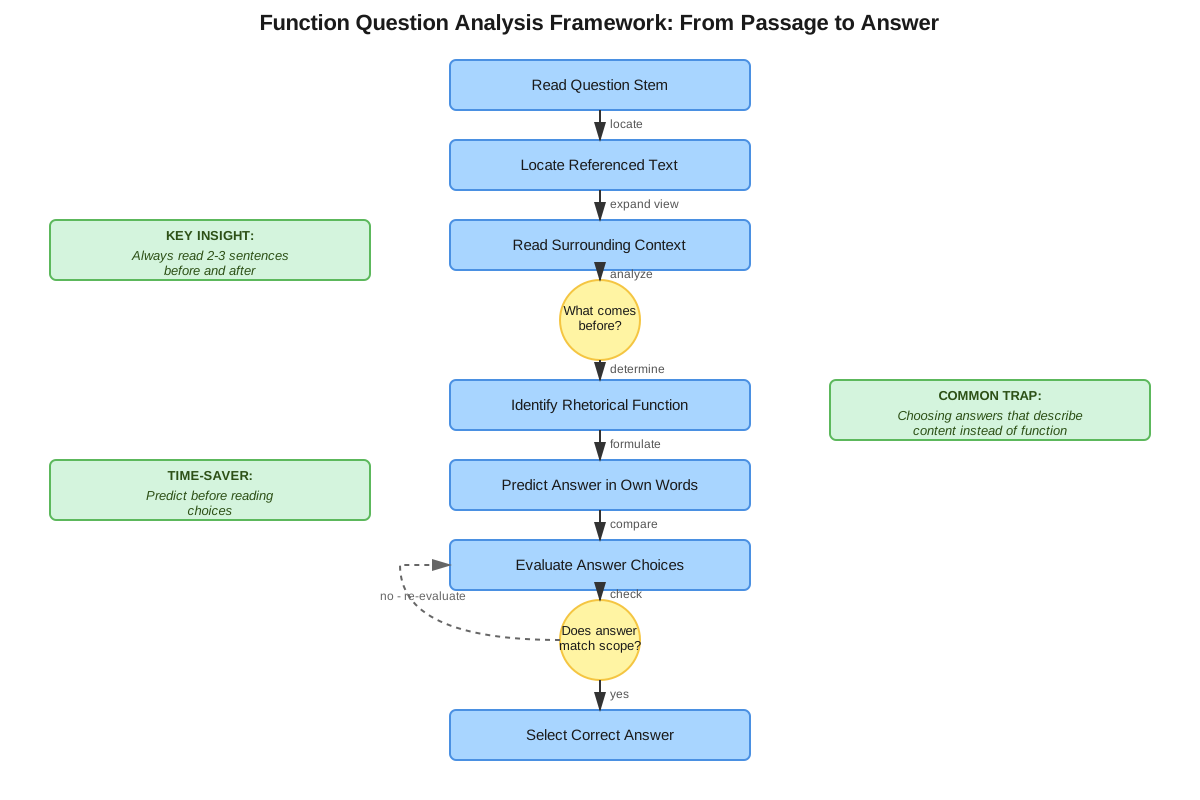
When encountering a function question, follow this four-step process:
- Identify the question type through trigger words ("purpose," "function," "in order to," "serves to")
- Locate the referenced text and read 1-2 sentences before and after for context
- Determine the structural relationship between the referenced text and surrounding content
- Match answer choices to the precise scope and purpose, eliminating content summaries
Trigger Words and Phrases
Train yourself to recognize these high-frequency function question indicators:
- "The author mentions X in order to..."
- "The primary purpose of..."
- "X serves to..."
- "The function of..."
- "The author discusses X primarily to..."
- "Why does the author include..."
- "The author's discussion of X serves mainly to..."
When you see these phrases, immediately shift from content-focused reading to purpose-focused analysis.
Process of Elimination Strategies
Eliminate answers that:
- Simply restate content without explaining purpose
- Are too broad (describing the entire passage when the question asks about one detail)
- Are too narrow (focusing on a minor detail when the question asks about a paragraph)
- Introduce information not present in the passage
- Use extreme language ("always," "never," "only") unless the passage is equally definitive
- Describe functions inconsistent with the passage's structure (e.g., "to support" when the text actually contrasts)
Favor answers that:
- Use precise functional language (support, illustrate, contrast, qualify, refute)
- Match the scope of the referenced text exactly
- Describe relationships between the referenced text and other passage elements
- Align with transition words and structural signals in the passage
Time Allocation
Function questions typically require 60-90 seconds—slightly more than detail questions but less than complex inference questions. Allocate time as follows:
- 15-20 seconds: Read and classify the question, locate referenced text
- 20-30 seconds: Analyze the structural context and determine function
- 25-40 seconds: Evaluate answer choices and eliminate wrong answers
If you find yourself exceeding 90 seconds, make your best educated guess and move forward. Function questions are important but not worth sacrificing time needed for other questions.
Using Passage Structure
The passage's organizational structure provides crucial clues about function:
- First paragraph elements typically introduce topics, present main ideas, or establish context
- "However," "Yet," "But" signal contrasts, meaning the following text likely challenges or qualifies what came before
- "For example," "For instance" introduce illustrations of preceding abstract concepts
- Final paragraph elements often synthesize information, restate main points, or suggest implications
- Middle paragraph elements usually develop arguments through evidence, analysis, or counterarguments
Memory Techniques
The SICRQ Mnemonic
Remember the five most common rhetorical functions with SICRQ:
- Support: Provides evidence for a claim
- Illustrate: Offers concrete examples of abstract concepts
- Contrast: Presents opposing or alternative views
- Refute: Challenges or disproves a position
- Qualify: Acknowledges limitations or exceptions
When analyzing a passage element's function, run through SICRQ to identify which category applies.
The "Why Chain" Technique
For each referenced element, ask three progressive "why" questions:
- Why is this information here? (immediate purpose)
- Why does that purpose matter? (relationship to surrounding text)
- Why does the author care? (connection to main argument)
This chain moves from surface-level to deep structural understanding, revealing the true function.
Visualization Strategy
Picture the passage as a building:
- Foundation = Background and context
- Support beams = Main arguments and claims
- Walls = Evidence and examples supporting the beams
- Decorative elements = Illustrations and clarifications
- Contrasting colors = Counterarguments and alternative views
When asked about a function, visualize where that element fits in the building and what structural role it plays.
The "Content vs. Purpose" Flashcard Method
Create mental flashcards with two sides:
- Side 1: What does this text say? (content)
- Side 2: Why did the author include it? (purpose)
Practice flipping between these perspectives quickly, training your brain to automatically analyze purpose alongside content.
Summary
Function questions constitute a critical component of GMAT Reading Comprehension, testing the ability to analyze why authors include specific information rather than merely what that information states. These questions assess higher-order analytical skills by requiring test-takers to understand rhetorical purpose, structural relationships, and argumentative strategy. Success with function questions depends on recognizing characteristic question stems, analyzing the structural context of referenced text, and distinguishing between content summaries and purpose descriptions. The most common rhetorical functions—support, illustration, contrast, qualification, and refutation—appear repeatedly across GMAT passages, making pattern recognition valuable. Effective function question strategy involves systematic analysis of the referenced text's relationship to surrounding content, careful attention to transition words and structural signals, and precise matching of answer choice scope to the question's focus. Mastering function questions not only improves Reading Comprehension scores but also develops analytical skills applicable to Critical Reasoning and real-world business communication analysis.
Key Takeaways
- Function questions ask "why" the author included information, requiring analysis of purpose rather than content retrieval
- Recognize function questions through trigger phrases like "in order to," "serves to," "function," and "primary purpose"
- The five most common rhetorical functions are support, illustration, contrast, refutation, and qualification (SICRQ)
- Correct answers match both the scope (how much text) and precision (exact purpose) of the referenced element
- Analyze structural context by reading 1-2 sentences before and after the referenced text
- Wrong answers typically restate content, use incorrect scope, or introduce information not in the passage
- Function questions appear in approximately 25-30% of Reading Comprehension questions, making them high-yield for focused preparation
Related Topics
Primary Purpose Questions: These questions ask about the function of the entire passage rather than specific elements, representing macro-level function analysis. Mastering function questions for passage components builds the skills needed to analyze overall passage purpose.
Organization and Structure Questions: These questions explicitly test understanding of how passages are organized and how components relate to each other. The structural awareness developed through function question practice directly supports organization question analysis.
Critical Reasoning - Argument Structure: Function questions share analytical DNA with identifying conclusions, premises, and assumptions in Critical Reasoning. The skills transfer bidirectionally, with each question type reinforcing the other.
Inference Questions: Drawing valid inferences requires understanding both what the passage states and why the author included that information. Function question mastery enhances inference question performance by deepening comprehension.
Author's Tone and Attitude: Understanding why authors include specific information connects to recognizing their attitude toward the subject matter. Function analysis often reveals whether authors support, criticize, or remain neutral toward ideas.
Practice CTA
Now that you've mastered the core concepts of function questions, it's time to apply this knowledge through deliberate practice. Attempt the practice questions associated with this topic, focusing on implementing the systematic four-step approach outlined in the exam strategy section. As you work through questions, consciously identify the structural context of referenced text and practice distinguishing between content summaries and purpose descriptions. Review the flashcards to reinforce recognition of common rhetorical functions and question stem triggers. Remember that function question mastery develops through repeated application—each practice question strengthens your analytical instincts and pattern recognition. Your investment in understanding these high-yield questions will pay dividends across your entire GMAT Verbal performance. You've built the foundation; now construct expertise through practice!
Sign up free to keep reading
Create a free AnvayaPrep account to finish this GMAT guide on Function questions — plus flashcards and practice questions.