Overview
Scientific passages represent one of the most frequently tested passage types in GMAT Reading Comprehension, appearing in approximately 30-40% of all reading passages on the exam. These passages present complex scientific concepts, research findings, theories, or phenomena drawn from fields such as biology, chemistry, physics, astronomy, geology, and environmental science. Unlike passages from business or humanities, GMAT scientific passages require test-takers to navigate technical vocabulary, understand experimental methodologies, and grasp cause-and-effect relationships within specialized domains—all while maintaining reading speed and comprehension under time pressure.
The GMAT does not test scientific knowledge directly; rather, it assesses the ability to comprehend, analyze, and draw inferences from scientific material presented in the passage itself. This distinction is crucial: students need not possess advanced science backgrounds to excel on these questions. Instead, success depends on developing systematic approaches to decoding complex information, identifying passage structure, and recognizing how scientific arguments are constructed and supported. Scientific passages typically feature dense information, multiple perspectives on a phenomenon, descriptions of experiments or observations, and discussions of competing theories or unexpected findings.
Within the broader Verbal Reasoning section, scientific passages serve as the testing ground for advanced reading comprehension skills that parallel those required in graduate-level academic work. They connect directly to critical reasoning skills by presenting evidence-based arguments, and they relate to sentence correction indirectly through the need to parse complex sentence structures common in scientific writing. Mastering scientific passages builds transferable skills in handling technical material, distinguishing main ideas from supporting details, and evaluating the strength of evidence—competencies essential for business school success and professional contexts requiring analytical reading.
Learning Objectives
- [ ] Identify scientific passages by recognizing their distinctive features, vocabulary, and structural patterns
- [ ] Explain the common organizational structures, purposes, and rhetorical strategies used in scientific passages
- [ ] Apply systematic reading strategies to GMAT questions based on scientific passages
- [ ] Analyze the relationship between scientific evidence and conclusions presented in passages
- [ ] Distinguish between factual information, hypotheses, and theories within scientific texts
- [ ] Evaluate the author's tone and purpose when presenting scientific information or debates
- [ ] Synthesize information from multiple paragraphs to answer inference and application questions
Prerequisites
- Basic reading comprehension skills: Ability to identify main ideas, supporting details, and passage structure—essential for processing any GMAT passage before tackling scientific complexity
- Understanding of passage types: Familiarity with the general categories of GMAT passages (business, social science, humanities, science)—provides context for recognizing scientific passages
- Fundamental question types: Knowledge of GMAT question formats (main idea, specific detail, inference, application, tone)—necessary to apply scientific passage strategies effectively
- Time management basics: Awareness of GMAT pacing requirements—critical since scientific passages often require slightly more processing time
Why This Topic Matters
Scientific passages hold particular significance for GMAT success because they consistently appear on every exam administration and often present the greatest challenge to test-takers from non-scientific backgrounds. Business schools value the ability to comprehend technical material because modern business leaders must regularly interpret data-driven reports, understand technological innovations, evaluate research findings, and communicate with technical specialists. The cognitive skills developed through mastering scientific passages—breaking down complexity, following logical chains of reasoning, and distinguishing evidence from interpretation—directly transfer to case analysis, strategic planning, and evidence-based decision-making in business contexts.
From an exam statistics perspective, scientific passages typically generate 3-4 questions per passage and appear in both the easier and more difficult question pools. They frequently test inference questions (35-40% of questions), specific detail questions (25-30%), main idea or primary purpose questions (15-20%), and application or strengthening/weakening questions (10-15%). The GMAT favors scientific topics that involve recent discoveries, competing theories, unexpected findings, or paradigm shifts—scenarios that create natural question opportunities about author perspective, logical relationships, and evidence evaluation.
Common manifestations of scientific passages include: descriptions of biological mechanisms (cellular processes, evolutionary adaptations, ecological relationships); presentations of competing scientific theories with supporting evidence for each; explanations of physical phenomena with cause-and-effect chains; discussions of experimental findings that challenge previous assumptions; and explorations of technological innovations or their applications. The passages often feature a "problem-solution" or "old view-new view" structure that creates natural pivot points for comprehension questions.
Core Concepts
Characteristics of Scientific Passages
Scientific passages on the GMAT exhibit several distinctive features that set them apart from other passage types. First, they employ technical vocabulary specific to scientific disciplines—terms like "photosynthesis," "quantum entanglement," "tectonic plates," or "neurotransmitters." Importantly, the GMAT typically provides sufficient context clues or definitions for truly specialized terms, as the exam tests reading comprehension rather than prior scientific knowledge. Second, these passages frequently describe processes, mechanisms, or systems that involve multiple steps or components working together, requiring readers to track relationships and sequences. Third, they often present empirical evidence in the form of experimental results, observational data, or quantitative findings that support or challenge theoretical claims.
The tone of scientific passages tends toward objectivity and precision, though authors may express measured enthusiasm about discoveries or skepticism about prevailing theories. Unlike opinion-based passages, scientific texts emphasize evidence-based reasoning and logical argumentation. The language often includes hedging phrases ("may suggest," "appears to indicate," "could potentially") that reflect scientific caution about drawing definitive conclusions from limited data. Recognizing these linguistic markers helps test-takers identify the author's degree of certainty and distinguish established facts from tentative hypotheses.
Common Structural Patterns
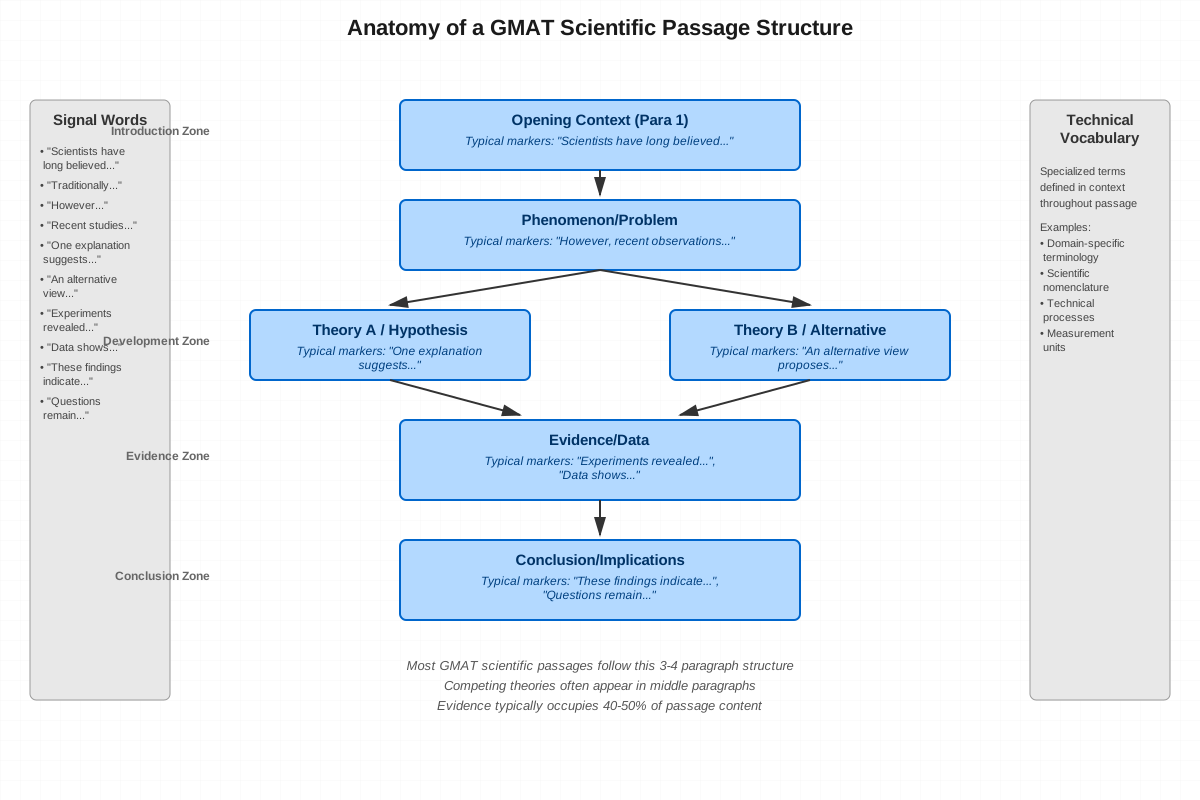
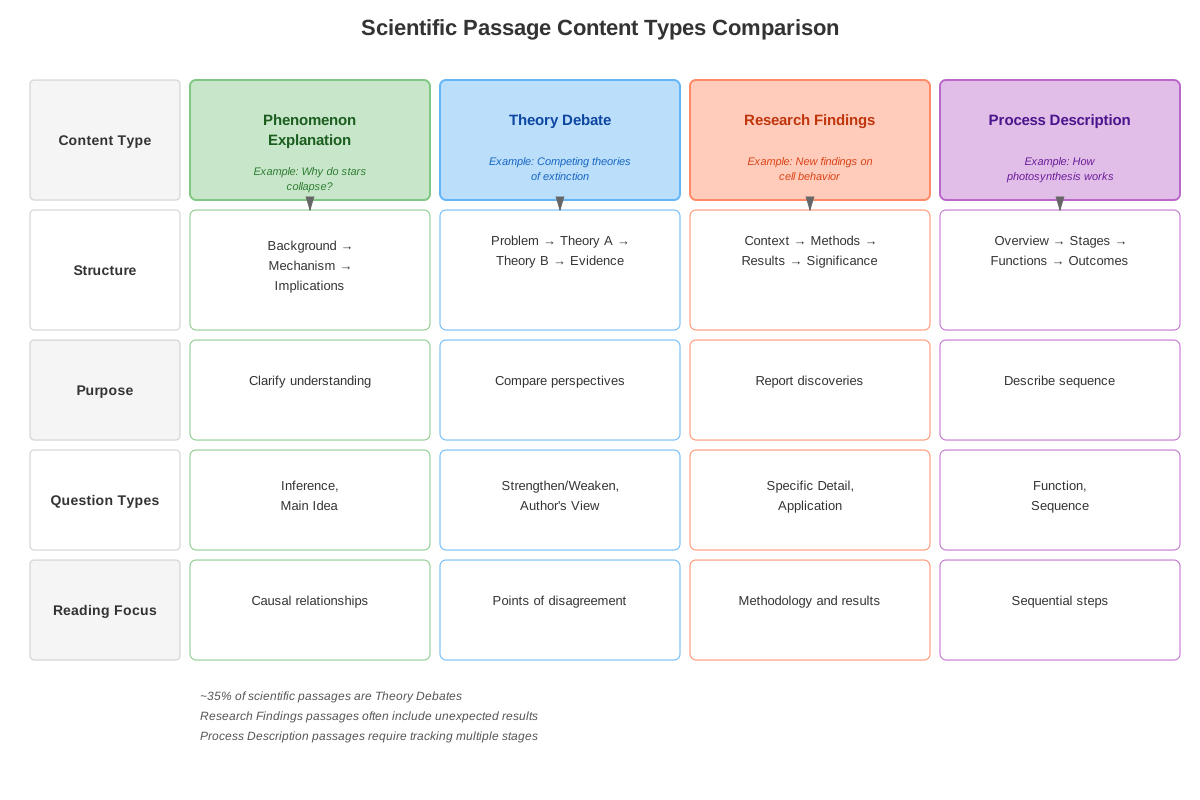
Scientific passages on the GMAT follow predictable organizational frameworks that, once recognized, significantly enhance comprehension speed and accuracy. The most frequent patterns include:
| Structure Type | Description | Typical Question Focus |
|---|---|---|
| Problem-Solution | Presents a scientific puzzle or challenge, then describes how researchers addressed it | Questions about methodology, effectiveness of solution, or implications |
| Theory Comparison | Introduces competing explanations for a phenomenon, often with evidence for each | Questions about differences between theories, author's position, or supporting evidence |
| Old View-New View | Describes a traditional understanding, then presents new findings that modify or overturn it | Questions about the shift in understanding, what prompted it, or remaining questions |
| Process Description | Explains how a natural or experimental process unfolds step-by-step | Questions about sequence, cause-effect relationships, or necessary conditions |
| Discovery Narrative | Chronicles how scientists made an unexpected finding and its significance | Questions about implications, what made the finding surprising, or future research directions |
Understanding these patterns allows readers to anticipate where key information will appear and how paragraphs relate to one another. For example, in a Theory Comparison passage, the first theory typically appears in paragraph one or two, the alternative theory in the following paragraph, and the author's evaluation or synthesis in the final paragraph.
The Role of Evidence in Scientific Passages
Scientific passages distinguish themselves through their emphasis on empirical evidence and the logical connections between observations and conclusions. The GMAT frequently tests whether readers can identify what evidence supports which claim, recognize when evidence is insufficient for a conclusion, or determine what additional evidence would strengthen or weaken an argument. Evidence in scientific passages takes several forms:
- Experimental results: Controlled studies with specific outcomes ("When researchers exposed the cells to the compound, 78% showed increased activity")
- Observational data: Patterns noticed in natural settings ("Astronomers detected unusual radiation signatures from three distant galaxies")
- Comparative findings: Differences between groups or conditions ("Species A exhibited the behavior in isolation, while Species B only displayed it in groups")
- Quantitative measurements: Numerical data supporting claims ("The temperature increased by 15 degrees Celsius over the 30-minute period")
Critical to GMAT success is recognizing the strength and scope of evidence. A single study provides weaker support than multiple replicated findings. Evidence from controlled experiments generally carries more weight than anecdotal observations. The passage may explicitly discuss limitations of evidence or alternative interpretations, creating opportunities for inference questions about what remains uncertain or what assumptions underlie the conclusions.
Scientific Reasoning and Logical Relationships
GMAT scientific passages emphasize several types of logical relationships that readers must track carefully:
Cause-and-Effect Chains: Scientific phenomena often involve multiple causal steps (A causes B, which leads to C, resulting in D). Questions may ask about intermediate steps, necessary conditions, or what would happen if one link were disrupted. For example, a passage might describe how increased ocean temperatures lead to coral bleaching through a multi-step process involving algae expulsion.
Correlation versus Causation: Passages sometimes present correlational data while discussing whether a causal relationship exists. The GMAT tests whether readers recognize this distinction and understand what additional evidence would establish causation.
Hypothesis Testing: Many passages describe how scientists formulated hypotheses and designed experiments to test them. Questions probe understanding of what results would support or refute the hypothesis, or what alternative explanations might account for the findings.
Analogical Reasoning: Scientific passages occasionally use analogies to explain complex concepts ("The protein acts like a lock, with the enzyme serving as the key"). Questions may test whether readers understand the limits of the analogy or can extend it appropriately.
Author's Purpose and Perspective
While scientific passages maintain objectivity, authors still have purposes and perspectives that the GMAT tests. Common authorial purposes include:
- Explaining a mechanism or phenomenon: The author aims to help readers understand how something works
- Presenting a discovery: The author highlights new findings and their significance
- Evaluating competing theories: The author weighs evidence for different explanations, sometimes favoring one
- Challenging conventional wisdom: The author argues that new evidence requires revising previous understanding
- Raising questions: The author identifies gaps in current knowledge or unresolved puzzles
Recognizing the author's purpose helps predict question types and locate relevant information. For instance, if the author's purpose is challenging conventional wisdom, expect questions about what the old view was, what evidence contradicts it, and what the new understanding suggests.
Technical Vocabulary Management
Encountering unfamiliar scientific terms is inevitable and intentional in GMAT passages. The exam assesses how effectively readers handle technical vocabulary without prior knowledge. Successful strategies include:
Context-based definition: The passage often provides functional definitions through context ("Mitochondria, the cellular structures responsible for energy production, contain their own DNA"). Questions rarely hinge on memorizing technical terms but rather on understanding their role in the passage's argument.
Functional understanding: Rather than precise definitions, readers need to grasp what role a term plays (e.g., "X is a type of enzyme that breaks down Y" is sufficient without knowing enzyme biochemistry).
Relationship tracking: Understanding how technical terms relate to each other matters more than individual definitions ("Compound A inhibits Process B, which normally produces Substance C").
Concept Relationships
The concepts within scientific passages form an interconnected system where structural patterns determine how evidence and reasoning are presented, which in turn shapes the author's purpose and the questions asked. The relationship flows as follows:
Structural Pattern → determines → Information Organization → influences → Question Types → requires → Reading Strategies
For example, recognizing an Old View-New View structure immediately signals that questions will likely ask about the contrast between perspectives, what prompted the shift, and implications of the new understanding. This recognition guides where to focus attention during reading and how to organize mental notes.
The relationship between evidence types and logical relationships is bidirectional: the nature of available evidence constrains what conclusions can be drawn, while the logical structure of the argument determines what evidence is relevant. A cause-and-effect claim requires different evidence than a correlational observation, and questions exploit whether readers recognize these distinctions.
Technical vocabulary connects to all other concepts as the medium through which scientific ideas are expressed. Effective vocabulary management enables comprehension of structural patterns, evidence evaluation, and logical relationships. The author's purpose often determines the density and type of technical language used—explanatory passages may include more definitions, while theory-comparison passages may use technical terms as shorthand for complex concepts.
These concepts also connect to prerequisite knowledge: basic reading comprehension skills provide the foundation for identifying structural patterns, while understanding general question types allows application of scientific passage strategies to specific questions. The relationship extends forward to related topics like critical reasoning, where scientific reasoning patterns appear in argument evaluation questions.
High-Yield Facts
⭐ Scientific passages appear in 30-40% of GMAT Reading Comprehension sections, making them the most or second-most common passage type on any given exam.
⭐ The GMAT never requires outside scientific knowledge; all information needed to answer questions appears in the passage itself, though scientific literacy helps with reading speed.
⭐ Old View-New View structure is the single most common pattern in scientific passages, typically signaled by transition words like "however," "recently," or "new findings suggest."
⭐ Inference questions constitute 35-40% of questions on scientific passages, often asking what can be concluded from evidence or what the author would likely agree with.
⭐ The first and last sentences of each paragraph contain disproportionately important information in scientific passages, often stating main points while middle sentences provide supporting detail.
- Scientific passages average 300-350 words and generate 3-4 questions, requiring approximately 3-4 minutes for initial reading and 1-1.5 minutes per question.
- Technical terms that are crucial to understanding are almost always defined or explained through context within the passage.
- Questions frequently test the relationship between evidence and conclusions, asking what would strengthen, weaken, or be consistent with claims made.
- Author's tone in scientific passages typically ranges from neutral-explanatory to cautiously optimistic about discoveries, rarely expressing strong emotions.
- Comparative structures ("unlike X, Y demonstrates...") and causal language ("consequently," "as a result," "leads to") are high-yield markers for question content.
- The GMAT favors scientific topics involving recent discoveries, unexpected findings, or paradigm shifts because these create natural question opportunities about change and implications.
- Approximately 60-70% of scientific passage questions can be answered by understanding paragraph-level main ideas rather than specific details.
Quick check — test yourself on Scientific passages so far.
Try Flashcards →Common Misconceptions
Misconception: Scientific passages require advanced science knowledge to answer correctly. → Correction: The GMAT is a reading comprehension test, not a science test. All necessary information appears in the passage, and questions specifically test whether you can extract and apply information from the text rather than recall external knowledge. Students with science backgrounds may actually struggle if they rely on outside knowledge that contradicts or extends beyond the passage.
Misconception: Every technical term must be fully understood before proceeding. → Correction: Functional understanding suffices for most technical vocabulary. If a passage mentions "phosphorylation" and explains it's a process that activates proteins, you need only remember "phosphorylation = activates proteins" rather than understanding the biochemistry. The GMAT tests whether you can track relationships and apply information, not whether you can define scientific terms precisely.
Misconception: Scientific passages always present objective facts without author perspective. → Correction: While scientific passages maintain a more neutral tone than opinion pieces, authors still have perspectives—they may favor one theory over another, express enthusiasm about discoveries, or indicate skepticism about certain claims. Questions frequently test whether you recognize the author's attitude, degree of certainty, or evaluative stance.
Misconception: All details in scientific passages are equally important and must be memorized. → Correction: Scientific passages contain varying levels of detail, with main ideas and structural relationships being far more important than specific facts or numbers. The GMAT tests comprehension of the passage's argument and organization more than recall of isolated details. Effective readers focus on understanding the "big picture" and paragraph purposes, returning to the passage for specific details only when questions require them.
Misconception: If a passage describes an experiment, questions will focus primarily on experimental details. → Correction: While some questions address experimental methodology, most questions about passages containing experiments focus on implications, conclusions drawn, what the results suggest about broader theories, or what would strengthen/weaken the findings. The experiment serves as evidence within a larger argument that questions typically target.
Misconception: Longer, more complex sentences in scientific passages should be read multiple times until fully understood. → Correction: Time constraints make re-reading inefficient. Instead, develop skills in extracting core meaning from complex sentences on first reading by identifying the main subject-verb-object structure and recognizing that subordinate clauses typically provide qualifying details. If a sentence remains unclear, note its location and return only if a question specifically addresses it.
Worked Examples
Example 1: Old View-New View Passage
Passage Excerpt:
"For decades, scientists believed that the deep ocean floor was a biological desert, devoid of significant life due to the absence of sunlight necessary for photosynthesis. This view changed dramatically in 1977 when researchers exploring the Galápagos Rift discovered hydrothermal vents surrounded by thriving ecosystems. These vents release superheated, mineral-rich water from beneath the Earth's crust, creating an environment where chemosynthetic bacteria convert chemicals like hydrogen sulfide into energy. These bacteria form the base of a food chain supporting tube worms, clams, and other organisms, demonstrating that life can flourish without sunlight when alternative energy sources exist."
Question: The passage suggests which of the following about the discovery of hydrothermal vent ecosystems?
(A) It confirmed scientists' understanding of deep ocean biology
(B) It revealed that photosynthesis can occur without sunlight
(C) It demonstrated that previous assumptions about requirements for thriving ecosystems were incomplete
(D) It proved that all deep ocean environments contain abundant life
(E) It showed that chemosynthetic bacteria are more efficient than photosynthetic organisms
Worked Solution:
Step 1: Identify the passage structure. This is a classic Old View-New View pattern. The old view (deep ocean as biological desert due to no sunlight) appears in the first sentence. The new view (thriving ecosystems at hydrothermal vents) appears after "This view changed dramatically."
Step 2: Understand what the discovery revealed. The key insight is that life can flourish "without sunlight when alternative energy sources exist." This challenges the assumption that sunlight (and therefore photosynthesis) was necessary for thriving ecosystems.
Step 3: Evaluate each answer choice:
(A) Incorrect - The discovery contradicted rather than confirmed previous understanding ("This view changed dramatically").
(B) Incorrect - The passage states that chemosynthesis, not photosynthesis, occurs at the vents. This misrepresents the mechanism.
(C) Correct - The discovery showed that the previous assumption (sunlight necessary for thriving ecosystems) was incomplete because alternative energy sources can support life. This directly addresses the learning objective of applying scientific passage understanding to questions.
(D) Incorrect - The passage discusses only hydrothermal vent environments, not "all deep ocean environments." This overgeneralizes.
(E) Incorrect - The passage makes no comparison of efficiency between chemosynthetic and photosynthetic organisms.
Key Takeaway: Old View-New View questions typically ask what changed, what prompted the change, or what the new understanding reveals about previous assumptions. The correct answer often involves recognizing that new evidence expanded or modified (rather than completely overturned) previous understanding.
Example 2: Process Description with Evidence
Passage Excerpt:
"The formation of thunderstorms involves a complex interaction between atmospheric conditions. Warm, moist air near the Earth's surface rises rapidly when it encounters cooler air above, creating an updraft. As this air rises and cools, water vapor condenses into droplets, releasing latent heat that further accelerates the updraft. This process continues until the rising air reaches an altitude where temperatures are cold enough to freeze water droplets into ice crystals. The weight of these ice crystals eventually overcomes the updraft, causing them to fall as precipitation. The descending precipitation creates a downdraft of cool air, which, upon reaching the surface, can trigger new updrafts in adjacent areas, potentially spawning additional storm cells."
Question: According to the passage, which of the following is necessary for the continuation of the initial updraft in thunderstorm formation?
(A) The presence of ice crystals at high altitudes
(B) The release of heat during water vapor condensation
(C) The creation of a downdraft from falling precipitation
(D) The encounter between cool surface air and warm air above
(E) The formation of additional storm cells in adjacent areas
Worked Solution:
Step 1: Identify what the question asks. This is a specific detail question about a necessary condition for updraft continuation. The word "necessary" indicates we need something that must occur for the process to continue.
Step 2: Locate relevant information. The passage describes updraft formation and continuation in the second and third sentences. The key phrase is "water vapor condenses into droplets, releasing latent heat that further accelerates the updraft."
Step 3: Understand the causal relationship. The sequence is: rising air → cooling → condensation → heat release → updraft acceleration. The heat release is what keeps the updraft going ("further accelerates").
Step 4: Evaluate each answer choice:
(A) Incorrect - Ice crystals form later and actually stop the updraft by creating precipitation that causes downdrafts.
(B) Correct - The passage explicitly states that latent heat release "further accelerates the updraft," making it necessary for continuation. This demonstrates application of understanding process descriptions.
(C) Incorrect - Downdrafts occur after the initial updraft process and actually represent a later stage.
(D) Incorrect - This describes the initial trigger for the updraft, not what continues it. The passage states warm air rises when encountering cool air above, not the reverse.
(E) Incorrect - Additional storm cells are a potential consequence, not a necessary condition for the initial updraft's continuation.
Key Takeaway: Process description questions often test understanding of causal sequences and necessary conditions. Pay attention to words like "causes," "leads to," "results in," and "necessary for" in both passages and questions. Distinguish between initial triggers, sustaining factors, and later consequences.
Exam Strategy
Systematic Approach to Scientific Passages
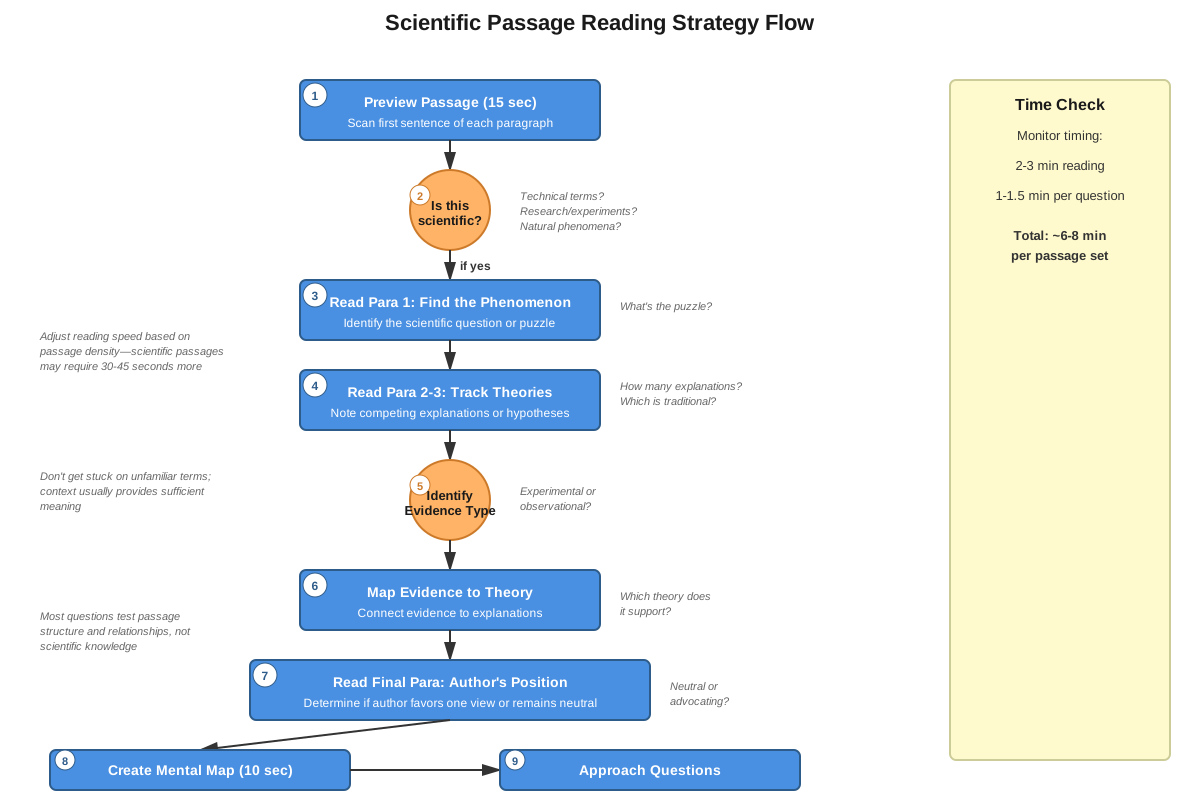
Pre-reading (5-10 seconds): Quickly scan the passage to identify it as scientific (look for technical terms, references to studies/experiments, or scientific concepts). Note the approximate length and number of paragraphs to gauge reading time allocation.
Active reading (2.5-3.5 minutes for a typical passage): Read for structure and main ideas rather than memorizing details. After each paragraph, mentally summarize its purpose in 3-5 words ("introduces old theory," "presents new evidence," "explains mechanism"). Pay special attention to:
- First and last sentences of each paragraph
- Transition words indicating shifts in perspective or logic
- The author's purpose and tone
- Relationships between concepts (cause-effect, comparison, sequence)
Question approach: Before looking at answer choices, formulate your own answer based on passage understanding. This prevents attractive wrong answers from misleading you. Return to the passage to verify specific details—don't rely on memory for factual questions.
Trigger Words and Phrases
Scientific passages contain linguistic markers that signal important information:
Structural signals:
- "However," "Nevertheless," "In contrast" → indicates shift to new view or contrasting information
- "Recently," "New findings," "Researchers discovered" → signals new information challenging old views
- "For example," "For instance" → introduces supporting detail (often less critical than main claims)
- "Consequently," "As a result," "Therefore" → marks conclusions or effects in causal chains
Certainty indicators:
- "Demonstrates," "Proves," "Establishes" → strong claims (rare in scientific passages)
- "Suggests," "Indicates," "May," "Could" → tentative claims (very common)
- "Appears to," "Seems to" → cautious interpretations
- "Remains unclear," "Scientists debate" → acknowledges uncertainty
Evidence markers:
- "Studies show," "Experiments revealed," "Observations indicate" → introduces empirical support
- "Data suggests," "Results demonstrate" → connects evidence to claims
Process-of-Elimination Tips
For inference questions: Eliminate answers that:
- Require outside knowledge not in the passage
- Make claims stronger than the passage supports (watch for "all," "never," "must")
- Contradict information explicitly stated
- Confuse correlation with causation when the passage only establishes correlation
For main idea/primary purpose questions: Eliminate answers that:
- Focus on details from only one paragraph rather than the whole passage
- Are too broad (could apply to many passages) or too narrow (cover only part of the passage)
- Mischaracterize the author's tone or purpose
For specific detail questions: Eliminate answers that:
- Use terminology from the passage but misstate relationships
- Confuse the sequence of events or causal relationships
- Attribute claims to the wrong source (e.g., stating the author believes something only mentioned as another's view)
Time Allocation
For a typical 350-word scientific passage with 4 questions:
- Initial reading: 3-3.5 minutes (slightly longer than other passage types due to complexity)
- Per question: 1-1.5 minutes
- Total: 7-9 minutes for passage and all questions
If a passage seems exceptionally dense, don't spend more than 4 minutes on initial reading—you can return for details. If you're struggling with a particular question after 90 seconds, make your best guess and move on to preserve time for other questions.
Memory Techniques
SCIENCE Acronym for Passage Elements:
- Structure: Identify the organizational pattern (Old View-New View, Problem-Solution, etc.)
- Claims: Note main arguments or theories presented
- Inferences: Consider what logically follows from the information
- Evidence: Track what supports each claim
- New information: Pay attention to discoveries or shifts in understanding
- Contrasts: Notice comparisons or competing views
- Explanations: Understand mechanisms or processes described
The "3P" Framework for Paragraph Purpose:
After reading each paragraph, categorize its purpose as one of three types:
- Present: Introduces new information, theories, or findings
- Prove: Provides evidence or support for claims
- Pivot: Shifts perspective, introduces contrasts, or transitions between ideas
This simple categorization helps maintain focus on structure rather than getting lost in details.
Visualization for Process Descriptions:
When passages describe multi-step processes, create a simple mental flowchart:
"Warm air rises → cools → condenses → releases heat → accelerates updraft"
This linear visualization helps answer questions about sequence, necessary conditions, or what would happen if one step were disrupted.
The "Old vs. New" T-Chart:
For passages with competing theories or changing views, mentally organize information into two columns:
| Old View/Theory A | New View/Theory B |
|---|---|
| Key characteristics | Key characteristics |
| Supporting evidence | Supporting evidence |
This organization makes comparison questions much easier to answer.
Summary
Scientific passages represent a high-frequency, high-importance component of GMAT Reading Comprehension, testing the ability to comprehend complex technical material without requiring prior scientific knowledge. Success depends on recognizing common structural patterns—particularly Old View-New View, Problem-Solution, and Process Description formats—and understanding how these patterns organize information and generate questions. Effective readers focus on paragraph purposes, main ideas, and logical relationships rather than memorizing details, using structural signals and transition words to navigate passages efficiently. The key distinction between scientific passages and other types lies in their emphasis on evidence-based reasoning, technical vocabulary, and causal relationships, all presented in a relatively objective tone. Questions predominantly test inference skills, understanding of evidence-conclusion relationships, and comprehension of how new findings modify previous understanding. By developing systematic approaches to handling technical vocabulary, tracking multi-step processes, and distinguishing between established facts and tentative hypotheses, test-takers can transform scientific passages from intimidating obstacles into predictable, manageable challenges that yield consistent points.
Key Takeaways
- Scientific passages appear in 30-40% of GMAT Reading Comprehension sections and require no outside scientific knowledge—all answers come from the passage itself
- The Old View-New View structure is the most common pattern, typically signaling questions about what changed, why, and what the new understanding implies
- Focus on paragraph purposes and structural relationships rather than memorizing details; approximately 60-70% of questions test big-picture understanding
- Technical vocabulary requires only functional understanding—grasp the role terms play in the passage's argument rather than precise scientific definitions
- Evidence-conclusion relationships are heavily tested; questions frequently ask what would strengthen, weaken, or follow from claims made in the passage
- First and last sentences of paragraphs contain disproportionately important information in scientific passages, making them high-yield reading targets
- Effective time management involves spending 3-3.5 minutes on initial reading to understand structure, then returning to the passage for specific details only when questions require them
Related Topics
Critical Reasoning - Scientific Arguments: Scientific passages build directly into Critical Reasoning questions that present scientific arguments requiring evaluation of assumptions, evidence, and conclusions. Mastering scientific passages develops the analytical skills needed to strengthen, weaken, or identify flaws in scientific reasoning.
Reading Comprehension - Social Science Passages: Social science passages share structural similarities with scientific passages (evidence-based reasoning, competing theories) but focus on human behavior, economics, and social phenomena. Skills in handling scientific passages transfer readily to social science material.
Data Sufficiency - Scientific Scenarios: Some Data Sufficiency questions present scientific contexts requiring interpretation of experimental conditions or data relationships. Understanding scientific reasoning patterns aids in determining what information suffices to answer questions.
Sentence Correction - Complex Scientific Sentences: Scientific writing features complex sentence structures with multiple clauses, technical terminology, and precise logical relationships. Exposure to scientific passages improves ability to parse complex sentences in Sentence Correction questions.
Practice CTA
Now that you've mastered the core concepts and strategies for scientific passages, it's time to put your knowledge into action. Attempt the practice questions to apply these techniques to actual GMAT-style problems, and use the flashcards to reinforce high-yield facts and common patterns. Remember: scientific passages become significantly less intimidating with practice, and each passage you work through builds pattern recognition that makes subsequent passages easier. Your ability to handle complex technical material is a skill that improves rapidly with deliberate practice—start building that skill now, and watch your confidence and accuracy soar!
Sign up free to keep reading
Create a free AnvayaPrep account to finish this GMAT guide on Scientific passages — plus flashcards and practice questions.