Overview
Assignment games represent one of the most frequently tested subcategories within Analytical Reasoning Legacy on the LSAT. These games challenge test-takers to match elements from one set (such as people, objects, or tasks) to elements from another set (such as positions, roles, or categories) according to specific rules and constraints. Unlike pure sequencing games that focus on order or basic grouping games that simply divide elements into categories, assignment games require determining which specific element goes with which specific slot or attribute, often involving multiple layers of relationships.
Understanding assignment games is essential for LSAT success because they appear in approximately 20-30% of all logic games sections and frequently combine with other game types to create hybrid challenges. These games test the ability to track multiple variables simultaneously, apply conditional reasoning, and make valid inferences from complex rule sets—skills that are fundamental to legal reasoning. The LSAT uses assignment games to evaluate how well candidates can organize information systematically, recognize patterns in constraints, and draw logical conclusions under time pressure.
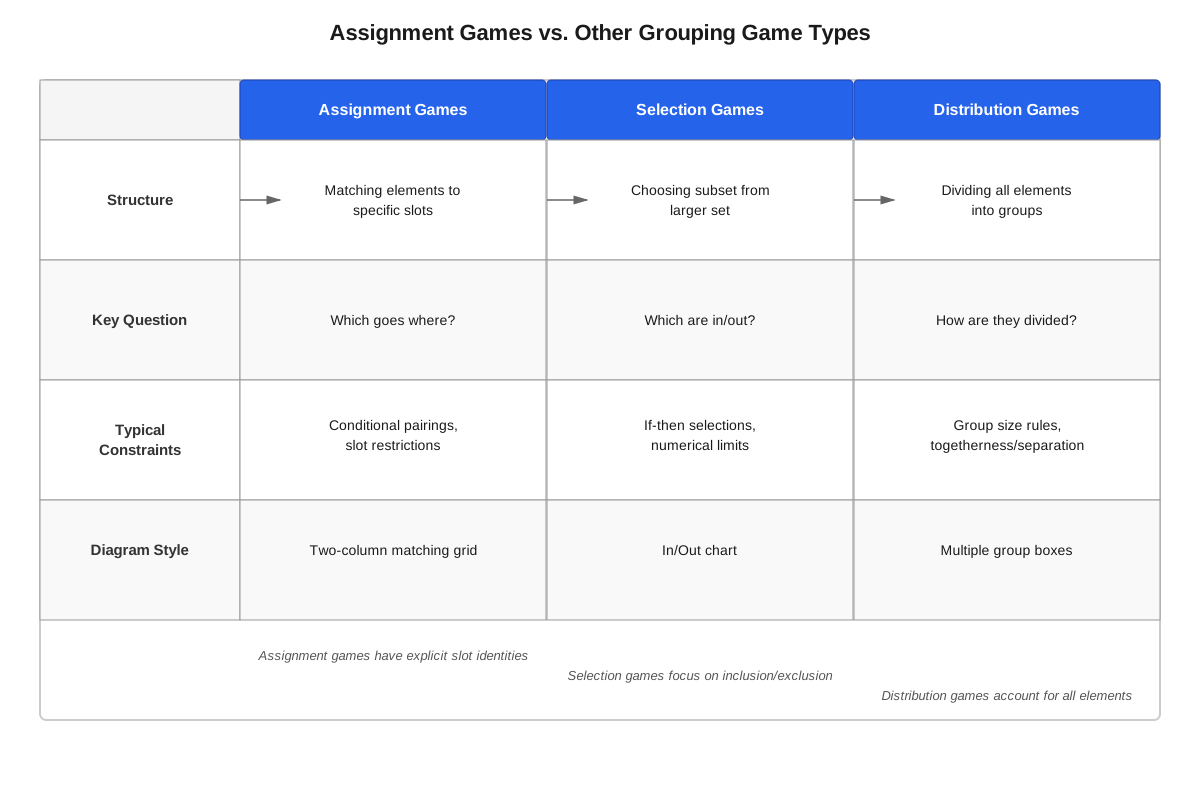
Within the broader framework of grouping games legacy, assignment games occupy a middle ground between simple selection tasks and complex distribution problems. They build upon basic grouping principles but add the critical dimension of specific pairing or matching. Mastering assignment games provides the foundation for tackling more advanced hybrid games and develops the analytical skills necessary for the entire Analytical Reasoning section. The structured approach required for these games—creating clear diagrams, tracking constraints methodically, and testing possibilities systematically—translates directly to success across all logic game types.
Learning Objectives
- [ ] Identify how Assignment games appears in LSAT questions
- [ ] Explain the reasoning pattern behind Assignment games
- [ ] Apply Assignment games to solve LSAT-style problems accurately
- [ ] Construct effective visual diagrams that represent assignment relationships clearly
- [ ] Recognize and apply the most common constraint patterns in assignment scenarios
- [ ] Distinguish assignment games from other grouping game types based on structural features
- [ ] Generate valid inferences by combining multiple assignment rules efficiently
Prerequisites
- Basic logic and conditional reasoning: Understanding "if-then" statements is essential because assignment game rules frequently use conditional logic to restrict which elements can be paired together.
- Set theory fundamentals: Recognizing relationships between groups, subsets, and individual elements helps in understanding how assignment games organize information.
- Diagramming basics: Familiarity with creating visual representations of logical relationships enables efficient setup of assignment game scenarios.
- Rule interpretation skills: The ability to translate written constraints into actionable logical statements is necessary for applying assignment game rules correctly.
Why This Topic Matters
Assignment games reflect real-world scenarios that lawyers encounter regularly: assigning cases to attorneys, matching clients with appropriate legal strategies, scheduling hearings across multiple courtrooms, or determining which evidence applies to which charges. The cognitive skills developed through assignment games—systematic organization, constraint satisfaction, and logical inference—are directly applicable to legal practice, making them a valid predictor of law school success.
On the LSAT, assignment games appear with high frequency and significant point value. Statistical analysis of recent LSAT administrations shows that lsat assignment games constitute roughly 25% of all Analytical Reasoning questions, with each game typically worth 5-7 points. These games often appear as the second or third game in a section, positioned where they can differentiate between average and high-scoring test-takers. The LSAT favors assignment games because they efficiently test multiple reasoning skills simultaneously: rule application, inference generation, and systematic elimination.
Common manifestations include: assigning employees to shifts or departments, matching performers to time slots or venues, pairing items with attributes or characteristics, distributing tasks among team members with specific qualifications, and connecting objects to locations or containers. The games typically present 5-8 elements to be assigned across 3-6 positions or categories, with 4-6 rules governing the assignments. Questions range from straightforward "which could be true" queries to complex "if X is assigned to Y, which must be false" conditional scenarios.
Core Concepts
Defining Assignment Games
Assignment games are logic puzzles where the primary task involves establishing one-to-one or many-to-one correspondences between elements from different sets. The defining characteristic is that each element from the "assignable" set must be matched with a specific position, attribute, or partner from the "receiving" set. Unlike selection games (which determine who is "in" or "out") or pure ordering games (which determine sequence), assignment games focus on the question: "Which goes with which?"
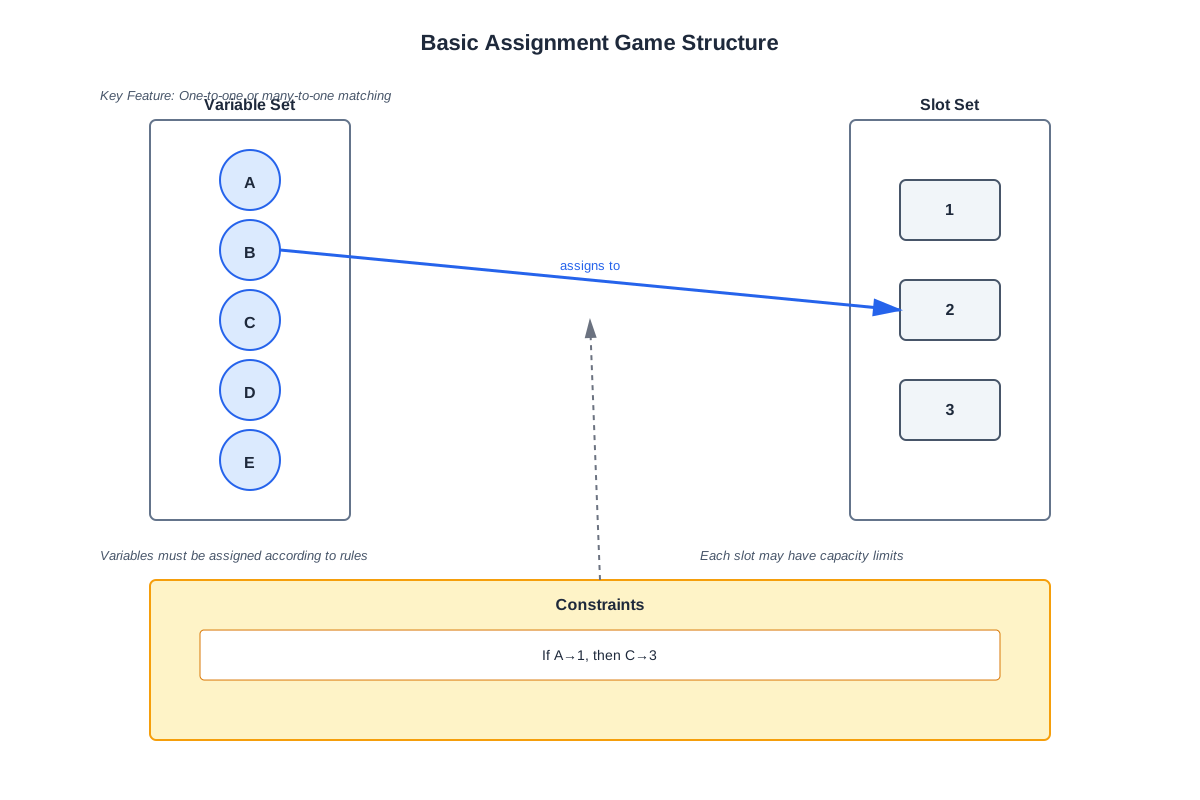
The structure typically involves two distinct sets: the variables (elements being assigned) and the slots (positions receiving assignments). For example, six lawyers (variables) might be assigned to three cases (slots), or five colors (variables) might be assigned to five houses (slots). The relationship can be one-to-one (each variable to exactly one slot) or many-to-one (multiple variables to the same slot), but rarely one-to-many in standard LSAT games.
Core Components of Assignment Games
Every assignment game contains these essential elements:
- Variable Set: The group of elements being assigned (people, objects, attributes)
- Slot Set: The positions, categories, or partners receiving assignments
- Assignment Rules: Constraints that restrict which variables can occupy which slots
- Numerical Constraints: Rules about how many variables per slot or vice versa
- Conditional Relationships: "If-then" rules linking assignments together
Standard Assignment Game Setup
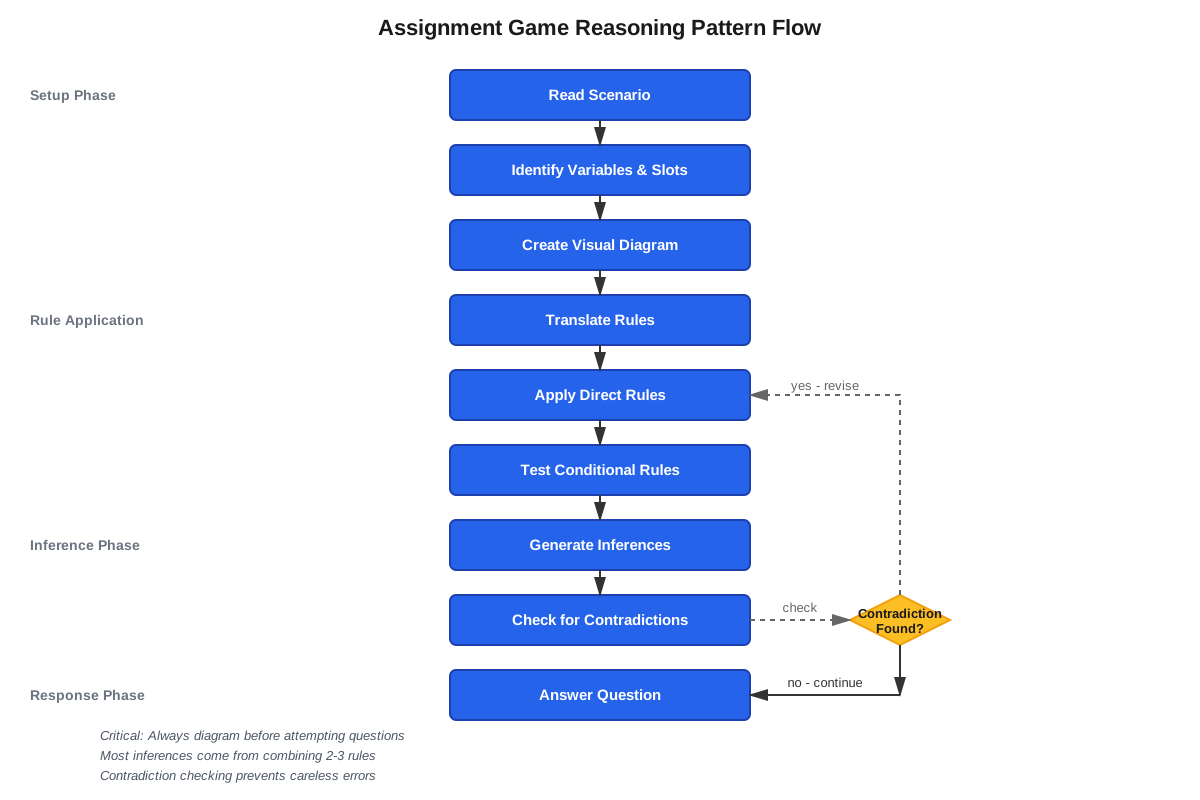
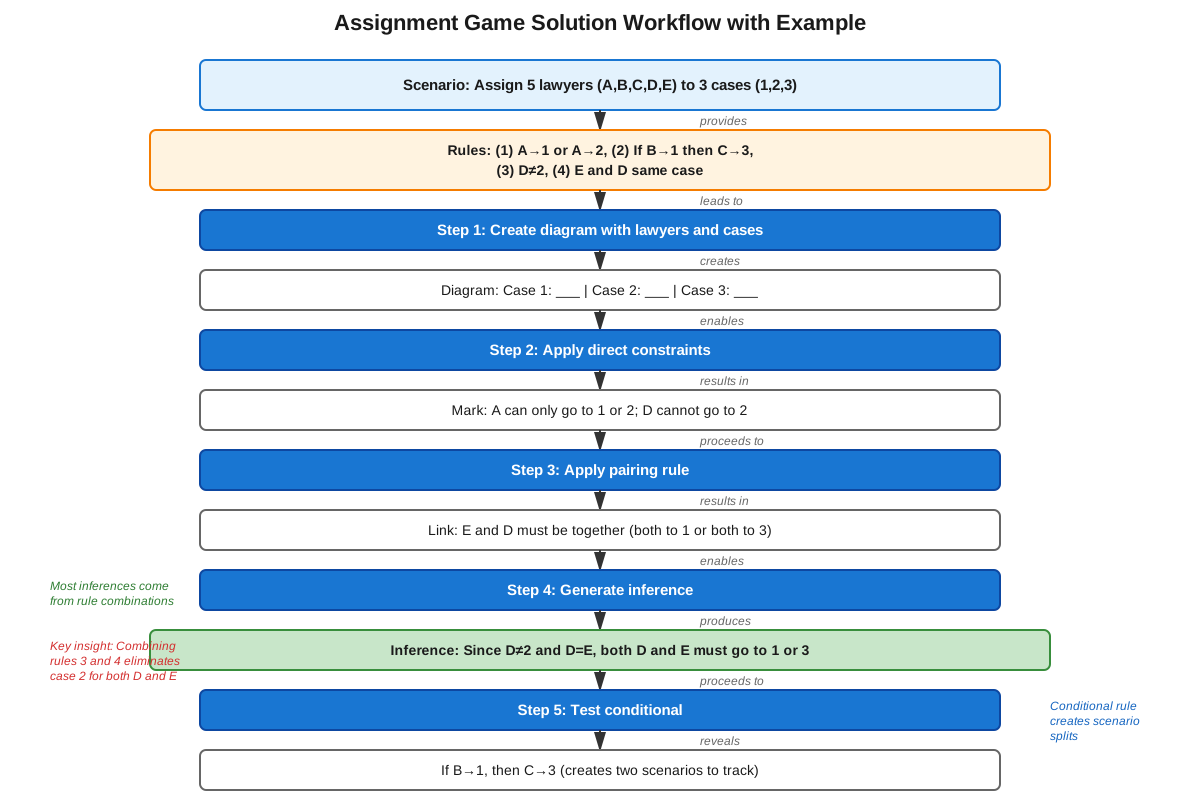
The optimal approach to lsat assignment games follows this systematic process:
- Identify the game type: Recognize assignment structure from the setup paragraph
- Create the base diagram: Draw a visual representation with slots clearly marked
- List all variables: Write out elements to be assigned, noting any subgroups
- Symbolize rules: Convert each constraint into clear, consistent notation
- Make initial inferences: Combine rules to determine forced assignments or restrictions
- Note numerical distributions: Calculate possible assignment patterns
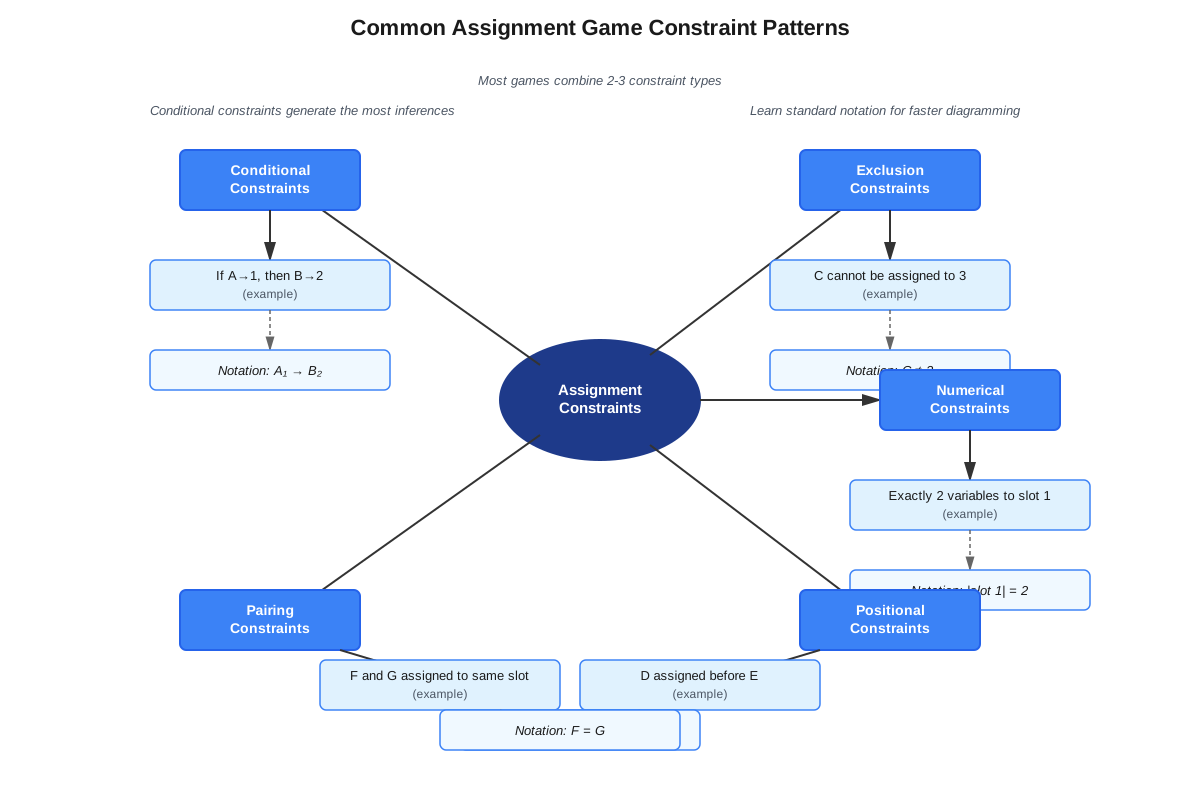
Common Rule Types in Assignment Games
| Rule Type | Example | Diagrammatic Representation | Strategic Implication |
|---|---|---|---|
| Direct Assignment | "A is assigned to slot 3" | A → 3 | Immediately place in diagram |
| Prohibition | "B cannot be in slot 1" | B ≠ 1 | Mark restriction clearly |
| Conditional Assignment | "If C is in slot 2, then D is in slot 4" | C₂ → D₄ | Track contrapositive |
| Pairing Requirement | "E and F must be assigned together" | E ↔ F | Treat as single unit when possible |
| Separation Requirement | "G and H cannot be in the same slot" | G ≠ H | Note mutual exclusion |
| Relative Constraint | "J must be assigned before K" | J...K | Establish ordering relationship |
The Assignment Matrix Approach
For complex assignment games with multiple attributes, the matrix diagram proves most effective. This creates a grid where rows represent variables and columns represent slots (or vice versa). Each cell can be marked with:
- ✓ (checkmark) for confirmed assignments
- ✗ (X) for impossible assignments
- ? (question mark) for uncertain possibilities
This visual system allows rapid scanning for forced assignments and contradictions. When a row or column reaches its numerical limit, all remaining cells in that row/column can be marked impossible, often triggering cascading inferences.
Inference Generation in Assignment Games
The power of assignment games lies in combining rules to generate new information. Key inference patterns include:
Numerical Elimination: If three variables must fill three slots and two are already placed, the third is determined automatically.
Conditional Chains: Linking multiple "if-then" rules creates extended chains: If A₁ → B₂ and B₂ → C₃, then A₁ → C₃.
Contrapositive Application: Every conditional rule has an equally valid contrapositive. If "X in slot 1 means Y in slot 2," then "Y not in slot 2 means X not in slot 1."
Block Formation: When rules require certain variables to be assigned together, treating them as a single block simplifies analysis.
Forced Assignments: When all but one option is eliminated for a particular variable or slot, that assignment becomes certain.
Distribution Patterns
Understanding possible numerical distributions is crucial. If six variables must be assigned to three slots with at least one per slot, the possible distributions are:
- 4-1-1 (four in one slot, one each in the others)
- 3-2-1 (three in one, two in another, one in the third)
- 2-2-2 (two in each slot)
Recognizing which distribution applies often unlocks the entire game. Rules that establish minimum or maximum assignments per slot directly constrain distribution possibilities.
Hybrid Assignment Features
Many LSAT assignment games incorporate additional dimensions:
Assignment with Ordering: Variables are both assigned to slots AND ordered within those slots (e.g., three people assigned to two teams, with ranking within each team).
Assignment with Selection: Some variables may not be assigned at all, adding a selection component to the assignment task.
Multi-Attribute Assignment: Each variable receives multiple assignments (e.g., each person gets both a role and a location).
These hybrid features require tracking multiple relationships simultaneously, making clear diagramming even more critical.
Concept Relationships
Assignment games build directly upon fundamental grouping principles from grouping games legacy. The core concept of dividing elements into categories extends into the more specific task of determining exact pairings. Where basic grouping asks "which elements are in group A versus group B," assignment games ask "which specific element occupies which specific position in group A."
The relationship flow follows this pattern:
Basic Set Theory → Grouping Principles → Assignment Mechanics → Complex Inference Generation
Within assignment games themselves, concepts interconnect hierarchically:
Game Identification → Diagram Construction → Rule Symbolization → Initial Inferences → Question-Specific Deductions → Answer Elimination
The conditional reasoning skills developed in assignment games transfer directly to other analytical reasoning legacy game types. The "if-then" logic practiced here applies equally to sequencing games, selection games, and hybrid scenarios. Similarly, the systematic elimination process—marking impossible options and identifying forced assignments—represents a universal LSAT logic games strategy.
Assignment games also connect forward to more advanced topics. Mastering basic assignment provides the foundation for tackling pattern games (which involve complex assignment patterns), mapping games (which layer multiple assignment relationships), and the most challenging hybrid games that combine assignment with sequencing and selection simultaneously.
High-Yield Facts
⭐ Assignment games appear in approximately 25% of all LSAT Analytical Reasoning sections, making them one of the most frequently tested game types.
⭐ The matrix diagram is the most efficient setup for assignment games with multiple variables and slots, allowing rapid visualization of possibilities and restrictions.
⭐ Every conditional rule in an assignment game has a contrapositive that is equally valid and often more useful for eliminating answer choices.
⭐ When a slot reaches its maximum capacity or a variable exhausts its assignment options, mark all remaining possibilities as impossible to trigger cascading inferences.
⭐ Numerical distribution constraints are often the key to unlocking assignment games—calculate possible distributions before attempting questions.
- Assignment games typically feature 5-8 variables being assigned to 3-6 slots, with 4-6 governing rules.
- The most common question types are "could be true," "must be true," and "if X then which must be false" conditional questions.
- Rules that create blocks (elements that must be assigned together) or anti-blocks (elements that cannot be assigned together) generate the most inferences.
- When two rules share a common element, they can often be combined to create a new inference not explicitly stated.
- Time-efficient test-takers spend 60-90 seconds on setup and initial inferences before attempting questions, which saves time overall.
- Approximately 70% of assignment game questions can be answered by referring to the master diagram and initial inferences without additional work.
- The contrapositive of conditional rules eliminates wrong answers more frequently than the original conditional statement.
Quick check — test yourself on Assignment games so far.
Try Flashcards →Common Misconceptions
Misconception: Assignment games and grouping games are the same thing. → Correction: While assignment games are a subcategory of grouping games, they have the distinct feature of requiring specific one-to-one or many-to-one correspondences. Basic grouping games may simply divide elements into categories without specifying which exact element goes where, while assignment games always require determining specific pairings.
Misconception: Every variable must be assigned to exactly one slot. → Correction: Assignment games vary in their numerical constraints. Some require one-to-one correspondence, but others allow multiple variables per slot (many-to-one) or even leave some variables unassigned. Always check the setup paragraph and rules carefully for numerical constraints.
Misconception: The contrapositive of a rule is less important than the original statement. → Correction: The contrapositive is logically equivalent to the original conditional and often proves more useful for eliminating answer choices. In assignment games, checking contrapositives should be automatic whenever applying conditional rules.
Misconception: All rules must be used to answer every question. → Correction: Different questions activate different subsets of rules. Some questions may be answerable using only 2-3 rules, while others require combining all constraints. Efficient test-takers identify which rules are relevant to each specific question.
Misconception: Making a complete list of all possible assignments is necessary before answering questions. → Correction: Creating exhaustive possibility lists is time-consuming and rarely necessary. Instead, focus on making key inferences from rule combinations and use the process of elimination on individual questions. Only create limited scenarios when a rule creates a clear split (e.g., "either A is in slot 1 or slot 2").
Misconception: Assignment games with more variables are always harder. → Correction: Difficulty depends more on rule complexity and inference density than on the number of variables. A game with eight variables but straightforward rules may be easier than a game with five variables and intricate conditional chains.
Worked Examples
Example 1: Basic Assignment Game
Setup: Six attorneys—F, G, H, J, K, and L—are each assigned to exactly one of three cases—Case 1, Case 2, or Case 3. Each case is assigned at least one attorney. The following conditions apply:
- F is assigned to Case 1
- G and H are assigned to the same case as each other
- If J is assigned to Case 2, then K is assigned to Case 3
- L is not assigned to Case 1
Solution Process:
Step 1 - Diagram Construction: Create a three-column setup with Cases 1, 2, and 3 as headers. List variables F, G, H, J, K, L to the side.
Step 2 - Apply Direct Rules:
- Place F in Case 1 immediately
- Mark L as impossible for Case 1 (L ≠ 1)
- Note that G and H form a block (GH together)
Step 3 - Symbolize Conditional:
- J₂ → K₃
- Contrapositive: K₂ or K₁ → J₁ or J₃
Step 4 - Initial Inferences:
- Case 1 currently has F; it needs at least one attorney, so this minimum is satisfied
- L must be in Case 2 or Case 3
- The GH block must fit entirely in one case
- Since each case needs at least one attorney and we have six attorneys for three cases, possible distributions are 4-1-1, 3-2-1, or 2-2-2
Step 5 - Question Application:
If the question asks "Which could be a complete and accurate assignment?" we would check each answer choice against our rules:
- Does it place F in Case 1? (Required)
- Does it keep G and H together? (Required)
- Does it keep L out of Case 1? (Required)
- Does it satisfy the conditional about J and K? (Required)
- Does each case have at least one attorney? (Required)
Key Insight: The GH block is the most restrictive element. Since it requires two slots in one case, and we need at least one attorney per case, the GH block's placement significantly constrains the remaining assignments.
Example 2: Complex Conditional Assignment
Setup: Five colors—red, blue, green, yellow, and purple—are assigned to five houses numbered 1 through 5. Each house receives exactly one color. The following rules apply:
- Red is assigned to house 3
- If blue is assigned to house 1, then green is assigned to house 5
- Yellow is assigned to a house numbered lower than purple's house
- Green is not assigned to house 2
Solution Process:
Step 1 - Create Linear Diagram: Draw five slots numbered 1-5.
Step 2 - Apply Absolute Rules:
- Place Red in house 3 (R₃)
- Mark Green as impossible for house 2 (G ≠ 2)
Step 3 - Analyze Conditional:
- B₁ → G₅
- Contrapositive: G₅̄ → B₁̄ (If green is NOT in 5, then blue is NOT in 1)
Step 4 - Analyze Relative Constraint:
- Y...P (Yellow comes before Purple in house number)
- This means: Y cannot be in house 5 (no room for P after it)
- P cannot be in house 1 (no room for Y before it)
- Mark: Y ≠ 5, P ≠ 1
Step 5 - Combine Inferences:
- Houses available: 1, 2, 4, 5 (since 3 has Red)
- Colors to place: Blue, Green, Yellow, Purple
- Green cannot be in 2, so Green must be in 1, 4, or 5
- Yellow cannot be in 5, so Yellow must be in 1, 2, or 4
- Purple cannot be in 1, so Purple must be in 2, 4, or 5
Step 6 - Test Scenarios:
If Blue is in house 1, then Green must be in house 5 (by conditional rule). This would leave houses 2 and 4 for Yellow and Purple. Since Yellow must come before Purple, Yellow would be in house 2 and Purple in house 4. This scenario is valid: B₁-Y₂-R₃-P₄-G₅.
If Blue is NOT in house 1, then Blue must be in house 2, 4, or 5. Green could be in 1, 4, or 5 (but not 2). Multiple arrangements become possible.
Key Insight: The conditional rule creates a clear split in possibilities. When approaching questions, first determine whether blue is in house 1, as this determines green's placement and constrains the remaining assignments significantly. The relative constraint (Y...P) eliminates specific positions for both colors, which combines with other rules to force certain assignments.
Exam Strategy
Recognition Triggers
Identify assignment games immediately by watching for these phrases in the setup paragraph:
- "Each [variable] is assigned to exactly one [slot]"
- "Six people are matched with three roles"
- "Colors are distributed among houses"
- "Employees are assigned to departments"
- "Items are paired with categories"
The key indicator is the presence of two distinct sets with a matching or pairing relationship between them.
Optimal Setup Sequence
Spend 60-90 seconds on initial setup following this sequence:
- Read the setup paragraph twice to understand the basic structure
- Draw the diagram with clear labels for all slots
- List all variables in a visible location
- Symbolize each rule using consistent notation
- Make immediate inferences from rule combinations
- Note numerical constraints and possible distributions
Exam Tip: Never skip the inference step. Spending an extra 20 seconds finding key inferences saves 60+ seconds across all questions.
Question Attack Strategy
For "Could Be True" questions: Look for answer choices that violate no rules. Often four answers will break explicit rules or forced inferences, making them quickly eliminable.
For "Must Be True" questions: Check your master diagram and initial inferences first. If the answer isn't immediately apparent, test each choice by seeing if its opposite creates a contradiction.
For "If X, then which..." questions: Create a mini-scenario incorporating the new condition. Apply all rules to this scenario and look for forced assignments. These questions often have one or two cascading inferences that determine the answer.
For "Complete and Accurate List" questions: Use process of elimination systematically. Check each answer choice against rules, eliminating those that violate constraints or omit required elements.
Time Management
Allocate time as follows for a typical 5-7 question assignment game:
- Setup and initial inferences: 60-90 seconds
- First question (usually "could be true" acceptability): 20-30 seconds
- Standard questions: 30-45 seconds each
- Complex conditional questions: 60-90 seconds each
If a question requires more than 90 seconds, mark it and return after completing easier questions. The LSAT rewards efficient point collection, not perfect completion.
Process of Elimination Tactics
Rule Violation Scanning: For acceptability questions, check each rule against all answer choices systematically. Eliminate choices that violate any rule.
Contrapositive Checking: When conditional rules are involved, always check both the original statement and its contrapositive against answer choices.
Numerical Verification: Ensure answer choices satisfy all numerical constraints (minimum/maximum assignments per slot).
Forced Assignment Recognition: If your inferences show that a particular assignment is forced, eliminate any answer choice that contradicts this.
Memory Techniques
The ASSIGN Mnemonic
Remember the systematic approach to assignment games with ASSIGN:
- Analyze the setup (identify game type and structure)
- Symbolize all rules clearly
- Slot diagram creation (draw the base)
- Inferences from rule combinations
- Generate scenarios only when necessary
- Numerical constraints tracking
Visual Anchoring
Create a mental image of a matching board with pegs on the left (variables) and holes on the right (slots). Imagine physically connecting them with strings, where rules are barriers that block certain connections. This visualization helps maintain spatial awareness of which assignments are possible.
The Contrapositive Reminder
Use the phrase "Flip and Negate" to remember contrapositive formation:
- Flip the order of the conditional statement
- Negate both components
For "If A then B," flip to "If B then A" and negate to "If NOT B then NOT A."
Rule Type Acronym: DPCPSR
Remember common rule types with DPCPSR:
- Direct assignment
- Prohibition
- Conditional
- Pairing requirement
- Separation requirement
- Relative constraint
Summary
Assignment games represent a critical component of LSAT Analytical Reasoning, requiring test-takers to establish specific correspondences between elements from different sets according to complex rule systems. Success depends on three core competencies: creating clear visual diagrams that represent assignment relationships, systematically applying rules to generate inferences, and efficiently eliminating impossible options. The matrix diagram approach proves most effective for tracking multiple variables and slots, while careful attention to conditional rules and their contrapositives unlocks the majority of challenging questions. Numerical distribution analysis often provides the key insight that determines possible assignment patterns. By recognizing assignment game structures immediately, investing time in thorough setup and inference generation, and applying systematic elimination strategies, test-takers can consistently achieve high accuracy on these frequently-tested games. The skills developed through assignment games—constraint satisfaction, logical inference, and systematic organization—transfer directly to other Analytical Reasoning game types and represent fundamental legal reasoning abilities.
Key Takeaways
- Assignment games require establishing specific one-to-one or many-to-one correspondences between variables and slots, distinguishing them from basic grouping games
- The matrix diagram with checkmarks and X's provides the most efficient visual system for tracking assignments and restrictions
- Every conditional rule has an equally valid contrapositive that often proves more useful for eliminating wrong answers
- Numerical distribution analysis (calculating how many variables per slot) frequently unlocks entire games
- Investing 60-90 seconds in setup and initial inferences saves significant time across all questions
- Combining rules that share common elements generates the most powerful inferences
- Recognition triggers include phrases like "assigned to," "matched with," "paired with," and "distributed among"
Related Topics
Sequencing Games: After mastering assignment games, sequencing games add the dimension of ordering elements in specific positions. The diagramming skills from assignment games transfer directly, with the added complexity of relative positioning rules.
Selection Games: These games determine which elements are "in" versus "out" rather than matching elements to specific slots. Understanding assignment principles helps recognize when selection and assignment combine in hybrid games.
Hybrid Grouping Games: Advanced games that combine assignment with other game types (sequencing, selection, or pattern matching) require fluency in basic assignment mechanics as a foundation.
Advanced Conditional Logic: Deeper exploration of conditional reasoning, including sufficient/necessary conditions and complex conditional chains, builds upon the conditional rules common in assignment games.
Distribution Games: These focus specifically on numerical patterns of how elements are distributed across categories, extending the distribution analysis introduced in assignment games.
Practice CTA
Now that you understand the core principles of assignment games, it's time to apply this knowledge through deliberate practice. Attempt the practice questions associated with this topic, focusing on implementing the systematic setup process and inference generation techniques covered in this guide. Use the flashcards to reinforce rule types, common patterns, and key strategies until they become automatic. Remember that mastery comes through repeated application—each practice game strengthens your pattern recognition and increases your speed. The investment you make in practicing assignment games will pay dividends not only on these specific game types but across the entire Analytical Reasoning section. You have the tools; now build the skill through consistent, focused practice.
Sign up free to keep reading
Create a free AnvayaPrep account to finish this LSAT guide on Assignment games — plus flashcards and practice questions.