Overview
Conditional grouping rules represent one of the most frequently tested and strategically important elements within Analytical Reasoning Legacy questions on the LSAT. These rules establish relationships between elements in grouping games legacy by creating "if-then" statements that dictate which elements must be included or excluded from groups based on the selection or placement of other elements. Unlike simple assignment rules that directly place elements into groups, conditional grouping rules create dynamic relationships that cascade through the game setup, often triggering multiple inferences and determining the correct answer to questions.
Mastering LSAT conditional grouping rules is essential because they appear in approximately 60-70% of all grouping games and frequently serve as the key to unlocking the most challenging questions. These rules require students to think both forward (what happens if X is selected?) and backward (what must be true for Y to be selected?), demanding a sophisticated understanding of logical relationships. The ability to quickly identify, notate, and apply these rules separates high-scoring test-takers from those who struggle with the Analytical Reasoning section.
Within the broader context of Analytical Reasoning Legacy, conditional grouping rules bridge fundamental logic concepts with practical game-solving strategies. They build upon basic conditional reasoning while adding the complexity of group membership, selection constraints, and numerical limitations. Understanding these rules provides the foundation for tackling advanced grouping scenarios, including games with multiple groups, overlapping conditions, and compound conditional statements that test the limits of logical reasoning under time pressure.
Learning Objectives
- [ ] Identify how Conditional grouping rules appears in LSAT questions
- [ ] Explain the reasoning pattern behind Conditional grouping rules
- [ ] Apply Conditional grouping rules to solve LSAT-style problems accurately
- [ ] Translate conditional grouping statements from English into symbolic notation efficiently
- [ ] Generate valid contrapositives of conditional grouping rules and recognize their implications
- [ ] Chain multiple conditional grouping rules together to derive complex inferences
- [ ] Distinguish between sufficient and necessary conditions in grouping contexts
Prerequisites
- Basic conditional logic (if-then statements): Understanding sufficient and necessary conditions is fundamental to interpreting conditional grouping rules correctly
- Contrapositive formation: The ability to form contrapositives is essential for working backward through conditional chains in grouping games
- Basic grouping game structure: Familiarity with selection games, distribution games, and group assignment provides the context in which conditional rules operate
- Symbolic notation conventions: Knowledge of standard LSAT notation (arrows, slashes, tildes) enables efficient diagramming and rule tracking
- Set theory basics: Understanding membership, inclusion, and exclusion concepts helps visualize how conditional rules affect group composition
Why This Topic Matters
Conditional grouping rules appear in the majority of Analytical Reasoning Legacy games and represent a high-yield investment of study time. According to analysis of released LSAT exams, approximately 65% of grouping games include at least one conditional rule, and these rules are disproportionately featured in questions worth the most points. Games with multiple conditional rules often appear as the most difficult game in a section, making them critical for achieving competitive scores.
In practical terms, conditional grouping rules test the core skill that law schools value most: the ability to track complex logical relationships and their implications. Legal reasoning frequently involves understanding how one fact or condition triggers others, making this topic directly relevant to legal practice. Students who master conditional grouping rules report significant score improvements, often gaining 3-5 additional correct answers per Analytical Reasoning section.
On the LSAT, conditional grouping rules typically appear in several distinct formats: selection games where choosing one element requires or prohibits choosing another; distribution games where placing an element in one group affects placement in other groups; and hybrid games combining selection with ordering or other constraints. Questions may ask about what must be true if a condition is met, what could be true, what must be false, or which elements could complete a valid scenario. The most challenging questions often require chaining multiple conditional rules together or recognizing when a contrapositive applies.
Core Concepts
Structure of Conditional Grouping Rules
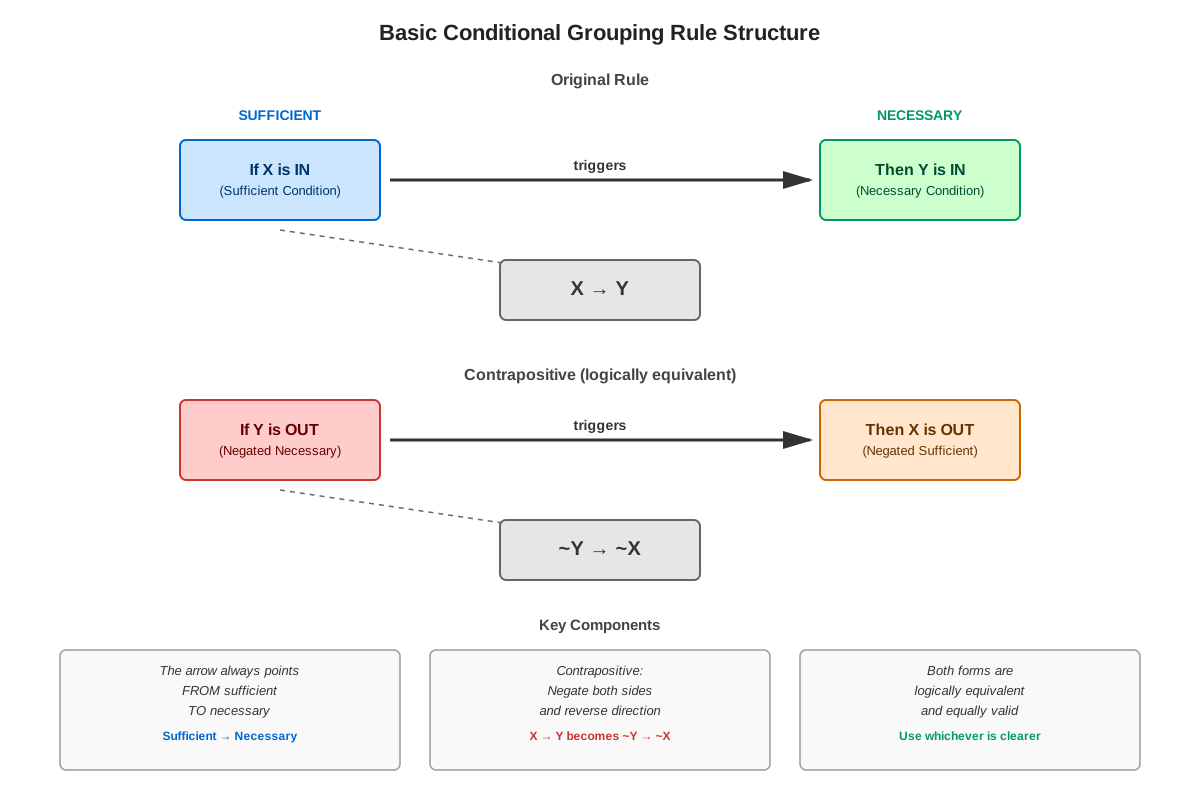
A conditional grouping rule establishes a logical relationship between the selection or placement of elements in a grouping game. The standard form follows the pattern: "If [sufficient condition], then [necessary condition]." In grouping contexts, these conditions involve whether elements are included in or excluded from specific groups.
The sufficient condition is the trigger—when this condition is met, the rule activates. The necessary condition is the guaranteed result—this must occur whenever the sufficient condition is satisfied. For example, "If Marcus is selected for the team, then Nora must also be selected" creates a conditional relationship where Marcus's selection (sufficient) guarantees Nora's selection (necessary).
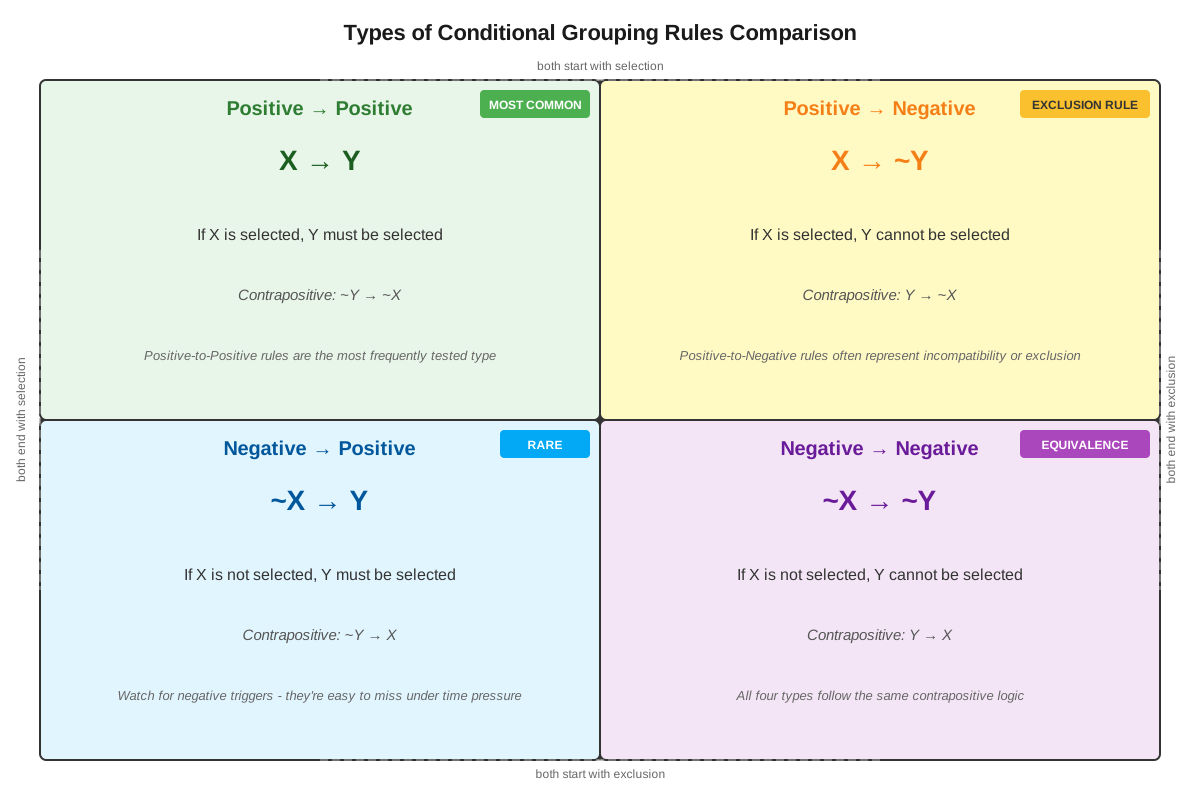
Conditional grouping rules can be expressed in four primary forms:
| Rule Type | Structure | Example | Notation |
|---|---|---|---|
| Positive → Positive | If X is in, then Y is in | If M is selected, N is selected | M → N |
| Positive → Negative | If X is in, then Y is out | If M is selected, N is not selected | M → ~N |
| Negative → Positive | If X is out, then Y is in | If M is not selected, N is selected | ~M → N |
| Negative → Negative | If X is out, then Y is out | If M is not selected, N is not selected | ~M → ~N |
Contrapositive Formation in Grouping Games
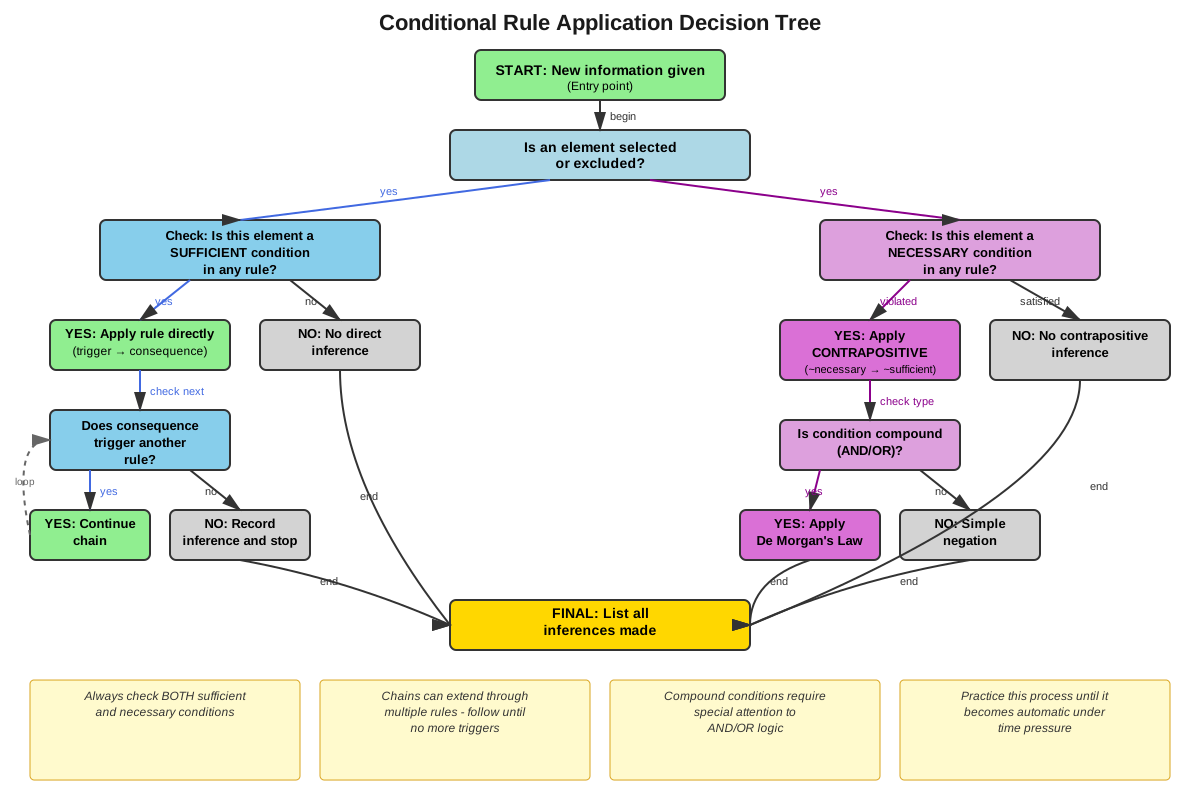
Every conditional rule has a logically equivalent contrapositive formed by negating both conditions and reversing their order. The contrapositive is not merely a related statement—it is logically identical to the original rule and must always be considered when applying conditional grouping rules.
For the rule "M → N" (If Marcus is selected, Nora is selected), the contrapositive is "~N → ~M" (If Nora is NOT selected, Marcus is NOT selected). This reveals a crucial insight: Nora's absence prevents Marcus's selection, even though the original rule only explicitly mentioned what happens when Marcus is selected.
The contrapositive becomes especially powerful in grouping games because it often reveals exclusionary relationships that aren't immediately obvious from the original rule. When a question asks "Which of the following could be true?" or "What must be false?", the contrapositive frequently provides the fastest path to elimination.
Conditional Chains and Transitive Inferences
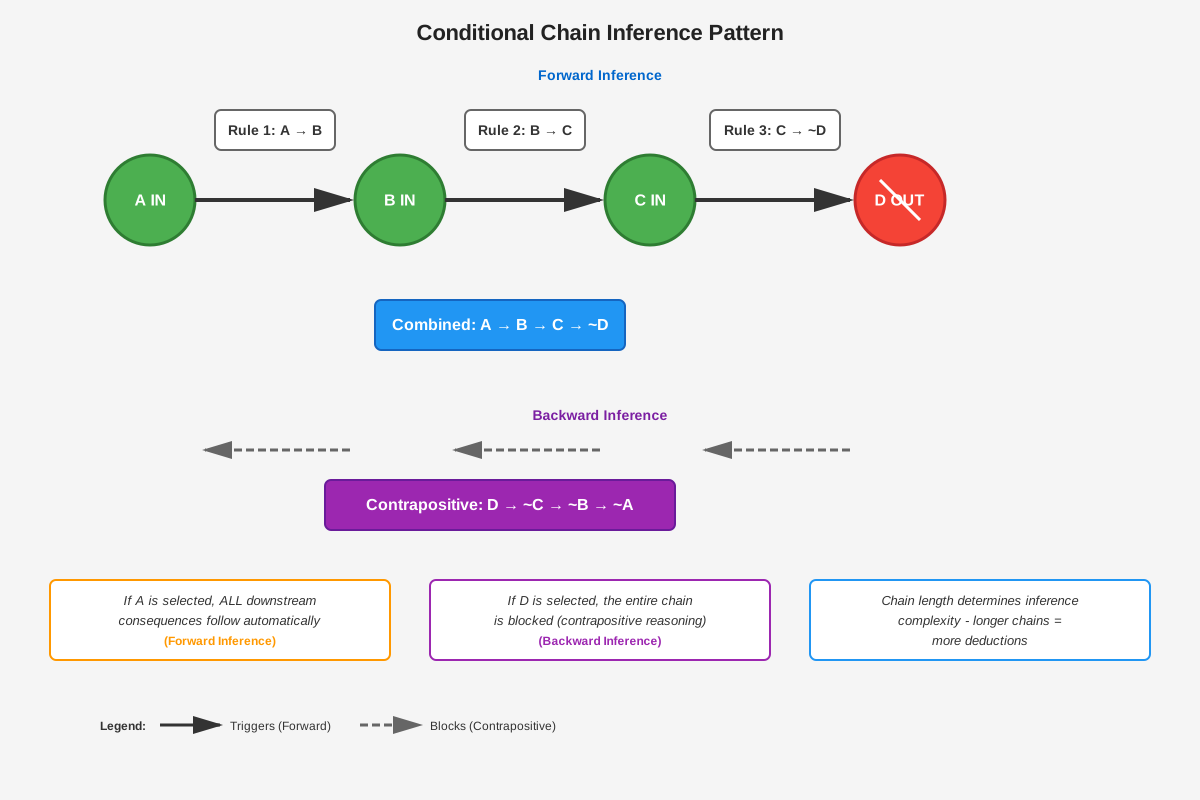
When multiple conditional grouping rules share common elements, they can be chained together to create transitive inferences. If "M → N" and "N → P" are both rules, then by transitivity, "M → P" must also be true. This derived rule, though not explicitly stated, is just as binding as the original rules.
Consider this chain:
- If Marcus is selected, then Nora is selected (M → N)
- If Nora is selected, then Paulo is selected (N → P)
- Therefore: If Marcus is selected, then Paulo is selected (M → P)
The contrapositive chain works in reverse:
- If Paulo is NOT selected, then Nora is NOT selected (~P → ~N)
- If Nora is NOT selected, then Marcus is NOT selected (~N → ~M)
- Therefore: If Paulo is NOT selected, then Marcus is NOT selected (~P → ~M)
Recognizing these chains quickly is essential for efficient game-solving. Many LSAT questions are designed specifically to test whether students can trace conditional chains to their logical conclusions.
Biconditional Relationships
Occasionally, grouping games include biconditional rules where two elements must always be selected or rejected together. This occurs when both "M → N" and "N → M" are true, creating a relationship where Marcus and Nora are inseparable—either both are selected or neither is selected.
Biconditional relationships can be notated as "M ↔ N" and should be recognized immediately because they significantly constrain the game. When one element of a biconditional pair appears in a question, the other element's status is automatically determined.
Conditional Rules with Multiple Necessary Conditions
Some conditional grouping rules have compound necessary conditions: "If Marcus is selected, then both Nora AND Paulo must be selected" (M → N + P). This single sufficient condition triggers multiple necessary results. The contrapositive becomes: "If Nora is NOT selected OR Paulo is NOT selected, then Marcus is NOT selected" (~N OR ~P → ~M).
The logical structure here is critical: the absence of ANY necessary condition prevents the sufficient condition. This "OR" relationship in the contrapositive often catches students off-guard, but it follows directly from the logic of necessary conditions.
Conditional Rules with Multiple Sufficient Conditions
Conversely, rules may specify that multiple sufficient conditions lead to a single necessary condition: "If Marcus is selected OR if Nora is selected, then Paulo must be selected" (M OR N → P). Here, either trigger activates the rule. The contrapositive states: "If Paulo is NOT selected, then Marcus is NOT selected AND Nora is NOT selected" (~P → ~M + ~N).
This structure means that Paulo's absence eliminates both potential triggers simultaneously, which can create powerful restrictions in the game.
Conditional Rules in Multi-Group Games
When grouping games involve multiple distinct groups (e.g., Team A and Team B), conditional rules may specify cross-group relationships: "If Marcus is on Team A, then Nora must be on Team B." These rules require careful notation to track which group each element enters.
The notation might be: M_A → N_B (Marcus in A requires Nora in B). The contrapositive becomes: ~N_B → ~M_A (If Nora is not in B, Marcus is not in A). Note that this doesn't tell us where Nora IS if she's not in B—she might be in A or not selected at all, depending on the game's structure.
Concept Relationships
Conditional grouping rules build directly upon fundamental conditional logic, extending "if-then" reasoning into the context of group membership and selection. The core relationship flows: Basic Conditional Logic → Contrapositive Formation → Conditional Grouping Rules → Conditional Chains → Complex Inferences.
Within conditional grouping rules themselves, several interconnected concepts operate simultaneously. Rule identification leads to symbolic notation, which enables contrapositive generation, which in turn allows chain recognition. These chained rules produce derived inferences that constrain the game's possible scenarios. Each inference may trigger additional rules, creating a cascade effect that experienced test-takers learn to trace efficiently.
The relationship between conditional grouping rules and other grouping game elements is also crucial. Numerical constraints (e.g., "exactly 3 elements must be selected") interact with conditional rules to create definitive scenarios. If a conditional chain requires three specific elements when one is selected, and the game limits selection to exactly three elements, then selecting that trigger element completely determines the solution.
Conditional grouping rules also connect forward to more advanced topics like conditional sequencing (where conditional rules affect ordering) and hybrid games (where grouping and ordering constraints interact). Mastering conditional grouping rules provides the logical foundation for these more complex game types.
Quick check — test yourself on Conditional grouping rules so far.
Try Flashcards →High-Yield Facts
⭐ Every conditional rule has a contrapositive that is logically equivalent and must be considered in every question
⭐ The contrapositive is formed by negating both conditions and reversing their order (A → B becomes ~B → ~A)
⭐ Conditional chains can be traced forward through sufficient conditions or backward through contrapositives
⭐ When a necessary condition fails, the sufficient condition cannot occur (contrapositive application)
⭐ Multiple conditional rules sharing common elements often create powerful derived inferences
- Biconditional relationships (A ↔ B) mean both elements must always have the same status (both in or both out)
- A rule with multiple necessary conditions (A → B + C) has a contrapositive with "OR" (~B OR ~C → ~A)
- A rule with multiple sufficient conditions (A OR B → C) has a contrapositive with "AND" (~C → ~A + ~B)
- Conditional rules never tell you what happens when the sufficient condition is NOT met—only the contrapositive provides that information
- In selection games, "If A is selected, B is not selected" (A → ~B) means A and B cannot both be selected, but both could be rejected
- Conditional rules can create "trigger elements" that, when selected, force multiple other selections through chains
- The absence of a necessary condition is just as informative as the presence of a sufficient condition
Common Misconceptions
Misconception: If the sufficient condition doesn't occur, the necessary condition cannot occur either.
Correction: Conditional rules only specify what happens when the sufficient condition IS met. If Marcus → Nora, and Marcus is NOT selected, Nora could still be selected for other reasons. The rule places no restriction on Nora when Marcus is absent.
Misconception: The contrapositive is a separate, additional rule that might or might not apply.
Correction: The contrapositive is logically identical to the original rule—it's the same rule expressed differently. If one is true, the other must be true. Both must be considered simultaneously when solving problems.
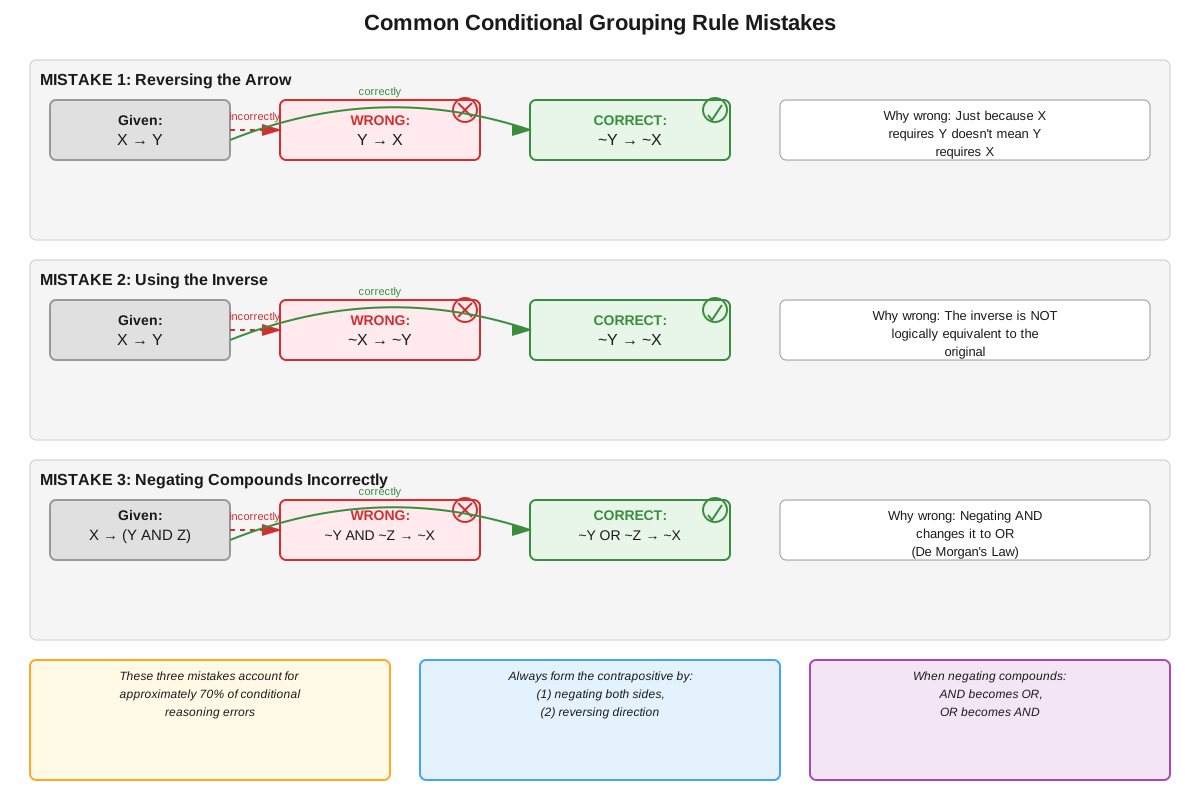
Misconception: "If A, then B" means the same as "If B, then A."
Correction: These are completely different statements. The first makes B necessary for A; the second makes A necessary for B. Reversing a conditional without negating creates an invalid inference called "reversing the logic."
Misconception: In a rule like "If A is selected, then B and C are selected," the contrapositive is "If B and C are not selected, then A is not selected."
Correction: The contrapositive uses "OR," not "AND": "If B is not selected OR C is not selected, then A is not selected." The failure of ANY necessary condition prevents the sufficient condition.
Misconception: Conditional rules tell you what must happen in every scenario.
Correction: Conditional rules only activate when their sufficient condition is met. Many game scenarios may never trigger certain conditional rules, making them irrelevant to those particular questions.
Misconception: If two elements appear in the same conditional rule, they must be related in every question.
Correction: The relationship only matters when the sufficient condition is satisfied. In questions where the sufficient condition isn't met, the elements may have no relationship at all.
Worked Examples
Example 1: Basic Conditional Chain
Game Setup: A committee must select exactly 4 members from 7 candidates: F, G, H, J, K, L, M. The following rules apply:
- If F is selected, then G must be selected
- If G is selected, then H must be selected
- If H is selected, then J cannot be selected
Question: If F is selected for the committee, which of the following must be true?
Solution Process:
Step 1: Identify the trigger. F is selected, which activates the first rule.
Step 2: Trace the conditional chain forward:
- F is selected → G must be selected (Rule 1)
- G is selected → H must be selected (Rule 2)
- H is selected → J cannot be selected (Rule 3)
Step 3: List what we know for certain:
- F is IN (given)
- G is IN (from Rule 1)
- H is IN (from Rule 2)
- J is OUT (from Rule 3)
Step 4: Apply the numerical constraint. We need exactly 4 members, and we've already determined 3 (F, G, H). Therefore, exactly one of K, L, or M must be selected to complete the committee.
Answer: G and H must both be selected, and J cannot be selected. The fourth member must be K, L, or M.
Connection to Learning Objectives: This example demonstrates how to identify conditional rules in context, trace the reasoning pattern through multiple linked conditions, and apply the rules to determine what must be true in a specific scenario.
Example 2: Contrapositive Application
Game Setup: A film festival will screen exactly 5 films from 8 options: A, B, C, D, E, F, G, H. The following rules apply:
- If A is screened, then B is screened
- If C is screened, then D is not screened
- If E is screened, then F is screened
Question: If B is not screened, which of the following could be a complete and accurate list of the films screened?
Solution Process:
Step 1: Identify the key information. B is NOT screened, which triggers a contrapositive.
Step 2: Find the relevant contrapositive. The rule "If A is screened, then B is screened" (A → B) has the contrapositive "If B is not screened, then A is not screened" (~B → ~A).
Step 3: Apply the contrapositive. Since B is not screened, A cannot be screened either.
Step 4: Determine what we know:
- A is OUT (from contrapositive)
- B is OUT (given)
- We need to select 5 films from the remaining 6: C, D, E, F, G, H
Step 5: Check other rules for additional constraints:
- Rule 2: C and D cannot both be selected (C → ~D)
- Rule 3: If E is selected, F must be selected (E → F)
Step 6: Evaluate answer choices. A valid list must:
- Exclude both A and B
- Not include both C and D
- Include F if it includes E
- Contain exactly 5 films
Answer: Any combination of 5 films from {C, D, E, F, G, H} that respects the remaining rules. For example: C, E, F, G, H (excludes D because C is included, includes F because E is included).
Connection to Learning Objectives: This example shows how to recognize when a contrapositive applies, translate the logical relationship correctly, and use it to eliminate impossible scenarios and identify valid solutions.
Exam Strategy
When approaching LSAT questions involving conditional grouping rules, begin by identifying all conditional statements in the game setup and immediately writing both the rule and its contrapositive. Use consistent notation (arrows, tildes, etc.) to avoid confusion under time pressure. Many students lose points not because they don't understand conditional logic, but because they fail to consider contrapositives or misread their own notation.
Trigger words and phrases that signal conditional grouping rules include: "if," "only if," "whenever," "unless," "must," "cannot," "requires," "prohibits," "depends on," and "is contingent upon." The phrase "only if" is particularly tricky—"A only if B" means A → B (not B → A). The word "unless" typically means "if not": "A unless B" translates to ~B → A.
For process of elimination, immediately eliminate answer choices that violate known conditional chains. If a question states "F is selected" and you've determined through conditional chains that this requires G and H, any answer choice that includes F without G or H can be eliminated instantly. Similarly, use contrapositives to eliminate choices: if an answer suggests an element is absent when a necessary condition for that element is present, it's impossible.
Time allocation for conditional grouping games should prioritize upfront inference-making. Spend 2-3 minutes at the start identifying all conditional chains and writing out key contrapositives. This investment pays dividends across all questions for that game. For individual questions, if you don't see the answer immediately, work backward from answer choices, testing each against your conditional rules rather than trying to construct the solution from scratch.
Exam Tip: When a question asks "which could be true," use conditional rules to eliminate what MUST be false. When a question asks "which must be true," use conditional rules to identify what cannot be false. The contrapositive is often the fastest route to elimination.
Memory Techniques
Mnemonic for Contrapositive Formation: "Negate and Reverse" (NR). To form a contrapositive, Negate both conditions and Reverse their order. Think "NR" as in "Not Reversed without Negation."
Visualization Strategy: Picture conditional rules as one-way streets with arrows. The sufficient condition is the entrance; the necessary condition is the required destination. The contrapositive is the same street viewed from the opposite direction—if you can't reach the destination, you couldn't have entered the street.
Acronym for Multiple Conditions: "SWAN" - Sufficient with AND becomes contrapositive with Not (OR). When multiple necessary conditions are connected with AND, the contrapositive connects them with OR (and vice versa).
Chain Recognition Technique: When reading rules, circle any element that appears in multiple rules. These "hub elements" are likely to create conditional chains and should be your focus for deriving inferences.
Contrapositive Quick-Check: Use the phrase "No Necessary, No Sufficient" to remember that when a necessary condition fails, the sufficient condition cannot occur. This helps trigger contrapositive thinking during questions.
Summary
Conditional grouping rules form the logical backbone of most LSAT Analytical Reasoning Legacy grouping games, establishing "if-then" relationships that determine which elements must be included or excluded from groups based on other elements' status. These rules require understanding both the original conditional statement and its contrapositive—the logically equivalent statement formed by negating and reversing both conditions. Mastery involves quickly identifying conditional relationships, translating them into efficient notation, recognizing when multiple rules chain together to create derived inferences, and applying both forward reasoning (from sufficient to necessary conditions) and backward reasoning (through contrapositives) to solve questions. The most common error is failing to consider contrapositives or misunderstanding how multiple conditions interact in compound rules. Success requires systematic notation, careful attention to logical structure, and practiced recognition of how conditional chains constrain possible scenarios. Students who master conditional grouping rules gain a significant advantage on the LSAT, as these rules appear frequently and often determine the correct answer to the most challenging questions in the Analytical Reasoning section.
Key Takeaways
- Every conditional rule has a contrapositive formed by negating both conditions and reversing their order; both must be considered simultaneously
- Conditional chains occur when rules share common elements, allowing transitive inferences that create powerful derived rules
- The contrapositive reveals what cannot happen when necessary conditions fail, often providing the fastest path to eliminating wrong answers
- Multiple necessary conditions connected with "AND" become "OR" in the contrapositive, and vice versa
- Conditional rules only specify what happens when the sufficient condition is met; they place no restrictions when it isn't met
- Systematic notation and upfront inference-making are essential for efficient problem-solving under time pressure
- Recognizing "hub elements" that appear in multiple rules helps identify the most important conditional chains quickly
Related Topics
Conditional Sequencing Rules: Builds on conditional grouping by adding ordering constraints, where conditional relationships determine not just group membership but also relative position or sequence. Mastering conditional grouping rules provides the logical foundation for these more complex scenarios.
Numerical Distribution in Grouping Games: Explores how numerical constraints (exactly X elements, at least Y elements) interact with conditional rules to create definitive scenarios. Understanding conditional grouping rules is essential before tackling how numbers further constrain possibilities.
Biconditional Relationships and Blocks: Examines special cases where elements must always appear together or never appear together, extending the conditional logic framework to more rigid constraints.
Hybrid Games (Grouping + Ordering): Combines grouping game elements with sequencing constraints, requiring simultaneous application of conditional grouping rules and ordering rules. This advanced topic builds directly on conditional grouping mastery.
Formal Logic in Logical Reasoning: Applies the same conditional reasoning principles to Logical Reasoning questions, demonstrating how conditional logic skills transfer across LSAT sections.
Practice CTA
Now that you've mastered the core concepts of conditional grouping rules, it's time to cement your understanding through active practice. Attempt the practice questions designed specifically for this topic, focusing on identifying conditional relationships, forming contrapositives, and tracing conditional chains efficiently. Use the flashcards to drill the key concepts until recognizing and applying these rules becomes automatic. Remember: conditional grouping rules appear in the majority of grouping games, making this one of the highest-yield topics for score improvement. Every minute spent practicing these concepts translates directly into points on test day. You've built the foundation—now strengthen it through deliberate, focused practice!
Sign up free to keep reading
Create a free AnvayaPrep account to finish this LSAT guide on Conditional grouping rules — plus flashcards and practice questions.