Overview
Numerical distribution is a foundational concept within Analytical Reasoning Legacy that appears frequently in grouping games legacy on the LSAT. This concept involves determining how a fixed number of elements can be allocated across multiple groups or categories, often with specific constraints governing the minimum, maximum, or exact number of elements each group must contain. Mastering numerical distribution is essential because it forms the structural backbone of many grouping games—before students can determine which specific elements go where, they must first understand the possible numerical arrangements that satisfy the game's rules.
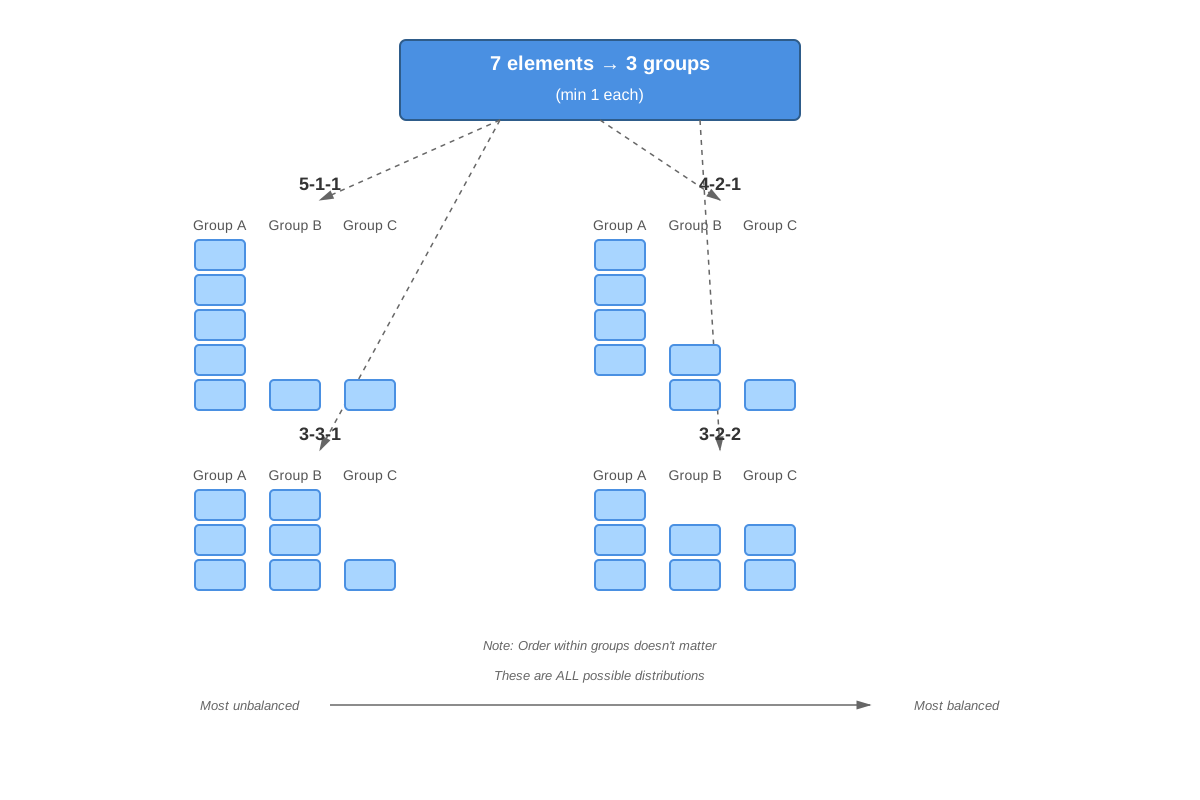
On the LSAT, numerical distribution questions test a student's ability to think systematically about possibilities and constraints. These problems require recognizing when distribution matters, calculating all viable distribution patterns, and applying those patterns to eliminate impossible answer choices or identify necessary truths. The skill extends beyond simple counting; it demands logical reasoning about how constraints interact to limit or expand possibilities. For instance, if seven people must be assigned to three committees with each committee having at least one member, the possible distributions (5-1-1, 4-2-1, 3-3-1, 3-2-2) become critical information that shapes every subsequent deduction.
Within the broader landscape of Analytical Reasoning, numerical distribution serves as a bridge between understanding game rules and making concrete deductions. It connects to sequencing games when order matters within groups, to selection games when choosing which elements to include, and to hybrid games that combine multiple reasoning patterns. Students who develop strong numerical distribution skills gain a significant advantage in game setup efficiency, often solving questions faster by eliminating entire categories of impossible arrangements before examining individual answer choices.
Learning Objectives
- [ ] Identify how Numerical distribution appears in LSAT questions
- [ ] Explain the reasoning pattern behind Numerical distribution
- [ ] Apply Numerical distribution to solve LSAT-style problems accurately
- [ ] Calculate all possible numerical distributions for a given set of constraints
- [ ] Distinguish between fixed, balanced, and unbalanced distribution patterns
- [ ] Recognize when numerical distribution analysis should be performed during game setup versus when it can be deferred
Prerequisites
- Basic arithmetic and combinatorial thinking: Understanding how to count possibilities systematically is essential for calculating distributions without missing options or double-counting.
- Familiarity with LSAT game types: Recognizing grouping games versus sequencing games helps identify when numerical distribution analysis is most valuable.
- Constraint interpretation skills: The ability to translate written rules into logical conditions is necessary because distribution possibilities emerge from constraint interactions.
- Game setup fundamentals: Knowledge of how to create visual representations of games provides the framework within which distribution analysis occurs.
Why This Topic Matters
Numerical distribution appears in approximately 60-70% of grouping games on the LSAT, making it one of the highest-yield topics within Analytical Reasoning Legacy. Questions explicitly testing distribution knowledge appear as both "could be true" and "must be true" question types, while distribution analysis implicitly supports efficient elimination strategies across nearly all grouping game questions. The LSAT frequently presents scenarios where understanding the numerical possibilities is the key insight that unlocks the entire game—students who skip this analysis often waste valuable time testing individual scenarios that violate basic distribution constraints.
In real-world applications, numerical distribution reasoning mirrors resource allocation problems, committee formation decisions, and scheduling challenges where limited resources must be distributed across competing demands. Legal professionals regularly encounter analogous situations when assigning cases to attorneys, allocating time across multiple matters, or organizing teams with specific expertise requirements. The logical rigor developed through distribution analysis transfers directly to these practical contexts.
Common LSAT manifestations include: assigning students to dormitories with capacity constraints, distributing employees across work shifts with minimum staffing requirements, selecting committee members from different departments with representation rules, and organizing items into categories with size limitations. The test writers favor scenarios where multiple constraints interact to create a limited set of viable distributions, rewarding students who systematically enumerate possibilities rather than attempting to intuit answers.
Core Concepts
Understanding Numerical Distribution Fundamentals
Numerical distribution refers to the pattern of how many elements are assigned to each group in a grouping game. When seven variables must be distributed across three groups, the distribution might be 3-2-2, 4-2-1, 5-1-1, or other patterns depending on constraints. The distribution itself is distinct from which specific elements occupy each group—it represents only the quantity pattern. This distinction is crucial: determining the distribution narrows possibilities before considering individual element placement.
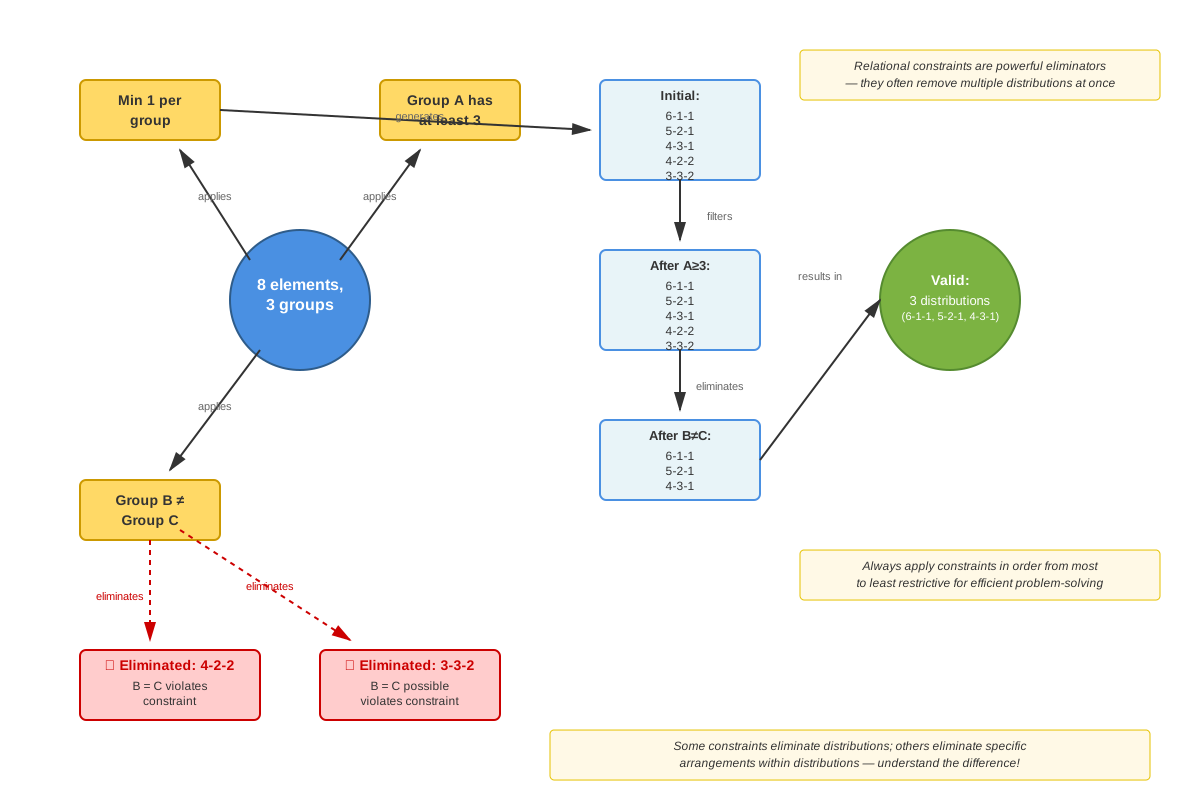
LSAT numerical distribution problems typically provide a total number of elements and a number of groups, along with constraints that limit possible distributions. Constraints fall into several categories: minimum requirements (each group must have at least one member), maximum limitations (no group can exceed four members), exact specifications (group A must have exactly two members), or comparative rules (group B must have more members than group C). Each constraint eliminates certain distribution patterns from consideration.
Fixed versus Flexible Distributions
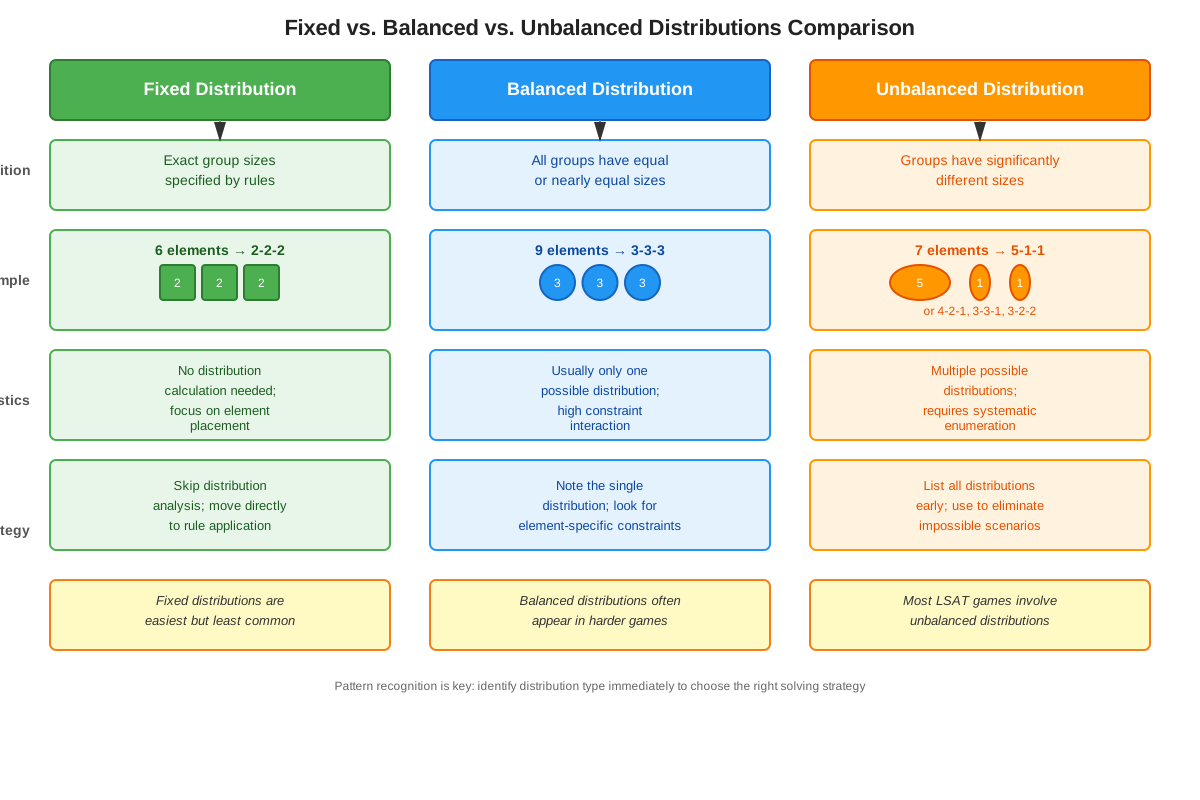
Distribution patterns exist on a spectrum from completely fixed to highly flexible. A fixed distribution occurs when constraints determine exactly one possible numerical pattern. For example, if nine elements must be distributed across three groups with each group having exactly three members, the distribution is fixed at 3-3-3. Fixed distributions simplify games significantly because they eliminate an entire dimension of uncertainty.
Flexible distributions occur when multiple numerical patterns satisfy the constraints. If eight elements distribute across three groups with each group having at least one member, possible distributions include 6-1-1, 5-2-1, 4-3-1, 4-2-2, and 3-3-2. Recognizing flexibility is critical—students must enumerate all possibilities and understand that different questions within the game may force different distributions. The LSAT frequently tests whether students recognize that what's possible under one distribution becomes impossible under another.
Balanced versus Unbalanced Distributions
Balanced distributions have elements spread relatively evenly across groups (e.g., 3-3-3 or 4-4-3), while unbalanced distributions concentrate elements in fewer groups (e.g., 6-1-1 or 5-2-1). This distinction matters because constraints often favor one pattern over another. Rules like "each group must have at least two members" eliminate highly unbalanced distributions, while rules like "at least one group must have exactly one member" require some imbalance.
The LSAT exploits the tension between balanced and unbalanced distributions by creating scenarios where intuition suggests balance but constraints require imbalance, or vice versa. Students must calculate distributions systematically rather than assuming the "most reasonable" arrangement. A common trap involves assuming elements will distribute evenly when no constraint requires it, leading to incorrect answer eliminations.
Calculating All Possible Distributions
The systematic approach to calculating distributions involves:
- Identify the total number of elements and groups: Establish the basic parameters (e.g., 8 elements, 3 groups).
- Apply minimum constraints first: If each group needs at least one element, allocate one to each group, then distribute the remainder (8 elements, 3 groups, minimum 1 each = 5 remaining to distribute).
- Apply maximum constraints: If no group can exceed 4 elements, eliminate distributions that violate this limit.
- Enumerate systematically from most unbalanced to most balanced: Start with the maximum possible in one group and work toward even distributions (6-1-1, 5-2-1, 5-1-2, 4-3-1, 4-2-2, 3-3-2).
- Account for group distinguishability: If groups are distinguishable (Group A, B, C), the distribution 5-2-1 differs from 5-1-2 depending on which group gets which number. If groups are indistinguishable, these are the same distribution.
- Check each distribution against all constraints: Verify that each enumerated distribution satisfies every rule before including it in the viable set.
Distribution Notation and Organization
Effective distribution notation uses descending order for clarity: write 5-2-1 rather than 1-2-5. This convention makes patterns easier to compare and prevents missing distributions during enumeration. When groups are distinguishable, create a table showing which group receives which number:
| Distribution | Group A | Group B | Group C |
|---|---|---|---|
| Option 1 | 5 | 2 | 1 |
| Option 2 | 5 | 1 | 2 |
| Option 3 | 4 | 3 | 1 |
| Option 4 | 4 | 2 | 2 |
This organizational approach prevents confusion during question-solving and enables quick reference when testing answer choices.
Interaction Between Distribution and Specific Rules
Distribution analysis must integrate with element-specific rules. If the game states "X and Y cannot be in the same group," this constraint doesn't directly affect numerical distribution but limits which specific elements can occupy each position within a distribution. However, some element-specific rules do affect distribution: "X must be alone in a group" requires at least one group with exactly one member, eliminating distributions like 3-3-3 in a 9-element, 3-group game.
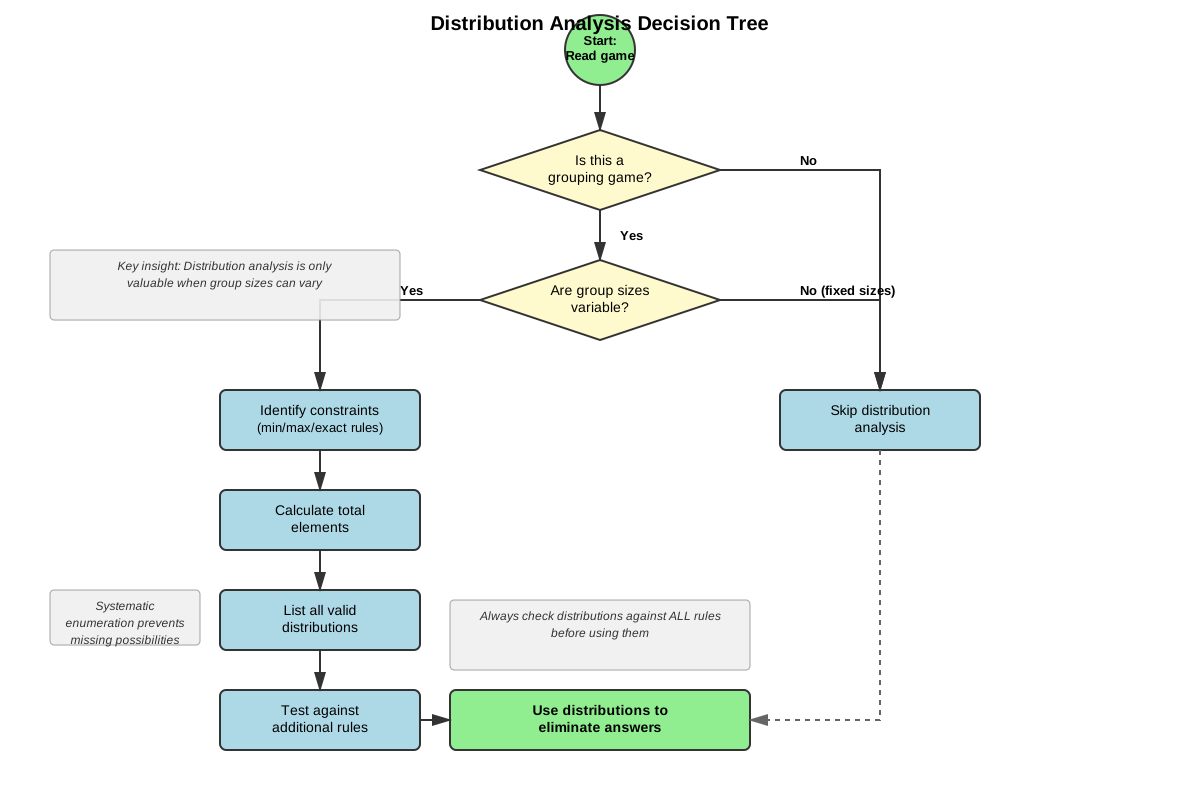
The strategic question becomes: when should distribution analysis occur? Perform distribution analysis during initial setup when constraints directly limit numerical patterns. Defer distribution analysis when constraints primarily govern element relationships rather than group sizes. The LSAT rewards students who recognize this distinction and allocate setup time efficiently.
Concept Relationships
Numerical distribution analysis forms the foundation upon which element placement occurs in grouping games. The relationship flows: game constraints → possible distributions → element placement rules → specific scenarios → answer choices. Understanding viable distributions eliminates impossible scenarios before testing individual elements, creating significant efficiency gains.
Distribution connects to constraint analysis because each rule either directly limits distributions (minimum/maximum requirements) or indirectly affects them (element-specific rules that force certain group sizes). The relationship is bidirectional: distribution possibilities help interpret ambiguous constraints, while clear constraints determine distributions.
Within grouping games, distribution relates to group capacity (how many elements each group can hold), selection requirements (whether all elements must be used or some remain unassigned), and group distinguishability (whether groups have distinct identities or are interchangeable). These factors collectively determine whether distribution analysis is simple or complex.
Distribution analysis also connects to deduction-making in games. Once viable distributions are identified, they enable powerful deductions: if only two distributions are possible and one leads to a rule violation, the other must be true. This "distribution-based deduction" pattern appears frequently in harder LSAT games and separates high-scoring students from average performers.
Quick check — test yourself on Numerical distribution so far.
Try Flashcards →High-Yield Facts
⭐ Numerical distribution must be calculated whenever grouping games include minimum or maximum constraints on group sizes.
⭐ The most common LSAT distribution scenario involves distributing elements across groups where each group must have at least one member.
⭐ Fixed distributions (only one possible pattern) dramatically simplify games and should be recognized immediately during setup.
⭐ When groups are distinguishable, the same numerical pattern (e.g., 4-2-1) can create multiple distinct distributions depending on which group gets which number.
⭐ Distribution analysis should occur before attempting to place specific elements—knowing the numerical framework prevents wasted effort on impossible scenarios.
- Unbalanced distributions (like 6-1-1) are more common in LSAT games than intuition suggests because minimum constraints often allow them.
- If the total number of elements doesn't divide evenly by the number of groups, the distribution must be unbalanced.
- Element-specific rules like "X must be alone" or "Y and Z must be together" can force specific distributions even without explicit numerical constraints.
- Questions asking "what must be true" often hinge on facts that hold across all possible distributions, while "could be true" questions may be true in only one distribution.
- The LSAT frequently includes wrong answer choices that would be correct under an impossible distribution, testing whether students properly calculated viable patterns.
- Distribution becomes more complex when groups have different constraints (Group A must have at least 2, Group B must have at least 3, Group C has no minimum).
- Some games allow elements to remain unassigned, creating an implicit additional "group" that must be included in distribution calculations.
Common Misconceptions
Misconception: Elements will naturally distribute evenly across groups unless constraints specify otherwise.
Correction: Without explicit constraints requiring balance, elements can distribute in any pattern that satisfies stated rules. The LSAT frequently exploits the assumption of balance by creating scenarios where highly unbalanced distributions are not only possible but necessary.
Misconception: If a game has 9 elements and 3 groups, the distribution must be 3-3-3.
Correction: This distribution is only required if rules explicitly state each group must have exactly three members or equivalent constraints. Without such rules, distributions like 7-1-1, 5-3-1, or 4-4-1 may be possible depending on other constraints.
Misconception: Distribution analysis is only necessary when questions explicitly ask about group sizes.
Correction: Distribution analysis is a setup tool that enables efficient answering of all question types. Even questions about specific element placement become easier when the numerical framework is understood, as impossible placements can be eliminated based on distribution constraints.
Misconception: Once a distribution is calculated, it applies to all questions in the game.
Correction: Many games allow multiple possible distributions, and different questions may force different distributions through their additional constraints. Each question must be evaluated to determine which distribution(s) it permits.
Misconception: Groups without explicit minimum requirements can be empty.
Correction: Unless the game explicitly states that groups can be empty or that not all elements must be assigned, assume each group must contain at least one element. The LSAT typically clarifies when empty groups are allowed because this significantly affects distribution possibilities.
Misconception: Distribution notation order doesn't matter (5-2-1 is the same as 1-2-5).
Correction: While these represent the same numerical pattern, using descending order (5-2-1) as a convention prevents confusion and makes systematic enumeration easier. When groups are distinguishable, the assignment of numbers to specific groups absolutely matters.
Worked Examples
Example 1: Basic Distribution Calculation
Scenario: Seven employees (F, G, H, J, K, L, M) must be assigned to three projects (Project 1, Project 2, Project 3). Each project must have at least one employee assigned to it.
Question: What are all possible numerical distributions?
Solution:
Step 1: Identify parameters: 7 elements, 3 groups, minimum 1 per group.
Step 2: Allocate minimums: Give 1 element to each group, leaving 4 elements to distribute (7 - 3 = 4).
Step 3: Enumerate distributions systematically, starting with most unbalanced:
- Maximum in one group: 5-1-1 (one group gets 5, others get 1 each)
- Next level: 4-2-1 (one group gets 4, one gets 2, one gets 1)
- More balanced: 3-3-1 (two groups get 3, one gets 1)
- Most balanced: 3-2-2 (one group gets 3, two get 2 each)
Step 4: Verify no distribution violates constraints:
- 5-1-1: ✓ (each group has at least 1)
- 4-2-1: ✓ (each group has at least 1)
- 3-3-1: ✓ (each group has at least 1)
- 3-2-2: ✓ (each group has at least 1)
Step 5: Check if any patterns were missed:
- Could we have 6-1-0? No, violates minimum requirement.
- Could we have 4-1-2? Yes, but this is the same as 4-2-1 in descending order.
Answer: The four possible distributions are 5-1-1, 4-2-1, 3-3-1, and 3-2-2.
Connection to Learning Objectives: This example demonstrates identifying how numerical distribution appears (in grouping constraints), explaining the reasoning pattern (systematic enumeration from unbalanced to balanced), and applying the concept to calculate all possibilities.
Example 2: Distribution with Multiple Constraints
Scenario: Nine books must be placed on three shelves (Shelf A, Shelf B, Shelf C). Each shelf must have at least two books. Shelf A must have more books than Shelf C.
Question: What are all possible numerical distributions?
Solution:
Step 1: Identify parameters: 9 elements, 3 distinguishable groups, minimum 2 per group.
Step 2: Allocate minimums: Give 2 books to each shelf, leaving 3 books to distribute (9 - 6 = 3).
Step 3: Enumerate base distributions (ignoring the Shelf A > Shelf C constraint temporarily):
- 5-2-2 (one shelf gets 5, two get 2)
- 4-3-2 (one shelf gets 4, one gets 3, one gets 2)
- 3-3-3 (all shelves get 3)
Step 4: Apply the distinguishability and Shelf A > Shelf C constraint:
For 5-2-2:
- A=5, B=2, C=2: ✓ (A > C: 5 > 2)
- A=2, B=5, C=2: ✗ (A > C: 2 > 2 is false)
- A=2, B=2, C=5: ✗ (A > C: 2 > 5 is false)
For 4-3-2:
- A=4, B=3, C=2: ✓ (A > C: 4 > 2)
- A=4, B=2, C=3: ✓ (A > C: 4 > 3)
- A=3, B=4, C=2: ✓ (A > C: 3 > 2)
- A=3, B=2, C=4: ✗ (A > C: 3 > 4 is false)
- A=2, B=4, C=3: ✗ (A > C: 2 > 3 is false)
- A=2, B=3, C=4: ✗ (A > C: 2 > 4 is false)
For 3-3-3:
- A=3, B=3, C=3: ✗ (A > C: 3 > 3 is false; A must be strictly greater)
Step 5: List viable distributions:
- A=5, B=2, C=2
- A=4, B=3, C=2
- A=4, B=2, C=3
- A=3, B=4, C=2
Answer: Four specific distributions satisfy all constraints. Notice that the same numerical pattern (4-3-2) creates two different valid distributions depending on whether B or C receives the middle number.
Connection to Learning Objectives: This example shows how to apply distribution analysis with multiple interacting constraints, demonstrating the importance of distinguishing between numerical patterns and specific group assignments. It also illustrates why systematic checking prevents missing viable options.
Exam Strategy
When approaching LSAT numerical distribution questions, begin by scanning the game setup for numerical constraints before reading individual rules. Look for phrases like "each group must have at least," "no group can have more than," "exactly," or comparative language like "more than" or "fewer than." These trigger words indicate that distribution analysis will be valuable.
During game setup, create a dedicated space in your diagram for distribution possibilities. Write out all viable distributions in descending order, and if groups are distinguishable, note which groups can receive which numbers. This upfront investment (typically 30-60 seconds) pays dividends across all questions in the game.
For elimination strategy, use distribution constraints to eliminate answer choices quickly. If a question asks "which could be true," immediately eliminate any choice that requires an impossible distribution. If a question asks "which must be true," look for facts that hold across all possible distributions—these are often correct answers.
Time allocation should favor distribution analysis in games where it's clearly relevant. Spend up to one minute on distribution calculation during setup for complex grouping games, but skip detailed distribution work in games where constraints primarily govern element relationships rather than group sizes. The key is recognizing when distribution is the game's central challenge versus when it's peripheral.
Exam Tip: If you find yourself testing the same impossible scenario repeatedly across multiple questions, you likely missed a distribution constraint during setup. Pause and recalculate distributions before continuing.
Watch for questions that add temporary constraints like "If Group A has exactly three members..." These questions force a specific distribution, and recognizing this immediately narrows possibilities dramatically. Don't waste time considering distributions that violate the question's additional constraint.
Memory Techniques
Mnemonic for Distribution Calculation Steps: "TAMES"
- Total: Identify total elements and groups
- Allocate: Apply minimum constraints first
- Maximize: Start with most unbalanced distribution
- Enumerate: List all patterns systematically
- Specify: Assign numbers to specific groups if distinguishable
Visualization Strategy: Picture distribution as a physical allocation of objects into containers. Imagine starting with all elements in one container (most unbalanced) and gradually moving them to other containers until reaching the most balanced distribution. This mental model helps ensure no patterns are missed during enumeration.
Acronym for Common Constraints: "MECC"
- Minimum requirements (at least)
- Exact specifications (exactly)
- Comparative rules (more than, fewer than)
- Capacity limits (no more than)
For remembering to check distinguishability: "Groups with Names Need Numbers"—if groups have distinct identities (names), you must assign specific numbers to each group, not just identify the numerical pattern.
Summary
Numerical distribution is a critical analytical tool for solving LSAT grouping games efficiently. It involves determining all possible patterns for allocating a fixed number of elements across multiple groups while satisfying stated constraints. The process requires systematic enumeration from unbalanced to balanced distributions, careful application of minimum and maximum constraints, and recognition of whether groups are distinguishable. Mastery of numerical distribution enables students to eliminate impossible scenarios before testing specific element placements, dramatically improving speed and accuracy. The concept appears in the majority of grouping games and serves as the foundation for more complex deductions. Students must distinguish between fixed distributions (only one possible pattern) and flexible distributions (multiple viable patterns), understanding that different questions within a game may force different distributions. Success requires both procedural fluency in calculating distributions and strategic judgment about when distribution analysis provides the highest value during game setup.
Key Takeaways
- Numerical distribution determines how many elements occupy each group before considering which specific elements go where—this separation is fundamental to efficient game solving.
- Always calculate distributions systematically from most unbalanced to most balanced, using descending order notation to prevent missing possibilities.
- Fixed distributions (only one viable pattern) dramatically simplify games and should be recognized immediately as a major constraint.
- When groups are distinguishable, the same numerical pattern creates multiple distinct distributions depending on which group receives which number.
- Distribution analysis should occur during setup when constraints directly limit group sizes, but can be deferred when rules primarily govern element relationships.
- The LSAT frequently tests whether students recognize impossible distributions by including wrong answers that would be correct under invalid numerical patterns.
- Mastering distribution analysis provides a significant competitive advantage because it enables elimination of entire categories of impossible scenarios across multiple questions.
Related Topics
Selection Games with Numerical Constraints: These games require choosing a subset of elements with specific quantity requirements, extending distribution concepts to scenarios where not all elements are used. Mastering basic distribution enables progression to these more complex selection scenarios.
Hybrid Games Combining Grouping and Sequencing: Some LSAT games require both distributing elements across groups and ordering elements within groups. Strong distribution skills provide the foundation for managing the grouping dimension while sequencing rules govern the ordering dimension.
Advanced Constraint Interaction: Higher-level games feature multiple constraints that interact in complex ways to limit distributions. Understanding basic distribution is prerequisite to analyzing how element-specific rules, capacity limits, and comparative constraints combine to create sophisticated logical puzzles.
Distribution-Based Deductions: Advanced techniques involve using distribution possibilities to make powerful inferences about what must or cannot be true. This topic builds directly on numerical distribution fundamentals and represents a key skill for achieving top LSAT scores.
Practice CTA
Now that you understand the principles of numerical distribution, it's time to cement your knowledge through active practice. Attempt the practice questions associated with this topic, focusing on applying the systematic enumeration process and recognizing distribution patterns quickly. Use the flashcards to reinforce key concepts and trigger words. Remember that distribution analysis is a skill that improves dramatically with deliberate practice—each game you solve builds pattern recognition that makes future games faster and easier. Your investment in mastering this high-yield topic will pay dividends across the entire Analytical Reasoning section. Start practicing now to transform understanding into automatic, exam-ready skill!
Sign up free to keep reading
Create a free AnvayaPrep account to finish this LSAT guide on Numerical distribution — plus flashcards and practice questions.