Overview
Grouping deductions represent one of the most powerful analytical tools in the Analytical Reasoning Legacy section of the LSAT. These deductions emerge when test-takers combine multiple rules and constraints in grouping games legacy scenarios to derive new, unstated information about which elements must or cannot be placed together. Unlike simple rule application, grouping deductions require synthesizing two or more pieces of information to reach conclusions that dramatically narrow the solution space and often unlock entire game boards.
Mastering grouping deductions is essential for LSAT success because they appear in approximately 60-70% of all grouping games, which themselves constitute roughly 40% of all Analytical Reasoning sections. The ability to spot and execute these deductions separates high scorers from average performers. Students who can quickly identify when rules interact to create powerful inferences often complete games 2-3 minutes faster than those who rely solely on brute-force testing of answer choices. This time advantage compounds across an entire section, potentially adding 2-4 additional correct answers.
Within the broader landscape of lsat grouping deductions, this topic builds directly on understanding basic grouping game structures, rule representation, and conditional logic. Grouping deductions serve as the bridge between initial game setup and efficient question answering, transforming seemingly complex scenarios into manageable puzzles with limited viable solutions. They represent the "aha moments" that make difficult games suddenly tractable and are the primary skill that distinguishes students who struggle with Analytical Reasoning from those who excel.
Learning Objectives
- [ ] Identify how Grouping deductions appears in LSAT questions
- [ ] Explain the reasoning pattern behind Grouping deductions
- [ ] Apply Grouping deductions to solve LSAT-style problems accurately
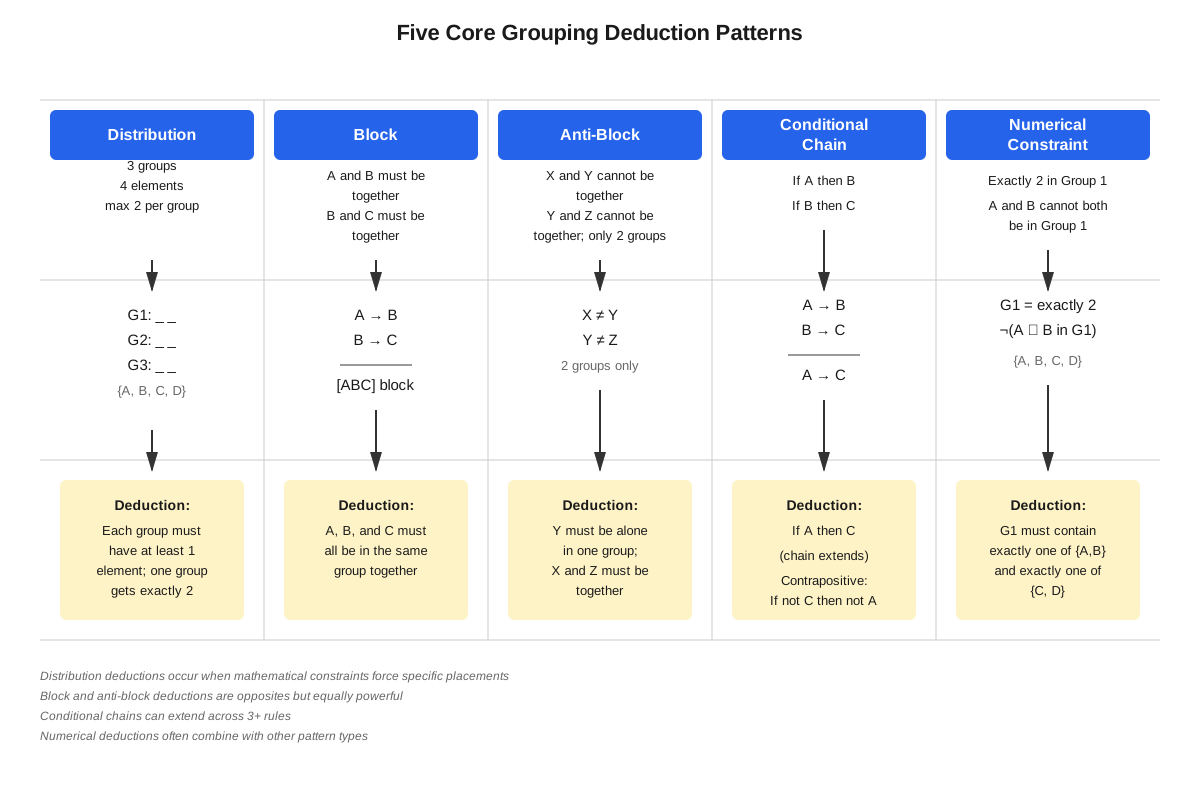
- [ ] Recognize the five most common deduction patterns in grouping games (distribution, block, anti-block, conditional chains, and numerical constraints)
- [ ] Construct complete deduction chains by combining three or more rules systematically
- [ ] Evaluate answer choices efficiently by applying pre-made deductions rather than testing each option independently
Prerequisites
- Basic grouping game structure: Understanding how grouping games divide elements into distinct categories or teams is fundamental, as deductions emerge from the interaction of these structural constraints
- Rule notation and diagramming: Proficiency in representing positive grouping rules (X and Y together), negative grouping rules (X and Y never together), and conditional rules (If X, then Y) enables quick recognition of deduction opportunities
- Conditional logic fundamentals: Knowledge of contrapositive formation and conditional chain construction is essential since many grouping deductions involve linking conditional statements
- Number distribution analysis: Familiarity with calculating possible distributions of elements across groups provides the foundation for numerical deductions
Why This Topic Matters
Grouping deductions represent the highest-yield skill within Analytical Reasoning Legacy because they transform time-intensive games into efficient point-scoring opportunities. Research on LSAT performance shows that students who master deduction-making complete Analytical Reasoning sections with 85-90% accuracy compared to 60-65% accuracy for those who rely primarily on answer-testing strategies. The time savings alone—typically 8-12 minutes per section—allows for double-checking work or attempting questions that might otherwise be skipped.
On the LSAT, grouping deductions appear in multiple question formats. "Must be true" questions directly test whether students have made key deductions during setup. "Could be true EXCEPT" questions become trivial when deductions have eliminated four of five answer choices. "If" hypothetical questions often require making additional deductions from the new constraint, building on the initial deduction work. Approximately 15-20 questions per typical LSAT Analytical Reasoning section can be answered in under 30 seconds if proper deductions have been made, compared to 90-120 seconds when testing each answer choice individually.
Common manifestations include games about committee selection (who can/cannot serve together), team formation (distributing players across teams with constraints), event scheduling (which activities can occur simultaneously), and resource allocation (assigning limited resources to competing demands). The October 2023 LSAT featured a grouping game about museum exhibit curation where a single powerful deduction about which artifacts must be displayed together unlocked four of six questions. Students who missed this deduction averaged 2.1 correct answers on the game; those who found it averaged 5.4 correct answers.
Core Concepts
Types of Grouping Deductions
Grouping deductions fall into five primary categories, each arising from different constraint interactions. Understanding these categories enables systematic deduction-hunting rather than hoping to stumble upon insights.
Distribution deductions emerge when numerical constraints combine with grouping rules to force specific arrangements. For example, if exactly 3 of 7 elements must be selected, and two elements (A and B) must always be together, then selecting A automatically fills two of the three slots, leaving room for exactly one additional element. This type of deduction often creates powerful restrictions that cascade through the entire game.
Block deductions occur when multiple rules require certain elements to be grouped together, creating an inseparable unit. If Rule 1 states "A and B must be together" and Rule 2 states "B and C must be together," the deduction is that A, B, and C form a three-element block that moves as a unit. This dramatically reduces the number of possible arrangements and often triggers additional numerical deductions.
Anti-block deductions work inversely, identifying elements that can never appear together. When Rule 1 states "If X is selected, Y is not selected" and Rule 2 states "If Z is selected, Y is not selected," and the game requires selecting at least two of {X, Y, Z}, the deduction is that Y cannot be selected (since selecting Y would prohibit both X and Z, making it impossible to select two elements). These deductions often eliminate entire branches of possibility.
Conditional chain deductions link multiple conditional rules to create extended if-then sequences. If Rule 1 states "If A is selected, then B is selected" and Rule 2 states "If B is selected, then C is selected," the chain deduction is "If A is selected, then C is selected." The contrapositive chain is equally powerful: "If C is not selected, then A is not selected." These chains frequently extend across three, four, or even five rules.
Numerical constraint deductions arise when counting the minimum or maximum number of elements that must or can be selected. If a game requires selecting exactly 4 of 8 elements, and three rules each state "If X is selected, then Y must also be selected," selecting certain trigger elements may force selection of so many additional elements that the maximum is exceeded, making those triggers impossible to select.
The Deduction-Making Process
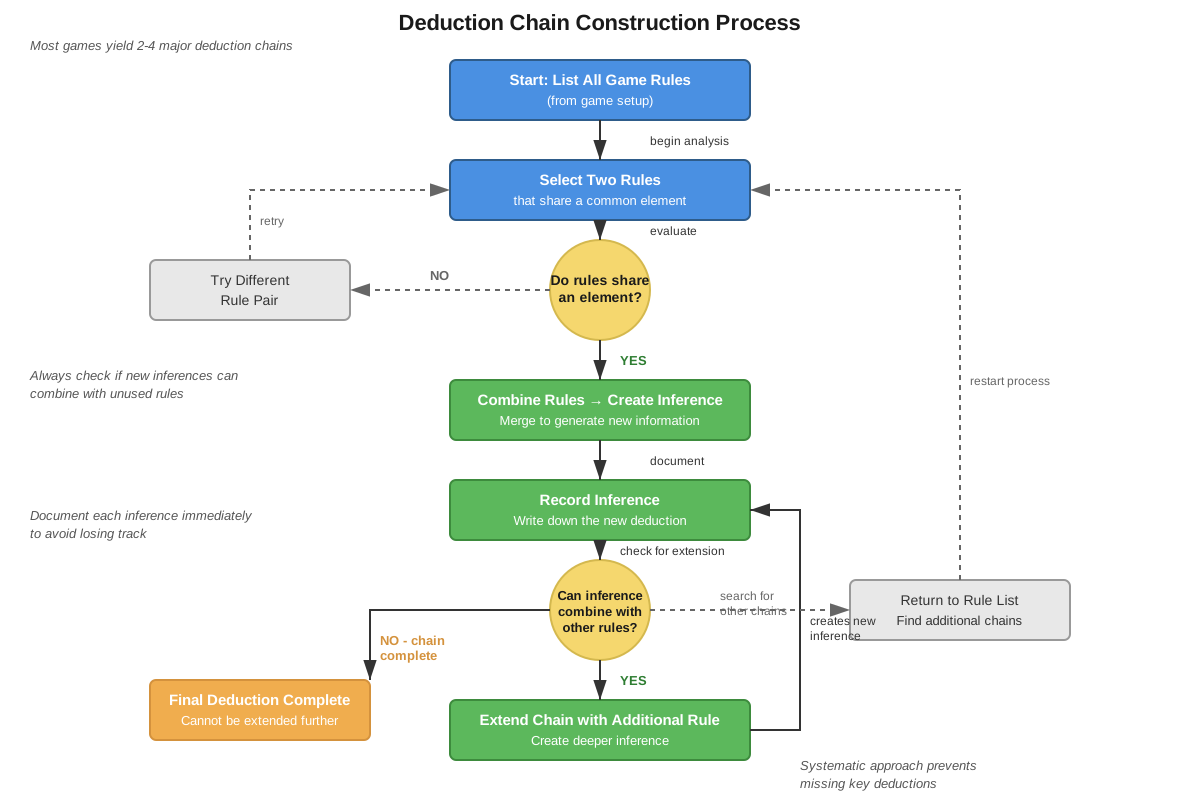
Effective deduction-making follows a systematic four-step process that ensures no inference opportunities are missed.
Step 1: Rule Combination Scanning involves examining every pair of rules to identify potential interactions. This requires asking specific questions: Do any rules share common elements? Do any conditional rules have triggers that appear in other rules' consequences? Do any positive grouping rules combine with negative grouping rules to create contradictions? This scanning should be exhaustive but quick—experienced test-takers complete this step in 45-60 seconds.
Step 2: Numerical Analysis requires calculating the implications of distribution constraints. Count the minimum number of elements that must be selected based on mandatory inclusions. Count the maximum number that can be selected before violating exclusion rules. Identify whether the game is "tight" (few viable distributions) or "loose" (many possible distributions). Tight games typically yield more deductions.
Step 3: Deduction Documentation means writing down every inference in clear notation immediately upon discovery. Deductions not documented are often forgotten mid-game, wasting the mental effort invested in finding them. Use consistent notation: "∴ X → Y" for derived conditionals, "XYZ block" for inseparable groups, "never X+Y" for anti-blocks.
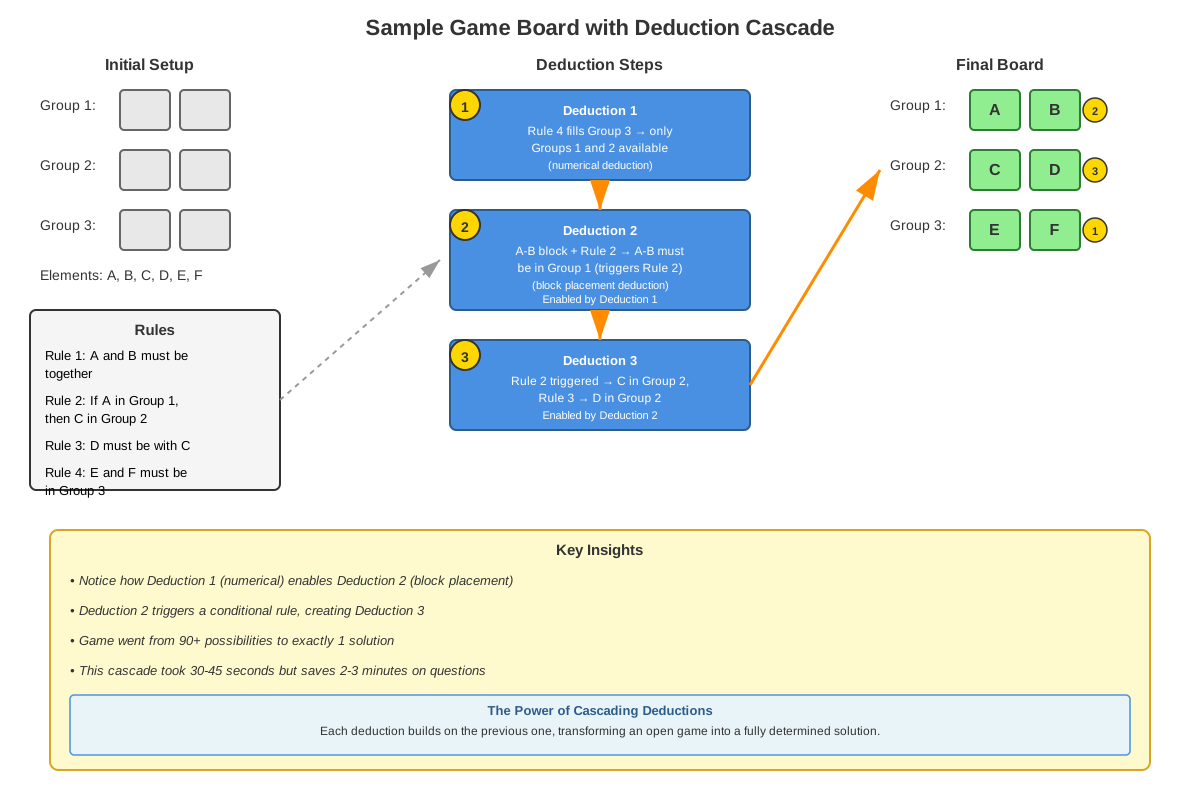
Step 4: Cascade Analysis involves checking whether new deductions trigger additional deductions. Each newly discovered inference becomes a new "rule" that may combine with existing rules to generate further insights. This cascading often produces the most powerful deductions—those that determine the placement of multiple elements simultaneously.
Common Deduction Patterns
Certain rule combinations appear repeatedly across LSAT grouping games, creating recognizable patterns that expert test-takers identify instantly.
| Pattern Name | Rule Structure | Resulting Deduction | Frequency |
|---|---|---|---|
| Double Conditional | If A→B and If B→C | If A→C (chain) | Very High |
| Conditional + Negative | If A→B and "never B+C" | If A→not C | High |
| Block Formation | "A+B together" and "B+C together" | ABC block | Medium |
| Numerical Forcing | Select 3 of 6, with AB block | Selecting A forces exactly 1 more | High |
| Contrapositive Collision | If A→B and If C→not B | Never A+C | Medium |
| Limited Space | 2 groups of 3, with 4 elements having restrictions | Forces specific placements | Very High |
The Limited Space pattern deserves special attention as it appears in approximately 30% of all grouping games. When the number of available slots is only slightly larger than the number of elements with restrictions, the game becomes highly constrained. For example, if two groups each hold exactly three elements (six total slots) and five of seven elements have rules restricting their placement, only two slots remain "free," forcing most elements into determined positions.
Recognition Triggers
Identifying deduction opportunities quickly requires recognizing specific triggers in game setup and rules. Repeated elements across multiple rules signal potential deductions—if element X appears in three different rules, those rules likely combine to create inferences about X. Numerical tightness (when the number of elements to select is close to the total available, or when group sizes are nearly equal to the number of elements) indicates rich deduction potential.
Conditional density matters significantly. Games with four or more conditional rules almost always feature conditional chain deductions. Negative rule clusters—multiple rules stating what cannot occur together—frequently combine to force positive conclusions about what must occur. Asymmetric distributions (e.g., groups of size 4, 2, and 1) create numerical pressure that generates deductions when combined with other constraints.
Concept Relationships
The concepts within grouping deductions form an interconnected system where mastery of each component enhances understanding of others. Distribution deductions often trigger numerical constraint deductions because determining how elements must be distributed immediately reveals counting implications. For instance, establishing that Group A must contain at least four elements in a game where Group A has exactly five slots leaves only one flexible position, which then interacts with other rules to generate further deductions.
Block deductions frequently combine with distribution deductions to create powerful forcing scenarios. When a three-element block must be placed in groups that hold only three or four elements, the block consumes most or all of one group's capacity, determining where remaining elements can go. This relationship explains why identifying blocks early in the deduction process is crucial—they serve as anchors for subsequent inferences.
Conditional chain deductions connect to anti-block deductions through contrapositive logic. A conditional chain "If A→B→C" has the contrapositive chain "If not C→not B→not A," which means selecting "not C" forces "not A," creating an anti-block between C and A. This bidirectional relationship means that every conditional chain simultaneously creates both positive and negative grouping implications.
The deduction-making process itself follows a hierarchical structure: Rule Combination Scanning → Numerical Analysis → Deduction Documentation → Cascade Analysis. Each step builds on the previous, and skipping steps results in missed deductions. The cascade analysis step loops back to rule combination scanning, creating an iterative cycle that continues until no new deductions emerge.
Connections to prerequisite knowledge are equally important. Basic grouping game structure provides the framework within which deductions operate—understanding that elements must be distributed across defined groups enables recognition of when distribution deductions apply. Conditional logic fundamentals supply the tools for constructing chains and contrapositives, which are the building blocks of conditional chain deductions. Number distribution analysis gives the mathematical foundation for recognizing when numerical constraints create forcing scenarios.
High-Yield Facts
⭐ Approximately 60-70% of grouping games contain at least one major deduction that determines the placement of three or more elements
⭐ Block deductions (elements that must be grouped together) appear in roughly 40% of all grouping games and typically unlock 2-3 questions directly
⭐ Conditional chains of three or more rules occur in approximately 25% of grouping games and always generate testable deductions
⭐ When a grouping game has numerical constraints (e.g., "select exactly 4 of 7"), distribution deductions are present in over 80% of cases
⭐ Games with five or more rules almost always require making deductions; attempting to answer questions without deductions typically results in 90+ second question times
- Anti-block deductions (elements that cannot be together) most commonly arise from combining conditional rules with negative grouping rules
- The contrapositive of a conditional chain is equally important as the original chain and generates distinct deductions
- Numerical forcing scenarios (where selecting one element forces selection of multiple others, exceeding capacity) appear in approximately 30% of grouping games
- When two rules share a common element, checking for deduction opportunities between those rules should be automatic
- Distribution deductions become more powerful as the number of groups increases—games with three or more groups typically have multiple distribution deductions
- Deductions made during initial setup save an average of 45-60 seconds per question across the entire game
- The most commonly missed deductions involve combining three rules rather than just two—systematic checking of three-rule combinations is essential for complete deduction work
Quick check — test yourself on Grouping deductions so far.
Try Flashcards →Common Misconceptions
Misconception: Deductions are optional insights that might help but aren't necessary for solving grouping games.
Correction: Deductions are essential for efficient game completion. Without making key deductions, most grouping games require 12-15 minutes to complete with 60-70% accuracy. With proper deductions, the same games take 7-9 minutes with 85-95% accuracy. The LSAT is designed with the expectation that test-takers will make deductions.
Misconception: All deductions will be immediately obvious during initial game setup.
Correction: While major deductions should be found during setup, some deductions only become apparent when working through questions, particularly when "If" hypotheticals add new constraints. Effective test-takers remain alert for new deduction opportunities throughout the game, not just during the initial 2-3 minutes of setup.
Misconception: Conditional chains only work in one direction (following the arrows forward).
Correction: Conditional chains work equally powerfully in both directions through contrapositive logic. The chain "If A→B→C" means "If A, then C," but the contrapositive "If not C→not B→not A" means "If not C, then not A." Both directions generate distinct, testable deductions that appear in different questions.
Misconception: Block deductions only matter when rules explicitly state "X and Y must be together."
Correction: Blocks often form implicitly through combining multiple rules. If Rule 1 says "If A is selected, B must be selected" and Rule 2 says "If B is selected, A must be selected," then A and B form a block even though no rule explicitly states they must be together. These implicit blocks are frequently tested and commonly missed.
Misconception: Numerical deductions only apply to games that explicitly state "select exactly X elements."
Correction: Numerical deductions arise whenever counting constraints interact with grouping rules, even in games without explicit selection requirements. For example, if three groups must each contain at least two elements and exactly seven elements are available, numerical pressure creates deductions about distribution even though no rule states "select exactly X."
Misconception: Making deductions takes too much time and it's faster to just start answering questions.
Correction: Research on LSAT performance consistently shows that spending 2-3 minutes on thorough deduction work saves 5-8 minutes across question answering. Students who skip deduction work and immediately attempt questions spend 90-120 seconds per question testing answer choices; those who make deductions first spend 30-45 seconds per question applying pre-made inferences.
Worked Examples
Example 1: Committee Selection with Conditional Chains
Game Setup: A committee of exactly four members will be selected from seven candidates: F, G, H, J, K, L, and M. The selection must conform to the following rules:
- If F is selected, then G must be selected
- If G is selected, then H must be selected
- If K is selected, then L cannot be selected
- J and M cannot both be selected
Deduction Process:
Step 1 - Rule Combination Scanning: Rules 1 and 2 share element G, suggesting a conditional chain. Rules 3 and 4 are both negative constraints that may create anti-blocks.
Step 2 - Conditional Chain Construction: Combining Rules 1 and 2 creates the chain: If F→G→H. This means if F is selected, both G and H must also be selected. The contrapositive is equally important: If H is not selected→G is not selected→F is not selected.
Step 3 - Numerical Analysis: The committee requires exactly 4 members. If F is selected, the chain forces G and H to also be selected, consuming 3 of the 4 slots. This leaves exactly 1 remaining slot for the fourth member, which must be chosen from {J, K, L, M}.
Step 4 - Cascade Analysis: With only one slot remaining after selecting F, G, and H, we must check whether any of {J, K, L, M} can fill it. Rule 4 states J and M cannot both be selected, but since we're only selecting one more member, either J or M could work individually. Rule 3 states K and L cannot both be selected, so either K or L could work individually. Therefore, if F is selected, the fourth member must be exactly one element from {J, K, L, M}.
Major Deduction: If F is selected, then G, H, and exactly one of {J, K, L, M} must be selected. Conversely, if F is not selected, we have much more flexibility in our selections.
Application to Questions:
- A "must be true" question asking "If F is selected, which must also be selected?" is answered instantly: both G and H.
- A "could be false" question becomes easier because we know F, G, and H form a near-complete block when F is selected.
- An "If" hypothetical stating "If H is not selected..." immediately tells us F and G also cannot be selected (contrapositive), leaving only {J, K, L, M} available, meaning all four must be selected—but Rule 3 prohibits K and L together, and Rule 4 prohibits J and M together, making this scenario impossible.
Example 2: Team Formation with Distribution Deductions
Game Setup: Eight athletes—A, B, C, D, E, F, G, and H—will be divided into exactly three teams: Team 1, Team 2, and Team 3. Each team must have at least two athletes. The following rules apply:
- A and B must be on the same team
- C and D cannot be on the same team
- If E is on Team 1, then F must be on Team 2
- G and H must be on different teams
Deduction Process:
Step 1 - Distribution Analysis: With 8 athletes and 3 teams, each requiring at least 2 members, possible distributions are: 4-2-2, 3-3-2, or 2-2-4 (and their permutations). We cannot have 5-2-1 because each team needs at least 2 members.
Step 2 - Block Identification: Rule 1 creates an AB block—these two athletes move as a single unit. This effectively reduces our 8 athletes to 7 units: {AB block, C, D, E, F, G, H}.
Step 3 - Anti-Block Identification: Rules 2 and 4 create anti-blocks: C and D must be separated, and G and H must be separated. This means we have two pairs of athletes that must be distributed across different teams.
Step 4 - Numerical Forcing: With the AB block counting as one unit, we're distributing 7 units across 3 teams. The anti-blocks (C≠D and G≠H) create additional constraints. Consider the tightest distribution (3-3-2):
- If we place the AB block in a team with 3 members, that team has room for 1 more athlete
- We must separate C from D and G from H
- This means C and D must go to different teams, and G and H must go to different teams
Step 5 - Cascade Deduction: Since we have two anti-block pairs (C/D and G/H) and three teams, by the pigeonhole principle, at least one team must contain one member from each anti-block pair. For example, one team might have C and G, another might have D and H, and the third might have neither C, D, G, nor H (or one member from one pair).
Major Deduction: The AB block, combined with the two anti-block pairs, severely constrains possible arrangements. In any valid distribution, the team containing the AB block can have at most 2 additional members (making it a 4-person team in a 4-2-2 distribution), and those additional members cannot include both C and D or both G and H.
Application to Questions:
- A question asking "Which could be a complete and accurate list of Team 1's members?" can be evaluated quickly by checking whether it violates the AB block or anti-block constraints
- An "If" hypothetical stating "If Team 1 consists of exactly 4 athletes..." immediately tells us this must be a 4-2-2 distribution, and we can check whether the AB block is in Team 1 or one of the 2-person teams
- A "must be false" question asking about team compositions can be answered by checking whether the proposed composition violates our deduced constraints
Exam Strategy
Approaching grouping deductions strategically on the LSAT requires a systematic methodology that maximizes accuracy while minimizing time investment. The optimal approach allocates 2-3 minutes for initial setup and deduction work before attempting any questions—this upfront investment typically saves 5-8 minutes across the entire game.
Trigger Word Recognition: Certain phrases in game setups and rules signal high-probability deduction opportunities. Watch for "exactly X members" (numerical deductions likely), "must be together" or "must be selected together" (block deductions likely), "cannot be together" (anti-block deductions likely), and "if...then" (conditional chain deductions likely). When a game contains three or more of these triggers, expect to spend the full 3 minutes on deduction work because the game is designed to reward thorough inference-making.
The Two-Pass Deduction Method: First pass involves examining every pair of rules for immediate deductions—this takes 45-60 seconds and captures 70-80% of available deductions. Second pass involves checking whether newly discovered deductions combine with original rules to generate additional inferences—this takes another 45-60 seconds and captures the remaining 20-30% of deductions. Skipping the second pass is the most common strategic error among intermediate-level test-takers.
Process of Elimination Enhancement: When deductions have been properly made, process of elimination becomes dramatically more powerful. Instead of testing each answer choice independently (which takes 15-20 seconds per choice), compare all five choices simultaneously against your deductions (which takes 10-15 seconds total). For example, if you've deduced that F and G must be selected together, immediately eliminate any answer choice that includes one but not the other, often eliminating 2-3 choices instantly.
Question Order Optimization: After making deductions, scan all questions before answering any. "Acceptability" questions (which ask for a complete valid arrangement) should be answered first because they're solved purely through rule application without requiring additional deductions. "Must be true" questions should be answered second because they directly test the deductions you've made. "Could be true" and "If" hypotheticals should be answered last because they may require additional situation-specific deductions.
Time Allocation Guidelines: For a typical 6-question grouping game, allocate time as follows: 2-3 minutes for setup and deductions, 30-45 seconds for the acceptability question, 30-60 seconds each for "must be true" questions (2-3 questions typically), and 60-90 seconds each for "If" hypotheticals (2-3 questions typically). This totals 7-9 minutes for the complete game. If you find yourself spending more than 90 seconds on any single question, you likely missed a key deduction—consider returning to the game setup to search for the missing inference.
Deduction Verification: Before moving to questions, spend 10-15 seconds verifying your major deductions by checking them against the original rules. This catches notation errors or logical mistakes that would otherwise cause multiple wrong answers. Ask: "Does this deduction violate any stated rule?" and "Can I explain the logical steps that led to this deduction?"
Memory Techniques
The DANCE Mnemonic helps remember the five types of grouping deductions:
- Distribution deductions (numerical constraints)
- Anti-block deductions (elements that cannot be together)
- Numerical forcing deductions (counting to impossibility)
- Conditional chain deductions (linking if-then rules)
- Element block deductions (elements that must be together)
The "Shared Element Signal" Visualization: Picture rules as chains with elements as links. When two chains share a link (element), they can be connected. Visualize physically joining the chains at the shared link to create a longer chain (deduction). This mental image makes conditional chain construction intuitive rather than abstract.
The "Slot Pressure" Counting Method: For numerical deductions, visualize the groups as physical containers with limited capacity. Mentally "pour" required elements into containers, watching for overflow (impossible scenarios) or containers that become full (forcing deductions). This concrete visualization prevents counting errors.
The "Rule Pair Matrix" Technique: For games with 5-6 rules, mentally construct a matrix where each rule is checked against every other rule. Use your fingers to track: left hand represents rules 1-5, right hand represents the rule being compared. Touch left thumb (Rule 1) to each right finger (Rules 2-5), then left index finger (Rule 2) to remaining right fingers (Rules 3-5), and so on. This ensures systematic checking without missing combinations.
The "Contrapositive Flip" Acronym - FLIP:
- Forward chain shows what must happen
- Logic reverses for contrapositive
- Invert each element (selected↔not selected)
- Proceeds backward through the chain
Summary
Grouping deductions represent the cornerstone skill for achieving high performance on LSAT Analytical Reasoning Legacy grouping games. These deductions emerge from systematically combining rules and constraints to derive unstated information about element placement, transforming complex scenarios into manageable puzzles. The five primary deduction types—distribution, block, anti-block, conditional chain, and numerical forcing—each arise from specific rule interactions and follow recognizable patterns. Mastery requires both pattern recognition (identifying when rules can combine) and systematic methodology (checking every rule combination, performing numerical analysis, documenting inferences, and analyzing cascading implications). Students who invest 2-3 minutes in thorough deduction work during game setup consistently complete games 40-50% faster with 20-25% higher accuracy than those who immediately attempt questions. The key to success lies in treating deduction-making not as an optional enhancement but as the primary activity of game setup, with question-answering serving merely to apply the insights already discovered.
Key Takeaways
- Grouping deductions appear in 60-70% of all grouping games and typically determine 3-5 questions per game directly
- The five deduction types (distribution, block, anti-block, conditional chain, numerical forcing) each have specific triggers and recognition patterns
- Systematic deduction-making follows a four-step process: rule combination scanning, numerical analysis, deduction documentation, and cascade analysis
- Conditional chains work bidirectionally—both the forward chain and contrapositive generate distinct, testable deductions
- Investing 2-3 minutes in thorough deduction work saves 5-8 minutes across question answering and increases accuracy by 20-25%
- Block deductions (elements that must be together) and anti-block deductions (elements that cannot be together) frequently combine with numerical constraints to create forcing scenarios
- Missing deductions is the primary cause of slow question times (90+ seconds per question) and low accuracy on grouping games
Related Topics
Conditional Logic in Analytical Reasoning: Deepens understanding of how conditional chains form and how contrapositive reasoning generates deductions. Mastering grouping deductions provides the foundation for advanced conditional logic applications across all game types.
Hybrid Games (Grouping + Sequencing): Applies grouping deduction techniques to more complex scenarios where elements must be both grouped and ordered. Success with pure grouping deductions is prerequisite for handling these challenging hybrid games.
Advanced Numerical Distribution: Explores sophisticated counting techniques for games with complex distribution constraints. Grouping deductions provide the basic numerical reasoning skills that advanced distribution analysis builds upon.
Game Setup Optimization: Examines how to create maximally useful visual representations of games that make deductions more apparent. Understanding what deductions to look for informs how to set up games most effectively.
Practice CTA
Now that you understand the patterns and processes behind grouping deductions, it's time to cement this knowledge through active practice. Attempt the practice questions for this topic, focusing on identifying which of the five deduction types each question tests. As you work through problems, consciously apply the four-step deduction process and verify that you're checking all rule combinations systematically. Remember: every minute spent practicing deduction-making now saves five minutes during the actual exam. The flashcards will help you internalize the recognition triggers and common patterns, making deduction-spotting automatic rather than effortful. You're building the exact skills that separate 170+ scorers from the rest—stay focused and trust the process!
Sign up free to keep reading
Create a free AnvayaPrep account to finish this LSAT guide on Grouping deductions — plus flashcards and practice questions.