Overview
Grouping inference strategy is a critical analytical skill within the Analytical Reasoning Legacy section of the LSAT, specifically within Grouping Games Legacy. This strategy involves systematically deriving new information from the initial rules and constraints provided in logic games where elements must be sorted into distinct groups, teams, or categories. Unlike sequencing games that focus on order, grouping games require test-takers to determine which elements can or must appear together, which must be separated, and what combinations are possible or impossible.
The LSAT grouping inference strategy represents the bridge between reading game rules and efficiently answering questions. When test-takers encounter a grouping game—whether it involves selecting committee members, assigning employees to projects, or distributing items among categories—the ability to make valid inferences determines success. These inferences emerge from combining multiple rules, recognizing when constraints force certain placements, and understanding the logical implications of group capacity limits. Without systematic inference-making, students waste valuable time testing possibilities on each question rather than working from a robust understanding of the game's structure.
Within the broader context of Analytical Reasoning Legacy, grouping inference strategy sits at the intersection of rule interpretation, logical deduction, and strategic game setup. It builds upon fundamental skills like identifying game type and diagramming rules, while serving as the foundation for efficiently answering both specific and hypothetical questions. Mastery of this strategy dramatically reduces the cognitive load during the exam, allowing test-takers to move confidently through questions that would otherwise require extensive trial-and-error.
Learning Objectives
- [ ] Identify how Grouping inference strategy appears in LSAT questions
- [ ] Explain the reasoning pattern behind Grouping inference strategy
- [ ] Apply Grouping inference strategy to solve LSAT-style problems accurately
- [ ] Distinguish between forced inferences and mere possibilities in grouping scenarios
- [ ] Combine multiple conditional rules to generate compound inferences
- [ ] Recognize when group capacity constraints create necessary deductions
- [ ] Evaluate the completeness of an inference chain before attempting questions
Prerequisites
- Basic conditional logic notation: Understanding "if-then" statements and their contrapositives is essential because grouping rules frequently take conditional form (e.g., "If X is selected, then Y cannot be selected").
- Game type identification: Recognizing grouping games versus sequencing or hybrid games ensures appropriate strategy application, as inference patterns differ significantly across game types.
- Rule diagramming fundamentals: The ability to translate written rules into symbolic notation provides the foundation for combining rules and spotting inference opportunities.
- Set theory basics: Understanding concepts like mutually exclusive categories and exhaustive possibilities helps navigate games with multiple groups or selection constraints.
Why This Topic Matters
Grouping inference strategy appears in approximately 25-30% of all Analytical Reasoning Legacy games on the LSAT, making it one of the most frequently tested game types. Within these games, the ability to make upfront inferences often determines whether a test-taker completes the section in time or gets bogged down in individual questions. Questions specifically designed to test inference-making include "Which of the following must be true?" and "If X is selected, which of the following could be false?" formats.
In real-world applications, grouping inference strategy mirrors the logical reasoning required in legal practice when analyzing case assignments, jury selection, committee formation, and resource allocation. Attorneys regularly face scenarios where multiple constraints must be satisfied simultaneously, and the ability to recognize what must, can, or cannot occur becomes essential to strategic decision-making.
On the LSAT, grouping games typically present scenarios involving selection (choosing some elements from a larger set), distribution (assigning all elements to groups), or matching (pairing elements with attributes). The inference strategy applies across all these variations, though the specific inference types vary. High-performing test-takers distinguish themselves by investing 2-3 minutes upfront to make key inferences, which then saves 30-60 seconds per question—a trade-off that dramatically improves both accuracy and timing.
Core Concepts
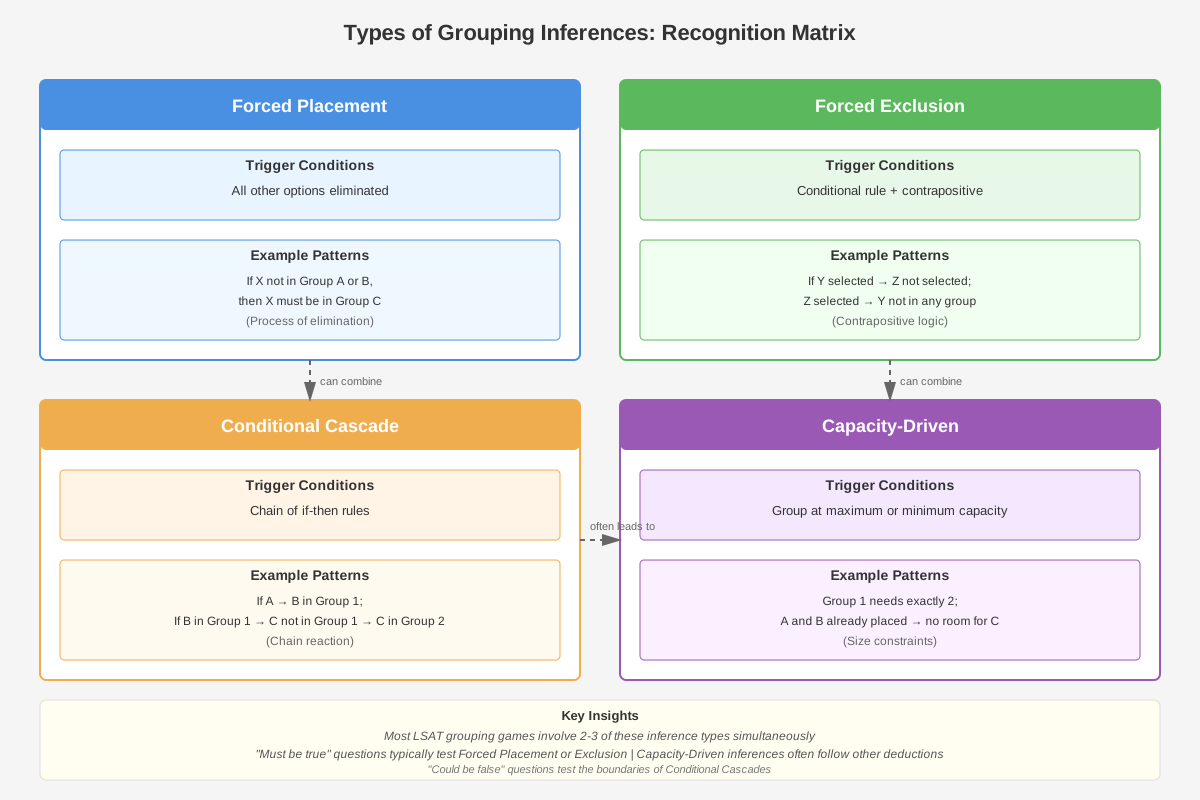
Types of Grouping Inferences
Forced placement inferences occur when rules and constraints leave only one possible location for an element. These represent the most powerful deductions because they reduce uncertainty and often trigger additional inferences. For example, in a game selecting 4 of 7 candidates where "If M is selected, both N and O must be selected," and "P cannot be selected with N," if the game establishes that M is selected, then N and O are forced selections, and P is forced out.
Exclusion inferences determine which elements cannot appear in certain groups or cannot be selected together. These often emerge from combining conditional rules with their contrapositives. When a rule states "If A is in group 1, then B is not in group 1," and another rule states "C and B must be in the same group," combining these reveals that if A is in group 1, then neither B nor C can be in group 1.
Numerical inferences arise from capacity constraints interacting with rules. In a game where exactly 3 of 6 elements must be selected, and two separate rules each require that "if X is selected, then Y must also be selected," the numerical constraint becomes critical. If both X-triggers are selected, the game may become impossible, or certain elements may be forced out to maintain the exact count.
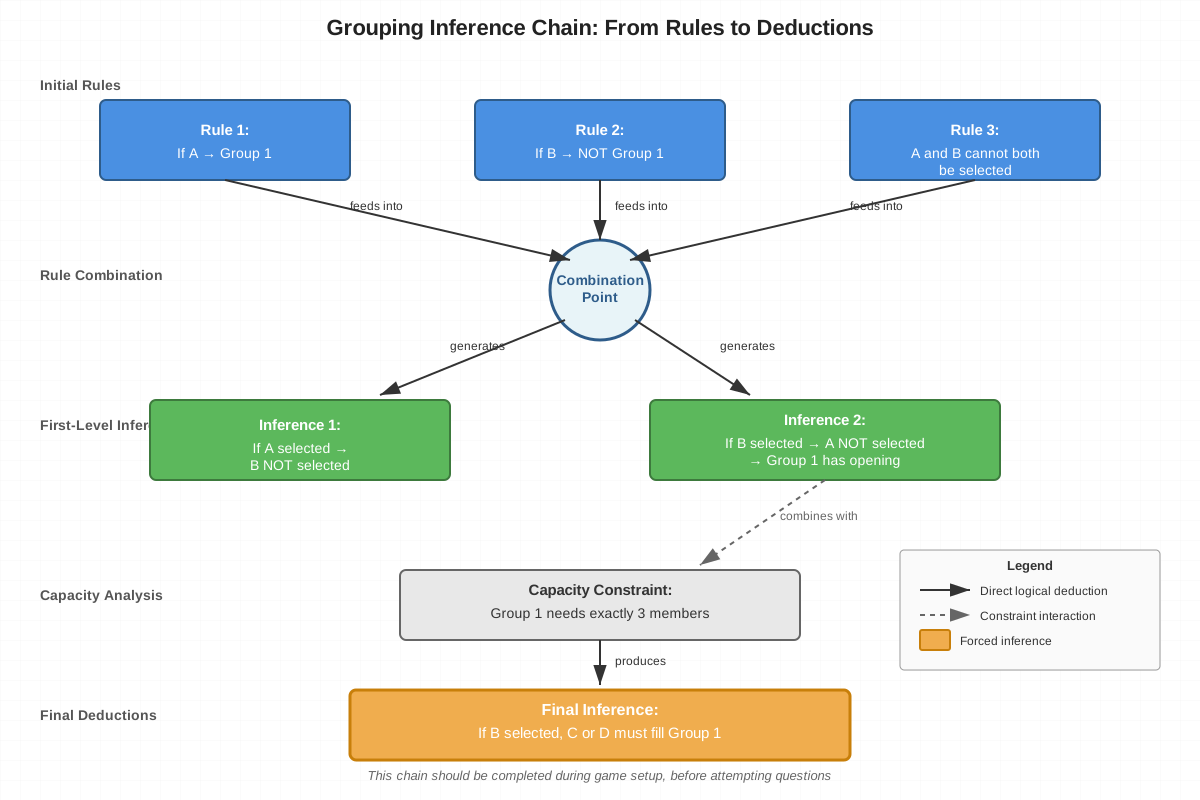
The Inference Chain Process
The systematic approach to generating grouping inferences follows a structured sequence:
- Identify all conditional rules and write both the rule and its contrapositive
- Look for rule overlap where the consequent of one rule matches the antecedent of another
- Apply numerical constraints to determine minimum and maximum group sizes
- Test forced scenarios where an element must be in or out based on game constraints
- Document all deductions in a master inference list or directly on the diagram
This process transforms a collection of isolated rules into an interconnected web of logical relationships. The most valuable inferences typically emerge from combining three or more rules, though even simple two-rule combinations can yield significant deductions.
Conditional Chain Inferences
When conditional rules link together, they create inference chains that extend logical implications across multiple steps. Consider these rules in a selection game:
- If J is selected → K is selected
- If K is selected → L is not selected
- If L is not selected → M is selected
These rules chain together to create: If J is selected → M is selected. Equally important, the contrapositive chain reveals: If M is not selected → J is not selected. Test-takers must recognize both forward and backward chains to maximize their inference generation.
Block and Anti-Block Inferences
Blocks represent elements that must appear together, while anti-blocks represent elements that cannot appear together. These concepts become particularly powerful when combined with numerical constraints. In a game selecting exactly 4 of 8 elements, if three elements form a block (all in or all out together), and two other elements form a separate block, the numerical constraint severely limits possibilities. Selecting both blocks would require at least 5 selections, making it impossible in this scenario.
Capacity-Driven Inferences
Group capacity limits create some of the most powerful inferences in grouping games. When a group has a maximum size, and multiple rules require certain elements to be included, the group may "fill up," forcing other elements elsewhere. Conversely, minimum size requirements combined with exclusion rules can force certain elements into a group to meet the minimum.
| Constraint Type | Inference Opportunity | Example |
|---|---|---|
| Maximum capacity | Forced exclusions when group approaches limit | Group 1 holds max 3; if 2 elements must be in Group 1, only 1 slot remains |
| Minimum capacity | Forced inclusions to meet requirement | Group 2 needs min 2; if only 3 elements can possibly go there, at least 2 of those 3 must be selected |
| Exact capacity | Both forced inclusions and exclusions | Exactly 4 selected; if 3 are forced in, exactly 1 more must be selected |
| Balanced distribution | Numerical deductions across groups | 6 elements into 2 equal groups means exactly 3 in each |
Contrapositive Inferences in Grouping
The contrapositive remains one of the most underutilized inference tools in grouping games. Every conditional rule generates a contrapositive that provides equal logical force. When a rule states "If X is selected, Y is not selected," the contrapositive "If Y is selected, X is not selected" often proves more useful for specific questions. Test-takers should automatically generate and notate contrapositives for every conditional rule during game setup.
Exhaustive Possibility Inferences
Some grouping games present scenarios where only a limited number of valid configurations exist. Recognizing when possibilities are exhaustive allows test-takers to enumerate all valid scenarios, creating a powerful reference for answering questions. This typically occurs when multiple strong constraints interact, leaving only 2-4 possible complete solutions. While time-intensive, this approach guarantees accuracy and speed on subsequent questions.
Concept Relationships
The core concepts within grouping inference strategy build upon each other in a hierarchical structure. Forced placement inferences and exclusion inferences represent the foundational inference types, emerging directly from individual rules or simple rule combinations. These basic inferences then enable numerical inferences by reducing the number of uncertain placements, which in turn may trigger additional forced placements.
Conditional chain inferences represent a more sophisticated application, requiring test-takers to recognize how multiple conditional rules connect. These chains often produce block and anti-block inferences when the chain conclusions force elements together or apart. The relationship flows: Individual conditionals → Conditional chains → Blocks/Anti-blocks → Capacity-driven inferences.
Contrapositive inferences operate as a parallel track, doubling the available information from each conditional rule. They interact with all other inference types, often revealing connections that aren't apparent from the original rule formulation. The relationship map appears as:
Rule Statement → Contrapositive → Combined with other rules → Forced placements/Exclusions → Numerical constraints → Capacity-driven inferences → Exhaustive possibilities (when applicable)
This strategy connects to prerequisite knowledge of conditional logic by applying those abstract principles to concrete grouping scenarios. It extends toward more advanced topics like hybrid games (combining grouping with sequencing) and complex conditional chains involving multiple variables.
High-Yield Facts
⭐ The contrapositive of every conditional rule carries equal logical weight and must be considered during inference generation.
⭐ When a grouping game has exact numerical requirements (e.g., "exactly 4 of 7"), combining this with forced inclusions immediately determines how many additional selections remain.
⭐ If two elements form an anti-block (cannot be together) in a two-group distribution game, they must be in opposite groups.
⭐ Conditional chains extend across multiple rules: if A→B and B→C, then A→C (and contrapositive: not C → not A).
⭐ In selection games, when an element triggers multiple other elements, selecting that trigger may violate numerical constraints, forcing the trigger element out.
- Block inferences (elements that must be together) reduce the effective number of independent elements in a game.
- When a group reaches maximum capacity, all remaining elements must be distributed among other groups or excluded entirely.
- Minimum capacity requirements combined with limited eligible elements create forced inclusions.
- In distribution games where all elements must be assigned, exclusion from one group forces inclusion in another.
- Rules stating "at least one of X or Y must be selected" create a contrapositive: if X is not selected, Y must be selected (and vice versa).
- When multiple conditional rules share the same trigger, that trigger creates a "bundle" of consequences that must all occur together.
- Numerical inferences often emerge from counting forced inclusions and comparing to maximum capacity.
Quick check — test yourself on Grouping inference strategy so far.
Try Flashcards →Common Misconceptions
Misconception: If a rule doesn't explicitly state an element must be selected or placed, no inference can be made about it.
Correction: Inferences frequently emerge from combining multiple rules, numerical constraints, and contrapositives. An element may be forced into a position through the logical interaction of several rules, even when no single rule directly addresses it.
Misconception: Contrapositives only matter when the original conditional rule doesn't apply.
Correction: Contrapositives should be generated upfront for all conditional rules and considered equally during inference-making. They often reveal connections that aren't apparent from the original rule formulation and are essential for complete inference chains.
Misconception: In a selection game, if an element isn't forced in or forced out, it's not worth noting.
Correction: Elements with uncertain status still provide valuable information, especially when combined with numerical constraints. Knowing that exactly 2 of 3 uncertain elements must be selected is a powerful inference, even though none individually is determined.
Misconception: Inference-making should happen while answering questions, not during initial setup.
Correction: The most efficient approach invests 2-3 minutes upfront generating inferences, which then accelerates every subsequent question. Attempting to make inferences question-by-question wastes time through repeated analysis.
Misconception: If a game has many rules, it will have many inferences; if it has few rules, it will have few inferences.
Correction: The number of inferences depends on rule interaction and constraint strength, not rule quantity. A game with three powerful, interconnected rules may yield more inferences than a game with seven independent rules.
Misconception: Exhaustive possibility analysis (listing all valid scenarios) is always too time-consuming to be worthwhile.
Correction: When strong constraints limit possibilities to 2-4 valid configurations, exhaustive analysis takes 2-3 minutes but guarantees perfect accuracy and speed on all subsequent questions, making it highly efficient for certain game types.
Worked Examples
Example 1: Selection Game with Conditional Chains
Game Setup: A committee will select exactly 4 of 7 candidates: F, G, H, J, K, L, M. The selection must conform to the following:
- If F is selected, G must be selected
- If G is selected, H cannot be selected
- If H is not selected, J must be selected
- K and L cannot both be selected
- M must be selected
Step 1 - Identify Direct Inferences:
From "M must be selected," we immediately know M is in, leaving exactly 3 more selections from the remaining 6 candidates.
Step 2 - Build Conditional Chains:
- F → G (given)
- G → not H (given)
- not H → J (given)
Combining these: F → G → not H → J
Therefore: If F is selected, then G and J must also be selected (and H cannot be selected).
Step 3 - Apply Numerical Constraints:
We need exactly 4 total selections. M is already in (1 selection). If F is selected, then G and J must also be selected, giving us F, G, J, M (4 selections). This means if F is selected, these are the only 4 selections, and H, K, and L are all out.
Step 4 - Test the Contrapositive Chain:
The contrapositive of F → G → not H → J is: not J → H → not G → not F
This means: If J is not selected, then H must be selected, G cannot be selected, and F cannot be selected.
Step 5 - Analyze the K/L Anti-Block:
K and L cannot both be selected. Combined with our previous inferences:
- If F is selected, neither K nor L can be selected (because all 4 slots are filled with F, G, J, M)
- If F is not selected, we need 3 more selections beyond M, and at most one of K/L can be among them
Final Inference Summary:
- M is always selected
- F, G, and J form a conditional block: selecting any one forces all three
- If F is selected: F, G, J, M are selected; H, K, L are out
- If F is not selected: H must be selected (because not F → not G → H), and exactly 2 more from {K, L} (but not both)
Example 2: Distribution Game with Capacity Constraints
Game Setup: Six employees—R, S, T, U, V, W—are assigned to exactly two projects, Project 1 and Project 2. Each employee is assigned to exactly one project. The assignments must conform to the following:
- Project 1 has exactly 4 employees
- If R is assigned to Project 1, then S must be assigned to Project 2
- T and U must be assigned to the same project
- V and W cannot be assigned to the same project
Step 1 - Establish Numerical Framework:
Project 1 has exactly 4 employees, so Project 2 has exactly 2 employees (since 6 total employees must be distributed).
Step 2 - Analyze the T/U Block:
T and U must be together. They form a block that goes entirely into one project. This block takes up 2 slots in whichever project receives it.
Step 3 - Consider Block Placement Options:
Option A: T/U block goes to Project 1
- Project 1 would have T, U, plus 2 more employees (4 total)
- Project 2 would have exactly 2 employees
Option B: T/U block goes to Project 2
- Project 2 would have T, U (exactly 2, filling it completely)
- Project 1 would have the remaining 4 employees: R, S, V, W
Step 4 - Test Option B Against Rules:
If T and U are in Project 2, then R, S, V, W are all in Project 1. But the rule states "If R is in Project 1, then S must be in Project 2." This creates a contradiction because S would be in Project 1.
Also, V and W cannot be together, but they would both be in Project 1.
Therefore, Option B is impossible. T and U must be assigned to Project 1.
Step 5 - Apply This Forced Inference:
T and U are in Project 1, occupying 2 of the 4 slots. Exactly 2 more employees must be assigned to Project 1 from {R, S, V, W}, and exactly 2 must be assigned to Project 2.
Step 6 - Apply Remaining Rules:
- V and W must be in different projects (one in Project 1, one in Project 2)
- If R is in Project 1, S must be in Project 2
Step 7 - Enumerate Possibilities:
Since V and W must split, and we need 2 more in Project 1 and 2 in Project 2:
Scenario 1: V in Project 1, W in Project 2
- Need 1 more in Project 1 from {R, S}
- If R is in Project 1: S must be in Project 2 ✓ (valid)
- If S is in Project 1: R must be in Project 2 ✓ (valid)
Scenario 2: W in Project 1, V in Project 2
- Need 1 more in Project 1 from {R, S}
- If R is in Project 1: S must be in Project 2 ✓ (valid)
- If S is in Project 1: R must be in Project 2 ✓ (valid)
Final Inference Summary:
- T and U must be assigned to Project 1 (forced inference)
- Exactly one of V/W is in Project 1, and the other is in Project 2
- Exactly one of R/S is in Project 1, and the other is in Project 2
- Four valid scenarios exist based on the combinations of V/W and R/S placements
Exam Strategy
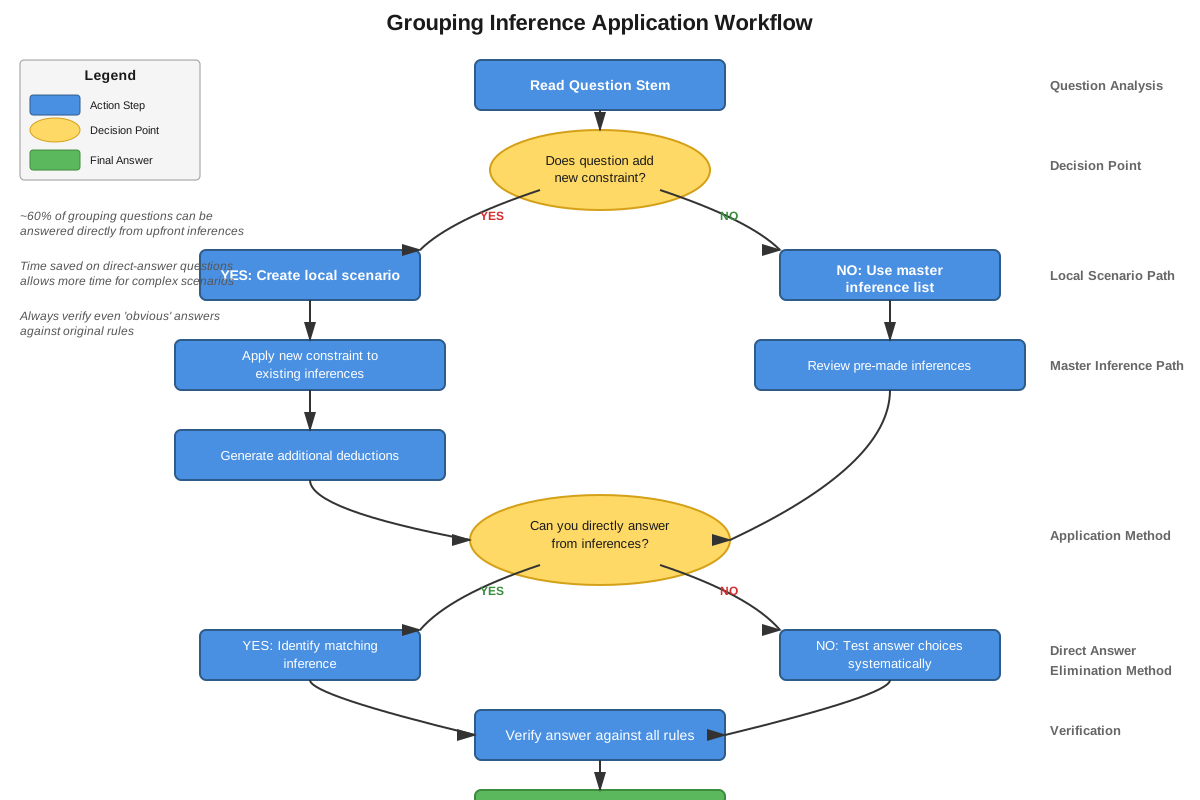
When approaching grouping games on the LSAT, begin by investing 2-3 minutes in systematic inference generation before attempting any questions. This upfront investment pays dividends across all questions and prevents the inefficiency of re-analyzing rules repeatedly.
Trigger words and phrases to watch for:
- "must be true" signals that the correct answer is a forced inference
- "could be false" indicates the correct answer is either uncertain or definitely false
- "completely determined" suggests looking for scenarios where all placements are forced
- "exactly," "at least," "at most" highlight numerical constraints that drive inferences
- "if and only if" indicates a biconditional relationship requiring special attention
Process-of-elimination approach:
For "must be true" questions, eliminate any answer choice that could be false in even one valid scenario. For "could be true" questions, eliminate only those answer choices that violate rules or forced inferences. When uncertain about an answer choice, quickly test it against your master inference list rather than re-reading all original rules.
Time allocation strategy:
Spend approximately 25-30% of your time on game setup and inference generation, then move through questions rapidly using your inferences. A typical 5-7 minute grouping game should break down as: 2 minutes setup/inferences, 3-5 minutes answering questions. If you find yourself spending more than 45 seconds on a question, you likely missed a key inference during setup—flag the question and return to it after completing others.
Question-specific tactics:
- For "if" hypothetical questions, immediately check whether the new condition triggers any conditional chains
- For "complete and accurate list" questions, use your inferences to eliminate impossible elements before testing scenarios
- For "must be false" questions, look for answer choices that contradict forced inferences or create impossible numerical situations
- When stuck, return to numerical constraints—they often provide the decisive inference
Exam Tip: The LSAT rewards test-takers who recognize when a game has limited possibilities (2-4 valid scenarios). If your initial inferences suggest this, invest the extra minute to map all scenarios completely. This approach transforms difficult questions into simple lookup tasks.
Memory Techniques
FORCE - Framework for generating grouping inferences:
- Forced placements (what must be in/out)
- Overlapping conditionals (chain rules together)
- Reverse all conditionals (write contrapositives)
- Capacity constraints (apply numerical limits)
- Exhaustive scenarios (when possibilities are limited)
The "Block and Lock" visualization: Picture elements that must be together as physically connected blocks, and elements that cannot be together as repelling magnets. When placing these mental objects into limited spaces (groups), the physical impossibilities become obvious.
Contrapositive Quick-Flip: For any conditional "If A then B," immediately write "If not B then not A" directly below it. Train yourself to see these as a single unit rather than separate rules. The visual pairing reinforces that both directions carry equal weight.
Numerical Countdown: When a game specifies "exactly X selections," write that number prominently and subtract each forced inclusion, keeping a running count of remaining slots. This running tally makes capacity-driven inferences obvious.
The Chain-Link Method: When building conditional chains, draw actual connecting links (arrows) between rules that share elements. The visual representation of A → B → C → D makes the extended inference A → D immediately apparent.
Summary
Grouping inference strategy represents the systematic process of deriving new information from the rules and constraints in LSAT grouping games. This strategy encompasses multiple inference types: forced placements that determine where elements must go, exclusion inferences that identify impossible combinations, numerical inferences that emerge from capacity constraints, conditional chains that extend logical implications across multiple rules, and block/anti-block inferences that identify elements that must or cannot appear together. The most effective approach invests time upfront during game setup to generate a comprehensive inference list, which then accelerates question-answering and improves accuracy. Key techniques include automatically generating contrapositives for all conditional rules, combining rules that share common elements, applying numerical constraints to identify forced placements, and recognizing when limited possibilities allow for exhaustive scenario enumeration. Mastery requires understanding that inferences emerge from rule interaction rather than individual rules, that numerical constraints often provide the most powerful deductions, and that systematic application of the inference process transforms complex games into manageable question sets.
Key Takeaways
- Grouping inference strategy is the systematic process of combining rules, constraints, and numerical limits to derive new information before attempting questions
- Conditional chains (A→B→C) and their contrapositives (not C→not B→not A) generate powerful extended inferences that reach across multiple rules
- Numerical constraints (exact counts, minimums, maximums) combined with forced inclusions or exclusions create capacity-driven inferences
- Blocks (elements that must be together) and anti-blocks (elements that cannot be together) interact with group capacity to force placements
- Investing 2-3 minutes in upfront inference generation saves 30-60 seconds per question and dramatically improves accuracy
- The most valuable inferences typically emerge from combining three or more rules, though simple two-rule combinations also yield important deductions
- When strong constraints limit a game to 2-4 valid scenarios, exhaustive enumeration provides the most efficient approach
Related Topics
Advanced Conditional Logic in Grouping Games: Building on basic grouping inference strategy, this topic explores complex conditional relationships including biconditionals, conditional blocks, and nested conditionals that appear in the most challenging grouping games.
Hybrid Games (Grouping + Sequencing): Mastering grouping inference strategy provides essential foundation for hybrid games that combine grouping constraints with ordering requirements, requiring simultaneous application of both inference strategies.
Numerical Distribution Patterns: This advanced topic examines recurring numerical patterns in grouping games (such as 3-2-1 distributions or balanced groups) and the specific inference opportunities each pattern creates.
Game Setup Optimization: Understanding grouping inference strategy enables more sophisticated game setup techniques, including when to use different diagramming methods and how to organize inferences for maximum efficiency.
Practice CTA
Now that you understand the systematic approach to grouping inference strategy, it's time to apply these concepts to actual LSAT-style problems. The practice questions and flashcards will reinforce your ability to identify inference opportunities, combine rules effectively, and generate the deductions that separate high scorers from average performers. Remember: inference-making is a skill that improves dramatically with deliberate practice. Each game you analyze strengthens your pattern recognition and speeds your inference generation. Approach the practice materials with the goal of internalizing the FORCE framework until inference generation becomes automatic. Your investment in mastering this strategy will pay dividends across every grouping game you encounter on test day.
Sign up free to keep reading
Create a free AnvayaPrep account to finish this LSAT guide on Grouping inference strategy — plus flashcards and practice questions.