Overview
Grouping rule diagramming is a fundamental skill within the Analytical Reasoning Legacy section of the LSAT, specifically within grouping games legacy problems. These games present scenarios where test-takers must sort elements (people, objects, or concepts) into distinct groups according to specific rules and constraints. The ability to translate verbal rules into clear, symbolic diagrams is essential for solving these problems efficiently and accurately under timed conditions.
Grouping games differ from sequencing games in that they focus on membership and categorization rather than order. A typical grouping game might ask you to assign seven employees to three different committees, or to determine which of five colors can be used to paint four rooms. The rules governing these assignments—such as "If X is selected, then Y cannot be selected" or "At least two members must be in Group A"—must be captured in a notation system that allows for quick reference and logical deduction. Mastering lsat grouping rule diagramming transforms complex verbal constraints into visual tools that reveal inferences and guide your problem-solving process.
Within the broader landscape of Analytical Reasoning, grouping rule diagramming serves as a bridge between reading comprehension and logical deduction. It requires you to parse conditional statements, understand quantitative constraints, and recognize relationships between elements. This skill directly supports your ability to make valid inferences, eliminate impossible scenarios, and identify what must be true or could be true given the game's constraints. Strong diagramming skills reduce cognitive load, minimize errors, and significantly improve your speed—all critical factors for LSAT success.
Learning Objectives
- [ ] Identify how Grouping rule diagramming appears in LSAT questions
- [ ] Explain the reasoning pattern behind Grouping rule diagramming
- [ ] Apply Grouping rule diagramming to solve LSAT-style problems accurately
- [ ] Translate verbal grouping rules into standardized symbolic notation
- [ ] Distinguish between different types of grouping constraints (conditional, numerical, exclusionary)
- [ ] Combine multiple diagrammed rules to generate valid inferences
- [ ] Recognize when a grouping rule requires contrapositive notation
Prerequisites
- Basic conditional logic notation: Understanding "if-then" statements and their contrapositives is essential because many grouping rules express conditional relationships between element selection or placement.
- Familiarity with LSAT game structure: Knowing how to identify the game scenario, elements, and groups allows you to establish the framework before diagramming individual rules.
- Set theory fundamentals: Basic understanding of membership, inclusion, and exclusion helps interpret rules about which elements can or cannot appear together in groups.
- Logical operators (AND, OR, NOT): These operators frequently appear in grouping rules and must be correctly represented in diagrams to avoid logical errors.
Why This Topic Matters
Grouping games constitute approximately 25-30% of all Analytical Reasoning games on the LSAT, making them one of the most frequently tested game types. Within each grouping game, typically 3-6 rules govern how elements can be assigned to groups, and every question in the game set relies on correctly understanding and applying these rules. A single misdiagrammed rule can cascade into multiple incorrect answers, potentially costing 5-7 points on a section where every point matters for competitive scores.
In real-world legal practice, attorneys constantly engage in grouping and categorization tasks: sorting evidence into admissible and inadmissible categories, determining which precedents apply to a case, or organizing parties into relevant legal classifications. The LSAT tests this skill because it reflects the analytical thinking required for legal reasoning. Law schools view performance on Analytical Reasoning as predictive of success in courses requiring systematic analysis and rule application.
On the exam, grouping rules appear in various forms: conditional statements ("If attorney F is on the committee, then attorney G must also be on the committee"), numerical constraints ("Exactly three of the five colors must be used"), exclusionary rules ("K and L cannot both be selected"), and distribution requirements ("Each team must have at least two members"). Questions may ask what must be true, what could be true, which element must be in a particular group, or what happens if a specific condition is imposed. Without effective diagramming, tracking these constraints across multiple questions becomes overwhelming and error-prone.
Core Concepts
Understanding Grouping Game Structure
Before diagramming individual rules, recognize the fundamental structure of grouping games. These games involve a set of elements (typically 5-8 items) that must be distributed among groups (usually 2-4 categories). Grouping games fall into three main categories:
- Selection games: Choose some elements from a larger pool (e.g., selecting 4 of 7 candidates)
- Distribution games: Assign all elements to groups (e.g., placing 6 students into 3 study groups)
- Matching games: Pair elements with attributes (e.g., assigning colors to rooms)
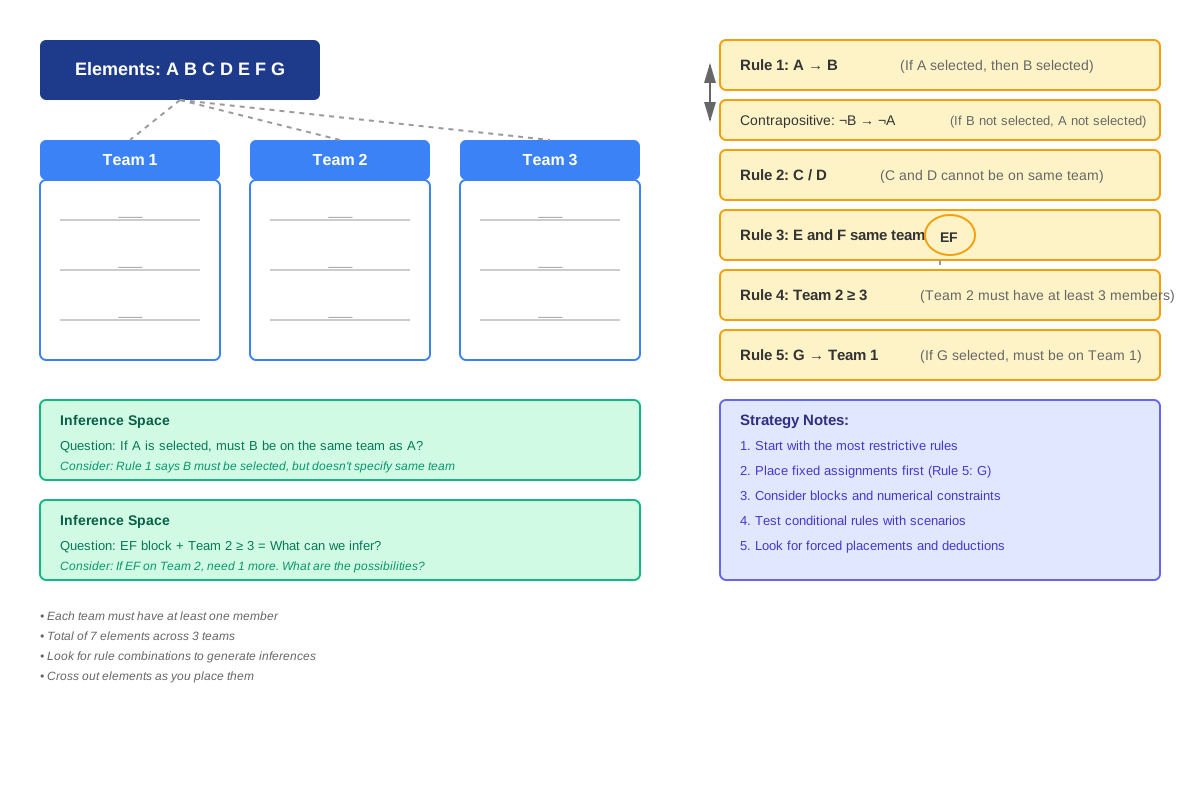
The initial setup should clearly show your elements and groups. For example, if seven lawyers (F, G, H, J, K, L, M) are being assigned to two committees (Committee 1 and Committee 2), your setup might look like:
Elements: F G H J K L M

Committee 1: ___  ___  ___
Committee 2: ___  ___  ___
Conditional Grouping Rules
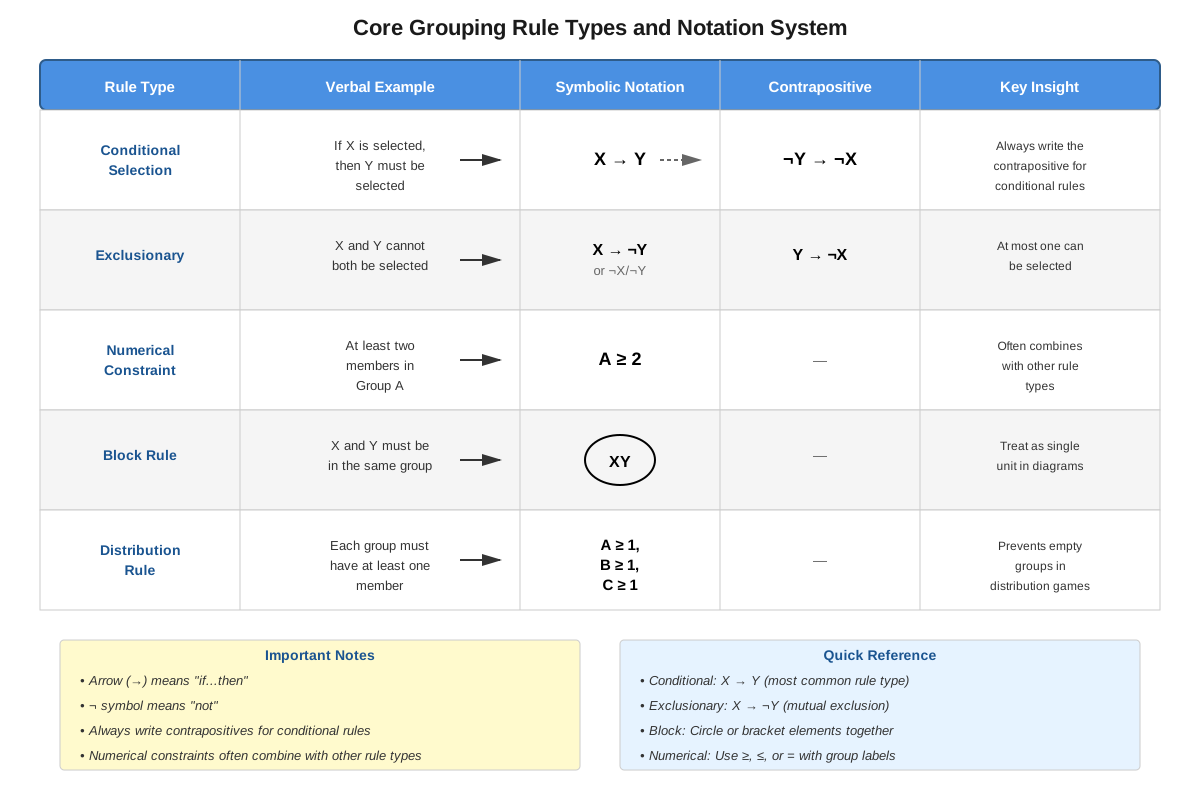
Conditional rules establish "if-then" relationships between element placements. These are among the most common and powerful rule types in grouping games. The standard notation uses an arrow to show the conditional relationship:
Rule: "If F is selected, then G must also be selected"
Diagram: F → G
Contrapositive: ~G → ~F (If G is not selected, then F cannot be selected)
Always write the contrapositive immediately below the original rule. The contrapositive is logically equivalent and often provides the key to solving questions. For grouping games, the contrapositive tells you what exclusions follow from an element's absence.
Rule: "If K is on Committee 1, then L must be on Committee 2"
Diagram: K₁ → L₂
Contrapositive: ~L₂ → ~K₁
Notice the subscripts indicating specific groups. This notation prevents confusion when the same element could appear in different groups.
Exclusionary Rules
Exclusionary rules (also called "anti-block" rules) specify that certain elements cannot appear together in the same group. These rules are fundamental to grouping games and often generate important inferences when combined with other constraints.
Rule: "F and G cannot both be selected"
Diagram: F ↔ G (with a slash through the double arrow) or F/G
Alternative notation: ~(F & G) or "Never FG"
The key insight: if one element is selected, the other must be excluded. This creates a conditional relationship:
- F → ~G
- G → ~F
Rule: "K and L cannot both be on Committee 1"
Diagram: Never K₁L₁ or K₁ → ~L₁ (with contrapositive L₁ → ~K₁)
Block Rules (Positive Grouping)
Block rules require certain elements to appear together. These are the opposite of exclusionary rules and often create powerful restrictions on possible arrangements.
Rule: "If F is selected, then G must also be selected"
This is actually a conditional rule, but when combined with "If G is selected, then F must also be selected," it creates a true block:
Diagram: FG (circled or boxed together)
This means F and G are always selected together or excluded together. They function as a single unit.
Rule: "H and J must be on the same committee"
Diagram: HJ (boxed together, with subscript indicating they share the same group number)
Numerical Constraints
Numerical constraints specify how many elements must appear in each group. These rules often determine the game's basic structure and limit possible distributions.
Rule: "Exactly three of the seven lawyers must be selected"
Diagram: 3 selected / 4 out (or 3 in, 4 out)
Rule: "Each committee must have at least two members"
Diagram: C1 ≥ 2, C2 ≥ 2
Rule: "Committee 1 must have more members than Committee 2"
Diagram: C1 > C2
Numerical constraints often combine with other rules to generate inferences. For example, if exactly three elements must be selected and you know F → G, then selecting F automatically uses two of your three slots.
Distribution and Capacity Rules
Some grouping games specify the exact capacity of each group or provide ranges for how many elements each group can contain.
Rule: "Committee 1 has exactly four members; Committee 2 has exactly three members"
Diagram:
C1: ___ ___ ___ ___ (4)
C2: ___ ___ ___ (3)Rule: "Each team must have at least one but no more than three members"
Diagram: 1 ≤ each team ≤ 3
Complex Conditional Rules
Advanced grouping rules may involve multiple conditions or compound statements. These require careful diagramming to capture all logical relationships.
Rule: "If F is selected, then both G and H must be selected"
Diagram: F → G & H
Contrapositive: ~G OR ~H → ~F
The contrapositive uses OR because if either G or H is absent, F cannot be selected.
Rule: "If either K or L is on Committee 1, then M must be on Committee 2"
Diagram: K₁ OR L₁ → M₂
Contrapositive: ~M₂ → ~K₁ & ~L₁
Biconditional Rules
Biconditional rules (if and only if) create two-way conditional relationships. These are rare but powerful when they appear.
Rule: "F is selected if and only if G is selected"
Diagram: F ↔ G (double arrow)
This means:
- F → G
- G → F
- ~F → ~G
- ~G → ~F
F and G must have identical status: both selected or both excluded.
Concept Relationships
The concepts within grouping rule diagramming form a hierarchical and interconnected system. At the foundation lies conditional logic notation, which provides the symbolic language for expressing relationships. This foundation supports conditional grouping rules, which are the most versatile rule type and can express many other relationships.
Exclusionary rules are actually a specific application of conditional logic: "F and G cannot both be selected" translates to the conditional statements F → ~G and G → ~F. Similarly, block rules represent biconditional relationships where elements must share the same status.
Numerical constraints interact with all other rule types by limiting the total number of possible arrangements. When combined with conditional rules, numerical constraints often force specific deductions. For example, if exactly three of seven elements must be selected, and you have the rule F → G & H, then selecting F immediately fills all three slots, making this a critical inference.
The relationship map flows as follows:
Conditional Logic Foundation
    ↓
Conditional Grouping Rules ← connects to → Contrapositives
    ↓
Exclusionary Rules (special case of conditionals)
Block Rules (biconditional relationships)
    ↓
Numerical Constraints (limit possibilities)
    ↓
Combined Inferences (integration of multiple rules)
Understanding these relationships allows you to recognize that mastering conditional notation provides the key to diagramming most grouping rules. The other rule types are variations or applications of this fundamental skill, combined with quantitative reasoning about group sizes and capacities.
High-Yield Facts
⭐ Every conditional rule must be immediately accompanied by its contrapositive to avoid missing critical deductions during question-solving.
⭐ Exclusionary rules create bidirectional conditional relationships: if F and G cannot both be selected, then F → ~G and G → ~F.
⭐ Numerical constraints often combine with conditional rules to force specific outcomes: if exactly 3 of 7 must be selected and F → G & H, selecting F fills all slots.
⭐ Block rules (elements that must be together) function as single units when counting group capacity and considering distributions.
⭐ The contrapositive of "F → G & H" is "~G OR ~H → ~F": if either consequent element is absent, the sufficient condition cannot occur.
- Subscript notation (e.g., K₁, L₂) prevents confusion when elements can appear in different groups and rules specify particular group assignments.
- Biconditional rules (F ↔ G) mean elements must have identical status: both in or both out, both in Group 1 or both in Group 2.
- "At least" constraints create minimum requirements but allow for more; "exactly" constraints create fixed requirements that enable stronger inferences.
- When a rule states "If F is selected, then G cannot be selected," this is equivalent to an exclusionary rule between F and G.
- Distribution games where all elements must be assigned often generate inferences from capacity constraints combined with block rules.
- Multiple conditional rules with the same sufficient condition can be combined: if F → G and F → H, then F → G & H.
- Rules stating "F and G cannot both be excluded" mean at least one must be selected: ~F → G and ~G → F.
Quick check — test yourself on Grouping rule diagramming so far.
Try Flashcards →Common Misconceptions
Misconception: The contrapositive of F → G is G → F.
Correction: The contrapositive of F → G is ~G → ~F. The contrapositive reverses AND negates both terms. The statement G → F is the converse, which is not logically equivalent to the original statement.
Misconception: "F and G cannot both be selected" means if F is selected, G must be excluded, but if G is selected, F could still be selected.
Correction: Exclusionary rules are symmetric. If F and G cannot both be selected, then F → ~G AND G → ~F. Either element's selection excludes the other.
Misconception: When a rule says "If F is selected, then G and H must be selected," you can satisfy this by selecting F and either G or H.
Correction: The word "and" in the consequent means both G and H are required. F → G & H means selecting F obligates you to select both G and H, not just one of them.
Misconception: Numerical constraints like "at least three members" mean exactly three members.
Correction: "At least three" means three or more. This is a minimum constraint, not a fixed requirement. Only "exactly three" specifies a precise number.
Misconception: If a rule states "F is on Committee 1 if G is on Committee 1," this means F and G must be together.
Correction: This rule (G₁ → F₁) only establishes a one-way conditional. G being on Committee 1 requires F to be there, but F could be on Committee 1 without G. For F and G to always be together, you need a biconditional (F₁ ↔ G₁).
Misconception: Block rules mean the elements must be adjacent or next to each other.
Correction: In grouping games (unlike sequencing games), block rules mean elements must be in the same group, not that they have any spatial relationship. "Adjacent" is a sequencing concept, not a grouping concept.
Misconception: When diagramming "Either F or G must be selected," you should write F OR G.
Correction: While this notation captures the idea, it's more useful to write the contrapositive form: ~F → G and ~G → F. This conditional notation integrates better with other rules and makes inferences clearer.
Worked Examples
Example 1: Selection Game with Multiple Rule Types
Scenario: A committee will select exactly four of seven candidates—F, G, H, J, K, L, and M—to receive scholarships. The selection must conform to the following rules:
- If F is selected, then G must also be selected.
- K and L cannot both be selected.
- If H is selected, then M cannot be selected.
- Either J or K must be selected, but not both.
Step 1: Set up the basic framework
Elements: F G H J K L M
Selected (4): ___ ___ ___ ___
Out (3): ___ ___ ___
Step 2: Diagram each rule with its contrapositive
Rule 1: F → G
Contrapositive: ~G → ~F
Rule 2: K ↔ L (exclusionary)
As conditionals: K → ~L and L → ~K
Rule 3: H → ~M
Contrapositive: M → ~H
Rule 4: J ↔ K (exactly one, not both)
As conditionals: J → ~K and K → ~J
Also: ~J → K and ~K → J
Step 3: Look for immediate inferences
From Rule 4, exactly one of J or K must be selected (since we need one but not both, and the rule structure with contrapositives shows if one is out, the other is in).
If K is selected:
- From Rule 2: L cannot be selected
- From Rule 4: J cannot be selected
- This accounts for 1 selected (K) and 2 out (L, J)
- We need 3 more selected from {F, G, H, M}
If J is selected:
- From Rule 4: K cannot be selected
- This accounts for 1 selected (J) and 1 out (K)
- L could be selected (Rule 2 only prohibits K and L together)
- We need 3 more selected from {F, G, H, L, M}
Step 4: Apply to a sample question
Question: If G is not selected, which of the following must be true?
Solution:
- ~G → ~F (from contrapositive of Rule 1)
- So both F and G are out
- That's 2 of our 3 "out" slots filled
- We need exactly 4 selected from {H, J, K, L, M}
- From Rule 4: exactly one of J or K must be selected
- We need 3 more from {H, L, M}
If K is selected (and thus J is out):
- L cannot be selected (Rule 2)
- We'd need both H and M selected
- But Rule 3 says H → ~M, so we can't select both
- This scenario is impossible
Therefore, J must be selected (and K is out):
- L can now be selected (no conflict)
- We need 2 more from {H, L, M}
- If we select H, we cannot select M (Rule 3)
- So we'd select H and L
- If we don't select H, we could select L and M
Answer: J must be selected.
Example 2: Distribution Game with Numerical Constraints
Scenario: Six employees—R, S, T, V, W, and X—are being assigned to three projects: Project 1, Project 2, and Project 3. Each employee is assigned to exactly one project. The assignments must conform to the following:
- Project 1 has exactly two employees.
- If R is assigned to Project 1, then S must be assigned to Project 2.
- T and V must be assigned to the same project.
- W and X cannot be assigned to the same project.
Step 1: Set up the framework
Elements: R S T V W X (all must be assigned)

Project 1: ___ ___ (exactly 2)
Project 2: ___ ___
Project 3: ___ ___
Step 2: Diagram the rules
Rule 1: Already incorporated into setup (P1 has exactly 2)
Rule 2: R₁ → S₂
Contrapositive: ~S₂ → ~R₁ (If S is not in P2, R is not in P1)
Rule 3: TV (block - they're together)
This means TV functions as a single unit
Rule 4: W ↔ X (exclusionary)
W₁ → ~X₁, X₁ → ~W₁ (and similar for P2 and P3)
Step 3: Analyze the structure
- 6 employees total, P1 gets exactly 2, leaving 4 for P2 and P3
- TV is a block, so they occupy 2 slots in whichever project they join
- W and X must be in different projects
Key inference: If TV is assigned to Project 1, they fill both slots (since P1 has exactly 2). This would be a major restriction.
Step 4: Apply to a sample question
Question: If S is assigned to Project 3, which of the following could be true?
Solution:
- S is in P3 (given)
- From contrapositive of Rule 2: ~S₂ → ~R₁
- Since S is in P3 (not P2), R cannot be in P1
- So R must be in P2 or P3
Since P1 needs exactly 2 employees and R is not one of them, P1 must contain 2 of {T, V, W, X}.
Could TV be in P1?
- Yes, they'd fill both P1 slots
- Then R, S, W, X would be distributed among P2 and P3
- S is already in P3
- W and X must be separated (Rule 4)
- R could be in P2 or P3
- This works: P1: TV, P2: RW, P3: SX (or other valid arrangements)
Could W and X both be in P1?
- No, Rule 4 prohibits them from being in the same project
Answer: TV could be assigned to Project 1.
Exam Strategy
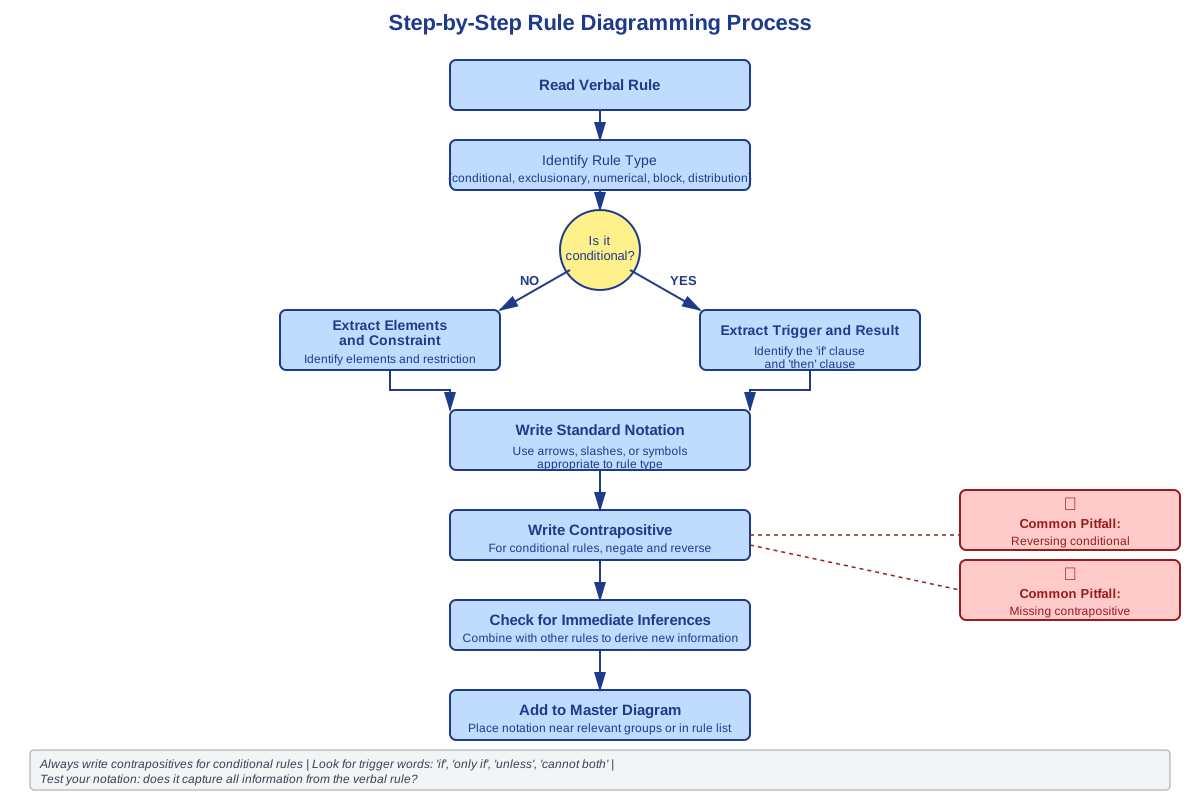
When approaching grouping rule diagramming questions on the LSAT, follow this systematic process:
1. Identify the game type immediately: Determine whether it's selection (choosing some elements), distribution (assigning all elements), or matching (pairing elements with attributes). This tells you what kind of setup to create.
2. Create your master diagram before reading rules: Write out all elements and create spaces for groups. Include any numerical constraints from the scenario description (e.g., "exactly four will be selected" or "each committee has three members").
3. Diagram rules in order, but mark complex ones for review: As you read each rule, immediately write its symbolic form and contrapositive. If a rule seems complex or confusing, mark it with a star and return after diagramming simpler rules.
4. Watch for trigger words:
- "If... then..." → conditional rule (draw arrow, write contrapositive)
- "Cannot both" → exclusionary rule (bidirectional conditionals)
- "Must be together" or "same group" → block rule
- "Exactly," "at least," "at most" → numerical constraint
- "If and only if" → biconditional (rare but powerful)
5. Combine rules to find inferences before attempting questions: Look for:
- Chains of conditionals (F → G and G → H means F → H)
- Numerical constraints that force outcomes
- Blocks combined with capacity limits
- Contrapositive applications
6. Use process of elimination strategically: For "must be true" questions, eliminate answers that could be false. For "could be true" questions, eliminate answers that must be false (violate rules). Your diagrams make rule violations immediately visible.
7. Time allocation: Spend 3-4 minutes on setup and rule diagramming for a typical grouping game. This upfront investment pays dividends across all 5-7 questions in the set. Rushing the setup leads to errors that cost more time fixing later.
8. When stuck, return to your diagrams: If a question seems difficult, don't stare at the answer choices. Look at your rule diagrams and contrapositives. The answer almost always follows from combining 2-3 rules you've already diagrammed.
Exam Tip: If a rule seems to say the same thing as another rule but with different wording, diagram both separately. The LSAT rarely includes redundant rules—you may be missing a subtle distinction that matters for a question.
Memory Techniques
CANE - The four main grouping rule types:
- Conditional (if-then relationships)
- Anti-block (exclusionary rules)
- Numerical (quantity constraints)
- Ensemble (block rules - elements together)
"Flip and Negate" - For contrapositives, remember this phrase. Flip the order of terms and negate both. F → G becomes ~G → ~F.
"Both Out, One In" - For exclusionary rules (cannot both be selected), remember: if both are out, that's fine; if one is in, the other is out. This helps you remember the conditional structure: F → ~G and G → ~F.
Visual anchors for rule types:
- Conditional: Draw arrows (→) - the arrow shows direction of logical flow
- Exclusionary: Draw a slash through elements (F/G) - the slash means "not together"
- Block: Draw a box around elements (FG boxed) - the box keeps them together
- Numerical: Circle the number - it's a hard constraint that can't be violated
"Subscripts Save Lives" - Always use subscript notation (K₁, L₂) when rules specify particular groups. This prevents confusion and makes inferences clearer. Make it automatic.
The Contrapositive Checklist - After diagramming any conditional rule, physically check off that you've written the contrapositive. Make this a habit so you never skip this critical step under time pressure.
Summary
Grouping rule diagramming is the essential skill for translating verbal constraints into symbolic notation that enables efficient problem-solving in LSAT Analytical Reasoning grouping games. The core rule types—conditional, exclusionary, block, and numerical—each have standard diagrammatic representations that must be mastered. Conditional rules use arrow notation with immediate contrapositives; exclusionary rules translate to bidirectional conditionals; block rules show elements that must appear together; and numerical constraints specify group sizes or selection quantities. Success requires not just memorizing notation but understanding the logical relationships each diagram represents. The contrapositive is particularly critical, as it often provides the key inference needed to answer questions. Effective diagramming reduces cognitive load, prevents errors, and reveals inferences that emerge from combining multiple rules. Students who master this skill can approach grouping games systematically, confident that their diagrams capture all constraints and support accurate, efficient reasoning across all question types in the game set.
Key Takeaways
- Every conditional rule requires an immediate contrapositive (~G → ~F for F → G) to capture the complete logical relationship and enable all possible inferences.
- Exclusionary rules are bidirectional conditionals: "F and G cannot both be selected" means F → ~G AND G → ~F, creating two separate conditional relationships.
- Numerical constraints interact with other rules to force deductions: combining "exactly 3 selected" with "F → G & H" means selecting F automatically fills all slots.
- Subscript notation prevents confusion: use K₁ and L₂ to specify which group an element occupies when rules reference particular group assignments.
- Block rules create single units: elements that must be together count as one unit when analyzing group capacity and distribution possibilities.
- Standard notation enables pattern recognition: consistent use of arrows, slashes, boxes, and contrapositives allows you to quickly identify rule types and their implications during timed testing.
- Upfront diagramming investment pays dividends: spending 3-4 minutes carefully diagramming all rules and finding initial inferences saves time and prevents errors across all questions in the game set.
Related Topics
Sequencing Rule Diagramming: While grouping games focus on membership and categorization, sequencing games involve ordering elements. The diagramming techniques overlap (both use conditional notation) but sequencing adds spatial relationships and relative positioning constraints. Mastering grouping rule diagramming provides the foundation for sequencing notation.
Making Inferences in Grouping Games: Once rules are properly diagrammed, the next skill is combining multiple rules to generate new information. This advanced topic builds directly on diagramming fundamentals and teaches systematic inference-finding techniques.
Hybrid Games: Some LSAT games combine grouping and sequencing elements, requiring you to both assign elements to groups and order them within those groups. Strong grouping rule diagramming skills are essential before tackling these complex hybrid scenarios.
Conditional Logic Chains: Advanced grouping games may feature long chains of conditional relationships (F → G → H → J). Understanding how to diagram and work with these chains extends your basic conditional diagramming skills.
Practice CTA
Now that you understand the principles and techniques of grouping rule diagramming, it's time to apply these skills to actual LSAT-style problems. The practice questions and flashcards will reinforce your ability to quickly recognize rule types, create accurate diagrams, and use those diagrams to make valid inferences. Remember: diagramming is a skill that improves dramatically with deliberate practice. Each game you diagram strengthens your pattern recognition and increases your speed. Approach the practice materials systematically, checking your diagrams against the explanations to identify any gaps in your technique. Your investment in mastering this foundational skill will pay dividends across every grouping game you encounter on test day. You've got this!
Sign up free to keep reading
Create a free AnvayaPrep account to finish this LSAT guide on Grouping rule diagramming — plus flashcards and practice questions.