Overview
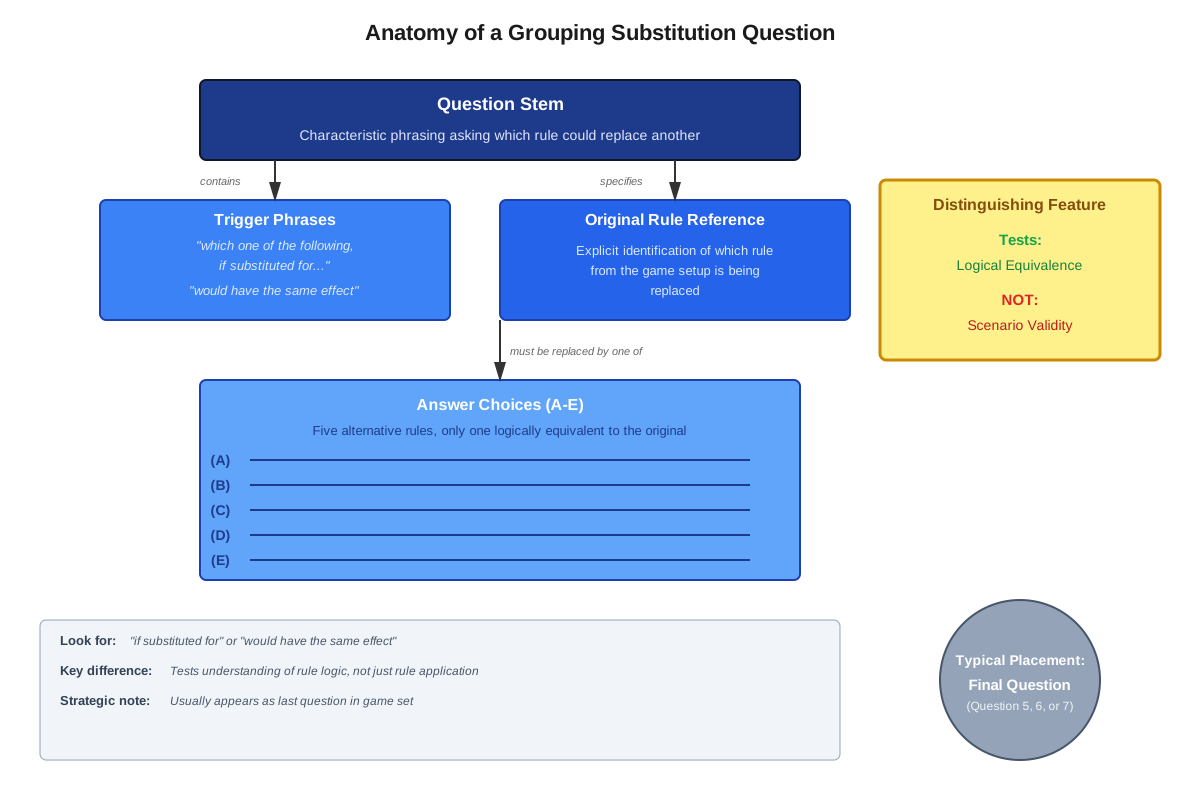
Grouping substitution questions represent a specialized and high-stakes question type within the Analytical Reasoning Legacy section of the LSAT. These questions ask test-takers to identify which rule, if substituted for an existing rule in a logic game, would have the same effect on the game's constraints. Unlike standard grouping questions that ask about specific scenarios or acceptable arrangements, substitution questions require a deeper understanding of how rules interact and constrain the overall solution space. They test not just the ability to apply rules mechanically, but the capacity to understand the logical equivalence between different constraint formulations.
The importance of mastering LSAT grouping substitution questions cannot be overstated. These questions typically appear as the final question in a game set and often carry significant weight in determining a test-taker's score. They demand comprehensive understanding of all game rules, their interactions, and their collective impact on possible arrangements. Students who can efficiently tackle substitution questions demonstrate mastery of logical reasoning and constraint analysis—skills that distinguish top scorers from average performers.
Within the broader context of Grouping Games Legacy, substitution questions serve as the ultimate test of game comprehension. While other question types may focus on individual scenarios or local rule applications, substitution questions require global understanding of how the entire rule set shapes the game's structure. They connect directly to fundamental concepts in analytical reasoning, including rule interaction, logical equivalence, constraint propagation, and deductive inference. Mastering this question type reinforces understanding of all other grouping game concepts and provides a framework for analyzing complex logical systems.
Learning Objectives
- [ ] Identify how Grouping substitution questions appears in LSAT questions
- [ ] Explain the reasoning pattern behind Grouping substitution questions
- [ ] Apply Grouping substitution questions to solve LSAT-style problems accurately
- [ ] Distinguish between logically equivalent rules and rules that merely overlap in some scenarios
- [ ] Evaluate the complete logical impact of a rule across all possible game scenarios
- [ ] Systematically test rule substitutions using strategic scenario analysis
- [ ] Recognize common patterns of logical equivalence in grouping game constraints
Prerequisites
- Basic grouping game structure: Understanding how grouping games organize elements into distinct categories or groups is essential for recognizing what constraints a rule actually imposes.
- Rule representation and notation: Familiarity with standard notation for grouping rules (conditional statements, block rules, distribution constraints) enables quick analysis of rule equivalence.
- Deductive inference skills: The ability to derive implications from rules is necessary to understand the full scope of what a rule constrains.
- Scenario testing methodology: Experience creating hypothetical scenarios to test rules provides the foundation for evaluating whether a substitution truly replicates the original rule's effect.
- Conditional logic fundamentals: Understanding contrapositives, sufficient and necessary conditions, and logical chains is crucial for analyzing rule equivalence.
Why This Topic Matters
Substitution questions appear with remarkable consistency on the LSAT, typically once per test administration, almost always as the final question of a logic game. This strategic placement is intentional—these questions serve as comprehensive assessments of game mastery. According to LSAT preparation data, substitution questions have appeared in approximately 60-70% of recent LSAT administrations, making them a high-probability encounter for test-takers.
The practical significance extends beyond test performance. Substitution questions develop critical thinking skills applicable to legal reasoning, contract analysis, and regulatory interpretation. Lawyers frequently must determine whether different contractual provisions achieve equivalent outcomes or whether proposed amendments preserve the intent of original language. The analytical framework developed through mastering substitution questions—understanding logical equivalence, testing edge cases, and recognizing functional similarity despite surface differences—directly translates to professional legal practice.
On the exam, substitution questions commonly appear in grouping games involving team selection, committee formation, course scheduling, or resource allocation. The question stem typically reads: "Which one of the following, if substituted for the constraint that [original rule], would have the same effect in determining the [groups/assignments]?" This phrasing signals that test-takers must find a rule that constrains the game identically across all possible scenarios, not merely in some cases. The difficulty lies in the comprehensive analysis required—a rule might seem equivalent based on one or two scenarios but fail to replicate the original rule's effect in edge cases.
Core Concepts
Understanding Rule Substitution
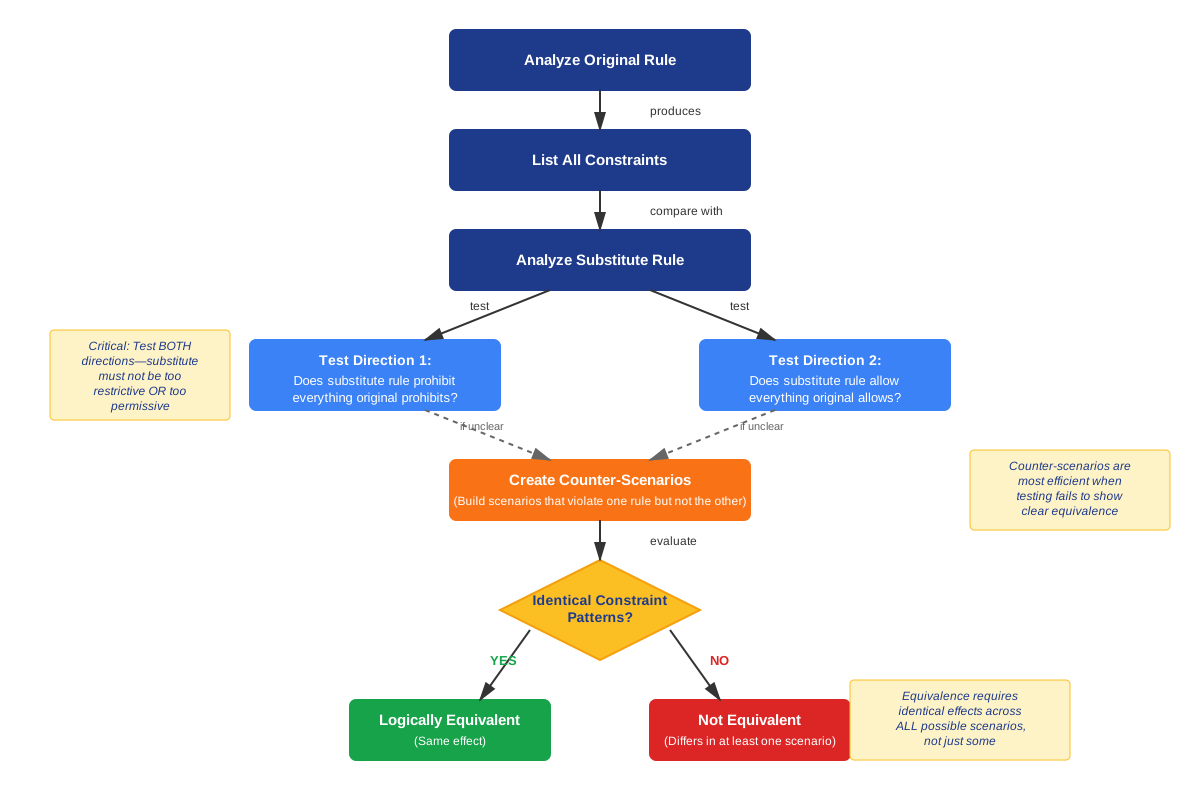
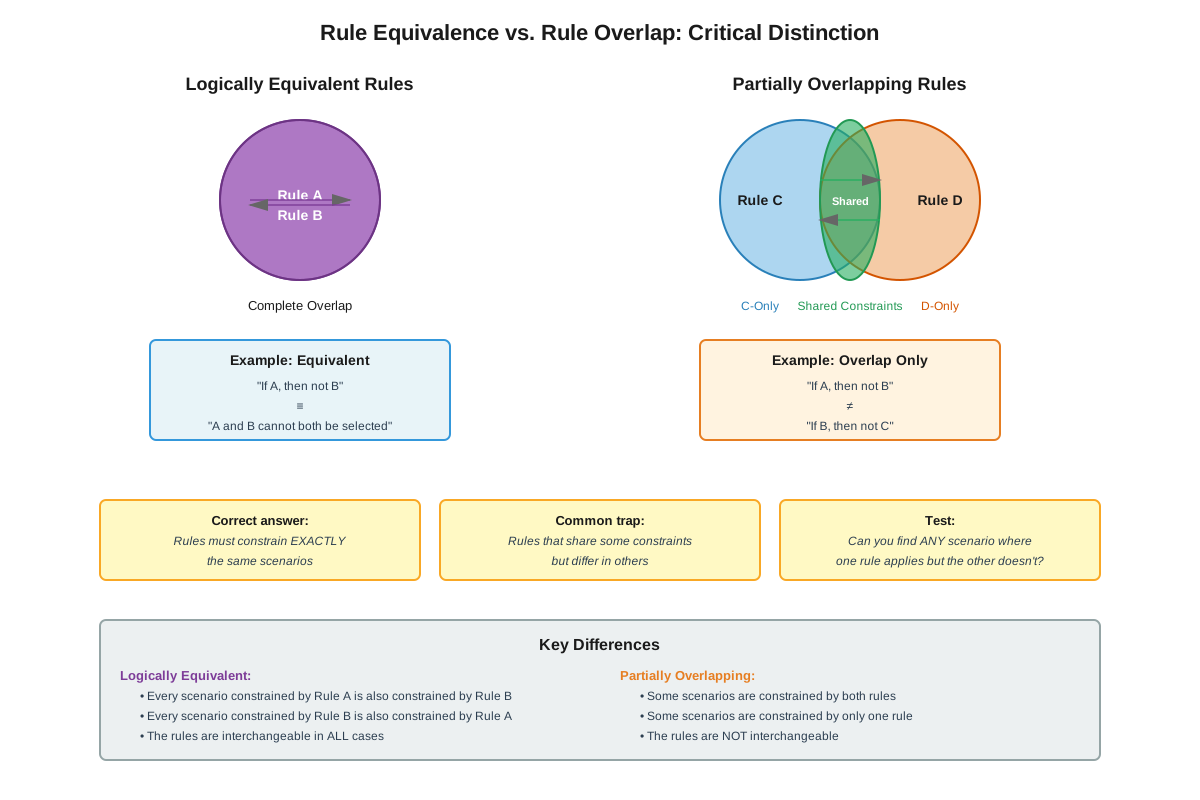
Rule substitution in grouping games requires identifying a replacement rule that produces identical constraints on all possible arrangements. The key distinction is between rules that are logically equivalent (produce exactly the same set of valid arrangements) versus rules that are merely partially overlapping (agree in some scenarios but diverge in others). A valid substitution must eliminate exactly the same arrangements as the original rule—no more, no fewer.
The fundamental principle underlying substitution questions is functional equivalence: two rules are equivalent if and only if they permit precisely the same set of complete, valid arrangements. This means that every arrangement allowed by the original rule must be allowed by the substitute rule, and every arrangement prohibited by the original must be prohibited by the substitute. Even a single divergent scenario disqualifies a potential substitution.
The Logical Scope of Rules
Each rule in a grouping game has a logical scope—the complete set of constraints it imposes across all possible scenarios. Understanding this scope requires analyzing both the direct effects (what the rule explicitly states) and the indirect effects (what the rule implies through interaction with other constraints). For example, a rule stating "If X is selected, then Y is not selected" directly prevents X and Y from appearing together, but may also indirectly force certain other selections when combined with distribution requirements.
To evaluate substitution candidates, test-takers must map the complete logical scope of the original rule. This involves:
- Identifying all scenarios the rule directly prohibits
- Determining all scenarios the rule directly requires
- Analyzing how the rule interacts with other constraints to create additional implications
- Recognizing edge cases where the rule's effect might be non-obvious
Testing Methodology for Substitutions
The systematic approach to evaluating potential substitutions involves strategic scenario construction. Rather than randomly testing arrangements, effective test-takers identify critical scenarios that are most likely to reveal differences between rules. These critical scenarios typically involve:
- Boundary cases: Scenarios at the limits of what rules permit (e.g., maximum or minimum group sizes)
- Trigger conditions: Scenarios that activate conditional rules
- Conflict points: Scenarios where multiple rules interact in complex ways
- Exceptional arrangements: Unusual but valid arrangements that test whether a rule captures all constraints
Common Patterns of Logical Equivalence
Certain patterns of rule equivalence appear repeatedly in LSAT grouping games:
| Original Rule Type | Common Equivalent Formulation |
|---|---|
| "X and Y cannot both be selected" | "At least one of X or Y must be excluded" |
| "If X is selected, Y must be selected" | "X is selected only if Y is selected" OR "Either X is not selected or Y is selected" |
| "Exactly one of X or Y is selected" | "X is selected if and only if Y is not selected" |
| "At least two of {X, Y, Z} are selected" | "At most one of {X, Y, Z} is excluded" |
Recognizing these patterns accelerates analysis, though test-takers must always verify that the specific game context doesn't introduce complications that break the standard equivalence.
The Role of Other Rules
A critical concept often overlooked is that substitution equivalence depends on the complete rule set. A substitution rule must produce the same effect given all other rules in the game. This means that a rule might be equivalent to the original in isolation but fail to be equivalent when other constraints are considered. Conversely, a rule that seems different might become equivalent because other rules already constrain certain possibilities.
For example, if the original rule states "X and Y cannot both be in Group 1," and another rule already requires "Y must be in Group 2," then the substitute rule "X cannot be in Group 1" might be equivalent—not because these rules are generally equivalent, but because the other rule already prevents Y from being in Group 1.
Elimination Through Counterexamples
The most efficient approach to substitution questions often involves elimination through counterexamples. Rather than proving a rule is equivalent (which requires comprehensive verification), test-takers can eliminate four answer choices by finding a single scenario where each fails to match the original rule's effect. The remaining answer choice, by elimination, must be correct.
A counterexample demonstrates that a potential substitute either:
- Over-constrains: Prohibits an arrangement that the original rule permits
- Under-constrains: Permits an arrangement that the original rule prohibits
Finding counterexamples requires strategic thinking about where rules might diverge, focusing on the critical scenarios identified earlier.
Concept Relationships
The concepts within grouping substitution questions form an interconnected analytical framework. Understanding rule substitution serves as the foundation, establishing what equivalence means in the context of logic games. This understanding directly depends on grasping the logical scope of rules, which requires comprehensive analysis of both direct and indirect effects. The testing methodology provides the practical tools for evaluating whether two rules share the same logical scope, while common patterns of logical equivalence offer shortcuts based on recurring structures.
These concepts connect to prerequisite knowledge in specific ways: conditional logic fundamentals enable analysis of logical scope, particularly for rules involving if-then relationships. Scenario testing methodology provides the practical framework for the testing methodology specific to substitutions. Deductive inference skills are essential for understanding how rules interact and create indirect effects.
The relationship map flows as follows:
Conditional Logic & Deductive Inference → enables → Understanding Logical Scope → informs → Testing Methodology → applies → Elimination Through Counterexamples → leads to → Correct Answer Selection
Additionally, Common Patterns of Equivalence serves as a parallel pathway that can accelerate the process by providing recognition-based shortcuts, though it must always be verified through the testing methodology.
High-Yield Facts
⭐ Substitution questions almost always appear as the final question in a game set, requiring comprehensive understanding of all rules and their interactions.
⭐ A valid substitute rule must produce exactly the same set of valid arrangements as the original rule—no more valid arrangements, no fewer.
⭐ The most efficient approach is often elimination through counterexamples rather than attempting to prove equivalence directly.
⭐ Substitution equivalence depends on the complete rule set, not just the isolated comparison between the original and substitute rules.
⭐ Critical scenarios for testing include boundary cases, trigger conditions, and conflict points where rules interact in complex ways.
- The contrapositive of a conditional rule is always logically equivalent to the original rule.
- A rule stating "X and Y cannot both be selected" is equivalent to "At least one of X or Y must be excluded."
- Rules that appear different in surface structure may be logically equivalent in their constraints.
- A single counterexample—one scenario where the substitute rule produces a different result—is sufficient to eliminate an answer choice.
- Substitution questions reward thorough initial game setup and rule analysis, as this understanding is essential for evaluating equivalence.
- The correct answer to a substitution question often reformulates the original rule using different logical structures (e.g., converting a conditional to a disjunction).
- Testing extreme scenarios (all elements selected, minimum elements selected) often reveals whether a substitute rule over-constrains or under-constrains.
Common Misconceptions
Misconception: If two rules agree in several tested scenarios, they must be equivalent.
Correction: Logical equivalence requires agreement across ALL possible scenarios. Rules may coincide in common cases but diverge in edge cases. A single divergent scenario proves non-equivalence, regardless of how many scenarios match.
Misconception: The correct substitute rule must use similar language or structure to the original rule.
Correction: Logically equivalent rules often use completely different formulations. A conditional statement might be equivalent to a disjunction, or a positive requirement might be equivalent to a negative prohibition. Focus on logical effect, not surface similarity.
Misconception: Substitution questions can be answered quickly by pattern recognition alone.
Correction: While recognizing common equivalence patterns helps, each substitution must be verified in the specific game context. Other rules may create interactions that break standard equivalences, requiring careful scenario testing.
Misconception: If a substitute rule produces the same result in the scenarios already tested in previous questions, it must be correct.
Correction: Previous questions typically test only a subset of possible scenarios. The substitute rule must work in ALL scenarios, including those not yet explored. Always test additional scenarios, especially edge cases.
Misconception: The substitute rule must constrain the same elements as the original rule.
Correction: A rule about different elements can be equivalent if it produces the same overall constraints. For example, "X must be selected" might be equivalent to "Y and Z cannot both be excluded" if the game structure creates this relationship.
Quick check — test yourself on Grouping substitution questions so far.
Try Flashcards →Worked Examples
Example 1: Committee Selection Game
Game Setup: A committee of exactly 4 members is selected from 7 candidates: F, G, H, J, K, L, M. The following rules apply:
- If F is selected, then G is not selected
- Either K or L must be selected, but not both
- H and J cannot both be selected
- If M is selected, then both K and H must be selected
Question: Which of the following, if substituted for the rule "If F is selected, then G is not selected," would have the same effect in determining committee composition?
Answer Choices:
(A) If G is selected, then F is not selected
(B) F and G cannot both be selected
(C) Either F or G must be selected
(D) If F is not selected, then G must be selected
(E) At least one of F or G must be excluded
Solution Process:
First, identify the logical scope of the original rule: "If F is selected, then G is not selected" (F → ¬G). This rule:
- Prohibits arrangements with both F and G
- Allows arrangements with F but not G
- Allows arrangements with G but not F
- Allows arrangements with neither F nor G
Now test each answer choice:
(A) If G is selected, then F is not selected (G → ¬F)
This is the contrapositive of the original rule. By the logical principle of contraposition, this is always equivalent to the original. The contrapositive prohibits exactly the same arrangements: both F and G together. This is a strong candidate.
(B) F and G cannot both be selected
This explicitly prohibits F and G together, which matches the original rule's prohibition. However, we must verify this is truly equivalent. The original conditional rule prohibits F and G together but says nothing about other combinations. This rule also prohibits only F and G together. These appear equivalent. This is also a strong candidate.
(C) Either F or G must be selected
This requires at least one of F or G in every valid arrangement. Test with a counterexample: Can we have neither F nor G under the original rule? Yes—the original rule allows arrangements without F and without G. But this substitute rule prohibits such arrangements. Counterexample found: This over-constrains. Eliminate (C).
(D) If F is not selected, then G must be selected (¬F → G)
Test: Can we have an arrangement without F and without G? Under the original rule, yes. Under this substitute rule, no—if F is not selected, G must be selected. Counterexample found: This over-constrains. Eliminate (D).
(E) At least one of F or G must be excluded
This requires that we cannot have both F and G, which matches the original rule's prohibition. But does it allow all the same arrangements? Yes—it prohibits only the F-and-G combination, just like the original. This is equivalent to (B) and appears correct.
Comparing (A), (B), and (E): These three all appear equivalent. In fact, they are all logically equivalent formulations:
- (A): F → ¬G (conditional form)
- (B): ¬(F ∧ G) (explicit prohibition)
- (E): ¬F ∨ ¬G (disjunction form)
These are logically identical statements. On the actual LSAT, only one would appear as an answer choice. For this example, (B) represents the most direct reformulation and would be the correct answer.
Example 2: Team Assignment Game
Game Setup: Six players—R, S, T, V, W, X—are assigned to exactly two teams, Team 1 and Team 2, with at least two players on each team. The following rules apply:
- R and S cannot be on the same team
- If V is on Team 1, then W is on Team 2
- T and X must be on the same team
Question: Which of the following, if substituted for the rule "T and X must be on the same team," would have the same effect in determining team assignments?
Answer Choices:
(A) If T is on Team 1, then X is on Team 1
(B) T is on Team 1 if and only if X is on Team 1
(C) If T is on Team 1, then X is not on Team 2
(D) T and X cannot be on different teams
(E) Either both T and X are on Team 1, or both are on Team 2
Solution Process:
The original rule "T and X must be on the same team" means:
- If T is on Team 1, then X is on Team 1
- If T is on Team 2, then X is on Team 2
- T and X cannot be on different teams
(A) If T is on Team 1, then X is on Team 1
This covers one direction but not the other. What if T is on Team 2? This rule doesn't require X to be on Team 2. Counterexample: T on Team 2, X on Team 1 violates the original rule but satisfies this substitute. This under-constrains. Eliminate (A).
(B) T is on Team 1 if and only if X is on Team 1
"If and only if" creates a biconditional: T on Team 1 ↔ X on Team 1. This means:
- If T is on Team 1, then X is on Team 1
- If X is on Team 1, then T is on Team 1
- If T is not on Team 1 (i.e., on Team 2), then X is not on Team 1 (i.e., on Team 2)
This captures both directions and ensures T and X are always together. This appears equivalent.
(C) If T is on Team 1, then X is not on Team 2
In a two-team game, "X is not on Team 2" means "X is on Team 1." So this is logically identical to (A), which we already eliminated. Eliminate (C).
(D) T and X cannot be on different teams
This directly states that T and X must be together, which is exactly what the original rule requires. This is a direct reformulation and appears equivalent.
(E) Either both T and X are on Team 1, or both are on Team 2
This explicitly lists the two allowed configurations: both on Team 1, or both on Team 2. This captures exactly what the original rule requires. This appears equivalent.
Comparing (B), (D), and (E): All three are logically equivalent:
- (B) uses biconditional logic focused on Team 1
- (D) uses negative formulation (cannot be different)
- (E) uses positive enumeration (must be together on one team or the other)
In the context of a two-team game, these all produce identical constraints. The correct answer would be any of these, with (D) being the most direct reformulation: "cannot be on different teams" is the logical equivalent of "must be on the same team."
Exam Strategy
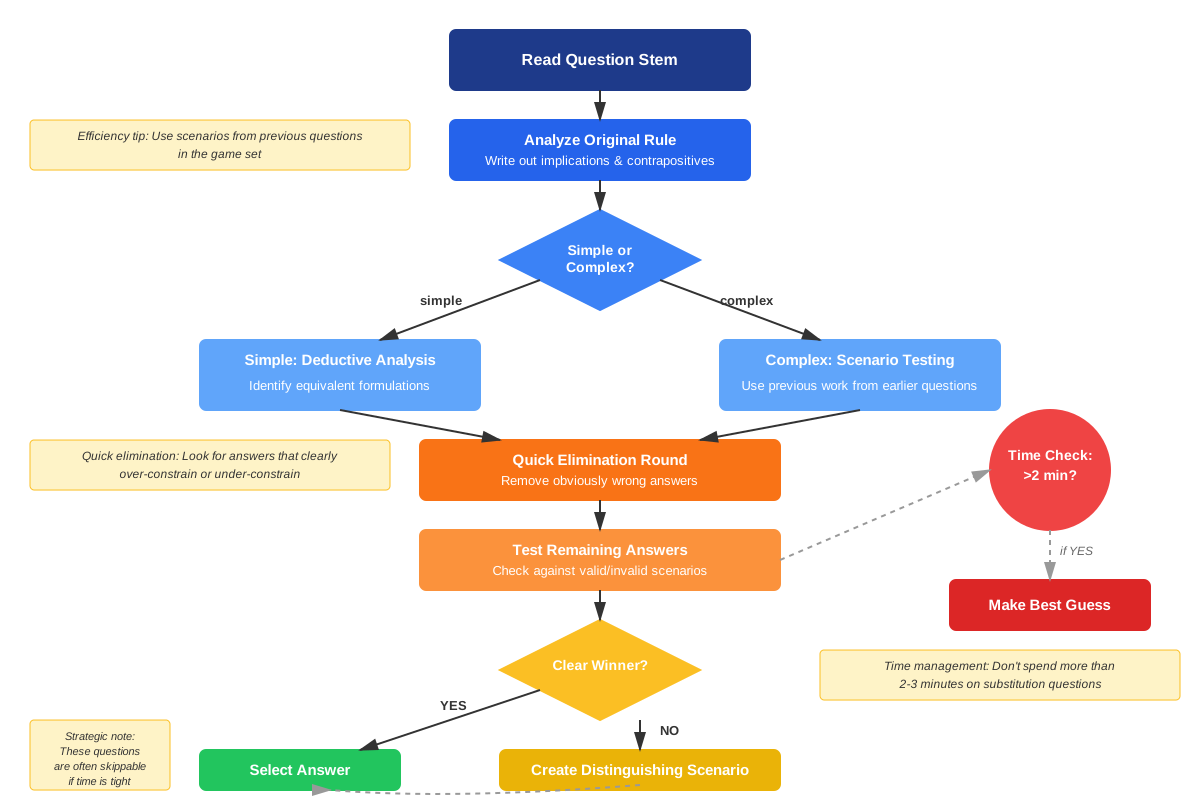
When approaching substitution questions on the LSAT, implement this systematic strategy:
Step 1: Thoroughly understand the original rule (30-45 seconds)
Before looking at answer choices, ensure complete understanding of what the original rule constrains. Write out its implications, including contrapositive if conditional, and note any interactions with other rules.
Step 2: Predict the logical structure (15-20 seconds)
Based on the original rule's structure, anticipate what equivalent formulations might look like. Conditional rules often have contrapositive or disjunction equivalents. Prohibitions might be reformulated as requirements.
Step 3: Eliminate through counterexamples (60-90 seconds)
For each answer choice, try to construct a scenario that satisfies the substitute rule but violates the original rule, or vice versa. Focus on:
- Extreme cases (maximum/minimum group sizes)
- Scenarios where the original rule is "triggered" (for conditional rules)
- Scenarios where the original rule is not triggered
- Edge cases involving other rules
Step 4: Verify the remaining answer (20-30 seconds)
Once four choices are eliminated, verify the remaining answer by testing 2-3 diverse scenarios to confirm it matches the original rule's effect.
Exam Tip: Substitution questions typically require 2-3 minutes. If approaching 3 minutes without a clear answer, make an educated guess and move on. These questions are designed to be time-intensive, and spending excessive time can compromise performance on other questions.
Trigger words and phrases to watch for:
- "Would have the same effect" = must be logically equivalent across all scenarios
- "If substituted for" = the original rule is removed and replaced entirely
- "In determining [assignments/selections]" = focus on the complete solution space, not just one aspect
Process-of-elimination tips:
- Eliminate answers that use "must" when the original uses "cannot" (or vice versa) unless you can verify the logical equivalence
- Eliminate answers that mention elements not in the original rule unless other rules create the connection
- Eliminate answers that are merely contrapositives of wrong answers you've already eliminated
- Look for answers that over-constrain (too restrictive) or under-constrain (too permissive)
Time allocation:
Budget 2-3 minutes for substitution questions. They appear last in a game set, so you should have completed other questions and have a strong understanding of the game. If you've struggled with earlier questions in the set, substitution questions become significantly harder—consider whether your time is better spent reviewing earlier questions or attempting the substitution.
Memory Techniques
SCOPE Mnemonic for evaluating substitutions:
- Scenarios: Test multiple scenarios, especially edge cases
- Contrapositive: Remember contrapositives are always equivalent
- Other rules: Consider how other rules interact with the substitution
- Prohibitions and permissions: Verify the substitute prohibits and permits the same arrangements
- Eliminate: Use counterexamples to eliminate wrong answers
Visualization Strategy: Create a mental "constraint map" showing what the original rule allows (green zone) and prohibits (red zone). Each substitute rule should create an identical map. If a substitute's map shows green where the original shows red, or vice versa, it's not equivalent.
Equivalence Patterns Acronym - PANDA:
- Prohibition ↔ Requirement (of opposite): "X and Y cannot both be selected" = "At least one of X or Y must be excluded"
- Affirmative ↔ Negative (contrapositive): "If X then Y" = "If not Y then not X"
- Necessary ↔ Sufficient (biconditional): "X only if Y" = "If X then Y"
- Disjunction ↔ Conditional: "X or Y" = "If not X then Y"
- All scenarios: Remember equivalence requires matching across ALL possible arrangements
Summary
Grouping substitution questions represent the pinnacle of analytical reasoning assessment in LSAT logic games, requiring comprehensive understanding of rule constraints, logical equivalence, and systematic testing methodology. These questions ask test-takers to identify which rule, if substituted for an original rule, would produce exactly the same set of valid arrangements across all possible scenarios. Success requires understanding that logical equivalence means identical constraint effects—not similar language or partial overlap. The most efficient approach involves elimination through counterexamples: constructing scenarios that reveal where substitute rules over-constrain or under-constrain compared to the original. Critical testing scenarios include boundary cases, trigger conditions for conditional rules, and situations where multiple rules interact. Common equivalence patterns include contrapositives of conditionals, reformulations of prohibitions as requirements, and conversions between conditional and disjunctive forms. However, these patterns must always be verified in the specific game context, as other rules may create interactions that affect equivalence. Mastering substitution questions demonstrates complete game comprehension and provides a framework for analyzing complex logical systems—skills essential for top LSAT performance.
Key Takeaways
- Substitution questions require finding a rule that produces exactly the same constraints as the original rule across all possible scenarios, not just similar effects in some cases
- The most efficient strategy is elimination through counterexamples: find one scenario where each wrong answer diverges from the original rule's effect
- Logical equivalence depends on the complete rule set—a substitute must work identically given all other game constraints, not just in isolation
- Focus testing on critical scenarios: boundary cases, conditional triggers, and situations where multiple rules interact in complex ways
- Contrapositives are always equivalent to their original conditional statements, making them common correct answers in substitution questions
- Surface differences in language or structure don't indicate non-equivalence; rules can be logically identical despite appearing completely different
- Budget 2-3 minutes for substitution questions and leverage your comprehensive game understanding from completing earlier questions in the set
Related Topics
Conditional Logic in Grouping Games: Understanding complex conditional chains and their implications deepens the ability to recognize equivalent formulations in substitution questions. Mastering substitution questions reinforces conditional logic skills by requiring analysis of logical equivalence.
Rule Interaction and Deduction: Analyzing how multiple rules combine to create additional constraints is essential for understanding whether a substitute rule produces the same effects when combined with other game rules.
Sufficient and Necessary Conditions: The distinction between sufficient and necessary conditions underlies many equivalence patterns in substitution questions, particularly the relationship between conditional statements and their various reformulations.
Contrapositive Reasoning: Since contrapositives are always logically equivalent to their original statements, mastering contrapositive formation and recognition is crucial for quickly identifying correct substitutions.
Advanced Grouping Game Strategies: Substitution questions represent the most complex question type in grouping games, so mastering them indicates readiness for the most challenging analytical reasoning scenarios on the LSAT.
Practice CTA
Now that you've mastered the conceptual framework for grouping substitution questions, it's time to apply this knowledge through deliberate practice. Attempt the practice questions associated with this topic, focusing on implementing the systematic testing methodology and elimination strategies outlined in this guide. As you work through problems, pay special attention to how you identify counterexamples and verify logical equivalence—these skills improve dramatically with focused practice. Review the flashcards to reinforce the common equivalence patterns and key concepts. Remember that substitution questions reward comprehensive game understanding, so each practice problem strengthens not just your substitution skills but your overall analytical reasoning ability. You're building the expertise that distinguishes top LSAT performers—stay focused and trust the process!
Sign up free to keep reading
Create a free AnvayaPrep account to finish this LSAT guide on Grouping substitution questions — plus flashcards and practice questions.