Overview
The contrapositive is one of the most powerful and frequently tested tools in LSAT logical reasoning. Understanding how to form and apply contrapositives is essential for success on the LSAT, particularly in questions involving conditional logic. A contrapositive represents a logically equivalent statement to a conditional claim, formed by negating both terms and reversing their order. When a conditional statement is true, its contrapositive is guaranteed to be true as well—making it an invaluable inference tool that appears across multiple question types.
Mastering the contrapositive is critical because the LSAT frequently presents arguments that rely on conditional relationships, and test-makers deliberately construct answer choices that test whether students can recognize valid logical inferences. Many incorrect answer choices exploit common errors in conditional reasoning, such as confusing the contrapositive with invalid forms like the converse or inverse. Students who can quickly and accurately form contrapositives gain a significant advantage in identifying correct inferences, spotting flawed reasoning, and eliminating trap answers.
The contrapositive sits at the heart of conditional logic, which itself underlies numerous LSAT question types including Must Be True, Sufficient Assumption, Necessary Assumption, and Flaw questions. It connects directly to broader logical reasoning skills such as recognizing valid argument structures, identifying necessary versus sufficient conditions, and understanding formal logic relationships. The ability to work fluently with contrapositives also supports success with more complex logical structures like conditional chains and formal logic games in the Analytical Reasoning section.
Learning Objectives
- [ ] Identify how Contrapositive appears in LSAT questions
- [ ] Explain the reasoning pattern behind Contrapositive
- [ ] Apply Contrapositive to solve LSAT-style problems accurately
- [ ] Distinguish between valid contrapositives and invalid logical forms (converse and inverse)
- [ ] Construct contrapositives from complex conditional statements involving "unless," "only if," and other conditional indicators
- [ ] Chain multiple conditional statements together using contrapositive relationships
- [ ] Recognize when LSAT answer choices present contrapositives as correct inferences
Prerequisites
- Basic conditional statement structure (if-then): Understanding the fundamental form of conditional statements is essential because contrapositives are derived directly from these structures
- Sufficient and necessary conditions: Recognizing which term is sufficient and which is necessary allows proper formation of the contrapositive by correctly reversing and negating
- Logical negation: The ability to negate statements accurately is required because forming a contrapositive involves negating both the sufficient and necessary conditions
- Symbolic logic notation: Familiarity with arrow notation (→) and negation symbols (~) enables efficient representation and manipulation of conditional statements
Why This Topic Matters
The contrapositive represents one of the most reliable inference patterns in formal logic, making it indispensable for legal reasoning and critical thinking—skills the LSAT is designed to measure. In legal practice, attorneys regularly work with conditional rules and regulations, and the ability to recognize logically equivalent formulations is crucial for interpreting statutes, contracts, and precedents. The contrapositive allows reasoners to approach conditional relationships from multiple angles, revealing implications that may not be immediately obvious in the original formulation.
On the LSAT, contrapositive reasoning appears with remarkable frequency. Research indicates that conditional logic questions appear in approximately 25-30% of Logical Reasoning questions, and a substantial portion of these either directly test contrapositive formation or require it as an intermediate step. The contrapositive is particularly prevalent in Must Be True questions (where it represents a guaranteed valid inference), Sufficient Assumption questions (where recognizing the contrapositive helps identify what would complete an argument), and Flaw questions (where test-makers exploit common errors in conditional reasoning).
Common manifestations of contrapositive reasoning on the LSAT include: arguments that present a conditional rule and then apply its contrapositive to reach a conclusion; answer choices that restate stimulus information using the contrapositive form; questions that test whether students can distinguish valid contrapositives from invalid converses; and complex conditional chains where forming the contrapositive of one statement allows it to connect with another. The LSAT also frequently embeds conditional statements in natural language using varied indicators like "unless," "only," "without," and "requires," testing whether students can extract the underlying logical structure and form the appropriate contrapositive.
Core Concepts
The Basic Contrapositive Structure
A conditional statement expresses a relationship where one condition is sufficient for another, which is necessary. The standard form is: "If A, then B" (symbolically: A → B). This means that whenever A occurs, B must also occur. The term A is the sufficient condition (its occurrence is sufficient to guarantee B), while B is the necessary condition (it is necessary whenever A occurs).
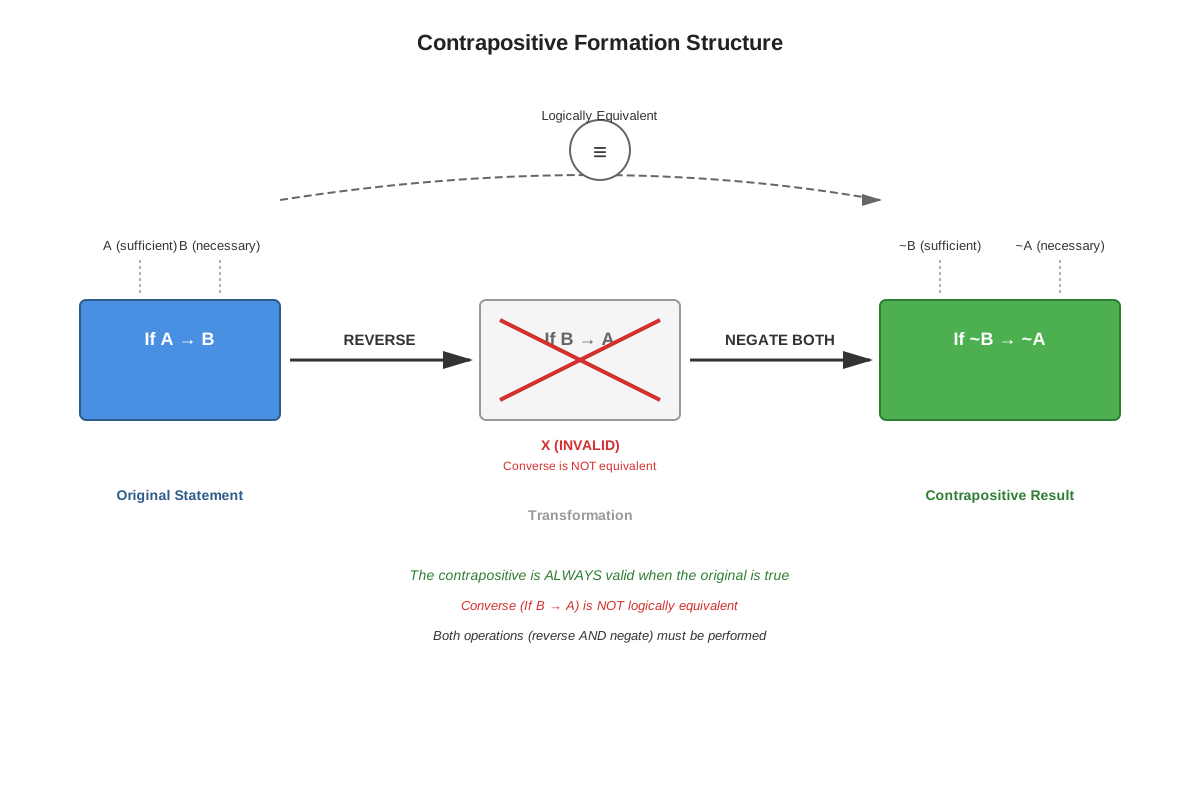
The contrapositive of a conditional statement is formed by two operations performed simultaneously:
- Negating both terms (changing each to its opposite)
- Reversing the order (switching the sufficient and necessary conditions)
For the statement "If A, then B" (A → B), the contrapositive is "If not B, then not A" (~B → ~A). Crucially, the contrapositive is logically equivalent to the original statement—they always have the same truth value. If the original conditional is true, the contrapositive must be true, and vice versa.
Why the Contrapositive Works
The logical validity of the contrapositive stems from the fundamental nature of conditional relationships. When we assert "If A, then B," we are claiming that A cannot occur without B also occurring. This means that if we ever observe B failing to occur (not B), we can definitively conclude that A did not occur (not A)—because if A had occurred, B would have been required to occur as well.
Consider this concrete example: "If someone is a doctor, then they have a medical degree" (Doctor → Medical Degree). The contrapositive states: "If someone does not have a medical degree, then they are not a doctor" (~Medical Degree → ~Doctor). This is clearly true: anyone lacking a medical degree cannot be a doctor, because having a medical degree is necessary for being a doctor.
Forming Contrapositives with Various Conditional Indicators
The LSAT rarely presents conditional statements in simple "if-then" form. Instead, test-makers use diverse conditional indicators that require translation into standard form before forming the contrapositive:
| Conditional Indicator | Example | Standard Form | Contrapositive |
|---|---|---|---|
| If...then | If it rains, the game is cancelled | Rain → Cancelled | ~Cancelled → ~Rain |
| All | All cats are mammals | Cat → Mammal | ~Mammal → ~Cat |
| Only | Only members can vote | Vote → Member | ~Member → ~Vote |
| Only if | You pass only if you study | Pass → Study | ~Study → ~Pass |
| Unless | The plant dies unless watered | ~Watered → Dies | ~Dies → Watered |
| Without | Without oxygen, fire cannot exist | ~Oxygen → ~Fire | Fire → Oxygen |
| Requires/Needs | Admission requires a ticket | Admission → Ticket | ~Ticket → ~Admission |
The "unless" construction deserves special attention because it frequently confuses students. "A unless B" translates to "If not B, then A" (~B → A), with contrapositive "If not A, then B" (~A → B). The key is recognizing that "unless" introduces the necessary condition in negated form.
Invalid Forms: Converse and Inverse
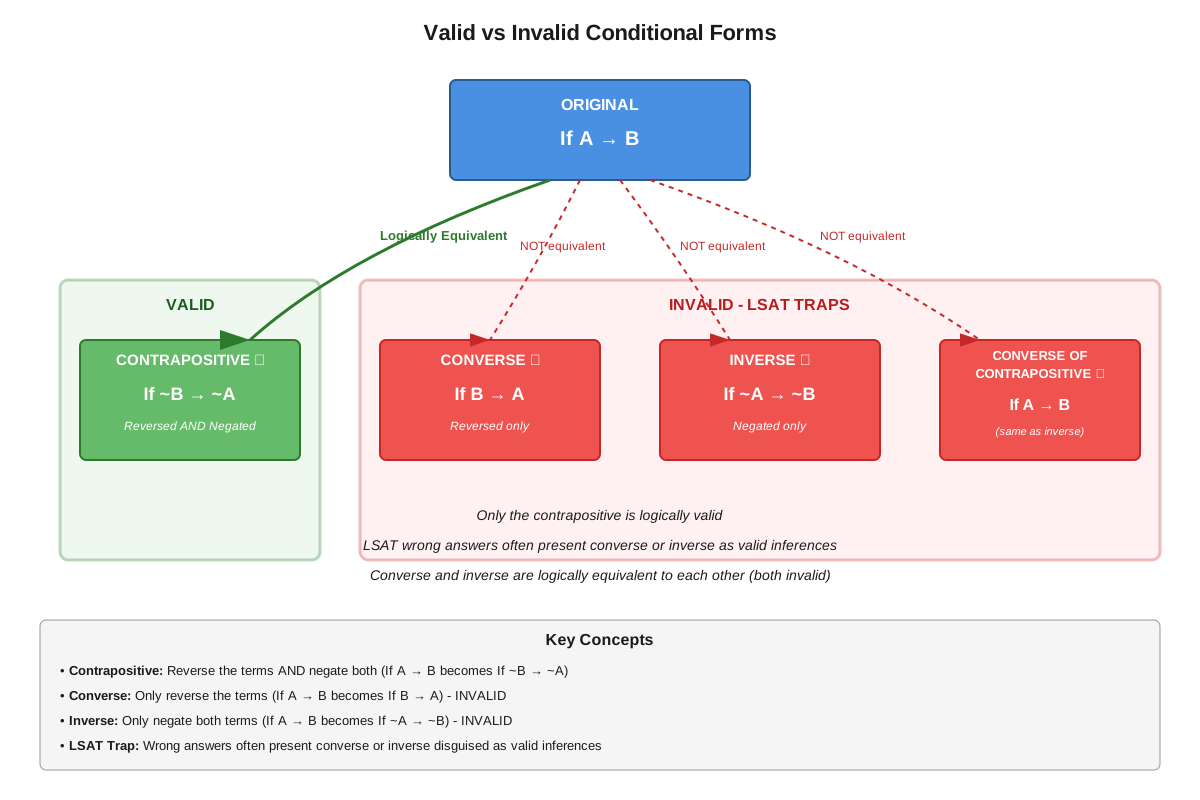
The LSAT frequently includes trap answers that present invalid logical forms that students might confuse with the contrapositive:
The Converse (INVALID): Simply reversing the terms without negating them. For "If A, then B," the converse is "If B, then A" (B → A). This is not logically equivalent to the original. Example: "If someone is a doctor, they have a medical degree" does NOT mean "If someone has a medical degree, they are a doctor" (they might be a nurse, researcher, etc.).
The Inverse (INVALID): Negating both terms without reversing them. For "If A, then B," the inverse is "If not A, then not B" (~A → ~B). This is also not logically equivalent. Example: "If someone is a doctor, they have a medical degree" does NOT mean "If someone is not a doctor, they don't have a medical degree."
Recognizing these invalid forms is crucial for LSAT success because incorrect answer choices frequently present converses or inverses as if they were valid inferences.
Conditional Chains and the Contrapositive
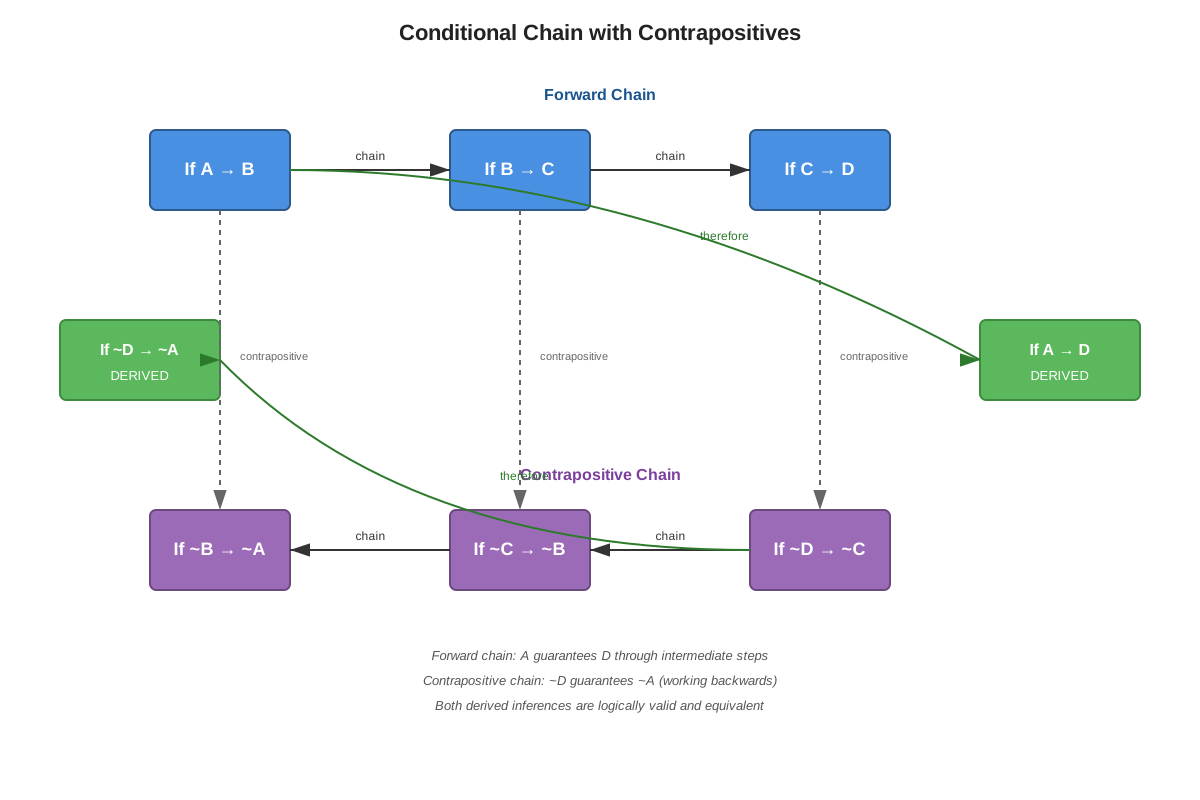
The LSAT often presents multiple conditional statements that can be chained together. The contrapositive is essential for creating these chains. When you have:
- Statement 1: A → B
- Statement 2: B → C
You can chain them: A → B → C, yielding the inference A → C.
The contrapositive becomes crucial when statements don't immediately connect. If you have:
- Statement 1: A → B
- Statement 2: ~C → ~B
Taking the contrapositive of Statement 2 gives you: B → C. Now you can chain: A → B → C.
This chaining technique appears frequently in both Logical Reasoning and Logic Games, where multiple rules must be combined to reach valid conclusions.
Negating Complex Terms
Forming accurate contrapositives requires proper negation of complex terms. Common negation patterns include:
- Quantifiers: "All" negates to "some...not" or "not all"; "Some" negates to "none"
- Compound statements: Negate "and" by changing to "or" and negating both parts (De Morgan's Law); negate "or" by changing to "and" and negating both parts
- Relative terms: "More than" negates to "not more than" or "at most"; "at least" negates to "less than"
For LSAT purposes, when negating simple terms in conditional statements, the negation typically means "not that term" or the logical opposite. For example, "tall" negates to "not tall," and "present" negates to "absent" or "not present."
Concept Relationships
The contrapositive is fundamentally derived from the structure of conditional statements, which establish sufficient-necessary relationships. Understanding sufficient and necessary conditions is therefore the foundation upon which contrapositive reasoning is built. The sufficient condition (the "if" part) provides enough information to guarantee the necessary condition (the "then" part), and this relationship remains intact when both terms are negated and reversed.
The contrapositive connects directly to logical equivalence—two statements are logically equivalent when they must always have the same truth value. The original conditional and its contrapositive are the primary example of logical equivalence in conditional logic. This equivalence principle distinguishes the contrapositive from invalid forms like the converse and inverse, which are not equivalent to the original statement.
Within the broader framework of logical reasoning, the contrapositive enables valid deductive inferences. When an argument presents a conditional statement and information about the necessary condition being absent, the contrapositive allows the reasoner to validly conclude that the sufficient condition is also absent. This inference pattern appears across multiple LSAT question types and connects to the general skill of recognizing valid versus invalid argument structures.
Relationship Map:
Conditional Statement (A → B) → generates → Contrapositive (~B → ~A) → enables → Valid Inferences → supports → Conditional Chains → leads to → Complex Logical Reasoning → applies to → Multiple LSAT Question Types
The contrapositive also relates to proof by contradiction and modus tollens (a valid argument form). When we know "If A, then B" and observe "not B," we can conclude "not A"—this is precisely the contrapositive in action and represents the modus tollens inference pattern.
High-Yield Facts
⭐ The contrapositive of "If A, then B" is "If not B, then not A"—formed by negating both terms and reversing their order
⭐ The contrapositive is always logically equivalent to the original conditional statement—if one is true, the other must be true
⭐ The converse (B → A) and inverse (~A → ~B) are NOT logically equivalent to the original conditional and represent invalid inferences
⭐ "Unless" introduces the necessary condition in negated form: "A unless B" means "If not B, then A" (~B → A)
⭐ "Only" and "only if" introduce the necessary condition: "Only A can B" means "If B, then A" (B → A)
- The contrapositive allows you to work backward from the absence of the necessary condition to conclude the absence of the sufficient condition
- Multiple conditional statements can be chained together, and forming contrapositives is often necessary to create valid chains
- When a conditional statement appears in an LSAT stimulus, both the original and its contrapositive are valid inferences
- Recognizing that an answer choice presents the contrapositive of a stimulus statement is often the key to identifying the correct answer in Must Be True questions
- The LSAT frequently tests whether students can distinguish between valid contrapositives and invalid converses or inverses
- Conditional indicators like "all," "any," "every," and "each" create universal conditionals that follow the same contrapositive rules
- The contrapositive of a contrapositive returns you to the original statement: the contrapositive of (~B → ~A) is (A → B)
Quick check — test yourself on Contrapositive so far.
Try Flashcards →Common Misconceptions
Misconception: The converse (reversing without negating) is logically equivalent to the original conditional statement.
Correction: The converse is NOT valid. Just because "If A, then B" is true does not mean "If B, then A" is true. For example, "If it's a dog, it's a mammal" does not mean "If it's a mammal, it's a dog." Only the contrapositive (negate and reverse) is logically equivalent.
Misconception: "Unless" means "if" and should be translated the same way.
Correction: "Unless" introduces the necessary condition in negated form. "A unless B" means "If not B, then A" (~B → A), not "If B, then A." For example, "The plant dies unless watered" means "If not watered, the plant dies" (~Watered → Dies), with contrapositive "If the plant doesn't die, it was watered" (~Dies → Watered).
Misconception: You can form a contrapositive by negating only one term or by reversing only.
Correction: The contrapositive requires BOTH operations simultaneously—negate both terms AND reverse their order. Doing only one operation produces an invalid form. Negating without reversing gives you the inverse (invalid), and reversing without negating gives you the converse (invalid).
Misconception: "Only" and "only if" mean the same thing as "if" in conditional statements.
Correction: "Only" and "only if" introduce the necessary condition, not the sufficient condition. "You can vote only if you're a member" means "If you vote, then you're a member" (Vote → Member), not "If you're a member, then you can vote." The sufficient condition is what comes before "only if," not after it.
Misconception: When negating "all," the result is "none."
Correction: The negation of "all" is "some...not" or "not all," not "none." If it's not true that "all cats are black," this means "some cats are not black" or "at least one cat is not black"—it doesn't mean "no cats are black." This distinction matters when forming contrapositives of statements with quantifiers.
Misconception: The contrapositive only applies to formal logic and doesn't help with natural language LSAT questions.
Correction: The contrapositive is essential for LSAT success precisely because conditional relationships are embedded throughout natural language arguments. Recognizing conditional indicators in everyday language and forming contrapositives is a core LSAT skill that applies to the majority of Logical Reasoning questions.
Worked Examples
Example 1: Basic Contrapositive Formation and Application
LSAT-Style Stimulus: "All students who receive academic honors must maintain a grade point average above 3.5. Jennifer did not maintain a grade point average above 3.5."
Question: Which of the following must be true?
Step 1 - Identify the conditional statement: "All students who receive academic honors must maintain a grade point average above 3.5."
Step 2 - Translate to standard form: "If a student receives academic honors, then that student maintains a GPA above 3.5"
- Symbolic form: Honors → GPA > 3.5
Step 3 - Form the contrapositive: Negate both terms and reverse the order
- Original: Honors → GPA > 3.5
- Contrapositive: ~(GPA > 3.5) → ~Honors
- In words: "If a student does not maintain a GPA above 3.5, then that student does not receive academic honors"
Step 4 - Apply to the given information: We're told "Jennifer did not maintain a grade point average above 3.5"
- This matches the sufficient condition of our contrapositive: ~(GPA > 3.5)
- Therefore, we can validly conclude the necessary condition: ~Honors
- Jennifer did not receive academic honors
Answer: Jennifer did not receive academic honors.
Connection to Learning Objectives: This example demonstrates how to identify conditional statements in LSAT questions, form the contrapositive using the standard pattern, and apply it to reach a valid inference—addressing all three primary learning objectives.
Example 2: Complex Conditional with "Unless" and Chain Reasoning
LSAT-Style Stimulus: "The company will not expand into new markets unless it secures additional funding. The company will hire new employees only if it expands into new markets. The company did not hire new employees."
Question: Which of the following can be properly inferred?
Step 1 - Translate each conditional statement:
Statement 1: "The company will not expand into new markets unless it secures additional funding"
- "A unless B" means "If not B, then A"
- Translation: "If the company does not secure additional funding, then it will not expand into new markets"
- Symbolic: ~Funding → ~Expand
- Contrapositive: Expand → Funding
Statement 2: "The company will hire new employees only if it expands into new markets"
- "A only if B" means "If A, then B"
- Translation: "If the company hires new employees, then it expands into new markets"
- Symbolic: Hire → Expand
Step 2 - Create a conditional chain:
- From Statement 2: Hire → Expand
- From Statement 1 contrapositive: Expand → Funding
- Chain: Hire → Expand → Funding
- This means: If the company hires new employees, then it must have secured funding
Step 3 - Form the contrapositive of the chain:
- Original chain: Hire → Expand → Funding
- Contrapositive: ~Funding → ~Expand → ~Hire
- This means: If the company did not secure funding, then it did not expand and did not hire
Step 4 - Apply the given information: "The company did not hire new employees"
- This gives us: ~Hire
- Looking at our chain contrapositive: ~Funding → ~Expand → ~Hire
- We know ~Hire is true, but this is the necessary condition at the end of the chain
- We need to use the contrapositive of Statement 2: ~Expand → ~Hire
- The contrapositive of this is: Hire → Expand
- Since we know ~Hire, we can use the contrapositive: ~Expand → ~Hire becomes Hire → Expand
- Actually, we should work with: Hire → Expand, contrapositive: ~Expand → ~Hire
- We know ~Hire, but we can't work backward from a necessary condition
- Let's reconsider: From Hire → Expand, we get contrapositive ~Expand → ~Hire
- We know ~Hire, but this doesn't tell us about ~Expand (that would be affirming the consequent)
Step 4 - Correct approach: We know ~Hire. Let's see what we can infer.
- From the chain Hire → Expand → Funding, the contrapositive is ~Funding → ~Expand → ~Hire
- But we can't work backward from ~Hire alone
- However, we CAN say: We cannot determine whether the company expanded or secured funding based solely on knowing it didn't hire employees
Better inference: The company either did not expand into new markets OR did not secure additional funding (or both), because if it had done both, it would have been able to hire employees.
Connection to Learning Objectives: This example demonstrates working with complex conditional indicators ("unless," "only if"), forming contrapositives of multiple statements, chaining conditionals, and recognizing the limits of valid inference—all advanced applications of contrapositive reasoning.
Exam Strategy
Approaching Contrapositive Questions
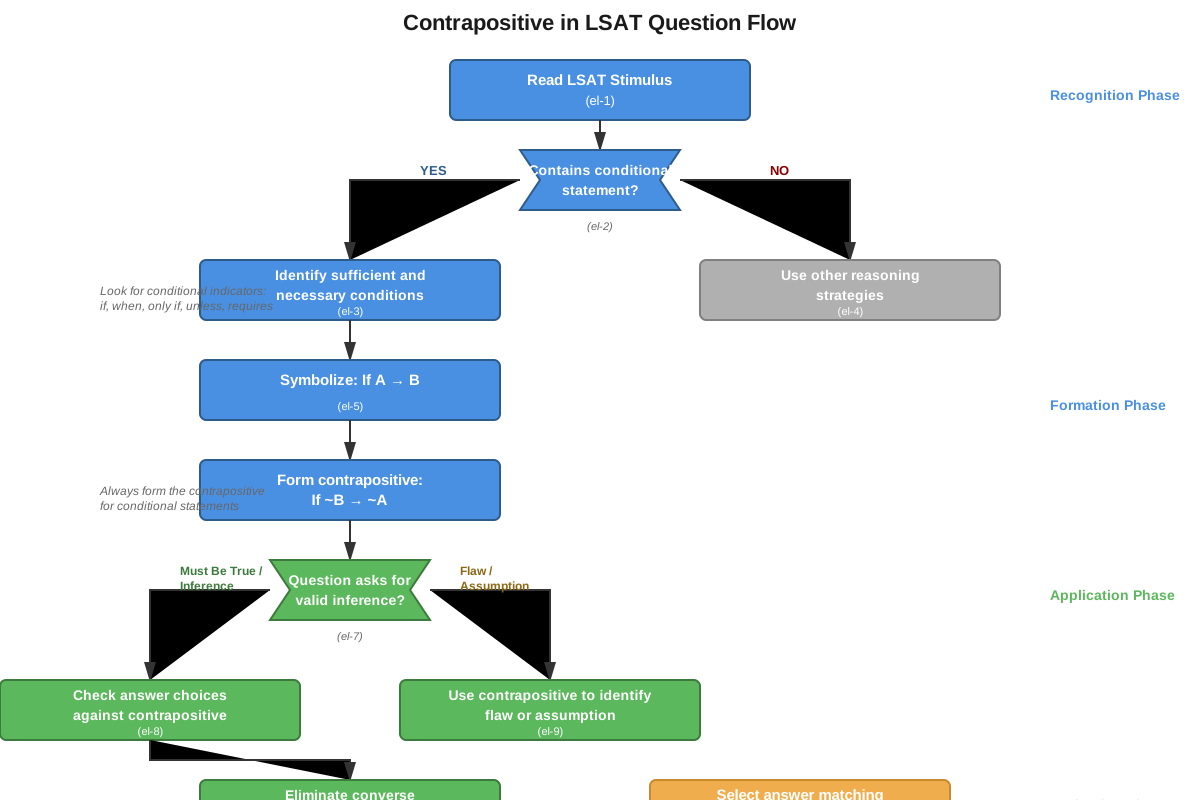
When you encounter conditional statements in LSAT Logical Reasoning questions, immediately identify the conditional indicator and translate the statement into standard "If...then" form. Write down the symbolic representation (A → B) and immediately form the contrapositive (~B → ~A) beneath it. This proactive approach ensures you have both valid forms available before evaluating answer choices.
Trigger words and phrases to watch for:
- Sufficient condition indicators (these introduce the "if" part): if, when, whenever, all, any, every, each, people who, in order to
- Necessary condition indicators (these introduce the "then" part): then, only, only if, only when, must, required, necessary, depends on, without
- "Unless" statements: Always translate "unless" as "if not" introducing the necessary condition
- Negative conditionals: Watch for "no," "none," "never," which create negative terms that must be carefully negated when forming contrapositives
Process of Elimination Tips
In Must Be True questions, eliminate answer choices that present:
- The converse (reversed but not negated): If the stimulus says "If A, then B," eliminate answers claiming "If B, then A"
- The inverse (negated but not reversed): Eliminate answers claiming "If not A, then not B"
- Mistranslations of "unless": Eliminate answers that treat "unless" as equivalent to "if"
- Backward reasoning from necessary conditions: Eliminate answers that conclude the sufficient condition occurred just because the necessary condition occurred
In Sufficient Assumption questions, look for answer choices that provide the contrapositive of what's needed to complete the argument. If the argument needs to establish "If A, then B" to reach its conclusion, an answer providing "If not B, then not A" would be equally sufficient.
In Flaw questions, correct answers often identify that the argument confused a conditional with its converse or inverse, or failed to recognize that the contrapositive would be required to make a valid inference.
Time Allocation
Spend 10-15 seconds translating conditional statements and forming contrapositives during your initial read of the stimulus. This upfront investment saves significant time when evaluating answer choices because you'll immediately recognize valid inferences. For questions involving multiple conditional statements, spend up to 30 seconds creating a conditional chain and its contrapositive before moving to answer choices—this systematic approach prevents errors and speeds up elimination.
Exam Tip: When you see conditional language in a stimulus, assume the LSAT is testing either your ability to form the contrapositive or your ability to avoid confusing it with invalid forms. Prepare both the original statement and its contrapositive before reading answer choices.
Memory Techniques
Mnemonic for Contrapositive Formation - "NERD":
- Negate both terms
- Exchange their positions (reverse)
- Remember: this is the only valid equivalent form
- Don't confuse with converse or inverse
Visualization Strategy: Picture a seesaw or balance. The original conditional has A on the left (up) and B on the right (down). To form the contrapositive, flip the seesaw completely—now not-B is on the left (up) and not-A is on the right (down). Both terms changed (negated) and both positions switched (reversed).
"Unless" Translation Acronym - "UNIT":
- Unless introduces the necessary condition
- Negate it to form the sufficient condition
- If not [the unless term], then [the other term]
- Take the contrapositive to get the alternative form
Converse/Inverse Warning - "COIN":
- Converse: just flipped (INVALID)
- Only contrapositive is valid
- Inverse: just negated (INVALID)
- Negate AND reverse for validity
Chain Visualization: Think of conditional chains as dominoes. Each statement is a domino that can knock down the next. The contrapositive is like reading the domino chain backward—if the last domino didn't fall, you can trace back to conclude the first domino didn't fall either.
Summary
The contrapositive is a fundamental tool in LSAT logical reasoning that allows test-takers to derive valid inferences from conditional statements. Formed by negating both terms of a conditional and reversing their order, the contrapositive is logically equivalent to the original statement—meaning both must always have the same truth value. For any conditional "If A, then B," the contrapositive "If not B, then not A" is guaranteed to be true whenever the original is true. This equivalence distinguishes the contrapositive from invalid forms like the converse (merely reversed) and inverse (merely negated), which the LSAT frequently uses as trap answers. Mastering contrapositive formation requires recognizing diverse conditional indicators including "unless," "only," and "only if," each of which requires specific translation into standard form. The contrapositive enables conditional chaining, supports valid deductive reasoning, and appears across multiple LSAT question types including Must Be True, Sufficient Assumption, and Flaw questions. Success with contrapositive reasoning demands both mechanical proficiency in forming contrapositives and conceptual understanding of why this logical operation preserves truth value.
Key Takeaways
- The contrapositive is formed by negating both terms AND reversing their order—both operations are required for validity
- The contrapositive is always logically equivalent to the original conditional statement and represents a guaranteed valid inference
- The converse (reversed only) and inverse (negated only) are invalid forms that frequently appear as trap answers on the LSAT
- "Unless" introduces the necessary condition in negated form: "A unless B" means "If not B, then A"
- Conditional statements can be chained together, and forming contrapositives is often necessary to create valid chains
- Recognizing conditional indicators in natural language and translating them accurately is essential for LSAT success
- When you know the necessary condition of a conditional is absent, the contrapositive allows you to validly conclude the sufficient condition is also absent
Related Topics
Formal Logic and Quantifiers: Building on contrapositive reasoning, formal logic extends to statements involving quantifiers like "all," "some," and "most," requiring understanding of how these quantifiers interact with conditional relationships and how to form valid inferences in more complex logical structures.
Sufficient and Necessary Assumptions: Mastering the contrapositive directly enables success with assumption questions, where recognizing that an argument depends on a conditional relationship (or its contrapositive) is often the key to identifying what the argument requires to be valid.
Conditional Chains and Complex Logic: Advanced applications of the contrapositive involve chaining multiple conditional statements together and working with complex logical structures that require forming multiple contrapositives to reach valid conclusions.
Formal Logic Games: In the Analytical Reasoning section, contrapositive reasoning is essential for working with rule-based logic games where multiple conditional constraints must be combined and manipulated to determine what must, could, or cannot be true.
Practice CTA
Now that you understand the contrapositive and its critical role in LSAT logical reasoning, it's time to cement your mastery through practice. Attempt the practice questions associated with this topic, focusing on accurately identifying conditional statements, forming contrapositives, and distinguishing valid inferences from trap answers. Use the flashcards to drill conditional indicators and contrapositive formation until the process becomes automatic. Remember: the contrapositive is one of the highest-yield concepts on the LSAT—every minute you invest in mastering it will pay dividends across multiple question types and significantly boost your score. You've built the foundation; now apply it with confidence!
Sign up free to keep reading
Create a free AnvayaPrep account to finish this LSAT guide on Contrapositive — plus flashcards and practice questions.