Overview
Grouping templates represent one of the most powerful and efficient techniques for solving complex LSAT grouping games. Within the Analytical Reasoning Legacy section of the LSAT, grouping games require test-takers to sort elements (people, objects, or variables) into distinct categories or groups based on a set of rules and constraints. When certain rules create limited possibilities for how elements can be distributed, constructing templates—complete diagrams showing all possible valid arrangements—becomes not just helpful but essential for maximizing speed and accuracy.
The template approach transforms what might otherwise be a time-consuming process of testing individual answer choices into a systematic method where most questions can be answered by simply checking which template(s) satisfy the question's conditions. This technique is particularly valuable because grouping games legacy questions frequently appear on the LSAT, and the ability to recognize when templates are appropriate can mean the difference between struggling through seven questions in twelve minutes versus confidently answering them in eight. Templates work by identifying a pivotal constraint—often a rule that severely limits how certain elements can be placed—and then exhaustively mapping out the small number of scenarios that satisfy all the game's rules.
Understanding grouping templates connects directly to broader analytical reasoning skills tested throughout the LSAT. The template method builds upon fundamental grouping game mechanics (identifying groups, tracking capacity constraints, and applying conditional rules) while introducing a meta-strategic layer: recognizing when the game's structure permits complete enumeration of possibilities. This recognition skill transfers to other game types and even to logical reasoning questions where considering limited scenarios can clarify complex conditional relationships.
Learning Objectives
- [ ] Identify how Grouping templates appears in LSAT questions
- [ ] Explain the reasoning pattern behind Grouping templates
- [ ] Apply Grouping templates to solve LSAT-style problems accurately
- [ ] Recognize the structural indicators that signal when a template approach will be efficient
- [ ] Construct complete and accurate templates from a given set of grouping rules
- [ ] Evaluate answer choices rapidly by reference to pre-constructed templates
- [ ] Distinguish between games where templates save time versus games where they waste time
Prerequisites
- Basic grouping game setup: Understanding how to represent groups, elements, and basic assignment rules is essential because templates build upon standard grouping game notation
- Conditional rule interpretation: Familiarity with "if-then" statements and their contrapositives is necessary because templates often branch based on conditional triggers
- Rule combination skills: The ability to apply multiple rules simultaneously is required because template construction demands integrating all constraints at once
- Diagramming conventions: Knowledge of standard LSAT logic game notation ensures templates can be drawn clearly and checked systematically
Why This Topic Matters
Grouping templates represent a high-impact strategy that directly addresses one of the most challenging aspects of LSAT Analytical Reasoning: managing complex rule interactions under time pressure. Research on LSAT performance consistently shows that students who master template-based approaches gain 2-4 additional correct answers on games sections compared to those who rely solely on question-by-question analysis. This improvement stems from templates' ability to eliminate repeated work—once templates are constructed, most questions become simple lookup tasks rather than reasoning challenges.
On the LSAT, grouping games appear in approximately 40-50% of all Analytical Reasoning sections, and roughly one-third of these games have structures conducive to templating. This means that in a typical four-game section, test-takers can expect to encounter at least one game where templates provide significant advantage. The questions most commonly associated with template-friendly games include "could be true" questions (which often require checking multiple scenarios), "must be false" questions (where templates reveal impossible combinations), and "complete and accurate list" questions (where templates make exhaustive checking straightforward).
Template-appropriate games typically feature one or more of these characteristics: a limited number of groups (usually 2-3), strict numerical constraints on group size, or a pivotal rule that creates a clear binary split in possibilities. For example, a game might state "Exactly three of seven candidates will be selected for the committee" with rules that force certain candidates to be together or apart—creating perhaps only 3-4 valid selection patterns that satisfy all constraints.
Core Concepts
What Are Grouping Templates?
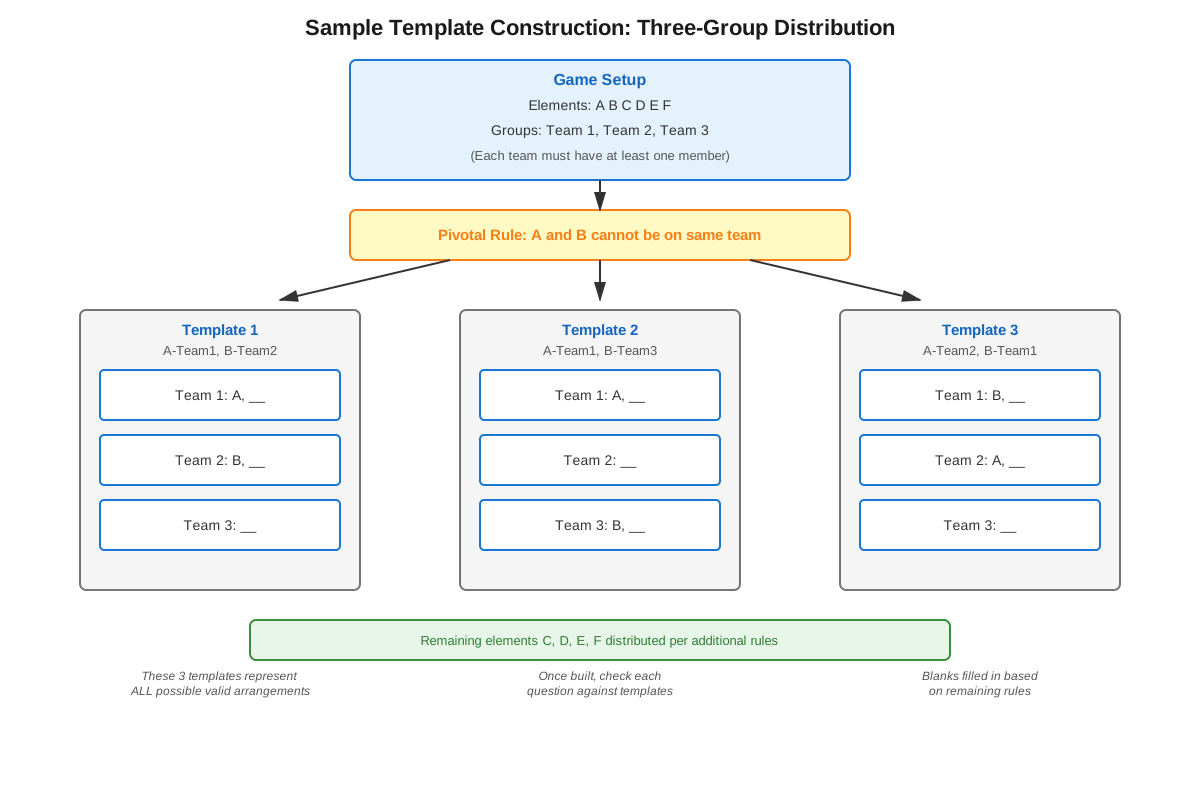
Grouping templates are complete diagrams that exhaustively represent all possible valid arrangements of elements into groups, given a game's rules and constraints. Rather than working through each question by testing possibilities individually, the template approach invests time upfront to map every scenario that satisfies the game's constraints. Each template represents one distinct way the elements can be legally distributed, and together, the complete set of templates encompasses every possibility allowed by the rules.
The fundamental insight behind templates is that some games, despite appearing complex, actually permit only a small number of valid configurations. When a game's rules are sufficiently restrictive—particularly when one rule creates a clear fork in possibilities—constructing templates becomes more efficient than repeatedly applying rules to test individual answer choices. A well-constructed template set serves as a reference tool: to answer most questions, test-takers simply check which template(s) satisfy the question's additional constraint, then examine what must or could be true in those scenarios.
Identifying Template-Appropriate Games
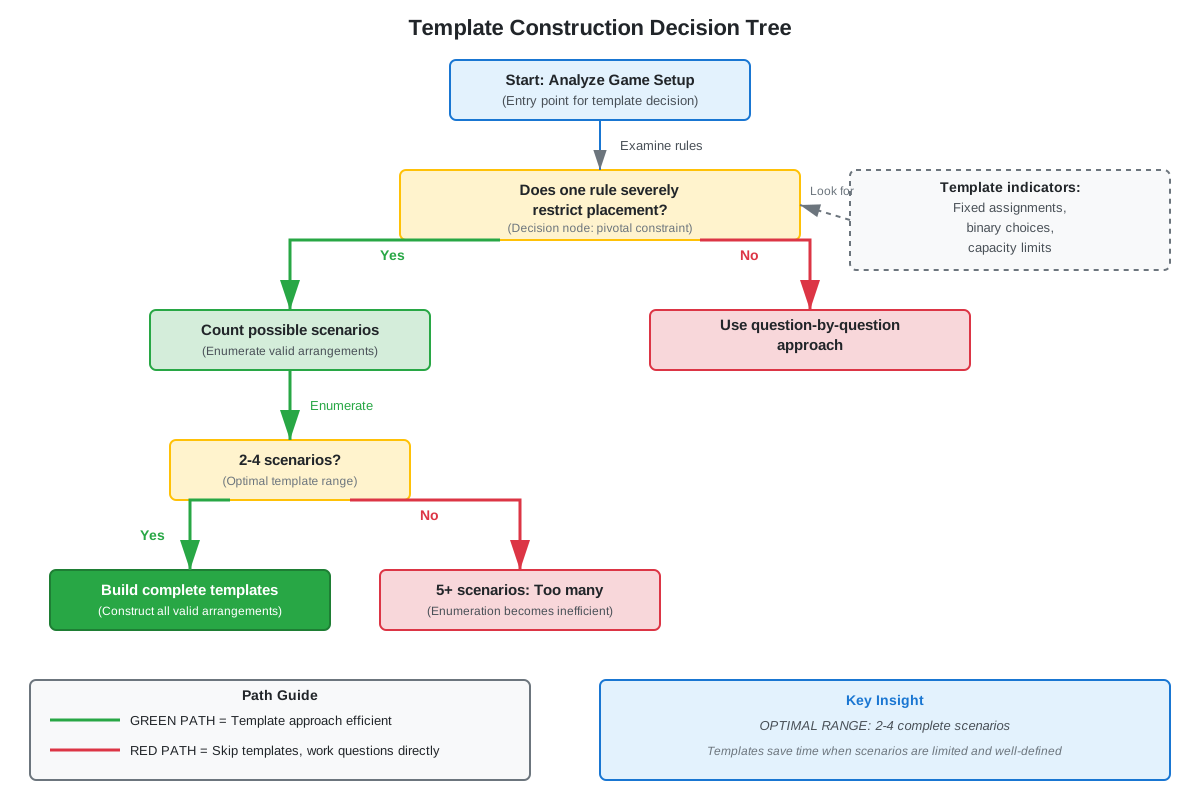
Not every grouping game benefits from templates. The decision to use templates should be strategic, based on recognizing specific structural indicators. Games well-suited to templating typically exhibit these characteristics:
Limited branching points: The game contains one or two rules that create clear either/or scenarios. For example, "Either F is selected or G is selected, but not both" creates exactly two branches to explore.
Restrictive numerical constraints: When groups have strict size requirements (e.g., "exactly 2 in Group A, exactly 3 in Group B") combined with rules about which elements must or cannot be together, the number of valid arrangements often becomes quite limited.
Powerful conditional rules: Rules like "If X is in Group 1, then Y and Z must both be in Group 2" can cascade through a game, leaving only a few valid configurations once all implications are traced.
Small element sets: Games with 6-8 elements are more template-friendly than those with 10+ elements, simply because fewer elements mean fewer possible arrangements to enumerate.
The critical question is: "Will this game have 5 or fewer templates?" If yes, templating is almost certainly worthwhile. If the game would require 6-8 templates, templating might still help but becomes less clearly advantageous. If more than 8 templates would be needed, the upfront investment typically exceeds the time saved.
Constructing Templates Systematically
Building templates requires a methodical approach to ensure completeness and accuracy. The process follows these steps:
- Identify the branching rule: Locate the constraint that most severely limits possibilities or creates the clearest division of scenarios. This becomes the foundation for splitting into separate templates.
- Create initial branches: Draw separate diagrams for each possibility created by the branching rule. If the rule is "Either A is in or B is in," create one template starting with A in and another with B in.
- Apply remaining rules to each branch: Working through each template individually, apply all other rules and trace their implications. Mark forced placements, note restrictions, and identify any elements whose placement becomes determined.
- Check for violations: Verify that each template satisfies all rules. If a template violates any constraint, eliminate it entirely.
- Look for sub-branching: Within each template, check whether any remaining uncertainty creates additional clear splits. If so, subdivide that template into multiple more-specific templates.
- Verify completeness: Ensure that the templates collectively cover all possibilities—there should be no valid arrangement that doesn't fit into at least one template.
Template Notation and Organization
Clear notation is essential for templates to be useful under test conditions. Each template should be drawn using the same basic structure as the initial game setup, with additional markings to show what's determined versus what remains flexible:
- Solid placements: Elements whose positions are fixed in that template should be written clearly in their assigned groups
- Restricted options: When an element could go in one of two specific places within a template, use notation like "M/N" to show the alternatives
- Prohibited placements: Mark spaces where certain elements cannot go, often using "¬X" notation
- Floating elements: Elements with no restrictions in a particular template can be listed separately with a note that they're flexible
Templates should be numbered (Template 1, Template 2, etc.) and arranged on the page so all are visible simultaneously, allowing quick scanning when answering questions.
Using Templates to Answer Questions
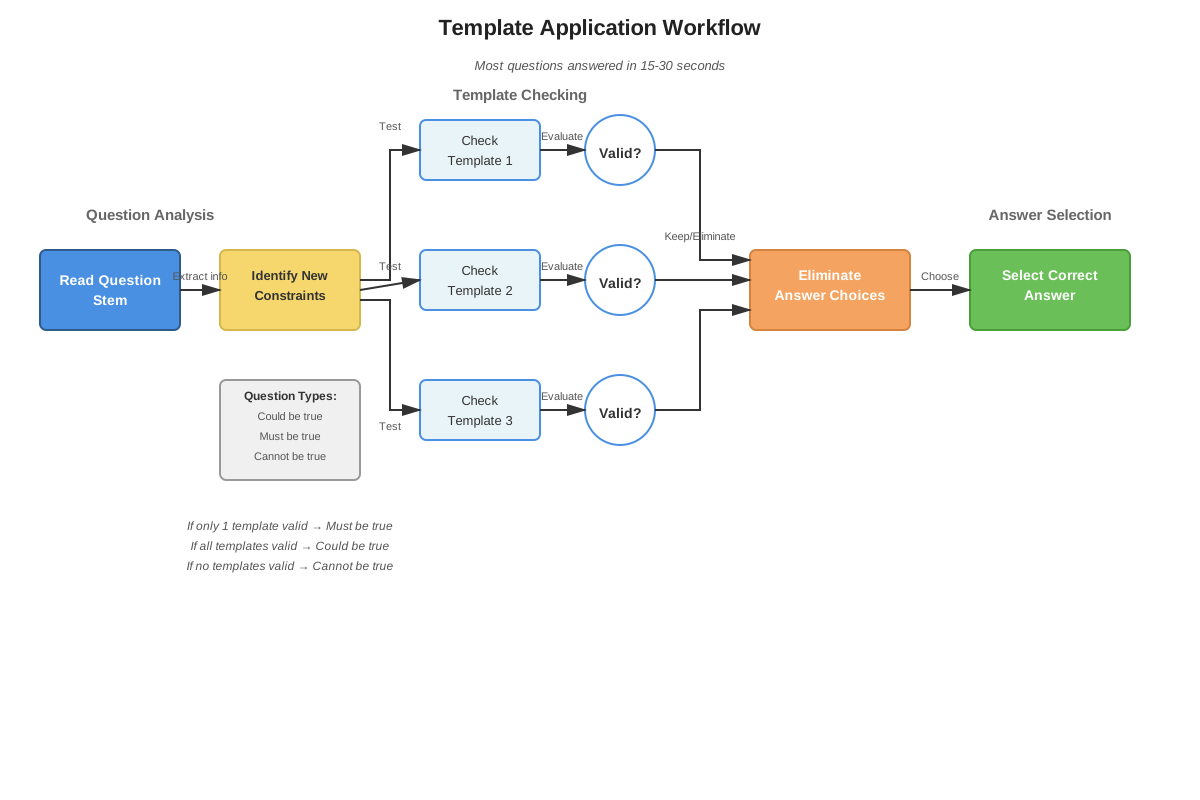
Once templates are constructed, the question-answering process becomes highly efficient:
For "could be true" questions: Check each template to see if the statement appears in any of them. If it appears in at least one valid template, it could be true.
For "must be true" questions: The statement must appear in every single template. If even one template shows a different possibility, the statement is not necessarily true.
For "must be false" questions: The statement should appear in zero templates—it's impossible given the game's constraints.
For "if" questions: The new condition in the question stem will typically eliminate all but one or two templates. Apply the new constraint to see which template(s) remain valid, then check what must be true in those scenarios.
For "complete and accurate list" questions: Check each answer choice against the templates to see if it captures exactly what's possible—no more, no less.
When Templates Become Inefficient
Recognizing when not to use templates is as important as knowing when to use them. Templates become counterproductive when:
- The game would require more than 6-8 templates (too much upfront time investment)
- No single rule creates a clear, powerful branching point (templates would be arbitrary rather than systematic)
- The game has many elements with few restrictions (too many possibilities to enumerate)
- Questions are highly specific with many "if" conditions (each question effectively creates its own mini-template anyway)
In these situations, a traditional approach—setting up the game clearly and working through questions individually while making local deductions—proves more efficient.
Concept Relationships
The template approach builds directly upon fundamental grouping game skills. Basic game setup (identifying groups, elements, and rules) → provides the foundation for → template construction (systematically enumerating valid arrangements). Without a clear initial setup, templates cannot be built accurately.
Conditional rule interpretation → enables → template branching decisions, because recognizing which rules create the most powerful splits determines how to divide the game into templates. The contrapositive understanding of conditionals also helps identify when certain templates violate rules and must be eliminated.
Rule combination skills → are intensified in → template construction, as building each template requires simultaneously applying all rules rather than considering them one at a time. This represents a more advanced application of the same fundamental skill.
Within the template method itself, identifying template-appropriate games → precedes → constructing templates → which enables → rapid question answering. Each step depends on the previous one: recognizing the opportunity, executing the construction, then leveraging the investment.
Templates also connect forward to more advanced analytical reasoning strategies. The meta-cognitive skill of recognizing structural patterns that permit complete enumeration transfers to hybrid games (which combine grouping with sequencing) and even to logical reasoning questions where considering limited scenarios can clarify complex conditional chains.
High-Yield Facts
⭐ Grouping templates are most efficient when a game permits 5 or fewer distinct valid arrangements of elements into groups
⭐ The branching rule—the constraint that most severely limits possibilities—should be identified first and used as the foundation for splitting into templates
⭐ Once templates are constructed, "must be true" questions require checking that a statement appears in ALL templates, while "could be true" questions only require it to appear in ONE template
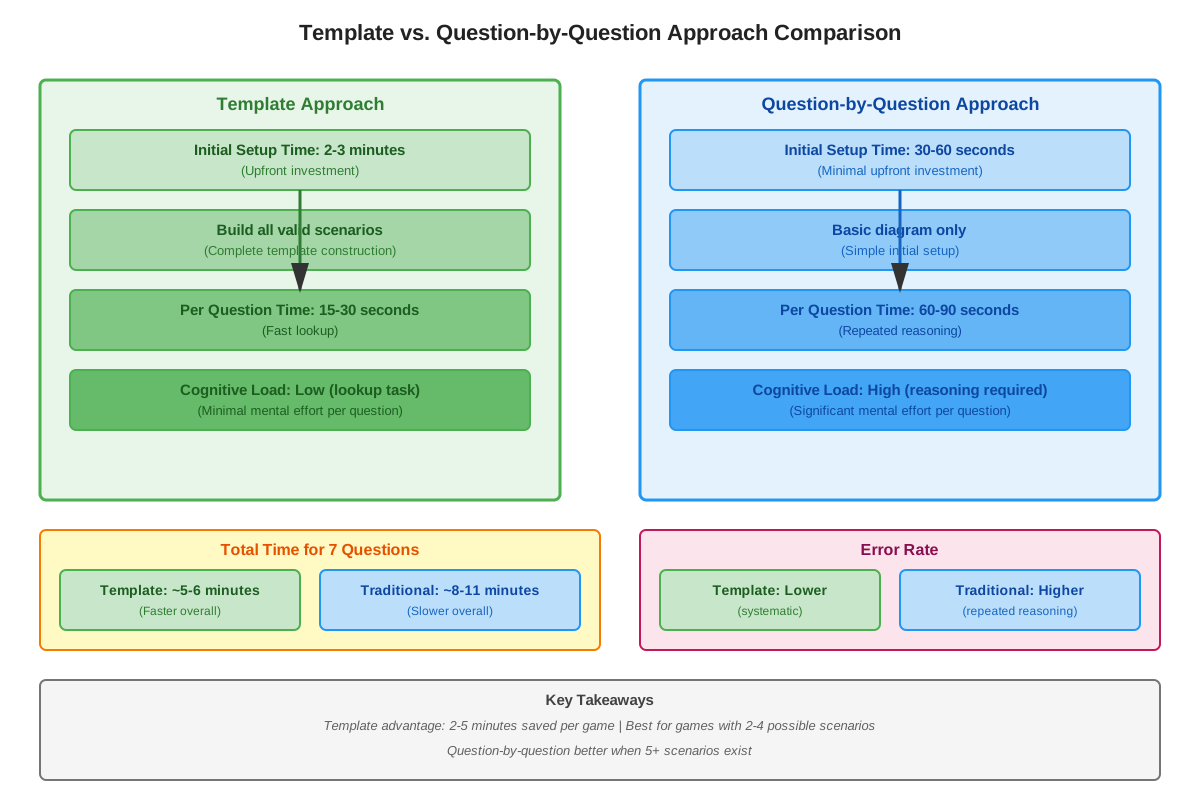
⭐ Template construction typically takes 3-4 minutes upfront but can reduce total game time from 12 minutes to 7-8 minutes by making questions trivial
⭐ Games with strict numerical constraints (e.g., "exactly 2 in Group A, exactly 3 in Group B") combined with conditional rules are prime template candidates
- Templates should be drawn using consistent notation with clear markings for fixed placements versus flexible elements
- If constructing templates reveals that only one or two valid arrangements exist, the game becomes extremely easy—most answers can be determined immediately
- "If" questions in template-friendly games typically eliminate all but one or two templates, making the question answerable by simple inspection
- Template completeness can be verified by ensuring that every element appears in at least one template and that no template violates any rule
- When a game requires more than 6 templates, the traditional question-by-question approach usually proves more time-efficient
- Templates are particularly powerful for "complete and accurate list" questions because they allow systematic checking of all possibilities
- The decision to use templates should be made within the first 60-90 seconds of reading a game's rules
Quick check — test yourself on Grouping templates so far.
Try Flashcards →Common Misconceptions
Misconception: Templates should be used for every grouping game to ensure accuracy.
Correction: Templates are only efficient for games with limited possibilities (typically 5 or fewer valid arrangements). Using templates on games with many possible configurations wastes valuable time without providing commensurate benefit. The key skill is recognizing which games have sufficiently restrictive rules to make templating worthwhile.
Misconception: Templates must show every single detail about where every element goes.
Correction: Templates should show what's determined by the rules, but elements that remain flexible across multiple positions don't need to be forced into specific spots. Good templates balance specificity (showing what's fixed) with efficiency (not over-determining what remains variable). Notation like "X or Y goes here" preserves flexibility while maintaining clarity.
Misconception: The branching rule for templates should always be the first rule listed in the game.
Correction: The branching rule should be whichever constraint most powerfully limits possibilities, regardless of where it appears in the rule list. Often, a conditional rule or a numerical constraint buried in the middle of the rules creates the clearest split. Identifying the most restrictive rule requires analyzing all constraints before beginning template construction.
Misconception: If one template violates a rule, the entire template approach should be abandoned.
Correction: Discovering that a potential template violates a rule is part of the normal construction process—simply eliminate that template and continue with the others. Finding violations actually confirms that the templating process is working correctly by systematically ruling out impossible scenarios. Only abandon templating if the number of valid templates grows beyond 6-8.
Misconception: Templates and making local deductions on individual questions are mutually exclusive approaches.
Correction: Even with templates constructed, some questions (particularly complex "if" questions) may require additional local deductions beyond what the templates show. Templates provide a foundation that makes these additional deductions easier, not a complete replacement for reasoning. The approaches complement rather than compete with each other.
Misconception: All templates must have the same level of specificity.
Correction: Different templates may determine different amounts of information. Template 1 might fix the positions of six elements while Template 2 might only fix four, leaving two flexible. This asymmetry is normal and reflects how different branches of the game's logic tree have different levels of constraint. What matters is that each template accurately represents what's determined in that scenario.
Worked Examples
Example 1: Committee Selection Game
Game Setup: A committee of exactly 3 members will be selected from 6 candidates: F, G, H, J, K, and L. The selection must satisfy these rules:
- If F is selected, then G cannot be selected
- If H is selected, then both J and K must be selected
- L and G cannot both be selected
Solution Process:
Step 1: Identify the branching rule
The second rule is most restrictive: "If H is selected, then both J and K must be selected." This creates a clear split: either H is selected (forcing J and K in, filling all three spots) or H is not selected.
Step 2: Create initial templates
Template 1: H is selected
- H is in → J must be in, K must be in
- All three spots are filled: H, J, K
- Check other rules: F is out (no room), so the F→¬G rule doesn't trigger. G is out (no room). L is out (no room).
- This template is valid: [H, J, K]
Template 2: H is not selected
- H is out → we need to select 3 from {F, G, J, K, L}
- Rule 1: F and G cannot both be in
- Rule 3: L and G cannot both be in
- This creates sub-branching...
Step 3: Sub-branch Template 2
Template 2A: H out, G in
- G is in → F must be out (Rule 1), L must be out (Rule 3)
- Need 2 more from {J, K}
- Must select both J and K
- Valid template: [G, J, K]
Template 2B: H out, G out
- G is out → F can be in, L can be in
- Need to select 3 from {F, J, K, L}
- No further restrictions from the rules
- Multiple possibilities exist here, but we can note: any 3 from {F, J, K, L}
- This splits into: [F, J, K], [F, J, L], [F, K, L], [J, K, L]
Step 4: Final template set
- [H, J, K]
- [G, J, K]
- [F, J, K]
- [F, J, L]
- [F, K, L]
- [J, K, L]
Step 5: Using templates to answer questions
Question: "Which of the following could be the complete committee?"
Check each answer choice against the six templates. Any answer matching a template could be true.
Question: "If F is selected, which must be true?"
Look at templates containing F: Templates 3, 4, and 5. What appears in ALL of them? J appears in 3 and 4 but not 5. K appears in all three. Therefore, K must be selected if F is selected.
Question: "Which pair of candidates CANNOT both be selected?"
Check all templates. H and F never appear together (H only in Template 1, F only in Templates 3-5). H and G never appear together. H and L never appear together. Any of these pairs would be correct answers.
Example 2: Team Assignment Game
Game Setup: Six employees—R, S, T, U, V, and W—are each assigned to exactly one of two teams: Team 1 or Team 2. Each team must have at least two members. The following rules apply:
- R and S cannot be on the same team
- If T is on Team 1, then U must be on Team 2
- V and W must be on the same team
Solution Process:
Step 1: Identify the branching rule
Rule 3 is powerful: V and W are a "block" that must stay together. This creates a clear split: either both are on Team 1 or both are on Team 2.
Step 2: Create initial templates
Template A: V and W both on Team 1
- Team 1: V, W, __, __, __, __
- Team 2: __, __, __, __
- Need at least 2 on Team 2, so at most 4 on Team 1
Template B: V and W both on Team 2
- Team 1: __, __, __, __
- Team 2: V, W, __, __, __, __
- Need at least 2 on Team 1, so at most 4 on Team 2
Step 3: Apply remaining rules to each template
Template A (V, W on Team 1):
- Rule 1: R and S split between teams
- Rule 2: If T on Team 1 → U on Team 2
Sub-case A1: T on Team 1
- Team 1: V, W, T → U must be on Team 2
- R and S split: one on Team 1, one on Team 2
- Team 1 could be: V, W, T, R (with S, U on Team 2) OR V, W, T, S (with R, U on Team 2)
Sub-case A2: T on Team 2
- Team 1: V, W, and 0-2 others from {R, S, U}
- Team 2: T, and others
- R and S must split
- Multiple valid arrangements
Template B (V, W on Team 2):
- Similar analysis with V, W as the base on Team 2
- Rule applications create parallel sub-cases
Step 4: Recognize complexity
This game is generating many templates (likely 8+). This suggests that while the V-W block seemed like a good branching point, the game may not be ideal for full templating. A hybrid approach—noting that V and W must be together and then working questions individually—might be more efficient.
Learning point: This example demonstrates when to recognize that template construction is becoming too complex and when to pivot to a different strategy. The initial attempt at templating still provides value (recognizing the V-W block), but full enumeration would be inefficient.
Exam Strategy
When approaching LSAT grouping games, develop a systematic decision-making process for whether to use templates:
Within the first 60-90 seconds of reading a game's rules, ask: "Is there one rule that severely limits possibilities?" Look specifically for:
- Either/or rules ("Either X is in or Y is in, but not both")
- Powerful conditionals with multiple consequences ("If A is selected, then B, C, and D must all be selected")
- Strict numerical constraints combined with grouping restrictions
- Block rules (elements that must stay together) in games with few groups
Trigger phrases that suggest template-friendly games include:
- "Exactly [number] will be selected"
- "Either...or...but not both"
- "Must be on the same team/in the same group"
- "Cannot be together"
- Any combination of the above
Time allocation strategy: If you decide to use templates, invest 3-4 minutes in construction before attempting any questions. This upfront investment should reduce per-question time from 90 seconds to 30-45 seconds, making the total game time shorter despite the initial investment. If template construction is taking longer than 4 minutes, you've likely chosen a game that's too complex for templating—cut your losses and proceed to questions with whatever partial templates you've created.
Process-of-elimination approach: When using templates to evaluate answer choices:
- For "could be true" questions, eliminate any answer that appears in zero templates
- For "must be true" questions, eliminate any answer that fails to appear in even one template
- For "complete and accurate list" questions, eliminate answers that either include impossible elements or exclude possible elements
Question order strategy: In template-friendly games, tackle "complete and accurate list" questions and "must be true/false" questions first, as these are most efficiently answered with templates. Save highly specific "if" questions for last, as these may require additional local deductions beyond the templates.
Memory Techniques
The "BRANCH" acronym for deciding whether to use templates:
- Binary splits: Does a rule create clear either/or scenarios?
- Restrictive: Are the numerical constraints tight?
- Arrangements: Will there be 5 or fewer valid arrangements?
- Necessary: Will templates actually save time on questions?
- Conditionals: Are there powerful if-then rules?
- How many: Count potential templates before committing
Visualization strategy: Picture templates as a "family tree" of possibilities. The trunk is the initial game setup, the first major branches represent the primary split (based on the branching rule), and smaller branches represent sub-divisions. If the tree has too many branches, it's not template-friendly.
The "5-or-fewer" rule: Remember that template-appropriate games typically yield five or fewer valid arrangements. Visualize holding up one hand—if you'd need more than five fingers to count the templates, reconsider the approach.
Template construction mnemonic "BRACE":
- Branch on the most restrictive rule
- Render each branch as a separate diagram
- Apply all remaining rules to each branch
- Check for rule violations and eliminate invalid templates
- Ensure completeness—all possibilities covered
Summary
Grouping templates represent a powerful strategic approach for LSAT Analytical Reasoning games where rules create a limited number of valid arrangements. By investing 3-4 minutes upfront to systematically enumerate all possible configurations, test-takers transform complex games into simple lookup tasks where most questions can be answered in 30-45 seconds by checking which template(s) satisfy the question's conditions. The key to successful templating lies in recognition: identifying games with sufficiently restrictive rules (typically yielding 5 or fewer valid arrangements) and locating the branching rule that creates the clearest division of possibilities. Template construction follows a systematic process—branch on the most restrictive rule, apply all other rules to each branch, eliminate violations, and verify completeness. Once constructed, templates make "must be true" questions (check all templates), "could be true" questions (check any template), and "complete and accurate list" questions (systematic verification) highly efficient. However, templates become counterproductive when games would require more than 6-8 templates or lack clear branching points. Mastering the decision of when to use templates—and executing the construction process accurately under time pressure—represents a high-yield skill that can improve Analytical Reasoning scores by 2-4 questions per section.
Key Takeaways
- Grouping templates work by exhaustively mapping all valid arrangements in games where rules create limited possibilities (typically 5 or fewer)
- The branching rule—the constraint that most severely limits possibilities—should be identified first and used as the foundation for template construction
- Template construction requires 3-4 minutes upfront but reduces per-question time from 90 seconds to 30-45 seconds, making total game time shorter
- "Must be true" questions require a statement to appear in ALL templates; "could be true" questions only require ONE template
- Games with strict numerical constraints combined with powerful conditional rules or either/or statements are prime template candidates
- Templates become inefficient when games would require more than 6-8 valid arrangements or lack clear branching points
- The decision to use templates should be made within 60-90 seconds of reading a game's rules, based on recognizing structural indicators
Related Topics
Advanced Hybrid Games: Games that combine grouping with sequencing or other game types often benefit from modified template approaches. Mastering pure grouping templates provides the foundation for recognizing when partial templating can help in more complex hybrid scenarios.
Conditional Chain Mapping: The skill of identifying powerful branching rules in grouping games transfers directly to mapping complex conditional chains in pure sequencing games, where similar either/or splits can create limited scenarios worth enumerating.
Game Type Recognition: Understanding when templates are appropriate deepens the broader skill of quickly categorizing games by type and selecting optimal strategies, a meta-skill that improves performance across all Analytical Reasoning questions.
Local Rule Application: Even in template-friendly games, some questions require additional deductions beyond what templates show. The interplay between global templates and local question-specific reasoning represents an advanced integration skill.
Practice CTA
Now that you understand the strategic power of grouping templates, it's time to put this knowledge into practice. Attempt the practice questions associated with this topic, focusing on the decision-making process: for each game, determine within 90 seconds whether templates would be efficient, identify the branching rule if applicable, and construct templates systematically. The flashcards will help reinforce recognition of template-appropriate game structures and common branching patterns. Remember, mastering templates isn't just about construction technique—it's about developing the judgment to recognize when this powerful tool will maximize your score. With deliberate practice, you'll internalize these patterns and approach grouping games with confidence and efficiency.
Sign up free to keep reading
Create a free AnvayaPrep account to finish this LSAT guide on Grouping templates — plus flashcards and practice questions.