Overview
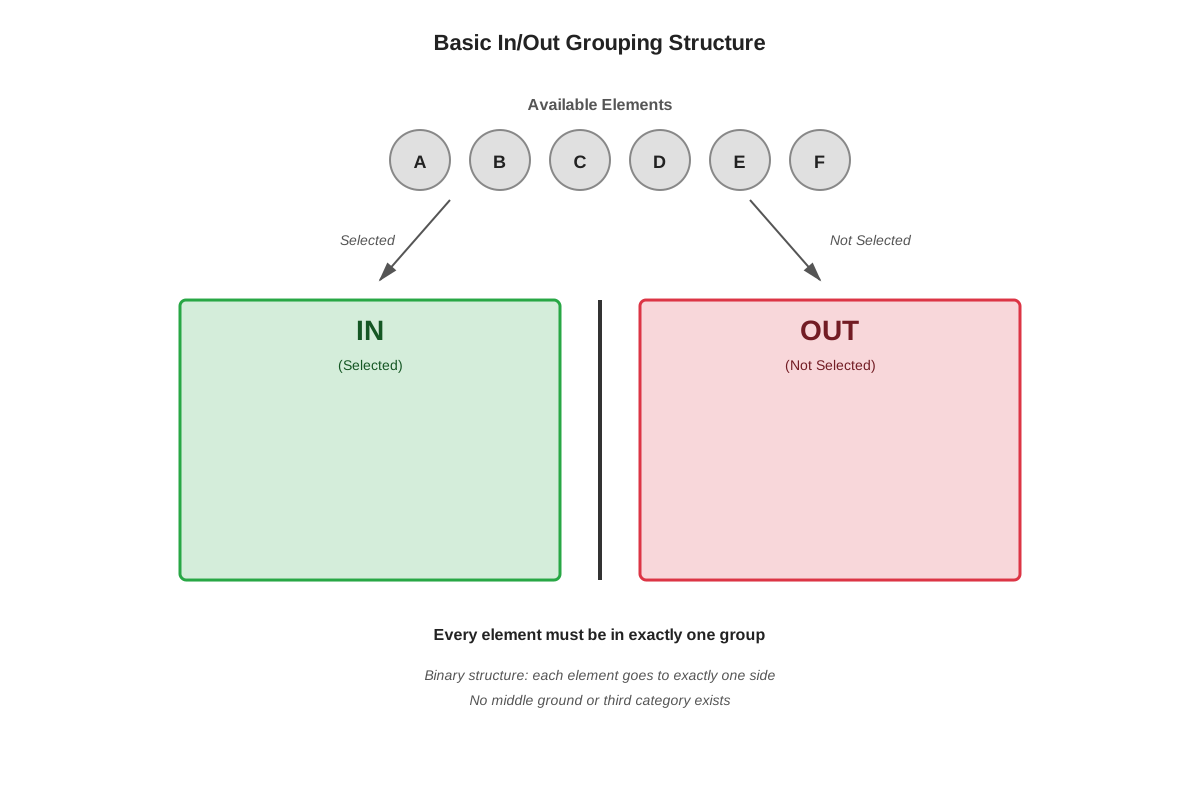
In out grouping is one of the most fundamental and frequently tested game types within Analytical Reasoning Legacy on the LSAT. This game structure presents test-takers with a scenario where elements must be divided into exactly two categories: those that are selected ("in") and those that are not selected ("out"). Unlike other grouping games legacy formats that may involve multiple groups or variable group sizes, in out grouping maintains a binary structure that requires precise logical reasoning about inclusion and exclusion.
The importance of mastering LSAT in out grouping cannot be overstated. These games appear regularly on the exam and form the foundation for understanding more complex grouping scenarios. Students who develop strong skills in this area gain a significant advantage because the binary nature of these games creates clear, traceable logical chains. When a rule states that "if X is selected, then Y is not selected," the contrapositive becomes immediately apparent and actionable. This clarity makes in out grouping games both teachable and, with practice, highly predictable.
Within the broader context of Analytical Reasoning Legacy, in out grouping represents a bridge between simpler ordering games and more complex distribution scenarios. The skills developed here—particularly the ability to track conditional relationships, recognize contrapositives, and manage binary constraints—transfer directly to hybrid games and advanced grouping scenarios. Understanding how selection and exclusion work in these pure binary contexts provides the logical foundation necessary for tackling the most challenging analytical reasoning questions on the LSAT.
Learning Objectives
- [ ] Identify how in out grouping appears in LSAT questions
- [ ] Explain the reasoning pattern behind in out grouping
- [ ] Apply in out grouping to solve LSAT-style problems accurately
- [ ] Construct accurate game boards and notation systems for binary selection scenarios
- [ ] Recognize and apply contrapositives within in out grouping constraints
- [ ] Synthesize multiple rules to identify forced selections and exclusions
- [ ] Evaluate answer choices efficiently using in out grouping deductions
Prerequisites
- Basic conditional logic: Understanding "if-then" statements and their contrapositives is essential because in out grouping rules frequently take conditional form, and recognizing contrapositives enables rapid deduction-making.
- Symbolic notation fundamentals: Familiarity with using letters, arrows, and negation symbols allows efficient representation of rules and relationships on the game board.
- Set theory basics: Understanding concepts of membership, inclusion, and exclusion provides the conceptual framework for binary grouping scenarios.
- Deductive reasoning principles: The ability to chain logical inferences together is critical for making the compound deductions that separate high scorers from average performers on these games.
Why This Topic Matters
In out grouping games appear on virtually every modern LSAT, typically comprising 15-25% of all Analytical Reasoning questions. The binary structure of these games makes them particularly amenable to systematic solving approaches, which means prepared students can often complete them more quickly and accurately than other game types. This efficiency creates valuable time for more challenging questions elsewhere in the section.
Beyond exam performance, the logical reasoning skills developed through in out grouping practice have direct applications to legal reasoning. Attorneys regularly must determine which evidence is admissible (in) versus inadmissible (out), which arguments are relevant versus irrelevant, and which precedents apply versus don't apply to a given case. The binary decision-making framework mirrors countless real-world legal scenarios.
On the LSAT specifically, in out grouping appears in several recognizable formats. The most common scenario involves selecting a subset from a larger group—for example, choosing five committee members from eight candidates, or determining which of seven projects will receive funding. The game setup explicitly or implicitly establishes that each element is either selected or not selected, with no middle ground. Questions typically ask about what must be true, what could be true, or what must be false given various conditions. The binary nature of these games means that determining one element's status often triggers a cascade of deductions about other elements, making thorough upfront work particularly valuable.
Core Concepts
The Binary Selection Framework
The foundational principle of in out grouping is the establishment of two mutually exclusive and collectively exhaustive categories. Every element in the initial set must be assigned to exactly one of two groups: the "in" group (selected) or the "out" group (not selected). This binary framework creates a zero-sum logical environment where placing an element in one category automatically excludes it from the other.
The game setup typically specifies either a fixed number of elements to be selected (e.g., "exactly five of eight candidates will be chosen") or provides enough constraints to determine the selection number through deduction. When the number is fixed, the complement is automatically determined—if exactly five of eight are selected, exactly three are not selected. This numerical constraint often becomes a powerful deduction tool.
Standard Notation Systems
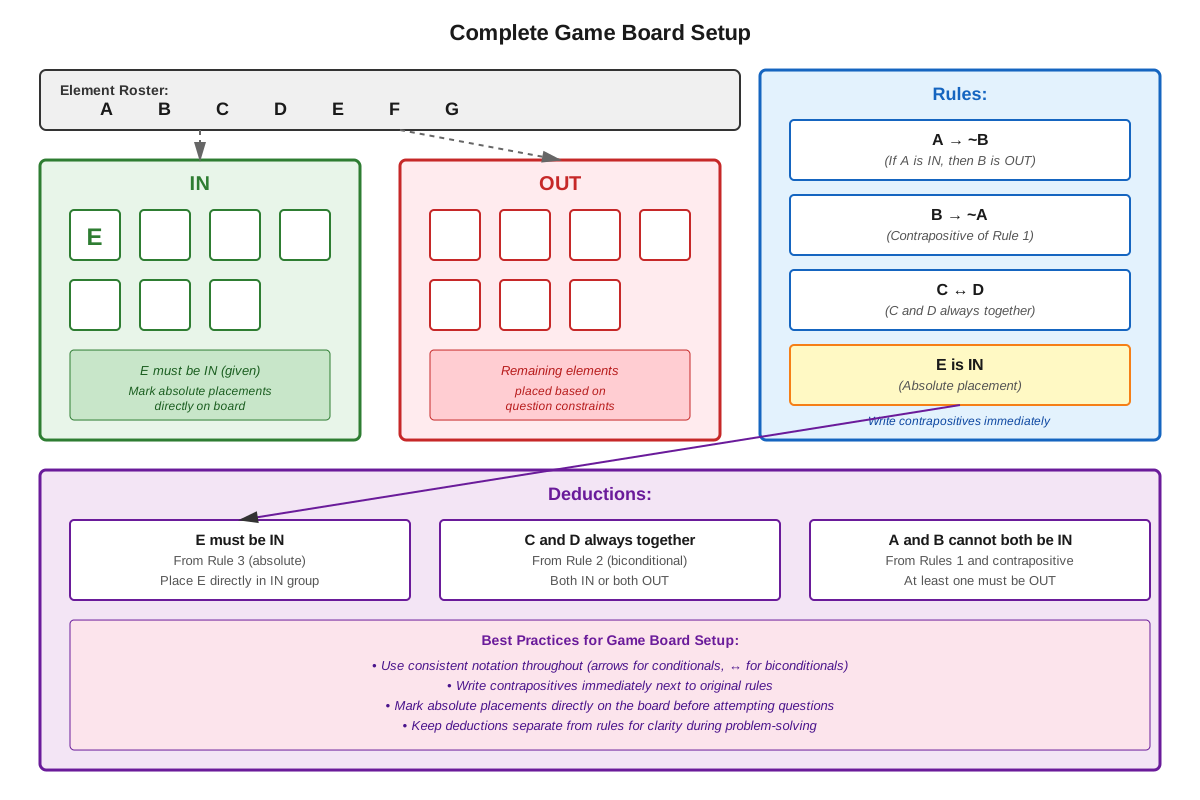
Effective notation is critical for success with in out grouping games. The most common approach uses a two-row system:
IN:  ___  ___  ___  ___  ___
OUT: ___  ___  ___
This visual representation immediately clarifies the selection requirement and provides spaces to track deductions. Some test-takers prefer a single-line approach with positive and negative indicators, but the two-row method generally provides clearer visual organization.
Elements are typically represented by capital letters (A, B, C, etc.). A selected element is shown as the letter itself (A), while an excluded element is shown with a slash or tilde (~A or Ā). This notation must be consistent throughout the game to avoid confusion.
Conditional Rules in Binary Contexts
The most powerful rules in in out grouping games are conditional statements. These take the form "If X is selected, then Y is not selected" or "If A is in, then B is in." The binary nature of these games makes conditional rules particularly potent because they create direct logical chains.
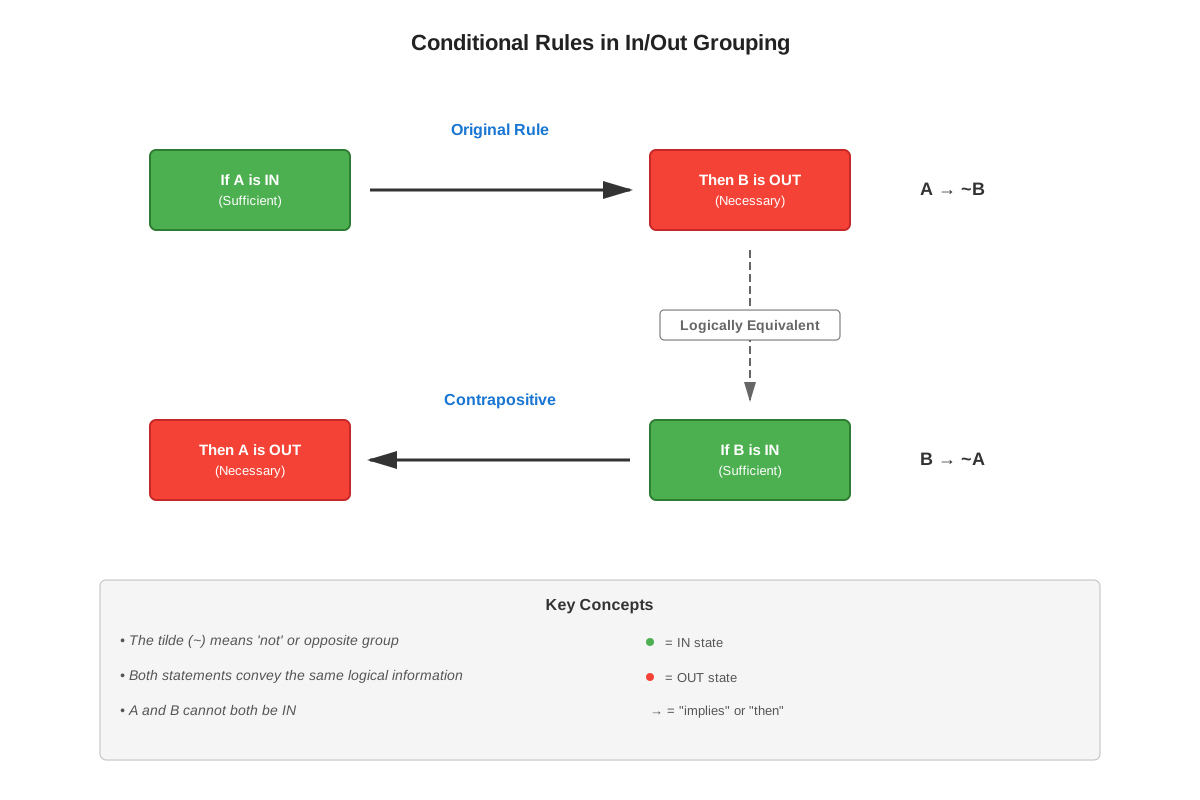
Consider the rule: "If M is selected, then N is not selected."
Notation: M → ~N
The contrapositive is equally important: N → ~M (If N is selected, then M is not selected)
This single rule actually provides four pieces of information:
- M and N cannot both be selected
- If M is in, N is out
- If N is in, M is out
- M and N can both be excluded (this is possible unless other rules prevent it)
Biconditional Relationships
Some rules create biconditional relationships where two elements must have the same status. "P is selected if and only if Q is selected" means P and Q are permanently linked—both in or both out.
Notation: P ↔ Q
This can also be represented as two conditional statements:
- P → Q
- Q → P
Biconditionals significantly reduce the game's complexity by treating linked elements as a single unit for decision-making purposes.
Negative Conditionals
Rules can also be triggered by exclusion: "If R is not selected, then S is selected."
Notation: ~R → S
Contrapositive: ~S → R
This type of rule is particularly important because it can force selections. If you determine that S cannot be selected (perhaps due to other constraints), the contrapositive immediately requires R to be selected.
Deduction Chains and Cascades
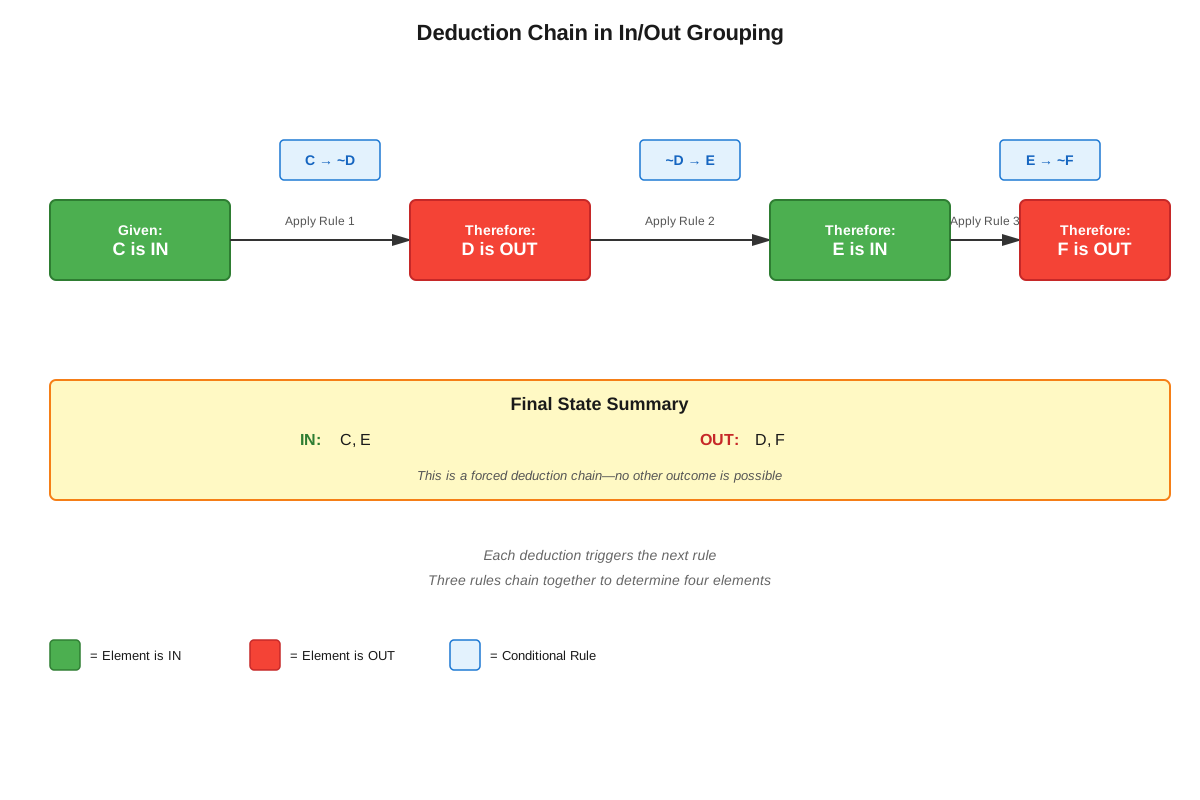
The true power of in out grouping emerges when multiple conditional rules chain together. Consider:
- Rule 1: A → B
- Rule 2: B → ~C
- Rule 3: C → D
If A is selected, a cascade occurs:
- A is in (given)
- B must be in (from Rule 1)
- C must be out (from Rule 2)
- D must be out (contrapositive of Rule 3: ~C → ~D is false, but C → D means ~D → ~C, so if C is out, D's status depends on other factors)
Careful chain analysis often reveals that selecting or excluding a single element determines the status of multiple other elements, sometimes solving the entire game.
Numerical Constraints and Counting
When the game specifies "exactly N elements are selected," counting becomes a crucial deduction tool. If you've determined that four elements must be selected and the requirement is exactly five, you know exactly one more element must be chosen from the remaining possibilities.
Conversely, if you've determined that three elements must be excluded and exactly three can be excluded (because five of eight must be selected), then all remaining undetermined elements must be selected.
Block and Anti-Block Rules
Some rules create permanent relationships between elements:
Block rules: "If X is selected, Y must also be selected" (X → Y) creates a selection block—X cannot be selected without Y.
Anti-block rules: "X and Y cannot both be selected" (X → ~Y) creates mutual exclusion.
These rules often combine with numerical constraints to force specific configurations. If three elements form a mutual exclusion set (A, B, and C cannot be selected together) and exactly two must be selected from a group of four, significant deductions follow.
Concept Relationships
The concepts within in out grouping form an interconnected logical system. The binary selection framework provides the foundational structure upon which all other concepts build. This framework necessitates the notation system, which enables efficient representation of the game state and rules.
Conditional rules operate within the binary framework, creating logical connections between elements. These conditionals naturally lead to contrapositives, which are simply the logical flip side of the same relationship. When multiple conditional rules share common elements, they form deduction chains, which represent the synthesis of individual rules into compound inferences.
Biconditional relationships can be understood as a special case of conditional rules—specifically, a pair of conditionals that point in opposite directions. Negative conditionals introduce the concept that exclusion can trigger inclusion, adding another layer to the logical landscape.
Numerical constraints interact with all rule types, but particularly powerfully with blocks and anti-blocks. When you know exactly how many elements must be selected, each forced inclusion or exclusion brings you closer to satisfying the numerical requirement, potentially triggering additional forced assignments.
The relationship map flows as follows:
Binary Framework → Notation System → Individual Rules (Conditionals, Biconditionals, Blocks) → Contrapositives → Deduction Chains → Integration with Numerical Constraints → Complete Game Solution
This progression mirrors the optimal solving approach: establish the framework, notate the rules, identify contrapositives, chain deductions, and apply numerical constraints to reach the solution.
High-Yield Facts
⭐ Every in out grouping game divides elements into exactly two mutually exclusive categories: selected (in) and not selected (out).
⭐ The contrapositive of every conditional rule is equally valid and often more useful than the original statement.
⭐ When a game specifies "exactly N elements are selected," exactly (Total - N) elements are not selected, creating a powerful counting constraint.
⭐ If selecting element X forces element Y to be selected (X → Y), then excluding Y forces X to be excluded (~Y → ~X).
⭐ Biconditional relationships (X ↔ Y) mean both elements must always have the same status—both in or both out.
- Anti-block rules (X → ~Y) mean at least one of the two elements must be excluded, but both can be excluded.
- Negative conditionals (~X → Y) can force selections when you determine Y cannot be selected.
- When multiple elements form a chain (A → B → C), selecting the first element forces all subsequent elements to be selected.
- If the number of forced inclusions equals the selection requirement, all remaining elements must be excluded.
- If the number of forced exclusions equals the maximum possible exclusions, all remaining elements must be selected.
- Elements that appear in no rules are "floaters" whose status depends entirely on numerical constraints and the status of other elements.
- When two elements cannot both be selected (X → ~Y) and cannot both be excluded (~X → Y), exactly one must be selected—this is an exclusive or relationship.
Quick check — test yourself on In out grouping so far.
Try Flashcards →Common Misconceptions
Misconception: If X → Y, then selecting Y means X must be selected.
Correction: Conditional rules only work in one direction. X → Y means selecting X forces Y, but selecting Y tells you nothing definite about X. Only the contrapositive (~Y → ~X) provides additional information.
Misconception: If X and Y cannot both be selected (X → ~Y), then at least one must be selected.
Correction: Anti-block rules only prevent both elements from being selected simultaneously. Both elements can be excluded unless other rules prevent this. The rule X → ~Y is satisfied when X is out, when Y is out, or when both are out.
Misconception: In a game where exactly 5 of 8 elements are selected, determining that 4 elements are definitely selected means the game is nearly solved.
Correction: While you know exactly one more element must be selected, if two or more elements remain undetermined, you haven't narrowed down which specific element must be selected. The game requires further analysis or may have multiple valid solutions.
Misconception: Biconditional relationships (X ↔ Y) mean that X and Y must both be selected.
Correction: Biconditionals only require that X and Y have the same status. Both can be selected OR both can be excluded. The biconditional doesn't determine which status they share, only that they share one.
Misconception: If a rule states "If X is selected, then either Y or Z is selected" (X → Y or Z), and X is selected, then both Y and Z must be selected.
Correction: The "or" in logical statements is typically inclusive, meaning at least one must be selected. When X is selected, Y could be selected, Z could be selected, or both could be selected. The rule is satisfied by any of these scenarios.
Misconception: Elements that appear in multiple rules are more likely to be selected.
Correction: The frequency with which an element appears in rules has no bearing on whether it will be selected. An element that appears in many rules may be highly constrained, but those constraints could force it in or out depending on the specific rules and the status of other elements.
Worked Examples
Example 1: Committee Selection
Setup: A committee of exactly 4 members will be selected from 7 candidates: F, G, H, J, K, L, and M. The selection must conform to the following rules:
- If F is selected, then G is not selected.
- If H is selected, then both J and K are selected.
- If L is not selected, then M is selected.
- G and M cannot both be selected.
Question: If H is selected, which of the following must be true?
Solution Process:
First, establish the framework:
IN (4):  ___  ___  ___  ___
OUT (3): ___  ___  ___
Next, notate the rules:
- F → ~G (contrapositive: G → ~F)
- H → J and K (contrapositive: ~J or ~K → ~H)
- ~L → M (contrapositive: ~M → L)
- G → ~M (contrapositive: M → ~G)
Now apply the question condition: H is selected.
From Rule 2: If H is in, then J is in AND K is in.
Current state:
IN (4):  H  J  K  ___
OUT (3): ___  ___  ___
We've filled 3 of 4 "in" slots, so exactly 1 more element must be selected, and exactly 3 elements must be excluded.
Remaining elements: F, G, L, M (4 elements, need to select 1 and exclude 3)
Now examine the rules for forced deductions:
Rule 4 states G → ~M (equivalently, M → ~G). This means G and M cannot both be selected. Since we can only select 1 more element, we definitely cannot select both G and M.
Rule 3 states ~L → M. The contrapositive is ~M → L. This means at least one of L or M must be selected.
Since we need exactly 1 more selection from {F, G, L, M}, and at least one of {L, M} must be selected, the final selection must be either L or M (not F or G).
If M is selected:
- G must be out (Rule 4)
- F could be in or out (no constraint)
- L could be in or out, but since we can only select 1 more, L must be out
If L is selected:
- M could be in or out, but since we can only select 1 more, M must be out
- If M is out, Rule 3 (~L → M) is not violated because L is in
- G could be in or out, but must be out (only 1 selection remaining)
- F must be out
Testing L selected:
IN (4):  H  J  K  L
OUT (3): F  G  M
Check all rules:
- F → ~G: F is out, so rule is satisfied ✓
- H → J and K: All three are in ✓
- ~L → M: L is in, so rule is satisfied ✓
- G → ~M: G is out, so rule is satisfied ✓
Testing M selected:
IN (4):  H  J  K  M
OUT (3): F  G  L
Check all rules:
- F → ~G: F is out, so rule is satisfied ✓
- H → J and K: All three are in ✓
- ~L → M: L is out, so M must be in, which it is ✓
- G → ~M: G is out, so rule is satisfied ✓
Both scenarios work! However, the question asks what must be true.
What's true in both scenarios?
- H, J, and K are all selected (forced by the question condition and Rule 2)
- F and G are both excluded
- Exactly one of {L, M} is selected
Answer: F and G must both be excluded, and exactly three of {F, G, L, M} must be excluded.
Example 2: Project Funding
Setup: A foundation will fund exactly 5 of 8 proposed projects: A, B, C, D, E, F, G, and H. The funding decisions must conform to these constraints:
- If A is funded, then B is funded.
- If C is funded, then D is not funded.
- E and F cannot both be funded.
- If G is not funded, then H is funded.
- If B is funded, then C is funded.
Question: If D is funded, what is the maximum number of projects that could be funded from the set {A, B, C, E, F}?
Solution Process:
Notate the rules:
- A → B (contrapositive: ~B → ~A)
- C → ~D (contrapositive: D → ~C)
- E → ~F (contrapositive: F → ~E) [anti-block]
- ~G → H (contrapositive: ~H → G)
- B → C (contrapositive: ~C → ~B)
Apply the question condition: D is funded (in).
From Rule 2 contrapositive: D → ~C, so C is not funded (out).
From Rule 5 contrapositive: ~C → ~B, so B is not funded (out).
From Rule 1 contrapositive: ~B → ~A, so A is not funded (out).
Current state:
IN (5):  D  ___  ___  ___  ___
OUT (3): A  B  C
We need 4 more funded projects from {E, F, G, H}.
Rule 3 states E and F cannot both be funded, so at most one of {E, F} can be funded.
Rule 4 states ~G → H. This means at least one of {G, H} must be funded.
From {E, F, G, H}, we need to select 4 projects, but E and F cannot both be selected.
If we select E (but not F), we need 3 more from {G, H}, but there are only 2 elements. Impossible.
If we select F (but not E), we need 3 more from {G, H}, but there are only 2 elements. Impossible.
If we select neither E nor F, we need 4 more from {G, H}, but there are only 2 elements. Impossible.
Wait—let me reconsider. We have 8 total projects and need exactly 5 funded.
Current definite status:
- IN: D
- OUT: A, B, C
Remaining: E, F, G, H (4 elements)
We need 4 more funded projects (to reach 5 total), and we have exactly 4 remaining elements.
This means ALL of {E, F, G, H} must be funded!
But Rule 3 states E and F cannot both be funded. This creates a contradiction.
Let me reconsider the deductions... Actually, this means the scenario "D is funded" might force a specific configuration or might be impossible under certain additional constraints. But the question asks about the maximum from {A, B, C, E, F}.
Given D is funded:
- A is out
- B is out
- C is out
- From {E, F}, at most 1 can be funded (Rule 3)
Therefore, the maximum number from {A, B, C, E, F} that could be funded is 1 (either E or F, but not both, and not A, B, or C).
Exam Strategy
When approaching in out grouping questions on the LSAT, begin by quickly identifying the game type. Look for trigger phrases such as "will be selected," "will be chosen," "will participate," or "will be included." The presence of a specific number (e.g., "exactly 5 of 8") immediately signals an in out grouping game.
Invest time upfront in proper setup. Draw your two-row board clearly, label the rows "IN" and "OUT," and mark the number of spaces in each row based on the selection requirement. This visual framework prevents errors and speeds up question-solving.
As you notate rules, immediately write the contrapositive next to each conditional rule. This doubles your working information and prevents the common error of forgetting to apply contrapositives. Use consistent notation throughout—if you use ~X for "X is not selected," don't switch to X' or other notation mid-game.
Before attempting questions, spend 30-60 seconds looking for immediate deductions. Check for:
- Elements that must be selected or excluded based on rule combinations
- Chains of conditional rules that link multiple elements
- Numerical constraints that limit possibilities
For "must be true" questions, look for deductions that follow necessarily from the given condition. For "could be true" questions, try to construct a valid scenario that includes the answer choice. For "must be false" questions, show that the answer choice creates a rule violation.
Process of elimination is particularly powerful in in out grouping games. If you can quickly determine that four answer choices are possible (or impossible, depending on the question type), you can select the remaining answer with confidence even if you haven't fully worked through its implications.
Time management is critical. If a question requires extensive hypothetical testing, consider marking it and returning after completing easier questions. In out grouping games often include 1-2 straightforward questions that can be answered quickly using your initial deductions, followed by more complex questions requiring scenario testing.
Memory Techniques
COIN - The four key steps for in out grouping:
- Conditionals: Identify all conditional rules
- Opposites: Write contrapositives immediately
- Inferences: Chain rules together for compound deductions
- Numbers: Apply numerical constraints to force selections
"Both Ways or No Way" - For biconditional relationships, remember that linked elements must have the same status—both in or both out, never split.
"One Forces, One Frees" - For anti-block rules (X → ~Y), remember that selecting one element forces the other out, but excluding one element frees the other (it could be in or out).
The Contrapositive Flip - Visualize flipping a conditional rule like flipping a card: the arrow reverses, and both elements get negated. If you can see the original, you can see the flip.
"Count Up, Count Down" - When you've determined some elements are definitely in, count up to the requirement. When you've determined some are definitely out, count down from the total. When the counts meet, all remaining elements are determined.
Summary
In out grouping represents a fundamental binary selection framework within LSAT Analytical Reasoning Legacy where elements are divided into exactly two mutually exclusive categories: selected (in) and not selected (out). Success with these games requires mastery of conditional logic, particularly the ability to recognize and apply contrapositives, chain multiple rules together to form compound deductions, and integrate numerical constraints with logical rules. The binary nature of these games creates clear logical pathways where determining one element's status often triggers a cascade of forced assignments. Effective notation systems, systematic rule analysis, and careful attention to both what must be true and what could be true distinguish high-performing test-takers. The skills developed through in out grouping practice—precise logical reasoning, careful deduction-chaining, and systematic elimination of impossible scenarios—transfer directly to more complex grouping games and provide essential foundations for LSAT success.
Key Takeaways
- In out grouping games divide all elements into exactly two categories: selected (in) and not selected (out), with no middle ground or partial membership.
- Every conditional rule has an equally valid contrapositive that must be identified and applied; the contrapositive often provides the key to solving complex questions.
- Numerical constraints (e.g., "exactly 5 of 8 must be selected") create powerful forcing mechanisms when combined with logical rules about which elements must or cannot be selected together.
- Biconditional relationships permanently link elements to share the same status, while anti-block rules prevent elements from being selected together but allow both to be excluded.
- Deduction chains formed by linking multiple conditional rules often determine the status of numerous elements from a single initial condition, making upfront deduction work highly valuable.
- Systematic notation, careful contrapositive identification, and integration of numerical constraints with logical rules form the foundation of efficient and accurate in out grouping game solutions.
- The binary framework of in out grouping makes these games particularly amenable to process-of-elimination strategies and systematic scenario testing.
Related Topics
Tiered Grouping Games: After mastering binary in out grouping, tiered grouping introduces scenarios with three or more distinct groups, requiring more complex tracking systems but building on the same fundamental logical principles.
Numerical Distribution Games: These games extend the numerical constraint concepts from in out grouping to scenarios where multiple groups must be filled with specific numbers of elements, requiring sophisticated counting and distribution strategies.
Hybrid Games: Many advanced LSAT games combine in out grouping with ordering or other game types, requiring simultaneous application of multiple analytical frameworks—mastery of pure in out grouping is essential before attempting these complex hybrids.
Conditional Sequencing: The conditional logic skills developed through in out grouping transfer directly to ordering games with conditional constraints, where the selection/exclusion binary becomes a before/after or left/right relationship.
Practice CTA
Now that you've mastered the core concepts of in out grouping, it's time to put your knowledge into action. Attempt the practice questions to test your ability to identify game types, construct efficient notation systems, chain deductions, and apply numerical constraints under timed conditions. Use the flashcards to reinforce key rules about conditionals, contrapositives, and common deduction patterns. Remember: in out grouping games reward systematic preparation and careful practice. Each game you complete strengthens your pattern recognition and speeds your solving process. You're building the analytical reasoning skills that will serve you throughout the LSAT and beyond. Start practicing now!
Sign up free to keep reading
Create a free AnvayaPrep account to finish this LSAT guide on In out grouping — plus flashcards and practice questions.