Overview
Hybrid game setup represents one of the most challenging and frequently tested question types within the Analytical Reasoning Legacy section of the LSAT. Unlike pure sequencing games or pure grouping games, hybrid games legacy require test-takers to simultaneously manage multiple constraint types—typically combining ordering elements with grouping or selection requirements. These games demand that students track relationships across different dimensions, making them cognitively demanding and time-intensive if approached without a systematic strategy.
The significance of mastering lsat hybrid game setup cannot be overstated. Historically, hybrid games appear in approximately 25-30% of all Analytical Reasoning sections, and they consistently generate the most difficult questions within those sections. A hybrid game might ask you to assign seven employees to three different departments while also determining the order in which they were hired, or to schedule presentations across multiple days while respecting both temporal sequence and categorical grouping constraints. The complexity arises not from any single constraint being particularly difficult, but from the cognitive load of managing multiple constraint systems simultaneously.
Within the broader framework of analytical reasoning legacy, hybrid games represent the culmination of foundational skills. They require fluency with basic sequencing rules (before/after relationships, fixed positions, blocks), grouping principles (distribution patterns, capacity constraints, membership rules), and often selection mechanics (in/out determinations). Students who struggle with hybrid games typically lack automaticity in one of these component skills, causing their working memory to become overwhelmed when multiple systems must operate concurrently. Mastering hybrid game setup provides the organizational framework that prevents this cognitive overload and enables efficient, accurate problem-solving.
Learning Objectives
- [ ] Identify how Hybrid game setup appears in LSAT questions
- [ ] Explain the reasoning pattern behind Hybrid game setup
- [ ] Apply Hybrid game setup to solve LSAT-style problems accurately
- [ ] Distinguish between different hybrid game subtypes (sequencing-grouping, grouping-selection, multi-layered sequencing)
- [ ] Construct effective visual representations that capture both constraint dimensions simultaneously
- [ ] Recognize when to prioritize one constraint type over another during initial setup
- [ ] Execute efficient inference chains that leverage interactions between different constraint systems
Prerequisites
- Basic sequencing game mechanics: Understanding linear ordering, relative positioning, and temporal constraints is essential because hybrid games always incorporate at least one ordering dimension
- Fundamental grouping principles: Knowledge of distribution rules, group capacity, and membership constraints provides the foundation for the categorical dimension present in most hybrid games
- Rule notation systems: Familiarity with standard symbolic notation for constraints enables rapid translation of game rules into workable visual representations
- Inference recognition: The ability to identify forced placements and impossible arrangements in simpler game types transfers directly to the more complex inference patterns in hybrid games
- Diagramming fundamentals: Competence with standard LSAT game boards and notation conventions allows focus on the strategic challenges rather than representational mechanics
Why This Topic Matters
Hybrid games represent the LSAT's most sophisticated test of analytical reasoning ability. They appear in virtually every modern LSAT administration, typically as the third or fourth game in a section—positioned strategically where they can differentiate high-scoring test-takers from average performers. According to LSAC data analysis, hybrid games generate the lowest accuracy rates among all Analytical Reasoning question types, with average test-takers answering only 40-50% of hybrid game questions correctly compared to 60-70% accuracy on pure sequencing or grouping games.
The practical significance extends beyond test performance. Hybrid games simulate real-world analytical challenges where multiple constraint systems must be satisfied simultaneously—scheduling conflicts with resource allocation, project sequencing with team assignments, or procedural ordering with categorical requirements. Legal practice regularly demands this type of multi-dimensional constraint satisfaction, making hybrid games one of the most professionally relevant components of the LSAT.
On the exam, hybrid games most commonly appear as:
- Sequencing-grouping combinations: Ordering elements while assigning them to categories (e.g., scheduling appointments across different doctors)
- Multi-track sequencing: Parallel ordering systems with cross-track constraints (e.g., ranking candidates for two different positions)
- Grouping with internal ordering: Forming teams while determining hierarchy within each team
- Selection-sequencing hybrids: Choosing a subset of elements and then ordering the selected items
The question types associated with hybrid games include all standard formats—acceptability questions, must-be-true/could-be-true questions, complete-and-accurate-list questions, and rule substitution questions—but with significantly higher difficulty due to the need to verify answers against multiple constraint dimensions.
Core Concepts
Defining Hybrid Game Characteristics
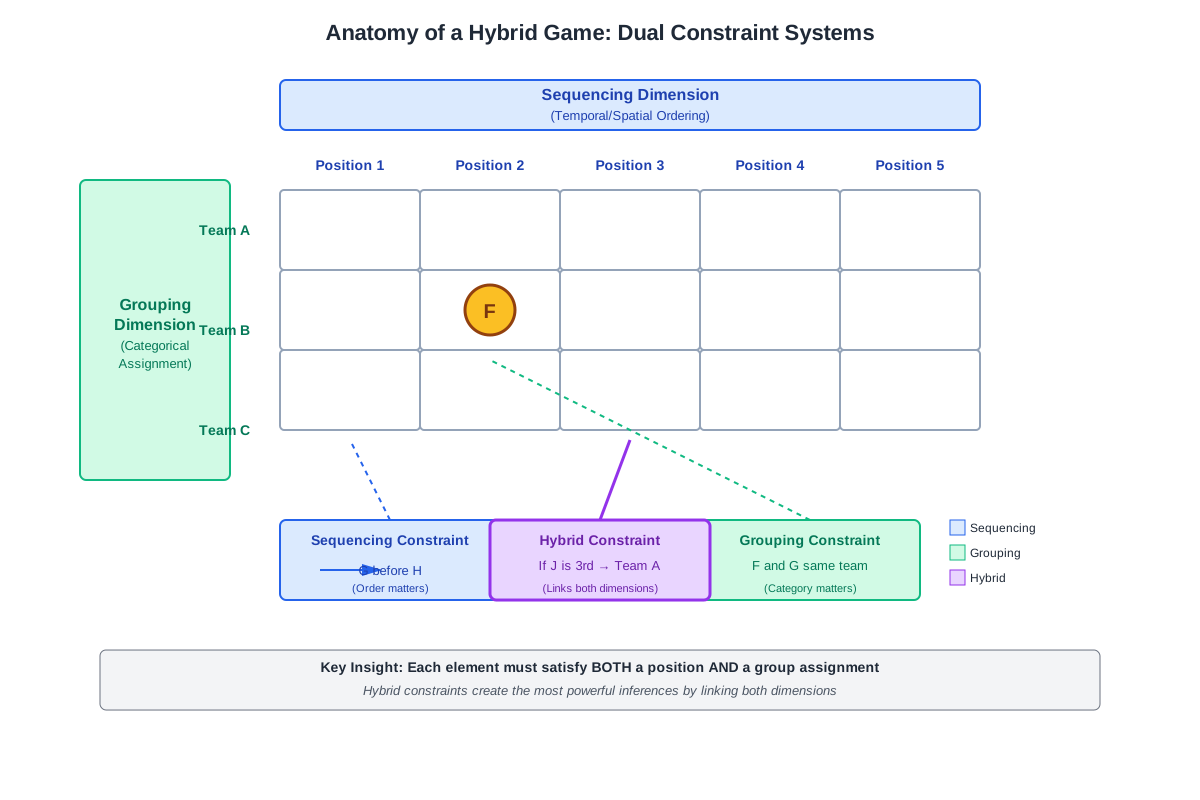
A hybrid game setup combines two or more distinct constraint systems that must be satisfied simultaneously. The defining characteristic is that neither constraint system can be fully resolved without considering the other—they are interdependent rather than sequential. This interdependence distinguishes true hybrid games from compound games where separate tasks happen to appear in the same scenario but can be solved independently.
The most common hybrid structure pairs linear sequencing (ordering elements in positions 1, 2, 3, etc.) with categorical grouping (assigning elements to distinct groups or categories). For example, a game might require ordering seven books on a shelf while also ensuring certain books are on the top shelf versus the bottom shelf. The sequencing dimension determines relative position; the grouping dimension determines categorical membership; and rules typically create dependencies between these dimensions.
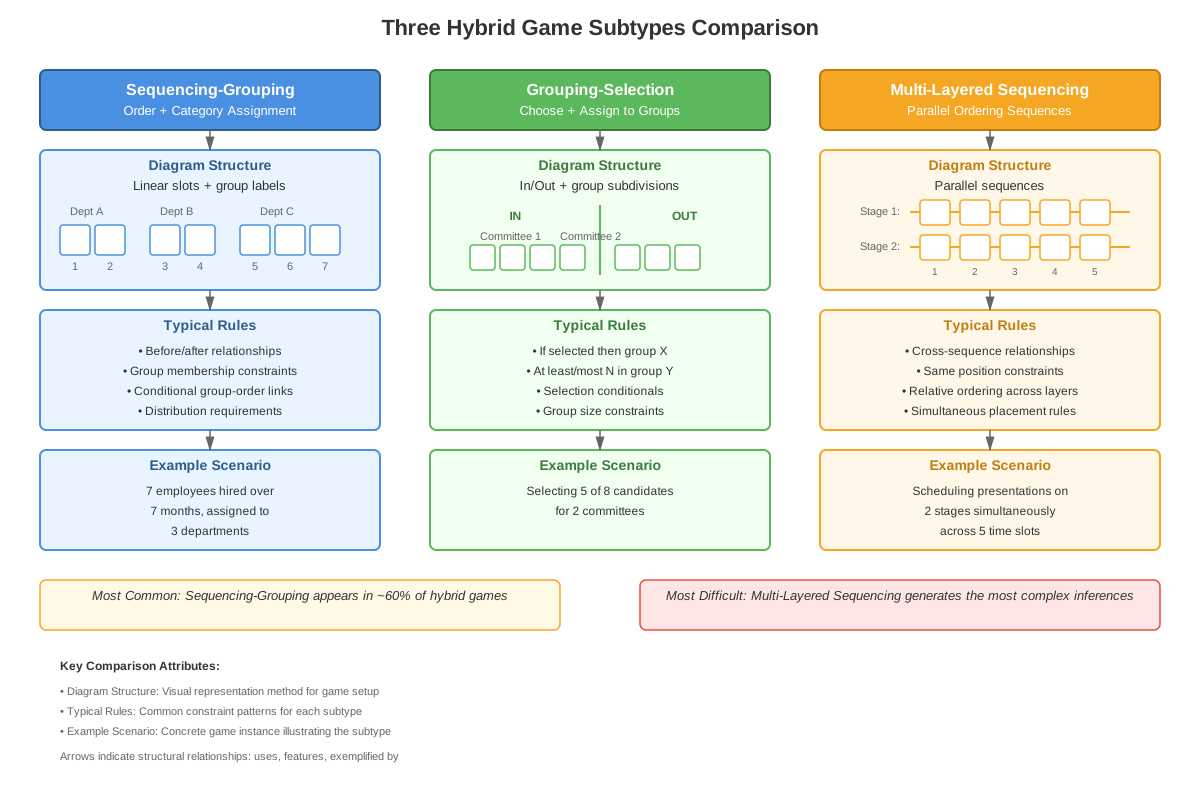
The Three Primary Hybrid Subtypes
| Hybrid Subtype | Primary Dimension | Secondary Dimension | Typical Setup |
|---|---|---|---|
| Sequencing-Grouping | Linear order | Category assignment | Timeline with multiple tracks or levels |
| Multi-Track Sequencing | Parallel orders | Cross-track relationships | Side-by-side sequences with correspondence rules |
| Grouping-Selection | Group formation | In/out determination | Teams with variable membership and internal structure |
Sequencing-grouping hybrids form the largest category. These games present a temporal or spatial sequence while simultaneously requiring categorical distinctions. The setup typically involves multiple "tracks" or "tiers" where elements must be ordered within their assigned category. For instance: "Seven presentations—F, G, H, J, K, L, M—will be scheduled across three days, with at least two presentations each day, and the presentations each day are ordered from first to last."
Multi-track sequencing games create parallel ordering systems with rules that connect across tracks. Example: "Six students are ranked for both academic achievement and athletic performance, with rankings from 1 to 6 in each category." The challenge lies in tracking two complete sequences while respecting rules like "Student X ranks higher in athletics than academics" or "The student ranked third academically is ranked first athletically."
Grouping-selection hybrids require first determining which elements are included (selection), then organizing those elements into groups with specific properties. These often appear as committee formation games where not all candidates are chosen, and those chosen must be assigned to subcommittees with internal structure.
Strategic Setup Methodology
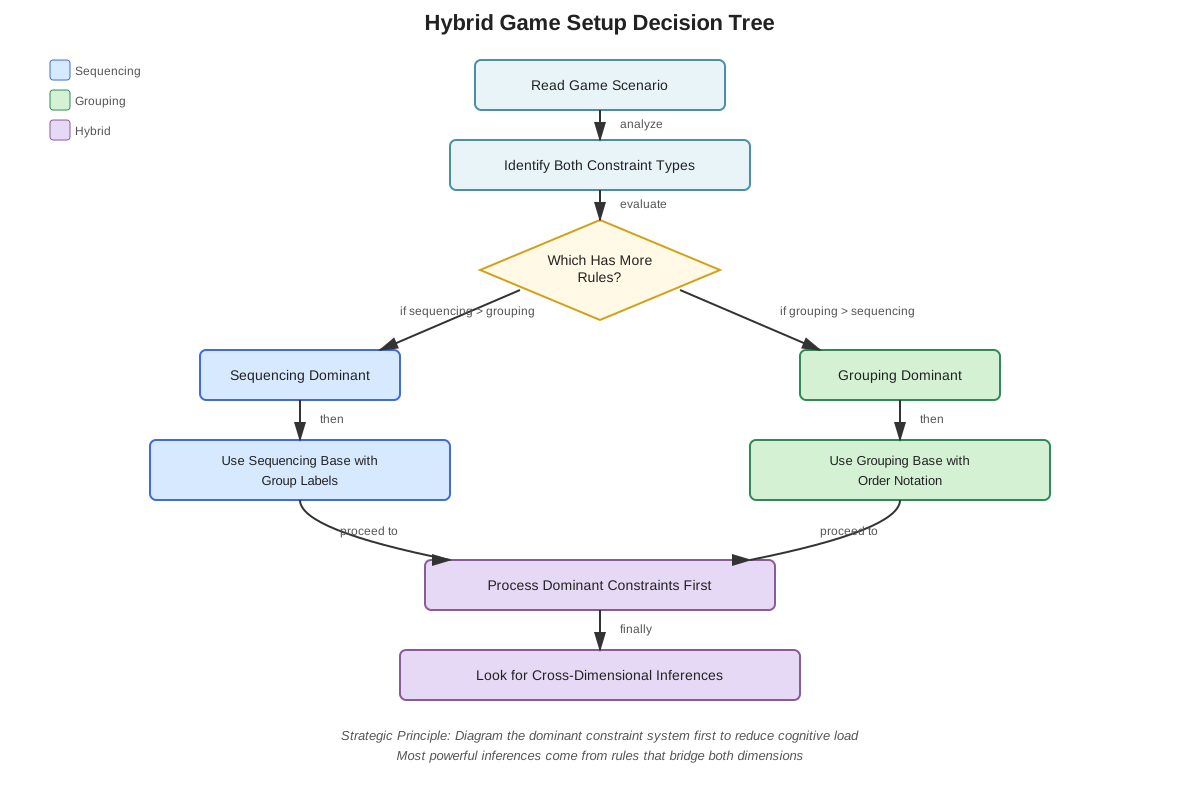
The initial setup phase determines success or failure in hybrid games. The optimal approach follows this sequence:
- Identify the primary constraint system: Determine which dimension has more rules or more restrictive constraints. This becomes the foundation of your diagram.
- Create a visual framework that accommodates both dimensions: For sequencing-grouping hybrids, this typically means a multi-tiered linear diagram. For multi-track sequencing, use parallel horizontal lines. For grouping-selection, create category boxes with internal position markers.
- Translate all rules into notation: Use standard symbols but ensure notation captures both dimensions. A rule like "F is presented on day 2" involves both sequencing (day 2) and implicit grouping (which presentation slot on day 2).
- Execute dimension-specific inferences first: Make all inferences possible within each constraint system independently before looking for cross-system inferences.
- Identify interaction points: Look for rules that explicitly connect the two dimensions—these generate the most powerful inferences and often provide the key to unlocking the game.
Rule Types and Their Hybrid Implications
Hybrid games feature standard rule types but with added complexity:
Conditional rules in hybrid games often span both dimensions: "If X is in group 1, then Y must come before Z in the sequence." These rules cannot trigger until both conditions are evaluated, making them particularly challenging to track.
Block rules may apply within a single dimension ("F and G are consecutive in the order") or across dimensions ("F and G must be in the same group"). Cross-dimensional blocks create especially powerful constraints.
Distribution rules in sequencing-grouping hybrids specify how elements spread across categories: "Exactly two presentations occur on day 1." These rules interact with sequencing constraints to limit possible arrangements dramatically.
Exclusion rules prevent certain combinations: "If X is selected, Y cannot be in the same group" or "X and Y cannot be consecutive." In hybrid games, exclusions may apply within one dimension, across dimensions, or both.
The Inference Chain Process
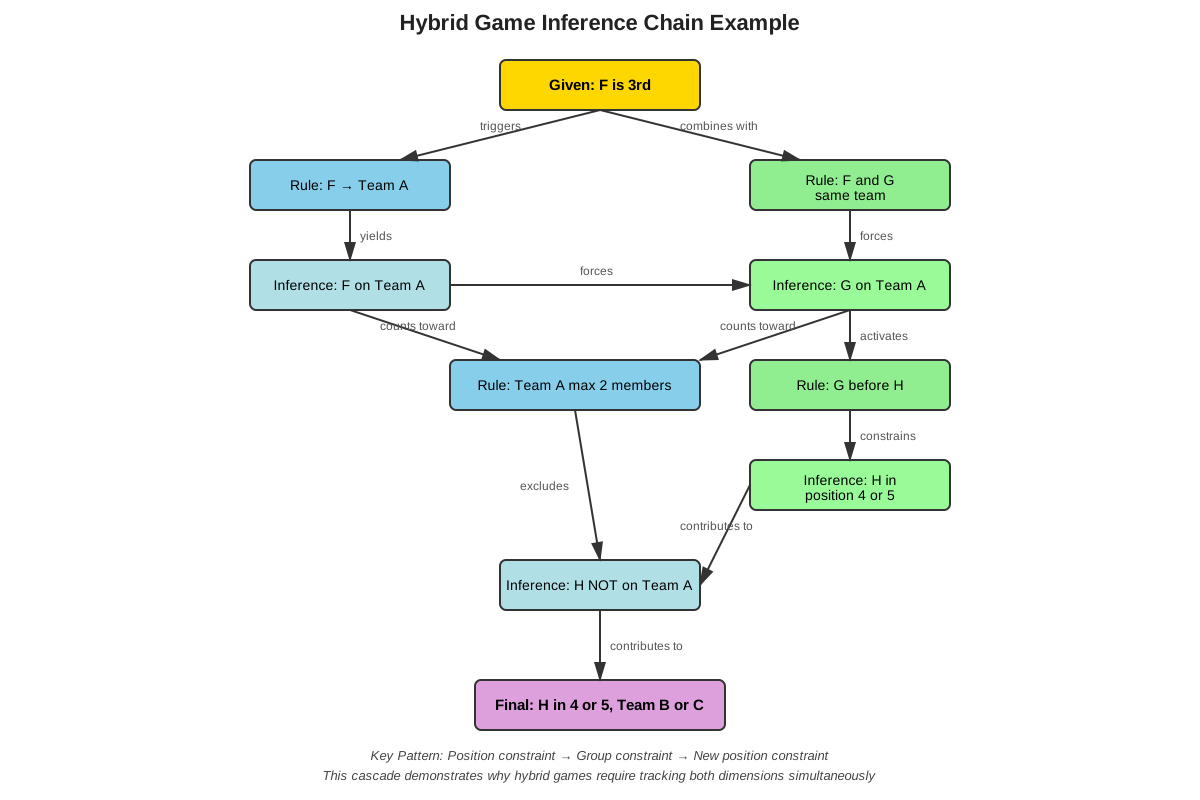
Hybrid games reward systematic inference-making more than any other game type. The process follows this pattern:
Step 1 - Fixed placements: Identify any elements with only one possible position across both dimensions. Example: "F must be in group 2 and must be third in sequence" creates a fixed placement.
Step 2 - Forced relationships: Determine what must be true given the fixed placements. If F is fixed and "G comes before F," then G's possibilities are constrained.
Step 3 - Impossibility elimination: Mark positions where elements cannot go. In a multi-tiered diagram, shade or mark impossible cells.
Step 4 - Distribution deductions: Calculate how elements must distribute given capacity constraints and existing placements.
Step 5 - Cross-dimensional implications: This is where hybrid games become powerful. A sequencing constraint might force a grouping outcome, or vice versa. Example: If only two slots remain in group 1, and three elements must come before element X, then X cannot be in group 1.
Diagram Design Principles
Effective hybrid game diagrams share these characteristics:
- Spatial separation of dimensions: The two constraint systems should occupy distinct visual spaces while remaining integrated. For sequencing-grouping, use horizontal rows for different groups with numbered positions across each row.
- Consistent notation: Use the same symbols throughout. Typical conventions include dashes for open positions, slashes for impossible placements, and letters for fixed elements.
- Inference tracking space: Reserve area for noting deductions, especially conditional chains and distribution calculations.
- Rule reference system: Number rules and reference them when making inferences to maintain logical rigor and enable error-checking.
Concept Relationships
The concepts within hybrid game setup form a hierarchical dependency structure. Hybrid game identification must occur first—recognizing that multiple constraint systems are present and interdependent. This recognition leads directly to subtype classification (sequencing-grouping, multi-track, or grouping-selection), which determines the appropriate diagram structure.
Once the diagram framework exists, rule translation converts the game's constraints into notation. This translation must capture both dimensions simultaneously, which requires understanding how rule types (conditional, block, distribution, exclusion) operate in hybrid contexts. The translated rules then enable inference generation, which proceeds through dimension-specific deductions before advancing to cross-dimensional implications—the most powerful and game-breaking inferences.
This entire process connects back to prerequisite knowledge: basic sequencing mechanics provide the foundation for the ordering dimension, grouping principles support the categorical dimension, and notation systems enable efficient representation. The synthesis of these prerequisites into hybrid game competency represents a qualitative leap in analytical reasoning ability.
The relationship to broader Analytical Reasoning Legacy concepts is integrative. Hybrid games don't introduce fundamentally new logical operations; rather, they test whether students can maintain multiple familiar operations simultaneously. This makes hybrid game mastery both a culmination of prior learning and a gateway to the most challenging LSAT material.
High-Yield Facts
⭐ Hybrid games appear in approximately 25-30% of all Analytical Reasoning sections and consistently generate the lowest accuracy rates among test-takers.
⭐ The most common hybrid structure combines linear sequencing with categorical grouping, typically represented as a multi-tiered timeline or multi-track diagram.
⭐ Cross-dimensional inferences—deductions that leverage interactions between the two constraint systems—provide the key to efficiently solving hybrid games.
⭐ Distribution rules in sequencing-grouping hybrids create powerful constraints by limiting how elements can spread across categories and positions simultaneously.
⭐ The primary strategic decision in hybrid game setup is determining which constraint dimension should form the foundation of your diagram—typically the dimension with more restrictive rules.
- Conditional rules in hybrid games often cannot trigger until both dimensions are evaluated, making them more complex than conditionals in pure game types.
- Multi-track sequencing games require tracking correspondence rules that connect elements across parallel sequences, creating unique inference patterns.
- Block rules that span dimensions (e.g., "F and G must be in the same group and consecutive") generate especially powerful constraints.
- Hybrid games typically appear as the third or fourth game in an Analytical Reasoning section, positioned where they can differentiate high-performing test-takers.
- Effective hybrid game diagrams integrate both constraint dimensions into a single visual framework rather than creating separate diagrams for each dimension.
- The inference chain in hybrid games must proceed systematically: fixed placements → forced relationships → impossibility elimination → distribution deductions → cross-dimensional implications.
- Grouping-selection hybrids add a third layer of complexity by requiring determination of which elements are included before organizing them into structured groups.
Quick check — test yourself on Hybrid game setup so far.
Try Flashcards →Common Misconceptions
Misconception: Hybrid games require creating separate diagrams for each constraint dimension.
Correction: Effective hybrid game setup integrates both dimensions into a single unified diagram. Separate diagrams force you to mentally track connections between representations, increasing cognitive load and error risk. A well-designed hybrid diagram spatially represents both dimensions simultaneously—for example, using rows for groups and columns for sequential positions.
Misconception: You should complete all inferences in one dimension before considering the other dimension.
Correction: While dimension-specific inferences should be made first, the most powerful deductions in hybrid games come from cross-dimensional interactions. After making initial inferences within each system, actively look for how constraints in one dimension limit possibilities in the other. A sequencing constraint might force a grouping outcome, or a grouping rule might determine sequential relationships.
Misconception: Hybrid games are just harder versions of basic games and require the same approach with more careful execution.
Correction: Hybrid games demand qualitatively different strategic thinking. The interdependence of constraint systems creates inference patterns that don't exist in pure game types. Success requires recognizing these unique patterns—particularly distribution-based deductions and cross-dimensional forcing chains—rather than simply applying basic techniques more carefully.
Misconception: The game scenario's narrative determines which dimension is primary (e.g., if it mentions "days" first, sequencing is primary).
Correction: The primary dimension should be determined by constraint density and restrictiveness, not narrative order. Analyze which dimension has more rules, more specific constraints, or more fixed elements. This dimension should form the foundation of your diagram because it provides more structure for organizing information.
Misconception: All rules in hybrid games affect both dimensions equally.
Correction: Most rules in hybrid games primarily constrain one dimension while secondarily affecting the other. Distinguishing primary from secondary effects helps prioritize inference-making. A rule like "F is in group 2" primarily constrains grouping but secondarily limits F's possible sequential positions to only those within group 2.
Misconception: Hybrid games always take longer to solve, so you should skip them and return if time permits.
Correction: While hybrid games are more complex, a strong setup with systematic inference-making often makes questions faster to answer than in games with weak initial deductions. The investment in thorough setup pays dividends across all questions. Skipping hybrid games guarantees lost points; engaging them strategically with proper technique often yields high accuracy.
Worked Examples
Example 1: Sequencing-Grouping Hybrid
Game Scenario: Seven employees—F, G, H, J, K, L, M—will give presentations over three days: Monday, Tuesday, and Wednesday. Each day has at least two presentations, and presentations each day are ordered from first to last. The following conditions apply:
- F presents on Monday
- G presents immediately before H
- K and L present on the same day
- M presents on Wednesday
- J presents before K (not necessarily immediately)
Setup Process:
Step 1 - Identify the hybrid structure: This is a sequencing-grouping hybrid. We must assign employees to days (grouping) and order presentations within each day (sequencing).
Step 2 - Determine the primary dimension: The grouping dimension has more specific constraints (F on Monday, M on Wednesday, K and L same day), so we'll use days as our primary organizational structure.
Step 3 - Create the diagram:
Monday:    ___  ___  (___)
Tuesday:   ___  ___  (___)
Wednesday: ___  ___  (___)
Step 4 - Place fixed elements:
Monday:    F    ___  (___)
Tuesday:   ___  ___  (___)
Wednesday: ___  M    (___) [M could be in any position on Wed]
Step 5 - Apply the block rule (G immediately before H):
The GH block must fit within a single day. This block could go on any day, but its placement is constrained by other rules.
Step 6 - Apply the same-day rule (K and L):
K and L must be on the same day. Combined with "J before K," we know J must present before K's day or on the same day as K in an earlier position.
Step 7 - Make cross-dimensional inferences:
- We have 7 employees and 3 days with at least 2 presentations each. Minimum distribution is 2-2-3 or 2-3-2.
- F is fixed on Monday. If Monday has only 2 presentations, the second must be from {G, H, J, K, L} (not M).
- The GH block takes 2 consecutive slots. If GH is on Monday with F, Monday has exactly 3 presentations (F, G, H in some order respecting the G-before-H constraint).
- If GH is on Monday, the order must be either F-G-H or G-H-F (since G must be immediately before H).
- K and L are on the same day. J must be before K. If K-L are on Monday, J must also be on Monday (but Monday already has F, and possibly GH). This creates capacity issues.
- Testing: If Monday = F, G, H (in order F-G-H or G-H-F), then K-L must be Tuesday or Wednesday. J must be before K, so J must be on the same day as K-L or earlier.
Step 8 - Identify the most constrained scenario:
The distribution and block constraints severely limit possibilities. The GH block and KL pairing, combined with J-before-K, create a forcing structure.
Key Inference: If we try to place K-L on Tuesday, J must be Monday or Tuesday. But Monday has F (and possibly GH). The interactions between grouping (which day) and sequencing (order within day) create a limited set of possible arrangements.
Example 2: Multi-Track Sequencing Hybrid
Game Scenario: Five students—R, S, T, V, W—are each ranked in both mathematics and science, with rankings from 1 (highest) to 5 (lowest). No two students receive the same ranking in the same subject. The following conditions apply:
- R ranks higher in mathematics than in science
- S ranks third in science
- T ranks immediately higher than V in mathematics (e.g., if T is 2nd, V is 3rd)
- W ranks first in exactly one subject
- The student ranked second in mathematics ranks fourth in science
Setup Process:
Step 1 - Create parallel sequences:
Math:    1___  2___  3___  4___  5___
Science: 1___  2___  3___  4___  5___
Step 2 - Place fixed elements:
Math:    1___  2___  3___  4___  5___
Science: 1___  2___  3_S_  4___  5___
Step 3 - Apply the correspondence rule:
"The student ranked second in mathematics ranks fourth in science." This creates a vertical connection:
Math:    1___  2_?_  3___  4___  5___
Science: 1___  2___  3_S_  4_?_  5___
The same student occupies Math-2 and Science-4.
Step 4 - Apply W's constraint:
W ranks first in exactly one subject. So W is either Math-1 or Science-1 (but not both).
Step 5 - Apply the T-V consecutive rule in mathematics:
T is immediately higher than V in math. Possible pairs: T1-V2, T2-V3, T3-V4, T4-V5.
Step 6 - Cross-dimensional inference:
If T is Math-2, then V is Math-3. But we know Math-2 = Science-4. So if T is Math-2, then T is also Science-4. And V would be Math-3.
Step 7 - Test scenarios with R's constraint:
R ranks higher in math than science. If R is Math-1, R could be Science-2, 3, 4, or 5. If R is Math-2, R could be Science-3, 4, or 5. But Math-2 = Science-4, so if R is Math-2, R is Science-4, which violates R's constraint (R would rank lower in math than science: 2 vs 4 means worse in math). Therefore, R cannot be Math-2.
Step 8 - Combine constraints:
- R ≠ Math-2 (from Step 7)
- Math-2 = Science-4 (given rule)
- S = Science-3 (given)
- T immediately before V in math
- W = first in exactly one subject
Since R ≠ Math-2, and we need someone at Math-2, it must be S, T, V, or W. If T is Math-2, then T is Science-4, and V is Math-3. If V is Math-2, then V is Science-4, but T must be Math-1 (immediately higher), which means T is Math-1. If W is Math-2, then W is Science-4, but W must be first in exactly one subject, so W cannot be Math-2 (not first) and Science-4 (not first). If S is Math-2, then S is Science-4, but S is Science-3 (contradiction).
Key Inference: The correspondence rule (Math-2 = Science-4) combined with individual constraints eliminates most possibilities for who occupies that position, creating a forcing chain that determines much of both sequences.
Exam Strategy
Recognition and Classification
When you encounter a game, invest 15-20 seconds in classification before beginning setup. Look for these trigger phrases that signal hybrid games:
- "...will be assigned to groups and ordered within each group"
- "...ranked in both [category A] and [category B]"
- "...scheduled across multiple days, with presentations ordered each day"
- "...selected for teams, with positions assigned within each team"
The presence of two distinct constraint vocabularies (ordering words + grouping words) confirms hybrid structure.
Setup Time Investment
Hybrid games reward thorough setup more than any other game type. Allocate 2.5-3.5 minutes for setup and initial inferences—longer than the 1.5-2 minutes typical for pure games. This investment pays off because:
- Questions become faster to answer with strong inferences in place
- Errors decrease dramatically when the constraint structure is fully understood
- Difficult "could be true" questions often become trivial with complete inference chains
Question Approach Sequence
For acceptability questions (which answer choice could be true): Test each choice against both dimensions systematically. Check grouping constraints first (faster to verify), then sequencing constraints within groups.
For must-be-true questions: Rely on your inference chain. If you've made thorough deductions, the answer should be among your established inferences. If no answer matches your inferences, you've likely missed a deduction—return to setup before testing choices.
For could-be-true questions: These are typically hardest in hybrid games. Use process of elimination aggressively. Test the most constrained elements first—if a choice places a highly constrained element in an impossible position, eliminate immediately.
For rule substitution questions: The replacement rule must have identical effects across both dimensions. Test edge cases where the original rule interacts with the other dimension.
Time Management Tactics
If you're running short on time:
- Prioritize acceptability and must-be-true questions—these rely most heavily on your setup work
- Skip complex could-be-true questions that would require extensive hypothetical testing
- Return to skipped questions only if you have 2+ minutes remaining
Never abandon a hybrid game after setup. The setup is the hard part; questions become tractable once the structure is clear.
Common Trap Patterns
LSAT writers exploit predictable errors in hybrid games:
- Dimension confusion: Answer choices that satisfy one dimension but violate the other. Always verify both dimensions.
- Incomplete inference testing: Choices that seem possible until you consider a subtle cross-dimensional constraint.
- Distribution miscounting: In sequencing-grouping hybrids, choices that violate capacity constraints (e.g., placing too many elements in one group).
Memory Techniques
The "GRID" Acronym for Setup
Grouping or Game type identification first
Rules translated into notation
Inferences made systematically
Dimensions integrated into unified diagram
Visualization Strategy: The Layer Cake
Think of sequencing-grouping hybrids as a layer cake: each group is a horizontal layer, and positions within each layer run left to right. Rules either constrain within a layer (sequencing) or between layers (grouping). This spatial metaphor helps maintain dimensional clarity.
The "BEFORE-BETWEEN-BOTH" Rule Priority
When making inferences, check constraints in this order:
- BEFORE: Rules that must be satisfied before others can apply (fixed placements, distribution minimums)
- BETWEEN: Rules that connect elements (blocks, conditionals)
- BOTH: Rules that span both dimensions (cross-dimensional constraints)
Mnemonic for Cross-Dimensional Inference Types
DICE captures the four main cross-dimensional inference patterns:
- Distribution forces placement (capacity constraints determine which elements can go where)
- Impossibility chains (if X can't be in group 1, and must be before Y, then Y can't be in group 1 either)
- Correspondence rules (explicit connections between dimensions)
- Elimination cascades (ruling out one possibility triggers multiple downstream eliminations)
Summary
Hybrid game setup represents the integration of multiple constraint systems—typically sequencing and grouping—into problems that require simultaneous satisfaction of interdependent rules. Success depends on recognizing the hybrid structure, determining which dimension should anchor your diagram, creating a visual framework that captures both dimensions, and systematically generating inferences within each dimension before identifying cross-dimensional implications. The most powerful deductions arise from interactions between constraint systems: distribution rules that force placements, correspondence rules that link dimensions, and elimination chains that cascade across both systems. Effective hybrid game setup transforms cognitively overwhelming problems into manageable, systematic analysis by externalizing complexity into well-designed diagrams and methodical inference chains. Students who master hybrid game setup gain access to the highest LSAT scores because these games differentiate top performers from average test-takers more reliably than any other Analytical Reasoning question type.
Key Takeaways
- Hybrid games combine two constraint systems (usually sequencing + grouping) that must be satisfied simultaneously and interdependently
- The most common hybrid structure pairs linear ordering with categorical assignment, represented as multi-tiered timelines or multi-track diagrams
- Setup strategy requires identifying the primary dimension (most constrained), creating an integrated visual framework, and systematically generating inferences
- Cross-dimensional inferences—deductions leveraging interactions between constraint systems—provide the key to efficient solving
- Distribution rules in sequencing-grouping hybrids create powerful constraints by limiting how elements spread across categories and positions
- Thorough setup (2.5-3.5 minutes) pays dividends across all questions by reducing cognitive load and enabling rapid answer verification
- Common errors include dimension confusion, incomplete inference chains, and distribution miscounting—all preventable through systematic approach
Related Topics
Advanced Inference Techniques in Complex Games: Building on hybrid game mastery, this topic explores sophisticated inference patterns including chain conditionals, distribution calculations, and numerical constraint optimization across multiple game types.
Game Timing and Section Management: Strategic approaches to allocating time across the four games in an Analytical Reasoning section, with emphasis on recognizing when to invest in thorough setup versus when to move quickly through simpler games.
Rule Substitution and Equivalence: Deep analysis of how to identify logically equivalent rules, particularly important in hybrid games where replacement rules must maintain effects across multiple dimensions.
Rare Game Types and Adaptive Strategies: Preparation for unusual game structures including mapping games, pattern games, and three-dimensional hybrids that occasionally appear on the LSAT.
Practice CTA
Now that you've mastered the conceptual framework for hybrid game setup, it's time to apply these strategies to actual LSAT problems. The practice questions and flashcards for this topic will challenge you to identify hybrid structures, construct effective diagrams, and generate the cross-dimensional inferences that unlock these complex games. Remember: hybrid games reward systematic thinking and thorough setup. Approach each practice problem methodically, and you'll develop the automaticity that transforms these challenging games into opportunities to demonstrate your analytical reasoning mastery. Your investment in practice now will pay significant dividends on test day—hybrid games separate good scores from great scores, and you're building the skills to excel.
Sign up free to keep reading
Create a free AnvayaPrep account to finish this LSAT guide on Hybrid game setup — plus flashcards and practice questions.