Overview
Hybrid rule diagramming is a critical skill within the Analytical Reasoning Legacy section of the LSAT, specifically within Hybrid Games Legacy. These games combine two or more game types—such as sequencing with grouping, or matching with distribution—requiring test-takers to manage multiple constraint systems simultaneously. The ability to diagram hybrid rules effectively determines whether a student can navigate these complex scenarios efficiently or becomes overwhelmed by competing organizational demands.
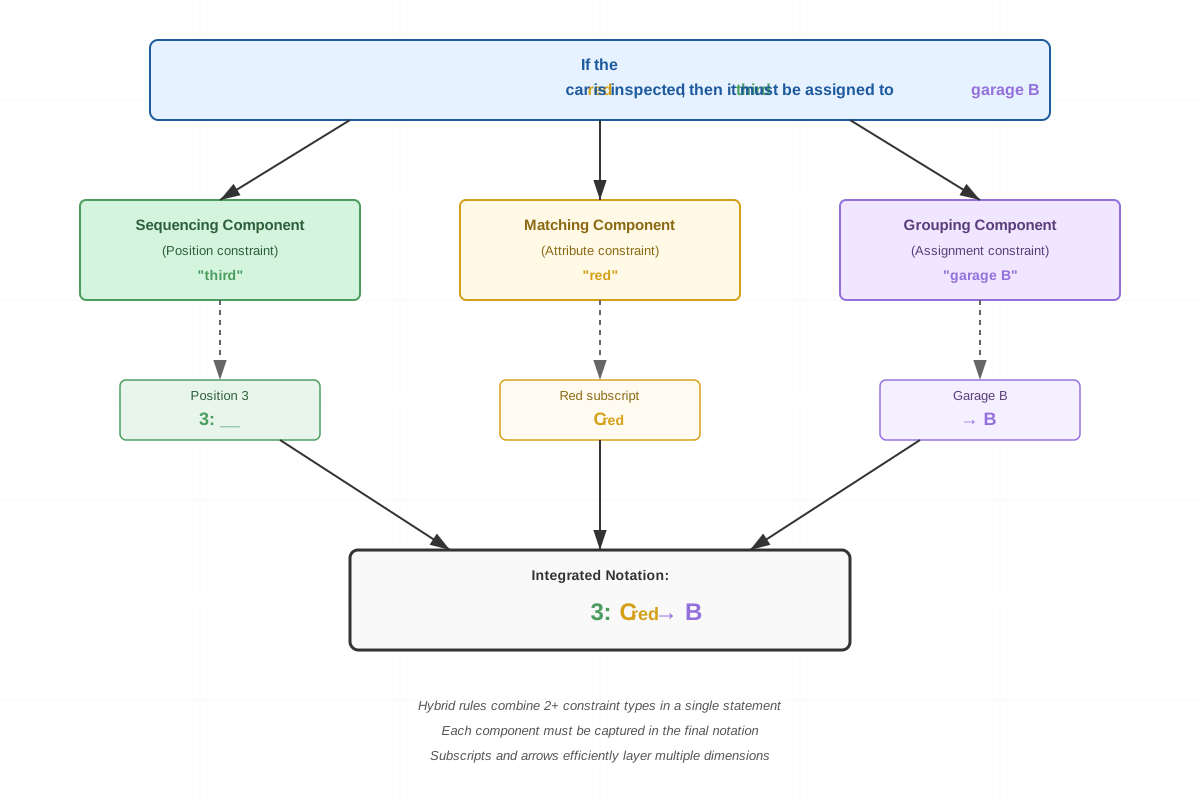
Unlike pure game types where a single diagramming framework suffices, hybrid games demand flexible notation systems that capture multiple dimensions of information without creating visual clutter. A hybrid rule might simultaneously constrain the order of elements, their group membership, and their attributes. For instance, a rule stating "If the red car is inspected third, then it must be assigned to garage B" combines sequencing (third position) with grouping (garage assignment) and matching (color attribute). Mastering LSAT hybrid rule diagramming means developing the ability to represent such multi-layered constraints in a unified, scannable format that facilitates rapid inference-making under time pressure.
This topic sits at the intersection of all basic game types within Analytical Reasoning Legacy. Students must synthesize their knowledge of linear sequencing notation, grouping frameworks, matching grids, and distribution principles. Hybrid rule diagramming represents the advanced application tier of logic games—where foundational skills converge to solve the most challenging scenarios that appear on modern LSAT administrations. Success here directly translates to higher scores, as hybrid games frequently appear as the most difficult game in a section and carry significant point value.
Learning Objectives
- [ ] Identify how Hybrid rule diagramming appears in LSAT questions
- [ ] Explain the reasoning pattern behind Hybrid rule diagramming
- [ ] Apply Hybrid rule diagramming to solve LSAT-style problems accurately
- [ ] Construct integrated diagrams that simultaneously represent multiple constraint types
- [ ] Recognize when to use layered notation versus separate frameworks for hybrid constraints
- [ ] Translate complex conditional hybrid rules into actionable diagram elements
- [ ] Evaluate the efficiency of different diagramming approaches for specific hybrid game structures
Prerequisites
- Basic sequencing notation: Understanding linear ordering symbols (dashes, slots, before/after relationships) is essential because hybrid games often include ordering components that must be integrated with other constraint types.
- Grouping fundamentals: Familiarity with in/out grouping and distribution principles provides the foundation for representing membership constraints that appear alongside other rule types in hybrid scenarios.
- Matching grid construction: Knowledge of how to create and use matching grids enables students to track attribute assignments when hybrid games involve pairing elements with characteristics.
- Conditional logic diagramming: Proficiency with if-then statements and contrapositive formation is critical because hybrid rules frequently express conditional relationships across multiple game dimensions.
- Rule notation conventions: Comfort with standard LSAT symbols (arrows, slashes, subscripts) ensures students can build upon established notation rather than inventing inconsistent systems under pressure.
Why This Topic Matters
Hybrid games represent the evolutionary direction of LSAT Analytical Reasoning. As test-makers have refined the exam over decades, they've increasingly combined game types to assess higher-order reasoning skills. Recent LSAT administrations feature hybrid games in approximately 40-50% of logic games sections, with these games typically positioned as the third or fourth game—the slots reserved for the most challenging scenarios. Understanding hybrid rule diagramming is not optional for competitive scores; it's the difference between attempting educated guesses and systematically working through complex deductions.
In practical terms, hybrid games test the cognitive flexibility that legal reasoning demands. Attorneys must simultaneously track procedural requirements, substantive rules, temporal constraints, and party relationships—precisely the multi-dimensional thinking that hybrid games simulate. A student who can diagram a rule like "The presentation scheduled for Tuesday must include either the marketing report or the financial analysis, but not both, and must be delivered by someone from the senior team" is demonstrating the ability to manage intersecting constraint systems that mirror real legal analysis.
On the exam, hybrid rules appear in several characteristic patterns: rules that combine temporal and categorical constraints, rules that link group membership to ordering positions, rules that make attribute assignments conditional on sequence, and rules that distribute elements across multiple dimensions simultaneously. Questions testing these rules typically ask about possible arrangements, must-be-true inferences, rule substitution, and local condition scenarios. The student who masters hybrid rule diagramming gains 3-5 additional correct answers per section on average—a difference that can elevate a score from the 160s to the 170s.
Core Concepts
Understanding Hybrid Game Structure
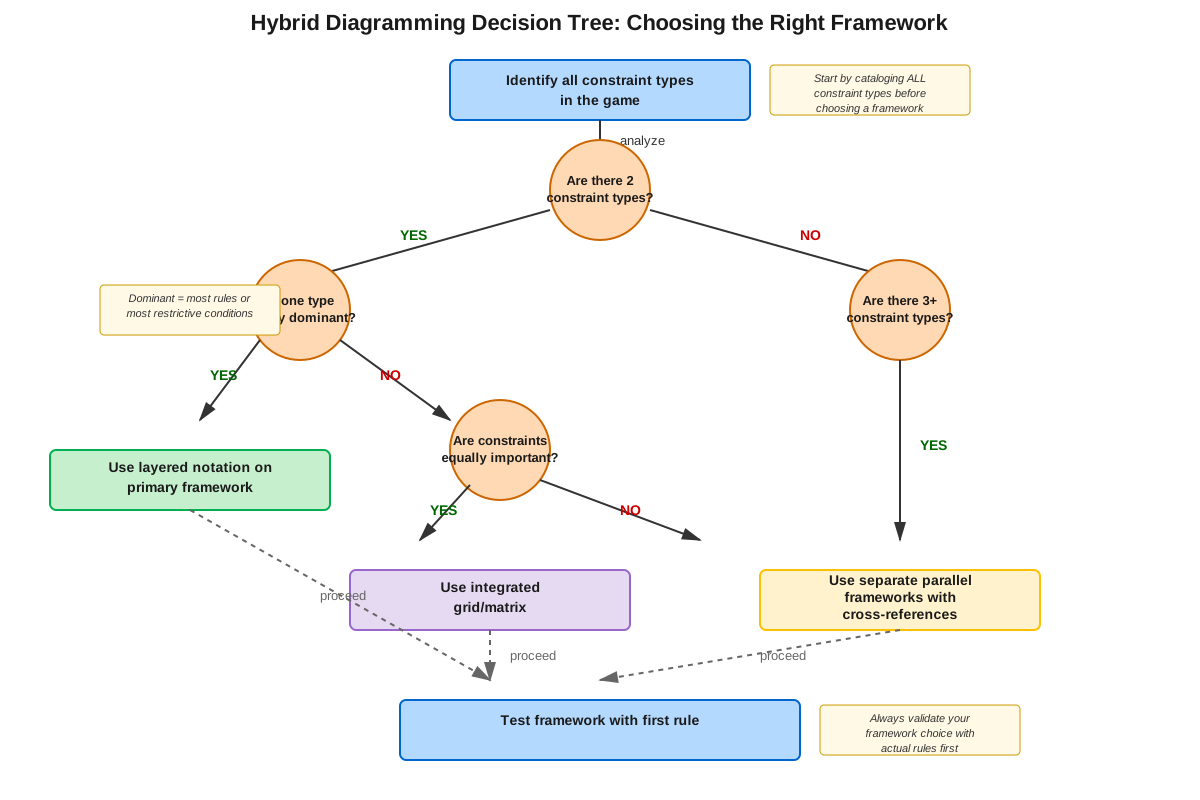
A hybrid game combines structural elements from two or more traditional game types. The most common combinations include sequencing-grouping hybrids (ordering elements while assigning them to categories), sequencing-matching hybrids (ordering elements while tracking their attributes), and grouping-matching hybrids (distributing elements across groups while maintaining attribute constraints). The fundamental challenge lies in creating a master diagram that accommodates all constraint types without sacrificing clarity or accessibility.
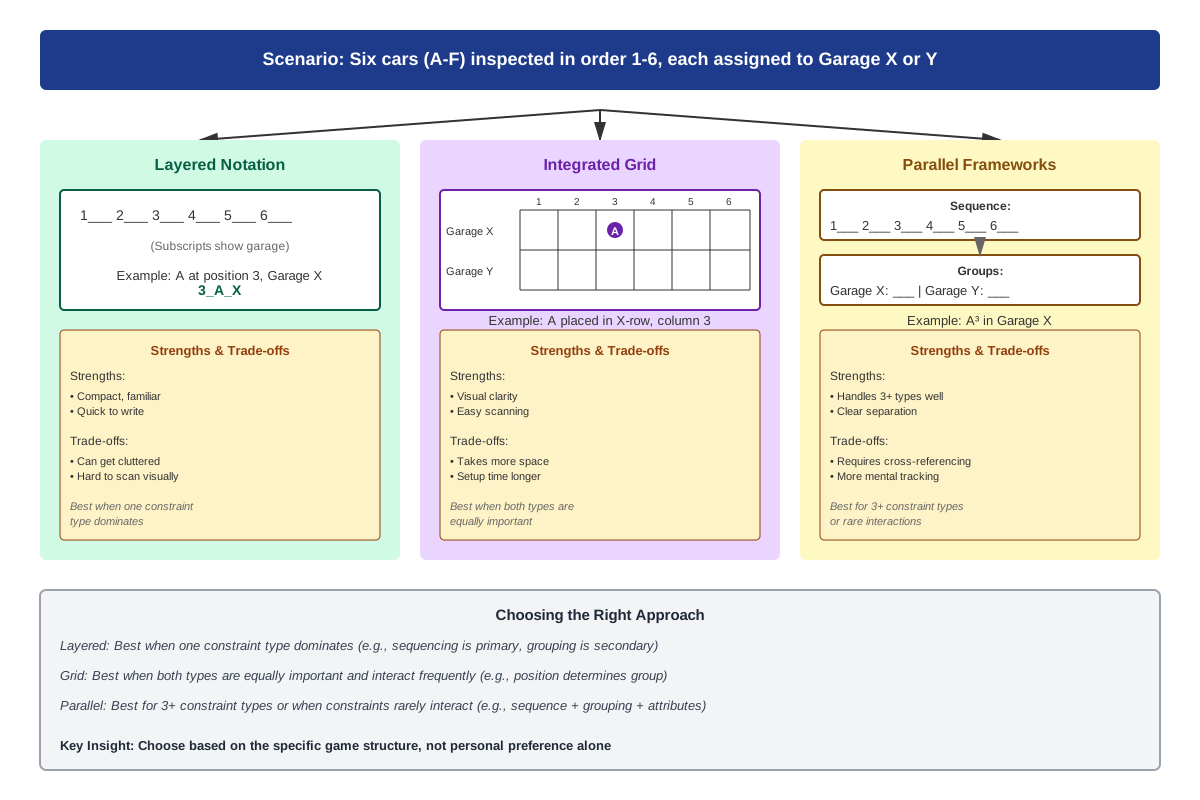
The key to effective hybrid rule diagramming is recognizing the primary framework versus secondary notation. The primary framework represents the dominant organizational structure—typically the aspect with the most slots or positions. Secondary notation layers additional information onto this framework using subscripts, superscripts, color coding (mentally, since the test is black-and-white), or adjacent tracking systems. For example, in a game about scheduling presentations (sequencing) by different departments (grouping), the primary framework would be a timeline with slots, while department membership might be tracked through letter subscripts beneath each slot.
Multi-Dimensional Rule Representation
Hybrid rules require notation that captures multiple constraint dimensions simultaneously. Consider the rule: "Any vehicle inspected before the motorcycle must be assigned to the north garage." This rule combines:
- Sequencing constraint: X comes before M (where M = motorcycle)
- Grouping constraint: X must be in north garage
- Conditional structure: The grouping constraint applies only when the sequencing relationship holds
The optimal diagram for this rule uses a conditional arrow with integrated notation:
X → M  →  X_N
(read as: "If X is before M, then X is in the North garage")
Alternatively, using a more explicit format:
X ... M → X ∈ NorthThe choice between notation styles depends on the game's overall framework and the student's working memory capacity. The critical principle is consistency—once a notation system is established for a game, maintain it throughout to avoid confusion.
Layered Constraint Integration
When multiple constraint types apply to the same elements, layered notation prevents diagram sprawl. Consider a hybrid game where six employees (A, B, C, D, E, F) are scheduled across three days (Monday, Tuesday, Wednesday) with two time slots per day (morning, afternoon), and each employee has a department affiliation (Sales, Marketing, Operations).
The master diagram might look like:
        Mon         Tue         Wed
AM:    ___         ___         ___
PM:    ___         ___         ___
A hybrid rule stating "B must be scheduled in the morning, must be from Sales, and must be scheduled before any Operations employee" requires three-dimensional notation:
B_S in AM position
B ... O (where O = any Operations employee)
This can be integrated into the master diagram by:
- Marking "B_S" as restricted to AM slots only
- Creating a separate sequencing chain showing B before all O-subscripted elements
- Noting the constraint in a rule list with clear reference notation
Conditional Hybrid Rules
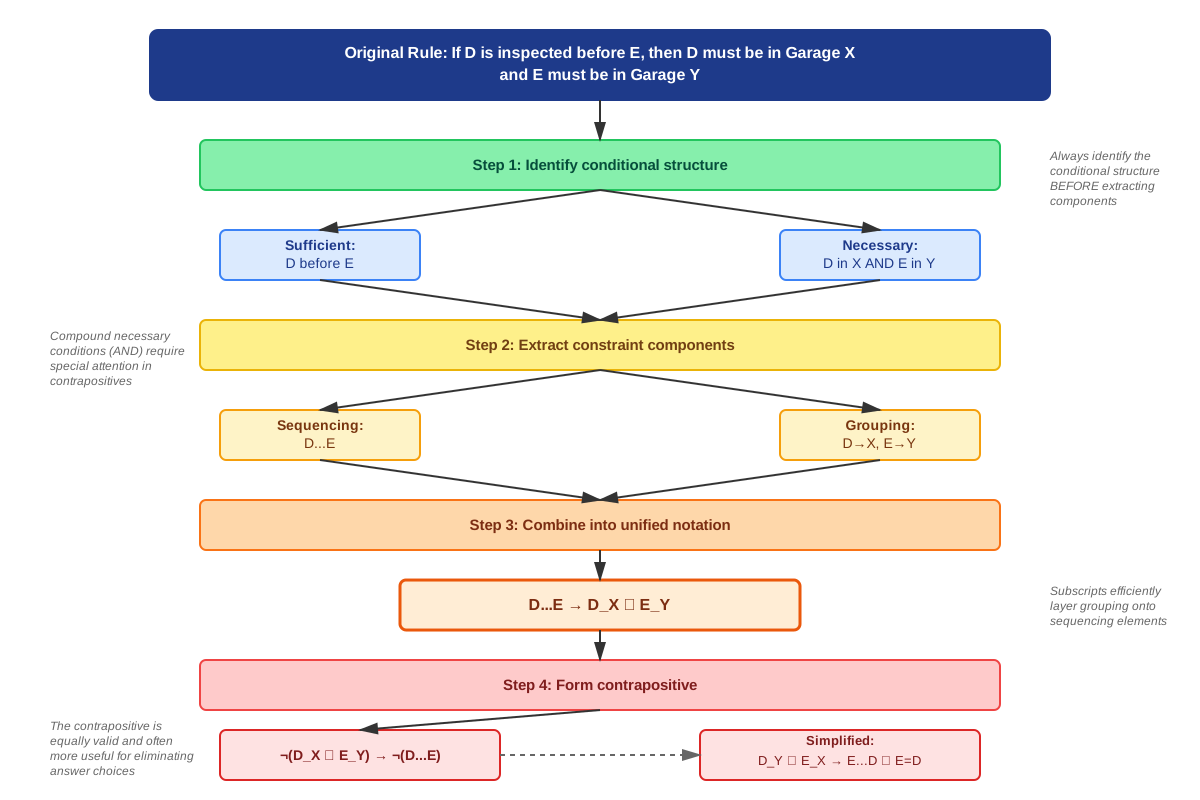
The most challenging hybrid rules involve conditional relationships that span multiple game dimensions. These rules follow the pattern: "If [condition in dimension A], then [consequence in dimension B]." For example: "If the red car is inspected third, then it must be assigned to garage B and cannot be a sedan."
The diagramming approach for such rules involves:
Step 1: Identify all dimensions involved
- Sequencing dimension (position 3)
- Attribute dimension (red color)
- Grouping dimension (garage B)
- Matching dimension (vehicle type: not sedan)
Step 2: Construct the conditional statement
Red car in position 3 → Red car in garage B AND Red car ≠ sedanStep 3: Diagram the contrapositive
Red car NOT in garage B OR Red car = sedan → Red car NOT in position 3Step 4: Integrate into master diagram
- Mark position 3 with notation: "If Red → B, ¬sedan"
- Mark garage B with notation: "If Red in 3 → must be here"
- Create a separate rule reference for quick consultation
Notation System Selection
Different hybrid combinations favor different notation approaches:
| Hybrid Type | Primary Framework | Secondary Notation | Example |
|---|---|---|---|
| Sequencing + Grouping | Linear slots | Subscripts for groups | Position 1: A_north |
| Sequencing + Matching | Linear slots | Superscripts for attributes | Position 2: B^red |
| Grouping + Matching | Group columns | Grid cells for attributes | North garage: [A-red, B-blue] |
| Triple hybrid | Dominant structure | Multiple notation layers | Position 1: A_north^red |
The selection principle: minimize cognitive load while maximizing information density. A notation system succeeds when it allows instant recognition of constraint violations and facilitates rapid inference-making.
Inference Chains in Hybrid Diagrams
Hybrid rule diagramming becomes powerful when it enables cross-dimensional inferences. When a rule in one dimension triggers a constraint in another dimension, the diagram should make this connection visually apparent. For example, if a sequencing rule places element A before element B, and a grouping rule states that anything before B must be in the east group, the diagram should show:
A → B  (sequencing rule)
___ → B  →  ___ ∈ East  (grouping rule)
Therefore: A ∈ East  (inference)
Effective hybrid diagrams include an inference tracking area where cross-dimensional deductions are recorded as they emerge. This prevents redundant reasoning and creates a reference for answering questions efficiently.
Spatial Organization Principles
The physical layout of a hybrid diagram follows these principles:
- Vertical separation: Different constraint types occupy different vertical zones (e.g., sequencing on top, grouping in middle, matching grid at bottom)
- Horizontal alignment: Elements that correspond across dimensions align vertically for easy cross-referencing
- White space management: Adequate spacing prevents visual crowding while maintaining compact overall structure
- Rule reference system: Numbered or lettered rules appear in a consistent location with clear notation in the main diagram
A well-organized hybrid diagram allows the test-taker to scan from question to diagram to answer in under 30 seconds per question—the pace required for section completion.
Concept Relationships
Hybrid rule diagramming synthesizes all foundational Analytical Reasoning Legacy skills into an integrated system. The relationship flow proceeds as follows:
Basic sequencing notation → provides the linear framework → Hybrid sequencing component
Grouping fundamentals → supplies categorical organization → Hybrid grouping component
Matching grids → enable attribute tracking → Hybrid matching component
Conditional logic → creates if-then relationships → Conditional hybrid rules
These components converge in Hybrid rule diagramming → which enables Complex inference generation → leading to Efficient question answering
Within hybrid rule diagramming itself, the concepts connect hierarchically:
- Game structure recognition (identifying which game types are combined) enables
- Framework selection (choosing primary and secondary notation systems) which facilitates
- Rule translation (converting verbal rules into diagram notation) that supports
- Inference generation (deriving must-be-true conclusions) culminating in
- Question application (using the diagram to answer specific questions)
The relationship to prerequisite topics is foundational—each basic game type contributes specific notation conventions and reasoning patterns that hybrid games combine. The relationship to subsequent topics involves applying hybrid rule diagramming to increasingly complex scenarios, including games with unusual twists, rule substitution questions, and time-pressured decision-making.
High-Yield Facts
⭐ Hybrid games appear in 40-50% of modern LSAT logic games sections, typically as the most difficult game.
⭐ The primary framework should represent the dimension with the most defined positions or slots, with other dimensions tracked through secondary notation.
⭐ Subscripts typically indicate group membership or categorical assignments, while superscripts often represent attributes or characteristics.
⭐ Conditional hybrid rules require both the standard conditional diagram AND integration into the master framework for maximum utility.
⭐ Cross-dimensional inferences—deductions that span multiple game types—are the highest-yield deductions in hybrid games and should be recorded immediately upon discovery.
- Hybrid rules that combine three or more dimensions are rare but appear in the most difficult games; these require hierarchical notation systems with clear visual separation.
- The contrapositive of a conditional hybrid rule must account for all dimensions mentioned in the consequent, using "OR" logic when multiple constraints appear.
- When a hybrid game includes both "at least/at most" numerical constraints AND categorical assignments, the numerical constraints typically govern the primary framework structure.
- Notation consistency within a single game is more important than following any universal standard—adapt symbols to the specific game's needs while maintaining internal logic.
- Time investment in creating a comprehensive hybrid diagram (2-3 minutes) typically saves 4-6 minutes across all questions for that game, yielding net time savings of 1-3 minutes.
- The most common hybrid rule error is failing to recognize that a single verbal rule contains multiple constraint types, leading to incomplete diagramming and missed inferences.
Quick check — test yourself on Hybrid rule diagramming so far.
Try Flashcards →Common Misconceptions
Misconception: Hybrid games require completely new diagramming techniques unrelated to basic game types.
Correction: Hybrid rule diagramming builds directly on foundational notation from pure game types. The skill involves combining familiar techniques, not learning entirely new systems. Students should leverage their existing knowledge of sequencing arrows, grouping columns, and matching grids, adapting them to work together in a unified framework.
Misconception: Every dimension of a hybrid game needs equal representation in the master diagram.
Correction: Effective hybrid diagrams prioritize the dominant structural dimension as the primary framework, with other dimensions tracked through secondary notation or auxiliary tracking systems. Attempting to give equal visual weight to all dimensions creates cluttered, unusable diagrams. Identify which dimension has the most defined structure (usually the one with specific numbered positions or slots) and build the primary framework around it.
Misconception: Conditional hybrid rules can be diagrammed the same way as simple conditional statements.
Correction: Conditional hybrid rules require expanded notation that captures all dimensions involved in both the sufficient and necessary conditions. A rule like "If A is third, then A is in the north group" cannot be adequately represented as simply "A3 → AN" without clarifying that the subscript N refers to group membership, not another element. The diagram must make the dimensional distinction explicit: "A in position 3 → A ∈ North group."
Misconception: Hybrid rule diagramming should be completed entirely before attempting any questions.
Correction: While the initial framework and explicit rules should be diagrammed before question-solving, many inferences emerge only when working through local condition questions. The diagram should be treated as a living document that evolves as new deductions arise. Attempting to derive every possible inference before starting questions wastes time and risks missing question-specific deductions.
Misconception: Complex hybrid rules should be broken into multiple separate diagrams for clarity.
Correction: While extremely complex rules may benefit from supplementary notation, fragmenting hybrid rules across multiple disconnected diagrams prevents the test-taker from seeing cross-dimensional relationships. The goal is integrated representation that shows how different constraint types interact. Use layered notation, clear subscript/superscript systems, and spatial organization to maintain unity while preserving clarity.
Misconception: Standardized notation systems from prep books must be followed exactly in hybrid games.
Correction: While learning standard notation provides a foundation, hybrid games often require adaptive notation tailored to the specific combination of game types and rules present. The test-taker should feel empowered to modify notation systems as needed, provided the modifications remain consistent within that game and clearly represent the intended constraints. Flexibility within a consistent personal system outperforms rigid adherence to external standards.
Worked Examples
Example 1: Sequencing-Grouping Hybrid
Game Setup: Six presentations—F, G, H, J, K, L—are scheduled across three time slots (1, 2, 3), with exactly two presentations per slot. Each presentation is delivered by either the Marketing team or the Sales team.
Hybrid Rules:
- F is scheduled before G
- H is scheduled in slot 2
- Any presentation in slot 1 must be from Marketing
- If K is from Sales, then K is scheduled before L
- G and J cannot both be from Marketing
Step 1: Establish Primary Framework
The sequencing dimension has defined positions (slots 1, 2, 3 with two presentations each), making it the primary framework:
Slot 1:  ___  ___
Slot 2:  ___  ___
Slot 3:  ___  ___
Step 2: Diagram Pure Sequencing Rules
Rule 1: F → G (F comes before G in the sequence)
Rule 2: H is in slot 2 (place directly in framework)
Slot 1:  ___  ___
Slot 2:  H    ___
Slot 3:  ___  ___

Sequencing: F → G
Step 3: Integrate Grouping Constraints
Rule 3: Slot 1 presentations must be Marketing (use subscript M)
Slot 1:  ___M  ___M
Slot 2:  H     ___
Slot 3:  ___   ___
Rule 5: G and J cannot both be Marketing
Diagram: ¬(GM and JM) or equivalently: If GM → JS; If JM → GS
Step 4: Diagram Conditional Hybrid Rule
Rule 4: If K is Sales, then K comes before L
KS → K ... L
Contrapositive: L ... K → KM
This rule combines grouping (K's team membership) with sequencing (K before L).
Step 5: Generate Cross-Dimensional Inferences
- Since slot 1 requires Marketing presentations, if F is in slot 1, then FM
- Since F → G, and slot 1 has two positions, possible arrangements include:
- F in slot 1, G in slot 2 or 3
- F in slot 2, G in slot 3
- F cannot be in slot 3 (no room for G after)
- If K is in slot 1, then KM (from slot 1 rule), which means the conditional "KS → K ... L" is inactive
Step 6: Complete Integrated Diagram
Slot 1:  ___M  ___M  (must be Marketing)
Slot 2:  H     ___
Slot 3:  ___   ___

Sequencing chains:
- F → G
- KS → K ... L (contrapositive: L ... K → KM)

Grouping constraints:
- ¬(GM and JM) equivalently: GM → JS and JM → GS

Key inferences:
- F cannot be in slot 3
- If K in slot 1 → KM → conditional rule inactive
- H is locked in slot 2
This integrated diagram allows rapid answering of questions by showing both the sequencing relationships and team assignments in a unified framework.
Example 2: Sequencing-Matching Hybrid with Conditional Rules
Game Setup: Five cars—R, S, T, V, W—are inspected in order from first to fifth. Each car is exactly one color: blue, green, or red. At least one car of each color must be inspected.
Hybrid Rules:
- R is inspected before S
- T is blue
- If V is green, then V is inspected fourth
- W is inspected immediately before or immediately after the red car
- S and T are not the same color
Step 1: Establish Primary Framework
Sequencing is the primary dimension with five defined positions:
Position:  1    2    3    4    5
Car:      ___  ___  ___  ___  ___
Color:    ___  ___  ___  ___  ___
Step 2: Diagram Pure Sequencing Rules
Rule 1: R → S (R before S, not necessarily adjacent)
Step 3: Integrate Matching Constraints
Rule 2: T is blue (place in framework when T's position is determined)
Notation: T^B (superscript indicates color attribute)
Rule 5: S and T have different colors
Since T is blue, S cannot be blue: S ≠ blue, so S is green or red
Step 4: Diagram Conditional Hybrid Rule
Rule 3: If V is green, then V is in position 4
V^G → V in position 4
Contrapositive: V not in position 4 → V^B or V^R
This combines matching (V's color) with sequencing (V's position).
Step 5: Diagram Adjacency-Matching Hybrid Rule
Rule 4: W is immediately adjacent to the red car
This means either:
- W is red and adjacent to another red car (impossible—only one car per color minimum, but multiple allowed)
- W is not red and is adjacent to the red car
Notation: W—Red or Red—W (where — indicates immediate adjacency)
Step 6: Apply Numerical Constraint
At least one car of each color (blue, green, red) must appear. With five cars and three colors, the distribution is either 3-1-1 or 2-2-1.
Step 7: Generate Cross-Dimensional Inferences
- T^B is one blue car (satisfies blue requirement)
- S must be green or red (cannot be blue)
- If V^G and V is in position 4, that satisfies the green requirement
- The red car must be adjacent to W
Step 8: Complete Integrated Diagram
Position:  1    2    3    4    5
Car:      ___  ___  ___  ___  ___
Color:    ___  ___  ___  ___  ___

Sequencing: R → S

Matching constraints:
- T^B (T is blue)
- S^G or S^R (S is green or red, not blue)
- At least one of each color (B, G, R)

Conditional hybrid:
- V^G → V in position 4
- Contrapositive: V not in 4 → V^B or V^R

Adjacency-matching:
- W—Red or Red—W (W adjacent to red car)

Key inferences:
- If V^G, then V is in position 4, satisfying green requirement
- If V not in position 4, then V is blue or red
- Red car's position is constrained by W adjacency
- Possible color distributions: 3-1-1 or 2-2-1
This diagram enables systematic evaluation of answer choices by tracking both the sequence of inspections and the color attributes simultaneously, with clear notation for the conditional relationship between V's color and position.
Exam Strategy
When approaching LSAT questions involving hybrid rule diagramming, follow this systematic process:
Initial Game Recognition (15-20 seconds): Read the setup paragraph and identify all game dimensions present. Look for trigger phrases like "in order" (sequencing), "assigned to groups" (grouping), "each has exactly one" (matching), or "distributed across" (distribution). Count the dimensions—two dimensions indicate a standard hybrid, three or more indicate a complex hybrid requiring especially careful notation planning.
Framework Construction (45-60 seconds): Determine which dimension has the most defined structure (usually the one with numbered positions or specific slots) and build your primary framework around it. Create clear visual space for secondary notation—subscripts below for group membership, superscripts above for attributes, or adjacent columns for matching grids. Resist the temptation to create multiple separate diagrams; integration is key.
Rule Translation (90-120 seconds): Work through each rule systematically, identifying which dimensions it affects. For hybrid rules affecting multiple dimensions, use layered notation that captures all constraints. Write out conditional hybrid rules in full conditional form with clear arrows, then integrate key information into the master framework. Mark rules that generate immediate inferences with a star or highlight.
Inference Generation (30-45 seconds): Look specifically for cross-dimensional inferences—these are the highest-yield deductions in hybrid games. Ask: "If I know something about dimension A, what does that tell me about dimension B?" Check whether any conditional hybrid rules are triggered by explicit constraints. Record all inferences in a designated area of your diagram.
Question Approach:
For "could be true" questions, scan answer choices against your diagram looking for violations of any dimension's constraints. Hybrid games make this efficient because violations are often visible across multiple dimensions simultaneously.
For "must be true" questions, focus on elements that are fully determined across all dimensions or that trigger conditional hybrid rules. These questions reward thorough inference generation during setup.
For local condition questions (those beginning with "If..."), add the new condition to your master diagram temporarily (use a different notation style, like circling, to indicate it's temporary). Generate any new inferences this condition triggers, especially cross-dimensional ones, before evaluating answer choices.
Trigger Words to Watch For:
- "If... then..." (conditional hybrid rule likely)
- "Immediately before/after" (adjacency constraint, often combined with other dimensions)
- "Must be" + dimension indicator (e.g., "must be in the north group"—links to other dimensions)
- "Cannot both" or "at least one" (numerical constraints that interact with categorical assignments)
- "Any" or "every" (universal quantifiers that create multiple constraint applications)
Time Allocation: Invest 2.5-3.5 minutes in setup and diagramming for hybrid games (compared to 1.5-2 minutes for pure game types). This additional upfront investment pays dividends through faster question answering. If you find yourself spending more than 45 seconds on a single question, you likely missed a key inference during setup—consider briefly returning to your diagram to look for overlooked deductions before continuing.
Process of Elimination: In hybrid games, wrong answers often violate constraints in one dimension while appearing to satisfy constraints in another. Systematically check each answer choice against each dimension's rules. Use your finger or pencil to track which dimension you're currently checking to avoid confusion. When an answer choice survives initial screening, verify it against conditional hybrid rules—these are frequently the source of subtle violations that eliminate otherwise plausible options.
Memory Techniques
The "SCAM" Framework for Hybrid Game Recognition:
- Sequencing: Are elements ordered?
- Categorization: Are elements assigned to groups?
- Attributes: Do elements have characteristics to match?
- Multiple: Are multiple dimensions present?
If you answer "yes" to M and at least two of S, C, or A, you're facing a hybrid game.
Notation Hierarchy Mnemonic: "Super Subs":
- Superscripts = attributes that are "above" or "on top of" the element (like a car's color)
- Subscripts = categories that "support" or "underlie" the element (like group membership)
This spatial metaphor helps maintain consistent notation under pressure.
The "DICE" Method for Conditional Hybrid Rules:
- Dimensions: Identify all dimensions involved
- If-then: Write the conditional structure
- Contrapositive: Diagram the logical opposite
- Embedding: Integrate into master framework
Work through DICE for every conditional hybrid rule to ensure complete representation.
Visualization Strategy: The "Layer Cake":
Imagine your hybrid diagram as a layer cake where each game dimension is a distinct layer. The primary framework is the bottom layer (foundation), with each additional dimension stacked on top. When reading a rule, visualize which layers it affects—this prevents missing multi-dimensional constraints.
Acronym for Inference Generation: "CROSS":
- Conditionals: Check if any conditional rules are triggered
- Restrictions: Identify elements with limited placement options
- Ordering: Look for forced sequence relationships
- Simultaneous: Find elements that must share positions/groups
- Separation: Identify elements that must be kept apart
Apply CROSS after diagramming all explicit rules to systematically generate inferences.
Summary
Hybrid rule diagramming represents the synthesis of all fundamental Analytical Reasoning Legacy skills, requiring test-takers to simultaneously manage multiple constraint systems within a unified framework. Success depends on recognizing which game dimensions are present, selecting an appropriate primary framework based on the most structured dimension, and using consistent secondary notation (subscripts for groups, superscripts for attributes) to layer additional information. Conditional hybrid rules—those that link constraints across dimensions—must be diagrammed both as standalone conditional statements and integrated into the master framework to facilitate rapid inference generation. The most valuable deductions in hybrid games are cross-dimensional inferences that reveal how constraints in one dimension force specific outcomes in another. Effective hybrid diagrams balance information density with visual clarity, using spatial organization and notation consistency to enable quick scanning during question-solving. Time invested in comprehensive setup (2.5-3.5 minutes) yields significant returns through accelerated question answering, as a well-constructed hybrid diagram makes constraint violations immediately visible across all dimensions simultaneously.
Key Takeaways
- Hybrid games combine two or more game types (sequencing, grouping, matching, distribution) and appear in 40-50% of modern LSAT logic games sections, typically as the most challenging game.
- The primary framework should represent the dimension with the most defined structure (numbered positions or specific slots), with other dimensions tracked through subscripts, superscripts, or adjacent notation systems.
- Conditional hybrid rules require dual representation: a standalone conditional diagram showing the if-then relationship and integration into the master framework for quick reference during question-solving.
- Cross-dimensional inferences—deductions that span multiple game types—are the highest-yield discoveries in hybrid games and should be recorded immediately in a designated inference area.
- Notation consistency within a game is more important than following universal standards; adapt symbols to the specific hybrid combination while maintaining internal logic throughout all questions.
- Time allocation should favor comprehensive setup (2.5-3.5 minutes) over rushed diagramming, as thorough hybrid diagrams enable 30-second question answering compared to 60+ seconds with incomplete frameworks.
- Systematic dimension checking during answer evaluation prevents the most common error in hybrid games: selecting answers that satisfy constraints in one dimension while violating constraints in another.
Related Topics
Advanced Inference Techniques in Hybrid Games: Building on hybrid rule diagramming, this topic explores sophisticated deduction strategies specific to multi-dimensional scenarios, including chain inference generation, numerical distribution analysis in hybrid contexts, and optimization techniques for identifying fully determined elements. Mastering hybrid rule diagramming provides the foundation for recognizing when advanced inference techniques will yield high-value deductions.
Rule Substitution in Hybrid Games: This advanced topic examines questions that ask which rule could replace an existing rule while maintaining the same solution set. In hybrid games, rule substitution requires understanding how constraints across multiple dimensions interact, making solid hybrid rule diagramming skills essential for evaluating whether proposed substitute rules preserve all cross-dimensional relationships.
Timing Optimization for Complex Games: This strategic topic addresses pacing decisions specific to hybrid and other challenging game types, including when to skip a difficult game temporarily, how to allocate time across questions of varying difficulty, and techniques for maintaining accuracy under time pressure. Proficiency in hybrid rule diagramming directly impacts these timing decisions by reducing per-question time investment.
Hybrid Games with Unusual Twists: Some hybrid games include non-standard elements like circular arrangements, flexible numerical distributions, or conditional frameworks. This advanced topic builds on standard hybrid rule diagramming by introducing adaptive techniques for handling unexpected game features while maintaining the core principles of integrated multi-dimensional representation.
Practice CTA
Now that you've mastered the principles of hybrid rule diagramming, it's time to put these skills into action. Access the practice questions and flashcards designed specifically for this topic to reinforce your understanding and build the speed necessary for test-day success. Remember: hybrid games separate good scores from great scores on the LSAT. Each practice problem you work through strengthens your ability to recognize patterns, construct efficient diagrams, and generate the cross-dimensional inferences that unlock these challenging scenarios. Your investment in mastering hybrid rule diagramming will pay dividends not only on test day but throughout your legal education, where multi-dimensional analytical thinking is the foundation of excellent legal reasoning. Start practicing now—your target score is within reach!
Sign up free to keep reading
Create a free AnvayaPrep account to finish this LSAT guide on Hybrid rule diagramming — plus flashcards and practice questions.