Overview
Hybrid templates represent one of the most sophisticated and challenging elements within Analytical Reasoning Legacy games on the LSAT. These templates emerge when a logic game combines multiple game types—such as sequencing and grouping, or matching and distribution—requiring test-takers to simultaneously track different organizational structures within a single setup. Unlike pure game types that follow a single organizational principle, LSAT hybrid templates demand that students maintain multiple frameworks concurrently, making them among the highest-yield topics for serious LSAT preparation.
The significance of hybrid templates extends beyond their frequency on the exam; they represent the LSAT's most direct assessment of a student's ability to manage complex logical relationships under time pressure. When the test writers create hybrid games legacy questions, they deliberately combine organizational principles to test whether students can maintain mental flexibility while applying multiple rule sets simultaneously. A typical hybrid game might require determining not only who sits in which position (sequencing) but also which attributes each person possesses (matching), all while respecting constraints that span both organizational dimensions.
Understanding hybrid templates is essential because they appear in approximately 20-30% of modern LSAT Analytical Reasoning sections, and they consistently generate the most difficult questions within those sections. Mastery of hybrid templates builds directly upon foundational skills in pure sequencing, grouping, and matching games, representing the synthesis of all basic game types. Students who can efficiently recognize, diagram, and solve hybrid games gain a significant competitive advantage, as these games often serve as the differentiating factor between good and exceptional LSAT scores.
Learning Objectives
- [ ] Identify how Hybrid templates appears in LSAT questions
- [ ] Explain the reasoning pattern behind Hybrid templates
- [ ] Apply Hybrid templates to solve LSAT-style problems accurately
- [ ] Distinguish between different hybrid game combinations and select appropriate diagramming strategies
- [ ] Construct integrated diagrams that efficiently represent multiple organizational dimensions
- [ ] Recognize when to split scenarios in hybrid games to maximize efficiency
- [ ] Evaluate which organizational dimension should serve as the primary framework in complex hybrid setups
Prerequisites
- Pure sequencing games: Understanding linear ordering is essential because sequencing forms one component of most hybrid games, providing the structural backbone for organizing information
- Basic grouping games: Familiarity with in/out grouping and distribution principles is necessary since grouping elements frequently combine with other game types in hybrid scenarios
- Matching games fundamentals: Knowledge of attribute assignment is required because matching often appears as a secondary layer in hybrid templates
- Rule representation techniques: Competence in symbolizing various constraint types enables efficient translation of hybrid game rules into workable diagrams
- Conditional logic: Proficiency with if-then statements and contrapositives is critical for managing the complex rule interactions that characterize hybrid games
Why This Topic Matters
Hybrid templates represent the pinnacle of analytical reasoning assessment on the LSAT, testing the cognitive flexibility and organizational skills that law schools value most highly. In legal practice, attorneys regularly encounter situations requiring simultaneous consideration of multiple frameworks—procedural rules, substantive law, factual chronologies, and strategic considerations—making hybrid reasoning skills directly transferable to legal work.
From an exam perspective, hybrid games appear in approximately 1-2 games per LSAT administration, accounting for roughly 5-7 questions per test. These questions consistently rank among the most difficult, with average accuracy rates 15-20% lower than pure game types. The LSAT test writers favor hybrid templates for the final game in a section, deliberately placing them where time pressure compounds their inherent complexity. Students who can efficiently handle hybrid games often complete them in 8-10 minutes, while unprepared test-takers may spend 12-15 minutes and still answer questions incorrectly.
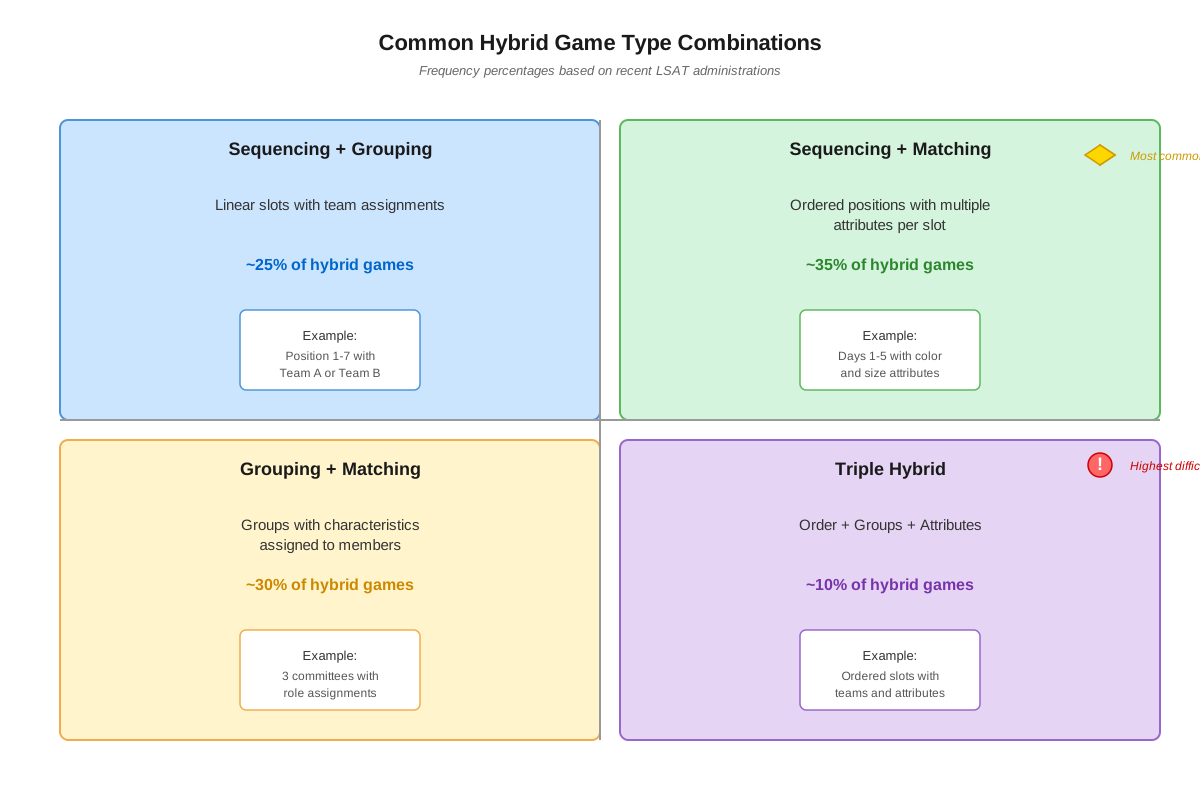
Hybrid templates commonly appear in several recognizable patterns: sequencing-grouping combinations (determining both the order of events and which category each belongs to), sequencing-matching hybrids (establishing both position and attributes), and three-dimensional games that add spatial or temporal layers to basic structures. Recent LSAT administrations have featured scenarios involving conference scheduling with speaker assignments, apartment building arrangements with tenant characteristics, and performance lineups with multiple attribute assignments. Recognition of these patterns enables rapid setup and efficient question-solving, directly translating to improved scores in the Analytical Reasoning section.
Core Concepts
Defining Hybrid Templates
Hybrid templates are logic game structures that combine two or more distinct organizational principles within a single scenario. Unlike pure games that require organizing elements according to one dimension (such as order, grouping, or attribute assignment), hybrid games demand simultaneous consideration of multiple organizational frameworks. The defining characteristic of a hybrid template is that neither organizational dimension can be ignored or solved independently—the game's rules and questions require integrated reasoning across both dimensions.
The most common hybrid combinations include:
| Primary Type | Secondary Type | Example Scenario |
|---|---|---|
| Sequencing | Grouping | Seven presentations occur Monday through Sunday, each classified as either technical or creative |
| Sequencing | Matching | Six students sit in positions 1-6, each studying exactly two of four subjects |
| Grouping | Matching | Eight employees are divided into two teams, each assigned specific roles and equipment |
| Sequencing | Spatial | Five items are arranged left to right on three shelves |
Recognition Patterns
Identifying hybrid templates quickly is crucial for efficient LSAT performance. Several textual indicators signal hybrid game structures:
Dual organizational language: The scenario explicitly mentions both ordering/positioning AND categorization/attribute assignment. Phrases like "in order from first to last" combined with "each assigned to exactly one of three departments" indicate a sequencing-grouping hybrid.
Multiple constraint types: When rules include both positional restrictions ("X is third") and categorical assignments ("Y is on the red team"), the game requires hybrid reasoning.
Question variety: If questions ask about both sequential relationships ("Which could be fourth?") and categorical memberships ("How many green items appear before any blue items?"), the game structure is hybrid.
Primary Framework Selection
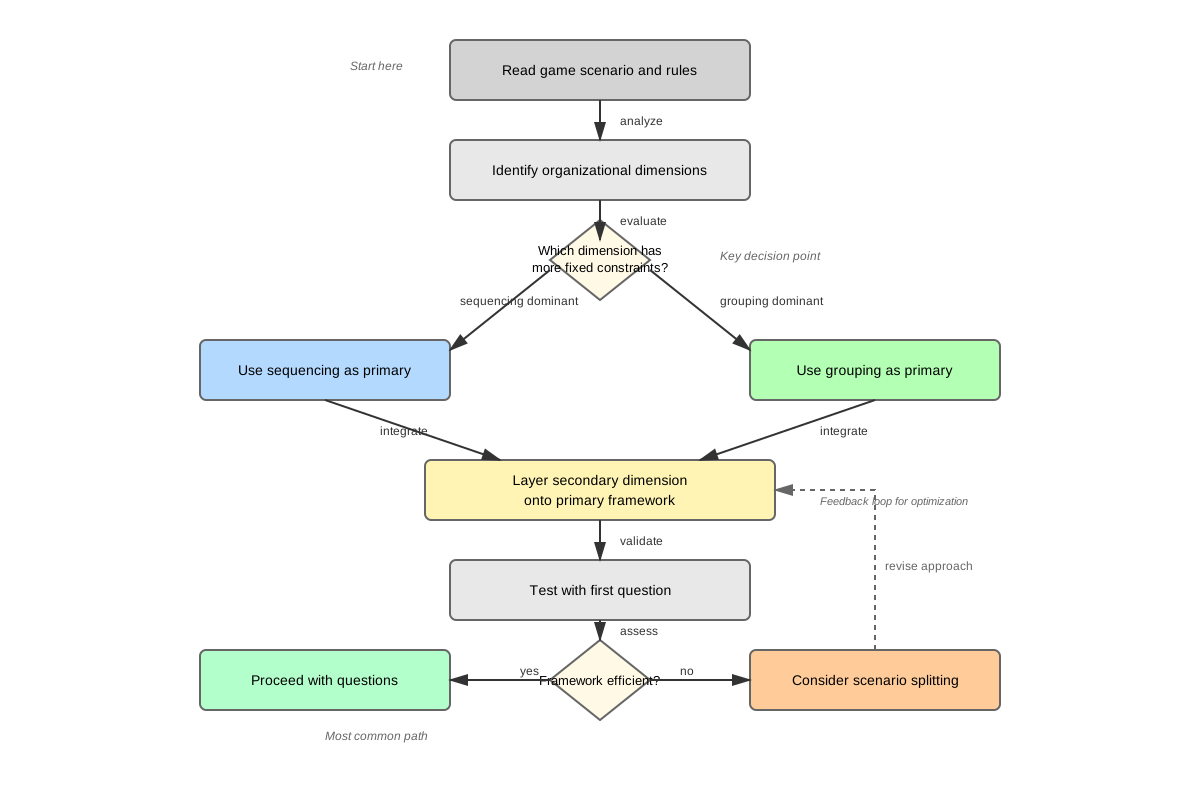
The most critical strategic decision in hybrid games involves determining which organizational dimension should serve as the primary framework—the main structure of the diagram. This choice dramatically affects efficiency and accuracy.
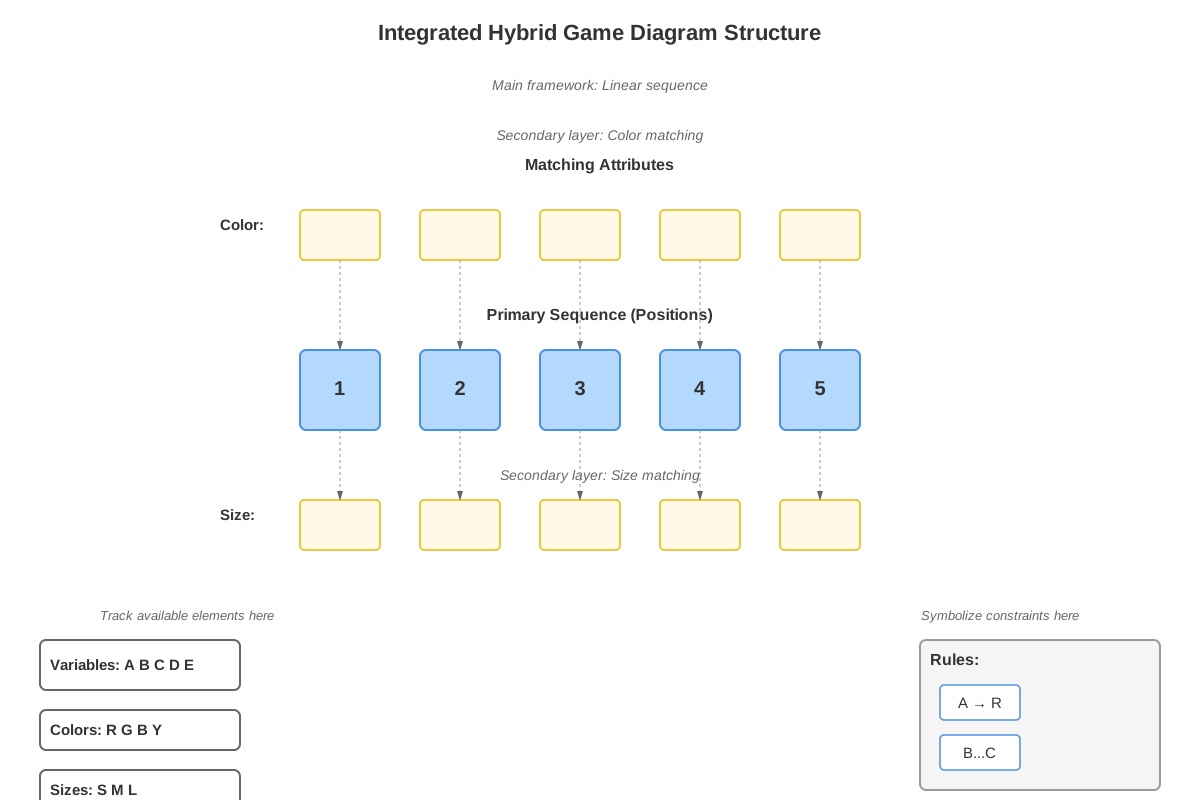
Sequencing-primary approach: When the game involves a fixed number of positions with clear sequential relationships, use a linear base as the primary framework and represent grouping/matching information above or below each position. This works best when:
- The number of positions is explicitly stated and limited
- Most rules reference specific positions or relative order
- Questions frequently ask about what could occupy specific positions
Grouping-primary approach: When the game emphasizes categorical divisions with less rigid sequential constraints, organize the diagram around groups and track order within each group. This approach excels when:
- Group membership is heavily constrained by rules
- The number of elements per group varies or is questioned
- Sequential order within groups matters more than absolute position
Integrated approach: Some hybrid games require truly integrated diagrams where neither dimension dominates. These typically involve spatial arrangements or three-dimensional structures where position and attributes are equally constrained.
Rule Integration Strategies
Hybrid games present rules that span multiple organizational dimensions, requiring sophisticated representation techniques:
Cross-dimensional rules link different organizational aspects. For example: "Any presentation on Monday or Tuesday must be technical" connects position (Monday/Tuesday) with category (technical). These rules should be represented both in the main diagram and as separate notations to ensure visibility during question-solving.
Cascading constraints occur when a rule about one dimension triggers implications for another. If "X must be in position 3" and another rule states "position 3 must contain a red item," then X must be red. Recognizing these cascades prevents errors and enables efficient deduction-making.
Conditional hybrids combine if-then logic with hybrid structures: "If X is in the first group, then Y must be assigned attribute A." These require careful tracking of both the triggering condition and the consequent across different organizational dimensions.
Scenario Splitting in Hybrid Games
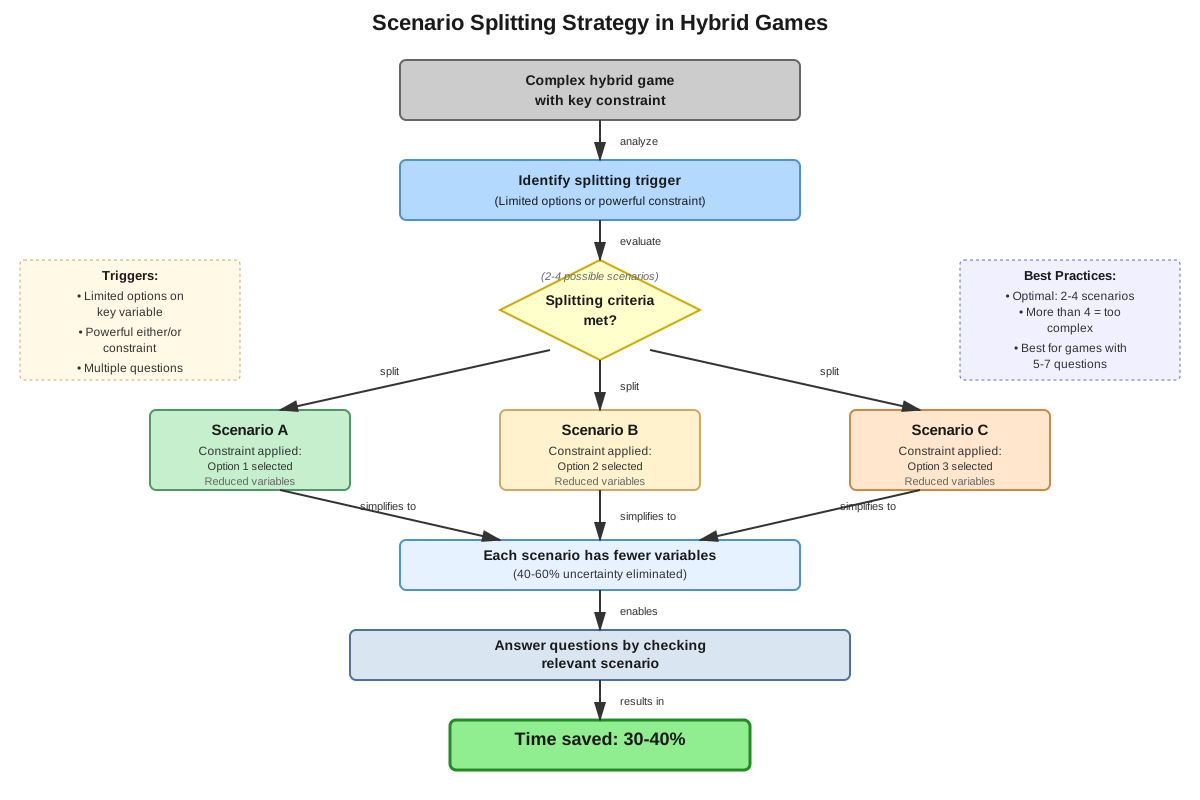
Scenario splitting—creating multiple diagram versions representing different possible configurations—becomes particularly powerful in hybrid games because constraints often interact across dimensions to create limited possibilities. When a rule or question creates a fork in possibilities, splitting scenarios can clarify the logical landscape.
Effective splitting in hybrid games occurs when:
- A key element can occupy only 2-3 positions, and its placement determines group membership or attributes
- A categorical assignment (grouping or matching) severely restricts sequential possibilities
- A question's condition creates distinct cases that are easier to analyze separately
However, avoid over-splitting. Create new scenarios only when the split generates significant deductions across both organizational dimensions. If a split clarifies only one dimension while leaving the other equally uncertain, the cognitive overhead may exceed the benefit.
Deduction Chains Across Dimensions
The most powerful deductions in hybrid games flow across organizational dimensions. A constraint in one dimension (e.g., sequencing) often combines with rules about another dimension (e.g., grouping) to generate conclusions impossible to reach by considering either dimension alone.
Example deduction chain:
- Rule: "X is in position 2 or 3" (sequencing constraint)
- Rule: "All red items must appear in positions 4-7" (hybrid constraint)
- Deduction: X cannot be red (because X's possible positions don't overlap with red item positions)
- Rule: "Each item is either red or blue" (matching constraint)
- Deduction: X must be blue (elimination across dimensions)
Developing facility with these cross-dimensional deduction chains separates strong hybrid game solvers from those who struggle. Practice identifying rules that reference both dimensions and actively seek combinations that yield new information.
Concept Relationships
The concepts within hybrid templates form an interconnected system where each element supports and depends upon others. Recognition patterns serve as the entry point, enabling students to identify hybrid structures quickly. Once recognized, primary framework selection determines the diagrammatic approach, which in turn affects how effectively rule integration strategies can be applied. The chosen framework influences when and how scenario splitting becomes useful, as different primary frameworks create different natural splitting points.
Deduction chains across dimensions represent the synthesis of all other concepts—they emerge from well-integrated rules within an appropriately chosen framework, and they often reveal when scenario splitting would be productive. These chains also feed back into framework selection: if the initial framework choice makes cross-dimensional deductions difficult to spot, reconsidering the primary framework may improve efficiency.
The relationship to prerequisite topics is hierarchical and integrative. Pure sequencing games provide the linear framework that often serves as the backbone of hybrid templates. Basic grouping principles supply the categorical organization that layers onto or integrates with sequential structures. Matching game fundamentals contribute the attribute-assignment dimension that adds complexity to both sequencing and grouping. Conditional logic, rather than being a separate game type, permeates hybrid games as the mechanism connecting different organizational dimensions.
Textual relationship map:
Recognition Patterns → identifies → Hybrid Game Type → determines → Primary Framework Selection → enables → Rule Integration → generates → Cross-Dimensional Deductions → reveals opportunities for → Scenario Splitting → produces → Complete Solution
High-Yield Facts
⭐ Hybrid templates combine two or more organizational principles (sequencing, grouping, matching) within a single logic game, requiring simultaneous tracking of multiple frameworks.
⭐ The primary framework decision—choosing which organizational dimension structures the main diagram—is the most important strategic choice in hybrid games and should be based on which dimension has the most fixed constraints.
⭐ Cross-dimensional rules that link different organizational aspects (e.g., "all items in positions 1-3 must be red") generate the most powerful deductions in hybrid games.
⭐ Scenario splitting in hybrid games is most effective when a constraint in one dimension severely limits possibilities in another dimension, creating 2-3 distinct cases worth analyzing separately.
⭐ Approximately 20-30% of LSAT Analytical Reasoning sections include at least one hybrid game, and these games consistently generate questions with below-average accuracy rates.
- Sequencing-grouping hybrids are the most common hybrid type, appearing more frequently than sequencing-matching or grouping-matching combinations.
- Questions in hybrid games often test cross-dimensional implications, asking what must be true about one dimension given constraints on another.
- The most time-consuming errors in hybrid games occur when students fail to recognize that a rule applies to both organizational dimensions simultaneously.
- Hybrid games typically appear as the third or fourth game in an Analytical Reasoning section, where time pressure compounds their inherent difficulty.
- Effective hybrid game diagrams integrate both dimensions visibly, avoiding the need to reference separate notations or mental tracking during question-solving.
- Rules that appear simple in hybrid games often have complex implications across dimensions that only emerge through systematic deduction-making.
- Local questions (those adding temporary conditions) in hybrid games frequently force scenario splits that wouldn't be necessary for the global setup.
- The most efficient hybrid game solvers spend 3-4 minutes on setup and deductions, recognizing that upfront investment pays dividends across all questions.
Quick check — test yourself on Hybrid templates so far.
Try Flashcards →Common Misconceptions
Misconception: Hybrid games are just two separate games combined, so they can be solved by handling each organizational dimension independently. → Correction: Hybrid games are fundamentally integrated structures where rules and deductions span both dimensions. Attempting to solve each dimension separately misses the cross-dimensional implications that are essential for efficient and accurate question-solving. The power of hybrid games lies precisely in how constraints interact across dimensions.
Misconception: The primary framework should always be sequencing when a game involves any ordering component. → Correction: Primary framework selection depends on which dimension has the most rigid constraints and generates the most deductions, not on which appears first in the scenario description. Some sequencing-grouping hybrids are better diagrammed with groups as the primary structure if group membership is heavily constrained while sequential order is flexible.
Misconception: Scenario splitting should be avoided in hybrid games because they're already complex enough. → Correction: Strategic scenario splitting often simplifies hybrid games by clarifying how constraints in different dimensions interact. When a key element's placement or categorization creates distinct cases with different implications across both dimensions, splitting scenarios reduces cognitive load and prevents errors.
Misconception: All rules in hybrid games affect both organizational dimensions equally. → Correction: Hybrid games include both single-dimension rules (affecting only sequencing, only grouping, or only matching) and cross-dimensional rules (linking different organizational aspects). Distinguishing between these rule types is essential for efficient diagram construction and deduction-making.
Misconception: Hybrid games always take longer to solve than pure game types, so time should be allocated accordingly. → Correction: While hybrid games have higher inherent complexity, well-prepared students with strong hybrid template recognition and diagramming skills often solve them as quickly as pure games. The key is investing adequate time in setup and initial deductions, which streamlines question-solving. Poor performance on hybrid games typically reflects inadequate preparation rather than inherent time requirements.
Misconception: The best approach to hybrid games is to diagram one dimension completely before adding the second dimension. → Correction: Effective hybrid game setup integrates both dimensions from the beginning, as early deductions often depend on seeing how constraints interact across dimensions. Sequential layering of dimensions can obscure these interactions and lead to missed deductions that would have simplified the entire game.
Worked Examples
Example 1: Sequencing-Grouping Hybrid
Scenario: Seven presentations—F, G, H, J, K, L, and M—are scheduled for seven consecutive days, Monday through Sunday. Each presentation is classified as either technical or creative. The following conditions apply:
- F is scheduled for Wednesday
- All technical presentations occur before all creative presentations
- G and H are both technical
- K is creative
- L is scheduled exactly two days after J
- M is scheduled for a day immediately before or immediately after a creative presentation
Solution Process:
Step 1: Recognize the hybrid structure. This game combines sequencing (days Monday-Sunday) with grouping (technical vs. creative classification). The phrase "scheduled for seven consecutive days" signals sequencing, while "classified as either technical or creative" indicates grouping.
Step 2: Select primary framework. The fixed seven-day sequence with specific position constraints (F on Wednesday, L two days after J) suggests sequencing should be the primary framework. Create a linear base:
Mon  Tue  Wed  Thu  Fri  Sat  Sun
 1    2    3    4    5    6    7
           F
Step 3: Integrate the grouping dimension. The critical rule "all technical presentations occur before all creative presentations" creates a clear division point. Since we have technical (G, H, at least) and creative (K, at least), there must be a boundary where technical ends and creative begins.
Step 4: Make initial deductions. F is in position 3. If F were creative, all technical presentations would need to occur in positions 1-2, but we have at least two technical presentations (G and H), which would fill positions 1-2 completely. However, we need to check if this works with other constraints. If F were technical, creative presentations would start at position 4 or later. Given that K is creative and must appear after all technical presentations, and M must be adjacent to a creative presentation, F is more likely technical.
Step 5: Apply the L-J constraint. L is exactly two days after J, creating pairs: J-Mon/L-Wed (impossible, F is Wed), J-Tue/L-Thu, J-Wed/L-Fri (impossible, F is Wed), J-Thu/L-Sat, J-Fri/L-Sun.
Step 6: Combine constraints. Since F is Wednesday and either technical or creative, and all technical precede all creative, if F is the last technical, then Thu-Sun are all creative (4 presentations). If F is creative, then Mon-Tue are technical (only 2 slots for G, H, and potentially others). Testing: if F is creative, G and H fill Mon-Tue, but then J-L pairs must fit in Thu-Sun (creative zone), which works. If F is technical, G, H, and F are technical (positions 1-3), and creative presentations (including K) fill 4-7.
Step 7: Test M's constraint. M must be adjacent to a creative presentation. If F is technical (positions 1-3 technical, 4-7 creative), M could be position 3 (F, adjacent to position 4 creative) or any position 4-7. If F is creative (positions 1-2 technical, 3-7 creative), M must be position 2 (adjacent to position 3, F creative) or positions 3-7.
Final deduction: The most constrained scenario has F as technical, making positions 1-3 technical (F, G, H in some order with F fixed at 3) and positions 4-7 creative (J, K, L, M with J-L pairing and M adjacent to creative).
Example 2: Sequencing-Matching Hybrid
Scenario: Six students—P, Q, R, S, T, and U—sit in six chairs numbered 1 through 6 from left to right. Each student studies exactly two of four subjects: biology, chemistry, physics, and mathematics. The following conditions apply:
- P sits in chair 3
- Q studies biology and chemistry
- The student in chair 1 studies physics
- R sits immediately to the left of S
- Any student who studies mathematics also studies physics
- T studies biology
- No two adjacent students study the same combination of subjects
Solution Process:
Step 1: Recognize hybrid structure. This combines sequencing (chairs 1-6) with matching (subject assignments). The fixed seating positions and "immediately to the left" language signal sequencing, while "studies exactly two of four subjects" indicates matching.
Step 2: Choose primary framework. Use the linear seating arrangement as the primary framework:
Chair:    1    2    3    4    5    6
Student:  _    _    P    _    _    _
Subjects:
Step 3: Record matching information. Create a subject tracking system:
- Q: biology, chemistry
- T: biology, (one more)
- Chair 1 student: physics, (one more)
- Rule: mathematics → physics (if math, then physics)
Step 4: Apply R-S adjacency. R is immediately left of S, creating pairs: R-1/S-2, R-2/S-3 (impossible, P is 3), R-3/S-4 (impossible, P is 3), R-4/S-5, R-5/S-6. Possible: R-1/S-2, R-4/S-5, R-5/S-6.
Step 5: Integrate cross-dimensional deductions. If R is in chair 1, R studies physics (from the chair 1 rule). The mathematics→physics rule means anyone studying mathematics must also study physics. Since each student studies exactly two subjects, a student studying mathematics and physics studies only those two.
Step 6: Apply the adjacency-matching rule. No two adjacent students study the same combination. Q studies biology-chemistry. If Q is in chair 2, chair 1 and chair 3 cannot have biology-chemistry. Chair 1 has physics (so not biology-chemistry). Chair 3 is P; P cannot study biology-chemistry.
Step 7: Synthesize constraints. Testing R-1/S-2: R would study physics + one other (not mathematics, or R would study physics-mathematics). S is in chair 2. Q must fit somewhere; if Q is chair 4, then chairs 3 and 5 cannot be biology-chemistry. P (chair 3) cannot be biology-chemistry (already established). This scenario is workable.
Final framework: The game requires tracking both seating positions and subject combinations simultaneously, with the critical recognition that the adjacency rule creates matching constraints based on sequential positions—a perfect example of cross-dimensional rule interaction in hybrid templates.
Exam Strategy
Initial Recognition Phase (30 seconds): Scan the scenario for dual organizational language. Look for explicit mentions of both order/position AND categories/attributes. Common triggers include "in order" + "each classified as," "positions 1-6" + "assigned to," or "scheduled for" + "each type." Immediately classify the hybrid type (sequencing-grouping, sequencing-matching, etc.) to activate the appropriate mental framework.
Framework Selection (30 seconds): Before drawing anything, identify which dimension has more rigid constraints. Count fixed positions, definite group memberships, or certain attribute assignments. The dimension with more certainty should typically serve as your primary framework. If both dimensions seem equally constrained, default to sequencing as primary for sequencing hybrids, as linear structures are generally easier to visualize and manipulate.
Setup and Rule Integration (2-3 minutes): Invest substantial time creating an integrated diagram that makes both dimensions visible simultaneously. Avoid the temptation to rush into questions. For each rule, explicitly note whether it affects one dimension or spans both. Mark cross-dimensional rules prominently—these generate the most valuable deductions. Create a separate notation area for complex conditional rules, but ensure these connect visibly to your main diagram.
Deduction Phase (1-2 minutes): Systematically seek cross-dimensional implications. Ask: "If element X is in position/group A, what does that mean for its attributes/category?" and vice versa. Look for rules that create limited possibilities when combined (e.g., "X is in position 1, 2, or 3" + "all items in positions 1-3 are red" → "X is red"). These deductions often unlock entire games.
Question Approach:
For global questions (those without additional conditions), rely heavily on your upfront deductions. Hybrid games reward thorough setup more than any other game type.
For local questions (those adding temporary conditions), immediately assess whether the new condition affects one or both dimensions. If it constrains one dimension, trace implications to the other dimension before evaluating answer choices. Consider scenario splitting if the local condition creates 2-3 distinct cases with different cross-dimensional implications.
For rule substitution questions (asking which rule could replace an original rule), focus on cross-dimensional rules, as these are most commonly tested in hybrid games.
Time Management: Allocate 8-10 minutes for hybrid games, with 3-4 minutes for setup and 5-6 minutes for questions. If you reach the 10-minute mark with questions remaining, switch to aggressive elimination strategies rather than attempting complete solutions. Hybrid games can consume excessive time if you allow perfectionism to dominate.
Elimination Strategies: In hybrid games, wrong answers often violate cross-dimensional implications. When eliminating, check each answer choice against both organizational dimensions. An answer might satisfy sequential constraints while violating categorical requirements, or vice versa. This two-dimensional checking makes elimination particularly effective in hybrid games.
Memory Techniques
H-Y-B-R-I-D Acronym for Setup:
- Hunt for dual organizational language in the scenario
- Yield to the dimension with more rigid constraints (make it primary)
- Build an integrated diagram showing both dimensions
- Record cross-dimensional rules prominently
- Infer deductions across dimensions systematically
- Divide into scenarios only when splits clarify both dimensions
"Two Worlds, One Map" Visualization: Picture hybrid games as requiring a single map that shows two different types of information simultaneously—like a road map that also shows elevation. Just as you wouldn't use separate maps for roads and elevation (you'd miss how steep roads are), don't separate the organizational dimensions in hybrid games. Keep them integrated in one visual framework.
The "Bridge Rule" Mnemonic: Remember that the most powerful rules in hybrid games are "bridge rules" that connect the two organizational dimensions. Visualize these rules as bridges between two islands (the two dimensions). When you spot a bridge rule, mark it with a special symbol (like a bridge icon) to remind yourself it's high-yield for deductions.
S-G-M Triangle: The three most common hybrid combinations form a triangle: Sequencing-Grouping, Sequencing-Matching, and Grouping-Matching. Visualize this triangle, with Sequencing at the top (most common in hybrids), and remember that any two can combine.
"Primary Framework = Most Fixed" Rule: When choosing your primary framework, remember the simple rule: "Most fixed wins." Count the number of definite, unchangeable constraints in each dimension. The dimension with more fixed elements becomes your primary framework. This prevents analysis paralysis during setup.
Summary
Hybrid templates represent the most sophisticated logic game structures on the LSAT, combining multiple organizational principles—typically sequencing with grouping or matching—within a single integrated scenario. Success with hybrid games depends on rapid recognition of the dual organizational structure, strategic selection of a primary framework based on which dimension has the most rigid constraints, and systematic integration of rules that span both dimensions. The most powerful deductions in hybrid games emerge from cross-dimensional implications, where constraints in one organizational aspect combine with rules about another aspect to generate conclusions impossible to reach by considering either dimension alone. Effective hybrid game solving requires investing 3-4 minutes in setup and initial deductions, creating integrated diagrams that make both dimensions simultaneously visible, and recognizing when scenario splitting clarifies the interaction between organizational principles. Students who master hybrid templates gain significant competitive advantage on the LSAT, as these games consistently generate the most difficult questions and serve as key differentiators between good and exceptional Analytical Reasoning scores.
Key Takeaways
- Hybrid templates combine two or more organizational principles (sequencing, grouping, matching) in a single game, requiring simultaneous tracking of multiple frameworks rather than sequential analysis of separate dimensions
- The primary framework decision—choosing which organizational dimension structures the main diagram—should be based on which dimension has the most fixed, definite constraints, as this creates the most stable foundation for integrating the secondary dimension
- Cross-dimensional rules that link different organizational aspects generate the most valuable deductions in hybrid games and should be marked prominently in your setup for easy reference during question-solving
- Effective hybrid game diagrams integrate both dimensions visibly in a single framework, avoiding the cognitive overhead of maintaining separate notations or relying on mental tracking across dimensions
- Strategic scenario splitting in hybrid games occurs when a constraint in one dimension severely limits possibilities in another dimension, creating 2-3 distinct cases that are easier to analyze separately than together
- Investing 3-4 minutes in thorough setup and systematic deduction-making pays substantial dividends in hybrid games, as upfront work streamlines all subsequent questions and prevents time-consuming errors
- Hybrid games appear in approximately 20-30% of LSAT Analytical Reasoning sections and consistently generate below-average accuracy rates, making them high-yield topics for focused preparation and practice
Related Topics
Advanced Scenario Splitting Techniques: Building on hybrid template foundations, this topic explores sophisticated splitting strategies for games with multiple decision points, teaching when to create parallel scenarios versus nested sub-scenarios and how to track deductions across multiple splits efficiently.
Three-Dimensional Logic Games: These rare but challenging games add a third organizational dimension to hybrid structures, such as sequencing-grouping-matching combinations or spatial arrangements with temporal and categorical constraints, representing the ultimate test of analytical reasoning flexibility.
Conditional Chain Mapping in Complex Games: This topic focuses on managing extensive conditional rule networks in hybrid games, teaching visualization techniques for tracking multiple if-then relationships that span different organizational dimensions and recognizing when conditional chains create forced outcomes.
Time-Optimized Game Selection: Strategic decision-making about game order and time allocation becomes crucial when hybrid games appear, as their complexity may warrant solving them last or first depending on individual strengths and the specific hybrid type encountered.
Practice CTA
Now that you've mastered the conceptual foundations of hybrid templates, it's time to cement your understanding through active practice. Attempt the practice questions designed specifically for this topic, focusing on applying the recognition patterns, framework selection strategies, and cross-dimensional deduction techniques you've learned. Use the flashcards to reinforce high-yield facts and test your ability to recall key concepts under time pressure. Remember: hybrid games separate good LSAT scores from great ones, and deliberate practice with these challenging structures will give you the confidence and skill to tackle them efficiently on test day. Your investment in mastering hybrid templates will pay dividends not only on the LSAT but in developing the flexible, multi-dimensional reasoning skills essential for success in law school and legal practice.
Sign up free to keep reading
Create a free AnvayaPrep account to finish this LSAT guide on Hybrid templates — plus flashcards and practice questions.