Overview
Limited options in hybrid games represents one of the most powerful strategic approaches in Analytical Reasoning Legacy sections of the LSAT. This technique involves recognizing when a game's constraints force the arrangement into only a few possible configurations, then systematically mapping out each scenario. Hybrid games—which combine elements from multiple game types such as ordering, grouping, and matching—present unique challenges because they require test-takers to track multiple variables simultaneously across different organizational structures. When these complex games also exhibit limited branching points, the limited options approach transforms seemingly overwhelming puzzles into manageable, concrete scenarios.
The power of this technique lies in its ability to convert abstract rule-following into visual, concrete representations. Rather than attempting to hold multiple conditional rules in working memory while answering questions, test-takers who identify limited options can create complete scenario diagrams upfront. This front-loaded investment of time typically pays dividends across all questions in the game, as each question becomes a simple matter of checking pre-drawn scenarios rather than re-deriving possibilities under time pressure.
Within the broader landscape of Analytical Reasoning Legacy, limited options in hybrid games sits at the intersection of strategic game-board setup and efficient question-answering. It builds upon foundational skills in rule representation and constraint analysis while preparing students for advanced techniques in scenario-based reasoning. Mastering this approach is particularly crucial because hybrid games frequently appear on modern LSAT administrations, and the ability to recognize when limited options exist can mean the difference between struggling through a game in 12+ minutes versus completing it confidently in 7-8 minutes.
Learning Objectives
- [ ] Identify how Limited options in hybrid games appears in LSAT questions
- [ ] Explain the reasoning pattern behind Limited options in hybrid games
- [ ] Apply Limited options in hybrid games to solve LSAT-style problems accurately
- [ ] Recognize the specific constraint patterns that signal limited options opportunities in hybrid game setups
- [ ] Construct complete scenario diagrams efficiently when limited options are present
- [ ] Evaluate whether investing time in scenario creation will yield net time savings across all questions
- [ ] Distinguish between true limited options scenarios and situations where branching remains too complex
Prerequisites
- Basic game type identification: Understanding the fundamental categories (sequencing, grouping, matching, distribution) is essential because hybrid games combine these elements, and recognizing each component helps identify constraint interactions.
- Rule representation techniques: The ability to translate written rules into symbolic notation and visual diagrams provides the foundation for tracking how constraints limit possibilities.
- Constraint-based deduction skills: Making inferences from rule combinations is necessary because limited options scenarios emerge from the interaction of multiple constraints, not single rules in isolation.
- Standard game board setup: Familiarity with creating organizational frameworks for different game types enables efficient construction of multiple scenario diagrams when limited options are identified.
Why This Topic Matters
In real-world contexts, the reasoning pattern underlying limited options mirrors decision-making in constrained environments—from project management where resource limitations force specific workflow sequences, to legal case analysis where procedural rules narrow possible outcomes. Legal professionals regularly encounter situations where multiple constraints interact to produce a limited set of viable options, making this analytical skill directly transferable to law practice.
On the LSAT, lsat limited options in hybrid games appears with significant frequency and impact. Approximately 15-20% of Analytical Reasoning games in recent administrations have been hybrid games, and roughly 40-50% of these hybrid games contain limited options opportunities. Questions from games with identifiable limited options tend to be answerable in 30-40% less time when scenarios are pre-drawn, creating substantial competitive advantages. The LSAT typically includes 4 games per section, so mastering this technique can directly impact 1-2 games per test, affecting 5-7 questions—enough to shift a score by several percentile points.
This topic commonly appears in exam passages through several recognizable patterns: games with a binary choice affecting multiple variables (e.g., "Either X is first or Y is last"), games with a limited number of ways to satisfy a complex numerical constraint (e.g., "Exactly three of the five categories must contain two items each"), and games where one variable's placement severely restricts all others. The LSAT often combines ordering and grouping elements in these scenarios, requiring test-takers to track both sequence and category membership simultaneously—precisely the situation where limited options analysis proves most valuable.
Core Concepts
Understanding Hybrid Games
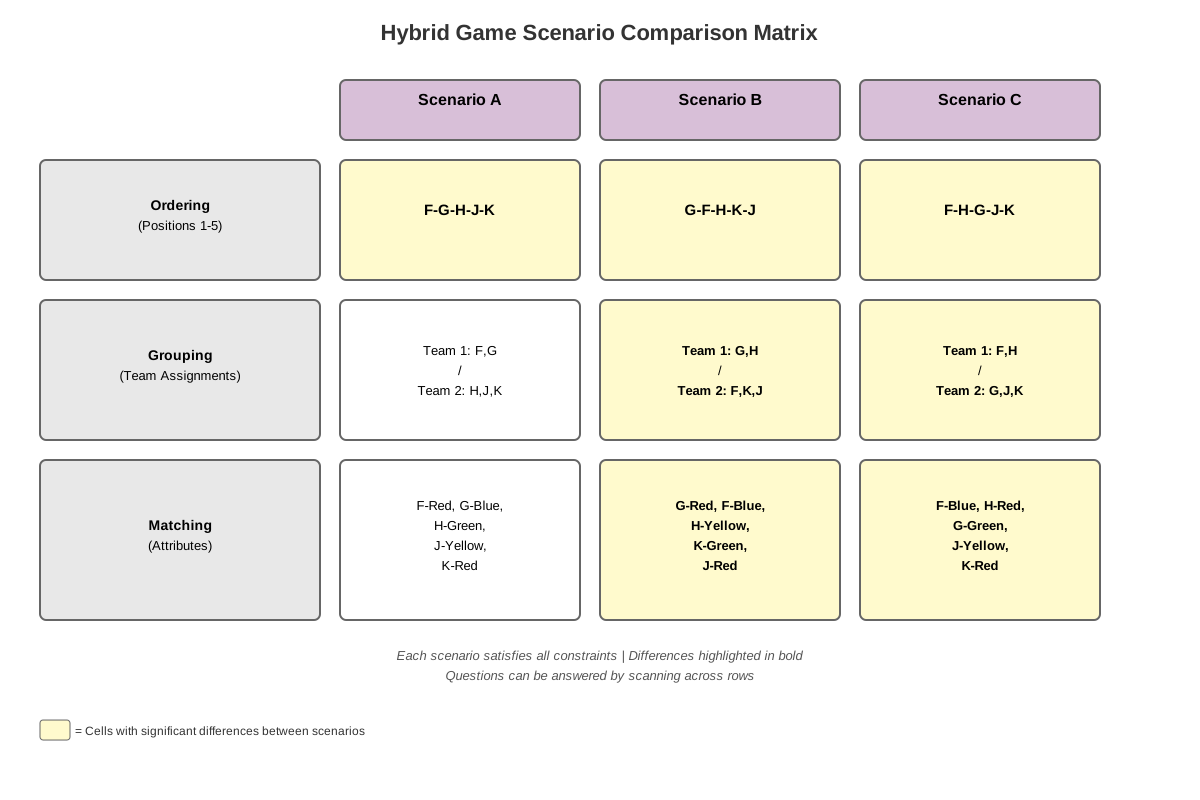
Hybrid games legacy refers to Analytical Reasoning puzzles that combine two or more traditional game types within a single scenario. The most common combinations include ordering-grouping hybrids (where elements must be both sequenced and categorized), grouping-matching hybrids (where elements are sorted into groups and assigned attributes), and three-way hybrids incorporating ordering, grouping, and matching simultaneously. These games challenge test-takers because they require maintaining multiple organizational frameworks concurrently—for example, tracking which person sits in which position (ordering) while also noting which team each person belongs to (grouping) and what role each person plays (matching).
The complexity of hybrid games stems from constraint interaction across different organizational dimensions. A rule might state "No two members of the red team can sit consecutively," which simultaneously constrains both the grouping aspect (team membership) and the ordering aspect (seating sequence). This multi-dimensional constraint structure creates opportunities for powerful deductions but also increases cognitive load, making systematic approaches essential.
The Limited Options Principle
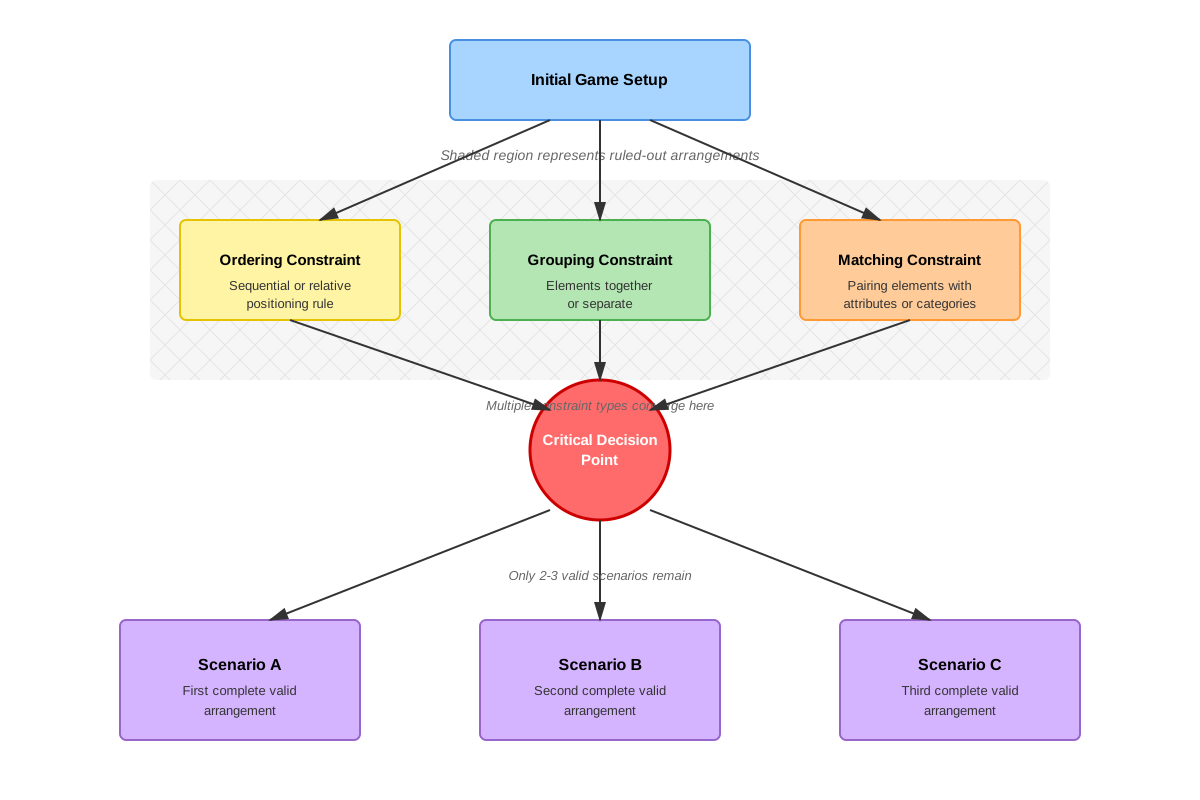
The limited options technique activates when game constraints force a small number of distinct scenarios—typically 2-4 complete or partial configurations. The key insight is recognizing that certain constraints create binary or limited-choice branch points that determine much of the remaining game structure. Rather than treating these branch points as conditional possibilities to track mentally, the limited options approach involves explicitly drawing out each scenario as a separate diagram.
The principle operates on a simple mathematical foundation: when constraints interact to create a decision point with few options, and each option significantly determines subsequent placements, the total number of valid complete arrangements remains small. For instance, if a rule states "Either A is in position 1 or B is in position 1," and subsequent rules heavily constrain what can happen in each case, the game effectively splits into two distinct scenarios. Drawing both scenarios upfront converts one complex game into two simpler games.
Identifying Limited Options Triggers
Several constraint patterns reliably signal limited options opportunities:
- Explicit binary rules: Statements like "Either X or Y must be selected" or "P is either first or last" create clear two-scenario splits
- Numerical constraints with few solutions: Rules such as "Exactly two groups contain three members each" in a five-group game with specific total elements often yield limited distributions
- Heavily constrained variables: When one variable has only 2-3 possible placements due to multiple restrictions, and its placement significantly affects others
- Block formations with limited positions: When a fixed block of elements can only fit in a few locations within the sequence
- Conditional chains with limited triggers: When a long conditional chain has only a few possible starting points
The critical skill involves distinguishing between constraints that genuinely limit options versus those that merely create conditional relationships. A rule like "If A is selected, then B is not selected" creates a conditional but doesn't necessarily limit options—A might or might not be selected, and many arrangements might satisfy this condition. Conversely, "Exactly one of A, B, or C must be selected" in a game with additional constraints on each option more likely creates limited scenarios.
Scenario Construction Strategy
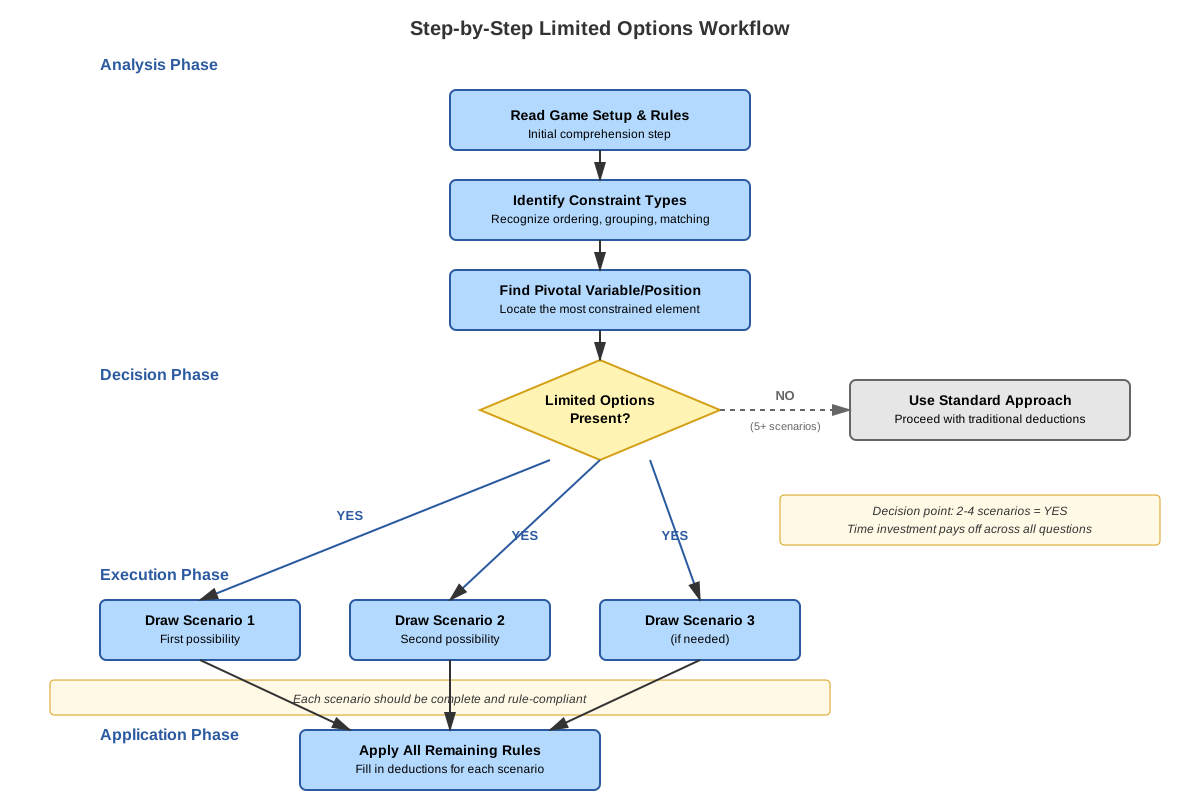
When limited options are identified, efficient scenario construction follows a systematic process:
- Identify the branching constraint: Determine which rule or rule combination creates the limited split
- Create separate diagrams: Draw a complete game board for each scenario, clearly labeled (Scenario 1, Scenario 2, etc.)
- Apply universal rules to each scenario: Work through all rules that apply regardless of which scenario is active, making all possible deductions within each scenario
- Note scenario-specific deductions: Identify what becomes determined or restricted uniquely in each scenario
- Check for scenario elimination: Occasionally, one scenario proves impossible when all rules are applied, reducing options further
The investment of time in scenario construction typically ranges from 2-4 minutes for a hybrid game with limited options. This upfront cost is recovered through dramatically faster question-answering—most questions become simple lookups across the scenarios rather than complex reasoning exercises.
Applying Scenarios to Questions
Once scenarios are constructed, question-answering follows a streamlined process:
| Question Type | Scenario Application Strategy |
|---|---|
| Could be true | Check if the statement is true in ANY scenario; one instance suffices |
| Must be true | Verify the statement holds in ALL scenarios; all must confirm |
| Could be false | Find if the statement is false in ANY scenario; one counterexample suffices |
| Must be false | Confirm the statement is false in ALL scenarios; all must contradict |
| Complete accurate list | Compile possibilities across all scenarios, eliminating duplicates |
The key advantage is that each question becomes a verification task rather than a generation task. Instead of reasoning through "What could happen if...?" the test-taker simply checks "Does this happen in Scenario 1? Scenario 2?" This reduces cognitive load and increases accuracy while decreasing time per question.
Partial Scenarios and Hybrid Flexibility
Not all limited options situations require complete scenario diagrams. Sometimes constraints create limited options for only part of the game—for example, determining that positions 1-3 have only two possible arrangements while positions 4-7 remain flexible. In these cases, partial scenario diagrams capture the constrained portion while leaving the flexible portion open for question-specific analysis.
Hybrid games particularly benefit from this flexibility because different dimensions of the game may have different degrees of constraint. The grouping aspect might split into limited options while the ordering aspect remains variable, or vice versa. Skilled test-takers recognize which dimension to diagram fully and which to handle through conditional notation or question-specific work.
Concept Relationships
The concepts within limited options in hybrid games form a logical progression: Understanding hybrid games provides the foundation by establishing what makes these puzzles complex → The limited options principle offers the strategic insight that complexity can be managed through scenario splitting → Identifying limited options triggers develops the pattern recognition needed to spot opportunities → Scenario construction strategy provides the tactical execution method → Applying scenarios to questions delivers the payoff through efficient question-answering → Partial scenarios and hybrid flexibility adds sophistication by recognizing when full scenario construction isn't necessary.
This topic connects to prerequisite knowledge by building on basic game type identification (hybrid games combine these types) and rule representation techniques (scenarios are sophisticated rule representations). It extends constraint-based deduction skills by systematizing how deductions are organized across multiple possible worlds rather than tracked conditionally in a single framework.
Looking forward, mastering limited options in hybrid games enables progression to advanced topics like game substitution techniques (recognizing when scenarios effectively create sub-games) and strategic time allocation (knowing when to invest in upfront work versus question-by-question analysis). The scenario-based thinking developed here also transfers to complex conditional reasoning in Logical Reasoning sections.
High-Yield Facts
⭐ Limited options scenarios typically emerge when 2-4 distinct configurations satisfy all game constraints, making complete scenario diagrams more efficient than conditional tracking.
⭐ Binary rules explicitly stating "Either X or Y" are the most reliable triggers for limited options approaches in hybrid games.
⭐ Time invested in scenario construction (2-4 minutes) is typically recovered through 30-40% faster question-answering across 5-7 questions.
⭐ In hybrid games, limited options most commonly arise from interactions between ordering and grouping constraints rather than from single rules.
⭐ "Must be true" questions are answered by checking if a statement holds in ALL scenarios; a single counterexample scenario eliminates an answer choice.
- Numerical distribution constraints in hybrid games with grouping elements frequently create limited options when combined with total element counts.
- Heavily constrained variables that can occupy only 2-3 positions often serve as effective branching points for scenario creation.
- Partial scenario diagrams are appropriate when only one dimension of a hybrid game (e.g., grouping but not ordering) exhibits limited options.
- Scenario elimination during construction—discovering one scenario violates rules—is a powerful simplification that reduces the game to even fewer options.
- Block formations in ordering-grouping hybrids create limited options when the block can only fit in a few sequence positions while maintaining grouping requirements.
- The limited options approach is most valuable when scenarios differ substantially; if scenarios are nearly identical, the technique offers less advantage.
- Hybrid games combining three elements (ordering, grouping, and matching) are prime candidates for limited options because constraint interactions multiply across dimensions.
Quick check — test yourself on Limited options in hybrid games so far.
Try Flashcards →Common Misconceptions
Misconception: Limited options only applies when a rule explicitly states "Either X or Y."
Correction: While explicit binary rules are clear triggers, limited options frequently emerge from the interaction of multiple constraints that together force a limited number of configurations. Numerical constraints, heavily restricted variables, and block placements can all create limited options without explicit either/or language.
Misconception: Drawing multiple scenarios always wastes time that could be spent answering questions.
Correction: When genuine limited options exist (2-4 scenarios), the upfront time investment is recovered through dramatically faster question-answering. The key is accurate identification—limited options saves time, but attempting it when 5+ scenarios exist can indeed waste time.
Misconception: All scenarios must be completely filled in before moving to questions.
Correction: Scenarios should include all deductions that follow from universal rules and the branching constraint, but some positions may remain flexible. The goal is to capture what's determined in each scenario, not to force complete determination where flexibility exists.
Misconception: If one scenario seems more likely or natural, focus on that scenario first.
Correction: All valid scenarios are equally important for LSAT purposes. Questions may target any scenario, and "must be true" questions require checking all scenarios. No scenario should be prioritized or neglected based on intuition about likelihood.
Misconception: Hybrid games are too complex for limited options approaches because there are too many variables to track.
Correction: Hybrid games are actually ideal candidates for limited options precisely because their complexity makes conditional tracking difficult. When constraints interact across multiple dimensions to create limited configurations, scenario diagrams provide clarity that conditional notation cannot match.
Misconception: Limited options and conditional diagramming are competing approaches—choose one or the other.
Correction: These techniques complement each other. Limited options handles the major branching structure, while conditional notation can still represent rules within each scenario. Skilled test-takers integrate both approaches as appropriate.
Worked Examples
Example 1: Ordering-Grouping Hybrid with Binary Trigger
Game Setup: Six attorneys—F, G, H, J, K, and L—will present arguments in a trial. Each attorney belongs to either the prosecution team or the defense team. The presentations occur in numbered positions 1 through 6, with the following constraints:
- Either F presents first or L presents first
- No two prosecution attorneys present consecutively
- G and H are both on the prosecution team
- J and K are both on the defense team
- F is on the defense team
- Exactly four attorneys are on the defense team
Analysis: The first rule creates an explicit binary trigger—F first OR L first. This is a clear limited options opportunity. Since exactly four attorneys are on defense and we know F, J, and K are defense (three identified), exactly one of G, H, or L must also be defense. But G and H are both prosecution, so L must be the fourth defense attorney.
Scenario 1: F is in position 1
Position: 1    2    3    4    5    6
         F(D)  _    _    _    _    _
Teams: D, P, D, P, D, P (alternating to satisfy "no two prosecution consecutively")
With F in position 1 (defense), and needing to alternate to avoid consecutive prosecution attorneys, positions must be: D-P-D-P-D-P. We have four defense (F, J, K, L) and two prosecution (G, H). So:
- Position 1: F (defense)
- Positions 2, 4, 6: must be G and H (prosecution), with one position having no one—wait, we have 6 positions and 6 attorneys, so positions 2, 4, 6 must include both G and H, but that's only 2 positions for 2 attorneys. Position 6 must be the third prosecution slot, but we only have 2 prosecution attorneys.
This reveals the constraint interaction: we cannot have D-P-D-P-D-P because we only have 2 prosecution attorneys for 3 prosecution slots. Let's reconsider: "No two prosecution attorneys present consecutively" doesn't require alternation—it just prohibits consecutive prosecution. So prosecution attorneys can be separated by multiple defense attorneys.
Revised Scenario 1: F is in position 1
Position: 1    2    3    4    5    6
         F(D)
G and H (prosecution) cannot be consecutive. With four defense attorneys (F, J, K, L) and two prosecution (G, H), we need G and H separated. Possible arrangements with F first:
- F in 1, then G and H must be non-consecutive in positions 2-6
Scenario 2: L is in position 1
Position: 1    2    3    4    5    6
         L(D)
Same constraint: G and H cannot be consecutive.
Key Deduction: In both scenarios, the challenge is placing G and H non-consecutively among the remaining positions. With 4 defense attorneys providing buffers, G and H can be in positions like (2,4), (2,5), (2,6), (3,5), (3,6), or (4,6).
Question Application: "Which of the following must be true?"
- Check each answer choice against both scenarios
- If true in both scenarios, it's a correct answer
- If false in either scenario, eliminate it
Example 2: Grouping-Matching Hybrid with Numerical Constraint
Game Setup: A committee assigns seven projects—M, N, O, P, Q, R, S—to three teams: Team 1, Team 2, and Team 3. Each project is assigned to exactly one team and designated as either high-priority or low-priority, with the following constraints:
- Each team receives at least two projects
- Exactly three projects are high-priority
- M and N must be on the same team
- If O is high-priority, then P is low-priority
- Q and R cannot be on the same team
- Team 1 receives exactly two projects
Analysis: The numerical constraints create limited options. With 7 projects, 3 teams, and Team 1 getting exactly 2, the distribution must be 2-2-3 or 2-3-2 (Teams 1, 2, 3 respectively). Since each team needs at least 2, these are the only options.
Scenario A: Distribution is 2-2-3 (Team 1: 2, Team 2: 2, Team 3: 3)
M and N must be together. They could be:
- On Team 1 (filling it completely: 2 projects)
- On Team 2 (filling it completely: 2 projects)
- On Team 3 (with one other project: 3 projects total)
Scenario B: Distribution is 2-3-2 (Team 1: 2, Team 2: 3, Team 3: 2)
M and N must be together. They could be:
- On Team 1 (filling it completely: 2 projects)
- On Team 2 (with one other project: 3 projects total)
- On Team 3 (filling it completely: 2 projects)
Further Refinement: Since M and N form a block, and Q and R must be separated, we can create sub-scenarios:
Scenario A1: Team 1 has M and N (2 projects—complete)
- Team 2 has 2 projects (not Q and R together)
- Team 3 has 3 projects (not Q and R together)
- Q and R must be split between Teams 2 and 3
Scenario A2: Team 1 has 2 projects (not M-N, not Q-R together)
- Team 2 has M and N (2 projects—complete)
- Team 3 has 3 projects
- Q and R must be split
Scenario A3: Team 1 has 2 projects (not M-N, not Q-R together)
- Team 2 has 2 projects (not M-N, not Q-R together)
- Team 3 has M, N, and one other (3 projects)
- Q and R must be split between Teams 1 and 2
Question Application: "If O is high-priority, which of the following could be true?"
Apply the conditional rule: O high-priority → P low-priority. With exactly 3 high-priority projects total, if O is high-priority, then P is low-priority, leaving 2 other high-priority projects among M, N, Q, R, S. Check each scenario to see which arrangements satisfy this constraint and evaluate answer choices accordingly.
Exam Strategy
When approaching LSAT questions involving limited options in hybrid games, follow this systematic process:
Initial Recognition Phase (30-45 seconds):
- Read the game setup and identify it as a hybrid by noting multiple organizational dimensions
- Scan rules for explicit binary language ("either...or," "exactly one of," "must be first or last")
- Check for numerical constraints that might yield limited distributions
- Identify heavily constrained variables with only 2-3 possible placements
Decision Point (15-20 seconds):
Evaluate whether to invest in scenario creation by asking:
- Do the constraints create 2-4 distinct scenarios (not 5+)?
- Does the branching point significantly determine other placements?
- Are there 5+ questions for this game (making upfront investment worthwhile)?
If yes to all three, proceed with scenario construction. If uncertain, start with one scenario and assess whether the pattern continues before committing to all scenarios.
Trigger Words and Phrases to Watch For:
- "Either X or Y" (explicit binary)
- "Exactly one of" (limited selection)
- "Must be first or last" (endpoint constraint)
- "Exactly [number]" combined with "at least [number]" (numerical squeeze)
- "Cannot be consecutive" combined with limited elements (spacing constraint)
- "The same [attribute]" creating blocks with limited placements
Process-of-Elimination Tips:
- For "must be true" questions with scenarios: eliminate any answer choice false in even one scenario
- For "could be true" questions: eliminate only if false in ALL scenarios
- When answer choices reference specific variable placements, check scenarios directly rather than re-reasoning
- If an answer choice seems complex to verify, check the contrapositive against scenarios instead
Time Allocation Advice:
- Allocate 2-4 minutes for scenario construction in true limited options games
- Spend 30-45 seconds per question after scenarios are drawn (vs. 60-90 seconds without scenarios)
- If scenario construction exceeds 4 minutes, reassess whether true limited options exist
- Budget time to verify scenarios are complete before moving to questions—catching errors early prevents cascading mistakes
Exam Tip: If you identify limited options but time is running short, create scenarios for just the first 2-3 questions, then assess whether continuing is worthwhile. Sometimes partial scenario work provides enough advantage without full commitment.
Memory Techniques
BENDS Mnemonic for identifying limited options triggers:
- Binary rules (either/or statements)
- Endpoint constraints (first/last requirements)
- Numerical squeezes (exact counts with limited solutions)
- Determined variables (heavily constrained elements)
- Spacing blocks (fixed groups with limited positions)
Visualization Strategy: Picture the game as a tree with a thick trunk (the initial setup) that splits into 2-4 major branches (the scenarios). Each branch is a complete world where different rules apply. Questions are like birds that land on branches—you just need to check which branch they're on, not figure out how they got there.
The "2-4 Rule" Acronym: Two To Four Scenarios = Time To Fork Setup. If constraints create 2-4 scenarios, it's time to fork your setup into multiple diagrams.
Scenario Labeling System: Always label scenarios with both a number and a brief descriptor:
- "Scenario 1: F first" and "Scenario 2: L first"
- This prevents confusion when checking scenarios during questions and helps maintain clarity under time pressure
The "ALL vs. ANY" Memory Device:
- Must be true = ALL scenarios (both start with letters near the beginning of the alphabet)
- Could be true = ANY scenario (C and A are close alphabetically)
- This helps quickly recall which verification standard applies to each question type
Summary
Limited options in hybrid games represents a high-leverage strategic technique for LSAT Analytical Reasoning Legacy sections, transforming complex multi-dimensional puzzles into manageable scenario-based analysis. The approach activates when game constraints—particularly binary rules, numerical squeezes, endpoint requirements, or heavily restricted variables—force arrangements into 2-4 distinct configurations. By investing 2-4 minutes upfront to construct complete scenario diagrams, test-takers convert subsequent questions from complex reasoning tasks into simple verification checks, typically reducing per-question time by 30-40%. The technique proves especially powerful in hybrid games because these puzzles combine multiple organizational dimensions (ordering, grouping, matching), creating constraint interactions that make conditional tracking cognitively demanding. Success requires accurate pattern recognition to identify genuine limited options opportunities, systematic scenario construction that captures all deductions within each configuration, and disciplined question-answering that checks statements against all scenarios for "must be true" questions or any scenario for "could be true" questions. Mastery of this technique directly impacts test performance, as hybrid games with limited options appear in approximately 6-10% of all Analytical Reasoning games, affecting 5-7 questions per test administration.
Key Takeaways
- Limited options in hybrid games converts complex multi-dimensional puzzles into 2-4 concrete scenarios, dramatically simplifying question-answering through upfront scenario construction
- Binary rules, numerical constraints, and heavily restricted variables serve as primary triggers for identifying limited options opportunities in hybrid game setups
- Time invested in scenario creation (2-4 minutes) yields net time savings through 30-40% faster question-answering across 5-7 questions per game
- "Must be true" questions require verification across ALL scenarios, while "could be true" questions need confirmation in only ANY single scenario
- Hybrid games combining ordering, grouping, and matching elements are prime candidates for limited options because constraint interactions across dimensions create natural branching points
- Partial scenario diagrams effectively handle situations where only one dimension of a hybrid game exhibits limited options while other dimensions remain flexible
- Accurate identification of true limited options (2-4 scenarios) versus excessive branching (5+ scenarios) determines whether the technique saves or wastes time
Related Topics
Advanced Scenario Manipulation: Building on limited options mastery, this topic explores techniques for modifying scenarios in response to new local conditions introduced by individual questions, enabling even faster question-answering through scenario adaptation rather than reconstruction.
Constraint Interaction Analysis: This advanced topic systematically examines how rules combine across different game dimensions to create emergent restrictions, providing the theoretical foundation for recognizing limited options triggers before they become explicit.
Strategic Game Selection and Ordering: Understanding limited options enables better decisions about which games to attempt first during the Analytical Reasoning section, as games with identifiable limited options often provide the best time-efficiency ratio.
Conditional Chain Mapping in Hybrid Contexts: This related topic addresses how to represent and track conditional relationships when they span multiple organizational dimensions, complementing limited options techniques for hybrid games that don't exhibit scenario-based structure.
Practice CTA
Now that you've mastered the conceptual framework for limited options in hybrid games, it's time to cement your understanding through active practice. The practice questions and flashcards designed for this topic will challenge you to identify limited options triggers in realistic LSAT scenarios, construct efficient scenario diagrams under time pressure, and apply your scenarios to answer questions with speed and accuracy. Remember: recognizing the pattern is only half the battle—fluent execution under test conditions requires deliberate practice. Each practice problem you work through strengthens your pattern recognition and builds the automaticity that transforms this technique from a conscious strategy into an instinctive response. Approach the practice materials with focus and intention, and you'll find that hybrid games that once seemed overwhelming become opportunities to demonstrate your analytical mastery.
Sign up free to keep reading
Create a free AnvayaPrep account to finish this LSAT guide on Limited options in hybrid games — plus flashcards and practice questions.