Overview
Block rules are one of the most fundamental and frequently tested constraint types in LSAT Analytical Reasoning Legacy, particularly within sequencing games legacy. A block rule establishes that two or more variables must appear consecutively or adjacent to one another in a sequence, though the internal order within the block may or may not be specified. These rules create powerful deductive opportunities because they reduce the number of possible arrangements dramatically—instead of placing individual variables independently, test-takers must treat the blocked variables as a single unit that moves together through the sequence.
Understanding block rules is essential for LSAT success because they appear in approximately 60-70% of sequencing games and often serve as the primary constraint that unlocks an entire game's logic. When a block rule is present, it typically generates the most significant inferences and becomes the focal point for efficiently eliminating answer choices. Block rules interact dynamically with other constraint types—such as ordering rules, conditional rules, and distribution rules—creating cascading deductions that separate high-scoring test-takers from those who struggle with timing.
Within the broader framework of analytical reasoning legacy, block rules represent a specific application of spatial reasoning and constraint satisfaction. They build upon basic sequencing concepts while preparing students for more complex game types that combine multiple constraint categories. Mastering block rules provides the foundation for tackling advanced sequencing variations, including games with multiple blocks, conditional blocks, and hybrid games that incorporate both sequencing and grouping elements.
Learning Objectives
- [ ] Identify how Block rules appears in LSAT questions
- [ ] Explain the reasoning pattern behind Block rules
- [ ] Apply Block rules to solve LSAT-style problems accurately
- [ ] Recognize the difference between ordered blocks and unordered blocks in game setups
- [ ] Generate complete inferences by combining block rules with other constraints
- [ ] Efficiently diagram block rules using standard LSAT notation conventions
- [ ] Anticipate how block rules restrict placement options in different positions of a sequence
Prerequisites
- Basic sequencing game structure: Understanding how to set up a linear sequence with numbered positions is essential because block rules operate within these frameworks
- Standard LSAT diagramming notation: Familiarity with arrows, dashes, and variable notation enables efficient representation of block constraints
- Fundamental ordering rules: Knowledge of simple "before/after" relationships provides context for how blocks interact with non-blocked variables
- Slot-based reasoning: The ability to think about which positions variables can and cannot occupy forms the foundation for block placement analysis
Why This Topic Matters
Block rules represent one of the highest-yield topics in LSAT Analytical Reasoning because they appear with remarkable consistency across test administrations. Statistical analysis of released LSAT exams reveals that sequencing games with block rules appear in approximately 65% of all Analytical Reasoning sections, and these games typically include 5-7 questions each, meaning block rule mastery directly impacts 8-12% of an entire LSAT score. The predictability of block rules makes them an exceptional investment of study time—the patterns repeat consistently, and the deductive techniques transfer reliably across different game contexts.
In practical exam conditions, block rules serve as the primary entry point for making deductions in sequencing games. Test-takers who quickly recognize block rules and understand their implications can often eliminate 2-3 answer choices immediately on most questions, dramatically improving both accuracy and speed. The LSAT frequently tests block rules through "could be true" questions, "must be false" questions, and "complete and accurate list" questions that require systematic consideration of where blocks can fit within a sequence.
Block rules commonly appear in LSAT passages through specific linguistic markers: "consecutive," "adjacent," "immediately before/after," "next to," or "side-by-side." The test also presents block rules through contextual scenarios such as "X and Y present together," "A performs immediately after B," or "C and D occupy adjoining seats." Recognizing these varied phrasings as manifestations of the same underlying block rule structure is crucial for consistent performance. Additionally, the LSAT often combines block rules with conditional statements, creating "conditional blocks" that activate only under specific circumstances—a sophisticated variation that appears in approximately 30% of games featuring blocks.
Core Concepts
Definition and Basic Structure
Block rules (also called lsat block rules) establish that two or more variables must occupy consecutive positions in a sequence. The fundamental characteristic of a block is that the variables within it cannot be separated by other variables—they form a contiguous unit. Block rules are typically diagrammed by writing the variables together with a horizontal line or bracket connecting them, indicating their inseparability.
For example, if variables F and G must be consecutive, the standard notation is: F G or [FG]
This notation indicates that wherever F appears, G must be immediately adjacent (either before or after, unless the rule specifies direction). The block functions as a single unit when considering placement options within the sequence.
Ordered vs. Unordered Blocks
A critical distinction exists between ordered blocks and unordered blocks, and the LSAT tests this difference extensively:
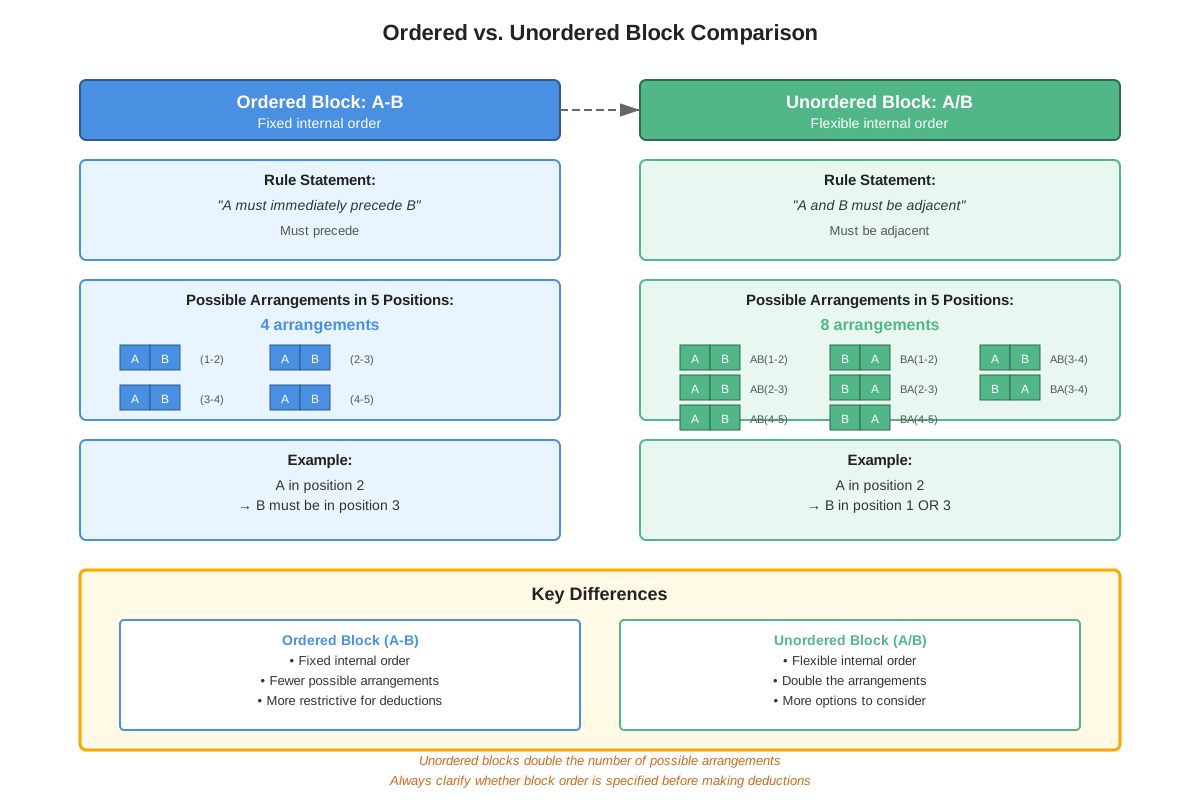
| Block Type | Characteristics | Notation | Example Rule |
|---|---|---|---|
| Ordered Block | Internal sequence is fixed; variables must appear in specified order | F → G (with connection) | "F performs immediately before G" |
| Unordered Block | Variables must be adjacent but can appear in either order | F ↔ G or [F/G] | "F and G perform consecutively" |
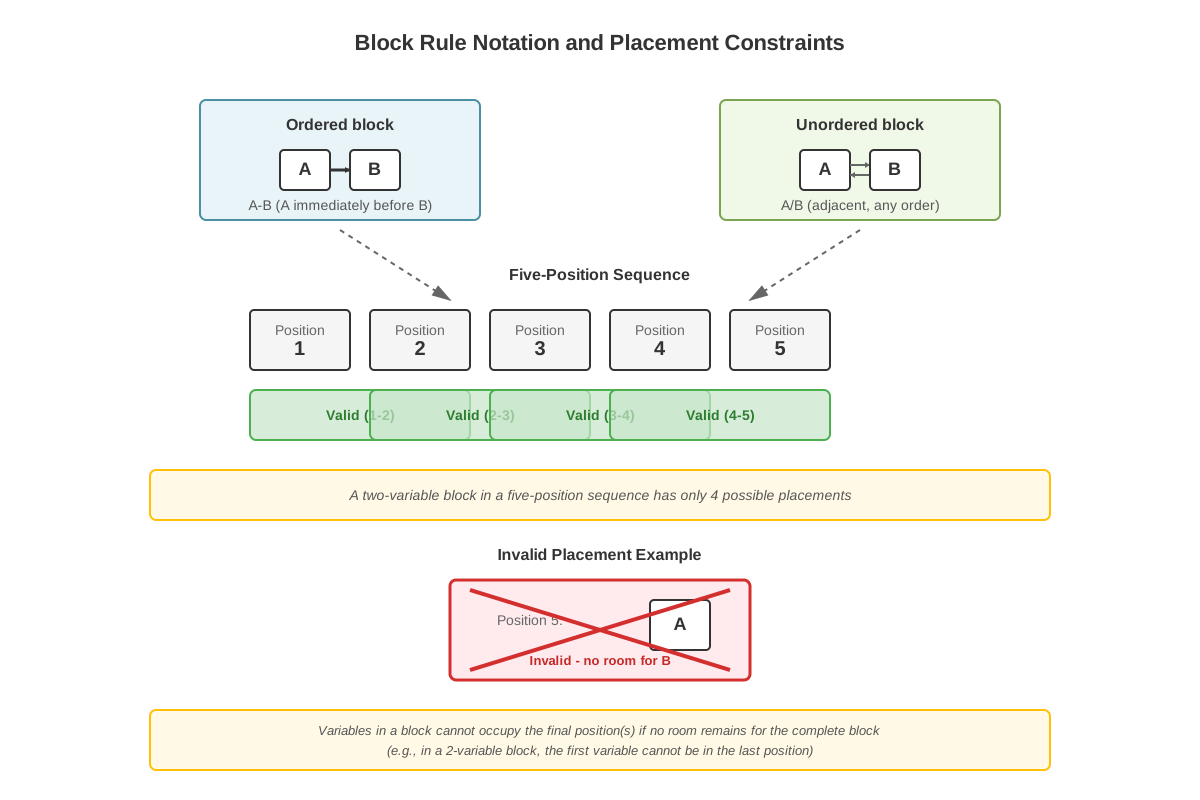
Ordered blocks reduce possibilities more significantly than unordered blocks. In a 5-position sequence, an ordered block FG can occupy only 4 possible positions (positions 1-2, 2-3, 3-4, or 4-5), while an unordered block F/G can occupy those same 4 positions but in 2 different arrangements each, yielding 8 total possibilities.
Block Size and Complexity
Blocks can involve more than two variables, creating extended blocks or multi-variable blocks. A three-variable block like H I J (in that order) functions as an even more restrictive constraint. In a 6-position sequence, a three-variable ordered block can occupy only 4 positions (1-2-3, 2-3-4, 3-4-5, or 4-5-6), dramatically limiting possibilities.
The LSAT occasionally presents multiple separate blocks within a single game. For example, a game might specify that F-G form one block and H-I form another block. These multiple blocks must be placed within the sequence without overlapping, creating complex spatial reasoning challenges. When two blocks exist in a 6-position sequence, the placement options become highly constrained, often yielding only 2-4 viable complete arrangements.
Negative Space and Block Placement
Understanding where blocks cannot go is as important as knowing where they can go. A two-variable block cannot place its first variable in the final position of a sequence, nor can its second variable occupy the first position. This negative space reasoning generates immediate deductions:
- In a 5-position sequence, a two-variable block cannot start in position 5 or end in position 1
- A three-variable block cannot start in positions 4 or 5, nor end in positions 1 or 2
- When other constraints eliminate certain positions for block variables, the entire block's placement becomes further restricted
Block Interactions with Other Rules
Block rules gain their full deductive power through interaction with other constraint types:
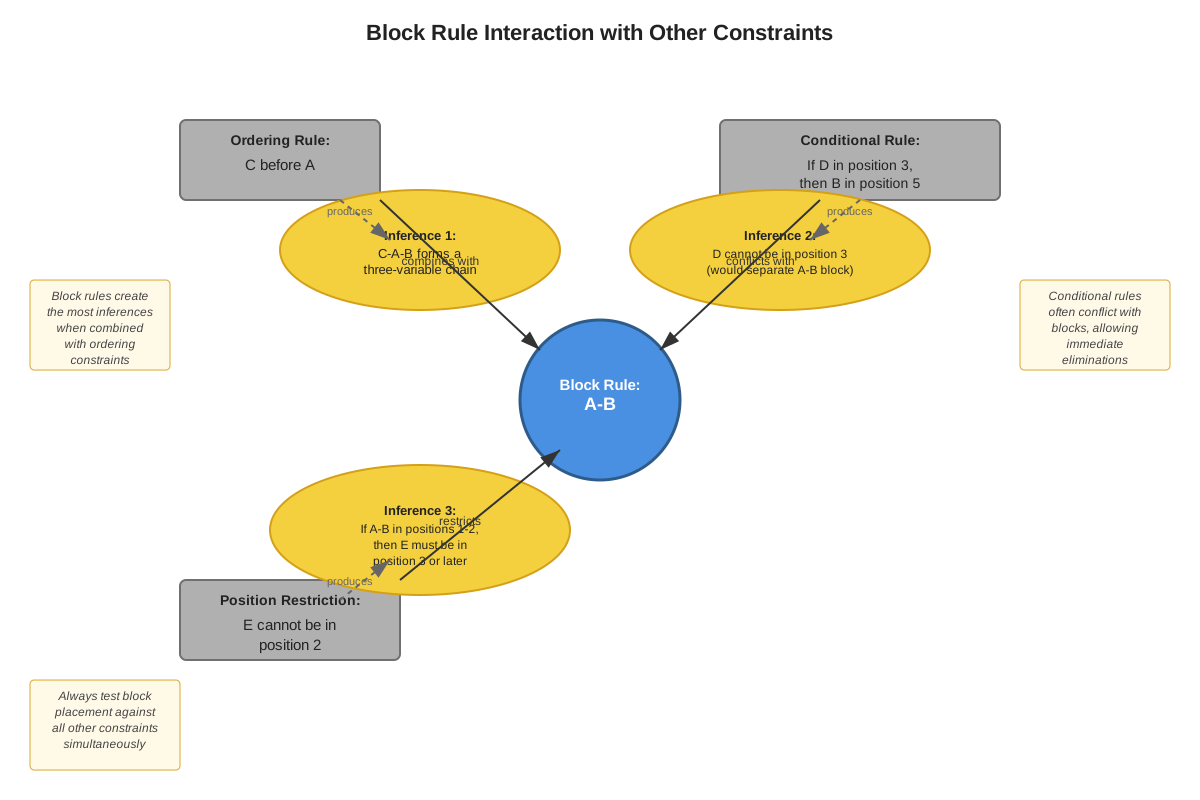
Block + Ordering Rule: If F-G form a block and a separate rule states "H comes before F," then H must come before the entire F-G block, effectively creating a three-variable sequence H...F-G.
Block + Position Rule: If F-G form a block and F must occupy position 3, then G must occupy position 2 or 4 (depending on whether the block is ordered or unordered).
Block + Exclusion Rule: If F-G form a block and F cannot occupy position 2, then the block cannot occupy positions 1-2 or 2-3, significantly limiting placement options.
Conditional Blocks
Advanced LSAT games introduce conditional blocks—blocks that form only when certain conditions are met. These are typically diagrammed as: "If X is selected, then Y and Z are consecutive." The conditional nature means the block constraint activates only in specific scenarios, requiring test-takers to track multiple possible game states.
Concept Relationships
Block rules serve as a bridge between basic sequencing concepts and advanced constraint satisfaction problems. The logical flow progresses as follows:
Basic Sequencing → Block Rules → Complex Multi-Constraint Games
Within block rule analysis itself, concepts build hierarchically:
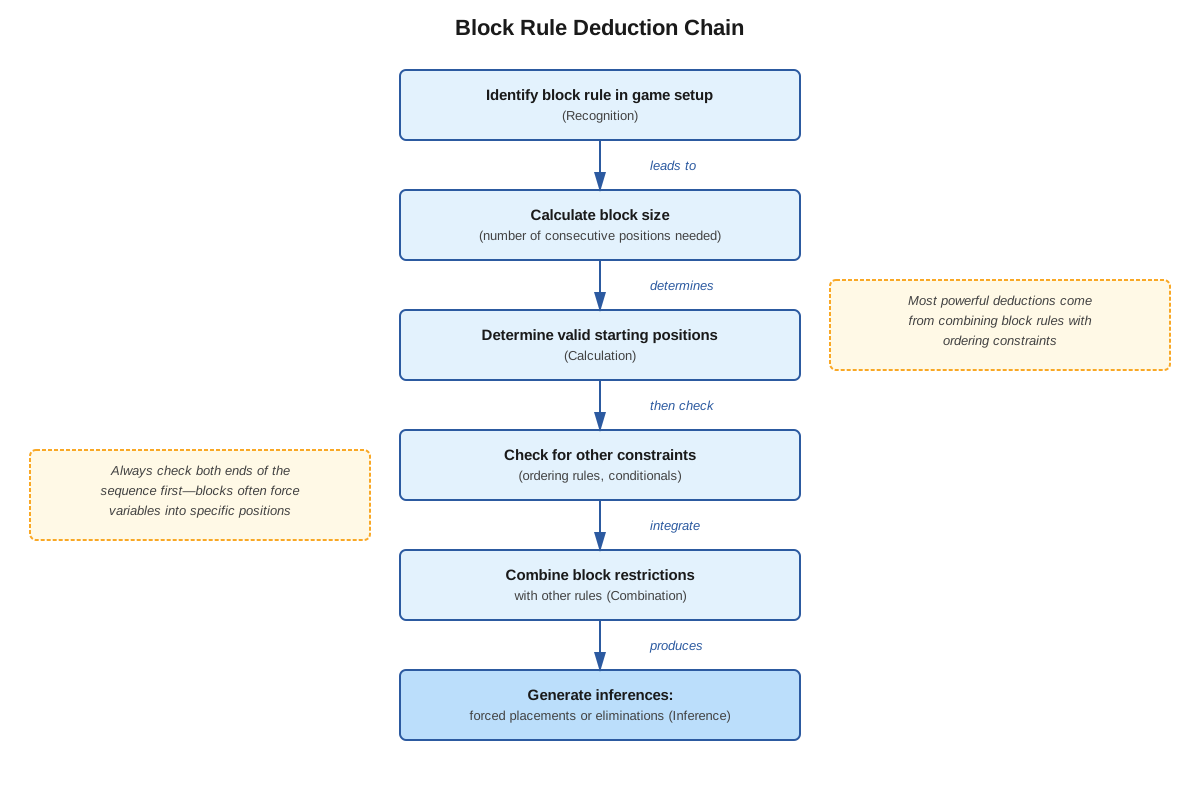
Block Identification → Block Type Classification (ordered vs. unordered) → Placement Analysis (where blocks can/cannot go) → Inference Generation (combining blocks with other rules) → Answer Elimination (using block constraints to test answer choices)
Block rules connect directly to prerequisite knowledge of basic ordering rules because blocks are essentially specialized ordering constraints with the additional requirement of adjacency. They also relate to position-based reasoning, as determining valid block placements requires systematic consideration of each possible starting position.
The relationship between blocks and other game elements creates a constraint network: Block rules → Position restrictions → Ordering implications → Distribution effects. For example, placing a block in positions 2-3 means those positions are "occupied," which affects where other variables can go, which may trigger conditional rules, which may force additional variables into specific positions. This cascading effect is the essence of LSAT Analytical Reasoning—one constraint activates others in a chain reaction of deductions.
High-Yield Facts
⭐ Block rules appear in approximately 65% of all LSAT sequencing games, making them the most common specialized constraint type
⭐ A two-variable block in an n-position sequence can occupy (n-1) different starting positions, but ordered vs. unordered status doubles the arrangements for unordered blocks
⭐ The first variable of a block can never occupy the final position of a sequence, and the last variable of a block can never occupy the first position
⭐ When two separate blocks exist in a game, their combined length determines minimum sequence length—two 2-variable blocks require at least 4 positions
⭐ Block rules combined with position-specific constraints generate the most powerful immediate deductions in sequencing games
- Unordered blocks create exactly twice as many possible arrangements as ordered blocks of the same size
- A three-variable block in a 6-position sequence eliminates 50% of possible arrangements immediately
- Conditional blocks require tracking multiple game scenarios, typically doubling the diagramming work
- Block rules are most commonly tested through "could be true" and "must be false" question types
- The LSAT uses varied language to express block rules: "consecutive," "adjacent," "immediately," "next to," "side-by-side," and "together"
Quick check — test yourself on Block rules so far.
Try Flashcards →Common Misconceptions
Misconception: All block rules mean the variables can appear in either order (treating all blocks as unordered)
Correction: Block rules must be carefully analyzed for directional language. "F immediately before G" creates an ordered block F→G, while "F and G are consecutive" creates an unordered block F↔G. The distinction significantly affects the number of valid arrangements.
Misconception: A block can be "split" if other rules require it
Correction: Block rules are absolute constraints—the variables must remain adjacent regardless of other rules. If a block rule conflicts with other constraints, those constraints together may make certain scenarios impossible, but the block itself never breaks apart.
Misconception: In an unordered block, the variables can appear anywhere in the sequence as long as they're both present
Correction: Unordered blocks still require adjacency—the variables must occupy consecutive positions. "Unordered" refers only to the internal arrangement (F-G or G-F), not to their overall placement requirement.
Misconception: When a block includes three variables, the middle variable can move to either end
Correction: In an ordered three-variable block H-I-J, the sequence is fixed. H must come first, I must be in the middle, and J must be last within the block. The entire block can move to different positions, but the internal order never changes.
Misconception: Block rules only affect the specific questions that mention the blocked variables
Correction: Block rules affect the entire game structure and generate inferences that impact all questions. Even questions that don't explicitly mention the blocked variables are constrained by the reduced placement options that blocks create.
Worked Examples
Example 1: Basic Ordered Block Application
Game Setup: Seven presentations—F, G, H, I, J, K, L—are scheduled in seven consecutive time slots, numbered 1 through 7. The following conditions apply:
- F is presented immediately before G
- H is presented in slot 4
- K is presented before L
Question: If J is presented in slot 2, which of the following must be true?
Solution Process:
Step 1: Diagram the block rule. F→G forms an ordered block that must occupy consecutive positions.
Step 2: Identify fixed positions. H occupies slot 4 (given), and J occupies slot 2 (question stem).
Step 3: Determine where the F-G block can fit. With slots 2 and 4 occupied, the F-G block can potentially occupy:
- Slots 1-2: No, because J is in slot 2
- Slots 2-3: No, because J is in slot 2 and F must come before G
- Slots 3-4: No, because H is in slot 4
- Slots 5-6: Possible
- Slots 6-7: Possible
Step 4: Consider the K before L constraint. With J in slot 2, H in slot 4, and F-G occupying either slots 5-6 or 6-7, we have limited space for K and L.
Step 5: Test each possibility:
- If F-G occupy slots 5-6, then slots 1, 3, and 7 remain for I, K, and L. Since K must precede L, and we have slots 1, 3, and 7 available, K could be in slot 1 or 3, with L later.
- If F-G occupy slots 6-7, then slots 1, 3, and 5 remain for I, K, and L. Again, K must precede L.
Step 6: Identify what must be true in both scenarios. In both cases, the F-G block occupies slots 5-6 or later, meaning F cannot be in slots 1, 2, or 3. This type of deduction—what must be false—helps identify what must be true.
Answer: The correct answer would identify a constraint that holds in all valid arrangements, such as "F is presented in slot 5, 6, or 7."
Example 2: Multiple Blocks with Complex Interactions
Game Setup: Six students—R, S, T, U, V, W—present in six consecutive time slots. The following conditions apply:
- R and S present consecutively (unordered block)
- T presents immediately before U (ordered block)
- V presents before W
- W presents in slot 4 or 5
Question: If R presents in slot 2, which of the following could be true?
Solution Process:
Step 1: Diagram both blocks. R↔S (unordered) and T→U (ordered).
Step 2: Apply the question condition. R is in slot 2, so S must be in slot 1 or slot 3 (adjacent to R).
Step 3: Consider W's position constraint. W is in slot 4 or 5, and V must precede W.
Step 4: Test S in slot 1:
- Slots 1-2: S-R
- Slot 4 or 5: W
- V must come before W, so V must be in a slot before W's position
- T-U block must fit in remaining consecutive slots
If W is in slot 4, V must be in slot 3 (the only remaining slot before 4), and T-U must occupy slots 5-6.
If W is in slot 5, V could be in slot 3 or 4. If V is in slot 3, T-U occupies slots 4-5 (but W is in slot 5—conflict). If V is in slot 4, T-U must occupy slots 5-6 (but W is in slot 5—conflict).
Therefore, if S is in slot 1, W must be in slot 4.
Step 5: Test S in slot 3:
- Slots 2-3: R-S
- Slot 4 or 5: W
- V must precede W
- T-U block must fit in remaining consecutive slots
If W is in slot 4, V must be in slot 1, and T-U occupies slots 5-6. This works: V(1), R(2), S(3), W(4), T(5), U(6).
If W is in slot 5, V could be in slot 1 or 4. If V is in slot 1, T-U could occupy slots 4-5 (but W is in slot 5—conflict) or slots 6-7 (no slot 7). If V is in slot 4, T-U must occupy slots 1-2 or 6-7 (no slot 7), so T-U in slots 1-2 would work: T(1), U(2), R(3)... but R is in slot 2 (conflict).
Step 6: Identify valid arrangements. The valid arrangement is: V(1), R(2), S(3), W(4), T(5), U(6).
Answer: Any statement consistent with this arrangement could be true, such as "V presents in slot 1" or "T presents in slot 5."
Exam Strategy
When approaching LSAT questions involving block rules, implement this systematic process:
Recognition Phase: Scan the game setup for trigger words indicating blocks: "consecutive," "adjacent," "immediately before/after," "next to," "together," "side-by-side." Circle or highlight these phrases immediately, as they signal high-value constraints.
Diagramming Phase: Represent blocks clearly using standard notation. Draw ordered blocks with an arrow (F→G) and unordered blocks with a double-arrow or bracket (F↔G or [F/G]). Keep block diagrams prominent in your workspace, as you'll reference them constantly.
Placement Analysis Phase: Before attempting questions, determine where each block can and cannot start. For a two-variable block in a 6-position sequence, note that it can start in positions 1, 2, 3, 4, or 5—but not 6. Mark these restrictions directly on your diagram.
Question-Specific Strategy:
For "could be true" questions, use block constraints to eliminate impossible answers. If an answer choice places a block variable in a position where the block cannot fit, eliminate it immediately.
For "must be true" questions, look for deductions that follow necessarily from block placement. If a block can only fit in one location given other constraints, everything about that placement must be true.
For "complete and accurate list" questions, systematically test each position by attempting to place blocks there. Positions where blocks cannot fit should not appear in the correct answer.
Time Management: Spend 30-45 seconds upfront identifying all block implications before attempting questions. This investment pays dividends across all 5-7 questions in the game. Block games reward thorough setup work more than rapid question attempts.
Process of Elimination: When testing answer choices, always check block constraints first. Block violations are often the fastest way to eliminate wrong answers, typically allowing elimination of 2-3 choices within 10-15 seconds.
Memory Techniques
BLOCK Mnemonic for systematic analysis:
- Boundaries: Identify where blocks cannot start or end
- Length: Count how many positions the block occupies
- Order: Determine if the block is ordered or unordered
- Combinations: Calculate how many ways the block can be arranged
- Key interactions: Note how the block combines with other rules
Visualization Strategy: Picture blocks as physical objects that cannot be broken. Imagine trying to fit rigid blocks into a sequence of slots—this spatial visualization helps prevent the common error of "splitting" blocks.
The Adjacency Rule: Remember "Adjacent means attached"—the variables in a block are attached and move together as a unit.
Position Counting Shortcut: For a block of size B in a sequence of length N, the block can start in (N - B + 1) positions. A 2-variable block in 6 positions can start in (6 - 2 + 1) = 5 positions.
Ordered vs. Unordered Acronym: OFD (Ordered = Fixed Direction) and UFE (Unordered = Flexible Either way)
Summary
Block rules represent one of the most powerful and frequently tested constraint types in LSAT Analytical Reasoning Legacy sequencing games. These rules establish that two or more variables must occupy consecutive positions in a sequence, functioning as an inseparable unit. The critical distinction between ordered blocks (fixed internal sequence) and unordered blocks (flexible internal arrangement) significantly impacts the number of valid arrangements and must be identified immediately when reading game rules. Block rules generate extensive deductions through their interactions with other constraints—position rules, ordering rules, and conditional rules—creating cascading inferences that often determine the entire game structure. Successful LSAT test-takers recognize block rules through varied linguistic markers, diagram them clearly using standard notation, systematically analyze where blocks can and cannot be placed, and leverage block constraints as the primary tool for eliminating wrong answers efficiently. Mastery of block rules directly impacts performance on approximately 65% of sequencing games, making this topic one of the highest-yield areas for focused study and practice.
Key Takeaways
- Block rules require variables to occupy consecutive positions and function as inseparable units throughout the sequence
- Ordered blocks have fixed internal sequence while unordered blocks allow either arrangement, creating different numbers of valid possibilities
- A block of size B in a sequence of length N can occupy (N - B + 1) different starting positions
- Block rules generate powerful deductions when combined with position constraints, ordering rules, and other blocks
- The first variable of any block cannot occupy the final position, and the last variable cannot occupy the first position
- Recognizing block rule trigger words ("consecutive," "adjacent," "immediately," "together") is essential for accurate game setup
- Block constraints should be checked first when eliminating answer choices, as they provide the fastest path to correct answers
Related Topics
Conditional Sequencing Rules: Building on block rule mastery, conditional sequencing introduces blocks that form only under specific circumstances, requiring management of multiple game scenarios simultaneously.
Anti-Block Rules: The logical opposite of block rules, anti-block rules specify that certain variables cannot be adjacent, creating negative space constraints that interact with positive block rules.
Hybrid Games: Advanced games that combine sequencing with grouping elements often feature blocks that must be placed within one group or another, requiring integration of multiple reasoning frameworks.
Numerical Distribution in Sequencing: When blocks interact with games that have unequal group sizes or variable numbers of positions, distribution analysis becomes essential for determining valid arrangements.
Mastering block rules provides the foundation for all these advanced topics, as the spatial reasoning and constraint satisfaction skills developed here transfer directly to more complex game types.
Practice CTA
Now that you understand the fundamental principles and strategic approaches for block rules, it's time to solidify your mastery through active practice. Attempt the practice questions associated with this topic, focusing on applying the systematic analysis process outlined in the Exam Strategy section. Pay particular attention to distinguishing ordered from unordered blocks and generating complete inferences by combining block rules with other constraints. Use the flashcards to reinforce recognition of block rule trigger words and common deduction patterns. Remember that block rules appear in the majority of sequencing games—every minute invested in mastering this topic yields returns across multiple questions on test day. Your ability to quickly recognize, diagram, and leverage block constraints will directly translate to improved accuracy and faster completion times in the Analytical Reasoning section.
Sign up free to keep reading
Create a free AnvayaPrep account to finish this LSAT guide on Block rules — plus flashcards and practice questions.