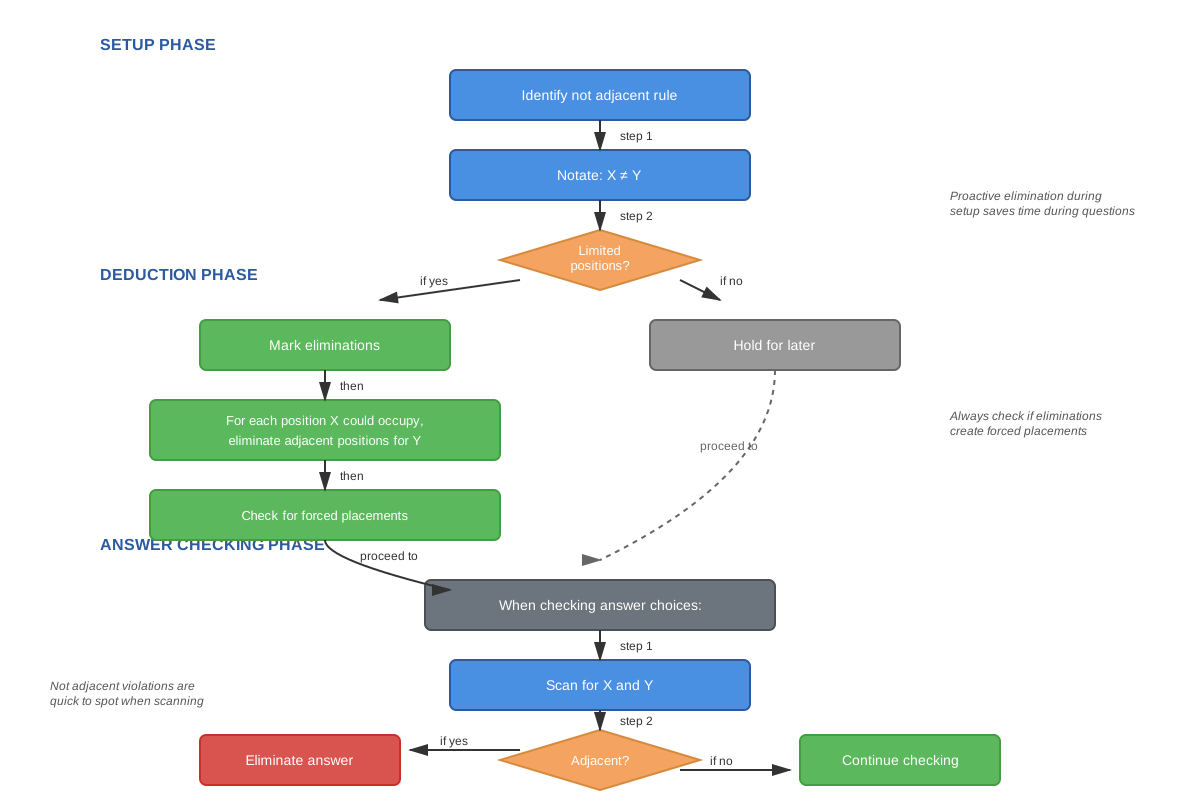
Overview
Not adjacent rules are a fundamental constraint type in LSAT Analytical Reasoning Legacy problems, particularly within sequencing games legacy. These rules specify that two or more elements cannot be placed immediately next to each other in a sequence or arrangement. Understanding and efficiently applying not adjacent rules is critical for success on the LSAT, as they appear frequently in logic games and directly impact how test-takers construct valid arrangements and eliminate incorrect answer choices.
In sequencing games, where elements must be ordered in positions (such as first through seventh, or Monday through Friday), not adjacent rules create spatial constraints that limit placement options. These rules function as negative conditions—they tell you what cannot happen rather than what must happen. This negative framing requires a different analytical approach than positive placement rules. Mastering not adjacent rules enables test-takers to make powerful deductions, quickly eliminate impossible scenarios, and identify forced placements when combined with other constraints.
Within the broader framework of Analytical Reasoning Legacy, not adjacent rules represent one of several constraint types that work together to define the logical structure of a game. They interact with conditional rules, block rules, and ordering rules to create complex logical puzzles. The ability to recognize, notate, and apply these rules efficiently separates high-scoring test-takers from those who struggle with timing and accuracy. Because sequencing games appear on virtually every LSAT administration, and not adjacent rules appear in a significant percentage of these games, this topic represents high-yield material that directly impacts test performance.
Learning Objectives
- [ ] Identify how Not adjacent rules appears in LSAT questions
- [ ] Explain the reasoning pattern behind Not adjacent rules
- [ ] Apply Not adjacent rules to solve LSAT-style problems accurately
- [ ] Translate verbal not adjacent rules into effective symbolic notation
- [ ] Recognize when not adjacent rules create forced placements in combination with other constraints
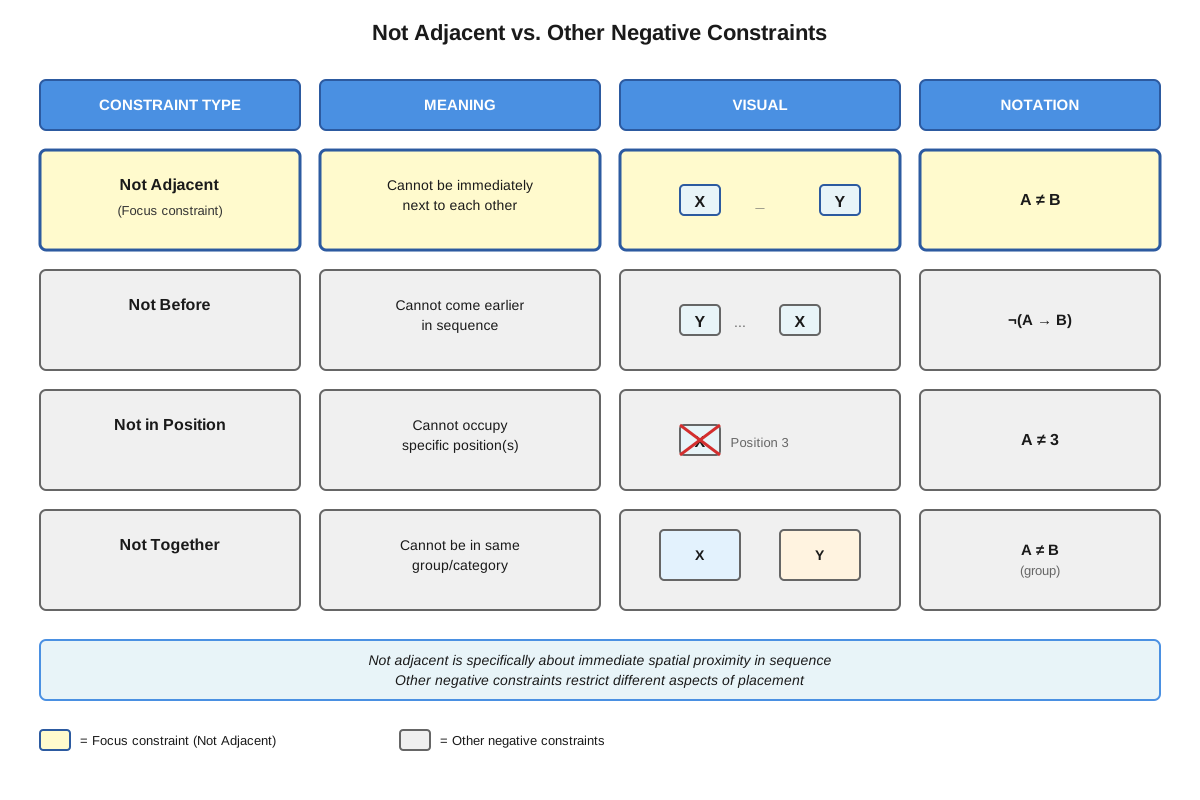
- [ ] Distinguish between not adjacent rules and other negative constraint types
- [ ] Efficiently test answer choices using not adjacent rules to eliminate violations
Prerequisites
- Basic sequencing game structure: Understanding positions, elements, and the goal of arranging elements in order is essential because not adjacent rules operate within these frameworks
- Symbolic notation fundamentals: Familiarity with representing rules symbolically enables efficient tracking of constraints during timed conditions
- Conditional reasoning basics: Recognizing if-then relationships helps identify when not adjacent rules trigger forced placements
- Game board setup techniques: Knowing how to create visual representations of games allows for effective application of spatial constraints
Why This Topic Matters
Not adjacent rules appear in approximately 60-70% of sequencing games on the LSAT, making them one of the most frequently tested constraint types in Analytical Reasoning Legacy. These rules are particularly important because they often serve as the foundation for major deductions that unlock entire games. When combined with other rules, not adjacent constraints frequently force specific placements or create limited scenarios that test-takers must recognize to work efficiently.
In real-world applications, not adjacent reasoning mirrors scheduling constraints (employees who cannot work consecutive shifts), project management (tasks that cannot occur back-to-back), and resource allocation (items that must be separated). This logical pattern appears throughout professional contexts, making it a valuable analytical skill beyond test preparation.
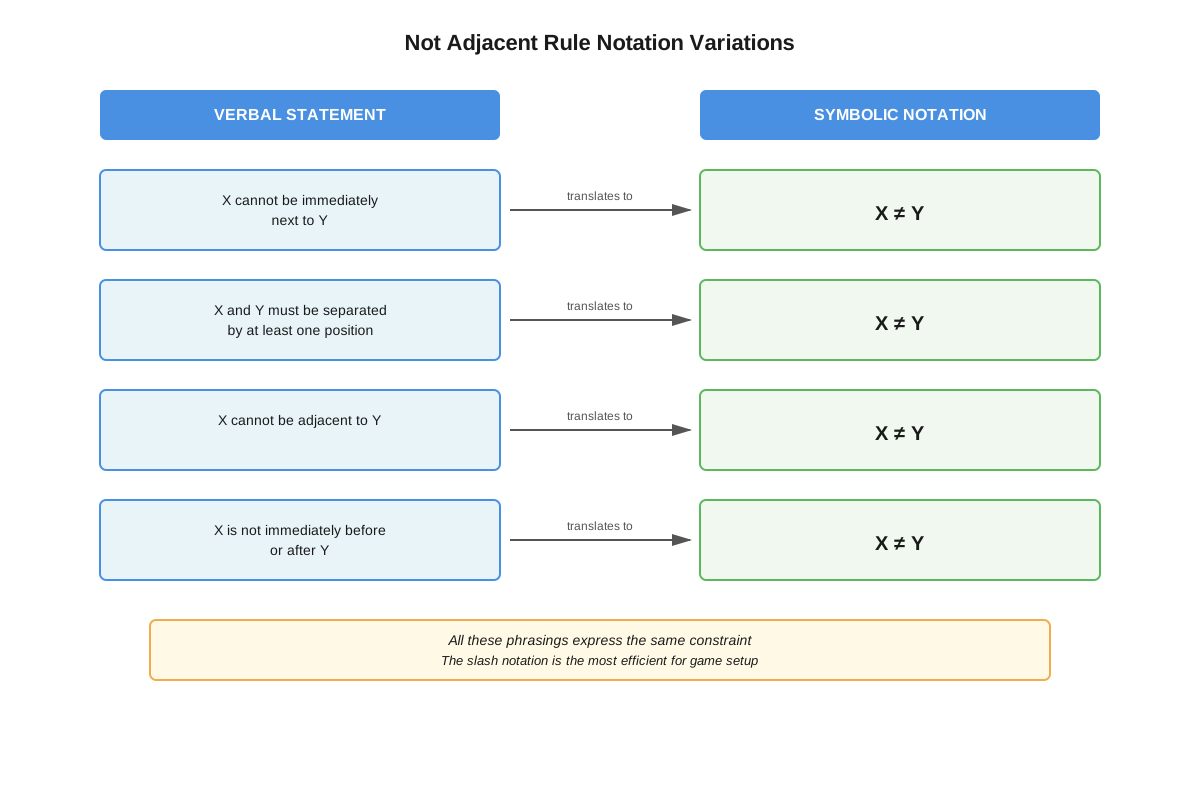
On the LSAT, not adjacent rules typically appear in several distinct formats: explicit statements ("X cannot be immediately before or after Y"), implicit constraints embedded in conditional rules ("If X is adjacent to Y, then..."), and compound rules involving multiple elements. Test-makers frequently use not adjacent rules in questions that ask about possible arrangements, must-be-true scenarios, and could-be-false situations. The most challenging questions combine not adjacent rules with conditional chains or block rules, requiring multi-step reasoning. Approximately 15-20% of all Analytical Reasoning questions directly test understanding of not adjacent constraints, while many additional questions require applying these rules as part of broader logical analysis.
Core Concepts
Definition and Basic Structure
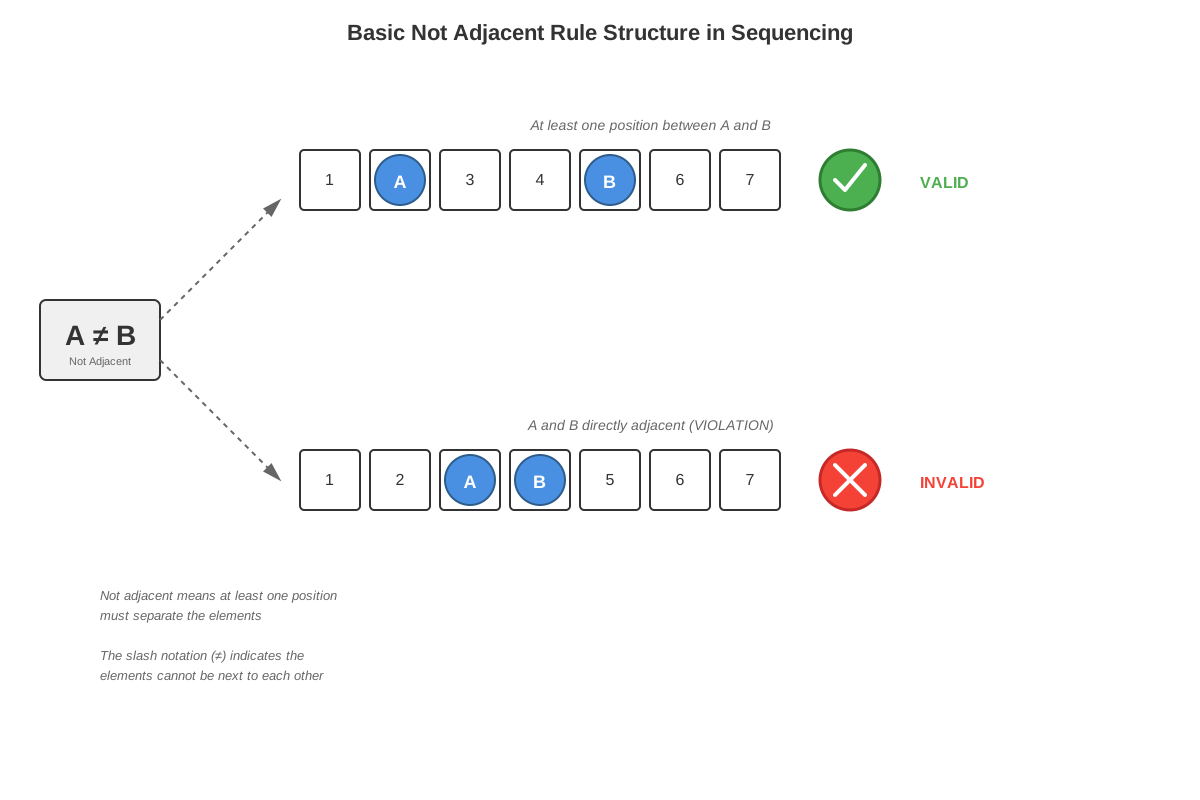
Not adjacent rules (also called anti-adjacency rules or separation rules) specify that two elements cannot occupy consecutive positions in a sequence. The fundamental structure is: Element A and Element B cannot be immediately next to each other. This constraint applies bidirectionally—A cannot be immediately before B, and A cannot be immediately after B. The rule does not prevent A and B from appearing in the same arrangement; it only restricts them from occupying adjacent positions.
The standard symbolic notation for not adjacent rules uses a "not" symbol with elements connected: ~(AB) or A ≠ B (adjacent). Some test-takers prefer visual notation showing the elements with a slash or X between them. The key is consistency and clarity in representation, as efficient notation directly impacts speed during timed conditions.
Spatial Implications in Sequencing
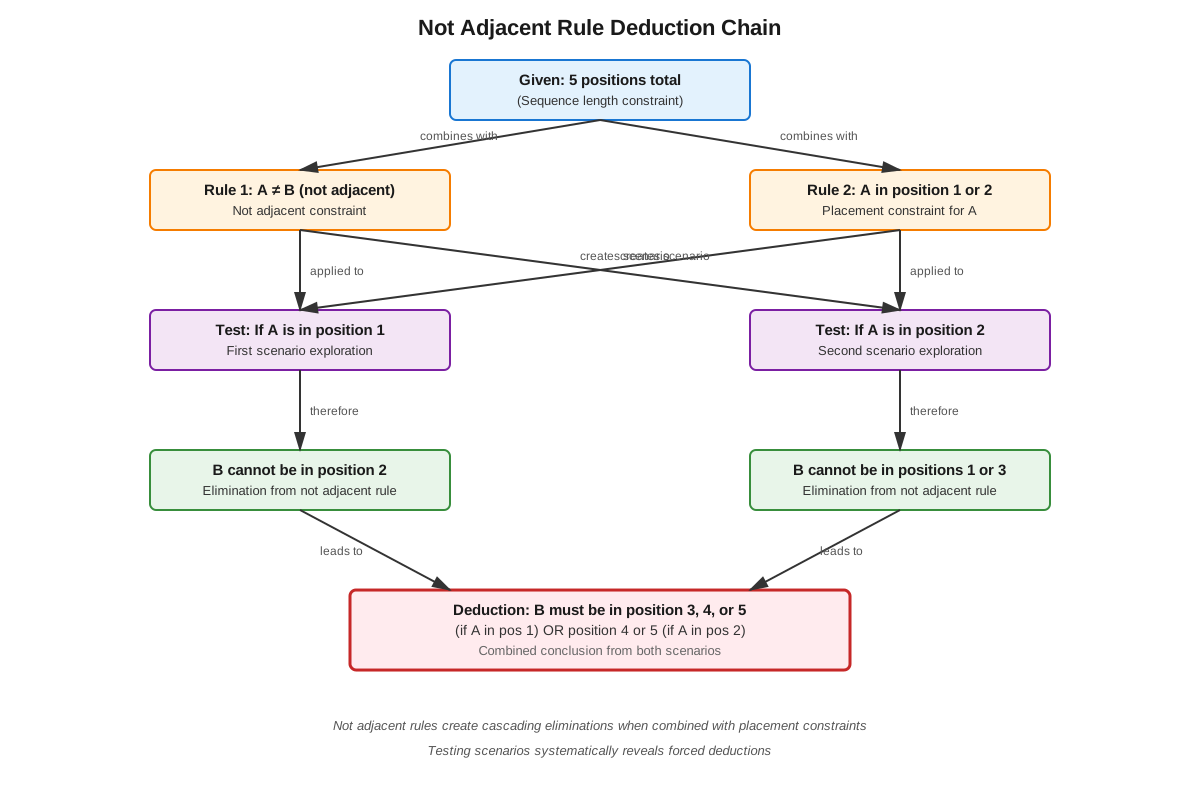
Not adjacent rules create buffer zones in sequencing arrangements. If element A is placed in position 3, and A cannot be adjacent to B, then B cannot occupy positions 2 or 4. This spatial restriction becomes more powerful at the endpoints of sequences. If A is in position 1, B cannot be in position 2. If A is in the final position of a seven-position sequence, B cannot be in position 6.
The spatial impact multiplies when multiple not adjacent rules involve the same element. If A cannot be adjacent to B, C, or D, then A's placement severely restricts the arrangement. In a five-position sequence, placing A in position 3 would require positions 2 and 4 to be filled by elements other than B, C, or D—potentially creating forced placements if few elements remain available.
Interaction with Other Rule Types
Not adjacent rules gain their greatest power through interaction with other constraints:
With Block Rules: If elements X and Y must be adjacent (a block rule), and Y cannot be adjacent to Z (a not adjacent rule), then X and Z cannot be separated by only Y. The XY block must be positioned so Z is not immediately after Y.
With Conditional Rules: When a conditional rule states "If P is in position 3, then Q is in position 4," and a not adjacent rule states Q cannot be adjacent to R, the conditional placement automatically restricts R from position 3 or 5.
With Ordering Rules: If A must come before B, and A cannot be adjacent to C, the combination restricts possible arrangements. If the sequence has only three positions, A cannot be in position 2 (because C could not be in position 1 or 3 without violating either the ordering or adjacency constraint).
Multiple Element Not Adjacent Rules
Some LSAT games present rules where one element cannot be adjacent to multiple other elements, or where multiple pairs have not adjacent relationships. These create complex constraint networks:
| Rule Type | Example | Implication |
|---|---|---|
| Single element, multiple restrictions | A cannot be adjacent to B, C, or D | A has very limited placement options; often forces A to endpoints |
| Multiple independent pairs | A ≠ B (adjacent) and C ≠ D (adjacent) | Two separate constraints that may create forced placements when combined |
| Chain restrictions | A ≠ B, B ≠ C, C ≠ D | Creates alternating pattern requirements |
Deductive Reasoning with Not Adjacent Rules
The most powerful application of not adjacent rules involves recognizing forced placements. Consider a five-position sequence with elements A, B, C, D, E, where A cannot be adjacent to B, and A cannot be adjacent to C. If positions 2, 3, and 4 must contain A, B, and C (due to other constraints), A must be in position 3, with B and C in positions 2 and 4 (in either order), because placing A in position 2 or 4 would require it to be adjacent to both B and C, which is impossible.
Another critical deduction pattern involves endpoint analysis. In a seven-position sequence, if A cannot be adjacent to B, C, or D, and there are only seven total elements, A can only be placed in positions where at most two positions are adjacent to it. Position 1 has only position 2 adjacent; position 7 has only position 6 adjacent. These become high-probability placements for heavily restricted elements.
Testing Answer Choices
When evaluating answer choices in LSAT questions, not adjacent rules provide quick elimination opportunities. The process involves:
- Identify all not adjacent rules applicable to the question
- Scan each answer choice for violations (elements that should not be adjacent appearing in consecutive positions)
- Eliminate any choice that violates a not adjacent rule
- Proceed to test remaining choices against other constraints
This systematic approach often eliminates 2-3 answer choices immediately, significantly improving efficiency and accuracy.
Concept Relationships
Not adjacent rules connect to other Analytical Reasoning Legacy concepts through multiple pathways:
Foundation Level: Basic sequencing game structure → provides the positional framework → where not adjacent rules operate
Constraint Level: Not adjacent rules + Block rules → create tension → requiring careful placement to satisfy both constraints simultaneously
Deduction Level: Not adjacent rules + Conditional rules → trigger forced placements → when conditional outcomes violate adjacency constraints
Strategic Level: Multiple not adjacent rules → create constraint networks → that limit possible arrangements → enabling scenario-based approaches
Within the topic itself, concepts build progressively: Basic definition and notation → Spatial implications in sequences → Interaction with single additional constraint → Complex multi-constraint deductions → Strategic application in timed conditions. Each level requires mastery of the previous level for effective application.
The relationship to prerequisite topics is direct: Sequencing game fundamentals provide the structure, symbolic notation enables efficient tracking, and conditional reasoning allows recognition of triggered constraints. These prerequisites are not merely helpful—they are essential for applying not adjacent rules effectively.
High-Yield Facts
⭐ Not adjacent rules are bidirectional: If A cannot be adjacent to B, then B also cannot be adjacent to A; the rule applies regardless of which element comes first in the sequence.
⭐ Endpoint positions have only one adjacent position: Elements in position 1 or the final position have fewer adjacency restrictions, making these positions strategic for heavily restricted elements.
⭐ Not adjacent rules do not prevent elements from appearing in the same arrangement: They only restrict consecutive positioning, not co-occurrence in the overall sequence.
⭐ Multiple not adjacent rules involving one element often force that element to specific positions: If A cannot be adjacent to three other elements in a five-position sequence, A's placement becomes severely limited.
⭐ Not adjacent rules combined with block rules create powerful deductions: When XY must be together and Y cannot be adjacent to Z, the XY block's placement is restricted relative to Z's position.
- Not adjacent rules apply to immediately consecutive positions only: Elements separated by one or more positions do not violate the rule.
- In circular arrangements, every position has two adjacent positions: The first and last positions are adjacent to each other, changing the spatial dynamics.
- Not adjacent rules can create forced scenarios: When enough positions are restricted, only one valid arrangement may remain.
- Testing answer choices for not adjacent violations is typically faster than testing for positive constraints: Visual scanning for consecutive forbidden pairs is efficient.
- Not adjacent rules often appear in "could be true" questions: These questions test whether test-takers recognize that separation (not adjacency) is possible.
Quick check — test yourself on Not adjacent rules so far.
Try Flashcards →Common Misconceptions
Misconception: Not adjacent rules mean the elements cannot appear in the same arrangement at all.
Correction: Not adjacent rules only restrict consecutive positioning. Elements can appear in the same sequence as long as at least one position separates them. In a seven-position sequence, A and B could be in positions 2 and 4, satisfying a not adjacent rule.
Misconception: If A cannot be adjacent to B, and B cannot be adjacent to C, then A cannot be adjacent to C.
Correction: Not adjacent rules are specific to the pairs mentioned. Unless explicitly stated, A and C can be adjacent. The rules create independent constraints that do not transfer transitively.
Misconception: Not adjacent rules are less important than positive placement rules.
Correction: Not adjacent rules are equally important and often create more powerful deductions when combined with other constraints. They frequently provide the key to unlocking entire games through forced placements.
Misconception: In a not adjacent rule, one element must come before the other in the sequence.
Correction: Not adjacent rules contain no ordering information. They only restrict spatial proximity. A could come before or after B in the sequence; the rule only prevents them from being consecutive.
Misconception: Not adjacent rules only matter for "must be true" questions.
Correction: Not adjacent rules are tested across all question types, including "could be true," "must be false," and "could be false" questions. They are also critical for elimination questions and partial arrangement questions.
Misconception: If three elements cannot be adjacent to each other (A ≠ B, B ≠ C, A ≠ C), they must alternate with other elements.
Correction: While alternation is one possibility, the elements could be grouped with multiple separating elements between them. In a seven-position sequence, A, B, and C could occupy positions 1, 3, and 7, with other elements filling the remaining positions.
Worked Examples
Example 1: Basic Application with Forced Placement
Setup: Seven students—A, B, C, D, E, F, G—are arranged in positions 1 through 7. The following rules apply:
- A cannot be adjacent to B
- C must be in position 4
- D must be immediately before E
- F must be in position 1 or 7
Question: If B is in position 3, which of the following must be true?
Solution:
Step 1: Place the given information. B is in position 3, C is in position 4 (from the rules).
1  2  3  4  5  6  7
_  _  B  C  _  _  _
Step 2: Apply the not adjacent rule. A cannot be adjacent to B. Since B is in position 3, A cannot be in position 2 or position 4. Position 4 is already occupied by C, so A cannot be in position 2.
Step 3: Consider the DE block. D and E must be consecutive. Possible positions for the DE block: 1-2, 2-3, 5-6, or 6-7. Position 2-3 is impossible because B is in position 3. So DE can be in positions 1-2, 5-6, or 6-7.
Step 4: Apply the F constraint. F must be in position 1 or 7.
Step 5: Test scenarios. If F is in position 1, then DE cannot be in positions 1-2. DE must be in positions 5-6 or 6-7. If F is in position 7, then DE cannot be in positions 6-7. DE must be in positions 1-2 or 5-6.
Step 6: Consider A's placement. A cannot be in position 2 (adjacent to B in position 3). A must be in position 1, 5, 6, or 7.
Step 7: Combine constraints. If F is in position 1, A must be in position 5, 6, or 7. If F is in position 7, and DE is in positions 1-2, then A must be in position 5 or 6. If F is in position 7, and DE is in positions 5-6, then A must be in position 1 or 2—but A cannot be in position 2, so A would be in position 1.
Conclusion: In all valid scenarios, A must be separated from B by at least one position, and the DE block's placement is restricted to specific position pairs. The question would provide answer choices to test against these deductions.
Example 2: Complex Multi-Rule Interaction
Setup: Five presentations—J, K, L, M, N—are scheduled in time slots 1 through 5. The following rules apply:
- J cannot be adjacent to K
- J cannot be adjacent to L
- M must be in slot 3
- N must be before K
Question: If K is in slot 4, which positions are possible for J?
Solution:
Step 1: Place the given information. M is in slot 3 (from rules), K is in slot 4 (from question).
1  2  3  4  5
_  _  M  K  _
Step 2: Apply not adjacent rules. J cannot be adjacent to K. Since K is in slot 4, J cannot be in slot 3 or slot 5. Slot 3 is already occupied by M, so J cannot be in slot 5.
Step 3: Apply the second not adjacent rule. J cannot be adjacent to L. This will restrict J's placement depending on where L is located.
Step 4: Determine possible positions for J. J cannot be in slot 3 (occupied by M) or slot 5 (adjacent to K). J could potentially be in slot 1 or slot 2.
Step 5: Test slot 1 for J. If J is in slot 1, L cannot be in slot 2 (would be adjacent to J). L must be in slot 5. N must be before K (slot 4), so N could be in slot 1, 2, or 3. But J is in slot 1 and M is in slot 3, so N must be in slot 2. This gives us: J-N-M-K-L. This arrangement satisfies all rules.
Step 6: Test slot 2 for J. If J is in slot 2, L cannot be in slot 1 or slot 3 (would be adjacent to J). Slot 3 is occupied by M, so L cannot be in slot 1. L must be in slot 5. N must be before K, so N must be in slot 1. This gives us: N-J-M-K-L. This arrangement satisfies all rules.
Conclusion: J can be in position 1 or position 2. Both positions keep J separated from K and allow valid arrangements with all other constraints satisfied.
Exam Strategy
When approaching LSAT questions involving not adjacent rules, follow this systematic process:
Recognition Phase: Identify trigger language such as "cannot be immediately before," "cannot be immediately after," "cannot be next to," "cannot be consecutive," or "must be separated by at least one." These phrases signal not adjacent rules. Also watch for negative conditional statements like "If X is adjacent to Y, then [contradiction]," which imply X and Y cannot be adjacent.
Notation Phase: Immediately translate not adjacent rules into clear symbolic notation on your game board. Use consistent symbols throughout the test. Place the notation where it is visible but does not clutter the main game board—typically above or to the side of the position diagram.
Deduction Phase: Before attempting questions, analyze not adjacent rules for immediate deductions:
- Identify elements with multiple not adjacent restrictions
- Check endpoint implications (elements restricted from positions 1 or the final position)
- Look for interactions with block rules or conditional rules
- Determine if any positions are impossible for specific elements
Question Approach: For each question type, apply not adjacent rules strategically:
"Must Be True" questions: Look for answer choices that would violate not adjacent rules if false. These violations make the opposite must be true.
"Could Be True" questions: Eliminate answer choices that place forbidden elements adjacent to each other. The correct answer will satisfy all not adjacent rules.
"Must Be False" questions: The correct answer will violate a not adjacent rule or create a scenario where such a violation is inevitable.
Time Management: Not adjacent rule violations are among the fastest to spot visually. When time is limited, scan answer choices for obvious adjacency violations before testing more complex constraints. This approach can eliminate 40-60% of wrong answers in under 10 seconds per question.
Process of Elimination: Create a mental checklist of all not adjacent pairs before evaluating answer choices. Systematically check each answer against this list. Mark eliminated choices clearly to avoid reconsidering them.
Memory Techniques
Mnemonic for Not Adjacent Rule Application: "SPACE"
- Spot the rule in the setup
- Place elements with restrictions at endpoints when possible
- Analyze interactions with other constraints
- Check answer choices for violations
- Eliminate impossible arrangements quickly
Visualization Strategy: Picture not adjacent rules as "force fields" around elements. When you place an element on your game board, visualize a one-position buffer zone on each side where restricted elements cannot go. This spatial visualization makes violations immediately apparent.
Symbol Consistency: Always use the same notation for not adjacent rules throughout your practice and on test day. Muscle memory in notation reduces cognitive load during timed conditions. Many high-scoring test-takers use a simple "≠" symbol with a small "adj" subscript: A ≠ₐdⱼ B.
Endpoint Acronym: "ENDS" - Elements with Not-adjacent restrictions Demand Strategic placement. Remember that positions 1 and the final position have only one adjacent position, making them ideal for heavily restricted elements.
Interaction Memory Device: Think of not adjacent rules as "repelling magnets" and block rules as "attracting magnets." When both types of rules exist in a game, visualize the tension between attraction and repulsion to remember that these rule types create powerful deductions when combined.
Summary
Not adjacent rules represent a critical constraint type in LSAT Analytical Reasoning Legacy, particularly within sequencing games. These rules specify that certain elements cannot occupy consecutive positions in an arrangement, creating spatial restrictions that limit valid configurations. Mastery requires understanding the bidirectional nature of these constraints, recognizing their interaction with other rule types, and efficiently applying them to eliminate incorrect answer choices. The most powerful applications involve identifying forced placements when not adjacent rules combine with block rules, conditional rules, or multiple restrictions on a single element. Endpoint positions (first and last) become strategically important because they have fewer adjacent positions, making them ideal placements for heavily restricted elements. Successful test-takers develop systematic approaches to notation, deduction, and answer choice evaluation that leverage not adjacent rules for quick eliminations and accurate reasoning. The ability to visualize spatial implications and test scenarios efficiently separates high-scoring performance from average results on questions involving these constraints.
Key Takeaways
- Not adjacent rules are bidirectional constraints that prevent consecutive positioning but do not prohibit elements from appearing in the same arrangement with separation
- Endpoint positions (first and last) have only one adjacent position, making them strategic placements for elements with multiple not adjacent restrictions
- The combination of not adjacent rules with block rules or conditional rules creates powerful forced placements that unlock entire games
- Visual scanning for adjacency violations provides the fastest method for eliminating incorrect answer choices in timed conditions
- Elements with multiple not adjacent restrictions often have severely limited placement options, leading to critical deductions
- Not adjacent rules appear in 60-70% of sequencing games and are tested across all question types, making them high-yield material for score improvement
- Systematic notation and consistent application processes reduce errors and improve speed on test day
Related Topics
Block Rules in Sequencing Games: Understanding how elements that must be adjacent interact with not adjacent rules creates advanced deduction opportunities. Mastering not adjacent rules provides the foundation for recognizing when blocks cannot be placed in certain positions due to adjacency restrictions.
Conditional Rules and Triggered Constraints: Not adjacent rules often appear in the consequent of conditional statements. Proficiency with not adjacent rules enables faster recognition of when conditional triggers create impossible scenarios due to adjacency violations.
Scenario-Based Game Approaches: When multiple not adjacent rules severely restrict arrangements, creating limited scenarios becomes an efficient strategy. Mastery of not adjacent rules allows accurate scenario construction and complete game solutions.
Circular Sequencing Games: In circular arrangements, every position has two adjacent positions, including the first and last. Understanding linear not adjacent rules prepares students for the modified spatial reasoning required in circular games.
Practice CTA
Now that you have thoroughly reviewed not adjacent rules, it is time to cement your understanding through active practice. Attempt the practice questions associated with this topic, focusing on applying the systematic approaches outlined in the exam strategy section. Pay particular attention to questions that combine not adjacent rules with other constraint types, as these represent the highest-yield question patterns on the LSAT. Use the flashcards to reinforce quick recognition of trigger language and common deduction patterns. Remember that mastery comes through repeated application—each practice question strengthens your pattern recognition and increases your speed for test day. Your investment in understanding this high-frequency topic will directly translate to points on the Analytical Reasoning section. Approach practice with focus and confidence, knowing that not adjacent rules are now a strength in your LSAT preparation.
Sign up free to keep reading
Create a free AnvayaPrep account to finish this LSAT guide on Not adjacent rules — plus flashcards and practice questions.