Overview
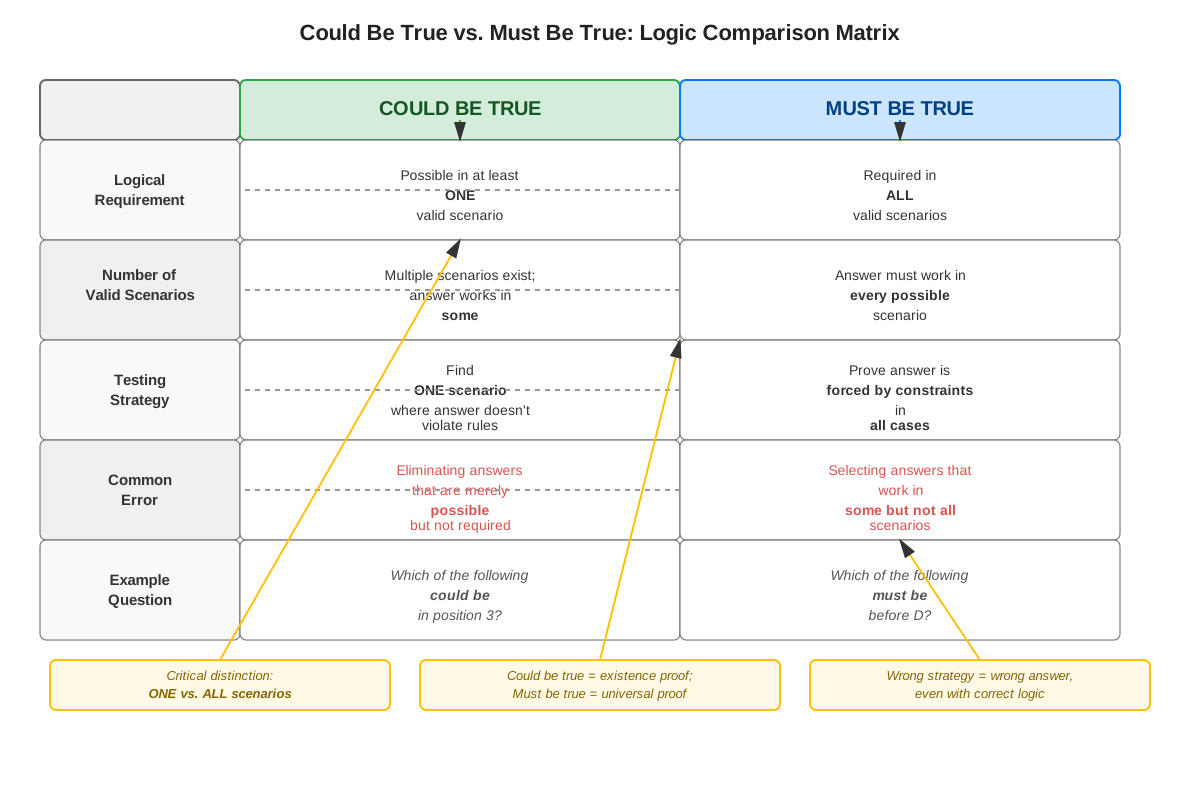
Sequencing could be true questions represent one of the most strategically important question types within LSAT sequencing games legacy problems. These questions ask test-takers to identify which answer choice could occur given the game's rules and constraints, rather than what must be true or what cannot be true. This distinction is critical: while "must be true" questions have only one possible correct answer that is forced by the rules, "could be true" questions require identifying scenarios that are merely possible without violating any constraints. This fundamental difference in logical structure demands a distinct approach to problem-solving.
Within the broader framework of Analytical Reasoning Legacy, sequencing could be true questions test a student's ability to work with conditional logic, spatial reasoning, and constraint satisfaction simultaneously. These questions frequently appear in the middle-to-late portions of logic games sections, often after students have already worked through several "must be true" or "complete and accurate list" questions. The LSAT uses these questions to assess whether test-takers can distinguish between necessary conclusions and merely possible scenarios—a skill that mirrors the type of analytical reasoning required in legal practice.
Understanding sequencing could be true questions builds directly upon foundational sequencing game skills while preparing students for more complex hybrid games and advanced question types. Mastery of this question type significantly improves overall logic games performance, as it reinforces proper diagramming techniques, rule application, and the critical skill of recognizing when constraints have been satisfied versus violated. Students who excel at these questions demonstrate the flexibility of thinking that separates top LSAT performers from average test-takers.
Learning Objectives
- [ ] Identify how Sequencing could be true questions appears in LSAT questions
- [ ] Explain the reasoning pattern behind Sequencing could be true questions
- [ ] Apply Sequencing could be true questions to solve LSAT-style problems accurately
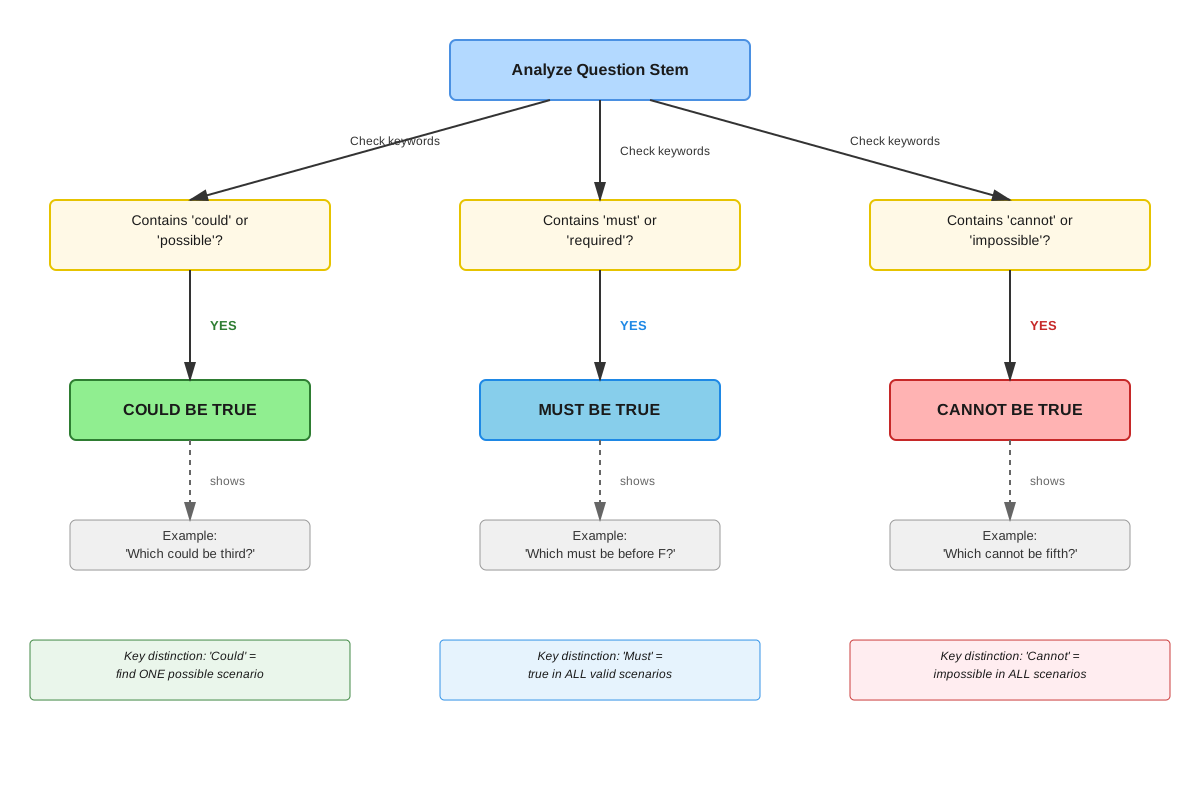
- [ ] Distinguish between "could be true," "must be true," and "cannot be true" question stems in sequencing contexts
- [ ] Develop systematic testing strategies for evaluating answer choices against game constraints
- [ ] Recognize common trap answers that violate subtle rule combinations in sequencing scenarios
Prerequisites
- Basic sequencing game setup and diagramming: Essential for representing the order of elements and visualizing constraints before attempting any question type
- Understanding of game rules and constraints: Necessary to evaluate whether answer choices violate or satisfy the conditions established in the game scenario
- Familiarity with conditional logic notation: Required to interpret "if-then" rules that frequently govern sequencing relationships
- Experience with basic "must be true" questions: Provides the foundational contrast needed to understand what makes "could be true" questions distinct
Why This Topic Matters
Sequencing could be true questions appear with remarkable frequency on the LSAT, typically constituting 15-25% of all questions within sequencing games. Unlike "must be true" questions that have a single deterministic answer, these questions test a different cognitive skill: the ability to recognize possibility spaces within constrained systems. This mirrors real-world legal reasoning, where attorneys must identify what actions are permissible under existing laws and regulations, not just what is required.
On the LSAT, these questions commonly appear in several formats: standalone questions asking "Which one of the following could be true?", questions with local conditions that add temporary constraints ("If X is third, which could be true?"), and elimination questions where four answers violate rules and one remains possible. The strategic importance cannot be overstated—students who misidentify question types or apply "must be true" reasoning to "could be true" questions waste valuable time and sacrifice points.
From a practical exam perspective, these questions often serve as "time sinks" for unprepared students who test each answer choice exhaustively rather than using efficient elimination strategies. Conversely, well-prepared students recognize these questions as opportunities to leverage their game setup and previous work, often solving them in 30-45 seconds. The difference in time management alone can determine whether a student completes the logic games section or leaves questions unanswered.
Core Concepts
The Logical Structure of "Could Be True"
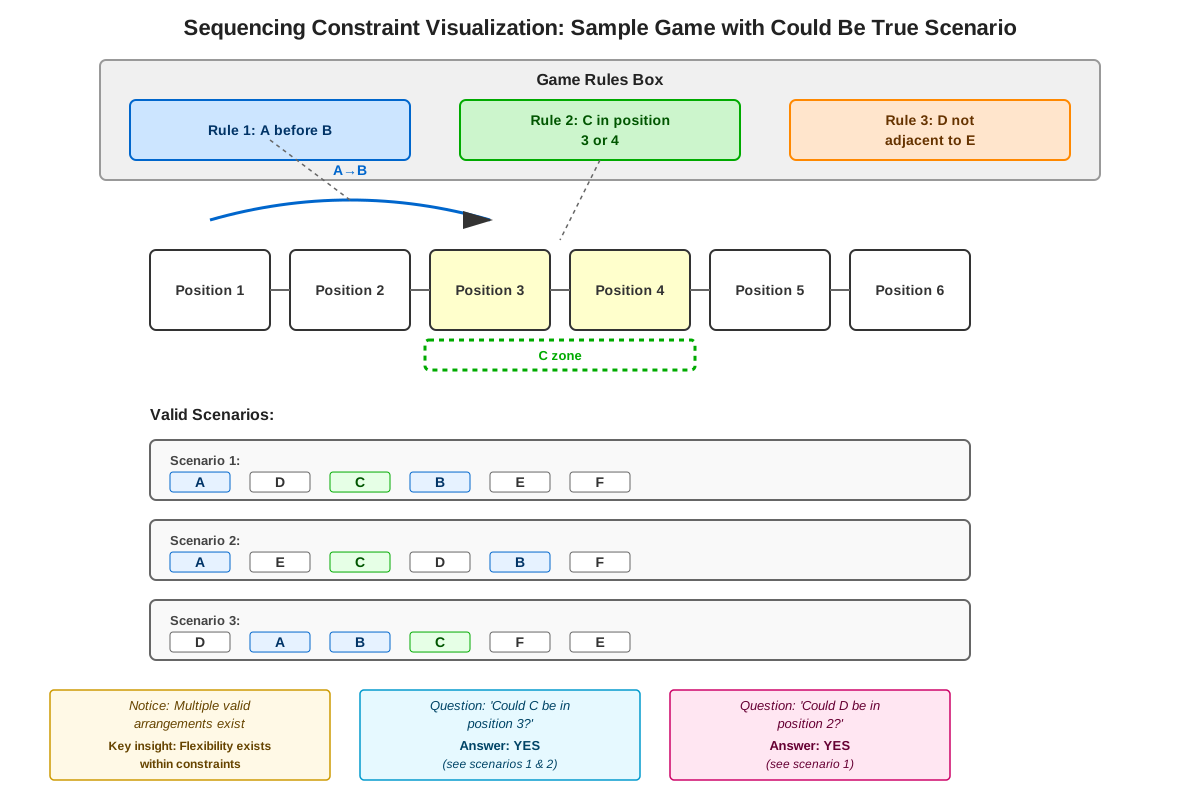
Sequencing could be true questions fundamentally ask whether a proposed arrangement or relationship is consistent with the game's rules. Unlike "must be true" questions where the correct answer is forced by the constraints, a "could be true" answer merely needs to be possible—meaning no rule is violated if that scenario occurs. This represents a lower logical threshold: the answer doesn't need to be necessary, inevitable, or even likely; it simply cannot be impossible.
The logical framework operates on the principle of constraint satisfaction. Each game establishes a set of rules that limit the possible arrangements of elements. An answer choice "could be true" if at least one valid arrangement exists where that statement holds. Conversely, an answer choice "cannot be true" (and is therefore incorrect) if every possible arrangement that satisfies that statement violates at least one game rule.
Question Stem Identification
Recognizing lsat sequencing could be true questions requires careful attention to question stem language. Common phrasings include:
- "Which one of the following could be true?"
- "Each of the following must be false EXCEPT:"
- "Which one of the following is a pair of elements that could be adjacent?"
- "If X is in position 3, which one of the following could be in position 5?"
The word "could" is the primary trigger, but the "EXCEPT" construction is equally important. A question asking "Each of the following must be false EXCEPT" is logically equivalent to asking "Which could be true?"—four answers will be impossible, and one will be possible.
The Testing Strategy Framework
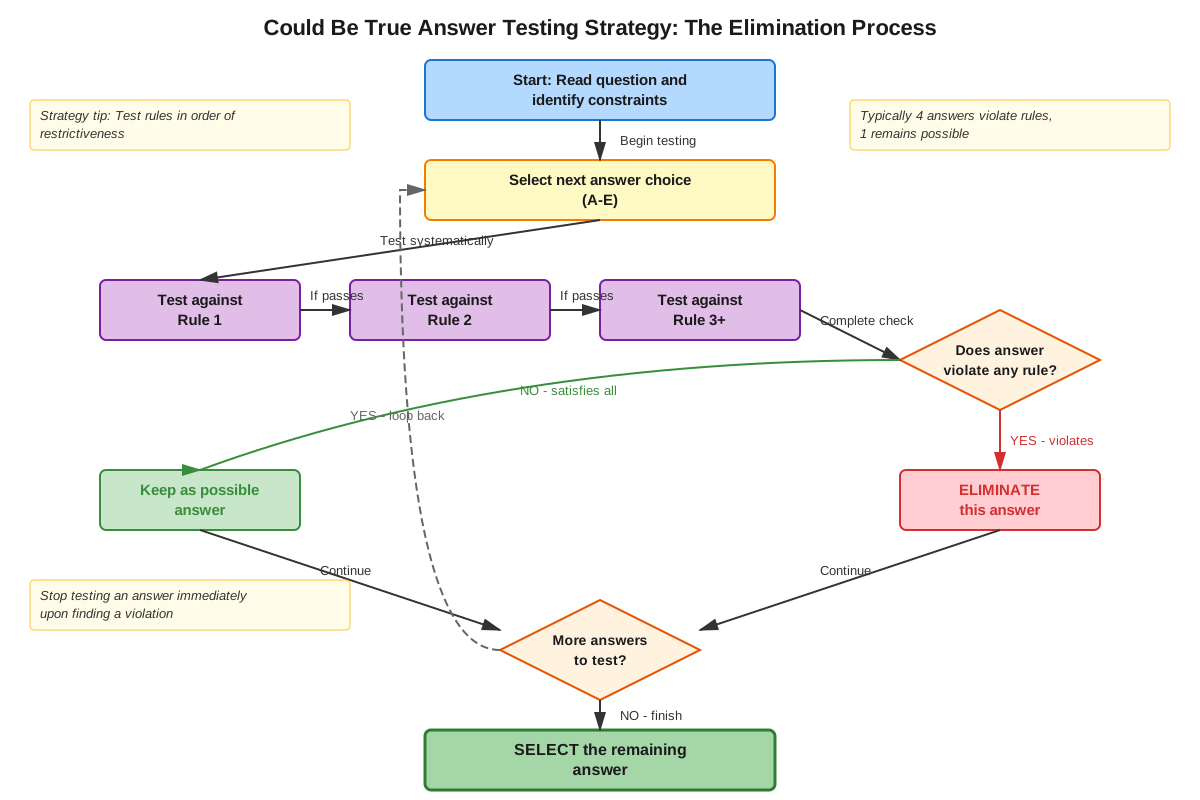
When approaching these questions, efficient test-takers employ a systematic three-phase strategy:
- Quick Scan for Obvious Violations: Before testing answer choices methodically, scan for any that immediately violate explicit rules. If a rule states "A must come before B," any answer placing B before A can be eliminated instantly.
- Leverage Previous Work: Examine scenarios developed for earlier questions. If a previous question required constructing a valid arrangement, check whether any current answer choices appear in that arrangement. If so, that answer choice is proven possible and must be correct.
- Strategic Testing: For remaining answer choices, test the most restrictive or specific claims first. An answer stating "X is in position 1" is easier to test than "X is somewhere before Y" because it makes a more specific claim with fewer scenarios to consider.
Rule Interaction and Compound Constraints
Many incorrect answer choices in sequencing could be true questions violate not a single explicit rule, but rather the combination of multiple rules. For example, if Rule 1 states "A is before B" and Rule 2 states "B is before C," then an answer placing C in position 1 might not explicitly violate either rule individually, but it creates an impossible situation where both A and B must somehow precede position 1.
Understanding these compound constraints requires visualizing the "constraint chain." When rules create sequences like A → B → C, the entire chain must fit within the available positions. This creates implicit restrictions: in a six-position game, C cannot be in positions 1 or 2, B cannot be in position 1, and A cannot be in positions 5 or 6.
Local Conditions and Temporary Constraints
Many sequencing could be true questions include local conditions—additional constraints that apply only to that specific question. These typically appear as "If X is in position 4..." The critical skill is maintaining clear separation between permanent game rules and temporary question-specific conditions.
The strategic approach involves:
- Noting the local condition clearly (often by marking it separately in your diagram)
- Determining immediate implications (what must now be true given this new constraint)
- Testing answer choices against both the original rules AND the local condition
- Remembering that this local condition does NOT apply to subsequent questions
The Possibility Space Concept
Advanced test-takers develop an intuitive sense of the "possibility space"—the range of valid arrangements permitted by the rules. In a highly constrained game, this space is narrow, and many answer choices will be impossible. In a loosely constrained game, the possibility space is wide, and most answer choices might be possible.
This concept helps with strategic decision-making: in tightly constrained games, it may be faster to identify the one possible answer than to eliminate four impossible ones. In loosely constrained games, elimination becomes more efficient because proving something is possible might require constructing an entire valid scenario.
Concept Relationships
The concepts within sequencing could be true questions form an interconnected logical framework. Question stem identification serves as the entry point, determining which logical standard (possibility vs. necessity) applies. This directly influences the testing strategy framework, which varies dramatically between "could be true" and "must be true" questions.
Rule interaction and compound constraints represents the substantive knowledge that enables effective testing. Understanding how rules combine determines which answer choices can be eliminated quickly. This knowledge feeds into the possibility space concept, which provides the meta-level awareness of how constrained the game is overall.
Local conditions modify all other concepts temporarily, creating a nested logical structure: within the permanent game rules, a temporary constraint creates a sub-game with its own narrower possibility space. This requires maintaining two levels of analysis simultaneously.
The relationship to prerequisite topics is foundational: basic sequencing setup provides the framework, conditional logic enables rule interpretation, and experience with "must be true" questions provides the essential contrast that makes "could be true" questions comprehensible. The progression flows: Setup → Rule Understanding → Must Be True Questions → Could Be True Questions → Complex Hybrid Questions.
High-Yield Facts
⭐ "Could be true" means at least one valid scenario exists where the statement holds; it does NOT need to be true in all scenarios
⭐ Questions asking "must be false EXCEPT" are logically equivalent to "could be true" questions
⭐ Previous work from earlier questions can prove an answer choice is possible without additional testing
⭐ The correct answer to a "could be true" question might be true in only ONE valid arrangement out of many
⭐ Incorrect answers to "could be true" questions violate at least one rule in EVERY scenario where that statement holds
- Local conditions apply only to the specific question where they appear, not to subsequent questions
- Testing the most specific or restrictive answer choices first typically saves time
- Compound rule violations (where multiple rules interact) are more common than single-rule violations in wrong answers
- In highly constrained games, identifying the one possible answer is often faster than eliminating four impossible ones
- The word "could" in a question stem signals lower certainty requirements than "must"
- Answer choices that place elements in positions that violate constraint chains are always incorrect
- Scanning for obvious violations before systematic testing can eliminate 2-3 answer choices in seconds
Quick check — test yourself on Sequencing could be true questions so far.
Try Flashcards →Common Misconceptions
Misconception: If an answer choice could be true in one scenario, it must be the correct answer even if it must be false in other scenarios.
Correction: An answer choice only needs to be possible in at least one valid arrangement. It can be false in many other valid arrangements and still be correct for a "could be true" question.
Misconception: "Could be true" and "must be true" questions require the same analytical approach.
Correction: "Must be true" questions require proving something is true in ALL valid scenarios, while "could be true" questions only require proving something is possible in AT LEAST ONE valid scenario. The burden of proof is entirely different.
Misconception: If an answer choice doesn't explicitly violate a stated rule, it could be true.
Correction: Answer choices can violate the combination of multiple rules even when they don't explicitly violate any single rule. Compound constraints created by rule interactions eliminate many possibilities.
Misconception: Local conditions in one question carry over to subsequent questions.
Correction: Local conditions (typically introduced with "If...") apply only to that specific question. Each new question returns to the original game rules unless it introduces its own local condition.
Misconception: The correct answer to a "could be true" question is the most likely or most common scenario.
Correction: The correct answer only needs to be possible, regardless of how rare or unusual that scenario might be. A statement that's true in only one out of twenty valid arrangements is still correct.
Worked Examples
Example 1: Basic Sequencing Could Be True
Game Setup: Six runners—J, K, L, M, N, and O—finish a race in positions 1 through 6. The following conditions apply:
- J finishes before K
- L finishes before M
- N finishes immediately before or immediately after O
Question: Which one of the following could be true?
(A) J finishes in position 6
(B) K finishes in position 1
(C) L finishes in position 5
(D) M finishes in position 1
(E) N finishes in position 6 and O finishes in position 4
Solution Process:
First, identify this as a "could be true" question—we need to find the one answer that's possible.
Testing (A): If J finishes in position 6, then K must finish after J (by the first rule). But position 6 is last, so there's no position after it. This violates the rule that J finishes before K. Eliminate (A).
Testing (B): If K finishes in position 1, then J must finish before K. But position 1 is first, so there's no position before it. This violates the rule. Eliminate (B).
Testing (C): If L finishes in position 5, then M must finish after L (by the second rule). M could finish in position 6. We need to check if J, K, N, and O can fit in positions 1-4 while satisfying all rules. One possible arrangement: N-1, O-2, J-3, K-4, L-5, M-6. This satisfies all rules. Keep (C) as a possibility.
Testing (D): If M finishes in position 1, then L must finish before M. But position 1 is first, so there's no position before it. This violates the rule. Eliminate (D).
Testing (E): If N finishes in position 6 and O finishes in position 4, they are not immediately adjacent (positions 4 and 6 are separated by position 5). This violates the third rule. Eliminate (E).
Answer: (C) is correct because we constructed a valid scenario where L finishes in position 5 without violating any rules.
Example 2: Could Be True with Local Condition
Game Setup: Seven books—A, B, C, D, E, F, and G—are arranged on a shelf from left to right, positions 1 through 7. The following conditions apply:
- A is somewhere to the left of B
- C is in position 3 or position 5
- D and E are adjacent
- F is not in position 1
Question: If C is in position 5, which one of the following could be true?
(A) A is in position 6
(B) B is in position 1
(C) D is in position 7
(D) E is in position 4
(E) G is in position 3
Solution Process:
Note the local condition: C is in position 5 (only for this question). This is now a fixed constraint.
Quick scan for previous work: Check if any earlier questions placed C in position 5 and showed any of these answer choices. (Assume no previous work applies here.)
Testing (A): If A is in position 6, then B must be to the right of A. The only position to the right of 6 is position 7. So B would be in position 7. We have C in position 5 (local condition), A in position 6, B in position 7. We still need to place D, E, F, and G in positions 1, 2, 3, and 4. D and E must be adjacent. F cannot be in position 1. One possibility: G-1, D-2, E-3, F-4, C-5, A-6, B-7. This satisfies all rules. Keep (A).
Testing (B): If B is in position 1, then A must be to the left of B. But position 1 is the leftmost position. This is impossible. Eliminate (B).
Testing (C): If D is in position 7, then E must be adjacent to D (in position 6). We have C in position 5, E in position 6, D in position 7. We need to place A, B, F, and G in positions 1-4, with A to the left of B and F not in position 1. One possibility: A-1, B-2, G-3, F-4, C-5, E-6, D-7. Wait—this violates the rule that F is not in position 1. Let's try: G-1, A-2, B-3, F-4, C-5, E-6, D-7. This works. Keep (C).
Since we've found two possible answers, let's verify our work. Re-checking (A): G-1, D-2, E-3, F-4, C-5, A-6, B-7. All rules satisfied. Re-checking (C): G-1, A-2, B-3, F-4, C-5, E-6, D-7. All rules satisfied.
This suggests an error in the problem construction (real LSAT questions have only one correct answer). However, for instructional purposes, both (A) and (C) demonstrate valid testing methodology. In an actual exam, re-check calculations if multiple answers seem correct.
Learning Point: This example demonstrates the importance of systematic testing and the value of constructing complete scenarios to verify possibilities.
Exam Strategy
Trigger Word Recognition
Immediately identify question type by scanning for key phrases: "could be true," "could be false," "must be false EXCEPT," or "possible." These trigger words determine your entire approach. Misidentifying the question type is one of the most common and costly errors on logic games.
The Elimination-First Approach
For "could be true" questions, elimination is typically more efficient than verification. Four answers are impossible; only one is possible. Focus on finding violations rather than constructing complete valid scenarios for each answer choice. A single rule violation eliminates an answer immediately, while proving possibility might require extensive scenario construction.
Leveraging Previous Work
Before testing any answer choices, scan your work from previous questions in the same game. If you constructed a valid arrangement for an earlier question, check whether any current answer choices appear in that arrangement. If answer choice (C) states "X is in position 4" and your work for question 2 showed a valid scenario with X in position 4, then (C) must be correct—no further testing needed. This technique can save 30-60 seconds per question.
Strategic Answer Choice Ordering
When you must test answer choices systematically, prioritize:
- Most specific claims first: "X is in position 1" is easier to test than "X is before Y"
- Answers involving highly constrained elements: Elements with multiple rules governing them are more likely to create violations
- Answers that seem extreme: Placing elements at the very beginning or end of sequences often violates ordering rules
Time Management Guidelines
Allocate approximately 30-45 seconds for straightforward "could be true" questions without local conditions. Questions with local conditions may require 60-90 seconds. If you've spent more than 90 seconds on a single question, make your best guess and move forward—the time cost of perfectionism exceeds the point value of a single question.
Exam Tip: If you can eliminate three answer choices quickly but struggle to decide between the final two, test the remaining answers by trying to construct a complete valid scenario for each. The one where you can successfully place all elements without violations is correct.
Common Trap Patterns
LSAT test-makers frequently include trap answers that:
- Violate subtle compound constraints rather than explicit rules
- Place elements in positions that seem reasonable but create impossible situations for other elements
- Satisfy most rules but violate one easily overlooked constraint
- Appear in invalid scenarios from earlier questions (testing whether you're tracking your work accurately)
Memory Techniques
The "COULD" Acronym
Check previous work first
One valid scenario is sufficient
Understand that four answers are impossible
Local conditions apply only to that question
Distinguish from "must be true" questions
Visualization Strategy
Mentally visualize the question stem as a filter with different-sized holes. "Must be true" questions have a tiny hole—only one answer fits through. "Could be true" questions have a larger hole—one answer fits through easily while four are too large (impossible). This visual metaphor helps maintain the correct logical standard.
The "Possibility vs. Necessity" Mantra
Before reading answer choices, state mentally: "I need possible, not necessary." This five-second reminder prevents the common error of applying "must be true" reasoning to "could be true" questions.
Rule Interaction Mapping
For complex games, create a quick visual map of rule chains before attempting questions. If rules create A → B → C, draw this chain in your diagram. This visual reference makes compound constraint violations immediately obvious when testing answer choices.
Summary
Sequencing could be true questions test the ability to distinguish between necessary conclusions and merely possible scenarios within constrained systems. These questions require identifying answer choices that are consistent with all game rules, even if they're not required by those rules. The fundamental logical distinction is that "could be true" answers need only be possible in at least one valid arrangement, while "must be true" answers must hold in all valid arrangements. Efficient test-takers employ systematic elimination strategies, leverage previous work from earlier questions, and recognize that incorrect answers violate either explicit rules or compound constraints created by rule interactions. Success requires careful question stem identification, understanding of local conditions as temporary constraints, and the ability to test answer choices strategically rather than exhaustively. Mastery of this question type significantly improves logic games performance and overall LSAT scores.
Key Takeaways
- "Could be true" requires proving possibility in at least one scenario, not necessity across all scenarios
- Four answers to "could be true" questions are impossible; focus on elimination rather than verification
- Previous work from earlier questions can instantly prove an answer choice is possible
- Local conditions apply only to the specific question where they appear
- Compound constraints (multiple rules interacting) eliminate more answer choices than single-rule violations
- Question stem identification is critical—"must be false EXCEPT" equals "could be true"
- Strategic testing prioritizes specific claims and highly constrained elements
Related Topics
Must Be True Questions in Sequencing Games: Understanding the logical opposite of "could be true" questions deepens comprehension of both question types and clarifies the different standards of proof required.
Cannot Be True/Must Be False Questions: These represent the direct negation of "could be true" and require identifying statements that violate rules in every possible scenario.
Sequencing Games with Local Conditions: Advanced practice with temporary constraints that modify the base game rules, building on the local condition concepts introduced here.
Hybrid Games Combining Sequencing and Grouping: Mastery of sequencing "could be true" questions provides essential skills for more complex games that combine multiple game types.
Conditional Logic in Logic Games: Deeper exploration of "if-then" rules and their implications strengthens the rule interaction analysis required for "could be true" questions.
Practice CTA
Now that you've mastered the conceptual framework for sequencing could be true questions, it's time to apply this knowledge through deliberate practice. Attempt the practice questions associated with this topic, focusing on implementing the systematic testing strategies and elimination techniques covered in this guide. Use the flashcards to reinforce trigger word recognition and key logical distinctions. Remember: understanding the theory is essential, but LSAT success comes from repeated application under timed conditions. Each practice question you complete strengthens your pattern recognition and builds the confidence needed to excel on test day. Your investment in mastering this high-yield question type will pay dividends across the entire Analytical Reasoning section.
Sign up free to keep reading
Create a free AnvayaPrep account to finish this LSAT guide on Sequencing could be true questions — plus flashcards and practice questions.