Overview
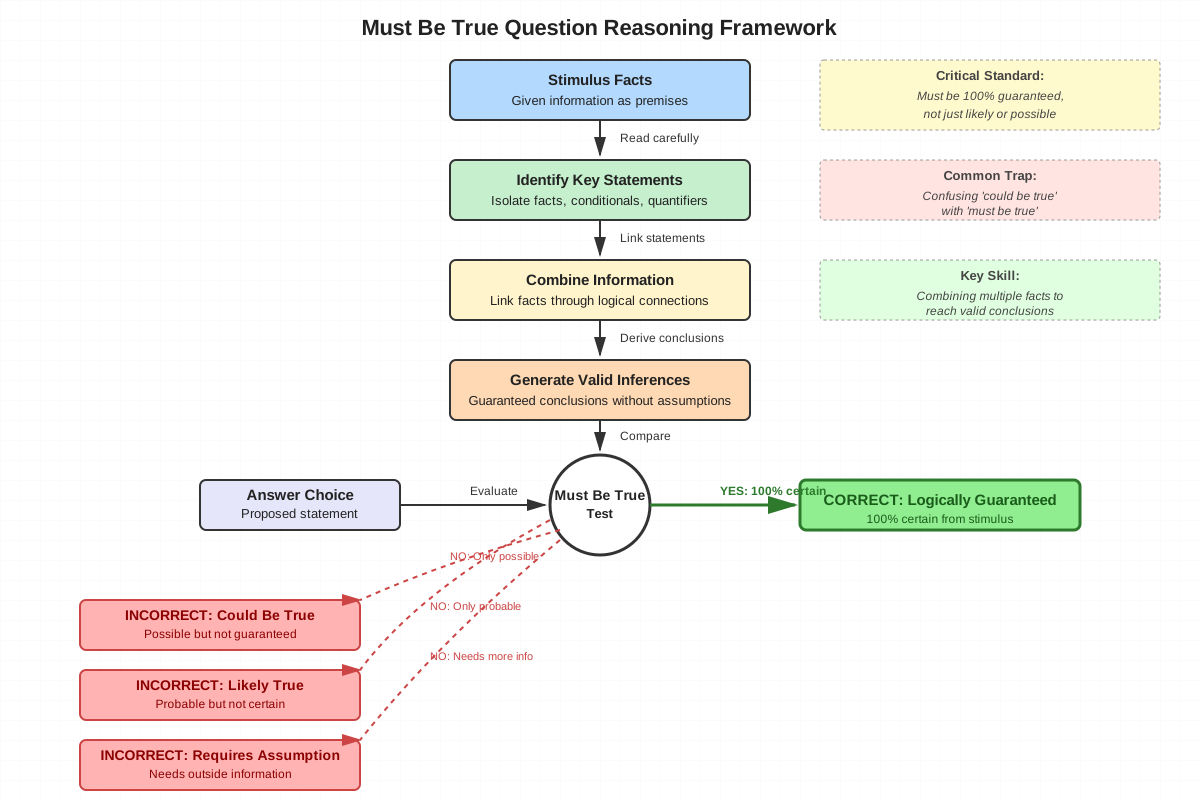
Must be true questions represent one of the most fundamental and frequently tested question types in LSAT Logical Reasoning. These inference questions require test-takers to identify what must logically follow from the information presented in the stimulus, without adding any outside assumptions or knowledge. Unlike questions that ask for strengthening, weakening, or identifying flaws, must be true questions test pure deductive reasoning—the ability to recognize what is guaranteed to be true based solely on the given facts.
Mastering must be true questions is essential for LSAT success because they appear consistently across both Logical Reasoning sections, typically comprising 15-20% of all Logical Reasoning questions. These questions assess a core skill that the LSAT values highly: the ability to draw only those conclusions that are fully supported by the evidence provided. This skill mirrors the type of careful, precise reasoning required in legal practice, where attorneys must distinguish between what the evidence actually proves versus what it merely suggests.
Within the broader landscape of Logical Reasoning, must be true questions serve as a foundation for understanding how arguments work. They connect closely to assumption questions (which ask what must be true for an argument to work), parallel reasoning questions (which require identifying logical structures), and formal logic questions (which often appear as must be true variants). Developing proficiency with must be true questions strengthens overall logical reasoning abilities and provides tools applicable across multiple question types, making this topic a high-yield investment of study time.
Learning Objectives
- [ ] Identify how Must be true questions appears in LSAT questions
- [ ] Explain the reasoning pattern behind Must be true questions
- [ ] Apply Must be true questions to solve LSAT-style problems accurately
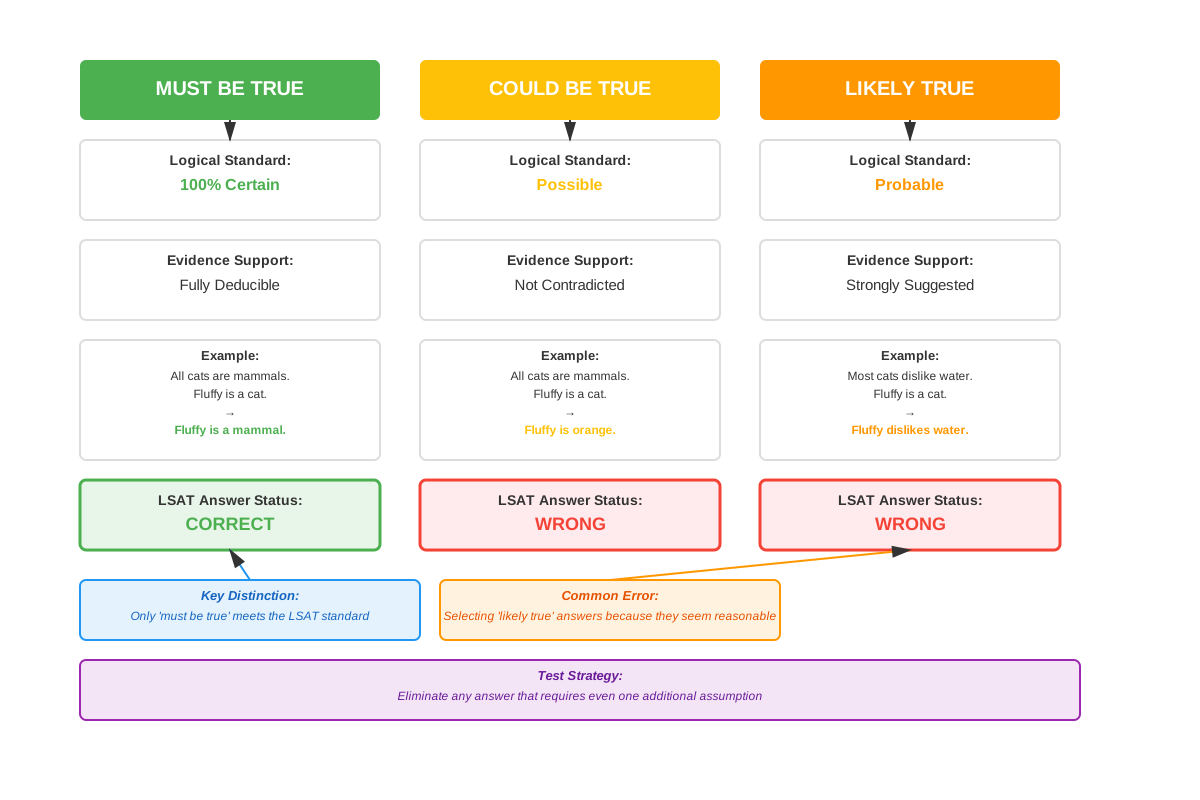
- [ ] Distinguish between statements that must be true versus those that could be true or are likely true
- [ ] Recognize common wrong answer patterns in must be true questions
- [ ] Combine multiple pieces of information from the stimulus to derive valid inferences
- [ ] Apply formal logic principles to guarantee correct inferences in complex scenarios
Prerequisites
- Basic conditional logic: Understanding "if-then" statements is essential because must be true questions frequently involve drawing valid inferences from conditional relationships
- Argument structure recognition: Familiarity with premises and conclusions helps identify which statements in the stimulus serve as the factual foundation for inferences
- Quantifier comprehension: Understanding terms like "all," "some," "most," and "none" is necessary because must be true questions often hinge on precise quantifier relationships
- Reading comprehension fundamentals: The ability to parse complex sentences and identify key information ensures accurate understanding of the stimulus before attempting inferences
Why This Topic Matters
Must be true questions appear with remarkable consistency on the LSAT, making them one of the highest-yield question types to master. In a typical LSAT administration, test-takers can expect to encounter 5-8 must be true questions across the two Logical Reasoning sections, representing approximately 10-15% of the total Logical Reasoning score. Given that Logical Reasoning comprises roughly half of the overall LSAT score, mastering this question type can directly impact performance by 5-7 percentile points.
Beyond exam statistics, must be true questions develop critical thinking skills directly applicable to legal reasoning. Attorneys must constantly evaluate what conclusions are definitively supported by evidence versus what remains speculative. Whether analyzing case law, reviewing contracts, or constructing legal arguments, the ability to identify what must be true based on given information is fundamental to legal practice. Law schools value this skill because it demonstrates the disciplined, precise thinking required for success in legal education and practice.
On the LSAT, must be true questions appear in several common formats. The most straightforward version presents a set of facts or observations and asks what can be properly inferred. More complex variants involve combining conditional statements, reconciling apparently contradictory information, or applying formal logic principles. These questions may appear with short stimuli (2-3 sentences) or longer passages (5-7 sentences), and they frequently incorporate formal logic elements, statistical reasoning, or causal relationships. Recognizing these patterns enables efficient question identification and appropriate strategy deployment.
Core Concepts
Defining Must Be True Questions
Must be true questions ask test-takers to identify the answer choice that is guaranteed to be true based solely on the information provided in the stimulus. The correct answer must follow with absolute logical necessity—there should be no possible scenario where the stimulus is true but the correct answer is false. This standard distinguishes must be true questions from "could be true" or "most strongly supported" questions, which allow for probabilistic or possible inferences rather than certain ones.
The question stems for must be true questions typically include language such as:
- "Which one of the following must be true?"
- "If the statements above are true, which one of the following must also be true?"
- "The statements above, if true, most strongly support which one of the following?"
- "Which one of the following can be properly inferred from the passage?"
- "Which one of the following follows logically from the statements above?"
While slight variations exist in wording, all these stems ask for the same fundamental task: identifying what is definitively proven by the stimulus.
The Logical Foundation: Valid Inference
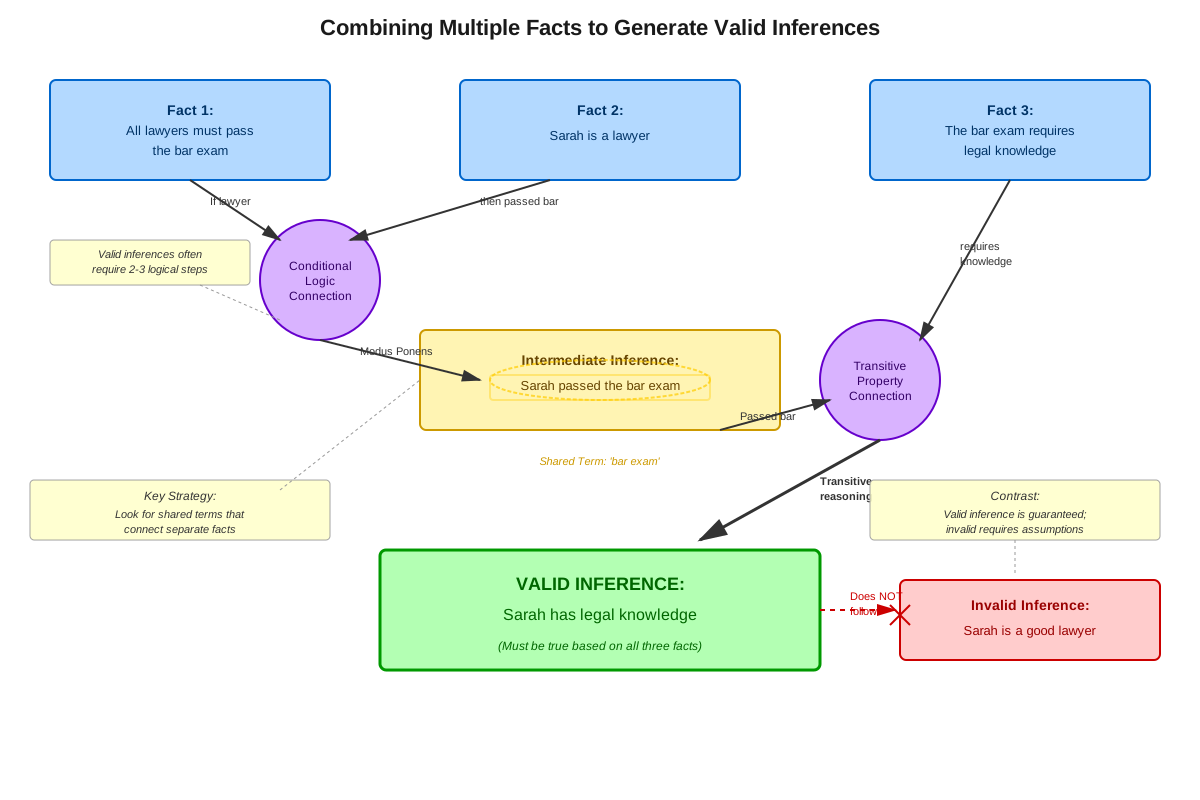
A valid inference is a conclusion that must be true if the premises are true. Must be true questions test the ability to recognize valid inferences while avoiding invalid ones. The key principle is that valid inferences add no new information beyond what is logically contained in the premises—they simply make explicit what was implicit in the given information.
Consider this simple example:
- Premise 1: All lawyers must pass the bar exam.
- Premise 2: Sarah is a lawyer.
- Valid inference: Sarah passed the bar exam.
This inference is valid because it follows necessarily from the premises. There is no possible scenario where both premises are true but the conclusion is false. Invalid inferences, by contrast, introduce information not guaranteed by the premises:
- Invalid inference: Sarah studied hard for the bar exam. (This might be true, but it doesn't follow necessarily from the premises.)
Types of Must Be True Stimuli
LSAT must be true questions present several distinct stimulus types, each requiring slightly different analytical approaches:
| Stimulus Type | Characteristics | Approach |
|---|---|---|
| Fact Set | Multiple independent or related facts with no argument structure | Combine facts to find overlaps or necessary implications |
| Conditional Chain | Series of if-then statements that can be linked | Map out the conditional logic and follow valid inferences |
| Quantified Statements | Uses "all," "some," "most," "none" | Apply formal logic rules for quantifiers |
| Comparative Information | Establishes relationships between items | Track the transitive properties and relative positions |
| Principle Application | States a general rule and specific circumstances | Apply the principle to the specific case |
Combining Information for Valid Inferences
Many must be true questions require combining multiple pieces of information from the stimulus. This process involves identifying points of connection between statements and recognizing what must follow when these statements are considered together.
For example:
- Statement 1: Everyone who attended the conference received a certificate.
- Statement 2: Marcus did not receive a certificate.
- Valid combination: Marcus did not attend the conference.
This inference works through the contrapositive of Statement 1: If someone did not receive a certificate, they did not attend the conference. Recognizing these connection points is essential for success on must be true questions.
The Certainty Standard
The defining characteristic of must be true questions is the certainty standard: the correct answer must be true in every possible scenario consistent with the stimulus. This standard has important implications:
- Eliminate possibilities: If you can imagine even one scenario where the stimulus is true but an answer choice is false, that answer is wrong.
- Avoid assumptions: Do not bring in outside knowledge or make assumptions beyond what the stimulus explicitly states or logically implies.
- Recognize sufficiency: The correct answer needs only to be guaranteed by the stimulus; it doesn't need to be the most interesting or important inference—just one that must be true.
Common Inference Patterns
Certain logical patterns appear repeatedly in must be true questions:
Conditional Logic Inferences:
- If A → B, and A is true, then B must be true (modus ponens)
- If A → B, and B is false, then A must be false (modus tollens/contrapositive)
- If A → B and B → C, then A → C (chain inference)
Quantifier Inferences:
- "All A are B" + "X is an A" → "X is a B"
- "No A are B" + "X is an A" → "X is not a B"
- "Some A are B" + "All B are C" → "Some A are C"
Numerical/Statistical Inferences:
- If more than 50% have property X and more than 50% have property Y, then some must have both X and Y
- If 100% of group A has property X, and item Z is in group A, then Z has property X
Formal Logic in Must Be True Questions
Many challenging must be true questions incorporate formal logic elements. Understanding how to diagram and manipulate these logical relationships is crucial:
Sufficient and Necessary Conditions:
- Sufficient condition: If this is true, the outcome must occur
- Necessary condition: This must be true for the outcome to occur
- In "If A then B": A is sufficient for B; B is necessary for A
Logical Operators:
- AND: Both conditions must be met
- OR: At least one condition must be met
- NOT: The negation of a condition
Properly tracking these relationships through diagramming or mental mapping enables accurate inference-drawing even in complex scenarios.
Concept Relationships
Must be true questions sit at the intersection of several logical reasoning skills. The certainty standard serves as the foundation, determining which inferences are valid. This standard connects directly to conditional logic principles, which provide the formal rules for drawing necessary conclusions from if-then statements. When the stimulus contains quantified statements, formal logic rules govern what can be properly inferred about relationships between groups.
The process of combining information from multiple statements builds upon basic argument structure recognition—identifying which pieces of information can be linked together. This combination process often reveals inference patterns that recur across questions, creating a bridge between individual question practice and broader pattern recognition.
Must be true questions also connect to other Logical Reasoning question types. The skills developed here directly support assumption questions (which ask what must be true for an argument to work) and parallel reasoning questions (which require matching logical structures). Additionally, understanding what must be true helps with flaw questions by highlighting when an argument concludes something that doesn't necessarily follow from its premises.
Relationship map:
Certainty Standard → governs → Valid Inference Rules → applied through → Conditional Logic & Quantifiers → combined via → Information Integration → produces → Correct Answer Recognition → supports → Broader LR Skills
High-Yield Facts
⭐ Must be true questions require the correct answer to be true in every scenario consistent with the stimulus—no exceptions allowed
⭐ The contrapositive of a conditional statement is always valid: If A → B, then NOT B → NOT A
⭐ Common wrong answers include statements that could be true, are likely true, or would strengthen the argument, but don't have to be true
⭐ When combining "most" statements, if most A are B and most A are C, then some A must be both B and C
⭐ The correct answer often combines information from multiple sentences in the stimulus rather than restating a single sentence
- Must be true questions typically comprise 10-15% of Logical Reasoning questions on any given LSAT
- "Some" in formal logic means "at least one"—it could be all, but must be at least one
- You cannot validly infer the converse of a conditional: A → B does NOT mean B → A
- Extreme language in answer choices ("always," "never," "only") is often wrong unless the stimulus uses equally extreme language
- The correct answer may seem obvious or underwhelming—it doesn't need to be profound, just guaranteed
- Numerical overlaps create necessary inferences: if 60% have trait X and 70% have trait Y, at least 30% must have both
- "Unless" introduces a necessary condition: "A unless B" means "If not B, then A" (or equivalently, "If not A, then B")
Quick check — test yourself on Must be true questions so far.
Try Flashcards →Common Misconceptions
Misconception: The correct answer must be the most interesting or important inference from the stimulus.
Correction: The correct answer simply needs to be guaranteed by the stimulus. It may be a relatively minor or obvious point. The LSAT tests logical validity, not significance or insight.
Misconception: If an answer choice seems very likely or probable based on the stimulus, it's correct.
Correction: Must be true questions require absolute certainty, not high probability. An answer that is 99% likely but not guaranteed is wrong. The standard is necessity, not likelihood.
Misconception: You can use common sense or real-world knowledge to fill in gaps in the stimulus.
Correction: Must be true questions test only what follows from the given information. Outside knowledge, no matter how reasonable, should not influence your answer. Treat the stimulus as the complete universe of relevant facts.
Misconception: The correct answer will restate or paraphrase something directly stated in the stimulus.
Correction: While some correct answers do paraphrase stimulus content, many require combining multiple pieces of information or recognizing implicit logical relationships. The correct answer often says something not explicitly stated but necessarily implied.
Misconception: If you can imagine any scenario where an answer choice is true, it's correct.
Correction: The question is not whether the answer could be true, but whether it must be true. The correct answer must be true in every scenario consistent with the stimulus, not just some scenarios.
Misconception: Conditional statements work in both directions—if A leads to B, then B leads to A.
Correction: Conditional statements are unidirectional. A → B does not mean B → A. Only the contrapositive (NOT B → NOT A) is valid. Confusing the converse with valid inferences is one of the most common errors on must be true questions.
Misconception: "Most" statements can be combined freely without restrictions.
Correction: Combining "most" statements requires careful attention to overlaps. "Most A are B" and "Most B are C" does NOT guarantee that most A are C. However, "Most A are B" and "Most A are C" DOES guarantee that some A are both B and C.
Worked Examples
Example 1: Combining Conditional Statements
Stimulus: Every member of the chess club is also a member of the debate team. No member of the debate team is a member of the drama club. Keisha is a member of the chess club.
Question: Which one of the following must be true?
Answer Choices:
(A) Keisha is not a member of the drama club.
(B) Some members of the debate team are members of the chess club.
(C) Most members of the debate team are members of the chess club.
(D) Keisha is the only member of both the chess club and the debate team.
(E) No member of the chess club is interested in drama.
Solution Process:
Step 1: Identify the logical structure
- Statement 1: Chess club → Debate team (All chess = debate)
- Statement 2: Debate team → NOT drama club (No debate = drama)
- Statement 3: Keisha = chess club member
Step 2: Chain the conditional statements
- Chess club → Debate team → NOT drama club
- Therefore: Chess club → NOT drama club
Step 3: Apply to Keisha
- Keisha is in chess club
- Therefore, Keisha is in debate team (from Statement 1)
- Therefore, Keisha is NOT in drama club (from Statement 2)
Step 4: Evaluate answer choices
- (A) Must be true—this follows directly from our chain of reasoning ✓
- (B) Must be true—since Keisha is in both, "some" is satisfied, but let's check if (A) is more directly proven
- (C) Not necessarily true—we know at least one (Keisha), but not "most"
- (D) Not necessarily true—there could be other members in both clubs
- (E) Not necessarily true—being unable to join drama club doesn't mean lacking interest
Correct Answer: (A)
Key Takeaway: This question rewards recognizing conditional chains and applying them to specific cases. Both (A) and (B) are technically correct, but (A) more directly answers what must be true about Keisha specifically.
Example 2: Quantifier Overlap
Stimulus: In a survey of 100 students, 65 students said they prefer studying in the library, and 70 students said they prefer studying in the morning. Each student expressed a preference for at least one of these options.
Question: If the statements above are true, which one of the following must also be true?
Answer Choices:
(A) Most students prefer both studying in the library and studying in the morning.
(B) At least 35 students prefer both studying in the library and studying in the morning.
(C) Exactly 35 students prefer both studying in the library and studying in the morning.
(D) Some students prefer studying in the library but not in the morning.
(E) Some students prefer studying in the morning but not in the library.
Solution Process:
Step 1: Set up the numerical relationships
- Total students: 100
- Library preference: 65
- Morning preference: 70
- Each student has at least one preference
Step 2: Calculate the minimum overlap
- If we add 65 + 70 = 135 total preferences
- But there are only 100 students
- Therefore, at least 135 - 100 = 35 students must have both preferences
Step 3: Visualize with a Venn diagram (described)
- Circle for Library: 65 students
- Circle for Morning: 70 students
- Overlap: at least 35 students
- Library only: at most 30 students (65 - 35)
- Morning only: at most 35 students (70 - 35)
Step 4: Evaluate answer choices
- (A) "Most" means more than 50—we only know at least 35, which is not most ✗
- (B) This matches our calculation exactly ✓
- (C) "Exactly" is too strong—it could be more than 35 ✗
- (D) Possibly true but not guaranteed—all 65 library students could also prefer morning ✗
- (E) Possibly true but not guaranteed—all 70 morning students could also prefer library ✗
Correct Answer: (B)
Key Takeaway: Numerical overlap questions require calculating the minimum (or maximum) based on the constraints. The formula for minimum overlap when groups exceed the total: (Group 1 + Group 2) - Total = Minimum overlap.
Exam Strategy
Identification Strategy
Quickly identify must be true questions by scanning for key phrases in the question stem: "must be true," "must also be true," "can be properly inferred," "follows logically," or "most strongly supported." Once identified, shift into inference mode rather than argument evaluation mode—you're looking for what follows from the facts, not evaluating whether an argument is good or bad.
Stimulus Analysis Approach
- Read actively for facts and relationships: As you read the stimulus, note conditional relationships, quantifiers, and numerical information. These elements frequently form the basis for valid inferences.
- Look for connection points: Identify where different statements in the stimulus relate to each other—shared terms, overlapping categories, or linked conditions.
- Anticipate the inference: Before looking at answer choices, try to predict what might be inferable. This prevents wrong answers from seeming attractive.
- Don't add assumptions: Treat the stimulus as a closed system. Only what is stated or logically implied is relevant.
Answer Choice Evaluation
Process of Elimination Tips:
- Eliminate "could be true" answers: If you can imagine a scenario where the stimulus is true but the answer is false, eliminate it immediately.
- Watch for extreme language: Words like "always," "never," "only," "must," and "cannot" in answer choices require strong support from the stimulus. Eliminate these unless the stimulus provides equally strong support.
- Identify scope shifts: Wrong answers often introduce new concepts or shift the scope beyond what the stimulus addresses.
- Recognize reversal errors: Watch for answer choices that reverse conditional relationships or confuse sufficient and necessary conditions.
- Check for combination errors: Ensure answer choices that combine information do so validly according to formal logic rules.
Time Management
Allocate approximately 1:15-1:30 per must be true question. These questions often have shorter stimuli than other Logical Reasoning questions, but they require careful logical analysis. If a question involves complex formal logic or numerical relationships, it may warrant an additional 15-30 seconds. However, if you find yourself spending more than 2 minutes, mark the question and return to it if time permits—you may be overthinking or missing a simpler approach.
Trigger Words and Phrases
In the stimulus, watch for:
- Conditional indicators: "if," "when," "whenever," "only if," "unless," "until"
- Quantifiers: "all," "some," "most," "none," "many," "few"
- Numerical information: percentages, fractions, specific numbers
- Comparative language: "more than," "less than," "at least," "at most"
In answer choices, be cautious of:
- Extreme absolutes: "always," "never," "impossible," "certainly"
- Weak qualifiers that might make wrong answers seem safe: "might," "could," "possibly"
- Scope expansions: terms or concepts not mentioned in the stimulus
Memory Techniques
VALID Inference Checklist:
- Verify the stimulus facts are accepted as true
- Avoid adding outside assumptions
- Link information from multiple statements when needed
- Identify conditional and quantifier relationships
- Determine if the answer must be true in every scenario
Conditional Logic Mnemonic - "SCAN":
- Sufficient condition triggers the result
- Contrapositive is always valid (flip and negate)
- Avoid the converse error (don't reverse without negating)
- Necessary condition is required for the result
Quantifier Overlap - "The 50% Rule":
When two "most" statements share the same subject, visualize two overlapping circles each covering more than half of the total. They must overlap because you can't fit two groups each larger than 50% into a space without some overlap. The minimum overlap is: (Group 1% + Group 2%) - 100%.
Visualization Strategy:
For complex must be true questions, quickly sketch simple diagrams:
- Venn diagrams for group relationships
- Arrow chains for conditional logic (A → B → C)
- Number lines for comparative relationships
- Simple tables for organizing multiple facts
These visual aids externalize the logical relationships, reducing working memory load and decreasing errors.
Summary
Must be true questions test the fundamental logical reasoning skill of identifying what necessarily follows from given information. These questions require recognizing valid inferences while maintaining a strict certainty standard—the correct answer must be true in every scenario consistent with the stimulus, without exception. Success depends on accurately identifying conditional relationships, properly applying formal logic rules for quantifiers, and combining multiple pieces of information according to valid inference patterns. Common pitfalls include selecting answers that could be true rather than must be true, importing outside assumptions, making conditional logic errors (especially confusing the converse with the contrapositive), and failing to recognize when numerical or quantifier overlaps create necessary inferences. The key to mastery is disciplined adherence to what the stimulus actually proves, systematic evaluation of answer choices against the certainty standard, and recognition of recurring logical patterns that appear across questions.
Key Takeaways
- Must be true questions require absolute certainty—the correct answer must be true in every possible scenario consistent with the stimulus
- Valid inferences add no new information; they make explicit what is logically contained in the premises
- The contrapositive is always valid (A → B means NOT B → NOT A), but the converse is not (A → B does NOT mean B → A)
- Combining information from multiple statements is often necessary; look for connection points between different parts of the stimulus
- Numerical and quantifier overlaps create necessary inferences that frequently appear in correct answers
- Wrong answers typically fall into predictable categories: could be true but not must be true, scope shifts, conditional logic errors, or unsupported assumptions
- Treat the stimulus as a closed system—use only the information provided, without importing outside knowledge or common sense assumptions
Related Topics
Assumption Questions: Understanding must be true questions provides the foundation for assumption questions, which ask what must be true for an argument's conclusion to follow from its premises. The logical reasoning skills developed here transfer directly to identifying necessary assumptions.
Formal Logic: More advanced formal logic topics build on the conditional reasoning and quantifier manipulation practiced in must be true questions. Mastering this topic enables progression to complex formal logic scenarios involving multiple conditional chains and quantifier interactions.
Parallel Reasoning Questions: These questions require identifying arguments with matching logical structures. The pattern recognition skills developed through must be true questions—recognizing conditional relationships, quantifier patterns, and inference types—directly support parallel reasoning analysis.
Sufficient Assumption Questions: These questions ask what, if added to the premises, would guarantee the conclusion. Understanding what must be true from given information helps identify what additional information would be sufficient to prove a conclusion.
Practice CTA
Now that you understand the core principles and strategies for must be true questions, it's time to apply this knowledge through deliberate practice. Work through the practice questions systematically, using the VALID checklist and SCAN mnemonic to guide your analysis. Review the flashcards to reinforce key concepts and inference patterns. Remember that mastery comes through repeated application—each question you practice strengthens your pattern recognition and logical reasoning skills. Must be true questions are highly learnable; consistent practice with these strategies will translate directly into points on test day. You've built the foundation—now solidify it through practice!
Sign up free to keep reading
Create a free AnvayaPrep account to finish this LSAT guide on Must be true questions — plus flashcards and practice questions.