Overview
Sequencing game setup forms the foundation of one of the most common and predictable question types in the Analytical Reasoning Legacy section of the LSAT. These games require test-takers to arrange elements—such as people, events, or objects—in a specific order based on a set of rules and constraints. Mastering the setup phase is critical because it determines how efficiently and accurately a student can answer all subsequent questions in the game. A well-executed setup transforms what might appear to be a complex logical puzzle into a manageable, systematic problem-solving exercise.
The setup phase involves several crucial steps: identifying the game type, creating an appropriate diagram, cataloging all elements, translating rules into symbolic notation, and making initial deductions. Students who invest time in developing a robust setup will find that many questions become immediately answerable, while those who rush through this phase often struggle with every question in the set. The LSAT sequencing game setup is not merely about drawing a diagram—it's about creating a visual and logical framework that captures all constraints and reveals hidden inferences.
Within the broader context of Analytical Reasoning Legacy, sequencing games represent approximately 30-40% of all logic games that appear on the LSAT. They serve as a gateway to understanding more complex hybrid games that combine sequencing with grouping or matching elements. The skills developed through mastering sequencing games legacy setup—systematic diagramming, rule translation, and deductive reasoning—transfer directly to other game types and strengthen overall analytical reasoning abilities essential for legal thinking.
Learning Objectives
- [ ] Identify how Sequencing game setup appears in LSAT questions
- [ ] Explain the reasoning pattern behind Sequencing game setup
- [ ] Apply Sequencing game setup to solve LSAT-style problems accurately
- [ ] Construct efficient and accurate sequencing diagrams that capture all game constraints
- [ ] Translate verbal rules into symbolic notation that facilitates rapid deduction-making
- [ ] Recognize and execute the most productive initial inferences before attempting questions
- [ ] Distinguish between strict sequencing and loose sequencing game variants
Prerequisites
- Basic logical reasoning skills: Understanding conditional statements and their contrapositives is essential for translating sequencing rules accurately
- Familiarity with symbolic notation: The ability to work with symbols (letters, numbers, arrows) allows for efficient representation of complex relationships
- Spatial reasoning ability: Visualizing ordered arrangements and understanding relative positioning helps in creating and interpreting diagrams
- Reading comprehension: Accurately extracting information from dense rule sets prevents setup errors that cascade through all questions
Why This Topic Matters
Sequencing games appear with remarkable consistency on the LSAT, making them one of the highest-yield topics for focused study. Historical data shows that approximately 1-2 sequencing games appear on nearly every LSAT administration, accounting for 5-7 questions per test. These questions are particularly valuable because they follow predictable patterns and reward systematic preparation more reliably than other question types.
In legal practice, the analytical skills developed through sequencing game setup translate directly to case timeline construction, procedural order analysis, and precedent sequencing. Attorneys regularly must determine the order of events, establish chronologies from conflicting accounts, and understand how procedural steps must unfold. The logical rigor required for sequencing games mirrors the precision needed in legal analysis.
On the exam, sequencing games typically appear as scenarios involving scheduling (appointments, performances, presentations), ordering (rankings, positions in line), or chronological arrangements (historical events, process steps). The setup phase is where most students either gain or lose significant time—a strong setup completed in 2-3 minutes enables answering all questions in 6-7 minutes, while a weak setup can result in spending 12+ minutes on a single game with multiple errors.
Core Concepts
Identifying Sequencing Game Types
The first critical skill in sequencing game setup is recognizing when a game involves ordering elements. Sequencing games contain language that explicitly or implicitly indicates a linear arrangement. Key phrases include "in order," "from first to last," "earlier than," "immediately before," "consecutive," and "ranked." The game scenario typically presents a fixed number of positions (slots) and a set of elements (variables) that must be placed into those positions according to specific rules.
Strict sequencing games provide a one-to-one correspondence between elements and positions—exactly one element per position, with the number of elements matching the number of positions. Loose sequencing games establish relative ordering relationships without necessarily filling every position or may involve more complex arrangements where some positions remain unfilled. Recognizing this distinction during setup determines the appropriate diagramming approach.
Creating the Base Diagram
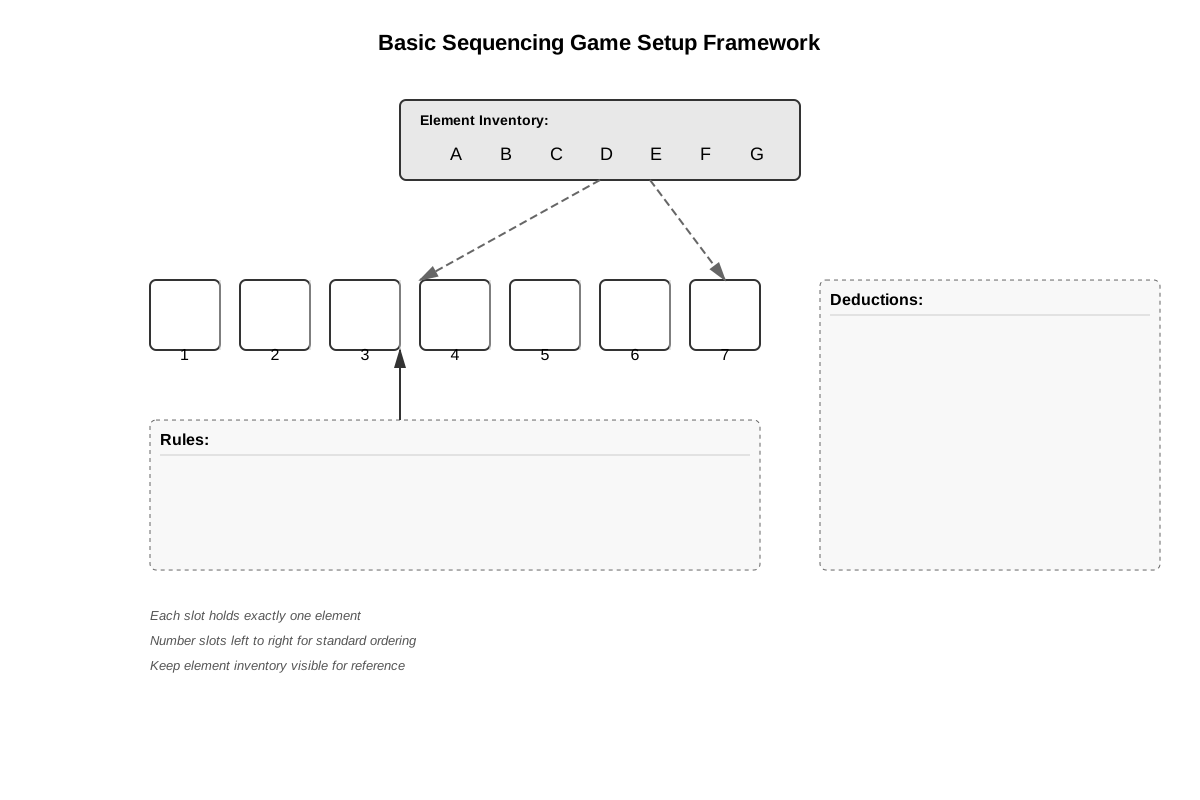
The foundation of any sequencing game setup is the base diagram—a visual representation of the available positions. This typically consists of a horizontal line of slots numbered or labeled to represent the sequence. For a game involving seven positions, the base diagram would show:
1    2    3    4    5    6    7
_    _    _    _    _    _    _
Above or beside this base, list all elements (variables) that must be placed. This inventory ensures no element is forgotten and provides a quick reference throughout the game. For example, if the elements are seven people (A, B, C, D, E, F, G), they should be clearly listed: A B C D E F G.
The base diagram serves multiple functions: it provides a consistent reference point, creates space for notating rules, and allows for testing hypothetical scenarios. Students should develop the habit of drawing their base diagram with adequate spacing—cramped diagrams lead to errors and confusion.
Rule Translation and Notation
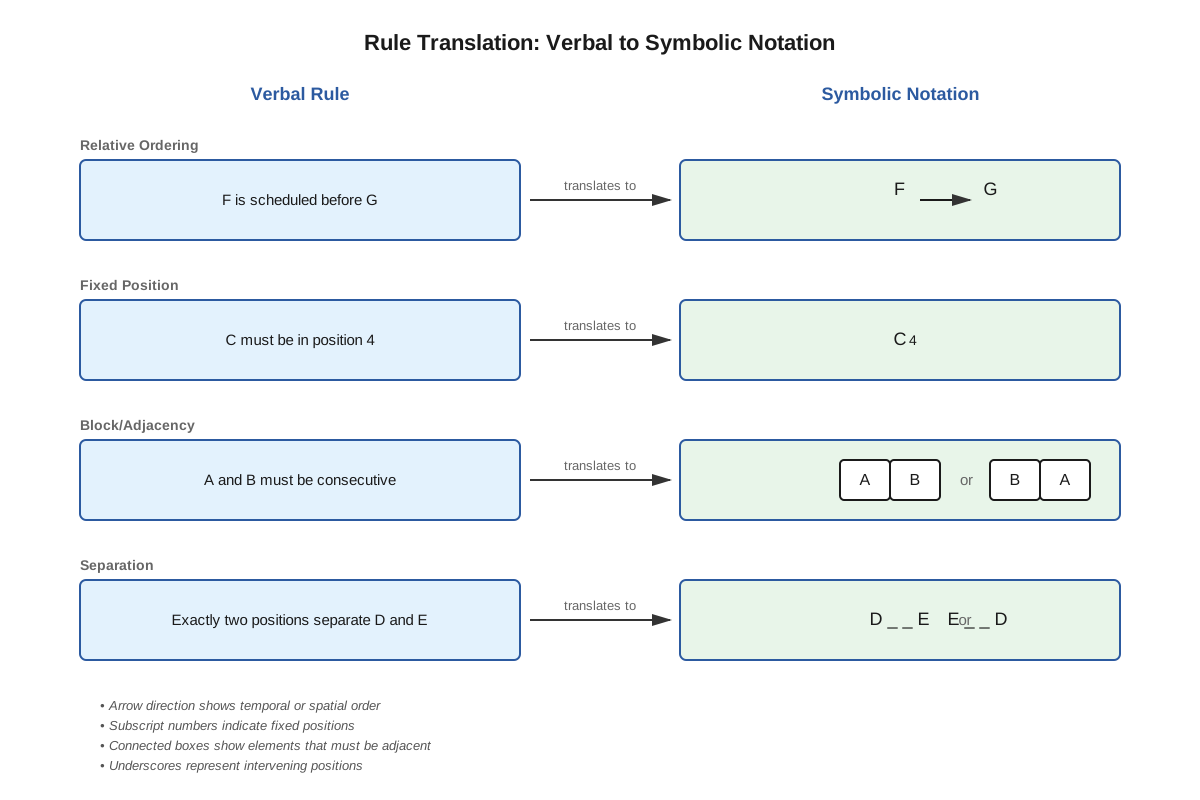
Each rule provided in a sequencing game must be translated into symbolic notation that captures its logical content precisely. This translation is where many students lose points through misinterpretation. Common rule types include:
| Rule Type | Example Language | Symbolic Notation | Meaning |
|---|---|---|---|
| Relative ordering | "A is before B" | A...B or A → B | A comes somewhere earlier than B |
| Immediate adjacency | "C is immediately before D" | CD (as a block) | C and D are consecutive, in that order |
| Fixed position | "E is third" | E in position 3 | E must occupy exactly position 3 |
| Separation | "F and G are not consecutive" | F ≠ G or ~FG | F and G cannot be adjacent |
| Conditional placement | "If H is first, then J is last" | H₁ → J₇ | When H occupies position 1, J must occupy position 7 |
The notation system should be consistent and intuitive. Many successful test-takers use arrows (→) for relative ordering, underlines or boxes for blocks, and slashes (/) for elements that cannot be adjacent. The key is developing a personal notation system and applying it consistently across all practice games.
Making Initial Deductions
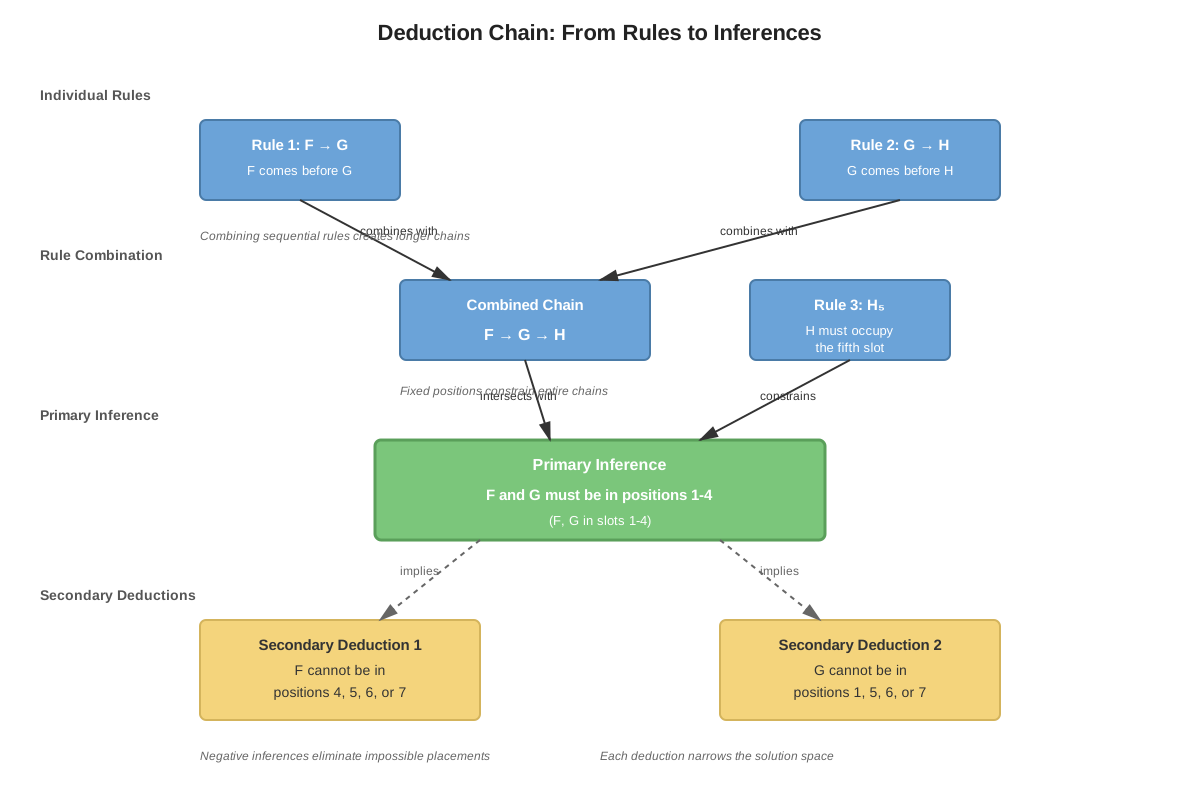
After translating all rules, the setup phase requires making initial deductions—inferences that follow necessarily from combining rules. This is where a mediocre setup becomes an excellent one. Common deduction types include:
Chain deductions: When multiple relative ordering rules connect, they form chains. If "A is before B" and "B is before C," then A must be before C (A → B → C). These chains often reveal that certain elements cannot occupy certain positions—A cannot be in the last two positions, and C cannot be in the first two positions.
Block and restriction interactions: When a rule creates a block (two elements that must be consecutive) and another rule restricts where one element can go, the entire block becomes restricted. If CD must be consecutive and C cannot be first, then the CD block cannot occupy positions 1-2.
Fixed position implications: When a rule places an element in a specific position, check all other rules involving that element. If E must be third and "D is before E," then D must occupy position 1 or 2. If "E is before F," then F must occupy positions 4, 5, 6, or 7.
Numerical deductions: Count how many elements must come before or after a particular element. If three elements must come before G in a seven-position game, G cannot occupy positions 1, 2, or 3—it must be in position 4 or later.
Creating a Master Diagram
The master diagram integrates the base diagram, all rule notations, and initial deductions into a single reference. This should include:
- The base diagram with numbered positions
- All elements listed
- Rules written in symbolic notation beside or below the diagram
- Deductions about restricted positions marked clearly
- Any forced placements indicated
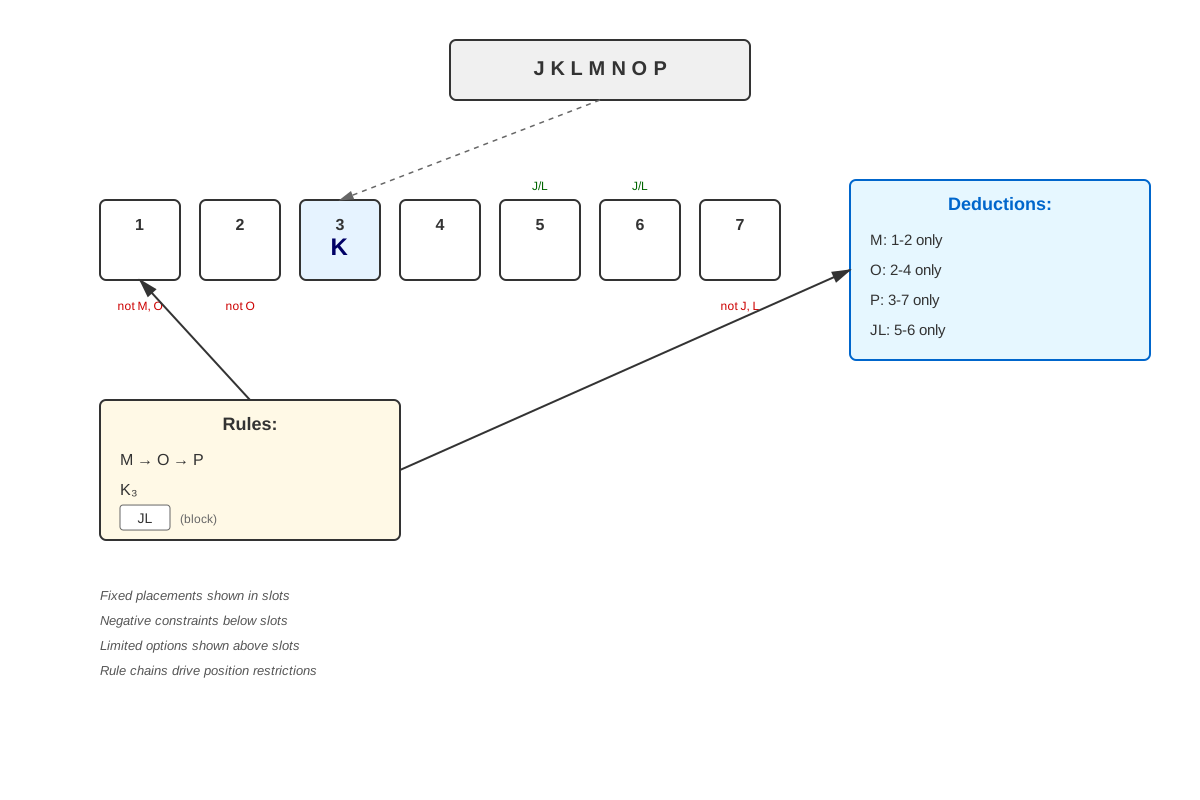
Some students benefit from creating a "not-laws" row beneath the base diagram, showing which elements cannot occupy which positions. For example:
     1    2    3    4    5    6    7
     _    _    _    _    _    _    _

Not: C    C    A
     D    D    B
This notation indicates that C cannot be in positions 1 or 2, D cannot be in positions 1 or 2, A cannot be in position 3, and B cannot be in position 3.
Recognizing Setup Completeness
A complete setup should enable the test-taker to answer "acceptability" questions (which list complete arrangements) in 30-45 seconds by checking each rule systematically. If this process takes longer, the setup likely lacks clarity or completeness. Before moving to questions, verify that:
- Every rule has been translated into notation
- All obvious deductions have been made
- The diagram is clear and uncluttered
- Restricted positions are marked
- Any blocks or chunks are clearly identified
The setup phase typically requires 2-4 minutes for most sequencing games. Investing this time upfront pays dividends across all questions in the set.
Concept Relationships
The components of sequencing game setup form an interconnected system where each element builds upon and reinforces the others. Game type identification → determines → appropriate diagram structure, which then provides the framework for → rule translation. The symbolic notation of rules → enables → deduction-making, as relationships between rules become visible when properly notated. Initial deductions → restrict → possible element placements, which simplifies → question-answering by reducing the solution space.
The relationship between setup and question-answering is bidirectional: a strong setup makes questions easier, while attempting questions sometimes reveals setup gaps that need correction. Master diagram creation → synthesizes → all previous setup steps into a unified reference tool that supports → efficient navigation through all question types.
Within the broader Analytical Reasoning Legacy framework, sequencing game setup skills transfer to → hybrid games that combine sequencing with grouping or matching. The systematic approach developed here underlies → success with more complex game types. Additionally, the deductive reasoning practiced during setup strengthens → conditional reasoning skills applicable to Logical Reasoning sections.
Quick check — test yourself on Sequencing game setup so far.
Try Flashcards →High-Yield Facts
⭐ Sequencing games appear on virtually every LSAT, typically 1-2 games per test, making setup mastery essential for consistent scoring.
⭐ The most common error in sequencing game setup is failing to make chain deductions by connecting multiple relative ordering rules.
⭐ Blocks (elements that must be consecutive) interact with other rules to create powerful restrictions on possible arrangements.
⭐ Fixed position rules are the most powerful constraints and should be the starting point for making deductions.
⭐ Approximately 60-70% of sequencing game questions can be answered directly from a complete setup without additional work.
- Relative ordering rules (A before B) do not specify how many positions separate the elements—they could be adjacent or far apart.
- Immediate adjacency rules create blocks that function as single units when testing arrangements.
- Conditional rules in sequencing games often create multiple scenarios that should be diagrammed separately.
- The contrapositive of conditional sequencing rules is equally important: if J is not last, then H is not first.
- Elements that appear in multiple rules are typically the most restricted and should be placed first when testing scenarios.
- Loose sequencing games require building a comprehensive ordering chain before attempting to place elements in specific positions.
- When a game has exactly as many elements as positions (1:1 correspondence), every position must be filled with exactly one element.
- Separation rules (elements that cannot be adjacent) are often violated in wrong answer choices for acceptability questions.
Common Misconceptions
Misconception: "A before B" means A must be immediately before B.
Correction: Relative ordering rules indicate only that A comes somewhere earlier in the sequence than B, with any number of positions potentially between them. Immediate adjacency is indicated by specific language like "immediately before" or "directly before."
Misconception: The setup phase should be completed as quickly as possible to maximize time for questions.
Correction: A thorough setup that takes 3-4 minutes will save significantly more time across all questions than a rushed 1-minute setup. The setup is an investment that pays returns on every subsequent question.
Misconception: All rules must be incorporated directly into the base diagram.
Correction: Some rules (particularly conditional rules and complex relative ordering chains) are better notated separately beside the diagram rather than cluttering the base. The goal is clarity, not cramming everything into one space.
Misconception: If a rule says "C is third or fourth," both options are equally likely in correct answers.
Correction: Other rules may interact with this flexibility to restrict C further. Always check whether additional rules or deductions eliminate one of the stated options.
Misconception: Deductions are optional enhancements that only advanced test-takers need to make.
Correction: Initial deductions are essential components of a complete setup. Many questions are specifically designed to test whether the student made key deductions during setup. Skipping deductions means solving the same logical puzzles repeatedly for each question.
Misconception: The same diagramming approach works equally well for all sequencing games.
Correction: Strict sequencing games with 1:1 correspondence require different diagram strategies than loose sequencing games with relative ordering chains. Flexible diagramming adapted to game type is more efficient than a one-size-fits-all approach.
Worked Examples
Example 1: Strict Sequencing Setup
Game Scenario: Seven students—A, B, C, D, E, F, and G—will give presentations, one student per time slot, from first to seventh. The order must conform to the following conditions:
- B presents sometime before D
- C presents immediately before E
- F presents fourth
- G presents sometime before B
- A does not present first
Setup Process:
Step 1: Identify game type. This is a strict sequencing game with seven elements and seven positions (1:1 correspondence).
Step 2: Create base diagram:
     1    2    3    4    5    6    7
     _    _    _    _    _    _    _

Elements: A B C D E F G
Step 3: Translate rules:
- B...D (B before D)
- CE (block—C immediately before E)
- F₄ (F in position 4)
- G...B (G before B)
- A ≠ 1 (A not first)
Step 4: Make deductions:
Chain deduction: G...B...D creates a three-element chain. G must come before both B and D; B must come before D.
Fixed position interaction: F is in position 4. The CE block needs two consecutive positions. Possible positions for CE block: 1-2, 2-3, 3-4 (impossible—F is in 4), 5-6, or 6-7.
Block restrictions: Since CE is a block, C cannot be in position 7 (no room for E after it), and E cannot be in position 1 (no room for C before it).
Chain and position interaction: G...B...D means G cannot be in positions 6 or 7 (insufficient room for B and D after it). B cannot be in position 7 (D must follow). D cannot be in positions 1 or 2 (both G and B must precede it).
Step 5: Create master diagram with not-laws:
     1    2    3    4    5    6    7
     _    _    _    _    F    _    _

Elements: A B C D E F G

Rules: G...B...D    CE (block)    A ≠ 1

Not: A    E    E    —    C    G    C
     D    D              E    G    B
     B                        B    D
This complete setup reveals that position 4 is fixed (F), positions 6-7 cannot contain G or B, and the CE block has limited placement options. Many questions will now be answerable by checking these restrictions.
Example 2: Loose Sequencing Setup
Game Scenario: A historian is arranging six events—J, K, L, M, N, and O—in chronological order. The following is known about their order:
- J occurred before K
- K occurred before L
- M occurred before N
- N occurred before J
- O occurred before M
Setup Process:
Step 1: Identify game type. This is a loose sequencing game—we're establishing relative order without specific positions.
Step 2: Build ordering chains by connecting rules:
- O...M (from rule 5)
- M...N (from rule 3)
- N...J (from rule 4)
- J...K (from rule 1)
- K...L (from rule 2)
Step 3: Connect chains into master sequence:
O → M → N → J → K → L
This complete chain shows the only possible chronological order for all six events.
Step 4: Make deductions:
If these events are placed in six specific time slots (1-6), the chain determines exact positions:
- O must be first (nothing comes before it)
- L must be last (nothing comes after it)
- M must be second (only O precedes it)
- K must be fifth (only L follows it)
- N must be third (O and M precede it; J, K, L follow it)
- J must be fourth (O, M, N precede it; K, L follow it)
Step 5: Create final diagram:
     1    2    3    4    5    6
     O    M    N    J    K    L

Complete chain: O → M → N → J → K → L
This setup reveals that the loose sequencing rules actually determine a unique, complete order. Any question asking about possible positions or relative order can be answered immediately from this chain.
Exam Strategy
When approaching sequencing games on the LSAT, begin by reading the scenario and rules carefully to identify trigger words that signal sequencing: "order," "before," "after," "consecutive," "immediately," "first," "last," "earlier," "later." These words confirm the game type and activate the appropriate setup protocol.
Allocate 2-4 minutes for setup, depending on game complexity. This time investment is not optional—it's the foundation for efficient question-answering. Resist the temptation to rush into questions before completing deductions. The LSAT rewards systematic preparation over speed.
For acceptability questions (which ask "Which of the following could be the complete order?"), use the rules as elimination filters. Check each rule against each answer choice systematically, eliminating choices that violate rules. A complete setup allows checking all five answer choices in 30-45 seconds.
For "must be true" questions, refer to your deductions and not-laws. These questions test whether you made key inferences during setup. If a question seems difficult, it often indicates a missing deduction—consider whether combining rules reveals new information.
For "could be true" questions, test the answer choice against your restrictions. If it doesn't violate any rule or deduction, it's possible. These questions often involve placements that seem unusual but don't actually break any rules.
When questions ask "If X is in position 3, which must be true?", create a mini-diagram showing this new constraint and make additional deductions. Don't try to solve these entirely in your head—write out the scenario.
Time-Saving Tip: If a sequencing game has a complete chain of all elements (like Example 2), many questions become trivial. Invest extra time in building comprehensive chains during setup.
Watch for answer choices that confuse "must be true" with "could be true." An answer that's possible but not necessary is wrong for "must be true" questions. Similarly, an answer that's impossible is wrong for "could be true" questions, but an answer that's merely not required can still be correct.
Memory Techniques
SETUP acronym for sequencing game setup steps:
- Scan the scenario to identify game type
- Establish base diagram with positions and elements
- Translate rules into symbolic notation
- Unify rules by making chain deductions
- Place restrictions and not-laws on diagram
CHAIN for building ordering sequences:
- Connect rules that share common elements
- Highlight the complete ordering from first to last
- Analyze what positions each element can/cannot occupy
- Identify the most restricted elements
- Note all deductions before attempting questions
For remembering rule types, visualize:
- Relative ordering as a loose rope connecting two elements (flexible distance)
- Immediate adjacency as handcuffs linking two elements (no separation possible)
- Fixed positions as nails pinning an element to a specific spot
- Conditional rules as switches that activate consequences
Create a mental checklist for setup completeness: "Every rule translated? All chains built? Fixed positions marked? Blocks identified? Not-laws recorded? Deductions made?" Running through this checklist before attempting questions prevents costly oversights.
Summary
Sequencing game setup is the foundational skill for success on one of the LSAT's most common and predictable game types. The setup process involves five essential steps: identifying the game type, creating an appropriate base diagram, translating rules into symbolic notation, making initial deductions by combining rules, and synthesizing everything into a master diagram. A complete setup captures all constraints, reveals hidden inferences, and creates a visual reference that makes most questions answerable in seconds rather than minutes. The most critical aspect of setup is making deductions—particularly chain deductions that connect multiple ordering rules and restrictions that emerge from interactions between rules. Students who invest 2-4 minutes in thorough setup consistently outperform those who rush to questions, because the setup investment pays returns across all 5-7 questions in the game. Mastering sequencing game setup requires developing systematic habits: consistent notation, comprehensive deduction-making, and clear diagramming that balances completeness with visual clarity.
Key Takeaways
- Sequencing game setup is a high-yield investment that determines performance across all questions in the game set
- The five essential setup steps—identify, diagram, translate, deduce, synthesize—must be completed systematically before attempting questions
- Chain deductions connecting multiple relative ordering rules are the most commonly missed inferences and the most frequently tested
- Fixed position rules and blocks (immediate adjacency) create powerful restrictions when combined with other rules
- A complete setup should enable answering acceptability questions in 30-45 seconds by systematically checking each rule
- Not-laws (marking which elements cannot occupy which positions) prevent errors and speed up question-answering
- Investing 2-4 minutes in setup typically saves 3-5 minutes across all questions while improving accuracy significantly
Related Topics
Sequencing Game Question Types: After mastering setup, students progress to specific question strategies for acceptability, must-be-true, could-be-true, and conditional questions within sequencing games. Understanding setup is prerequisite to efficient question-answering.
Grouping Games: The systematic approach developed through sequencing setup—diagramming, rule translation, deduction-making—transfers directly to grouping games where elements are sorted into categories rather than ordered sequentially.
Hybrid Games: Many advanced LSAT games combine sequencing with grouping or matching, requiring simultaneous application of multiple game type strategies. Mastery of pure sequencing setup is essential before attempting hybrid games.
Conditional Reasoning in Logic Games: The conditional rules that appear in sequencing games connect to broader conditional reasoning skills tested throughout the LSAT, particularly in Logical Reasoning sections.
Practice CTA
Now that you understand the systematic approach to sequencing game setup, it's time to apply these concepts to actual LSAT-style problems. The practice questions and flashcards will reinforce your ability to identify game types, create efficient diagrams, translate rules accurately, and make the critical deductions that separate good scores from great scores. Remember: setup mastery comes through deliberate practice with immediate feedback. Each game you set up systematically strengthens the neural pathways that will activate automatically on test day. Approach practice with the same rigor you'll bring to the actual exam—your performance on test day will reflect the habits you build now.
Sign up free to keep reading
Create a free AnvayaPrep account to finish this LSAT guide on Sequencing game setup — plus flashcards and practice questions.