Overview
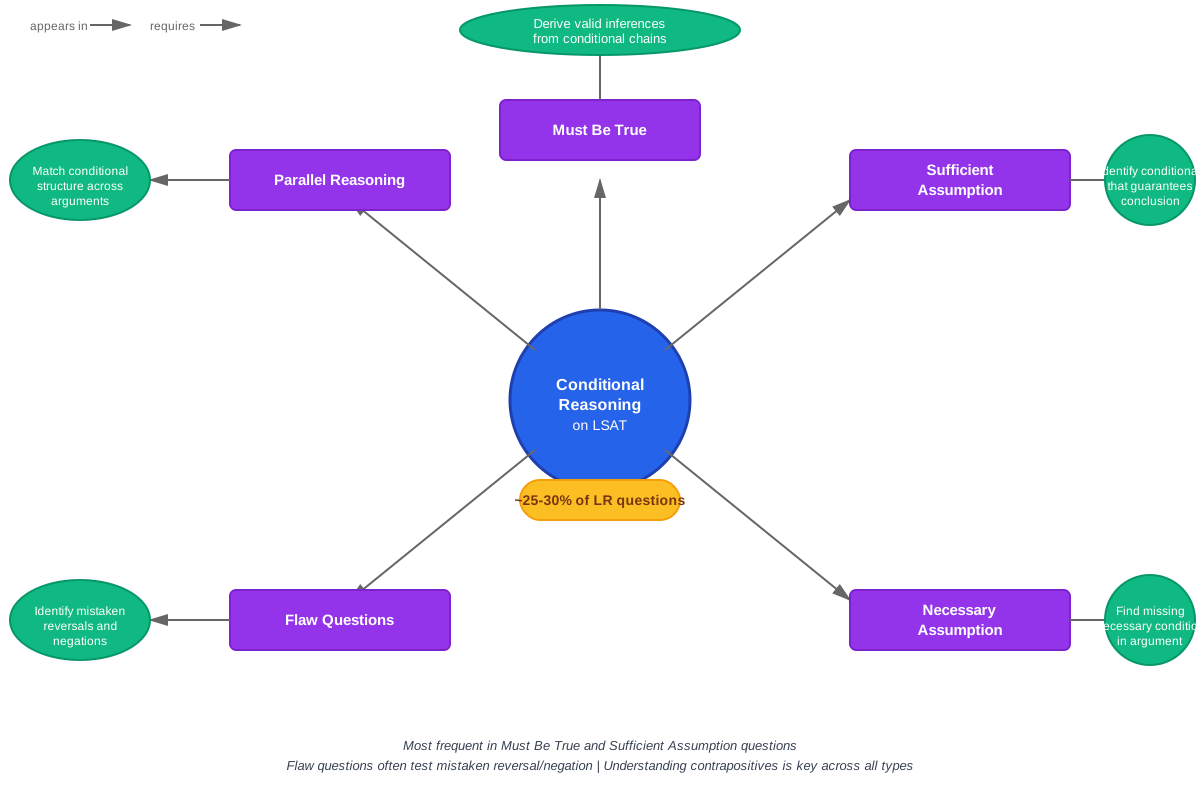
Conditional reasoning is one of the most fundamental and frequently tested concepts in LSAT logical reasoning. It forms the backbone of formal logic and appears in approximately 25-30% of all Logical Reasoning questions, making it an essential skill for achieving a competitive score. Conditional statements express "if-then" relationships between ideas, and understanding how to manipulate, diagram, and apply these relationships is crucial for success on test day.
The LSAT tests conditional reasoning in multiple ways: through Must Be True questions, Sufficient Assumption questions, Necessary Assumption questions, Flaw questions, and Parallel Reasoning questions. Mastering LSAT conditional reasoning requires not just recognizing conditional statements but also understanding their logical implications, contrapositive forms, and how they chain together to create complex arguments. Students who develop fluency in conditional logic gain a significant advantage, as these skills apply across virtually every question type in the Logical Reasoning section.
Within the broader framework of argument fundamentals, conditional reasoning serves as a bridge between basic argument structure and advanced logical operations. While understanding premises and conclusions provides the foundation for analyzing arguments, conditional reasoning adds precision and rigor to that analysis. It connects directly to topics like formal logic, necessary and sufficient conditions, and logical validity—all critical components of the LSAT's assessment of analytical thinking skills.
Learning Objectives
- [ ] Identify how Conditional reasoning appears in LSAT questions
- [ ] Explain the reasoning pattern behind Conditional reasoning
- [ ] Apply Conditional reasoning to solve LSAT-style problems accurately
- [ ] Construct accurate symbolic representations of conditional statements from natural language
- [ ] Generate valid contrapositives for any conditional statement
- [ ] Chain multiple conditional statements together to derive valid inferences
- [ ] Distinguish between necessary and sufficient conditions in complex arguments
Prerequisites
- Basic argument structure: Understanding premises and conclusions is essential because conditional statements often serve as premises in LSAT arguments, and recognizing their role requires familiarity with argument anatomy.
- Logical indicators: Knowledge of conclusion and premise indicators helps identify where conditional relationships fit within an argument's structure.
- Valid vs. invalid reasoning: A foundational understanding of what makes an inference logically sound provides the framework for evaluating conditional logic chains.
Why This Topic Matters
Conditional reasoning appears in real-world contexts constantly: legal contracts ("If you breach this agreement, then you owe damages"), scientific hypotheses ("If the temperature exceeds 100°C, then water boils"), and policy debates ("If we implement this regulation, then compliance costs will increase"). Legal professionals—the target audience for the LSAT—must navigate conditional language daily when interpreting statutes, contracts, and precedents.
On the LSAT specifically, conditional reasoning appears in approximately 8-12 questions per test across both Logical Reasoning sections. This represents roughly 15-20% of your total score from these sections alone. The topic appears most frequently in:
- Must Be True questions: Testing your ability to derive valid inferences from conditional premises
- Sufficient Assumption questions: Requiring you to identify the conditional statement that guarantees a conclusion
- Necessary Assumption questions: Testing whether you understand what must be true for a conditional argument to work
- Flaw questions: Identifying errors in conditional reasoning, particularly mistaken reversals and negations
- Parallel Reasoning questions: Matching the conditional structure of one argument to another
The LSAT presents conditional reasoning in both explicit forms ("If A, then B") and disguised forms using various linguistic constructions. Questions may test a single conditional statement, chains of multiple conditionals, or complex scenarios involving both conditional and categorical statements. The ability to quickly recognize, diagram, and manipulate these relationships under time pressure separates high scorers from average performers.
Core Concepts
The Basic Conditional Statement
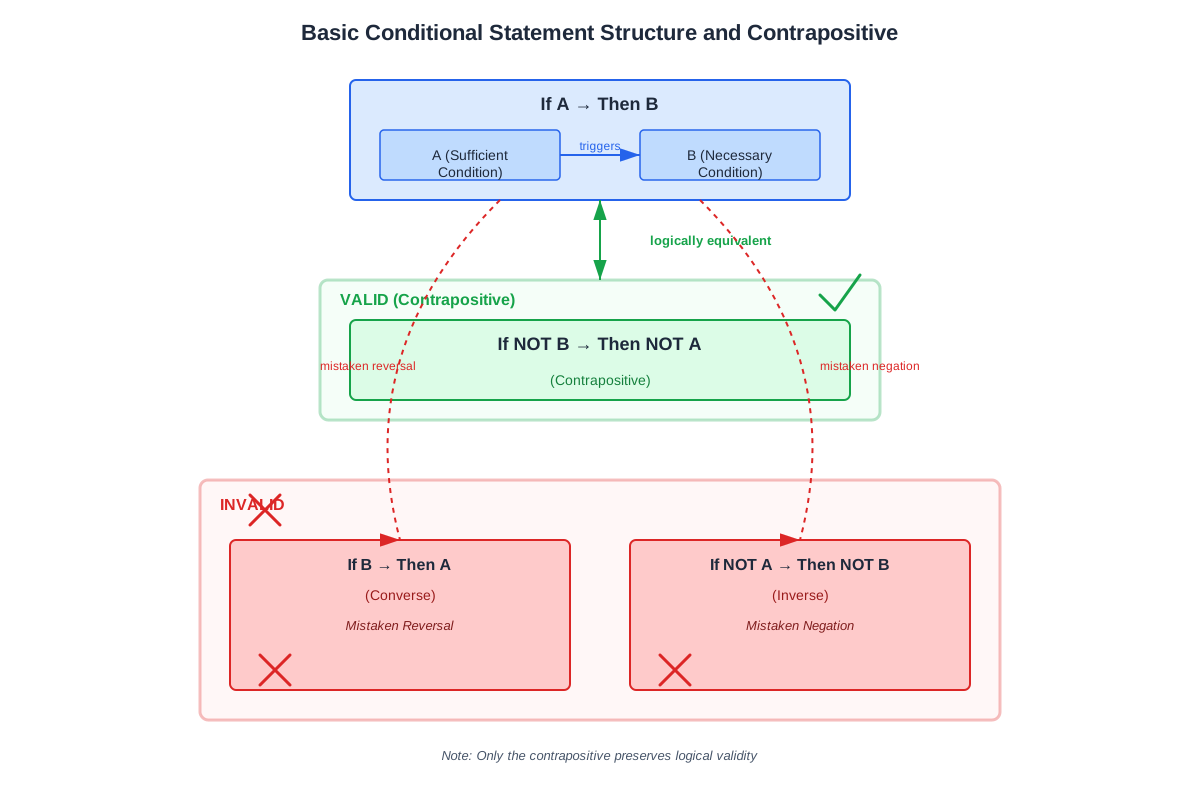
A conditional statement establishes a relationship between two events, conditions, or propositions where one (the sufficient condition) guarantees the occurrence of the other (the necessary condition). The standard form is "If A, then B," where A is the sufficient condition (sufficient to guarantee B) and B is the necessary condition (necessary whenever A occurs).
The logical structure can be represented symbolically as: A → B (read as "A implies B" or "if A, then B")
In this relationship:
- Sufficient condition (A): The trigger or guarantee; when this occurs, the necessary condition must follow
- Necessary condition (B): The result or requirement; this must occur whenever the sufficient condition is present
Consider the statement: "If Maria studies diligently, then she will pass the exam."
- Sufficient condition: Maria studies diligently
- Necessary condition: She will pass the exam
- Symbolic form: Study → Pass
This does NOT mean that studying is the only way to pass (other paths might exist), nor does it mean that passing proves Maria studied (the logic only flows one direction).
Recognizing Conditional Indicators
The LSAT disguises conditional relationships using diverse linguistic constructions. Mastering these indicators is crucial for rapid identification:
Sufficient Condition Indicators (these introduce the "if" part):
- If, when, whenever
- All, any, every, each
- People who, those who
- In order to (when followed by a verb)
- The only way to (introduces sufficient condition)
Necessary Condition Indicators (these introduce the "then" part):
- Then, must, requires
- Only, only if, only when
- Unless (introduces necessary condition; means "if not")
- Until, without, except
Example translations:
- "All lawyers are college graduates" → Lawyer → College Graduate
- "Only members can vote" → Vote → Member
- "You cannot enter unless you have a ticket" → Enter → Ticket
The Contrapositive
The contrapositive is the logically equivalent form of a conditional statement created by reversing and negating both conditions. This is one of the most powerful tools in LSAT logic because it's the ONLY valid transformation of a conditional statement.
Formation rule: If the original statement is A → B, the contrapositive is ~B → ~A (read as "not B implies not A")
Example:
- Original: "If it rains, then the game is cancelled" (Rain → Cancel)
- Contrapositive: "If the game is not cancelled, then it did not rain" (~Cancel → ~Rain)
Both statements are logically equivalent—they convey identical information. If one is true, the other must be true. The contrapositive is NOT a new inference; it's simply another way of expressing the same relationship.
Why this matters on the LSAT: Many correct answers are contrapositives of stated premises. Many wrong answers are invalid transformations (mistaken reversals or negations).
Invalid Transformations
Two common logical errors involve conditional statements:
| Transformation | Form | Validity | Example |
|---|---|---|---|
| Original | A → B | Valid | Rain → Cancel |
| Contrapositive | ~B → ~A | Valid | ~Cancel → ~Rain |
| Mistaken Reversal | B → A | INVALID | Cancel → Rain |
| Mistaken Negation | ~A → ~B | INVALID | ~Rain → ~Cancel |
Mistaken Reversal: Incorrectly assuming that if B occurs, then A must have occurred. Just because the game is cancelled doesn't mean it rained (could be other reasons).
Mistaken Negation: Incorrectly assuming that if A doesn't occur, then B won't occur. Just because it doesn't rain doesn't mean the game won't be cancelled (again, other reasons possible).
The LSAT frequently includes these errors in wrong answer choices and tests your ability to identify them in flawed arguments.
Conditional Chains
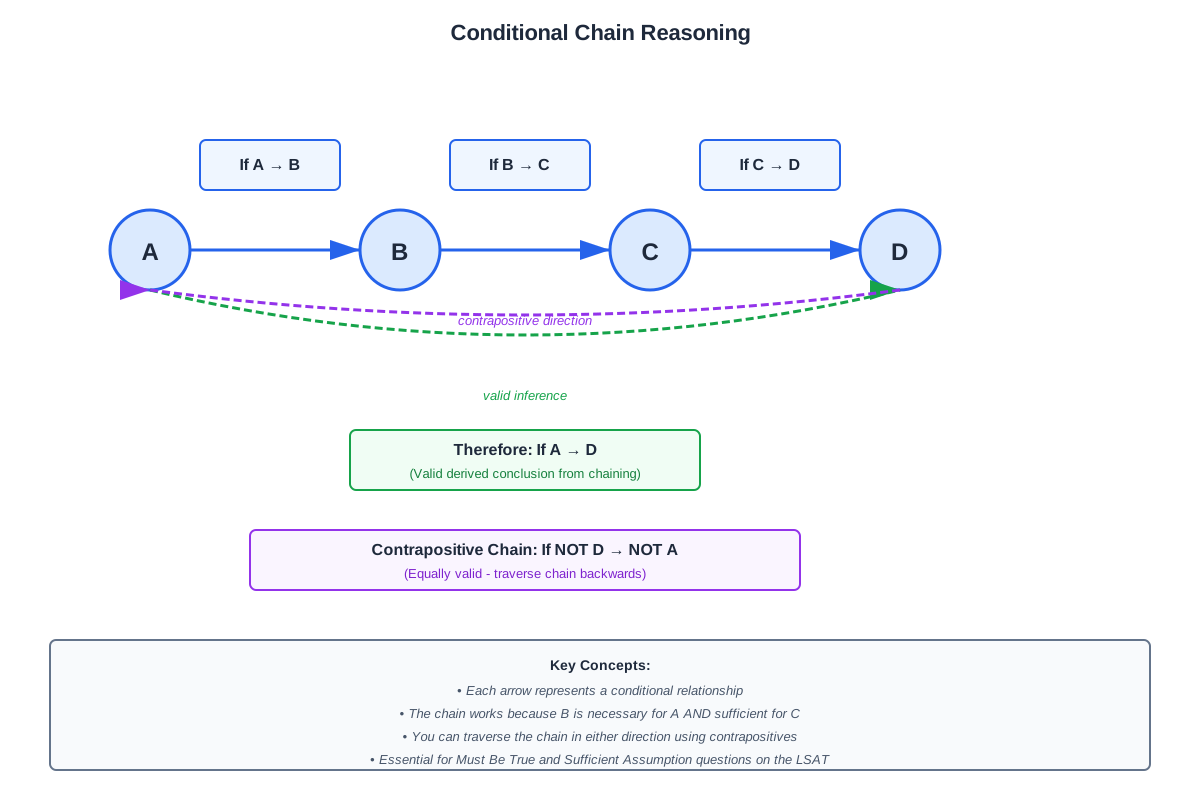
Multiple conditional statements can link together when the necessary condition of one statement matches the sufficient condition of another, creating a conditional chain.
Chain formation:
- Statement 1: A → B
- Statement 2: B → C
- Valid inference: A → C
Example:
- "If you study law, then you take the LSAT" (Law → LSAT)
- "If you take the LSAT, then you complete an undergraduate degree" (LSAT → Undergrad)
- Valid conclusion: "If you study law, then you complete an undergraduate degree" (Law → Undergrad)
The contrapositive of the entire chain is also valid: ~C → ~B → ~A, which means ~Undergrad → ~LSAT → ~Law.
Critical rule: You can only chain conditionals in the direction of the arrows. You cannot work backwards without taking the contrapositive first.
"Unless" Statements
The word "unless" creates conditional statements but requires special handling. The logical structure of "unless" is: "A unless B" translates to "If not B, then A" or symbolically: ~B → A.
Translation process:
- Identify the two components
- Negate the component following "unless"
- Make the negated component the sufficient condition
- Make the other component the necessary condition
Example: "You cannot vote unless you are registered"
- Components: vote, registered
- Translation: If you are not registered, then you cannot vote (~Registered → ~Vote)
- Contrapositive: If you vote, then you are registered (Vote → Registered)
The contrapositive often feels more intuitive and matches the intended meaning more closely.
Necessary vs. Sufficient Conditions
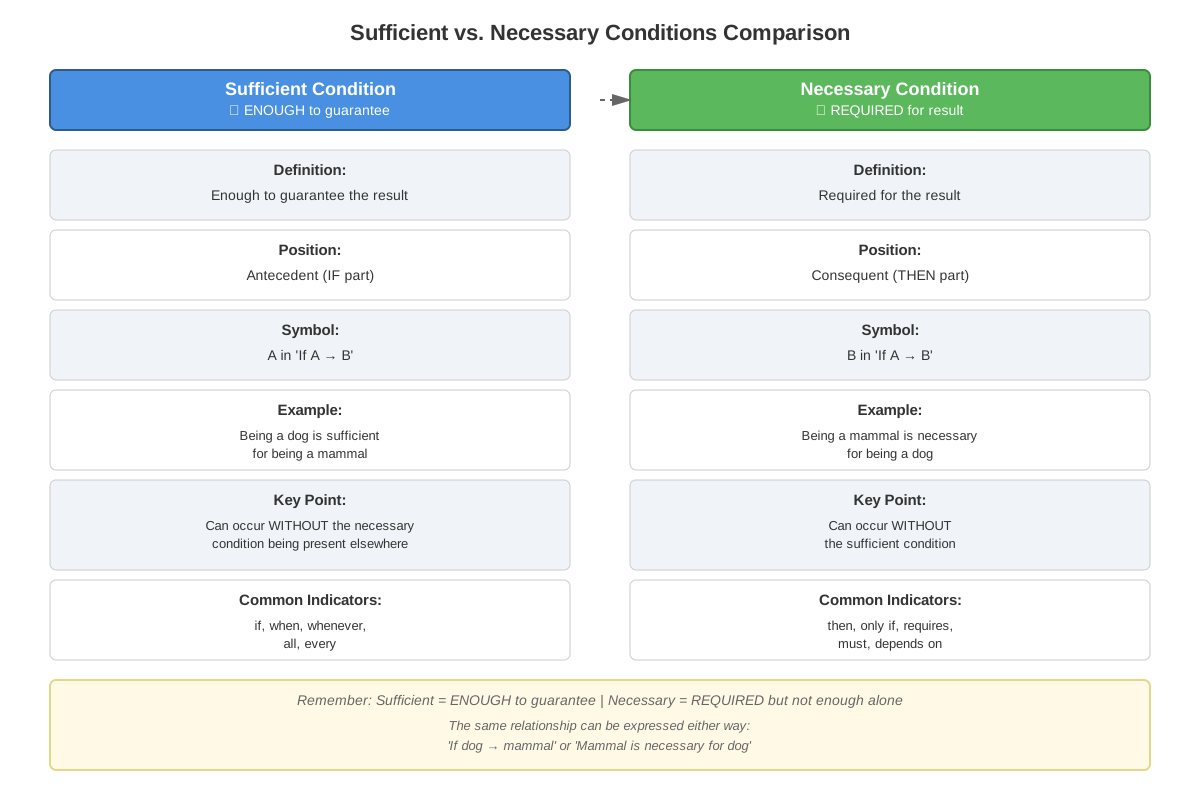
Understanding the distinction between necessary and sufficient conditions is fundamental to LSAT success:
Sufficient Condition:
- Enough to guarantee the result
- "If this happens, the result MUST follow"
- Can have multiple sufficient conditions for the same result
- Example: Scoring 180 on the LSAT is sufficient for admission to most law schools
Necessary Condition:
- Required for the result to occur
- "Without this, the result CANNOT happen"
- Can have multiple necessary conditions for the same result
- Example: Taking the LSAT is necessary for admission to law school
A condition can be:
- Sufficient but not necessary (scoring 180 guarantees admission, but you can get in with lower scores)
- Necessary but not sufficient (taking the LSAT is required, but doesn't guarantee admission)
- Both sufficient and necessary (rare; means if and only if)
- Neither (most conditions fall into this category)
Concept Relationships
Conditional reasoning forms the logical foundation upon which many other LSAT concepts build. The basic conditional statement (A → B) connects directly to the contrapositive (~B → ~A), which is not a separate concept but rather the same relationship expressed differently. This equivalence is crucial because the LSAT often states information in one form and requires you to recognize its contrapositive to answer correctly.
The distinction between necessary and sufficient conditions underlies the entire conditional framework. Understanding this distinction enables you to properly construct conditional statements from natural language and avoid the common errors of mistaken reversals and negations. These invalid transformations represent a breakdown in understanding the directional nature of conditional logic.
Conditional chains emerge when multiple basic conditional statements connect, with the necessary condition of one becoming the sufficient condition of another (A → B → C). This chaining process demonstrates how simple logical relationships can combine to create complex inference patterns. The ability to chain conditionals is essential for Must Be True questions and forms the basis for understanding how arguments build from multiple premises to a conclusion.
The relationship map flows as follows:
Basic Conditional (A → B) ↔ Contrapositive (~B → ~A) → Conditional Chains (A → B → C) → Complex Inferences
Necessary/Sufficient Distinction → Proper Statement Construction → Avoiding Invalid Transformations → Identifying Flawed Reasoning
These concepts connect to broader argument fundamentals by providing the formal logical structure that underlies many LSAT arguments. While basic argument analysis identifies premises and conclusions, conditional reasoning reveals the precise logical relationships between those components.
Quick check — test yourself on Conditional reasoning so far.
Try Flashcards →High-Yield Facts
⭐ The contrapositive is the ONLY valid transformation of a conditional statement; it is logically equivalent to the original.
⭐ A mistaken reversal (B → A from A → B) is always invalid and represents a common logical flaw on the LSAT.
⭐ "Unless" translates to "if not": "A unless B" means "If not B, then A" (~B → A).
⭐ The sufficient condition is the trigger/guarantee; the necessary condition is the result/requirement.
⭐ Conditional chains work only in the direction of the arrows; to reverse direction, you must use the contrapositive.
- "Only" introduces the necessary condition: "Only A are B" means B → A.
- "All" introduces the sufficient condition: "All A are B" means A → B.
- A mistaken negation (~A → ~B from A → B) is invalid and represents flawed reasoning.
- Multiple sufficient conditions can lead to the same necessary condition (A → C and B → C are both valid).
- The absence of the necessary condition guarantees the absence of the sufficient condition (contrapositive logic).
- Conditional statements tell you what MUST be true, not what MIGHT be true or what IS true in all cases.
- "If and only if" creates a biconditional relationship where both A → B and B → A are true.
Common Misconceptions
Misconception: If A is sufficient for B, then A is the only way to achieve B.
Correction: A sufficient condition guarantees the result but is not necessarily the exclusive path. Other sufficient conditions may exist. "If you score 180, you'll be admitted" doesn't mean 180 is the only score that gets you admitted.
Misconception: The contrapositive is a new inference derived from the original statement.
Correction: The contrapositive is logically equivalent to the original statement—it's the same information expressed differently. If the original is true, the contrapositive is automatically true, and vice versa.
Misconception: "If A, then B" means "If B, then A" (mistaken reversal).
Correction: Conditional logic is directional and does not work in reverse. The occurrence of B tells you nothing definitive about A unless you have additional information. Only the contrapositive (~B → ~A) is valid.
Misconception: When the sufficient condition doesn't occur, the necessary condition cannot occur (mistaken negation).
Correction: The absence of the sufficient condition tells you nothing about the necessary condition. If it doesn't rain, the game might still be cancelled for other reasons.
Misconception: "Only if" means the same as "if."
Correction: "Only if" introduces the necessary condition, not the sufficient condition. "You can vote only if you're registered" means Vote → Registered, not Registered → Vote.
Misconception: All conditional statements on the LSAT are explicitly stated using "if-then" language.
Correction: The LSAT disguises conditional relationships using diverse linguistic constructions including "all," "only," "unless," "requires," "without," and many others. Recognizing these variations is essential.
Misconception: In a conditional chain, you can jump directly from the first to the last element in either direction.
Correction: Chains work only in the direction of the arrows (A → B → C allows A → C). To work backwards, you must use the contrapositive of the entire chain (~C → ~B → ~A).
Worked Examples
Example 1: Basic Conditional Recognition and Application
Stimulus: "All members of the debate team have completed the public speaking course. Jamal has not completed the public speaking course."
Question: Which of the following must be true?
(A) Jamal is not a member of the debate team.
(B) Jamal will eventually join the debate team.
(C) Some debate team members have not completed the public speaking course.
(D) The public speaking course is required for debate team membership.
(E) Jamal is interested in public speaking.
Solution Process:
Step 1: Identify the conditional statement.
"All members of the debate team have completed the public speaking course."
Translation: Debate Team → Public Speaking Course
Step 2: Diagram the given information.
- Conditional: DT → PSC
- Fact: Jamal has ~PSC (not completed the course)
Step 3: Apply the contrapositive.
Original: DT → PSC
Contrapositive: ~PSC → ~DT
Step 4: Apply the contrapositive to Jamal.
Jamal has ~PSC, so by the contrapositive, Jamal has ~DT (is not on the debate team).
Step 5: Evaluate answer choices.
(A) Matches our inference exactly—this must be true. ✓
(B) No information about the future; not supported.
(C) Contradicts the original statement; all members have completed it.
(D) Goes beyond what's stated; we know completion is necessary, but "required" suggests policy.
(E) No information about Jamal's interests.
Answer: (A)
Connection to Learning Objectives: This example demonstrates identifying conditional reasoning in LSAT questions, explaining the reasoning pattern (using the contrapositive), and applying it to reach the correct answer.
Example 2: Conditional Chain with "Unless"
Stimulus: "A company will not expand internationally unless it has secured adequate funding. The company will not secure adequate funding unless it demonstrates consistent profitability. The company has not demonstrated consistent profitability."
Question: Which of the following can be properly concluded?
(A) The company has secured adequate funding.
(B) The company will expand internationally.
(C) The company will not expand internationally.
(D) If the company expands internationally, it has demonstrated consistent profitability.
(E) The company may still expand internationally through other means.
Solution Process:
Step 1: Translate "unless" statements.
"Will not expand unless has funding" → ~Funding → ~Expand
Contrapositive: Expand → Funding
"Will not secure funding unless demonstrates profitability" → ~Profitability → ~Funding
Contrapositive: Funding → Profitability
Step 2: Create the conditional chain.
Expand → Funding → Profitability
Step 3: Apply the given fact.
We're told: ~Profitability (has not demonstrated consistent profitability)
Step 4: Use the contrapositive of the chain.
Chain: Expand → Funding → Profitability
Contrapositive chain: ~Profitability → ~Funding → ~Expand
Step 5: Apply to our fact.
Since we have ~Profitability, the contrapositive chain tells us we must have ~Funding and ~Expand.
Step 6: Evaluate answers.
(A) Contradicts our inference; we concluded ~Funding.
(B) Contradicts our inference; we concluded ~Expand.
(C) Matches our inference perfectly. ✓
(D) This is actually the contrapositive of our chain and is valid, but let's check if (C) is more direct.
(E) The conditional chain rules this out; no other means are mentioned.
Answer: (C) is the most direct conclusion, though (D) is also valid.
Connection to Learning Objectives: This example demonstrates translating "unless" statements, chaining multiple conditionals, and deriving valid inferences through contrapositive reasoning—all essential skills for LSAT conditional reasoning mastery.
Exam Strategy
Recognition Phase
When approaching any Logical Reasoning question, scan for conditional indicators in the first 10 seconds. Look for: if, then, all, only, unless, requires, necessary, sufficient, when, whenever, without. These trigger words signal that conditional reasoning will be central to solving the question correctly.
Create a quick symbolic representation as you read. Don't try to hold complex conditional relationships in your head—diagram them using arrows. This external representation prevents errors and speeds up your analysis.
Common Question Types and Approaches
Must Be True Questions: Look for opportunities to apply the contrapositive or chain conditionals. The correct answer often requires combining multiple conditional statements or recognizing a contrapositive relationship.
Sufficient Assumption Questions: The correct answer will be a conditional statement that bridges the gap between premise and conclusion. Diagram the argument's structure, identify the logical gap, and find the conditional that closes it.
Necessary Assumption Questions: Use the negation test on conditional statements. The correct answer, when negated, will break the argument's logic. Often involves recognizing what must be true for a conditional chain to hold.
Flaw Questions: Watch for mistaken reversals and mistaken negations. If the argument treats B → A as equivalent to A → B, or treats ~A → ~B as following from A → B, you've found the flaw.
Process of Elimination Tips
Eliminate answers that:
- Commit mistaken reversals (reverse the conditional without negating)
- Commit mistaken negations (negate without reversing)
- Confuse necessary and sufficient conditions
- Make claims about what "might" or "could" happen when the logic demands what "must" happen
- Introduce new conditional relationships not supported by the stimulus
Time Management
Spend 15-20 seconds diagramming complex conditional relationships upfront. This investment saves time by preventing errors and making the correct answer obvious. For questions with multiple conditional statements, diagram each one before attempting to answer.
If a question involves three or more conditional statements, it's likely testing your ability to chain them. Don't try to see the answer immediately—work through the chain systematically.
Trigger Phrases to Watch
- "Must be true" → Apply contrapositive or chain conditionals
- "Properly inferred" → Look for valid conditional transformations
- "Assumption required" → Identify the conditional link needed
- "Reasoning is flawed because" → Check for mistaken reversal/negation
- "Parallel reasoning" → Match the conditional structure
Memory Techniques
Mnemonic for Contrapositive Formation: "Reverse and Negate" → RN (Registered Nurse). When you see a conditional, think of an RN: Reverse the order, Negate both terms.
Visualization for Sufficient vs. Necessary: Picture sufficient as a key (it unlocks/guarantees the result) and necessary as a door (you must go through it to reach the result). Multiple keys might open the same door (multiple sufficient conditions), but you always need the door (necessary condition).
Acronym for "Unless" Translation: NUT → Negate the Unless Term. When you see "unless," negate what follows it and make that the sufficient condition.
Conditional Chain Visualization: Picture a domino chain. Each domino (conditional statement) must fall in order. You can't skip dominoes, and they only fall in one direction unless you reverse the entire setup (contrapositive).
Invalid Transformation Memory Aid: "MR. MN is invalid" → Mistaken Reversal and Mistaken Negation are both invalid transformations. If you see MR. MN in an argument, it's flawed.
"Only" Placement Rule: "Only points to necessary" → The term following "only" is always the necessary condition (the arrow points TO it).
Summary
Conditional reasoning forms the logical backbone of LSAT Logical Reasoning, appearing in approximately 25-30% of questions across multiple question types. A conditional statement establishes that one condition (sufficient) guarantees another (necessary), represented as A → B. The contrapositive (~B → ~A) is the only valid transformation and is logically equivalent to the original statement. Common errors include mistaken reversals (B → A) and mistaken negations (~A → ~B), both of which are invalid. The LSAT disguises conditionals using diverse language including "all," "only," "unless," and "requires," making recognition skills essential. Multiple conditionals can chain together when properly connected, allowing valid inferences across multiple steps. Success requires three core competencies: accurate translation from natural language to symbolic form, fluent manipulation of conditional relationships through contrapositives and chains, and rapid identification of valid versus invalid inferences. Mastering these skills provides a significant competitive advantage, as conditional reasoning underlies not just explicit logic questions but also the formal structure of many LSAT arguments.
Key Takeaways
- Conditional statements express sufficient-necessary relationships: the sufficient condition guarantees the necessary condition, represented as A → B.
- The contrapositive is the only valid transformation: reverse and negate both terms (~B → ~A) to create a logically equivalent statement.
- Mistaken reversals and mistaken negations are always invalid: these common errors appear frequently in wrong answers and flawed arguments.
- "Unless" means "if not": translate "A unless B" as ~B → A, then use the contrapositive for the more intuitive form.
- Conditional chains require systematic connection: link statements where the necessary condition of one matches the sufficient condition of another.
- Recognize diverse conditional indicators: "all," "only," "requires," "without," and many other words signal conditional relationships beyond simple "if-then" constructions.
- Diagram complex relationships immediately: external symbolic representation prevents errors and reveals valid inferences that might otherwise be missed.
Related Topics
Formal Logic: Builds directly on conditional reasoning by introducing additional logical operators (and, or, not) and more complex logical structures. Mastering conditional reasoning is essential before tackling formal logic's advanced applications.
Necessary and Sufficient Assumptions: These question types explicitly test your understanding of conditional relationships by asking you to identify what must be true (necessary) or what would guarantee (sufficient) an argument's conclusion.
Logical Validity and Soundness: Understanding conditional reasoning provides the foundation for evaluating whether conclusions follow logically from premises, a skill tested across all Logical Reasoning question types.
Causal Reasoning: While distinct from conditional reasoning, causal arguments often contain conditional elements ("If X causes Y, then when X occurs, Y follows"), making conditional reasoning skills transferable.
Quantifiers and Categorical Logic: Statements like "All A are B" and "Some A are B" involve conditional relationships and build on the sufficient-necessary framework established in conditional reasoning.
Practice CTA
Now that you've mastered the fundamentals of conditional reasoning, it's time to cement your understanding through active practice. Attempt the practice questions associated with this topic, focusing on accurately diagramming each conditional relationship before selecting your answer. Use the flashcards to drill conditional indicators and contrapositive formation until these skills become automatic. Remember: conditional reasoning is a skill that improves dramatically with deliberate practice. Each question you work through builds the pattern recognition and logical fluency that will serve you throughout the LSAT. You've built the foundation—now construct mastery through application!
Sign up free to keep reading
Create a free AnvayaPrep account to finish this LSAT guide on Conditional reasoning — plus flashcards and practice questions.