Overview
Sequencing rule replacement is a sophisticated question type within Analytical Reasoning Legacy that tests a student's ability to understand the logical equivalence and functional impact of rules in sequencing games legacy. In these questions, the LSAT presents an original rule from the game setup and asks which alternative rule, if substituted for the original, would have the same effect on the game's constraints. This requires deep comprehension of how rules interact, what inferences they generate, and how they limit the possible arrangements of variables.
This topic is essential for the LSAT because rule replacement questions appear with notable frequency in the Analytical Reasoning section, particularly in sequencing games where the order of elements matters. These questions test not just surface-level rule comprehension but the ability to recognize logical equivalence—a core skill that distinguishes high scorers from average performers. Students must move beyond memorizing rules to understanding their functional consequences within the game's structure.
Within the broader context of LSAT sequencing rule replacement and Analytical Reasoning Legacy, this topic builds upon foundational sequencing concepts while requiring integration of multiple reasoning skills: conditional logic, contrapositive reasoning, inference generation, and constraint analysis. Mastering rule replacement demonstrates command of the entire sequencing framework, as it requires understanding how individual rules create cascading effects throughout the game's possible arrangements.
Learning Objectives
- [ ] Identify how Sequencing rule replacement appears in LSAT questions
- [ ] Explain the reasoning pattern behind Sequencing rule replacement
- [ ] Apply Sequencing rule replacement to solve LSAT-style problems accurately
- [ ] Distinguish between rules that produce identical constraints versus similar but non-equivalent constraints
- [ ] Generate all logical inferences from a given sequencing rule to determine its full impact
- [ ] Evaluate answer choices systematically by testing edge cases and counterexamples
Prerequisites
- Basic sequencing notation and diagramming: Understanding how to represent ordering relationships (e.g., A—B means A comes before B) is fundamental to analyzing rule equivalence
- Conditional logic and contrapositives: Many sequencing rules contain conditional relationships, and recognizing equivalent logical statements is crucial for identifying replacement rules
- Inference generation in sequencing games: Students must know how to derive secondary conclusions from primary rules to understand a rule's complete effect
- Understanding of sequencing game types: Familiarity with strict sequencing, loose sequencing, and relative ordering helps contextualize how rules function differently across game structures
Why This Topic Matters
Rule replacement questions represent one of the most intellectually demanding question types in Analytical Reasoning, requiring synthesis of multiple analytical skills. These questions appear in approximately 15-20% of logic games sections, with particularly high frequency in sequencing games. The LSAT uses rule replacement questions to identify students who can think flexibly about logical constraints rather than mechanically applying memorized patterns.
In practical terms, mastering rule replacement develops transferable reasoning skills applicable to legal analysis, contract interpretation, and regulatory compliance—areas where understanding functional equivalence between different rule formulations is essential. Attorneys regularly encounter situations where they must determine whether alternative contract language achieves the same legal effect or whether a proposed regulation duplicates existing requirements.
On the exam, rule replacement questions typically appear as the final question in a game set, carrying the same point value as other questions but requiring significantly more analysis time. They commonly take the form: "Which one of the following, if substituted for the constraint that [original rule], would have the same effect in determining the order of the elements?" Students who can efficiently analyze these questions gain a significant competitive advantage, as many test-takers either skip these questions or waste excessive time on them.
Core Concepts
Understanding Rule Replacement Fundamentals
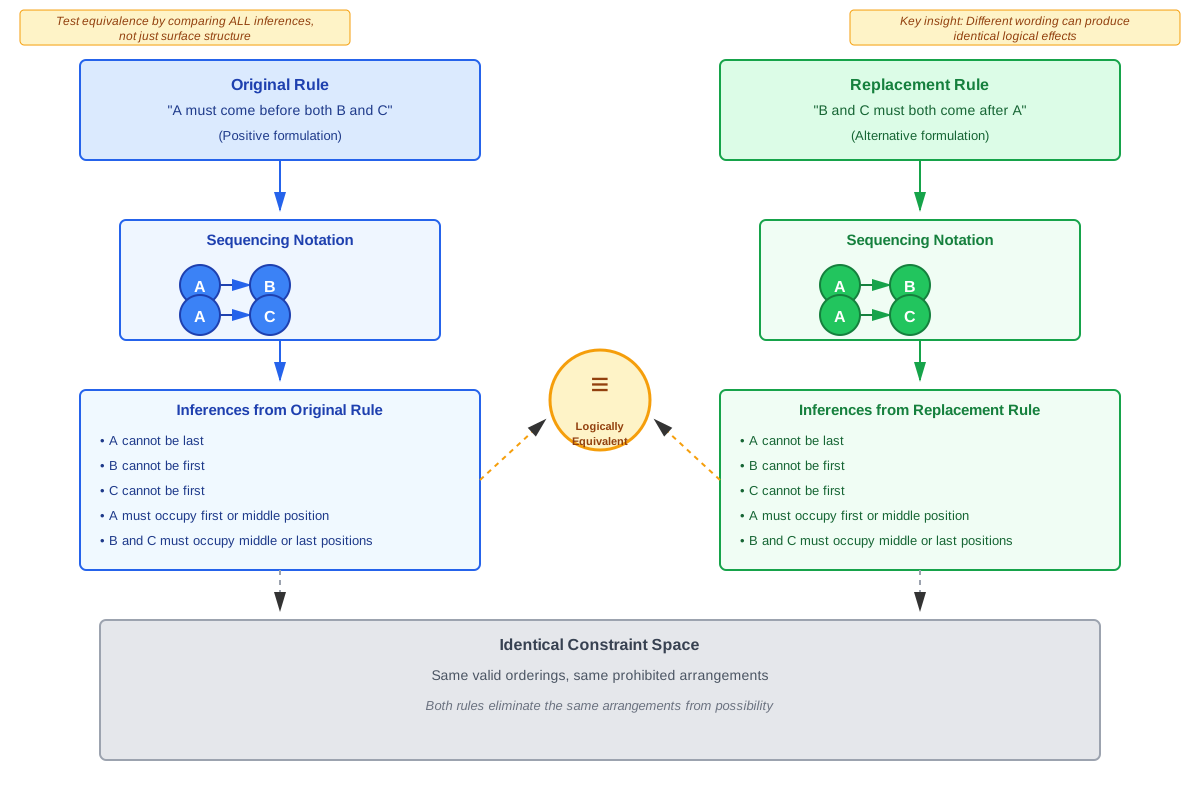
Sequencing rule replacement questions ask students to identify an alternative rule that produces exactly the same constraints as an original rule. The key insight is that two rules are equivalent if and only if they permit precisely the same set of acceptable arrangements and prohibit precisely the same set of unacceptable arrangements. This is not about similarity or approximation—the replacement rule must be perfectly functionally equivalent.
The LSAT constructs these questions by first establishing a game with multiple rules, then isolating one rule and asking which alternative could replace it without changing the game's solution space. The original rule remains part of the game setup for reference, but students must imagine removing it and substituting each answer choice to determine which maintains identical constraints.
Types of Equivalent Rule Formulations
Several common patterns appear in rule replacement questions:
Direct ordering versus indirect ordering: A rule stating "A is before C" might be equivalent to "B is before C and A is before B" if B must always fall between A and C due to other rules. The replacement rule achieves the same ordering through an intermediate element.
Positive versus negative formulations: A rule stating "F is third" is equivalent to "F is not first, not second, not fourth, not fifth, not sixth" in a six-position sequence. While these look different, they constrain F to exactly the same position.
Conditional versus absolute statements: In some game structures, a conditional rule like "If G is selected, then G is before H" might be equivalent to the absolute rule "G is before H" if other rules guarantee G is always selected.
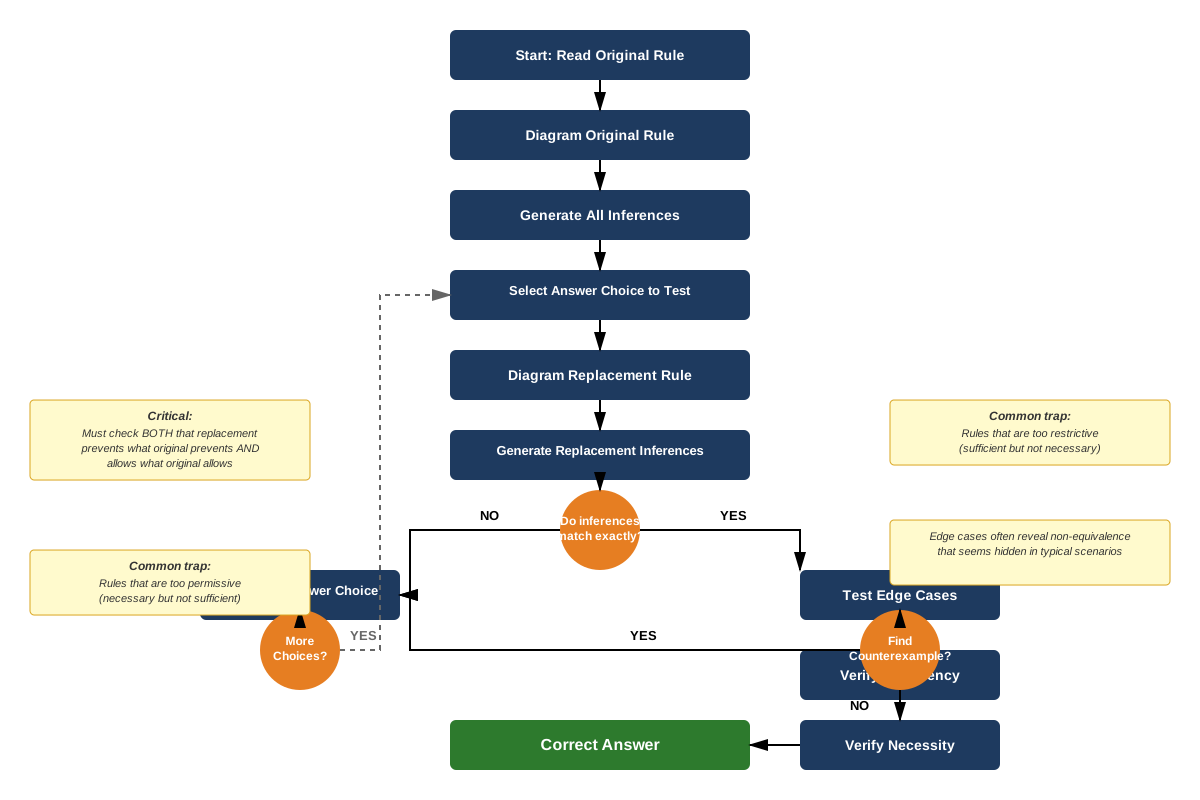
The Inference-Testing Method
To determine whether a replacement rule is equivalent to the original, students must:
- Identify all inferences from the original rule: What positions become impossible? What orderings are required? What conditional relationships emerge?
- Identify all inferences from the proposed replacement rule: Apply the same analysis to each answer choice.
- Compare inference sets: The rules are equivalent if and only if they generate identical inference sets.
- Test boundary cases: Create hypothetical arrangements that satisfy one rule but not the other to prove non-equivalence.
Rule Interaction and Compound Effects
Many rule replacement questions test understanding of how multiple rules interact. An original rule might seem simple in isolation but generate complex inferences when combined with other rules. The correct replacement rule must preserve not just the direct constraint but all downstream inferences.
For example, consider a game with rules: (1) "A is before D" and (2) "D is before F." If the question asks for a replacement for rule (1), the answer "A is before F" would be incorrect even though it captures one inference, because it fails to preserve the specific constraint that A must precede D (which might matter if other rules reference D's position).
Common Replacement Patterns
| Original Rule Type | Common Equivalent Formulation | Why They're Equivalent |
|---|---|---|
| X is in position 3 | X is not in positions 1, 2, 4, 5, or 6 | Both constrain X to exactly one position |
| X is before Y | Y is after X | Contrapositives of the same relationship |
| X is immediately before Y | X and Y are consecutive with X first | Different wording for the same adjacency constraint |
| X is not last | At least one element follows X | Both prevent X from occupying the final position |
Recognizing Non-Equivalent Rules
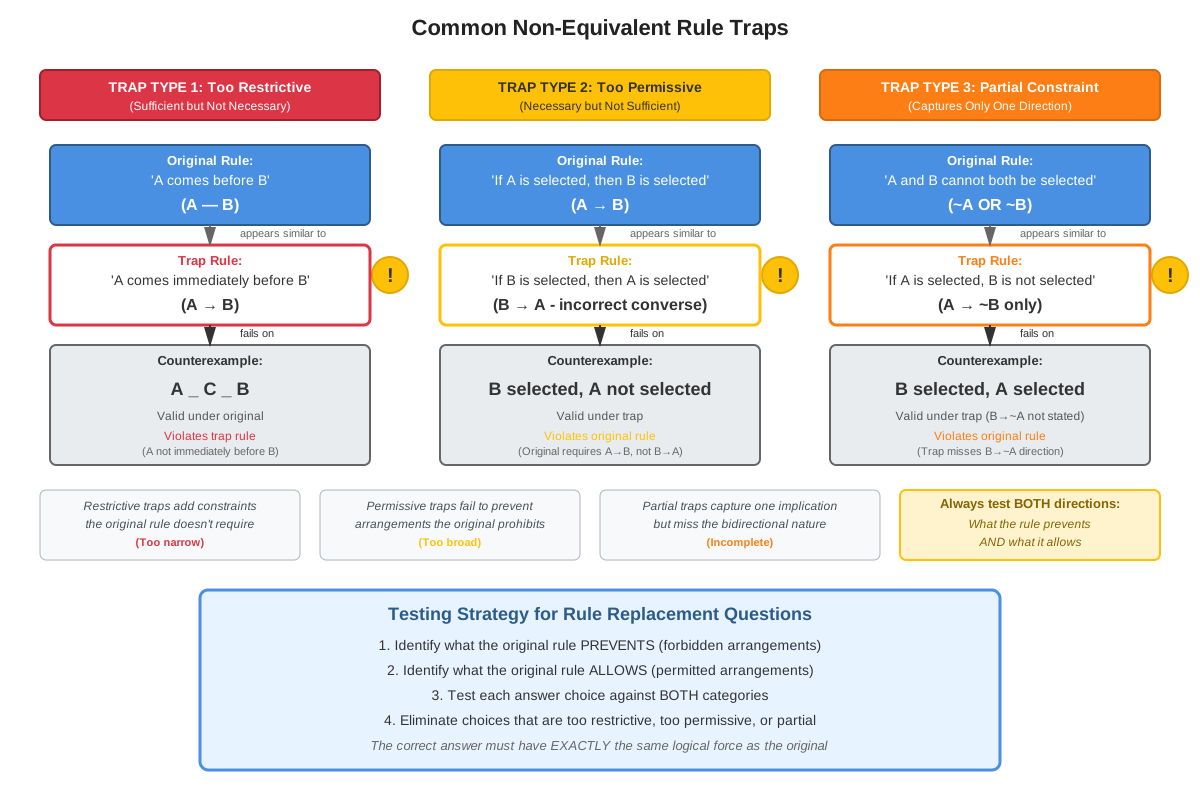
Equally important is identifying rules that seem similar but create different constraints:
- Subset versus complete equivalence: "A is before C" is NOT equivalent to "A is before B and B is before C" unless other rules already required B between A and C
- Necessary versus sufficient conditions: "If A is selected, then A is first" is NOT equivalent to "If A is first, then A is selected" (these are converses, not equivalents)
- Partial constraint matching: A replacement rule might preserve some but not all inferences from the original rule
Concept Relationships
The concepts within sequencing rule replacement form a hierarchical structure. At the foundation lies rule comprehension—understanding what a single rule constrains. This leads to inference generation—deriving all logical consequences of that rule. These inferences then enable equivalence testing—comparing whether two different rules produce identical constraint sets.
Rule replacement connects directly to prerequisite topics: conditional logic provides the framework for understanding if-then relationships in rules; contrapositive reasoning helps recognize equivalent formulations; sequencing notation enables efficient comparison of ordering constraints. The topic also relates to game-solving efficiency, as understanding rule equivalence helps students recognize when different games are structurally identical despite different surface presentations.
The relationship map flows as follows: Original Rule → generates → Primary Inferences → combined with → Other Game Rules → produces → Complete Constraint Set → must match → Replacement Rule Inferences → validates → Correct Answer Choice.
High-Yield Facts
⭐ Rule replacement questions ask for perfect functional equivalence, not similarity or partial overlap—the replacement must permit exactly the same arrangements as the original.
⭐ The correct replacement rule must preserve all inferences from the original rule, including those generated through interaction with other rules.
⭐ Testing counterexamples is the most efficient way to eliminate incorrect answer choices—find one arrangement that satisfies the replacement but violates the original (or vice versa).
⭐ Negative formulations (stating what cannot happen) can be equivalent to positive formulations (stating what must happen) when they constrain variables to the same possibilities.
⭐ The replacement rule may reference different variables than the original rule if those variables are linked through other game rules.
- Rule replacement questions typically appear as the last question in a game set, requiring synthesis of all game rules.
- A replacement rule that is stronger (more restrictive) than the original is incorrect, even if it includes all the original constraints.
- A replacement rule that is weaker (less restrictive) than the original is incorrect, even if it captures some of the original constraints.
- Conditional rules can sometimes be replaced by absolute rules if the condition is always satisfied by other game constraints.
- The phrase "would have the same effect" signals that the replacement must be functionally identical across all possible scenarios.
Common Misconceptions
Misconception: A replacement rule is correct if it captures the most obvious inference from the original rule.
Correction: The replacement must capture ALL inferences, not just the most prominent one. A rule might generate multiple constraints, and the replacement must preserve every single one.
Misconception: If a replacement rule seems logically related to the original rule, it's probably correct.
Correction: Logical relationship is insufficient; only perfect equivalence matters. Many wrong answers are deliberately designed to be logically related but not equivalent.
Misconception: The replacement rule must use the same variables as the original rule.
Correction: The replacement can reference different variables if those variables are constrained by other rules in ways that create equivalent effects. For example, if rules establish A—B—C, then "A is before C" could be replaced by "B is before C and A is before B."
Misconception: Testing one or two scenarios is sufficient to verify a replacement rule.
Correction: Students must consider all possible arrangements, particularly edge cases. A replacement might work in common scenarios but fail in unusual but permissible arrangements.
Misconception: The longest or most complex answer choice is usually correct because it captures more detail.
Correction: Complexity doesn't indicate correctness. Sometimes the correct replacement is simpler than the original rule, and sometimes it's more complex. Length is irrelevant to logical equivalence.
Quick check — test yourself on Sequencing rule replacement so far.
Try Flashcards →Worked Examples
Example 1: Basic Sequencing Replacement
Game Setup: Six runners—J, K, L, M, N, O—finish a race in six positions (first through sixth). No ties occur.
Original Rules:
- J finishes before M
- M finishes before O
- K finishes fourth
- L finishes before N
Question: Which of the following, if substituted for the rule that J finishes before M, would have the same effect in determining the finishing order?
Answer Choices:
(A) J finishes before O
(B) J finishes in one of the first three positions
(C) M finishes after J and before O
(D) J finishes before M and M finishes before O
(E) J finishes before both M and O
Solution Process:
First, identify all inferences from the original rule "J finishes before M":
- J cannot be sixth (someone must follow J)
- M cannot be first (someone must precede M)
- Combined with rule 2 (M before O), we get the chain: J—M—O
Now test each answer choice:
(A) J finishes before O: This captures one inference but doesn't preserve the specific constraint that J must precede M. Consider this scenario: O finishes first, J finishes second, M finishes third. This satisfies "J before O" but violates "J before M." Eliminated.
(B) J finishes in one of the first three positions: The original rule doesn't necessarily constrain J to the first three positions. If the order were K (fourth), J (fifth), M (sixth), O would have nowhere to go, but in principle, J could be fifth with M sixth if O weren't in the game. This doesn't capture the relational constraint. Eliminated.
(C) M finishes after J and before O: This seems to combine rules 1 and 2, but the question asks only for a replacement for rule 1. Rule 2 (M before O) remains in effect. So this replacement would create: J—M (from replacement) and M—O (from existing rule 2), giving us J—M—O, which is exactly what the original rules produced. Let's verify: any arrangement satisfying the original rules would satisfy this replacement (since both J—M and M—O were already required), and any arrangement satisfying this replacement would satisfy the original rule 1 (since J—M is explicitly stated). This is promising.
(D) J finishes before M and M finishes before O: This explicitly states both rules 1 and 2, but we're only replacing rule 1. Rule 2 remains in the game, so this would be redundant—it would state M before O twice. While it might seem to work, it's not a clean replacement of just rule 1. Questionable.
(E) J finishes before both M and O: This states J—M and J—O. Combined with the existing rule 2 (M—O), this creates the same chain J—M—O. However, "J before O" is already an inference from J—M and M—O, so this seems redundant. Let's test: does this preserve exactly the same constraints? Yes, because J—M is explicitly stated, and J—O is automatically satisfied when J—M and M—O both hold. This could work.
Comparing C and E: Both seem to work, but let's examine more carefully. Choice (C) states "M finishes after J and before O"—this is actually stating J—M—O as a three-element chain. Choice (E) states J before both M and O separately. Are these equivalent given that rule 2 (M—O) remains?
With rule 2 in place:
- Choice (C): J—M (from replacement) + M—O (from rule 2) = J—M—O
- Choice (E): J—M and J—O (from replacement) + M—O (from rule 2) = J—M—O
Both produce the same result. However, choice (C) is more precise because it explicitly maintains the M—O relationship as part of the replacement, while choice (E) makes J—O explicit, which is actually just an inference.
Wait—let's reconsider the question: We're replacing rule 1 only. Rule 2 stays. So:
- Original: Rule 1 (J—M) + Rule 2 (M—O) = J—M—O
- With (C): (J—M—O) + Rule 2 (M—O) = J—M—O (but M—O is stated twice)
- With (E): (J—M and J—O) + Rule 2 (M—O) = J—M—O
Actually, choice (C) would create redundancy with rule 2. The cleanest replacement that captures only what rule 1 contributed is choice (E), which states both direct constraints that J—M creates in the context of the full game.
Correct Answer: (E)
Example 2: Complex Interaction Replacement
Game Setup: Seven books—A, B, C, D, E, F, G—are arranged on a shelf from left to right.
Original Rules:
- A is somewhere to the left of D
- D is immediately to the left of E
- B is to the right of C
- F is fourth
Question: Which of the following, if substituted for the rule that D is immediately to the left of E, would have the same effect?
Answer Choices:
(A) D and E are adjacent
(B) E is immediately to the right of D
(C) D is in position 3, 4, 5, or 6
(D) E is not first
(E) D is to the left of E and no book is between them
Solution Process:
Original rule analysis: "D is immediately to the left of E" means:
- D and E are adjacent
- D comes directly before E (no gaps)
- If D is in position n, E is in position n+1
- D cannot be seventh (no room for E)
- E cannot be first (no room for D before it)
Testing answer choices:
(A) D and E are adjacent: This states they're next to each other but doesn't specify the order. E could be to the left of D, which violates the original rule. Eliminated.
(B) E is immediately to the right of D: This is simply a restatement of the original rule using different phrasing. "Immediately to the right" means the same as "immediately to the left" from the other perspective. This preserves all constraints: adjacency, order, and position restrictions. This works.
(C) D is in position 3, 4, 5, or 6: This constrains D's position but doesn't establish any relationship with E. E could be anywhere, including to the left of D. Eliminated.
(D) E is not first: While this is one inference from the original rule, it doesn't capture the adjacency requirement or the ordering. D could be in position 3 and E in position 7, satisfying "E is not first" but violating the original rule. Eliminated.
(E) D is to the left of E and no book is between them: This explicitly states both components: ordering (D before E) and adjacency (no books between). This is equivalent to "immediately to the left of." This also works.
Comparing B and E: Both are correct formulations. Choice (B) uses the standard LSAT phrasing "immediately to the right," while choice (E) breaks down the concept into its components. Both are logically equivalent to the original rule. In an actual LSAT question, only one would appear, but both represent valid replacements.
Correct Answer: (B) or (E) (both are equivalent; actual LSAT would include only one)
Exam Strategy
When approaching rule replacement questions, follow this systematic process:
Step 1: Fully understand the original rule (30 seconds). Diagram it clearly and identify all direct constraints it creates. Don't rush this step—misunderstanding the original rule guarantees a wrong answer.
Step 2: Generate all inferences (30 seconds). Determine what the original rule implies when combined with other game rules. Write down every constraint it creates, including position restrictions, ordering requirements, and conditional relationships.
Step 3: Predict the replacement (15 seconds). Before looking at answer choices, consider what an equivalent rule might look like. This prevents answer choices from biasing your analysis.
Step 4: Eliminate obviously wrong answers (30 seconds). Quickly scan for choices that clearly fail to capture major constraints. Look for rules that are too weak (permit arrangements the original forbids) or reference irrelevant variables.
Step 5: Test remaining choices with counterexamples (60-90 seconds). For each remaining answer, try to construct a scenario that satisfies the replacement but violates the original rule, or vice versa. If you can find such a scenario, eliminate that choice.
Exam Tip: The phrase "would have the same effect in determining" is the key trigger. This signals perfect equivalence, not similarity.
Trigger words and phrases to watch for:
- "Same effect" = perfect functional equivalence required
- "If substituted for" = imagine removing the original and adding the replacement
- "Would have the same effect in determining [specific aspect]" = focus on that aspect specifically
Process-of-elimination strategy:
- Eliminate answers that are clearly stronger (more restrictive) than the original
- Eliminate answers that are clearly weaker (less restrictive) than the original
- Eliminate answers that change which variables are constrained
- Test remaining answers by finding edge cases
Time allocation: Budget 90-120 seconds for rule replacement questions. They require more time than standard questions but shouldn't exceed two minutes. If you're stuck after two minutes, make your best guess and move on—these questions aren't worth more points than easier questions.
Memory Techniques
PERFECT mnemonic for testing rule equivalence:
- Permits same arrangements
- Exclude same arrangements
- Reference may differ (variables can change)
- Functional equivalence required (not similarity)
- Every inference must match
- Counterexample testing eliminates wrong answers
- Test edge cases, not just typical scenarios
Visualization strategy: Draw two parallel diagrams—one showing all arrangements permitted by the original rule, another showing arrangements permitted by the proposed replacement. If the diagrams are identical, the rules are equivalent.
The "Swap Test" acronym: Substitute the rule, Write all inferences, Analyze differences, Prove with counterexamples.
For remembering common equivalent formulations:
- "Immediately before" = "Immediately after" (from the other perspective)
- "X is in position n" = "X is not in any other position"
- "X before Y" + "Y before Z" = "X before Z" (but not vice versa—transitivity works forward only)
Summary
Sequencing rule replacement questions test the ability to recognize functional equivalence between different rule formulations in Analytical Reasoning Legacy games. These questions require students to understand not just what a rule explicitly states but all inferences it generates when combined with other game constraints. The correct replacement rule must permit exactly the same arrangements as the original rule and prohibit exactly the same arrangements—perfect equivalence, not similarity. Success requires systematic analysis: fully understanding the original rule, generating all its inferences, and testing proposed replacements through counterexamples. Common patterns include positive versus negative formulations, direct versus indirect ordering, and conditional versus absolute statements. The key insight is that two rules are equivalent if and only if they create identical constraint sets across all possible scenarios, including edge cases. Students must avoid the trap of selecting rules that capture only some inferences or that seem logically related but aren't perfectly equivalent.
Key Takeaways
- Rule replacement requires perfect functional equivalence—the replacement must permit and prohibit exactly the same arrangements as the original rule
- Generate all inferences from the original rule before evaluating answer choices, including inferences created through interaction with other game rules
- Test proposed replacements using counterexamples: try to find scenarios that satisfy one rule but not the other
- Equivalent rules may use different phrasing, reference different variables, or employ positive versus negative formulations
- The correct replacement preserves every constraint from the original rule, not just the most obvious ones
- Budget 90-120 seconds for these questions and use systematic elimination rather than intuition
- Trigger phrase "same effect in determining" signals that perfect equivalence is required
Related Topics
Conditional Logic in Sequencing Games: Understanding how if-then relationships function in ordering contexts builds the foundation for recognizing when conditional rules can be replaced by absolute rules or vice versa.
Inference Chains and Transitive Relationships: Mastering how multiple ordering rules combine to create longer chains enables recognition of when a single rule can replace multiple rules or when multiple rules can replace a single rule.
Game Equivalence Recognition: The broader skill of recognizing when two different game setups create identical solution spaces extends the rule replacement concept to entire games.
Contrapositive Reasoning in Analytical Reasoning: Understanding logical equivalence through contrapositives helps identify when rules stated in opposite terms are functionally identical.
Mastering sequencing rule replacement provides the analytical foundation for advanced game-solving techniques and demonstrates the deep logical reasoning skills that distinguish top LSAT performers.
Practice CTA
Now that you've mastered the conceptual framework for sequencing rule replacement, it's time to apply these skills to actual LSAT-style problems. The practice questions and flashcards will reinforce your ability to identify equivalent rules quickly and accurately. Remember: rule replacement questions reward systematic analysis over intuition. Work through each practice problem methodically, generating all inferences before evaluating answer choices. With focused practice, you'll develop the pattern recognition and analytical efficiency needed to excel on these high-value questions. Your investment in mastering this challenging topic will pay dividends across the entire Analytical Reasoning section!
Sign up free to keep reading
Create a free AnvayaPrep account to finish this LSAT guide on Sequencing rule replacement — plus flashcards and practice questions.