Overview
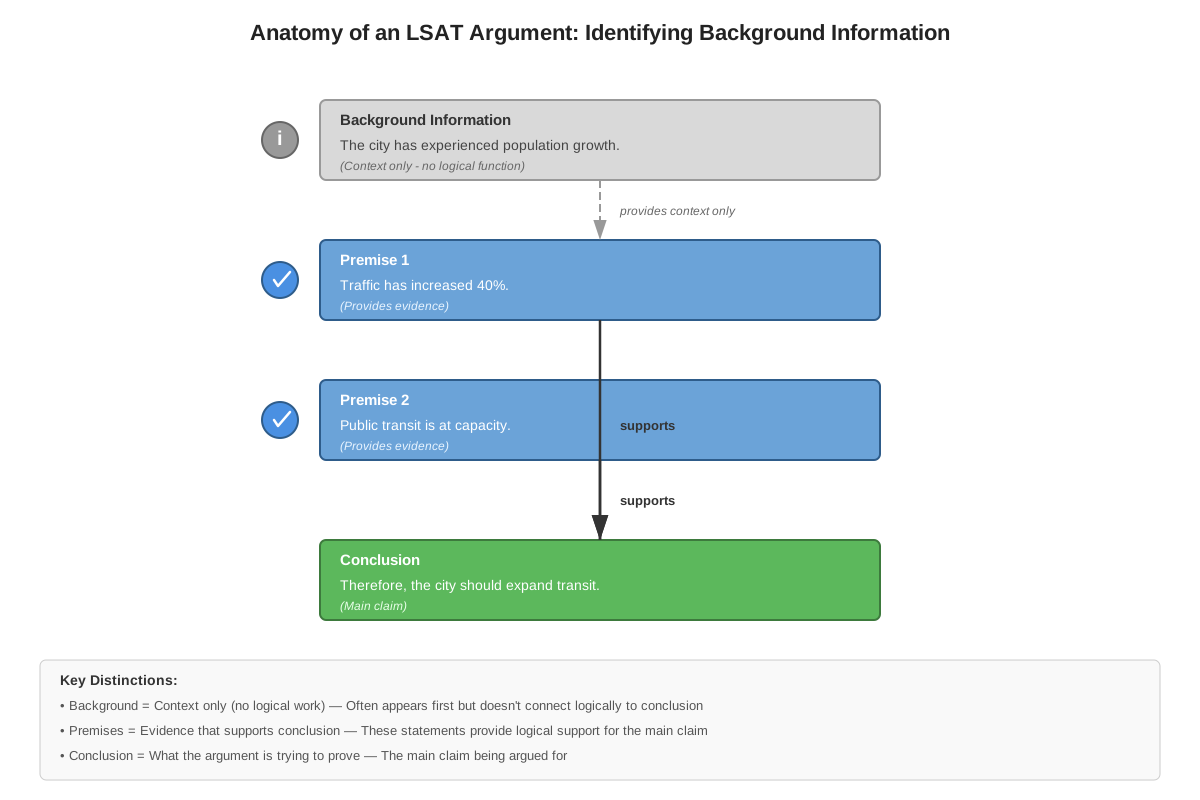
Background information is a critical component of argument fundamentals in LSAT Logical Reasoning that students must master to achieve top scores. In LSAT arguments, background information refers to contextual statements, facts, or circumstances that set the stage for the argument but do not directly function as premises supporting the conclusion or as the conclusion itself. These statements provide necessary context that helps readers understand the situation being discussed, but they play a neutral role in the logical structure of the argument.
Understanding how to identify and distinguish background information from active argumentative components is essential for success on the LSAT. Many students struggle with this distinction because background information often appears at the beginning of stimulus passages and can superficially resemble premises. However, recognizing background information allows test-takers to focus their analytical energy on the actual logical structure—the premises and conclusions that form the argument's reasoning chain. This skill becomes particularly important in question types such as Assumption questions, Strengthen/Weaken questions, and Flaw questions, where understanding what is and isn't doing logical work in the argument directly impacts answer selection.
The ability to parse background information connects to broader logical reasoning skills including argument structure analysis, premise identification, and conclusion recognition. When students can quickly identify background information, they can more efficiently diagram arguments, spot logical gaps, and predict what assumptions the argument relies upon. This foundational skill supports virtually every question type in the Logical Reasoning section and represents a high-yield investment of study time.
Learning Objectives
- [ ] Identify how Background information appears in LSAT questions
- [ ] Explain the reasoning pattern behind Background information
- [ ] Apply Background information to solve LSAT-style problems accurately
- [ ] Distinguish background information from premises and conclusions in complex arguments
- [ ] Recognize the typical placement and linguistic markers of background information
- [ ] Evaluate how background information affects argument scope and context
Prerequisites
- Basic argument structure: Understanding what constitutes a premise and conclusion is essential because background information is defined by what it is NOT—it is neither premise nor conclusion.
- Indicator words: Familiarity with conclusion indicators (therefore, thus, hence) and premise indicators (because, since, for) helps distinguish these elements from background information, which typically lacks such indicators.
- Reading comprehension fundamentals: The ability to parse complex sentences and identify main ideas enables students to separate contextual setup from argumentative content.
Why This Topic Matters
In real-world contexts, distinguishing background information from argumentative claims is crucial for critical thinking, legal reasoning, and professional communication. Lawyers must identify which facts are merely contextual versus which facts support legal conclusions. Business professionals need to separate market context from strategic recommendations. Academic researchers must distinguish literature review context from their own argumentative contributions.
On the LSAT, background information appears in approximately 60-70% of Logical Reasoning stimuli, making it one of the most frequently encountered elements. This topic is particularly important for:
- Assumption questions (15-20% of LR questions): Identifying background information helps isolate the actual logical gap between premises and conclusion
- Strengthen/Weaken questions (25-30% of LR questions): Understanding what is background versus what is argumentative helps predict what information would impact the argument
- Flaw questions (10-15% of LR questions): Recognizing background information prevents students from mistakenly identifying it as a problematic premise
- Method of Reasoning questions (5-10% of LR questions): Accurately describing argument structure requires distinguishing background from active reasoning
Background information typically appears in the opening sentences of LSAT stimuli, though it can appear anywhere in the passage. It often provides historical context, defines terms, describes situations, or establishes facts that both parties in a debate would accept as true.
Core Concepts
Definition and Characteristics of Background Information
Background information consists of statements in an LSAT stimulus that provide context, define terms, or establish a situation without directly supporting the argument's conclusion. These statements are descriptive rather than argumentative—they tell you what is the case without trying to prove anything or draw inferences.
Key characteristics include:
- Neutrality: Background information doesn't advocate for a position or support a claim
- Contextual function: It establishes the setting, circumstances, or framework for understanding the argument
- Logical independence: Removing background information might make the argument harder to understand, but it doesn't break the logical chain between premises and conclusion
- Universal acceptance: Background information typically consists of facts or definitions that aren't controversial within the argument's context
Distinguishing Background Information from Premises
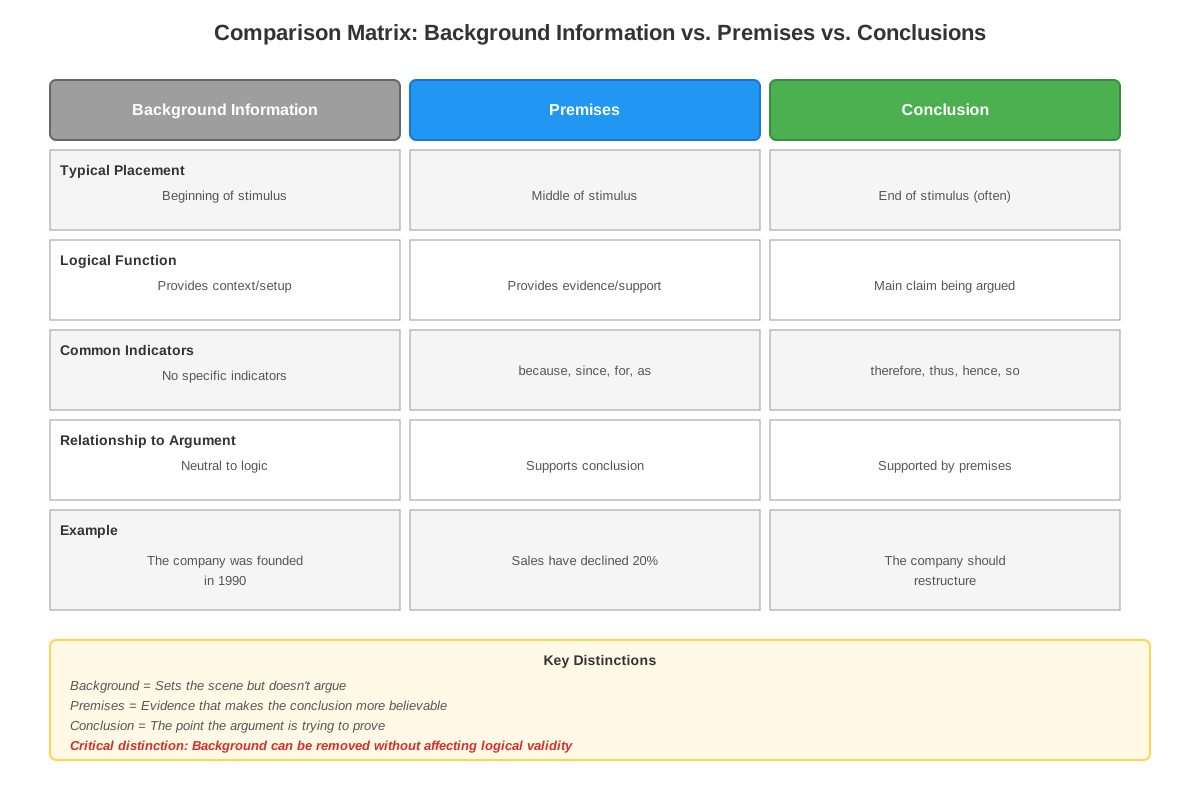
The distinction between background information and premises represents one of the most important skills in LSAT background information analysis. Consider this comparison:
| Feature | Background Information | Premises |
|---|---|---|
| Function | Provides context | Supports conclusion |
| Logical role | Neutral setup | Active reasoning |
| Relationship to conclusion | Indirect or none | Direct support |
| Typical placement | Beginning of stimulus | Before or after conclusion |
| Indicator words | Rarely has indicators | Often has "because," "since," "for" |
| Necessity for argument | Helpful but not essential | Essential to logical structure |
For example, consider: "Many companies have adopted remote work policies. TechCorp implemented remote work last year. This change has improved employee satisfaction."
- Background: "Many companies have adopted remote work policies" (contextual fact)
- Background: "TechCorp implemented remote work last year" (establishes situation)
- Premise: "This change has improved employee satisfaction" (if this supports a conclusion)
Positional Patterns in LSAT Stimuli
Background information follows predictable patterns in logical reasoning passages:
- Opening context (most common): 1-2 sentences establishing the general situation before the argument begins
- Mid-argument clarification: Definitions or explanations inserted to clarify terms used in the reasoning
- Transitional background: Information that bridges between different parts of a complex argument
- Concluding context: Occasionally, background appears after the conclusion to provide additional context (rare)
Functional Categories of Background Information
Background information serves several distinct functions:
Historical/Temporal Context: Establishes when events occurred or provides historical background
- Example: "In the 1990s, internet usage was limited to universities and research institutions."
Definitional Background: Defines terms or concepts that will be used in the argument
- Example: "Photosynthesis is the process by which plants convert sunlight into chemical energy."
Situational Setup: Describes a current state of affairs or situation
- Example: "The city council is considering a proposal to expand public transportation."
Statistical/Factual Context: Provides data or facts that frame the discussion
- Example: "Approximately 40% of adults in the region commute more than 30 minutes to work."
Comparative Background: Establishes contrasts or comparisons relevant to understanding the argument
- Example: "Unlike traditional manufacturing, modern production relies heavily on automation."
The "So What?" Test
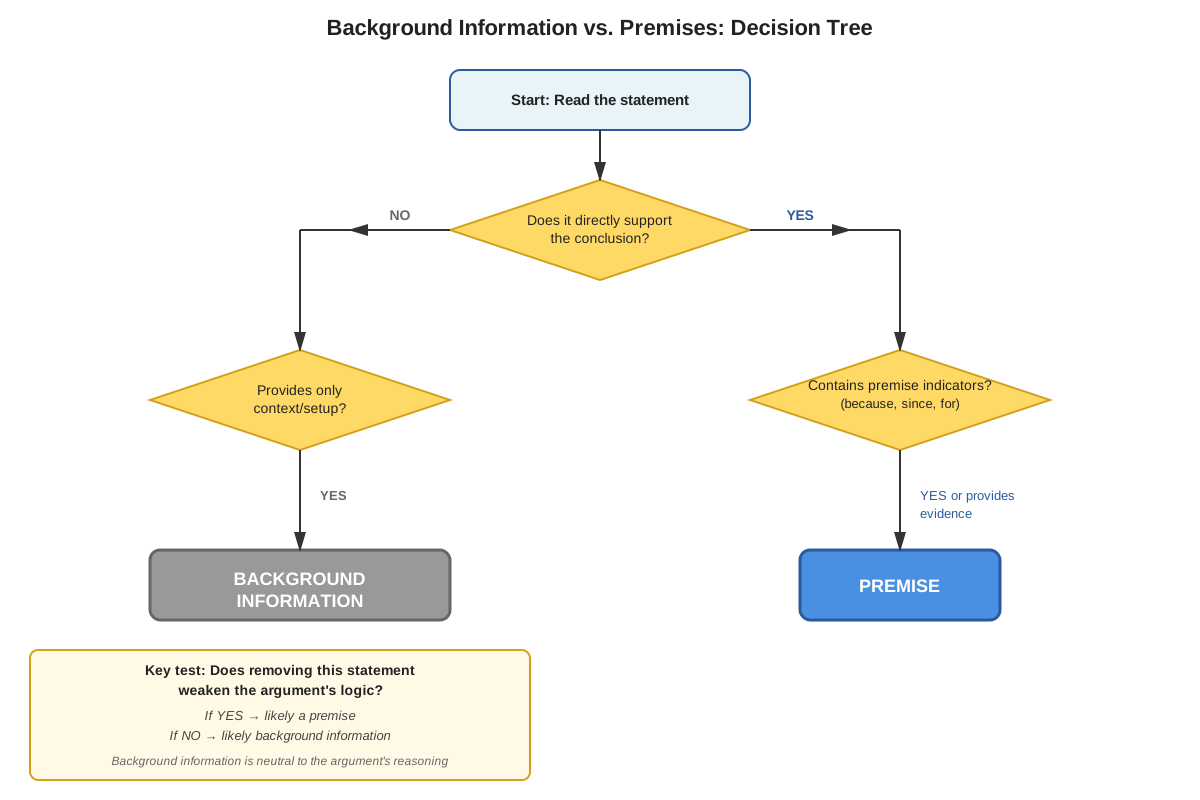
A practical method for identifying background information is the "So What?" test. Ask: "Does this statement directly support the conclusion, or does it just provide context?" If removing the statement would leave the logical connection between premises and conclusion intact (though perhaps less clear), it's likely background information.
Consider: "Electric vehicles have become increasingly popular. Studies show they produce fewer emissions than gasoline cars. Therefore, widespread adoption of electric vehicles would reduce air pollution."
- "Electric vehicles have become increasingly popular" → So what? This doesn't support the conclusion about reducing pollution. It's background.
- "Studies show they produce fewer emissions" → This directly supports why adoption would reduce pollution. It's a premise.
Concept Relationships
Background information serves as the foundation upon which arguments are built, but it remains distinct from the argument's logical structure. The relationship flows as follows:
Background Information → Establishes Context → Premises → Support → Conclusion
Background information connects to argument structure by defining what is NOT part of the core reasoning. This negative definition is crucial: by identifying background, students can focus on the actual premises and conclusions that form the logical chain.
The relationship to premise identification is complementary—recognizing background information makes premises stand out more clearly. Similarly, understanding background information enhances conclusion recognition because students learn to distinguish between statements that assert claims (conclusions) and statements that merely describe situations (background).
Background information also relates to scope analysis. The background often establishes the scope or domain of the argument, indicating what population, time period, or context the argument addresses. This becomes critical in Strengthen/Weaken questions where answer choices must match the argument's scope.
Within the topic itself, the different functional categories of background information (historical, definitional, situational, statistical) all serve the same ultimate purpose: providing context without contributing to logical reasoning. Understanding this unity of purpose across diverse forms helps students develop a reliable recognition pattern.
High-Yield Facts
⭐ Background information provides context but does not directly support the conclusion of an argument.
⭐ Background information most commonly appears in the first 1-2 sentences of LSAT Logical Reasoning stimuli.
⭐ The "So What?" test helps distinguish background from premises: if removing the statement doesn't break the logical chain, it's likely background.
⭐ Background information typically lacks premise indicators like "because," "since," or "for."
⭐ Identifying background information correctly allows test-takers to focus analytical energy on the actual argument structure.
- Background information can include historical facts, definitions, statistical context, or situational descriptions.
- Unlike premises, background information would be accepted as true by both sides of a debate.
- Background information establishes the scope and domain of the argument without making argumentative claims.
- In Method of Reasoning questions, background information is typically described as "providing context" or "establishing a framework."
- Confusing background information with premises is one of the most common errors in Assumption and Flaw questions.
- Background information can appear anywhere in a stimulus, though opening placement is most typical.
- The removal of background information makes an argument less clear but doesn't invalidate the logical structure.
- Background information often uses neutral, descriptive language rather than evaluative or argumentative language.
Quick check — test yourself on Background information so far.
Try Flashcards →Common Misconceptions
Misconception: All information at the beginning of a stimulus is background information.
Correction: While background information commonly appears at the start, opening sentences can also be premises or even conclusions. The position doesn't determine the function—the logical role does.
Misconception: Background information is unimportant and can be ignored when analyzing arguments.
Correction: Background information is crucial for understanding context, scope, and the meaning of terms used in the argument. It shouldn't be ignored, but rather recognized as serving a different function than premises and conclusions.
Misconception: If a statement is factual, it must be background information.
Correction: Premises are also frequently factual statements. The distinction is whether the fact is being used to support a conclusion (premise) or merely to establish context (background).
Misconception: Background information never appears in the correct answer to LSAT questions.
Correction: While background information itself isn't typically the focus of correct answers, understanding what is background helps eliminate wrong answers and correctly identify argument structure.
Misconception: Longer statements are more likely to be background information than shorter ones.
Correction: Length has no correlation with function. A single word could be background (a definition), while a long sentence could be a complex premise. Focus on logical role, not length.
Misconception: Background information and premises are mutually exclusive categories.
Correction: While typically distinct, some statements can serve dual functions—providing context while also offering support for a conclusion. The key is recognizing the primary function in the argument's structure.
Worked Examples
Example 1: Identifying Background in an Assumption Question
Stimulus: "Archaeological evidence suggests that ancient civilizations in the region traded extensively with distant cultures. A recent excavation uncovered pottery fragments with distinctive markings found only in artifacts from a civilization 500 miles away. The archaeologist concluded that direct trade routes must have existed between these two civilizations."
Question: Which of the following is an assumption required by the archaeologist's argument?
Analysis:
Step 1: Identify background information
- "Archaeological evidence suggests that ancient civilizations in the region traded extensively with distant cultures" → This is background information. It provides general context about ancient trade but doesn't directly support the specific conclusion about direct trade routes.
Step 2: Identify the premise
- "A recent excavation uncovered pottery fragments with distinctive markings found only in artifacts from a civilization 500 miles away" → This is the premise. It provides specific evidence supporting the conclusion.
Step 3: Identify the conclusion
- "Direct trade routes must have existed between these two civilizations" → This is the conclusion, indicated by "must have."
Step 4: Identify the logical gap
Now that we've separated background from the actual argument structure, we can see the gap: The premise tells us pottery from civilization B was found at civilization A's site. The conclusion claims direct trade routes existed. The assumption must bridge this gap—perhaps that the pottery couldn't have arrived through intermediary traders.
Learning objective connection: This example demonstrates how identifying background information (Objective 1) allows us to focus on the actual reasoning pattern (Objective 2) and apply this understanding to solve the problem accurately (Objective 3).
Example 2: Background Information in a Strengthen Question
Stimulus: "Coffee consumption has increased dramatically over the past decade. A nutritionist argues that this trend is beneficial for public health because recent studies show that moderate coffee consumption is associated with reduced risk of certain diseases. However, the nutritionist acknowledges that excessive consumption can lead to negative health effects."
Question: Which of the following, if true, most strengthens the nutritionist's argument?
Analysis:
Step 1: Separate background from argument
- "Coffee consumption has increased dramatically over the past decade" → Background information. This establishes the context but doesn't support the conclusion about health benefits.
Step 2: Identify the argument structure
- Conclusion: "This trend is beneficial for public health"
- Premise: "Recent studies show that moderate coffee consumption is associated with reduced risk of certain diseases"
- Acknowledgment: "Excessive consumption can lead to negative health effects" (this qualifies the argument but isn't the main premise)
Step 3: Understand what would strengthen the argument
Since we've identified that the background about increased consumption is separate from the argument about health benefits, we know that strengthening the argument requires supporting the connection between moderate consumption and health benefits, or showing that the increased consumption falls within the "moderate" range rather than "excessive."
A strong answer might be: "The majority of the increased coffee consumption falls within the range defined as moderate in the studies."
Learning objective connection: This example shows how recognizing background information prevents us from being distracted by contextual facts when evaluating what would strengthen the actual argument.
Exam Strategy
Recognition Triggers
Watch for these linguistic patterns that often signal background information:
- Temporal framing: "In recent years," "Historically," "Over the past decade"
- General statements: "Many experts believe," "It is widely known that," "Studies have shown"
- Definitional language: "X is defined as," "X refers to," "X is the process by which"
- Situational descriptions: "The company faces," "The city is considering," "Researchers are investigating"
Approach Process
- First read: Quickly identify where the argument actually begins (often after 1-2 sentences of setup)
- Mark transitions: Note where the passage shifts from description to argumentation
- Apply the "So What?" test: For each statement, ask whether it directly supports a conclusion
- Focus energy: Spend more analytical time on premises and conclusions than on background
Time Management
- Don't spend more than 5-10 seconds identifying background information
- Once identified, mentally bracket it and focus on the argument structure
- In complex stimuli with multiple sentences of background, quickly skim the background and slow down when the argument begins
Process of Elimination
When evaluating answer choices:
- Eliminate answers that treat background as premises: If an answer choice suggests that background information is a key premise or assumption, it's likely wrong
- Eliminate answers that focus solely on background: Correct answers typically address the argument's reasoning, not just its context
- Be cautious of answers that expand on background: Answer choices that elaborate on contextual information without addressing the logical structure are often distractors
Exam Tip: In Assumption questions, the correct answer will never be something that merely restates or elaborates on background information. Assumptions bridge gaps between premises and conclusions, not between background and premises.
Memory Techniques
The CONTEXT Acronym
Remember what background information provides:
- Contextual setup
- Opening framework
- Neutral description
- Temporal or situational setting
- Establishes scope
- X-tra information (not essential to logic)
- Tells "what is" not "what follows"
The Background/Building Analogy
Visualize an argument as a building:
- Background information = the ground/foundation (necessary for context but not part of the structure)
- Premises = the support beams (holding up the conclusion)
- Conclusion = the roof (what the structure supports)
The "News Article" Method
Think of LSAT stimuli like news articles:
- Background information = the opening paragraph that sets the scene
- The argument = the analysis or opinion section where claims are supported
When you read "In recent developments..." or "Experts have noted..." you're likely in the background section, just as in a news article.
Summary
Background information represents contextual statements in LSAT Logical Reasoning stimuli that establish the setting, define terms, or provide situational facts without directly supporting the argument's conclusion. Mastering the identification of background information is essential for LSAT success because it allows test-takers to focus their analytical energy on the actual logical structure—the premises and conclusions that form the reasoning chain. Background information typically appears at the beginning of stimuli, uses neutral descriptive language, and lacks premise or conclusion indicators. The key distinction is functional: background provides context while premises provide support. By applying the "So What?" test and recognizing common linguistic patterns, students can quickly separate background from argumentative content. This skill directly impacts performance on Assumption, Strengthen/Weaken, Flaw, and Method of Reasoning questions, which collectively comprise the majority of Logical Reasoning questions. Understanding background information connects to broader argument analysis skills and represents a high-yield investment that improves efficiency and accuracy across the entire Logical Reasoning section.
Key Takeaways
- Background information provides context without directly supporting the conclusion—it's descriptive rather than argumentative
- The most reliable identification method is the "So What?" test: if removing the statement doesn't break the logical chain, it's likely background
- Background information most commonly appears in the opening 1-2 sentences of LSAT stimuli but can appear anywhere
- Distinguishing background from premises is crucial for correctly analyzing argument structure in all question types
- Background information establishes scope and context but isn't itself the focus of correct answers in most question types
- Recognizing background information improves time management by allowing students to focus analytical energy on actual reasoning
- Common linguistic markers include temporal framing, general statements, definitions, and situational descriptions
Related Topics
Premise Identification: After mastering background information, students should focus on recognizing premises—the statements that directly support conclusions. Understanding what background is NOT (premises) makes premise identification significantly easier.
Conclusion Recognition: Closely related to background information, conclusion identification requires distinguishing between statements that assert claims versus statements that provide context. These skills work together to enable complete argument structure analysis.
Argument Structure Diagramming: Once students can identify background, premises, and conclusions separately, they can diagram complete argument structures, showing the logical relationships between components.
Assumption Questions: This question type directly builds on background information recognition because identifying assumptions requires focusing on the gap between premises and conclusions, not between background and premises.
Scope Analysis: Background information often establishes an argument's scope. Advanced scope analysis skills help students evaluate whether answer choices match the domain established by the background information.
Practice CTA
Now that you understand how background information functions in LSAT Logical Reasoning, it's time to apply these concepts to real practice questions. Work through the practice problems focusing specifically on identifying background information before analyzing the argument structure. Use the flashcards to reinforce the key distinctions between background, premises, and conclusions. Remember: mastering this foundational skill will improve your performance across all Logical Reasoning question types. The time invested in distinguishing background information will pay dividends in increased accuracy and efficiency throughout your LSAT preparation. You've built the conceptual foundation—now strengthen it through deliberate practice!
Sign up free to keep reading
Create a free AnvayaPrep account to finish this LSAT guide on Background information — plus flashcards and practice questions.