Overview
Causal conclusion arguments represent one of the most frequently tested reasoning patterns on the LSAT Logical Reasoning section. These arguments claim that one event, condition, or phenomenon causes another—establishing a cause-and-effect relationship between two variables. Understanding how to identify, analyze, and evaluate causal reasoning is essential for success on the LSAT, as these arguments appear across multiple question types including Strengthen, Weaken, Flaw, Assumption, and Evaluate questions.
The LSAT tests causal reasoning because it reflects a fundamental pattern of thinking used in legal analysis, policy evaluation, and everyday decision-making. Lawyers must constantly assess whether one factor truly causes an outcome or whether the relationship is merely correlational, coincidental, or explained by alternative factors. When an argument concludes that X causes Y, test-makers expect students to recognize the logical gaps inherent in such claims and to understand what additional information would strengthen or undermine the causal relationship.
Within the broader framework of Logical Reasoning and the Causation and Explanation unit, causal conclusions form the foundation for understanding how arguments move from observed correlations to explanatory claims. Mastering this topic enables students to tackle related concepts such as alternative explanations, correlation versus causation, and necessary versus sufficient conditions. The ability to dissect lsat causal conclusion arguments is not merely about memorizing patterns—it requires developing a critical mindset that questions whether the evidence truly supports the causal claim being made.
Learning Objectives
- [ ] Identify how Causal conclusion appears in LSAT questions
- [ ] Explain the reasoning pattern behind Causal conclusion
- [ ] Apply Causal conclusion to solve LSAT-style problems accurately
- [ ] Distinguish between causal claims and mere correlations in argument structures
- [ ] Recognize the five major vulnerabilities in causal reasoning that the LSAT exploits
- [ ] Evaluate answer choices that introduce alternative explanations for observed phenomena
- [ ] Construct valid objections to causal arguments using reversed causation and third-factor scenarios
Prerequisites
- Basic argument structure: Understanding premises and conclusions is essential because causal arguments follow the standard structure where evidence (correlation or temporal sequence) supports a causal claim.
- Conditional reasoning fundamentals: Recognizing the difference between sufficient and necessary conditions helps distinguish causal relationships from conditional ones.
- Correlation concepts: Knowing that two things can occur together without one causing the other provides the foundation for understanding causal reasoning errors.
- Evidence evaluation: The ability to assess whether evidence adequately supports a conclusion is necessary for determining if causal claims are justified.
Why This Topic Matters
Causal reasoning appears in approximately 20-25% of all Logical Reasoning questions on the LSAT, making it one of the highest-yield topics for test preparation. Questions involving causal conclusions span virtually every question type: Weaken questions frequently ask students to identify alternative explanations; Strengthen questions require recognizing what would make a causal claim more plausible; Flaw questions test whether students can articulate why a causal inference is problematic; and Assumption questions probe the unstated premises necessary for causal arguments to work.
In real-world legal contexts, causal reasoning is fundamental to tort law (did the defendant's action cause the plaintiff's injury?), criminal law (did the accused's conduct cause the prohibited result?), and policy analysis (will this regulation cause the desired outcome?). Lawyers must constantly evaluate whether sufficient evidence exists to establish causation beyond mere temporal sequence or correlation.
On the LSAT, causal conclusions typically appear in arguments about scientific studies, policy proposals, historical explanations, and business decisions. Common scenarios include: a study showing that people who do X also experience Y (concluding X causes Y); a policy implemented before an observed change (concluding the policy caused the change); or a correlation between two demographic factors (concluding one causes the other). The test consistently rewards students who can identify when an argument has jumped from "these things occur together" to "one causes the other" without adequate justification.
Core Concepts
The Basic Structure of Causal Arguments
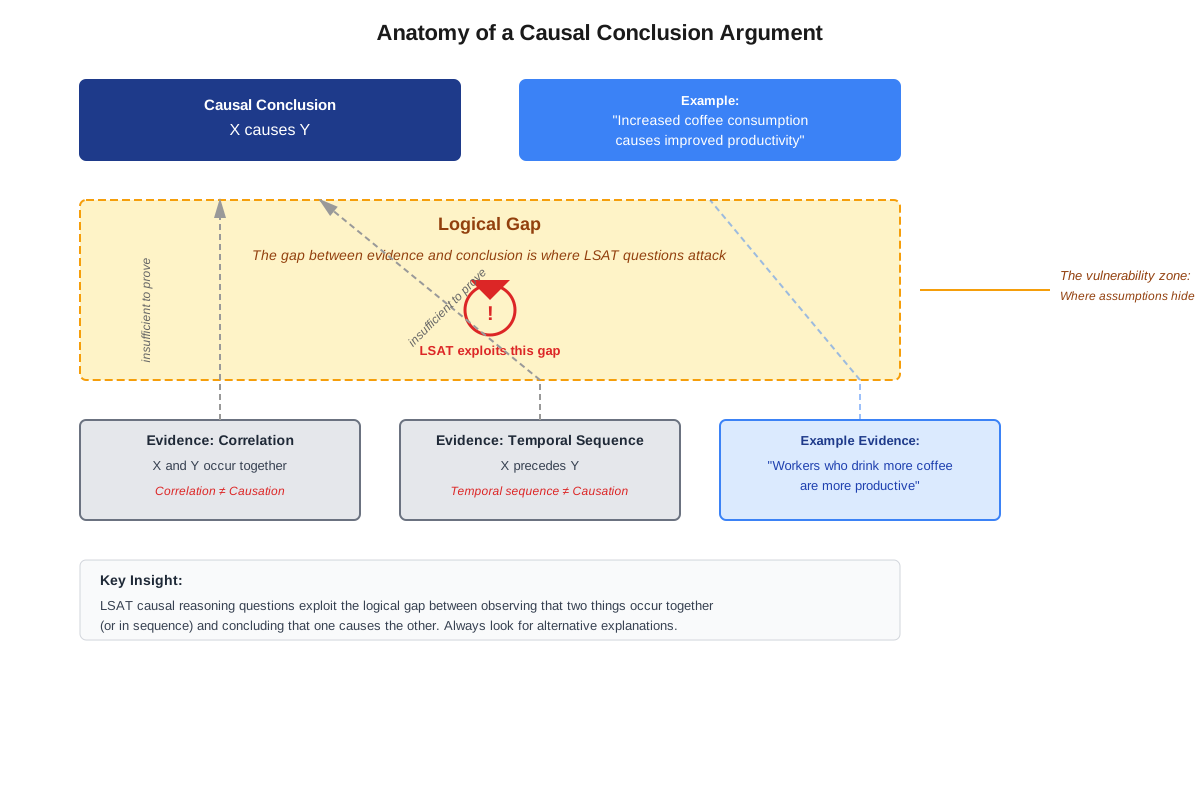
A causal conclusion is an argument that claims one phenomenon (the cause) brings about, produces, or is responsible for another phenomenon (the effect). The standard structure involves:
- Evidence: Observations showing that two things occur together, in sequence, or with some pattern
- Conclusion: A claim that one of these things causes the other
The logical leap occurs when the argument moves from descriptive observation (what happens) to explanatory claim (why it happens). For example:
- Evidence: Students who eat breakfast score higher on tests than students who skip breakfast
- Conclusion: Eating breakfast causes improved test performance
The conclusion asserts a causal relationship—that breakfast consumption produces the higher scores—rather than merely noting the correlation.
Identifying Causal Language
Recognizing causal conclusions requires attention to specific linguistic markers. The LSAT uses various phrasings to indicate causal claims:
Strong causal indicators:
- "X causes Y"
- "X produces Y"
- "X brings about Y"
- "X is responsible for Y"
- "X leads to Y"
- "X results in Y"
Moderate causal indicators:
- "X contributes to Y"
- "X influences Y"
- "X affects Y"
- "X explains Y"
Subtle causal indicators:
- "Because of X, Y occurred"
- "X is the reason for Y"
- "Y is due to X"
- "Thanks to X, Y happened"
Not every use of "because" or "since" indicates a causal conclusion—these words often introduce premises rather than conclusions. The key is identifying when the argument's main claim is that one thing causes another.
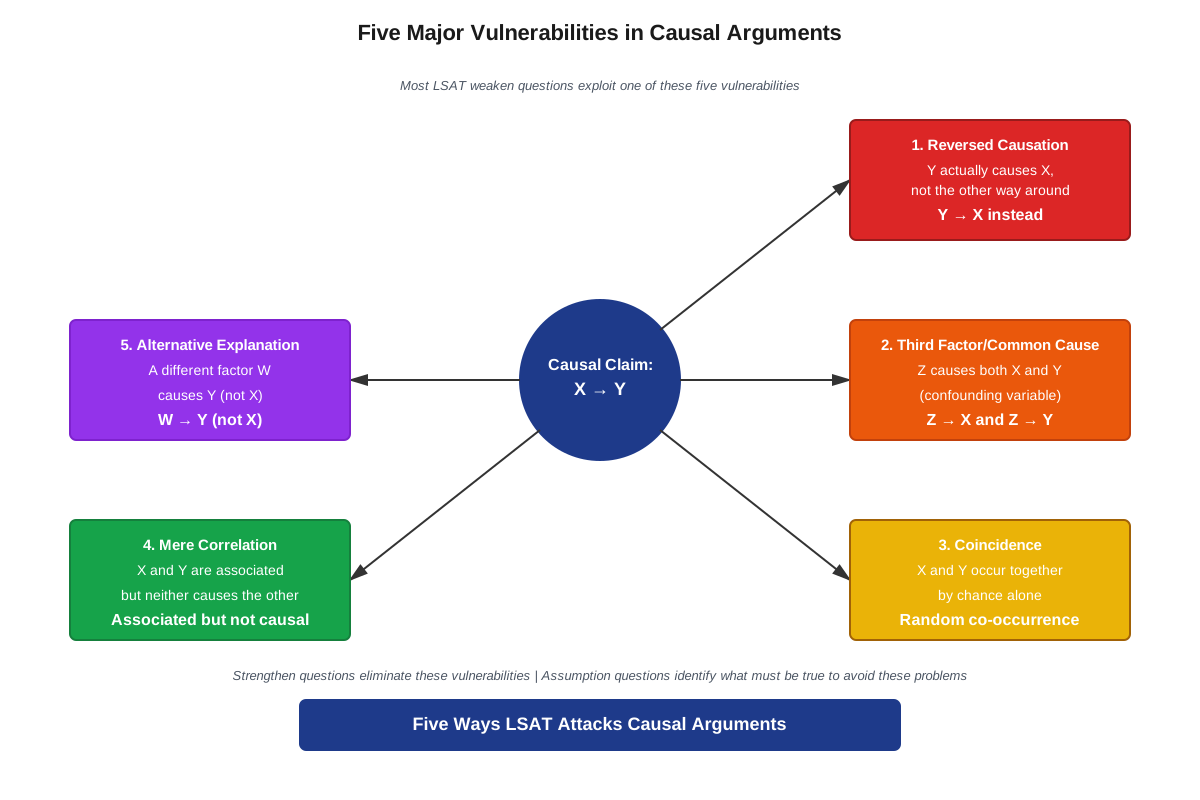
The Five Major Vulnerabilities in Causal Reasoning
The LSAT exploits five recurring weaknesses in causal arguments. Understanding these vulnerabilities is essential for answering questions correctly:
| Vulnerability | Description | Example |
|---|---|---|
| Reversed Causation | The effect actually causes the supposed cause | Maybe high test scores cause students to eat breakfast (confidence leads to healthy habits) |
| Third Factor | An unmentioned variable causes both observed phenomena | Perhaps family income causes both breakfast consumption and test performance |
| Coincidence | The correlation is merely accidental with no causal connection | The events happen to occur together by chance |
| Temporal Confusion | Sequence is mistaken for causation (post hoc reasoning) | Just because X happened before Y doesn't mean X caused Y |
| Complexity Ignored | Multiple factors work together, but the argument credits only one | Test performance depends on many factors beyond breakfast |
Alternative Explanations
The most common way the LSAT challenges causal conclusions is through alternative explanations—different accounts of why the observed correlation exists. When an argument concludes that X causes Y based on their correlation, any of the following alternatives could be true:
- Y causes X (reversed causation)
- Z causes both X and Y (common cause)
- The correlation is coincidental (no causal relationship)
- X and Y are both effects of a complex system (multiple causation)
Weaken questions often present alternative explanations as correct answers. Strengthen questions often eliminate alternative explanations. Understanding this pattern is crucial for logical reasoning success.
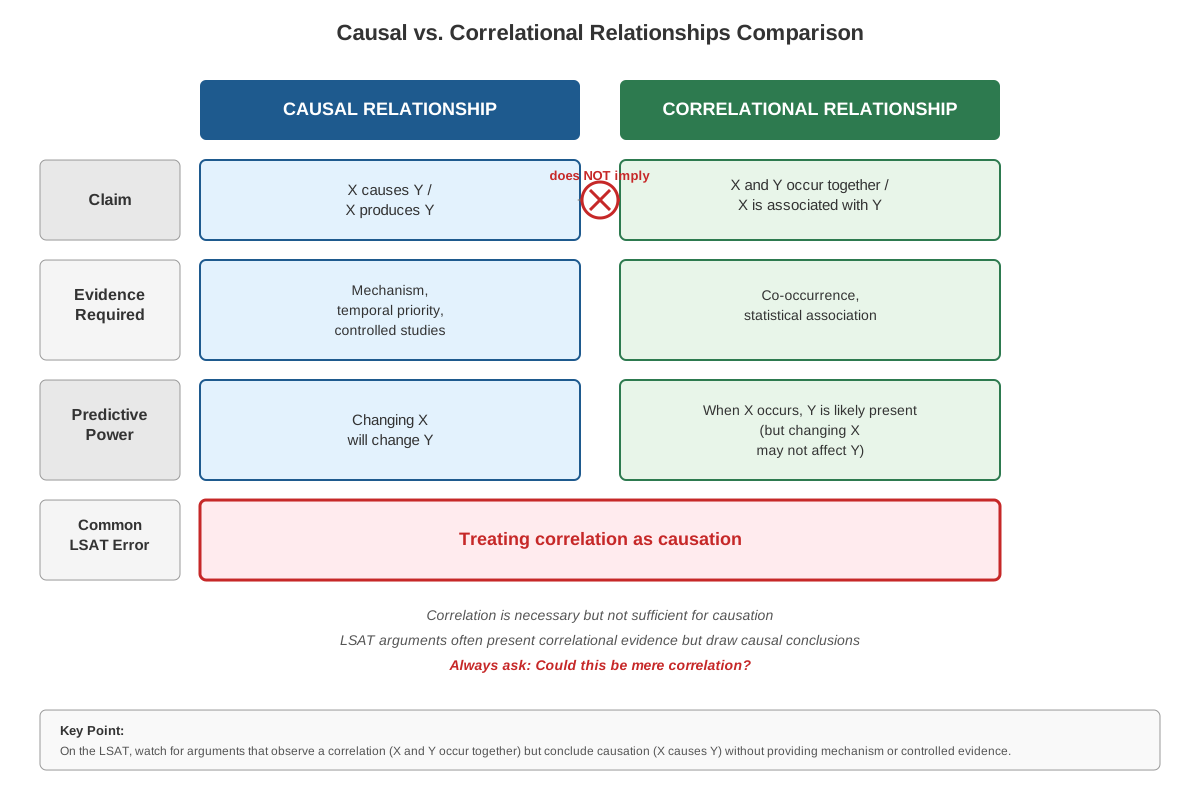
The Correlation-Causation Distinction
A fundamental principle tested repeatedly on the LSAT: correlation does not imply causation. When two variables correlate (occur together, move in the same direction, or show a pattern), this observation alone does not establish that one causes the other.
The LSAT presents correlations in various forms:
- Positive correlation: As X increases, Y increases
- Negative correlation: As X increases, Y decreases
- Temporal correlation: X occurs before Y
- Group correlation: People with characteristic X tend to have characteristic Y
Each correlation type can support a causal hypothesis, but none proves causation without additional evidence ruling out alternative explanations.
What Makes Causal Arguments Stronger
While causal arguments on the LSAT typically contain flaws, understanding what would strengthen them helps with Strengthen and Assumption questions. Causal claims become more plausible when:
- Alternative explanations are ruled out: Evidence shows that reversed causation, third factors, and coincidence don't explain the correlation
- Mechanism is identified: An explanation of how X produces Y makes the causal claim more credible
- Experimental evidence exists: Controlled studies where X is manipulated and Y changes accordingly
- Dose-response relationship: More X leads to more Y (or less X leads to less Y)
- Temporal sequence is clear: X consistently precedes Y with appropriate timing
- Consistency across contexts: The X-Y relationship appears in multiple settings and populations
Concept Relationships
The concepts within causal reasoning form an interconnected system. At the foundation lies the correlation-causation distinction—the recognition that observed patterns don't automatically imply causal relationships. This principle generates the five major vulnerabilities that the LSAT exploits: reversed causation, third factors, coincidence, temporal confusion, and complexity.
These vulnerabilities lead directly to alternative explanations, which represent the primary tool for weakening causal arguments. The relationship flows as follows:
Observed Correlation → Causal Conclusion (the logical leap) → Vulnerabilities in the inference → Alternative Explanations that exploit those vulnerabilities
Understanding causal language enables identification of when arguments make causal claims, which then triggers analysis of whether the evidence adequately supports the conclusion. This connects to the broader prerequisite knowledge of argument structure (premises and conclusions) and evidence evaluation (whether support is sufficient).
The topic also connects forward to related concepts in causation and explanation: understanding causal conclusions is prerequisite for analyzing causal chains (where X causes Y, which causes Z), distinguishing necessary from sufficient causes, and evaluating explanatory hypotheses in scientific reasoning questions.
High-Yield Facts
⭐ Correlation does not establish causation—the most fundamental principle tested in causal reasoning questions.
⭐ Reversed causation is the most common alternative explanation on Weaken questions involving causal conclusions.
⭐ Temporal sequence alone does not prove causation—just because X happened before Y doesn't mean X caused Y (post hoc fallacy).
⭐ Third-factor explanations (common cause scenarios) appear frequently in correct answer choices for Weaken questions.
⭐ Strengthen questions often eliminate alternative explanations rather than providing direct evidence for the causal claim.
- Causal language includes "causes," "produces," "brings about," "results in," "leads to," "is responsible for," and "explains."
- The absence of alternative explanations is often a necessary assumption in causal arguments.
- Experimental evidence (controlled studies) provides stronger support for causal claims than observational correlations.
- Multiple factors can contribute to an outcome—arguments that credit a single cause often ignore complexity.
- Coincidental correlations can occur by chance, especially with small sample sizes or selective reporting.
- Mechanism explanations (how X produces Y) strengthen causal arguments but don't appear in every strong causal claim.
- Dose-response relationships (more cause leads to more effect) provide evidence against coincidence explanations.
Quick check — test yourself on Causal conclusion so far.
Try Flashcards →Common Misconceptions
Misconception: If X always happens before Y, then X must cause Y.
Correction: Temporal sequence is necessary but not sufficient for causation. Night always precedes day, but night doesn't cause day. The sequence could be coincidental, or both could be effects of a third factor (Earth's rotation causes both night and day in sequence).
Misconception: Eliminating one alternative explanation proves the causal claim.
Correction: Multiple alternative explanations could exist. Ruling out reversed causation doesn't eliminate third-factor explanations or coincidence. Causal arguments require eliminating all plausible alternatives, not just one.
Misconception: Correlation in the opposite direction (negative correlation) cannot indicate causation.
Correction: Negative correlations can indicate causal relationships just as positive correlations can. If increasing X leads to decreasing Y, X might cause Y to decrease. The same vulnerabilities apply to both positive and negative correlations.
Misconception: Strong correlations are more likely to be causal than weak correlations.
Correction: Correlation strength doesn't determine causation. A weak correlation might be causal (small effect size), while a strong correlation might be coincidental or due to a third factor. The LSAT tests logical relationships, not statistical strength.
Misconception: If an argument says "X contributes to Y" rather than "X causes Y," it's not making a causal claim.
Correction: "Contributes to," "influences," "affects," and similar phrases all indicate causal relationships, just with varying degrees of strength. These arguments have the same vulnerabilities as stronger causal claims.
Misconception: Scientific studies automatically establish causation.
Correction: Observational studies show correlations but don't prove causation without ruling out alternative explanations. Only controlled experiments where the cause is manipulated provide strong causal evidence, and even these can have confounding variables.
Misconception: If the argument provides a mechanism explaining how X causes Y, the causal claim must be valid.
Correction: A plausible mechanism strengthens a causal argument but doesn't prove causation. The mechanism itself might be incorrect, or alternative mechanisms might better explain the correlation.
Worked Examples
Example 1: Identifying and Analyzing a Causal Conclusion
Argument: "A recent study found that employees who work from home more than three days per week report higher job satisfaction than those who work primarily in the office. Therefore, working from home causes increased job satisfaction."
Step 1 - Identify the conclusion: The conclusion is the causal claim: "working from home causes increased job satisfaction." The word "therefore" signals the conclusion, and "causes" explicitly indicates a causal relationship.
Step 2 - Identify the evidence: The evidence is a correlation: employees who work from home more frequently also report higher job satisfaction. This is an observed pattern, not proof of causation.
Step 3 - Recognize the logical leap: The argument moves from correlation (work-from-home frequency correlates with job satisfaction) to causation (work-from-home causes the satisfaction). This is the classic correlation-to-causation leap.
Step 4 - Identify vulnerabilities:
- Reversed causation: Perhaps employees with higher job satisfaction request to work from home more often (satisfaction causes work-from-home, not vice versa)
- Third factor: Maybe employees with certain personality types both prefer working from home and tend to be more satisfied with their jobs generally
- Self-selection: Employees who choose to work from home might differ systematically from those who don't
Step 5 - Apply to question types:
- Weaken: An answer showing that satisfied employees request work-from-home arrangements would weaken the argument by suggesting reversed causation
- Strengthen: An answer showing that employees randomly assigned to work-from-home arrangements became more satisfied would strengthen by eliminating self-selection
- Assumption: The argument assumes that the correlation isn't better explained by reversed causation or third factors
Example 2: Evaluating Answer Choices in a Weaken Question
Argument: "City officials implemented a new traffic light timing system in January. Traffic accidents decreased by 15% in the following six months. The new timing system has clearly reduced traffic accidents in the city."
Question: Which of the following, if true, most weakens the argument?
Answer Choice Analysis:
(A) The city also launched a major public awareness campaign about safe driving in January.
- This introduces an alternative explanation (the campaign, not the timing system, might have caused the reduction)
- This is a strong weakener because it presents a third factor that could explain the observed effect
- This is likely the correct answer
(B) Some drivers have complained that the new timing system increases their commute time.
- This is irrelevant to whether the system reduced accidents
- Longer commutes don't address the causal claim about accident reduction
- Eliminate
(C) Traffic accidents had been increasing in the city for the previous three years.
- This might seem to strengthen the argument by showing the decrease was notable
- It doesn't provide an alternative explanation for the decrease
- Eliminate
(D) The new timing system cost the city $2 million to implement.
- Cost is irrelevant to whether the system caused the accident reduction
- This doesn't address the causal relationship
- Eliminate
(E) Traffic accidents also decreased in a neighboring city that did not change its timing system.
- This suggests a regional trend unrelated to the timing system
- This provides an alternative explanation: perhaps weather, gas prices, or other regional factors caused the decrease
- This is also a strong weakener
Final Analysis: Both (A) and (E) weaken the argument by providing alternative explanations. (A) introduces a concurrent cause in the same city; (E) suggests the decrease would have happened anyway due to regional factors. Either could be correct depending on which more directly challenges the causal claim. This demonstrates how understanding alternative explanations helps evaluate answer choices systematically.
Exam Strategy
Recognition Strategy
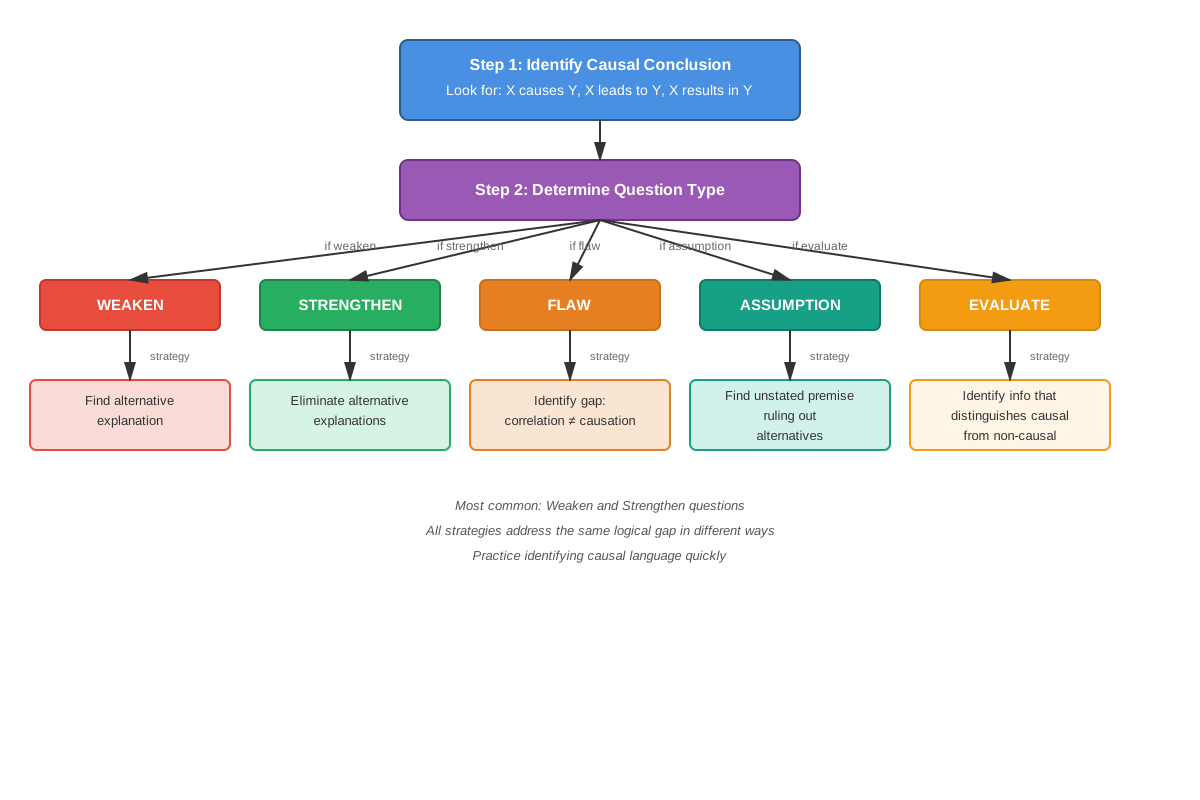
When reading LSAT arguments, immediately flag any causal language: "causes," "produces," "results in," "leads to," "brings about," "is responsible for," "explains," or "is due to." Once identified, mentally note: "This is a causal conclusion—I should look for alternative explanations."
Question-Type Specific Approaches
For Weaken Questions:
- Identify the causal claim (X causes Y)
- Scan answer choices for alternative explanations:
- Does Y cause X? (reversed causation)
- Could Z cause both X and Y? (third factor)
- Is the correlation coincidental or due to other factors?
- Eliminate answers that are irrelevant to the causal relationship
- Choose the answer that most directly challenges the causal inference
For Strengthen Questions:
- Identify what would need to be true for the causal claim to be valid
- Look for answers that:
- Rule out alternative explanations
- Provide experimental or controlled evidence
- Establish a mechanism
- Show dose-response relationships
- Be wary of answers that merely restate the correlation—these don't strengthen
For Assumption Questions:
- The argument assumes alternative explanations don't hold
- Use the negation test: if reversed causation were true, would the argument fall apart?
- The correct answer often states "it's not the case that Y causes X" or "no third factor Z explains both"
For Flaw Questions:
- The correct answer will describe the correlation-to-causation leap
- Look for language like "treats a correlation as if it established causation" or "fails to rule out alternative explanations"
- Be specific about which vulnerability the argument exhibits
Time Management
Causal reasoning questions typically require 1:15-1:30 to complete. Spend:
- 20-30 seconds identifying the causal conclusion and evidence
- 10-15 seconds recognizing the vulnerability
- 30-45 seconds evaluating answer choices
- 10-15 seconds confirming your selection
Exam Tip: If you're stuck between two answer choices on a Weaken question, choose the one that provides a more direct alternative explanation rather than one that merely raises doubts about the evidence.
Common Trap Answers
Trap Type 1 - Irrelevant Information: Answer choices that provide true information but don't address the causal relationship. Example: If the argument claims X causes Y, an answer about the cost or popularity of X is likely irrelevant.
Trap Type 2 - Strengthens Instead of Weakens: On Weaken questions, wrong answers sometimes strengthen the argument. Always confirm you're selecting an answer that challenges rather than supports the causal claim.
Trap Type 3 - Restates the Correlation: Answers that merely repeat the observed correlation without addressing causation. These appear frequently on Strengthen questions as traps.
Memory Techniques
The CRATE Mnemonic for Causal Vulnerabilities
Coincidence - The correlation might be accidental
Reversed causation - The effect might cause the supposed cause
Alternative explanation - A third factor might cause both
Temporal confusion - Sequence doesn't prove causation
Exaggerated simplicity - Multiple factors might be involved
Visualization Strategy
Picture a causal argument as an arrow: X → Y. Now visualize the five ways this arrow could be wrong:
- The arrow points backward: Y → X
- A third arrow points to both: Z → X and Z → Y
- The arrow is dotted (coincidence): X ··· Y
- The arrow is just a timeline: X (then) Y
- Multiple arrows converge: X, A, B, C → Y
The "Breakfast Test" Shortcut
When evaluating any causal argument, apply the breakfast test from our core example:
- What's the correlation? (breakfast eaters score higher)
- What's the causal claim? (breakfast causes higher scores)
- Could it be reversed? (high scorers eat breakfast)
- Could a third factor explain it? (family income causes both)
- Could it be coincidence? (unrelated factors)
This quick mental check works for any causal argument structure.
Acronym for Strengthening Causal Arguments
ARMED - what makes causal arguments stronger:
Alternatives ruled out
Randomized/controlled evidence
Mechanism explained
Experimental manipulation
Dose-response relationship
Summary
Causal conclusions represent arguments that claim one phenomenon causes another, moving from observed correlations to explanatory claims about cause-and-effect relationships. The LSAT tests this reasoning pattern extensively because it reflects fundamental analytical skills required in legal practice. Students must recognize causal language, understand that correlation does not establish causation, and identify the five major vulnerabilities in causal reasoning: reversed causation, third-factor explanations, coincidence, temporal confusion, and ignored complexity. The most critical skill is recognizing alternative explanations—different accounts of why a correlation exists that don't involve the proposed causal relationship. Success on causal reasoning questions requires systematic analysis: identify the causal claim, recognize the logical leap from correlation to causation, consider what alternative explanations could account for the evidence, and evaluate answer choices based on whether they strengthen or weaken the causal inference by addressing these alternatives.
Key Takeaways
- Causal conclusions claim that one thing causes another—recognize this claim through causal language like "causes," "produces," "results in," and "leads to"
- Correlation never proves causation by itself—the LSAT consistently tests whether students understand this fundamental principle
- Reversed causation and third-factor explanations are the most common ways to weaken causal arguments on the LSAT
- Alternative explanations are the key to most causal reasoning questions—Weaken questions present them, Strengthen questions eliminate them, and Assumption questions require their absence
- Temporal sequence (X before Y) does not establish causation—post hoc reasoning is a classic flaw in causal arguments
- Strengthen answers often provide experimental evidence or rule out alternatives rather than merely restating the correlation
- Systematic analysis beats intuition—use the CRATE framework to identify vulnerabilities and evaluate answer choices methodically
Related Topics
Correlation vs. Causation: While this guide covers causal conclusions, a deeper exploration of different types of correlations and statistical relationships builds on this foundation. Understanding positive, negative, and spurious correlations enhances the ability to evaluate causal claims.
Alternative Explanations in Scientific Reasoning: Many LSAT passages present scientific studies with causal claims. Mastering causal conclusions enables analysis of experimental design, control groups, and confounding variables in these more complex scenarios.
Necessary and Sufficient Conditions: Causal relationships often involve necessary or sufficient conditions. Understanding when a cause is necessary (required for the effect) versus sufficient (guarantees the effect) deepens causal reasoning skills.
Flaw Question Types: Causal reasoning represents one specific category of logical flaws. Mastering this topic enables progression to other flaw types like sampling errors, equivocation, and circular reasoning.
Argument Evaluation Questions: These questions ask what information would be most useful to evaluate an argument. For causal arguments, this typically involves information that would confirm or rule out alternative explanations.
Practice CTA
Now that you understand the structure and vulnerabilities of causal conclusions, you're ready to apply these concepts to actual LSAT questions. The practice questions and flashcards will reinforce your ability to identify causal claims, recognize alternative explanations, and systematically evaluate answer choices. Remember: causal reasoning appears in approximately one-quarter of all Logical Reasoning questions, making this one of the highest-yield topics for your LSAT preparation. Each practice question you complete strengthens your pattern recognition and builds the analytical reflexes you'll need on test day. Approach the practice materials with the systematic framework you've learned here, and you'll see consistent improvement in your performance on these critical question types.
Sign up free to keep reading
Create a free AnvayaPrep account to finish this LSAT guide on Causal conclusion — plus flashcards and practice questions.