Overview
Causal overstatement is one of the most frequently tested reasoning flaws in LSAT Logical Reasoning sections. This error occurs when an argument claims a stronger causal relationship than the evidence actually supports. For instance, an argument might conclude that X causes Y when the evidence only demonstrates that X is associated with or correlated with Y. Alternatively, an argument might claim that X is the only cause of Y, or that X always causes Y, when the evidence merely shows that X sometimes contributes to Y. Recognizing these subtle but critical distinctions between what evidence proves and what conclusions are drawn is essential for success on the LSAT.
Understanding causal overstatement is crucial because it appears across multiple question types, including Flaw questions, Strengthen/Weaken questions, Necessary Assumption questions, and Sufficient Assumption questions. The LSAT frequently presents arguments that leap from limited evidence to sweeping causal claims, and test-takers must identify precisely how the conclusion overstates what the premises establish. This skill requires careful attention to the language of causation—distinguishing between "contributes to," "causes," "is the primary cause of," "is necessary for," and "is sufficient for."
Within the broader framework of Causation and Explanation in Logical Reasoning, causal overstatement represents a specific type of reasoning error that stems from misunderstanding the strength and nature of causal relationships. It connects closely to other causal reasoning topics such as correlation versus causation, alternative causes, and causal chains. Mastering causal overstatement provides a foundation for understanding how arguments can fail by claiming too much from their evidence—a pattern that extends beyond causation to other forms of logical reasoning on the LSAT.
Learning Objectives
- [ ] Identify how Causal overstatement appears in LSAT questions
- [ ] Explain the reasoning pattern behind Causal overstatement
- [ ] Apply Causal overstatement to solve LSAT-style problems accurately
- [ ] Distinguish between different degrees of causal claims (correlation, contribution, causation, sole cause)
- [ ] Recognize the specific language markers that signal causal overstatement in arguments
- [ ] Evaluate answer choices that correctly identify or address causal overstatement flaws
- [ ] Construct counterexamples that expose causal overstatement reasoning errors
Prerequisites
- Basic understanding of argument structure: Recognizing premises and conclusions is essential because causal overstatement involves the relationship between evidence provided and causal claims made.
- Familiarity with correlation versus causation: This foundational distinction helps identify when arguments inappropriately upgrade correlational evidence to causal conclusions.
- Knowledge of conditional reasoning: Understanding necessity and sufficiency helps distinguish between different strengths of causal claims.
- Experience with common LSAT question types: Knowing how Flaw, Weaken, and Assumption questions work provides context for how causal overstatement appears in different formats.
Why This Topic Matters
Causal overstatement appears in approximately 15-20% of all Logical Reasoning questions on the LSAT, making it one of the highest-yield topics for test preparation. This reasoning flaw appears most commonly in Flaw questions (where test-takers must identify the error), Weaken questions (where correct answers often point to alternative causes or limitations on the causal claim), and Necessary Assumption questions (where the argument depends on assumptions about the strength or exclusivity of the causal relationship).
In real-world contexts, recognizing causal overstatement is essential for critical thinking in legal, scientific, and policy arguments. Attorneys must evaluate whether evidence truly supports causal claims in tort cases, medical malpractice suits, and regulatory disputes. Policymakers must assess whether proposed interventions will actually cause desired outcomes or merely correlate with them. Scientists must carefully distinguish between demonstrating association and proving causation. The LSAT tests this skill because it is fundamental to legal reasoning and analysis.
On the exam, causal overstatement typically appears in arguments about social science research, policy proposals, business decisions, and scientific studies. Common scenarios include: studies showing correlations between behaviors and outcomes that are presented as causal relationships; evidence that one factor contributes to an outcome being used to claim it is the sole or primary cause; observations that something sometimes causes an effect being generalized to claim it always does; and temporal sequences (X happened before Y) being treated as proof of causation.
Core Concepts
The Nature of Causal Overstatement
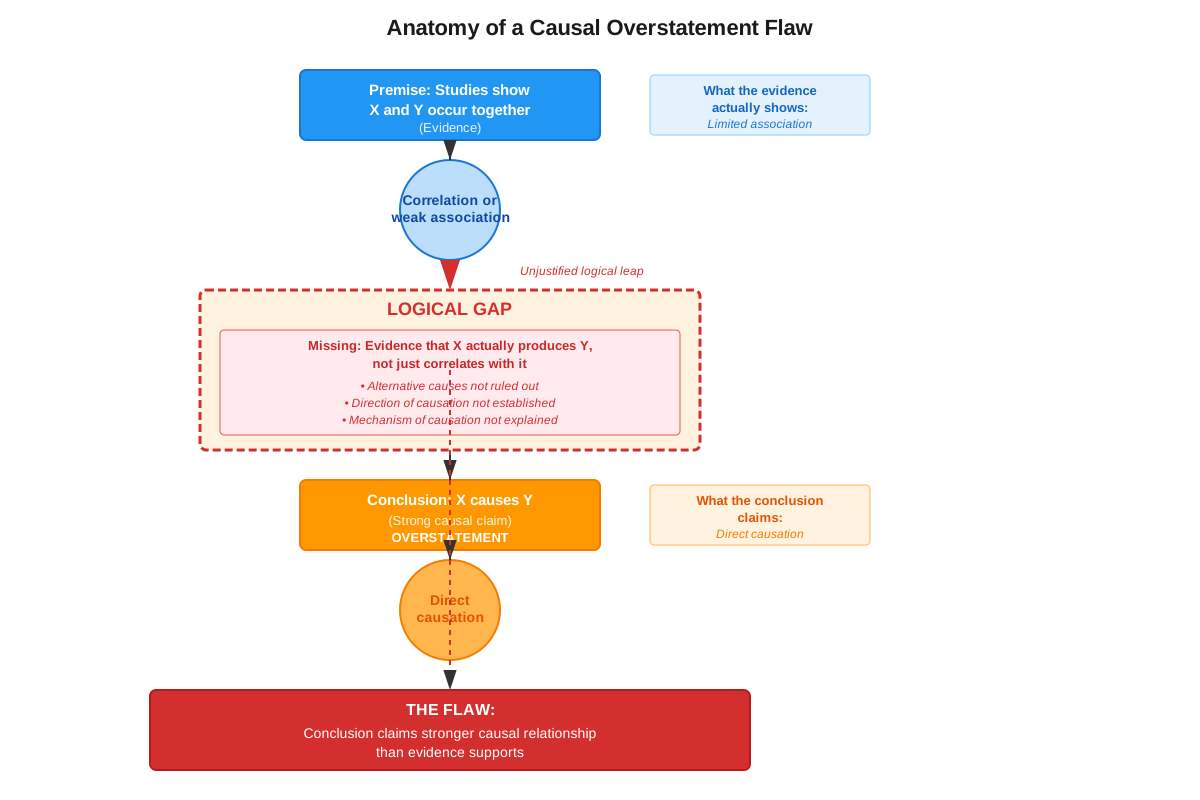
Causal overstatement occurs when an argument's conclusion asserts a stronger, more definitive, or more exclusive causal relationship than the premises actually establish. This flaw involves a mismatch between the strength of the evidence and the strength of the causal claim. The argument "overstates" by claiming more certainty, more exclusivity, or more universality than warranted.
The fundamental pattern involves premises that establish a weaker relationship (correlation, occasional causation, partial causation, or contribution) being used to support a conclusion that claims a stronger relationship (definitive causation, sole causation, universal causation, or necessary causation). The logical gap lies in the unjustified leap from limited evidence to an overly broad causal claim.
Degrees of Causal Claims
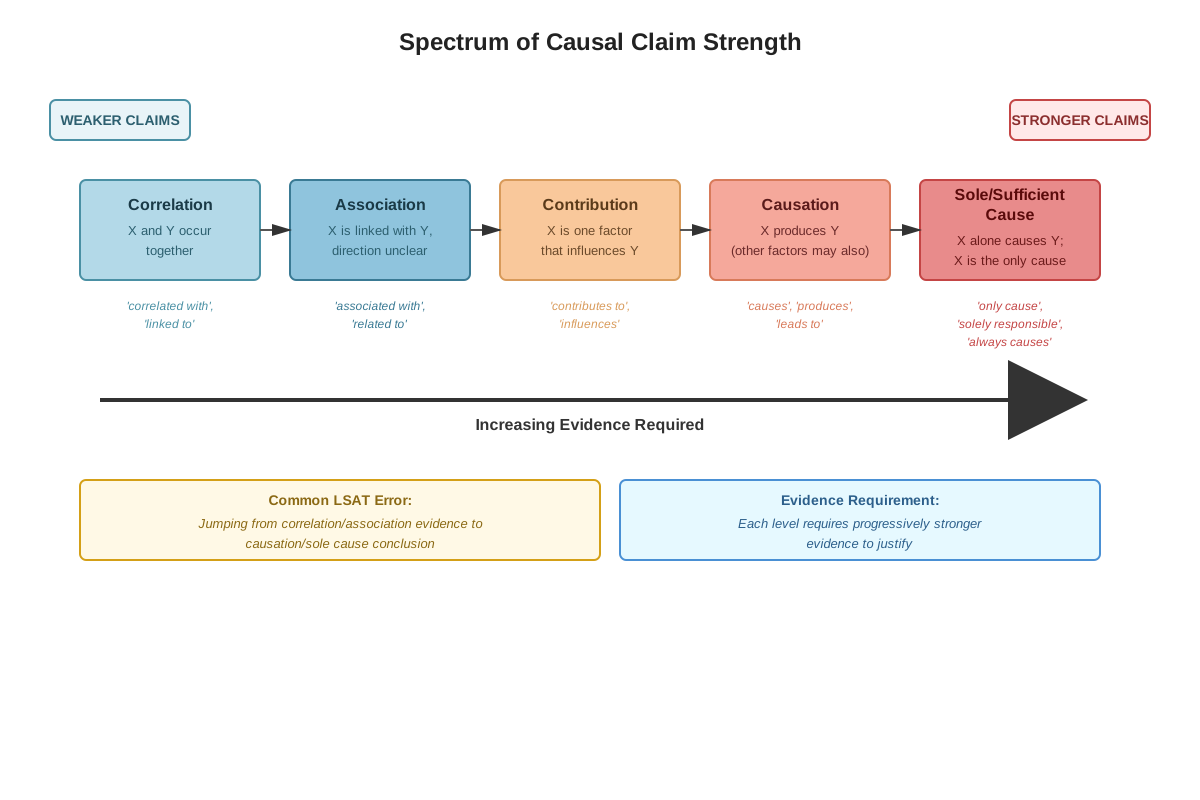
Understanding causal overstatement requires recognizing that causal relationships exist on a spectrum of strength:
| Strength Level | Description | Example Language |
|---|---|---|
| Correlation/Association | Two things occur together | "X is associated with Y"; "X correlates with Y" |
| Contribution | X is one factor among many | "X contributes to Y"; "X plays a role in Y" |
| Causation | X produces Y | "X causes Y"; "X leads to Y" |
| Primary Causation | X is the main cause | "X is the primary cause of Y"; "X is the most important factor" |
| Sole Causation | X is the only cause | "X is the sole cause of Y"; "Only X causes Y" |
| Universal Causation | X always causes Y | "X always causes Y"; "Whenever X, then Y" |
LSAT causal overstatement typically involves moving from a lower level on this spectrum to a higher level without adequate justification. For example, evidence of correlation being used to claim causation, or evidence of contribution being used to claim sole causation.
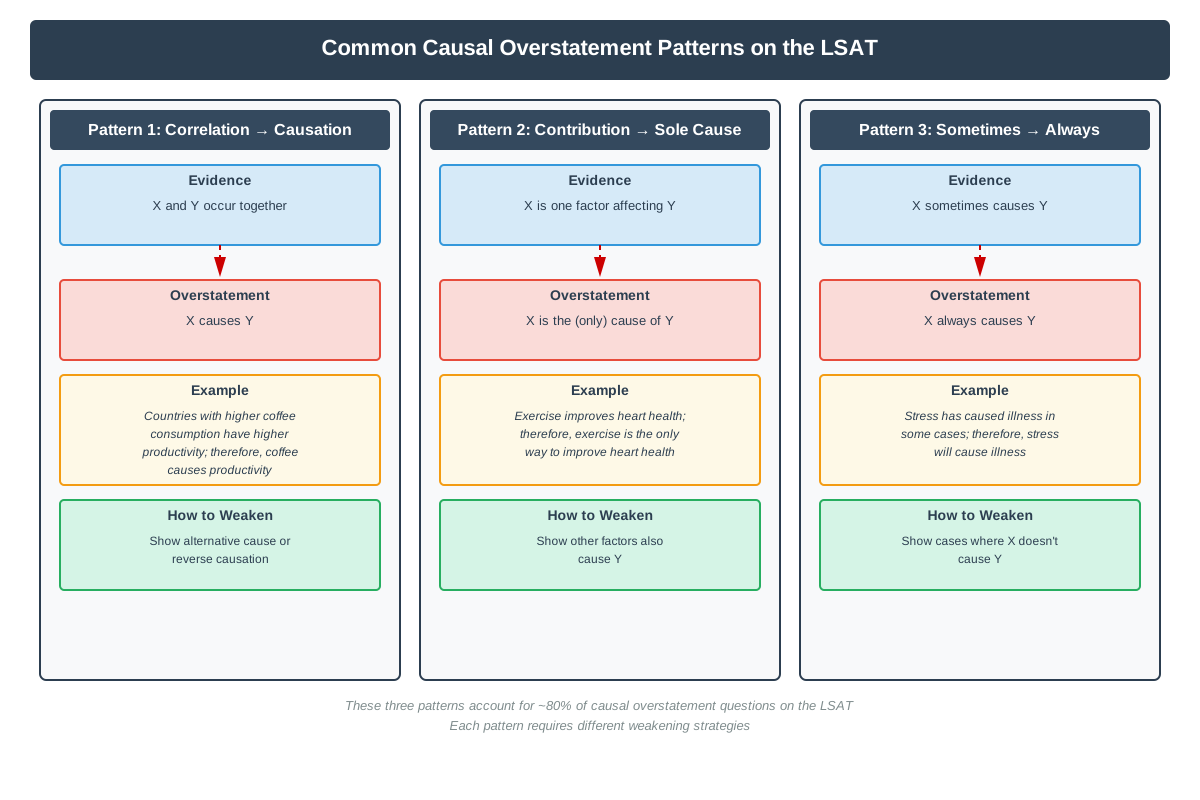
Common Patterns of Overstatement
Pattern 1: Correlation to Causation
The argument presents evidence that two phenomena occur together or are statistically associated, then concludes that one causes the other. This is perhaps the most common form of causal overstatement on the LSAT.
Example: "Studies show that people who drink coffee regularly have higher rates of anxiety. Therefore, coffee consumption causes anxiety."
The evidence establishes correlation, but the conclusion claims causation. Alternative explanations (reverse causation, common cause, coincidence) remain unaddressed.
Pattern 2: Partial Cause to Sole Cause
The argument shows that X contributes to or influences Y, then concludes that X is the only cause or the complete explanation for Y.
Example: "Research demonstrates that lack of sleep impairs cognitive performance. Thus, the decline in students' test scores is due to insufficient sleep."
The evidence shows sleep affects performance, but the conclusion treats it as the sole explanation, ignoring other potential factors.
Pattern 3: Sometimes to Always
The argument provides evidence that X causes Y in some cases or under certain conditions, then concludes that X always or generally causes Y.
Example: "In several documented cases, exposure to violent video games preceded aggressive behavior in adolescents. Therefore, playing violent video games causes aggressive behavior in young people."
The evidence shows occasional instances, but the conclusion generalizes to a universal or typical causal relationship.
Pattern 4: Necessary to Sufficient
The argument establishes that X is necessary for Y (Y cannot occur without X), then concludes that X is sufficient for Y (X alone will produce Y), or vice versa.
Example: "Without adequate funding, the program cannot succeed. Therefore, providing adequate funding will ensure the program's success."
The evidence establishes necessity, but the conclusion claims sufficiency, ignoring other required conditions.
Identifying Causal Overstatement in Arguments
To identify causal overstatement, follow this systematic approach:
- Locate the conclusion: Find the main claim, paying special attention to causal language
- Identify the causal claim's strength: Determine whether it asserts correlation, contribution, causation, primary causation, sole causation, or universal causation
- Examine the premises: Assess what evidence is actually provided
- Determine the evidence's strength: What level of causal relationship does the evidence establish?
- Compare conclusion to evidence: Is there a gap between what's proven and what's claimed?
- Identify the specific overstatement: Precisely articulate how the conclusion overstates the evidence
Language Markers
Certain words and phrases signal different strengths of causal claims. Recognizing these markers helps identify overstatement:
Weak causal language (often in premises):
- "is associated with"
- "correlates with"
- "is linked to"
- "tends to occur with"
- "contributes to"
- "plays a role in"
- "is a factor in"
Strong causal language (often in overstated conclusions):
- "causes"
- "produces"
- "results in"
- "leads to"
- "is responsible for"
- "explains"
- "accounts for"
Exclusive/universal causal language (signals potential overstatement):
- "the cause"
- "the only cause"
- "solely responsible for"
- "entirely due to"
- "always causes"
- "necessarily results in"
Concept Relationships
Causal overstatement connects to several other logical reasoning concepts in a hierarchical and complementary structure:
Correlation vs. Causation → serves as foundation for → Causal Overstatement: Understanding that correlation doesn't prove causation is the most basic form of recognizing causal overstatement. Causal overstatement is the broader category that includes correlation-to-causation errors plus other forms of overstating causal relationships.
Causal Overstatement → is weakened by → Alternative Causes: When an argument overstates a causal claim (especially by claiming sole or primary causation), pointing to alternative causes directly undermines the overstatement by showing the claimed cause is not exclusive or complete.
Causal Overstatement → requires → Unstated Assumptions: Arguments that overstate causal relationships depend on assumptions that bridge the gap between weak evidence and strong conclusions. Identifying these assumptions is crucial for Necessary Assumption questions.
Conditional Reasoning → informs → Causal Overstatement: The logical structure of necessity and sufficiency helps analyze causal claims. Confusing necessary and sufficient conditions is one form of causal overstatement.
Sampling and Generalization → can lead to → Causal Overstatement: When arguments generalize from limited cases to universal causal claims, they combine generalization errors with causal overstatement.
Within the topic itself, the concepts connect as follows: Understanding the degrees of causal claims enables recognition of common patterns of overstatement, which in turn allows application of the systematic identification approach, all supported by recognition of language markers that signal the strength of causal claims.
High-Yield Facts
⭐ Causal overstatement occurs when a conclusion claims a stronger causal relationship than the premises establish.
⭐ The most common form is treating correlation or association as proof of causation.
⭐ Arguments that claim "sole cause" or "only cause" are particularly vulnerable to causal overstatement flaws.
⭐ Evidence that X sometimes causes Y does not support a conclusion that X always or generally causes Y.
⭐ Temporal sequence (X before Y) does not prove causation, and treating it as such is causal overstatement.
- Causal overstatement appears in approximately 15-20% of Logical Reasoning questions across all question types.
- Flaw questions often include answer choices describing causal overstatement as "treats a correlation as evidence of causation" or "concludes that one thing is the cause when it may be only a contributing factor."
- Weaken questions targeting causal overstatement often present alternative causes or show the claimed cause is absent when the effect occurs.
- Strengthen questions may ask for evidence that eliminates alternative causes or demonstrates the causal mechanism.
- Necessary Assumption questions involving causal overstatement typically require assumptions that rule out alternative explanations or reverse causation.
- Language precision matters: "the cause" implies sole causation, while "a cause" implies one among potentially many causes.
- Causal overstatement can occur even when a genuine causal relationship exists—the flaw is in overstating its strength, exclusivity, or universality.
- Arguments about policy effectiveness frequently commit causal overstatement by assuming a proposed intervention will be sufficient to achieve desired outcomes.
Quick check — test yourself on Causal overstatement so far.
Try Flashcards →Common Misconceptions
Misconception: Causal overstatement only occurs when an argument treats correlation as causation.
Correction: While correlation-to-causation is the most common form, causal overstatement includes any instance where a conclusion claims a stronger causal relationship than warranted—including treating partial causes as sole causes, occasional causation as universal causation, or necessary conditions as sufficient conditions.
Misconception: If a causal relationship actually exists, there cannot be causal overstatement.
Correction: Causal overstatement is about the strength and scope of the claim relative to the evidence, not whether causation exists at all. An argument can correctly identify a genuine cause but still overstate by claiming it's the only cause, the primary cause, or that it always produces the effect when evidence only shows it sometimes does.
Misconception: Temporal sequence (X happened before Y) provides no evidence for causation.
Correction: While temporal sequence alone is insufficient to prove causation, it is often a necessary condition for causation and can be part of causal evidence. The error is treating temporal sequence as sufficient proof of causation, not considering it as one piece of evidence among others.
Misconception: On Flaw questions, any argument mentioning causation commits a causal reasoning flaw.
Correction: Not all causal arguments are flawed. Some provide adequate evidence for their causal conclusions. The task is to determine whether the specific argument overstates, understates, or appropriately characterizes the causal relationship given its evidence.
Misconception: Causal overstatement and "post hoc ergo propter hoc" are the same thing.
Correction: Post hoc ergo propter hoc (after this, therefore because of this) is one specific type of causal overstatement that treats temporal sequence as proof of causation. Causal overstatement is the broader category that includes post hoc reasoning plus other forms of overstating causal claims.
Misconception: If an argument uses strong causal language like "causes" or "results in," it automatically commits causal overstatement.
Correction: The flaw depends on whether the evidence supports the strength of the claim. If premises provide robust experimental evidence with controlled conditions, a strong causal conclusion may be warranted. The overstatement occurs when strong causal language exceeds what the evidence establishes.
Worked Examples
Example 1: Flaw Question
Argument: "A recent study found that employees who work from home report higher job satisfaction than those who work in offices. Additionally, the study showed that remote workers are 15% more productive on average. Clearly, allowing employees to work from home causes increased productivity and job satisfaction."
Question: Which of the following describes a flaw in the argument's reasoning?
Analysis:
Step 1 - Identify the conclusion: "Allowing employees to work from home causes increased productivity and job satisfaction."
Step 2 - Assess the conclusion's causal claim: This is a strong causal claim asserting that remote work causes (not merely correlates with) both outcomes.
Step 3 - Examine the premises: The study found associations—remote workers report higher satisfaction and show higher productivity. This is correlational evidence.
Step 4 - Identify the gap: The premises establish correlation/association, but the conclusion claims causation. This is classic causal overstatement.
Step 5 - Consider alternative explanations: Perhaps more productive and satisfied employees are selected for or choose remote work (reverse causation). Perhaps certain personality types both prefer remote work and are naturally more productive (common cause). The argument doesn't rule out these alternatives.
Step 6 - Predict the answer: The correct answer will identify that the argument treats correlation as proof of causation or fails to rule out alternative explanations.
Correct Answer Pattern: "The argument treats evidence that two phenomena are correlated as proof that one causes the other" or "The argument fails to consider that the correlation might be explained by remote workers differing from office workers in ways other than their work location."
Connection to Learning Objectives: This example demonstrates how to identify causal overstatement (Objective 1), explains the reasoning pattern of upgrading correlation to causation (Objective 2), and shows the systematic approach to solving such problems (Objective 3).
Example 2: Necessary Assumption Question
Argument: "Studies have shown that cities with extensive public transportation systems have lower rates of air pollution than cities without such systems. Therefore, building a comprehensive public transit network will reduce air pollution in our city."
Question: Which of the following is an assumption required by the argument?
Analysis:
Step 1 - Identify the conclusion: "Building public transit will reduce air pollution in our city."
Step 2 - Assess the causal claim: The conclusion asserts that public transit will cause reduced pollution (predictive causation).
Step 3 - Examine the premises: The evidence shows correlation between existing transit systems and lower pollution in other cities.
Step 4 - Identify the overstatement: The argument moves from correlation in other cities to predicted causation in this city. It assumes the correlation reflects causation and that the causal relationship will hold in this new context.
Step 5 - Determine necessary assumptions: For the argument to work, it must assume:
- The correlation in other cities reflects causation (transit reduces pollution rather than low-pollution cities being more likely to build transit)
- No relevant differences exist between this city and the studied cities that would prevent the same causal relationship
- Other factors don't explain the correlation (e.g., cities with transit aren't also cities with stricter emission standards)
Step 6 - Evaluate answer choices using negation test: The correct answer, when negated, will destroy the argument.
Correct Answer Pattern: "The lower pollution levels in cities with public transit are not primarily due to factors other than the transit systems themselves" or "Cities with extensive public transit do not differ from cities without such systems in other ways that significantly affect air pollution levels."
Connection to Learning Objectives: This example shows how causal overstatement creates gaps that require assumptions (Objective 2), demonstrates application to a different question type (Objective 3), and illustrates how to distinguish between correlation and causation claims (Objective 4).
Exam Strategy
Approaching Causal Overstatement Questions
Step 1 - Identify causal language in the conclusion: Look for words like "causes," "results in," "leads to," "produces," "is responsible for," "explains," or "accounts for." These signal potential causal overstatement.
Step 2 - Assess the strength of the causal claim: Determine whether the conclusion claims correlation, contribution, causation, primary causation, sole causation, or universal causation. Pay special attention to words like "the cause," "only," "solely," "always," or "necessarily."
Step 3 - Examine the evidence carefully: What does the argument actually establish? Look for language indicating correlation ("associated with," "linked to"), contribution ("plays a role," "is a factor"), or limited causation ("in some cases," "can lead to").
Step 4 - Identify the gap: Compare the strength of the evidence to the strength of the conclusion. Is there a mismatch?
Step 5 - Consider alternative explanations: Could reverse causation explain the relationship? Could a common cause explain both phenomena? Could the correlation be coincidental?
Trigger Words and Phrases
In conclusions (watch for overstatement):
- "Therefore, X causes Y"
- "Thus, X is responsible for Y"
- "X explains Y"
- "The cause of Y is X"
- "X will result in Y"
In premises (often weaker than conclusion):
- "X is associated with Y"
- "X correlates with Y"
- "Studies show a link between X and Y"
- "X tends to occur with Y"
- "X is a factor in Y"
Red flags for extreme overstatement:
- "the only cause"
- "solely responsible"
- "entirely due to"
- "always causes"
- "necessarily results in"
Process of Elimination Tips
For Flaw questions:
- Eliminate answers describing flaws the argument doesn't commit
- Keep answers that accurately describe the mismatch between evidence strength and conclusion strength
- Correct answers often use phrases like "treats correlation as causation," "fails to rule out alternative causes," or "assumes without justification that X is the only factor"
For Weaken questions:
- Eliminate answers that are irrelevant to the causal claim
- Keep answers that suggest alternative causes, reverse causation, or show the claimed cause absent when the effect occurs
- Correct answers often introduce new information that undermines the exclusivity or strength of the causal claim
For Necessary Assumption questions:
- Eliminate answers the argument doesn't depend on (use negation test)
- Keep answers that, when negated, break the causal inference
- Correct answers often rule out alternative causes or reverse causation
Time Allocation
Causal overstatement questions typically require 1:15 to 1:30 minutes. Spend:
- 20-30 seconds reading and identifying the argument structure
- 15-20 seconds identifying the causal claim and evidence
- 10-15 seconds recognizing the overstatement pattern
- 30-45 seconds evaluating answer choices
Don't spend excessive time generating every possible alternative cause—recognize the pattern and move to the answer choices.
Memory Techniques
The SCOPE Acronym
Remember different types of causal overstatement with SCOPE:
- Sole cause (claiming only one cause when evidence shows contribution)
- Correlation to causation (treating association as proof of causation)
- Occasional to universal (generalizing from sometimes to always)
- Primary cause (claiming main cause when evidence shows partial cause)
- Exclusive causation (claiming X is the complete explanation)
The Strength Ladder Visualization
Visualize causal claims as a ladder with rungs representing increasing strength:
[Universal/Sole Causation] ← Top rung (strongest claim)
[Primary Causation]
[Causation]
[Contribution]
[Correlation] ← Bottom rung (weakest claim)
Causal overstatement occurs when an argument climbs the ladder in its conclusion without evidence supporting the climb. Visualize the evidence placing you on one rung and the conclusion jumping to a higher rung without a ladder.
The Three Questions Mantra
When evaluating any causal argument, ask:
- What does the evidence show? (correlation, contribution, or causation?)
- What does the conclusion claim? (contribution, causation, or sole causation?)
- Is there a gap? (does the conclusion claim more than the evidence establishes?)
The Alternative Causes Checklist
Remember the three main alternatives to any causal claim with RCC:
- Reverse causation (Y causes X, not X causes Y)
- Common cause (Z causes both X and Y)
- Coincidence (X and Y are unrelated; correlation is spurious)
Summary
Causal overstatement is a high-yield LSAT topic that appears when arguments claim stronger, more exclusive, or more universal causal relationships than their evidence supports. The core pattern involves a mismatch between the strength of premises (often showing correlation, contribution, or limited causation) and the strength of conclusions (claiming definitive causation, sole causation, or universal causation). Success requires recognizing the spectrum of causal claims from correlation through contribution to various levels of causation, identifying language markers that signal claim strength, and systematically comparing what evidence establishes to what conclusions assert. This reasoning flaw appears across multiple question types—most commonly Flaw, Weaken, and Necessary Assumption questions—making it essential for LSAT success. Mastery involves not just recognizing that an argument makes a causal claim, but precisely identifying how the conclusion overstates the evidence and understanding what assumptions or additional evidence would be needed to bridge the gap.
Key Takeaways
- Causal overstatement occurs when conclusions claim stronger causal relationships than premises establish—this is the fundamental pattern underlying 15-20% of Logical Reasoning questions
- The most common form treats correlation or association as proof of causation, but overstatement also includes claiming sole causes, universal causation, or confusing necessary and sufficient conditions
- Language precision is critical: distinguish between "associated with" (correlation), "contributes to" (partial cause), "causes" (causation), and "the only cause" (sole causation)
- Systematic analysis requires comparing evidence strength to conclusion strength: identify what the premises actually establish, then assess whether the conclusion claims more
- Alternative explanations undermine causal overstatement: reverse causation, common causes, and coincidence all challenge arguments that overstate causal relationships
- Different question types test causal overstatement differently: Flaw questions ask you to identify the error, Weaken questions provide evidence against the causal claim, and Necessary Assumption questions require assumptions that bridge the gap
- Temporal sequence alone never proves causation—treating "X before Y" as sufficient evidence for "X causes Y" is a classic form of causal overstatement
Related Topics
Alternative Causes and Explanations: Understanding how to identify and evaluate alternative causal explanations directly builds on recognizing causal overstatement. When arguments overstate causal claims, they typically fail to rule out alternatives.
Correlation vs. Causation: This foundational topic provides the basis for understanding the most common form of causal overstatement. Mastering causal overstatement requires fluency with this distinction.
Necessary and Sufficient Conditions: Causal claims often involve necessity and sufficiency. Understanding conditional logic helps analyze whether arguments confuse necessary causes with sufficient causes.
Sampling and Generalization: Arguments that generalize from limited cases to universal causal claims combine generalization errors with causal overstatement, making both topics relevant.
Strengthen and Weaken Questions: These question types frequently test causal reasoning. Mastering causal overstatement enables more effective analysis of how answer choices affect causal arguments.
Practice CTA
Now that you understand causal overstatement—its patterns, identification strategies, and application across question types—it's time to cement this knowledge through practice. Attempt the practice questions focusing specifically on causal overstatement, paying careful attention to the strength of causal claims and the evidence provided. Use the flashcards to reinforce recognition of language markers and common patterns. Remember: recognizing causal overstatement is a skill that improves dramatically with deliberate practice. Each question you analyze strengthens your ability to spot these patterns quickly and accurately on test day. You've built the foundation—now apply it!
Sign up free to keep reading
Create a free AnvayaPrep account to finish this LSAT guide on Causal overstatement — plus flashcards and practice questions.