Overview
Weaken questions represent one of the most frequently tested question types on the LSAT Logical Reasoning sections, appearing approximately 4-6 times per test. These questions assess a test-taker's ability to identify information that undermines or casts doubt on an argument's reasoning. Mastering weaken questions is essential because they directly test critical thinking skills that law schools value: the ability to spot vulnerabilities in reasoning, identify unstated assumptions, and evaluate the strength of evidence supporting a conclusion.
In LSAT weaken questions, test-takers encounter an argument with a conclusion supported by premises, and must select the answer choice that most damages the logical connection between those premises and the conclusion. Unlike questions that ask about formal logical validity, weaken questions operate in the realm of inductive reasoning, where conclusions are made more or less probable rather than definitively proven or disproven. Understanding this probabilistic nature is crucial—the correct answer doesn't need to completely destroy an argument, merely make it less convincing than it was before.
Within the broader landscape of Logical Reasoning, weaken questions form a complementary pair with strengthen questions, together comprising the category of strengthen and weaken questions. Both question types require identifying an argument's assumptions—the unstated logical gaps between premises and conclusion. However, while strengthen questions ask for information that supports these assumptions, weaken questions demand information that challenges them. This fundamental relationship means that mastering weaken questions simultaneously builds skills applicable to assumption questions, flaw questions, and strengthen questions, making this topic a cornerstone of LSAT preparation.
Learning Objectives
- [ ] Identify how Weaken questions appears in LSAT questions
- [ ] Explain the reasoning pattern behind Weaken questions
- [ ] Apply Weaken questions to solve LSAT-style problems accurately
- [ ] Distinguish between answer choices that weaken an argument and those that are merely irrelevant
- [ ] Recognize the most common types of assumptions that weaken questions target
- [ ] Evaluate the relative strength of multiple weakening answer choices
- [ ] Predict potential weakeners before reviewing answer choices
Prerequisites
- Basic argument structure: Understanding premises, conclusions, and how to identify them is essential because weaken questions require isolating what needs to be undermined.
- Assumption identification: Recognizing unstated logical gaps enables prediction of what information would damage an argument's reasoning.
- Conditional reasoning fundamentals: Many weaken questions involve conditional statements, and understanding sufficient/necessary conditions helps identify logical vulnerabilities.
- Causal reasoning patterns: Since many arguments make causal claims, recognizing cause-and-effect relationships allows identification of alternative explanations that weaken arguments.
Why This Topic Matters
Weaken questions constitute approximately 15-20% of all Logical Reasoning questions on the LSAT, making them one of the highest-yield question types for focused study. Each LSAT typically contains 50-52 Logical Reasoning questions across two sections, meaning test-takers can expect to encounter 8-10 weaken questions per exam. Missing these questions significantly impacts overall scores, while mastering them provides a reliable source of correct answers.
Beyond exam performance, the critical thinking skills developed through weaken questions have direct real-world applications in legal practice. Attorneys must constantly evaluate opposing arguments, identify weaknesses in adversarial positions, and anticipate counterarguments to their own reasoning. Law school classrooms employ the Socratic method specifically to train students in finding vulnerabilities in legal arguments—precisely the skill weaken questions assess.
On the LSAT, weaken questions appear with characteristic question stems such as "Which one of the following, if true, most seriously weakens the argument?" or "Which one of the following, if true, casts the most doubt on the conclusion above?" These questions typically follow arguments in various contexts: scientific studies, business decisions, policy recommendations, historical explanations, or everyday reasoning scenarios. The arguments themselves usually contain subtle logical gaps—unstated assumptions that connect premises to conclusions—and the correct answer exploits these gaps by introducing information that makes the conclusion less likely to follow from the premises.
Core Concepts
The Anatomy of Weaken Questions
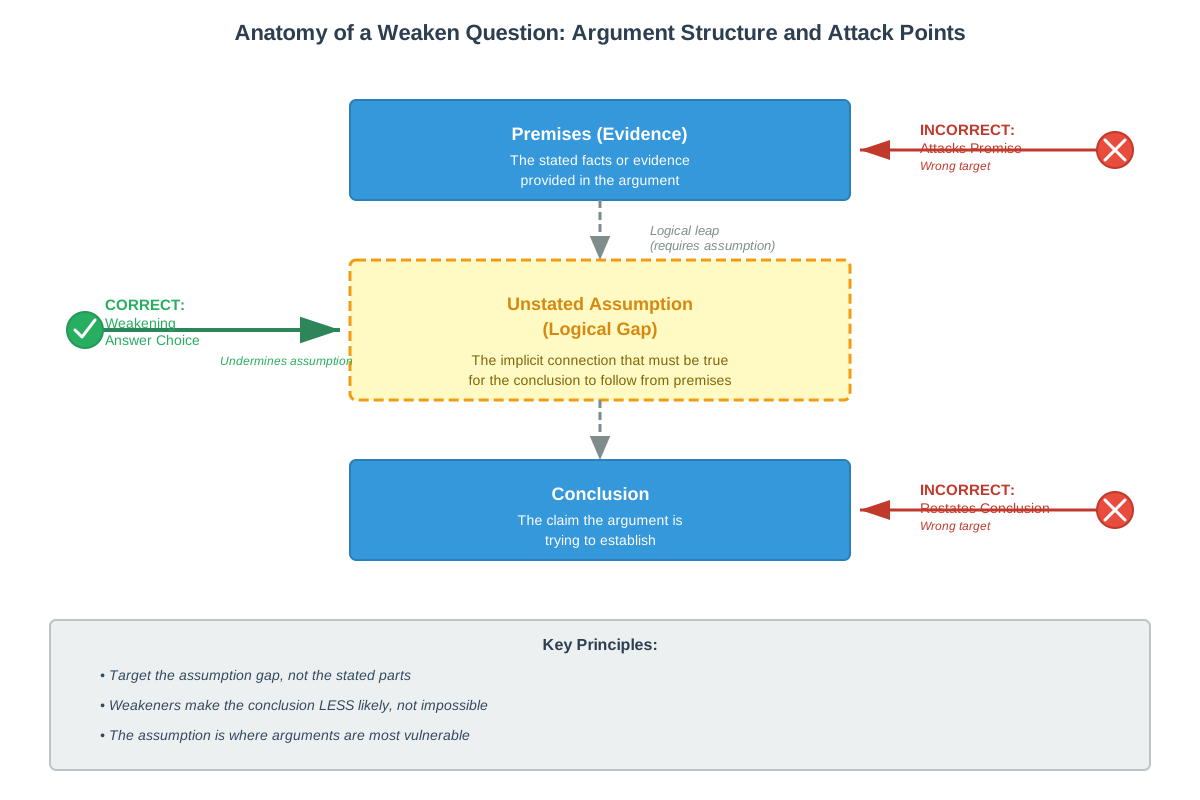
Weaken questions ask test-takers to identify information that damages an argument's reasoning by making its conclusion less likely to be true given its premises. The fundamental structure involves three components: the argument's premises (stated evidence), the conclusion (the claim being made), and the assumption (the unstated logical connection). The correct answer introduces new information that attacks this assumption, thereby undermining the argument's logical force.
The key distinction in weaken questions is that they operate on inductive reasoning rather than deductive logic. The correct answer doesn't need to prove the conclusion false; it merely needs to make the conclusion less probable or less well-supported than before. This probabilistic nature means test-takers should avoid seeking answer choices that completely demolish arguments and instead look for choices that introduce reasonable doubt.
Common Question Stem Variations
Recognizing weaken questions requires familiarity with their characteristic phrasings:
- "Which one of the following, if true, most seriously weakens the argument?"
- "Which one of the following, if true, casts the most doubt on the conclusion?"
- "Which one of the following, if true, most calls into question the claim above?"
- "Which one of the following, if true, would most undermine the reasoning?"
- "Which one of the following, if true, provides the strongest grounds for questioning the argument?"
All these variations share the critical phrase "if true," which signals that test-takers should accept the answer choice as factually accurate and evaluate only whether it weakens the argument. This instruction eliminates the need to assess the plausibility of answer choices themselves.
Types of Arguments Vulnerable to Weakening
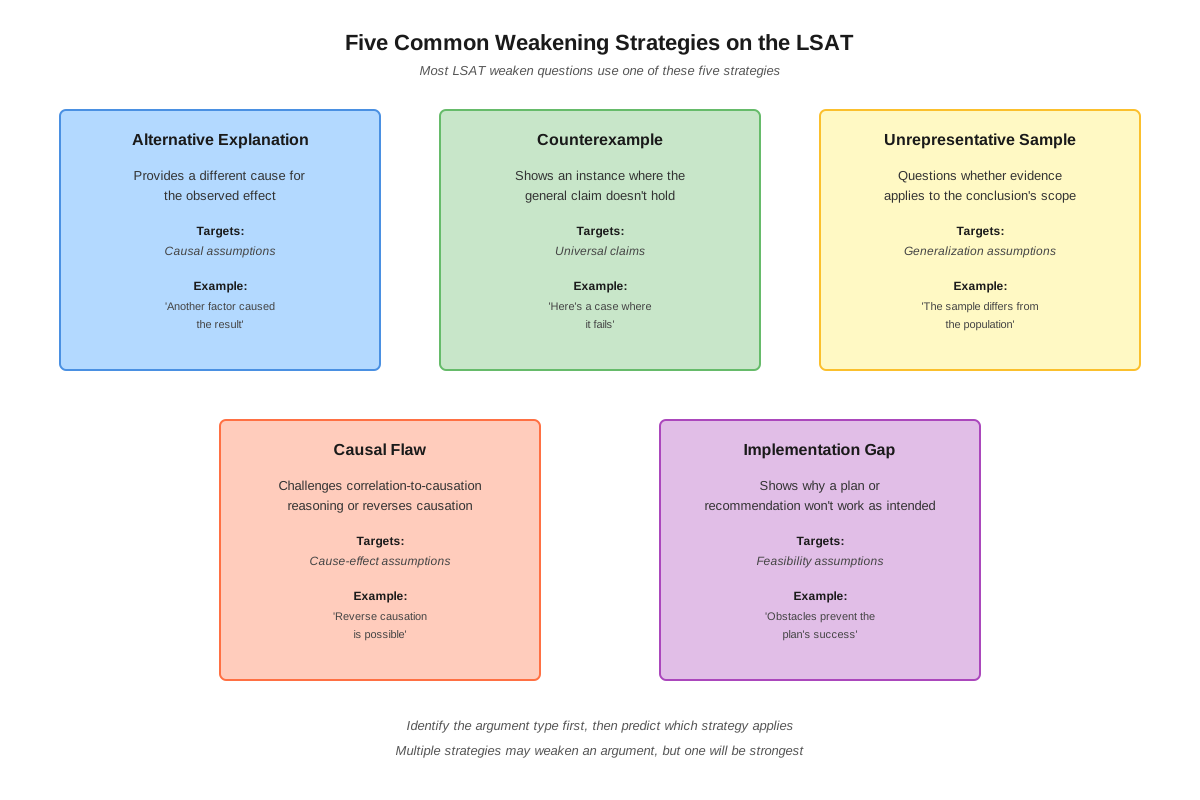
Causal Arguments
Arguments claiming that X causes Y are particularly vulnerable to weakening. These arguments can be undermined by:
- Alternative causes: Showing that Z, not X, might cause Y
- Reversed causation: Demonstrating that Y might cause X instead
- Correlation without causation: Revealing that both X and Y result from a common cause
- Counterexamples: Presenting cases where X occurs without Y, or Y occurs without X
Example: "Sales increased after we hired a new marketing director. Therefore, the new director's strategies caused the sales increase." This can be weakened by showing that a competitor went out of business during the same period (alternative cause).
Analogical Arguments
Arguments reasoning that because two things are similar in some respects, they must be similar in another respect can be weakened by highlighting relevant differences between the compared items.
Example: "City A implemented a recycling program successfully, so City B should implement the same program." This weakens if City B has significantly different population density, infrastructure, or demographics that affect recycling feasibility.
Statistical/Survey Arguments
Arguments based on surveys, studies, or statistical data are vulnerable to challenges regarding:
- Sample representativeness: The sample doesn't reflect the broader population
- Sample size: Too few subjects to draw reliable conclusions
- Methodology flaws: Biased question wording, selection bias, or confounding variables
- Temporal issues: Data from one time period may not apply to another
Predictive Arguments
Arguments projecting future outcomes based on past trends can be weakened by showing that conditions have changed or that the past pattern resulted from factors no longer present.
The Assumption-Based Approach
The most effective strategy for weaken questions involves identifying the argument's central assumption—the unstated logical leap connecting premises to conclusion. Once identified, the correct answer typically provides information suggesting this assumption is questionable or false.
Process:
- Identify the conclusion (what is the argument trying to prove?)
- Identify the premises (what evidence is offered?)
- Identify the gap (what must be true for the conclusion to follow?)
- Predict what information would suggest this assumption is wrong
- Find the answer choice matching this prediction
Degree of Weakening
Not all weakening answer choices are equally strong. The LSAT often includes multiple choices that weaken to some degree, requiring test-takers to identify which weakens most. Stronger weakeners typically:
- Attack more central assumptions rather than peripheral ones
- Introduce more directly relevant information
- Create more significant doubt about the conclusion
- Address the specific reasoning path rather than tangential issues
Concept Relationships
The concepts within weaken questions form an interconnected system. Argument structure (premises and conclusions) provides the foundation, as test-takers cannot weaken what they cannot identify. This leads to assumption identification, which reveals the logical gaps vulnerable to attack. Understanding argument types (causal, analogical, statistical, predictive) enables recognition of type-specific vulnerabilities, which in turn guides prediction of effective weakeners. Finally, evaluating degree of weakening allows selection among multiple weakening answer choices.
Weaken questions connect to prerequisite topics through shared analytical skills. Basic argument structure knowledge enables isolation of conclusions that need weakening. Assumption identification skills transfer directly, as assumptions represent the targets of weakening. Conditional reasoning appears when arguments contain if-then relationships that can be undermined by showing the sufficient condition without the necessary condition. Causal reasoning understanding is essential because causal arguments are among the most frequently weakened argument types.
Within the broader unit of strengthen and weaken questions, these concepts exist in mirror-image relationships. The same assumption that a strengthen question would support becomes the target a weaken question attacks. This symmetry means: Assumption identification → reveals vulnerability → which strengthen questions support OR weaken questions attack → requiring evaluation of degree of impact.
High-Yield Facts
⭐ Weaken questions appear 4-6 times per LSAT, making them one of the highest-frequency question types
⭐ The phrase "if true" in question stems means accept the answer choice as fact and evaluate only its impact on the argument
⭐ The correct answer doesn't need to destroy the argument completely—it only needs to make the conclusion less likely
⭐ Causal arguments are the most commonly tested argument type in weaken questions, vulnerable to alternative causes, reversed causation, and correlation-without-causation challenges
⭐ Identifying the argument's central assumption is the most reliable method for predicting the correct weakening answer
- Weaken questions test inductive rather than deductive reasoning, focusing on probability rather than certainty
- Answer choices that are merely irrelevant to the argument do not weaken it, even if they seem negative
- Strengthening an argument's premises does not weaken the argument—the attack must target the reasoning gap
- Statistical arguments are vulnerable to sample size, representativeness, and methodology challenges
- Analogical arguments weaken when relevant differences between compared items are revealed
- Predictive arguments weaken when conditions have changed since the historical pattern was established
- The most common wrong answer types include irrelevant information, premise strengtheners, and conclusion restaters
Quick check — test yourself on Weaken questions so far.
Try Flashcards →Common Misconceptions
Misconception: Any negative information about the topic weakens the argument. → Correction: Only information that specifically undermines the logical connection between premises and conclusion weakens an argument. Negative but irrelevant information has no weakening effect. For example, if an argument concludes that a restaurant's new menu will increase profits based on customer survey responses, learning that the restaurant has poor parking doesn't weaken the reasoning from survey data to profit prediction.
Misconception: The correct answer must prove the conclusion false. → Correction: Weaken questions operate on inductive reasoning where the goal is to make the conclusion less probable, not impossible. An answer that introduces reasonable doubt is sufficient. The argument may still have some merit after weakening—it's simply less convincing than before.
Misconception: Attacking the premises weakens the argument. → Correction: LSAT arguments assume their premises are true. Weakening occurs by showing that even if the premises are true, the conclusion doesn't follow well. Challenging premise truth is outside the scope of these questions. For instance, if an argument states "Sales increased 20% last quarter," the correct weakener won't dispute this fact but will show why this doesn't support the conclusion.
Misconception: Longer, more complex answer choices are more likely to be correct. → Correction: Answer choice length has no correlation with correctness. The LSAT deliberately includes verbose wrong answers and concise correct answers. Evaluate based on logical impact, not complexity or length.
Misconception: If an answer choice weakens the argument at all, it must be correct. → Correction: Many weaken questions include multiple answer choices that weaken to some degree. The task is identifying which weakens most. Compare the relative impact of each weakening answer choice, selecting the one that creates the most significant doubt about the conclusion.
Worked Examples
Example 1: Causal Argument
Argument: "Hospital readmission rates decreased by 15% after the hospital implemented a new patient education program. Therefore, the patient education program caused the reduction in readmissions."
Question: Which one of the following, if true, most weakens the argument?
Answer Choices:
(A) The patient education program was expensive to implement
(B) Other hospitals without patient education programs also experienced similar readmission rate decreases during the same period
(C) Some patients reported that they found the education program helpful
(D) The hospital's readmission rate had been higher than the national average
(E) Patient education programs require trained staff to administer
Analysis:
Step 1: Identify the conclusion: The patient education program caused the reduction in readmissions.
Step 2: Identify the premises: Readmission rates decreased 15% after implementing the program.
Step 3: Identify the assumption: The program was the cause of the decrease (no other factors were responsible; the timing wasn't coincidental).
Step 4: Predict a weakener: Information suggesting an alternative cause or showing the decrease would have happened anyway.
Step 5: Evaluate answer choices:
- (A) Addresses cost, which is irrelevant to whether the program caused the decrease. Eliminate.
- (B) Shows that hospitals without the program experienced similar decreases, suggesting an alternative cause (perhaps a broader healthcare trend, seasonal variation, or policy change). This directly attacks the causal assumption. Strong candidate.
- (C) Actually strengthens by providing supporting evidence. Eliminate.
- (D) Provides background context but doesn't address whether the program caused the decrease. Eliminate.
- (E) Discusses implementation requirements, irrelevant to causation. Eliminate.
Correct Answer: (B)
This exemplifies weakening a causal argument by introducing an alternative explanation. If hospitals without the program saw similar results, the program likely wasn't the cause.
Example 2: Predictive Argument
Argument: "For the past five years, every time our company has increased advertising spending, sales have increased the following quarter. We are planning to increase advertising spending next quarter, so we can expect sales to increase in the quarter after that."
Question: Which one of the following, if true, most seriously weakens the argument?
Answer Choices:
(A) The company's main competitor has recently declared bankruptcy
(B) Advertising costs have increased significantly over the past five years
(C) The company's previous advertising increases occurred during economic expansions, but the economy is now entering a recession
(D) Some customers report that they rarely notice the company's advertisements
(E) The company's sales have generally trended upward over the past decade
Analysis:
Step 1: Identify the conclusion: Increasing advertising next quarter will lead to increased sales in the following quarter.
Step 2: Identify the premises: This pattern has held for the past five years.
Step 3: Identify the assumption: Conditions remain similar to the past five years; the past pattern will continue into the future.
Step 4: Predict a weakener: Information showing that conditions have changed, making the past pattern unreliable for future prediction.
Step 5: Evaluate answer choices:
- (A) This would actually strengthen the argument by removing competition, making sales increases more likely. Eliminate.
- (B) Discusses costs rather than the effectiveness of advertising in driving sales. Eliminate.
- (C) Identifies a crucial difference between past and future conditions: the economic context has changed from expansion to recession. This suggests the past pattern may not hold because consumer behavior differs in recessions. Strong candidate.
- (D) Weakens slightly by questioning advertising effectiveness, but doesn't explain why the past pattern wouldn't continue. Weaker than C.
- (E) Provides general context but doesn't address why the specific advertising-to-sales pattern might not continue. Eliminate.
Correct Answer: (C)
This demonstrates weakening a predictive argument by showing that conditions have changed since the historical pattern was established, making past results unreliable for future predictions.
Exam Strategy
Systematic Approach
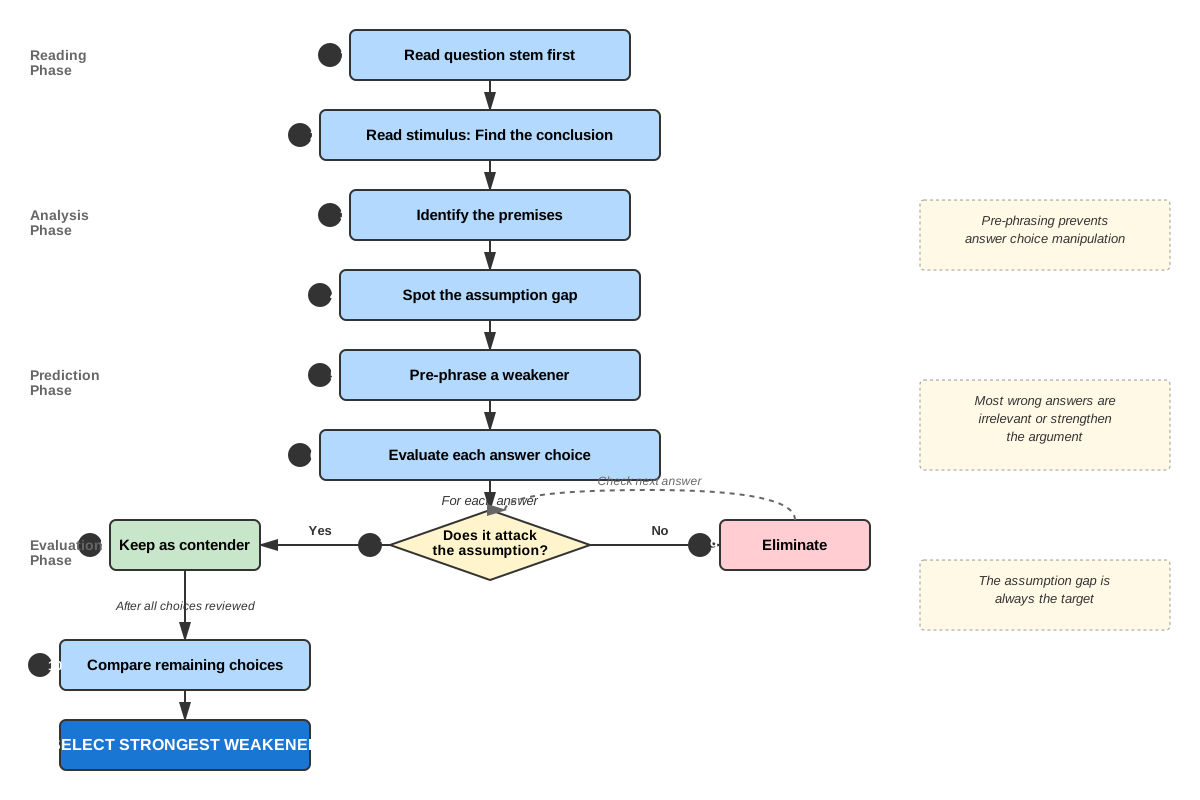
When encountering weaken questions on the LSAT, employ this consistent process:
- Read the question stem first to confirm it's a weaken question and prime your mind for the task
- Identify the conclusion by asking "What is the author trying to prove?"
- Identify the premises by asking "What evidence is offered?"
- Identify the assumption by asking "What must be true for this conclusion to follow?"
- Predict a weakener before looking at answer choices
- Eliminate wrong answers systematically
- Compare remaining choices if multiple seem to weaken
Trigger Words and Phrases
Question stems containing these phrases indicate weaken questions:
- "weakens," "undermines," "calls into question"
- "casts doubt on," "challenges," "counters"
- "most seriously damages," "provides grounds for questioning"
- Always accompanied by "if true"
Within arguments, watch for these vulnerability indicators:
- Causal language: "caused by," "resulted in," "led to," "because of"
- Predictive language: "will," "is likely to," "can expect"
- Analogical language: "similarly," "likewise," "just as"
- Statistical language: "survey shows," "study found," "data indicates"
Process of Elimination Tips
Eliminate answer choices that:
- Are irrelevant to the argument's reasoning (most common wrong answer type)
- Strengthen rather than weaken the argument
- Attack the premises rather than the reasoning gap
- Are outside the scope of the argument
- Merely restate information already in the argument
Keep answer choices that:
- Introduce alternative explanations (for causal arguments)
- Reveal relevant differences (for analogical arguments)
- Challenge representativeness or methodology (for statistical arguments)
- Show changed conditions (for predictive arguments)
- Directly address the argument's central assumption
Time Allocation
Weaken questions typically require 1:15-1:30 minutes each. Allocate time as follows:
- 15-20 seconds: Read question stem and argument
- 20-30 seconds: Identify conclusion, premises, and assumption
- 10-15 seconds: Predict a weakener
- 30-40 seconds: Evaluate answer choices
- 5-10 seconds: Confirm selection
If stuck between two answer choices, compare their relative impact: which creates more doubt about the conclusion? Which addresses a more central assumption?
Exam Tip: If you can't identify the assumption, focus on the conclusion and ask "What would make this less likely to be true?" This often leads to the correct answer even without explicitly articulating the assumption.
Memory Techniques
The WEAKEN Acronym
What's the conclusion?
Evidence provided (premises)?
Assumption connecting them?
Kill the assumption
Eliminate irrelevant choices
Narrow to strongest weakener
Visualization Strategy
Picture the argument as a bridge: premises on one side, conclusion on the other, and the assumption as the supporting structure. The correct answer is a wrecking ball that damages the bridge's support (assumption), making it less stable. This visualization helps distinguish between:
- Attacks on the bridge itself (premises) - wrong
- Attacks on the destination (conclusion) - wrong
- Attacks on the support structure (assumption) - correct
The "Alternative Cause" Mnemonic: RACE
For causal arguments, remember RACE for common weakeners:
- Reversed causation (Y causes X, not X causes Y)
- Alternative cause (Z causes Y, not X)
- Correlation only (common cause for both X and Y)
- Exceptions (counterexamples where X occurs without Y)
The "If True" Reminder
Whenever you see "if true" in a question stem, mentally add "so I accept this as fact and only evaluate its impact." This prevents wasting time questioning answer choice plausibility.
Summary
Weaken questions constitute a high-frequency, high-value question type on the LSAT Logical Reasoning sections, appearing 4-6 times per test. These questions assess the ability to identify information that undermines an argument's reasoning by attacking the unstated assumptions connecting premises to conclusions. Success requires a systematic approach: identify the conclusion, isolate the premises, recognize the assumption, predict what would challenge that assumption, and select the answer choice that most effectively introduces doubt. The correct answer operates on inductive reasoning, making the conclusion less probable rather than impossible. Common argument types include causal arguments (vulnerable to alternative causes), analogical arguments (vulnerable to relevant differences), statistical arguments (vulnerable to methodology challenges), and predictive arguments (vulnerable to changed conditions). Mastering weaken questions requires distinguishing between answer choices that genuinely undermine reasoning and those that are merely irrelevant, negative, or tangential to the argument's logical structure.
Key Takeaways
- Weaken questions ask for information that makes an argument's conclusion less likely to follow from its premises, not information that proves the conclusion false
- The phrase "if true" means accept answer choices as factual and evaluate only their logical impact on the argument
- Identifying the argument's central assumption is the most reliable path to predicting and recognizing the correct weakener
- Causal arguments are the most frequently tested type, vulnerable to alternative causes, reversed causation, and correlation-without-causation challenges
- The correct answer must be relevant to the argument's reasoning—negative but irrelevant information does not weaken
- When multiple answer choices weaken, select the one that creates the most significant doubt about the conclusion
- Systematic process (identify conclusion → identify premises → identify assumption → predict weakener → eliminate wrong answers) maximizes accuracy and efficiency
Related Topics
Strengthen Questions: The mirror image of weaken questions, asking for information that supports rather than undermines an argument's assumptions. Mastering weaken questions directly builds skills for strengthen questions since both require identifying the same assumptions.
Assumption Questions: These questions explicitly ask test-takers to identify the unstated logical gaps that weaken questions target. Strong assumption identification skills make weaken questions significantly easier.
Flaw Questions: These ask test-takers to describe the logical error in an argument's reasoning. The flaws identified are often the same vulnerabilities that correct weaken answers exploit.
Evaluate Questions: These ask what information would be most useful in assessing an argument's strength. Understanding what weakens an argument helps identify what information would be evaluatively relevant.
Causal Reasoning: A deeper study of cause-and-effect relationships, alternative explanations, and correlation versus causation enhances performance on the many weaken questions involving causal arguments.
Practice CTA
Now that you've mastered the core concepts, reasoning patterns, and strategic approaches for weaken questions, it's time to apply this knowledge. Attempt the practice questions to reinforce your understanding and build the pattern recognition that leads to automatic, confident performance on test day. Each practice question you complete strengthens your ability to quickly identify assumptions and predict weakeners—skills that will serve you throughout the Logical Reasoning sections. Remember: weaken questions are highly learnable, and consistent practice with the systematic approach outlined in this guide will transform them from challenging obstacles into reliable opportunities to earn points. Your investment in mastering this high-frequency question type will pay dividends across your entire LSAT score.
Sign up free to keep reading
Create a free AnvayaPrep account to finish this LSAT guide on Weaken questions — plus flashcards and practice questions.