Overview
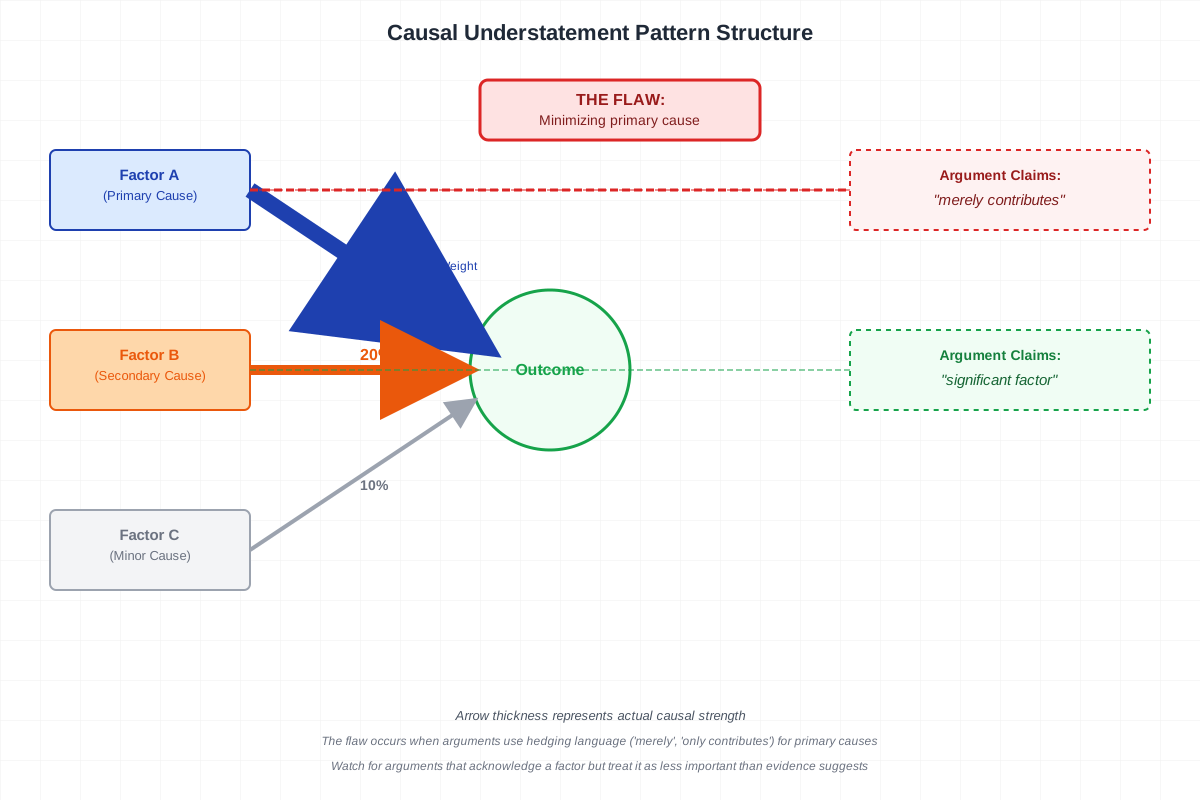
Causal understatement is a sophisticated reasoning pattern that appears frequently in LSAT Logical Reasoning questions, particularly within the broader domain of causation and explanation. This pattern occurs when an argument acknowledges that a factor contributes to an outcome but fails to recognize or adequately emphasize that this factor is the primary or most significant cause. In essence, the argument understates the causal importance of a key variable while potentially overstating the role of other factors. Understanding this pattern is crucial because the LSAT regularly tests whether students can identify when an argument has minimized the true causal weight of an important factor.
This topic sits at the intersection of causal reasoning and argument evaluation, two pillars of logical reasoning on the LSAT. While many students can identify basic causal claims (X causes Y), recognizing when an argument has inappropriately downplayed a causal relationship requires more nuanced analytical skills. The LSAT exploits this complexity by presenting arguments that technically acknowledge a causal factor but treat it as minor or secondary when evidence suggests it should be considered primary or dominant. This creates a subtle flaw that separates high-scoring test-takers from those who miss the deeper logical issues.
Mastering lsat causal understatement enhances performance across multiple question types, including Flaw questions, Strengthen/Weaken questions, and Assumption questions. When an argument commits causal understatement, it typically relies on an unstated assumption that other factors are more important than they actually are, or it overlooks evidence that would elevate the understated factor to primary importance. Recognizing this pattern allows students to predict correct answers, eliminate trap choices, and approach causal reasoning questions with greater confidence and accuracy.
Learning Objectives
- [ ] Identify how Causal understatement appears in LSAT questions
- [ ] Explain the reasoning pattern behind Causal understatement
- [ ] Apply Causal understatement to solve LSAT-style problems accurately
- [ ] Distinguish causal understatement from other causal reasoning flaws (such as causal oversimplification or correlation-causation confusion)
- [ ] Recognize the specific language patterns and hedging phrases that signal causal understatement
- [ ] Evaluate answer choices that correctly identify or address causal understatement in argument structures
Prerequisites
- Basic causal reasoning: Understanding the fundamental structure of causal claims (cause → effect) is essential because causal understatement involves evaluating the strength or importance of causal relationships.
- Argument structure analysis: The ability to identify premises, conclusions, and logical gaps enables students to spot where an argument has minimized a causal factor's significance.
- Necessary vs. sufficient conditions: Recognizing these distinctions helps differentiate between factors that merely contribute to an outcome and those that are primary or essential causes.
- Quantitative reasoning with qualifiers: Understanding terms like "some," "most," "primary," and "contributing" is crucial for detecting when an argument has inappropriately downgraded a factor's causal role.
Why This Topic Matters
Causal understatement represents a real-world reasoning error that extends far beyond standardized testing. In policy debates, scientific discussions, and everyday arguments, people frequently minimize the importance of inconvenient causal factors while emphasizing more palatable or politically expedient explanations. For instance, a company might acknowledge that its product contributes to environmental harm but characterize this contribution as "minor" when evidence suggests it's actually the dominant factor. Recognizing this pattern develops critical thinking skills applicable to professional, academic, and civic contexts.
On the LSAT, causal understatement appears with notable frequency—approximately 8-12% of Logical Reasoning questions involve some form of causal reasoning flaw, and causal understatement represents a significant subset of these questions. This pattern most commonly appears in Flaw questions (where students must identify the reasoning error), Weaken questions (where correct answers often provide evidence that an understated factor is actually primary), and Assumption questions (where the argument depends on the assumption that the understated factor truly is minor). Less frequently, it appears in Strengthen questions and Method of Reasoning questions.
The LSAT typically presents causal understatement through arguments that use hedging language like "merely contributes," "plays only a small role," "is just one factor among many," or "has some effect but not a major one." The test-makers craft these arguments to appear reasonable on first reading, making the understatement subtle enough that only careful analysis reveals the flaw. This makes causal understatement a high-yield topic for score improvement, as students who master this pattern gain an advantage over those who accept the argument's characterization at face value.
Core Concepts
The Structure of Causal Understatement
Causal understatement occurs when an argument structure follows this pattern: (1) Evidence suggests that Factor X has a substantial or primary causal role in producing Outcome Y; (2) The argument acknowledges that Factor X contributes to Outcome Y; but (3) The argument characterizes Factor X's role as minor, secondary, or merely contributory without adequate justification for this minimization. The logical error lies not in denying the causal relationship entirely but in mischaracterizing its magnitude or importance.
This pattern differs from outright causal denial. An argument that commits causal understatement doesn't claim "X doesn't cause Y" but rather "X causes Y, but only a little" or "X is just one of many factors." The flaw emerges when the evidence presented (or common knowledge) suggests that X is actually the primary, dominant, or most significant cause. The argument has understated the causal importance without providing sufficient justification for doing so.
Key Components of the Pattern
The causal understatement pattern contains several identifiable elements:
- Acknowledgment: The argument explicitly or implicitly recognizes that a particular factor has some causal influence
- Minimization: The argument uses qualifying language to characterize this influence as small, secondary, or relatively unimportant
- Insufficient justification: The argument fails to provide adequate evidence or reasoning to support the minimization
- Implicit comparison: The argument often suggests (directly or indirectly) that other factors are more important
- Overlooked evidence: Information exists (either stated or reasonably inferable) that the understated factor is actually primary or dominant
Linguistic Markers and Signal Phrases
The LSAT uses specific language patterns to create causal understatement. Recognizing these trigger words dramatically improves identification speed:
| Minimizing Language | Function | Example Context |
|---|---|---|
| "merely," "only," "just" | Diminishes importance | "The policy merely contributes to the problem" |
| "one factor among many" | Suggests equal or minor weight | "Pollution is one factor among many affecting health" |
| "plays a small role" | Explicitly minimizes magnitude | "Diet plays a small role in the disease" |
| "somewhat," "slightly" | Quantitative minimization | "The change slightly affected outcomes" |
| "not the primary cause" | Comparative minimization | "While relevant, it's not the primary cause" |
| "contributes but doesn't determine" | Necessary/sufficient confusion | "It contributes but doesn't determine success" |
The Logical Gap Created
When an argument commits causal understatement, it creates a specific type of logical gap: the argument moves from evidence about a causal relationship to a conclusion about the magnitude or importance of that relationship without adequate support for the characterization. This gap becomes exploitable in various question types:
- In Flaw questions: The correct answer identifies that the argument "treats a factor that may be the primary cause as though it were merely a contributing factor" or similar language
- In Weaken questions: The correct answer provides evidence that the understated factor is actually primary, dominant, or more significant than acknowledged
- In Assumption questions: The correct answer states an assumption necessary for the minimization to be justified (often something like "no evidence suggests Factor X is the primary cause")
Distinguishing from Related Patterns
Causal understatement must be distinguished from other causal reasoning patterns:
Causal Understatement vs. Causal Oversimplification: Oversimplification occurs when an argument treats a complex, multi-causal phenomenon as having only one cause. Understatement occurs when an argument acknowledges a cause but inappropriately minimizes its importance. An argument can commit both errors simultaneously (understating one factor while oversimplifying by focusing exclusively on another).
Causal Understatement vs. Correlation-Causation Confusion: The correlation-causation error involves inferring causation from mere correlation. Causal understatement assumes causation exists but mischaracterizes its strength. These are distinct logical moves.
Causal Understatement vs. Ignoring Alternative Causes: Ignoring alternatives means failing to consider other possible causes. Understatement means acknowledging a cause but treating it as less important than warranted. The former is an error of omission; the latter is an error of characterization.
The Role of Context and Background Knowledge
LSAT questions involving causal understatement often rely on test-takers' ability to recognize when a minimization contradicts common knowledge or evidence presented in the stimulus. For example, if an argument states "while smoking contributes to lung cancer, it plays only a minor role compared to genetic factors," the test-taker should recognize this as potential causal understatement based on well-established medical knowledge. The LSAT doesn't require specialized expertise but does expect reasonable general knowledge and the ability to recognize when an argument's characterization seems inconsistent with its own evidence.
Quantitative vs. Qualitative Understatement
Causal understatement can manifest in two forms:
Quantitative understatement involves minimizing the numerical or measurable impact of a cause. Example: "The new regulation reduced accidents by 40%, but this represents only a small improvement."
Qualitative understatement involves minimizing the importance or significance of a cause without specific numerical claims. Example: "While the CEO's decisions contributed to the bankruptcy, they were not a major factor."
Both forms appear on the LSAT, though qualitative understatement is more common because it's harder to definitively refute without additional evidence.
Concept Relationships
Causal understatement connects to broader causation and explanation concepts through a hierarchical relationship. At the foundation lies basic causal reasoning (understanding that X causes Y). Building on this, students learn to evaluate causal strength and identify various causal reasoning flaws. Causal understatement represents a specific type of flaw within this framework—one that involves mischaracterizing magnitude rather than misidentifying relationships.
The relationship map flows as follows: Basic Causal Claims → Causal Strength Evaluation → Causal Understatement (alongside other flaws like oversimplification, reverse causation, and correlation-causation confusion). Mastering causal understatement requires first understanding how to identify causal relationships, then developing the ability to assess whether an argument has appropriately characterized the importance of those relationships.
Causal understatement also connects to argument structure analysis because identifying the flaw requires recognizing the gap between premises (which may provide evidence of strong causation) and conclusion (which characterizes the causation as weak). This relationship reinforces the importance of carefully tracking what evidence supports and what claims require additional justification.
Additionally, causal understatement relates to necessary and sufficient conditions because arguments sometimes commit understatement by treating a necessary condition as merely contributory or by failing to recognize that a sufficient condition is also the primary cause. Understanding these modal relationships helps students recognize when minimizing language inappropriately downplays a factor's logical role.
High-Yield Facts
⭐ Causal understatement occurs when an argument acknowledges a causal factor but characterizes it as minor or secondary without adequate justification, despite evidence suggesting it's primary or dominant.
⭐ Key trigger phrases include "merely contributes," "plays only a small role," "one factor among many," and "not the primary cause."
⭐ In Flaw questions, correct answers identifying causal understatement often use language like "treats what may be a primary cause as though it were merely a contributing factor."
⭐ Weaken questions exploit causal understatement by providing evidence that an understated factor is actually the most significant or dominant cause.
⭐ Causal understatement differs from causal oversimplification: understatement minimizes an acknowledged cause, while oversimplification ignores multiple causes entirely.
- Arguments committing causal understatement often implicitly compare the understated factor unfavorably to other factors without justification for the comparison.
- The logical gap in causal understatement involves moving from evidence of causation to a conclusion about magnitude without adequate support.
- Causal understatement can be quantitative (minimizing measurable impact) or qualitative (minimizing importance or significance).
- Recognizing causal understatement requires evaluating whether the argument's characterization is consistent with its own evidence and reasonable background knowledge.
- Assumption questions involving causal understatement typically require identifying that the argument assumes no evidence exists showing the understated factor is primary.
- Causal understatement frequently appears in arguments about policy, where acknowledging but minimizing a factor serves rhetorical purposes.
- The LSAT tests causal understatement approximately 3-5 times per exam across various question types, making it a high-yield pattern for score improvement.
Quick check — test yourself on Causal understatement so far.
Try Flashcards →Common Misconceptions
Misconception: Causal understatement only occurs when an argument completely denies a causal relationship.
Correction: Causal understatement specifically involves acknowledging a causal relationship but inappropriately minimizing its importance. Complete denial represents a different error (causal denial or ignoring relevant factors).
Misconception: Any time an argument says a factor "contributes" to an outcome, it's committing causal understatement.
Correction: The word "contributes" alone doesn't indicate understatement. The flaw occurs only when the argument characterizes the contribution as minor without adequate justification and when evidence suggests the factor is actually primary or dominant.
Misconception: Causal understatement and causal oversimplification are the same thing.
Correction: These are distinct flaws. Oversimplification treats a multi-causal phenomenon as having only one cause (ignoring other factors). Understatement acknowledges a factor but inappropriately minimizes its importance (mischaracterizing magnitude). An argument can commit one without the other, or both simultaneously.
Misconception: To identify causal understatement, students need specialized scientific or technical knowledge.
Correction: The LSAT tests logical reasoning, not specialized knowledge. Questions involving causal understatement either provide sufficient evidence within the stimulus to recognize the minimization is unjustified, or they rely on general knowledge that any educated person would possess.
Misconception: If an argument provides any evidence that other factors exist, it's justified in characterizing a factor as minor.
Correction: The mere existence of other causal factors doesn't justify minimizing a particular factor's importance. The argument must provide evidence about the relative magnitude of different factors to justify characterizing one as minor or secondary.
Misconception: Causal understatement only appears in Flaw questions.
Correction: While common in Flaw questions, causal understatement appears across multiple question types including Weaken, Strengthen, Assumption, and occasionally Method of Reasoning questions. The pattern manifests differently depending on question type.
Misconception: Hedging language like "may" or "might" always indicates causal understatement.
Correction: Hedging about whether a causal relationship exists differs from minimizing an acknowledged relationship's importance. "X may cause Y" expresses uncertainty about causation; "X causes Y but only slightly" expresses certainty about causation but minimizes magnitude.
Worked Examples
Example 1: Flaw Question
Stimulus: "Recent studies show that employees who work from home are 15% more productive than office-based employees. However, remote work arrangements merely contribute to productivity gains and should not be considered a primary factor in improving organizational performance. The real drivers of productivity are employee motivation and effective management practices."
Question: Which one of the following describes a flaw in the reasoning above?
Analysis:
Step 1: Identify the argument structure. The premises state that remote work correlates with a 15% productivity increase. The conclusion characterizes remote work as "merely" contributing (minimizing language) and claims it's "not a primary factor."
Step 2: Evaluate the logical gap. The argument provides evidence of a substantial productivity increase (15%) associated with remote work but then characterizes this factor as minor without justification. The argument doesn't provide evidence that motivation and management are more important—it simply asserts this.
Step 3: Recognize the pattern. This is classic causal understatement: acknowledging a causal factor (remote work → productivity) but minimizing its importance ("merely contributes," "not a primary factor") without adequate support for the minimization.
Step 4: Predict the correct answer. It should identify that the argument treats a potentially primary cause as merely contributory, or that it fails to justify why remote work should be considered minor despite the 15% increase.
Correct Answer Type: "The argument treats a factor that may be a primary contributor to productivity as though it were merely one minor factor among many, without providing adequate justification for this characterization."
Connection to Learning Objectives: This example demonstrates how to identify causal understatement in LSAT questions (Objective 1), explains the reasoning pattern of acknowledging but minimizing causation (Objective 2), and shows how to apply this knowledge to eliminate incorrect answers and select the correct flaw description (Objective 3).
Example 2: Weaken Question
Stimulus: "City officials claim that while the new highway construction contributed to increased traffic congestion downtown, it played only a minor role. They argue that the primary causes of congestion are the growing population and inadequate public transportation. Therefore, the city should focus on expanding public transit rather than reconsidering the highway project."
Question: Which one of the following, if true, most weakens the city officials' argument?
Analysis:
Step 1: Identify the causal understatement. The officials acknowledge the highway contributed to congestion but characterize this contribution as "only a minor role" while identifying other factors as "primary causes."
Step 2: Determine what would weaken this characterization. Evidence that the highway is actually a primary or dominant cause would directly undermine the officials' minimization and their conclusion that focus should be elsewhere.
Step 3: Consider what form this evidence might take. It could be quantitative (the highway accounts for most of the congestion increase), comparative (the highway's impact exceeds population growth's impact), or temporal (congestion increased dramatically only after highway construction).
Step 4: Evaluate answer choices for evidence elevating the highway's causal importance.
Correct Answer Type: "Traffic studies show that 70% of the increased downtown congestion occurred on routes directly affected by the highway construction, while areas unaffected by the construction experienced only minimal congestion increases despite similar population growth."
Why This Weakens: This evidence suggests the highway is actually the primary cause (accounting for 70% of the problem), directly contradicting the officials' characterization of it as "only a minor role." The comparison between affected and unaffected areas controls for population growth, undermining the officials' claim that population is the primary cause.
Alternative Incorrect Answer: "Public transportation ridership has declined by 5% since the highway construction began." This might seem relevant but doesn't directly address whether the highway is a minor or major cause of congestion. It could even support the officials' claim that inadequate public transit is a problem.
Connection to Learning Objectives: This example shows how causal understatement appears in Weaken questions (Objective 1), demonstrates the reasoning pattern where evidence contradicts the minimization (Objective 2), and illustrates how to apply this understanding to identify the most effective weakening answer (Objective 3).
Exam Strategy
Recognition Strategy
When approaching LSAT Logical Reasoning questions, develop a systematic process for detecting causal understatement:
- Scan for causal language: Identify any claims about causes and effects in the stimulus
- Flag minimizing qualifiers: Circle or mentally note words like "merely," "only," "minor role," "one factor among many"
- Assess evidence-claim alignment: Compare the evidence provided about a causal factor with how the argument characterizes that factor's importance
- Check for justification: Ask whether the argument provides adequate support for treating a factor as minor or secondary
Question-Type Specific Approaches
For Flaw Questions: After identifying potential causal understatement, predict that the correct answer will describe the argument as "treating a potentially primary cause as merely contributory" or "failing to justify characterizing a factor as minor." Eliminate answers that describe different flaws (correlation-causation, oversimplification, etc.).
For Weaken Questions: If the argument minimizes a causal factor, the correct answer will likely provide evidence that this factor is actually primary, dominant, or more significant than acknowledged. Look for quantitative evidence, comparative studies, or temporal patterns that elevate the understated factor's importance.
For Assumption Questions: The argument likely assumes that no evidence exists showing the understated factor is primary, or that other factors are indeed more important. The correct answer will state what must be true for the minimization to be justified.
For Strengthen Questions: Less common, but when causal understatement appears, the correct answer will provide evidence supporting the characterization of a factor as minor (evidence that other factors are more important, or that the understated factor's impact is genuinely small).
Time Management
Causal understatement questions typically require 1:15-1:30 to complete accurately. Allocate time as follows:
- 30-40 seconds: Read and analyze the stimulus, identifying the causal claim and minimization
- 10-15 seconds: Process the question stem and predict answer characteristics
- 30-40 seconds: Evaluate answer choices, eliminating clear mismatches
- 5-10 seconds: Confirm the selected answer addresses the causal understatement
Process of Elimination Tips
Eliminate answers that:
- Describe correlation-causation confusion when the argument clearly establishes causation
- Claim the argument ignores a factor that it actually acknowledges (even if it minimizes)
- Focus on irrelevant aspects of the argument unrelated to causal characterization
- In Flaw questions, describe the argument as "failing to consider" when it actually considers but minimizes
Favor answers that:
- Use language about "treating as minor" or "characterizing as merely contributory"
- Reference the gap between evidence and characterization
- In Weaken questions, provide comparative or quantitative evidence about causal magnitude
- Specifically address the relationship between the understated factor and other factors mentioned
Trigger Word Awareness
Develop automatic recognition of these high-frequency phrases that signal potential causal understatement:
- "merely contributes"
- "plays only a small/minor role"
- "one factor among many"
- "not the primary cause"
- "just one of several factors"
- "contributes somewhat"
- "has some effect but"
When these phrases appear, immediately evaluate whether the argument has justified this characterization or whether evidence suggests the factor is actually more important.
Memory Techniques
The UNDERPLAY Mnemonic
Remember the key features of causal understatement with UNDERPLAY:
- Unjustified minimization of causal importance
- Not denying causation, just downplaying it
- Discrepancy between evidence and characterization
- Evidence suggests factor is actually primary
- Relative importance is mischaracterized
- Phrases like "merely" and "only" signal the pattern
- Logical gap between causation and magnitude
- Acknowledgment of the factor occurs
- Yielding to other factors without justification
Visualization Strategy
Picture a scale or balance where one side represents the evidence about a causal factor's importance and the other side represents how the argument characterizes that importance. In causal understatement, these sides are imbalanced: the evidence side is heavy (suggesting significant causation) while the characterization side is light (claiming minor causation). This visual helps quickly identify when an argument has inappropriately minimized a factor.
The "But Actually" Test
When reading an argument, mentally insert "but actually" before any minimizing language. If the evidence suggests the opposite of what follows "but actually," you've likely found causal understatement:
- Argument: "The policy merely contributes to the problem"
- Mental test: "The policy [but actually is the main cause] merely contributes to the problem"
- If the evidence supports what's in brackets, causal understatement exists
Contrast Pair Memory
Remember the distinction between related concepts:
- Understatement = acknowledges but minimizes
- Oversimplification = ignores multiple causes
- Denial = rejects causation entirely
- Overstatement = exaggerates causal importance
Creating these contrast pairs helps prevent confusion during time pressure.
Summary
Causal understatement represents a sophisticated reasoning flaw where arguments acknowledge that a factor contributes to an outcome but characterize this contribution as minor, secondary, or merely contributory without adequate justification—despite evidence suggesting the factor is actually primary or dominant. This pattern appears frequently across LSAT Logical Reasoning question types, particularly in Flaw, Weaken, and Assumption questions. Recognizing causal understatement requires identifying specific linguistic markers ("merely," "only a small role," "one factor among many"), evaluating whether the argument's characterization aligns with its evidence, and distinguishing this pattern from related causal reasoning flaws like oversimplification or correlation-causation confusion. The key to mastering this topic lies in developing automatic recognition of minimizing language, systematically assessing whether minimization is justified, and understanding how different question types exploit this reasoning pattern. Students who master causal understatement gain a significant advantage because they can quickly identify a subtle flaw that many test-takers miss, leading to faster, more accurate performance on high-value Logical Reasoning questions.
Key Takeaways
- Causal understatement occurs when an argument acknowledges a causal factor but inappropriately minimizes its importance without adequate justification
- Recognition depends on identifying minimizing language ("merely," "only," "minor role") and evaluating whether evidence supports the characterization
- This pattern differs from oversimplification (which ignores causes) and correlation-causation confusion (which misidentifies causation)
- In Flaw questions, correct answers describe treating a potentially primary cause as merely contributory; in Weaken questions, correct answers provide evidence elevating the understated factor's importance
- The logical gap involves moving from evidence of causation to a conclusion about magnitude without adequate support
- Causal understatement appears 3-5 times per LSAT exam across multiple question types, making it a high-yield pattern for score improvement
- Systematic recognition strategies and question-type-specific approaches dramatically improve accuracy and speed on these questions
Related Topics
Causal Oversimplification: Understanding how arguments inappropriately reduce complex, multi-causal phenomena to single causes builds on causal understatement mastery by exploring the opposite error—overemphasizing rather than underemphasizing causal factors.
Necessary and Sufficient Conditions in Causal Reasoning: Exploring how modal logic applies to causation helps students recognize when arguments confuse necessary conditions (which may be understated) with sufficient conditions (which may be overstated).
Comparative Causal Claims: Studying arguments that explicitly compare the causal importance of multiple factors provides advanced practice in evaluating relative causal magnitude, directly building on causal understatement concepts.
Quantitative Reasoning in Arguments: Developing skills in evaluating numerical evidence and statistical claims enhances the ability to recognize when quantitative evidence contradicts an argument's qualitative characterization of causal importance.
Practice CTA
Now that you've mastered the conceptual foundation of causal understatement, it's time to cement your understanding through active practice. Attempt the practice questions designed specifically for this topic, paying special attention to identifying minimizing language and evaluating whether arguments have justified their characterizations of causal importance. Use the flashcards to reinforce recognition of trigger phrases and key distinctions between causal understatement and related patterns. Remember: recognizing this pattern quickly and accurately can add multiple points to your LSAT score, as it appears consistently across exams and separates high scorers from the rest. Your investment in mastering this sophisticated reasoning pattern will pay dividends not only on test day but in developing critical thinking skills that serve you throughout law school and legal practice.
Sign up free to keep reading
Create a free AnvayaPrep account to finish this LSAT guide on Causal understatement — plus flashcards and practice questions.