Overview
Causal reasoning is one of the most frequently tested concepts in LSAT logical reasoning sections, appearing in approximately 15-20% of all Logical Reasoning questions. This fundamental reasoning pattern involves arguments that claim one event, condition, or factor causes another. Understanding causal relationships is essential not only for identifying argument structures but also for recognizing the vulnerabilities inherent in causal claims—vulnerabilities that the LSAT exploits repeatedly across question types including Strengthen, Weaken, Flaw, Assumption, and Evaluate questions.
The LSAT tests causal reasoning because it represents a critical thinking skill applicable to legal analysis and everyday decision-making. Attorneys must constantly evaluate whether evidence truly supports causal claims: Did the defendant's actions cause the plaintiff's injuries? Does a particular policy cause the intended outcomes? The ability to distinguish between correlation and causation, identify alternative explanations, and recognize the conditions necessary for valid causal inferences is fundamental to legal reasoning and, consequently, to success on the LSAT.
Within the broader framework of argument fundamentals, causal reasoning connects intimately with other core concepts including conditional reasoning, evidence evaluation, and assumption identification. While conditional reasoning deals with sufficient and necessary conditions, causal reasoning addresses the mechanism by which one phenomenon brings about another. Mastering causal reasoning provides the foundation for understanding how arguments can be strengthened or weakened, what assumptions underlie causal claims, and how to evaluate the logical force of evidence presented in support of cause-and-effect relationships.
Learning Objectives
- [ ] Identify how causal reasoning appears in LSAT questions
- [ ] Explain the reasoning pattern behind causal reasoning
- [ ] Apply causal reasoning to solve LSAT-style problems accurately
- [ ] Distinguish between correlation and causation in argument structures
- [ ] Recognize the five major vulnerabilities in causal arguments
- [ ] Predict how answer choices will strengthen or weaken causal claims
- [ ] Evaluate whether evidence provided adequately supports a causal conclusion
Prerequisites
- Basic argument structure: Understanding premises and conclusions is essential because causal reasoning represents a specific type of relationship between premises and conclusions where one phenomenon is claimed to produce another.
- Correlation vs. causation distinction: Familiarity with the difference between events occurring together and one event causing another provides the foundation for recognizing flawed causal reasoning.
- Conditional logic basics: Understanding "if-then" relationships helps distinguish between necessary/sufficient conditions and causal mechanisms, which students often confuse.
- Evidence evaluation: The ability to assess whether evidence supports a claim is crucial for determining whether causal conclusions are justified by the premises provided.
Why This Topic Matters
Causal reasoning appears across virtually every LSAT Logical Reasoning section, making it one of the highest-yield topics for test preparation. Research on LSAT question distribution shows that causal arguments appear in approximately 3-5 questions per Logical Reasoning section, accounting for roughly 15-20% of all questions. These questions span multiple question types: Weaken (most common), Strengthen, Flaw, Assumption, Evaluate, and occasionally Method of Reasoning questions.
In real-world legal practice, causal reasoning underlies tort law (did the defendant's negligence cause the plaintiff's injury?), criminal law (did the defendant's actions cause the prohibited result?), policy analysis (will this regulation cause the desired outcome?), and contract disputes (did the breach cause the damages?). The ability to critically evaluate causal claims separates strong legal reasoning from weak argumentation.
On the LSAT, causal reasoning typically appears in several predictable formats: arguments claiming that one factor causes an outcome, arguments inferring causation from correlation, arguments about the effectiveness of policies or interventions, and arguments about the causes of observed phenomena. The test-makers consistently exploit the same vulnerabilities in causal reasoning, making this topic highly learnable and predictable once students understand the underlying patterns. Questions may present causal claims in contexts ranging from scientific studies to business decisions to social policy debates, but the logical structure remains consistent across contexts.
Core Concepts
The Basic Structure of Causal Arguments
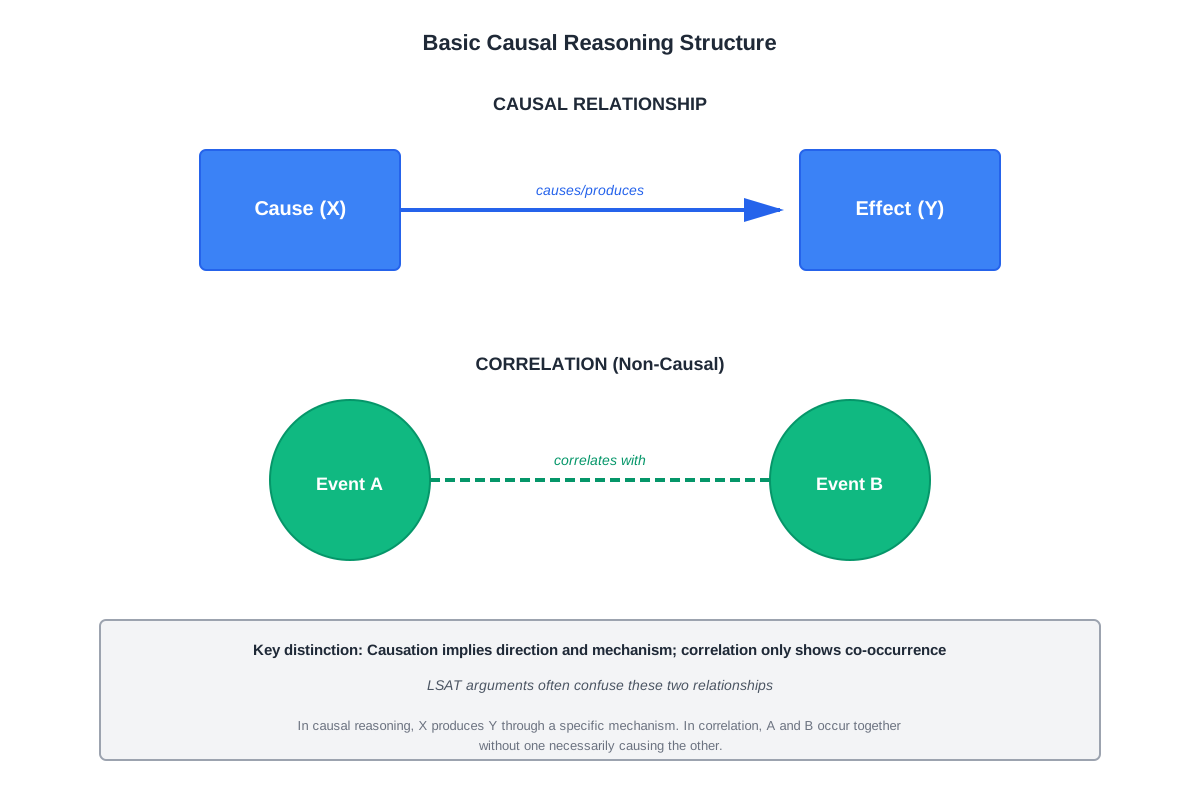
A causal reasoning argument claims that one phenomenon (the cause) brings about, produces, or is responsible for another phenomenon (the effect). The basic structure follows this pattern: "X causes Y" or "X is responsible for Y" or "X leads to Y." On the LSAT causal reasoning questions, these claims appear in various linguistic forms, but the underlying logical structure remains constant.
The cause is the independent variable—the factor claimed to produce the change. The effect is the dependent variable—the outcome or result that allegedly occurs because of the cause. For example: "Increased exercise causes improved cardiovascular health." Here, increased exercise is the cause, and improved cardiovascular health is the effect.
Causal arguments differ fundamentally from conditional statements. A conditional statement ("If X, then Y") establishes a logical relationship where X is sufficient for Y, but it does not claim that X produces or brings about Y. A causal statement claims a productive relationship where one phenomenon actually generates another. This distinction is crucial for LSAT success because test-makers frequently include answer choices that confuse these two types of reasoning.
Correlation vs. Causation
The most fundamental concept in logical reasoning involving causation is the distinction between correlation and causation. Correlation means that two phenomena occur together or vary together—when one increases, the other increases (positive correlation) or decreases (negative correlation). Causation means that one phenomenon actually produces or brings about the other.
The LSAT repeatedly tests whether students can recognize that correlation alone does not establish causation. Three scenarios can produce correlation without causation:
- Coincidence: The two phenomena happen to occur together by chance, with no causal relationship
- Common cause: A third factor causes both observed phenomena
- Reverse causation: The effect actually causes what was identified as the cause, not vice versa
For example, ice cream sales and drowning deaths are positively correlated—both increase during summer months. However, ice cream consumption does not cause drowning. Instead, warm weather (a common cause) leads to both increased ice cream purchases and more swimming, which increases drowning incidents.
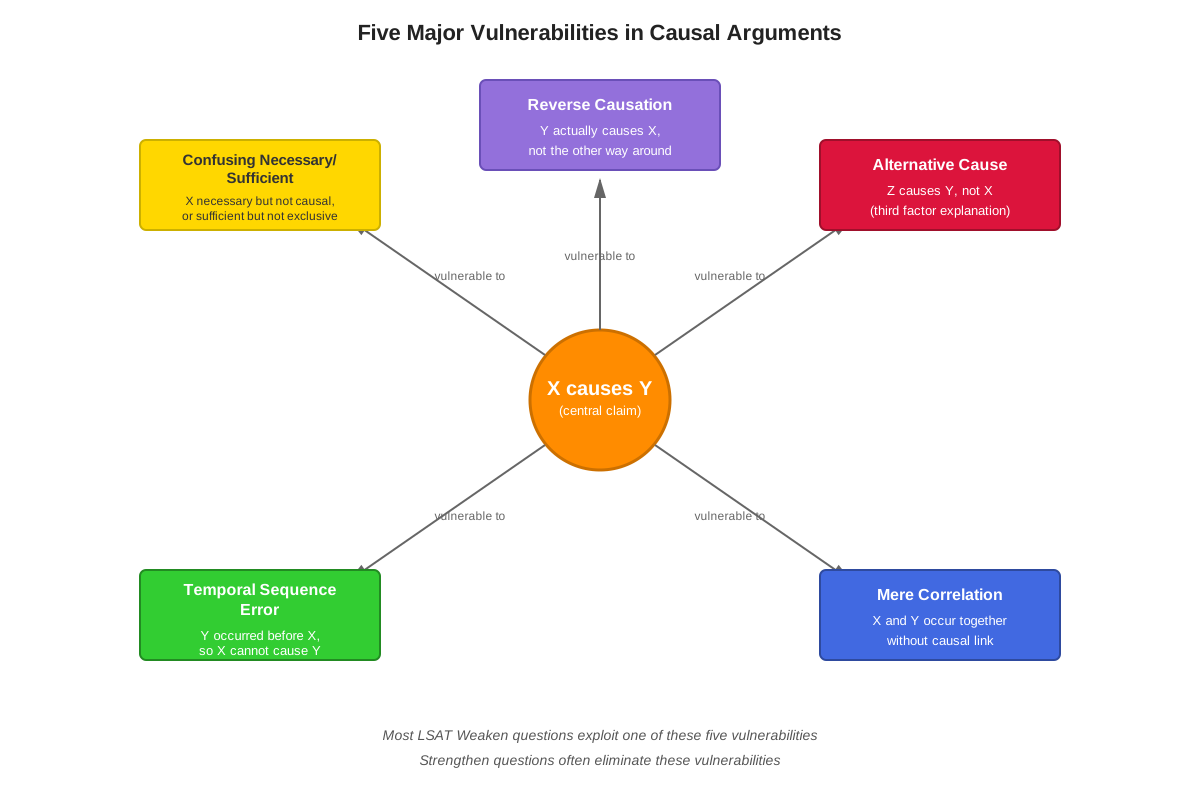
The Five Major Vulnerabilities in Causal Arguments
LSAT causal reasoning questions exploit five predictable vulnerabilities that appear repeatedly across question types:
| Vulnerability | Description | Example |
|---|---|---|
| Alternative Cause | Another factor could produce the observed effect | Argument claims fertilizer caused plant growth, but increased sunlight might be responsible |
| Reverse Causation | The supposed effect actually causes what was identified as the cause | Argument claims happiness causes success, but success might cause happiness |
| Correlation Without Causation | The argument mistakes mere correlation for a causal relationship | Argument claims coffee causes heart disease based only on correlation data |
| Causal Chain Interruption | An intermediate step in the causal chain might not occur | Argument claims policy X will cause outcome Z, but assumes intermediate step Y will occur |
| Confounding Variable | A third factor causes both the supposed cause and effect | Argument claims education causes income, but intelligence might cause both |
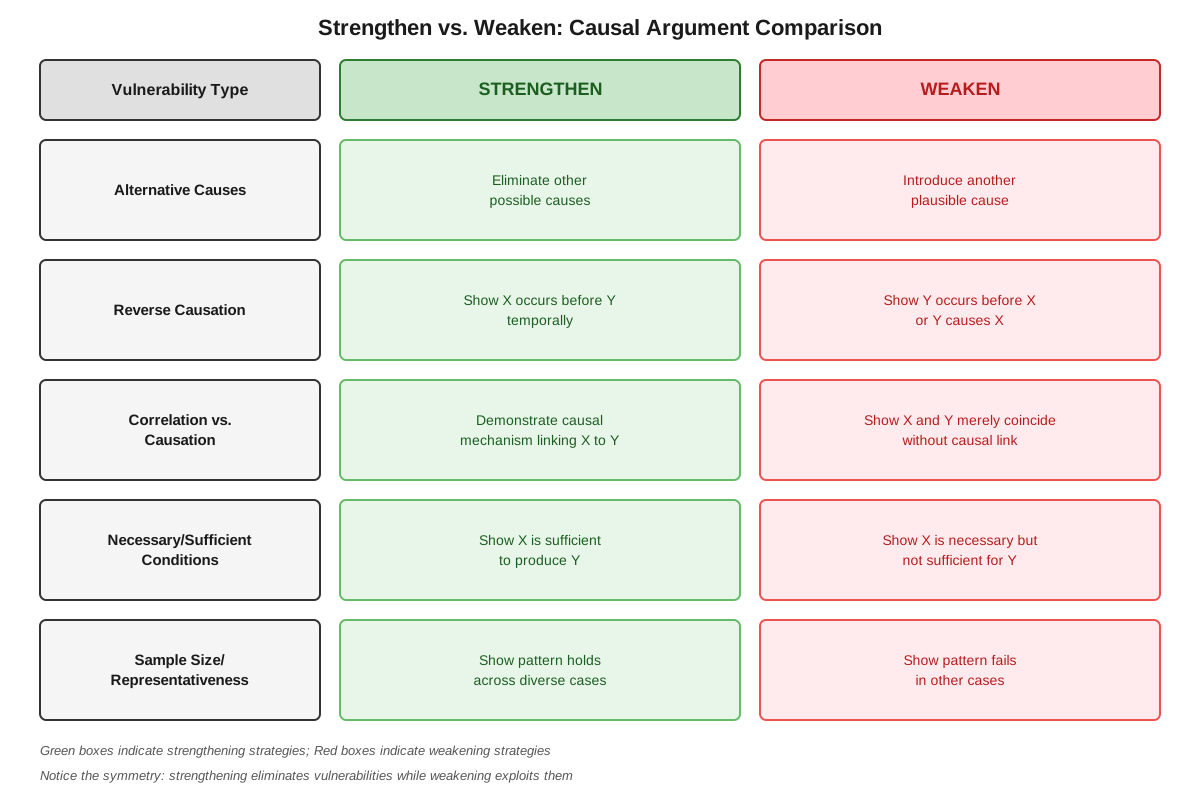
Understanding these five vulnerabilities enables students to predict how answer choices will attack or support causal arguments. Weaken questions typically introduce alternative causes or break causal chains. Strengthen questions eliminate alternative explanations or provide evidence of the causal mechanism. Assumption questions identify what must be true for the causal claim to hold (often that no alternative cause exists).
Causal Indicators and Language Patterns
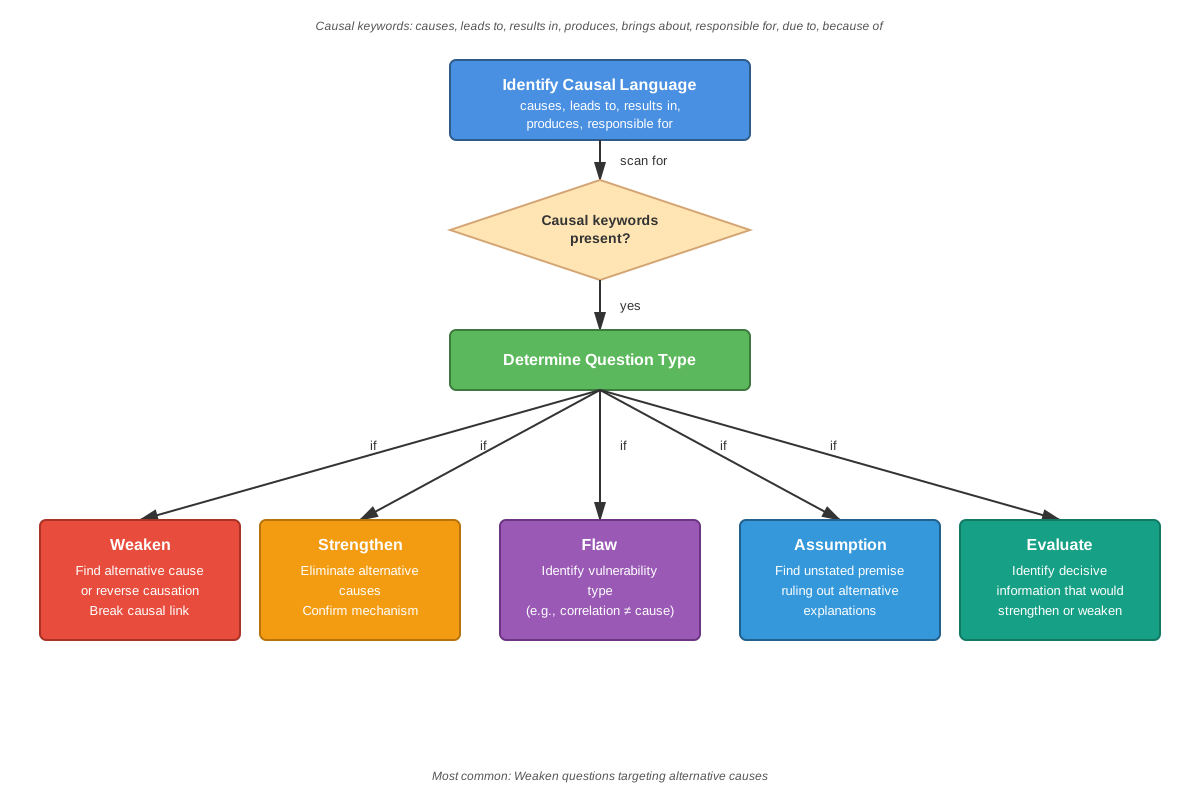
The LSAT uses specific language patterns to signal causal claims. Recognizing these argument fundamentals triggers allows students to immediately identify causal reasoning and activate the appropriate analytical framework:
Direct causal language:
- "X causes Y"
- "X produces Y"
- "X brings about Y"
- "X is responsible for Y"
- "X generates Y"
- "X creates Y"
Indirect causal language:
- "X leads to Y"
- "X results in Y"
- "X contributes to Y"
- "Because of X, Y occurred"
- "X explains Y"
- "Due to X, Y happened"
Causal language in policy contexts:
- "X will increase/decrease Y"
- "To achieve Y, we must do X"
- "X is effective at producing Y"
- "X prevents Y"
Evidence Types in Causal Arguments
Causal arguments on the LSAT typically rely on several types of evidence, each with characteristic strengths and weaknesses:
- Temporal correlation: Evidence that X and Y occur together or that X precedes Y. This is the weakest form of causal evidence because correlation does not establish causation.
- Controlled experiments: Evidence from studies where one group receives the supposed cause while a control group does not. This is stronger evidence because it can rule out some alternative explanations.
- Mechanism explanation: Evidence describing how X produces Y through intermediate steps. This strengthens causal claims by showing the causal pathway.
- Dose-response relationship: Evidence that increasing X leads to proportional increases in Y. This pattern supports causation more strongly than simple correlation.
- Elimination of alternatives: Evidence ruling out other potential causes. This strengthens causal arguments by addressing the alternative cause vulnerability.
Necessary vs. Sufficient Causes
The LSAT occasionally tests the distinction between necessary and sufficient causes, concepts that bridge causal and conditional reasoning:
A sufficient cause is one that, by itself, can produce the effect. If X is a sufficient cause of Y, then whenever X occurs, Y will occur. However, Y might also occur without X (through other causes).
A necessary cause is one that must be present for the effect to occur. If X is a necessary cause of Y, then Y cannot occur without X. However, X alone might not be enough to produce Y (other factors might also be required).
For example, oxygen is necessary for fire but not sufficient (fuel and heat are also required). Striking a match in the presence of oxygen and fuel is sufficient to cause fire, but not necessary (fire can start other ways).
Concept Relationships
The concepts within causal reasoning form an interconnected logical framework. The basic causal structure (X causes Y) serves as the foundation upon which all other concepts build. Understanding this structure enables recognition of causal language patterns, which serve as triggers for identifying causal arguments in LSAT passages.
Once a causal argument is identified, the correlation vs. causation distinction becomes immediately relevant. This distinction leads directly to understanding the five major vulnerabilities, as each vulnerability represents a specific way that correlation might exist without causation (alternative cause, reverse causation) or that a causal claim might fail (interrupted causal chain, confounding variable).
The relationship map flows as follows:
Causal Structure Recognition → Language Pattern Identification → Correlation/Causation Analysis → Vulnerability Assessment → Answer Choice Prediction
This framework connects to prerequisite topics in several ways. Basic argument structure provides the foundation for identifying causal claims as a specific type of conclusion. Conditional logic contrasts with causal reasoning, helping students avoid confusing sufficient/necessary conditions with causal mechanisms. Evidence evaluation skills apply directly to assessing whether the evidence provided actually supports the causal conclusion.
Causal reasoning also connects forward to more advanced topics. Understanding causal vulnerabilities is essential for assumption questions (the argument assumes no alternative cause exists) and strengthen/weaken questions (answers that eliminate or introduce alternative causes). The concept of necessary vs. sufficient causes bridges to conditional reasoning and helps students understand complex arguments involving multiple causal factors.
Quick check — test yourself on Causal reasoning so far.
Try Flashcards →High-Yield Facts
⭐ Correlation does not establish causation—the most frequently tested principle in LSAT causal reasoning questions.
⭐ Alternative causes are the most common way to weaken causal arguments on the LSAT, appearing in approximately 60% of Weaken questions involving causation.
⭐ Temporal sequence (X before Y) is necessary but not sufficient for causation—the cause must precede the effect, but precedence alone does not prove causation.
⭐ Eliminating alternative explanations strengthens causal arguments—answer choices that rule out other potential causes make the proposed causal relationship more likely.
⭐ Reverse causation is a distinct vulnerability from alternative causation—the supposed effect might actually cause what was identified as the cause.
- Causal arguments assume no confounding variables exist that cause both the supposed cause and effect.
- Controlled experiments provide stronger evidence for causation than observational correlations because they can rule out some alternative explanations.
- Causal chains can be broken at any intermediate step—if the argument claims X causes Y which causes Z, showing that Y does not cause Z defeats the argument.
- Necessary causes must be present for the effect to occur, while sufficient causes guarantee the effect will occur.
- The phrase "contributes to" indicates partial causation, suggesting the factor is one of multiple causes rather than the sole cause.
- Causal language in policy arguments ("this policy will reduce crime") makes predictions about future causal relationships, which are vulnerable to challenges about whether the causal mechanism will actually operate as claimed.
- Statistical correlation strength does not determine causal relationship validity—even perfect correlation might reflect coincidence or common cause rather than causation.
Common Misconceptions
Misconception: If X always occurs before Y, then X causes Y.
Correction: Temporal precedence is necessary for causation but not sufficient. Night always precedes day, but night does not cause day. The LSAT frequently includes answer choices that assume temporal sequence proves causation.
Misconception: Strong correlation proves causation.
Correction: Even perfect correlation (1.0 correlation coefficient) does not establish causation. The correlation might result from coincidence, common cause, or reverse causation. The LSAT tests this distinction repeatedly, particularly in questions involving statistical studies.
Misconception: Eliminating one alternative cause proves the proposed cause is correct.
Correction: Eliminating one alternative explanation strengthens the argument but does not prove causation because other alternative causes might exist. The LSAT includes trap answers that eliminate one alternative while leaving others unaddressed.
Misconception: If X is necessary for Y, then X causes Y.
Correction: Necessary conditions are not the same as causes. Oxygen is necessary for fire but does not cause fire by itself. The LSAT exploits confusion between conditional relationships (necessary/sufficient) and causal relationships.
Misconception: Causal arguments can be proven true with certainty.
Correction: Causal arguments on the LSAT are inductive, not deductive—they can be made stronger or weaker but rarely proven with certainty. Students who look for answer choices that "prove" causation often miss correct answers that merely strengthen the causal claim.
Misconception: If the cause is absent and the effect does not occur, this proves causation.
Correction: This pattern shows the factor might be necessary but does not prove it is the cause. Multiple necessary conditions might exist, and the factor might be necessary without being causal (correlation with a common cause could produce this pattern).
Misconception: Complex causal arguments with multiple steps are stronger than simple causal claims.
Correction: Causal chains are actually more vulnerable because they can be broken at any link. The more intermediate steps an argument requires, the more opportunities exist for the causal chain to fail.
Worked Examples
Example 1: Identifying and Analyzing a Causal Argument
Passage: "Studies show that countries with higher chocolate consumption have more Nobel Prize winners per capita. Therefore, eating chocolate improves cognitive function, leading to greater intellectual achievement."
Question: Which of the following, if true, most weakens the argument?
Analysis:
Step 1: Identify the causal claim. The argument concludes that chocolate consumption causes improved cognitive function, which causes intellectual achievement (measured by Nobel Prizes). This is a causal chain: chocolate → cognitive function → Nobel Prizes.
Step 2: Recognize the evidence type. The evidence is correlation—countries with more chocolate consumption have more Nobel Prize winners. This is observational data, not experimental evidence.
Step 3: Identify vulnerabilities. The argument is vulnerable to:
- Alternative causes (something else might cause both chocolate consumption and Nobel Prizes)
- Reverse causation (Nobel Prize winners might celebrate by eating chocolate)
- Confounding variables (wealth might cause both chocolate consumption and better education systems that produce Nobel laureates)
Step 4: Predict answer choices. Correct answers will likely:
- Introduce an alternative cause
- Suggest reverse causation
- Identify a confounding variable
- Show the causal chain is broken (chocolate does not actually improve cognitive function)
Step 5: Evaluate options. The strongest weakener would be: "Wealthier countries both consume more chocolate and invest more heavily in education and research institutions that produce Nobel Prize winners." This introduces a confounding variable (wealth) that causes both the supposed cause and effect, explaining the correlation without requiring a causal relationship between chocolate and cognitive achievement.
Connection to learning objectives: This example demonstrates how to identify causal reasoning (objective 1), explains the reasoning pattern of inferring causation from correlation (objective 2), and shows how to apply this understanding to predict and evaluate answer choices (objective 3).
Example 2: Strengthening a Causal Argument
Passage: "After the city implemented a new traffic light timing system, traffic accidents at major intersections decreased by 30%. The new timing system has proven effective at reducing accidents."
Question: Which of the following, if true, most strengthens the argument?
Analysis:
Step 1: Identify the causal claim. The argument concludes that the new traffic light timing system caused the reduction in accidents. Cause: new timing system. Effect: 30% decrease in accidents.
Step 2: Assess the evidence. The evidence is temporal correlation—the decrease occurred after the implementation. This is weak evidence because it does not rule out alternative explanations.
Step 3: Identify what would strengthen the argument. Strong answers will:
- Eliminate alternative causes
- Provide evidence of the causal mechanism
- Show the effect does not occur without the cause
- Demonstrate a dose-response relationship
Step 4: Consider alternative explanations that need to be ruled out:
- Weather conditions might have improved
- Traffic volume might have decreased
- A new law with stricter penalties might have been enacted
- Better road maintenance might have occurred
- Driver education campaigns might have been implemented
Step 5: Evaluate potential strengtheners. The strongest answer would eliminate the most plausible alternatives: "Traffic volume, weather conditions, and traffic laws remained constant during the period, and no other changes to traffic management were implemented." This answer eliminates multiple alternative causes, making the proposed causal relationship more likely.
A moderately strong answer might be: "Intersections with the new timing system showed decreased accidents, while intersections without the new system showed no change in accident rates." This provides comparative evidence suggesting the timing system specifically caused the decrease.
Connection to learning objectives: This example shows how to recognize causal reasoning in policy contexts (objective 1), explains how temporal correlation alone provides weak evidence for causation (objective 2), and demonstrates how to predict which answer choices will strengthen causal arguments by eliminating alternatives (objective 3 and extended objective 6).
Exam Strategy
Recognition Phase
When approaching any Logical Reasoning question, immediately scan for causal language indicators: "causes," "leads to," "results in," "produces," "is responsible for," "explains," or "because of." These triggers signal that causal reasoning is central to the argument. Also watch for policy language like "will increase," "will reduce," or "is effective at," which implies causal predictions.
Once causal reasoning is identified, immediately ask three questions:
- What is claimed to be the cause?
- What is claimed to be the effect?
- What evidence supports this causal claim?
Analysis Phase
Determine whether the evidence is correlation, controlled experiment, mechanism explanation, or another type. Correlational evidence is weak and vulnerable to all five major vulnerabilities. Experimental evidence is stronger but still vulnerable to alternative explanations if the experiment was not properly controlled.
Systematically consider each of the five vulnerabilities:
- Could an alternative cause produce this effect?
- Could reverse causation explain the correlation?
- Is this mere correlation without causation?
- Could the causal chain be interrupted?
- Could a confounding variable cause both phenomena?
Question-Type Specific Strategies
For Weaken questions: The correct answer will typically introduce an alternative cause (most common), suggest reverse causation, identify a confounding variable, or show the causal mechanism does not operate as claimed. Eliminate answers that are irrelevant to the causal relationship or that address different aspects of the argument.
For Strengthen questions: The correct answer will eliminate alternative causes, provide evidence of the causal mechanism, show dose-response relationships, or demonstrate that the effect does not occur without the cause. Avoid answers that merely restate the conclusion or provide additional correlation without addressing causation.
For Assumption questions: The correct answer will typically state that no alternative cause exists, that the causal mechanism operates as claimed, or that no confounding variable is present. Use the negation test: if negating the answer choice destroys the argument, it is a necessary assumption.
For Flaw questions: Look for answer choices describing the correlation/causation error, failure to consider alternative explanations, or assuming a causal relationship without adequate evidence.
Time Management
Causal reasoning questions typically require 60-90 seconds. Spend 20-30 seconds identifying the causal claim and evidence type, 20-30 seconds considering vulnerabilities and predicting answer choices, and 20-30 seconds evaluating options. If a question takes longer than 90 seconds, flag it and return later—causal reasoning questions are predictable enough that spending excessive time rarely improves accuracy.
Process of Elimination
Eliminate answer choices that:
- Address non-causal aspects of the argument
- Introduce irrelevant information
- Confuse correlation with causation (in Strengthen questions)
- Fail to address the specific causal claim made
- Strengthen when they should weaken, or vice versa
Memory Techniques
The CARC Mnemonic for Vulnerabilities
Remember the four most common vulnerabilities with CARC:
- Confounding variable (common cause)
- Alternative cause
- Reverse causation
- Correlation without causation
The "Before, Together, Because" Framework
To evaluate causal claims, remember three questions:
- Before: Does the cause precede the effect? (necessary but not sufficient)
- Together: Do the cause and effect occur together? (correlation)
- Because: Is there evidence that one produces the other? (causation)
Only when all three are satisfied with adequate evidence should a causal claim be accepted.
Visualization Strategy
Picture causal arguments as arrows: X → Y. When evaluating the argument, visualize alternative arrows pointing at Y (alternative causes), a reverse arrow Y → X (reverse causation), or a third factor Z with arrows to both X and Y (confounding variable). This visual representation helps identify vulnerabilities quickly.
The "Chocolate and Nobel Prizes" Anchor
Remember the chocolate/Nobel Prize example as an anchor for correlation without causation. Whenever an argument presents correlation as evidence for causation, recall this absurd example to remind yourself that correlation alone proves nothing about causation.
Summary
Causal reasoning represents one of the highest-yield topics for LSAT Logical Reasoning preparation, appearing in 15-20% of questions across multiple question types. The fundamental principle is that correlation does not establish causation—arguments claiming one phenomenon causes another must provide evidence beyond mere temporal sequence or co-occurrence. The LSAT exploits five predictable vulnerabilities in causal arguments: alternative causes, reverse causation, correlation without causation, interrupted causal chains, and confounding variables. Success on causal reasoning questions requires recognizing causal language patterns, identifying the specific causal claim and evidence type, systematically considering vulnerabilities, and predicting how answer choices will strengthen or weaken the argument. Weaken questions typically introduce alternative explanations, while Strengthen questions eliminate them. Understanding these patterns enables students to approach causal reasoning questions with confidence and accuracy, as the logical structure remains consistent even when the content varies across scientific, policy, business, and social contexts.
Key Takeaways
- Correlation never proves causation—temporal sequence and co-occurrence are necessary but not sufficient evidence for causal relationships
- Alternative causes are the most common way to attack causal arguments on the LSAT, appearing in the majority of Weaken questions involving causation
- Five vulnerabilities appear repeatedly: alternative cause, reverse causation, correlation without causation, interrupted causal chain, and confounding variable
- Causal language triggers ("causes," "leads to," "results in," "produces") signal that causal reasoning is central to the argument structure
- Eliminating alternative explanations strengthens causal arguments more effectively than providing additional correlational evidence
- Causal chains are more vulnerable than simple causal claims because they can be broken at any intermediate step
- Controlled experiments provide stronger evidence than observational correlations, but even experimental evidence can be challenged by identifying confounding variables or alternative explanations
Related Topics
Conditional Reasoning: Understanding sufficient and necessary conditions helps distinguish between logical relationships (if X then Y) and causal relationships (X produces Y), preventing confusion between these distinct reasoning patterns.
Strengthen and Weaken Questions: Mastering causal reasoning directly enables success on these question types, as approximately 40% of Strengthen/Weaken questions involve causal arguments.
Assumption Questions: Many assumption questions require identifying what causal arguments take for granted, typically that no alternative cause exists or that the causal mechanism operates as claimed.
Flaw Questions: The correlation/causation error is one of the most common flaws tested on the LSAT, making causal reasoning essential for identifying logical errors.
Statistical Reasoning: Understanding how to interpret studies, surveys, and statistical evidence builds on causal reasoning principles, particularly the distinction between correlation and causation in research contexts.
Practice CTA
Now that you have mastered the core concepts of causal reasoning, it is time to apply this knowledge to actual LSAT questions. Complete the practice questions associated with this topic, focusing on identifying causal language, recognizing vulnerabilities, and predicting answer choices before evaluating options. Use the flashcards to reinforce recognition of causal indicators and the five major vulnerabilities. Remember that causal reasoning is one of the most predictable and learnable patterns on the LSAT—consistent practice with these concepts will translate directly into points on test day. Approach each practice question systematically using the strategies outlined in this guide, and you will develop the pattern recognition and analytical skills necessary for excellence on causal reasoning questions.
Sign up free to keep reading
Create a free AnvayaPrep account to finish this LSAT guide on Causal reasoning — plus flashcards and practice questions.