Overview
Competing explanations represent a critical reasoning pattern tested extensively on the LSAT Logical Reasoning section. This concept involves situations where multiple plausible theories or hypotheses could account for the same set of observed facts or phenomena. On the LSAT, test-makers frequently present scenarios where one explanation is offered for a particular outcome, and students must evaluate alternative explanations, strengthen or weaken one explanation relative to another, or identify which piece of evidence would help distinguish between rival theories.
Understanding competing explanations is essential for LSAT success because approximately 15-20% of Logical Reasoning questions involve causation and explanation patterns, with competing explanations forming a substantial subset. These questions test the ability to think critically about evidence, recognize that correlation does not necessarily imply causation, and evaluate the relative strength of different causal or explanatory hypotheses. Mastery of this topic directly improves performance on Strengthen, Weaken, Assumption, Evaluate, and Flaw question types—collectively representing nearly half of all Logical Reasoning questions.
Within the broader landscape of LSAT Logical Reasoning, competing explanations sits at the intersection of causal reasoning, evidence evaluation, and argument structure analysis. This topic builds upon foundational skills in identifying conclusions and premises while requiring more sophisticated analysis of how evidence supports or undermines different interpretive frameworks. Students who master competing explanations develop the analytical flexibility to see multiple perspectives on data—a skill that distinguishes top LSAT performers from average test-takers.
Learning Objectives
- [ ] Identify how competing explanations appears in LSAT questions
- [ ] Explain the reasoning pattern behind competing explanations
- [ ] Apply competing explanations to solve LSAT-style problems accurately
- [ ] Distinguish between evidence that supports one explanation over another
- [ ] Recognize when an argument fails to consider alternative explanations
- [ ] Evaluate which additional information would help adjudicate between rival explanations
- [ ] Construct and deconstruct arguments involving multiple causal hypotheses
Prerequisites
- Basic argument structure: Understanding premises, conclusions, and how evidence supports claims is fundamental to recognizing when multiple explanations compete for the same evidence base.
- Causation vs. correlation: Distinguishing between mere association and causal relationships is essential because competing explanations often arise when correlation is mistaken for causation.
- Conditional reasoning: Many competing explanation scenarios involve understanding sufficient and necessary conditions, as different explanations may propose different causal pathways.
- Strengthen and Weaken question types: Familiarity with how evidence can support or undermine arguments provides the foundation for evaluating competing theories.
Why This Topic Matters
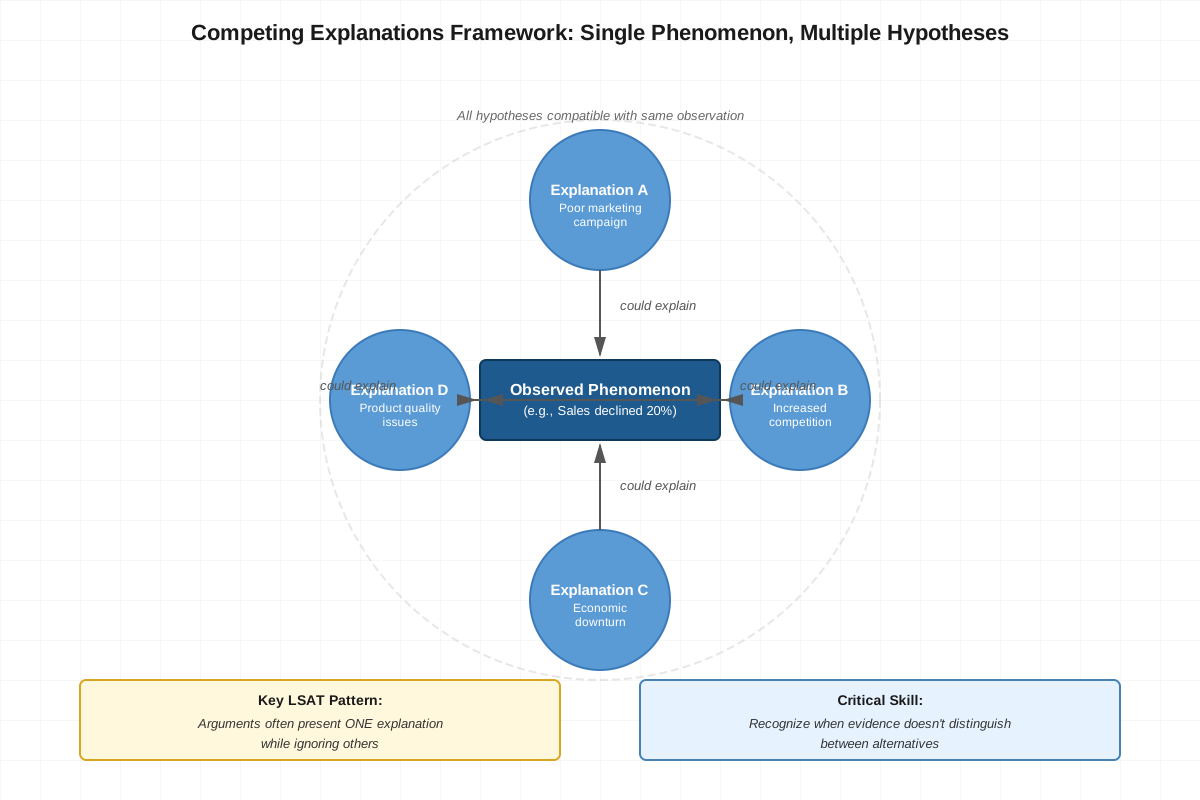
In real-world contexts, competing explanations are ubiquitous in scientific research, legal reasoning, medical diagnosis, business analysis, and policy debates. When a company's sales decline, is it due to poor marketing, increased competition, economic downturn, or product quality issues? Medical professionals constantly evaluate competing diagnoses for the same symptoms. Legal professionals must consider alternative theories of a case. The LSAT tests this reasoning pattern because it reflects the analytical thinking required in law school and legal practice.
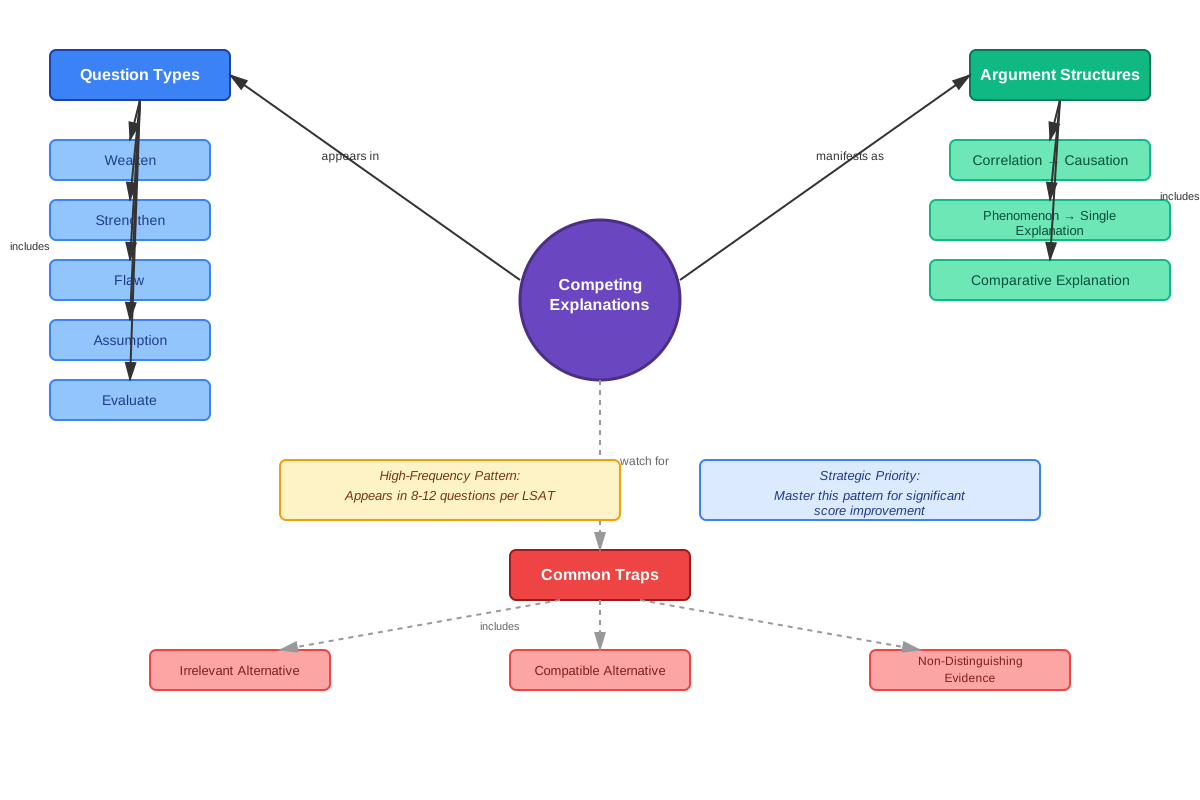
On the LSAT, competing explanations appears in approximately 8-12 questions per test across both Logical Reasoning sections. This topic most commonly manifests in:
- Weaken questions asking which answer choice presents an alternative explanation that undermines the argument's conclusion
- Strengthen questions requiring identification of evidence that rules out competing explanations
- Flaw questions where the correct answer identifies the failure to consider alternative explanations
- Evaluate questions asking what information would help determine which of two explanations is correct
- Assumption questions where the argument assumes no alternative explanation exists
The LSAT particularly favors scenarios involving scientific studies, business outcomes, historical events, and social phenomena where multiple causal factors could plausibly explain observed results. Questions often present correlation data and ask students to evaluate competing causal interpretations.
Core Concepts
The Structure of Competing Explanations
Competing explanations arise when a set of observed facts, data, or phenomena could be accounted for by two or more different theories, hypotheses, or causal mechanisms. The fundamental structure involves:
- Observable phenomenon or data: A fact pattern that requires explanation (e.g., "Sales increased by 30% last quarter")
- Explanation A: One proposed account of why the phenomenon occurred (e.g., "The new advertising campaign caused the sales increase")
- Explanation B (or C, D, etc.): Alternative account(s) of the same phenomenon (e.g., "A competitor went out of business" or "The economy improved")
The key insight is that the same evidence can be consistent with multiple explanations. Strong reasoning requires considering which explanation best accounts for all available evidence, not just some of it.
Types of Competing Explanations
Causal vs. Non-Causal Explanations: One explanation may propose a causal relationship while another suggests the correlation is coincidental or due to a third factor. For example, if ice cream sales and drowning deaths both increase in summer, one might incorrectly infer causation when both are actually caused by warm weather.
Alternative Causal Pathways: Multiple explanations may all be causal but propose different mechanisms. If students perform better after a new teaching method is introduced, competing explanations might include: (1) the method itself is more effective, (2) teachers are more enthusiastic about the new approach, (3) students selected for the program were already more motivated, or (4) the Hawthorne effect (people perform better when being observed).
Reverse Causation: Sometimes the proposed cause and effect are correctly identified but the causal direction is reversed. If researchers observe that people who drink coffee have higher stress levels, one explanation is that coffee causes stress, but a competing explanation is that stressed people seek out coffee.
Evidence Evaluation in Competing Explanations
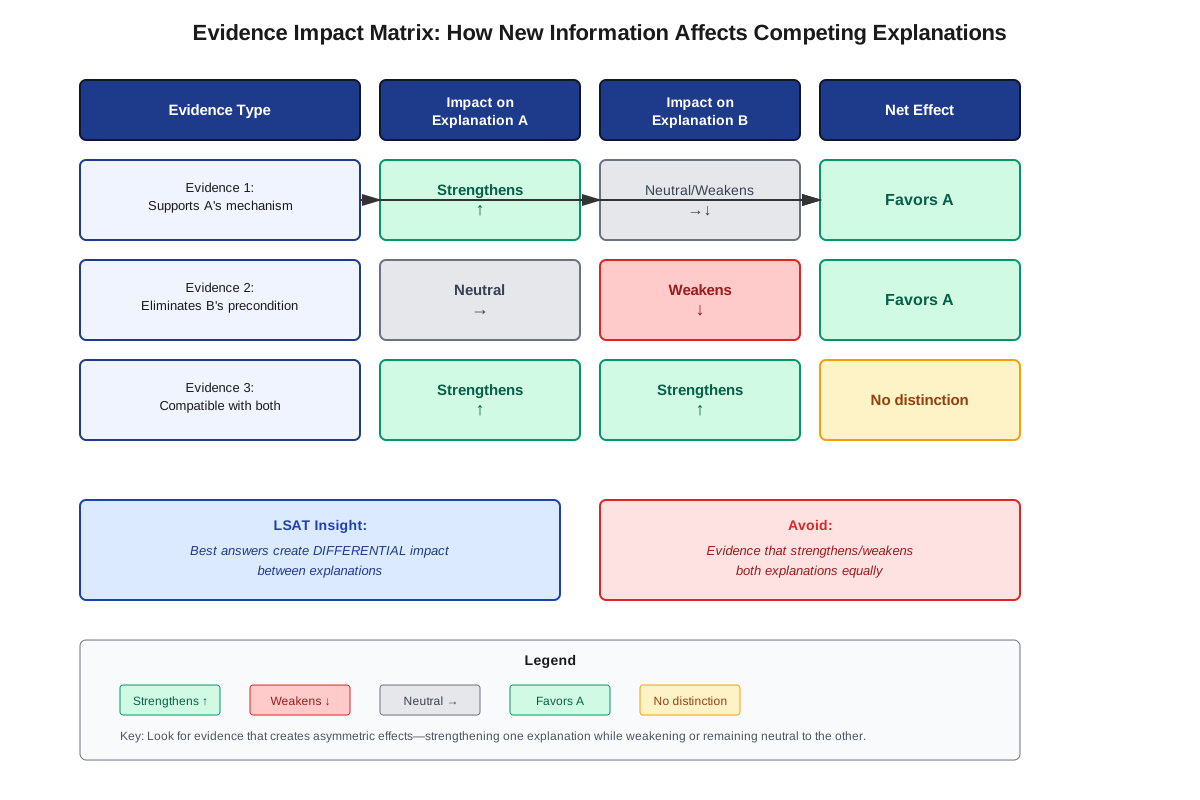
| Evidence Type | Effect on Competing Explanations |
|---|---|
| Discriminating evidence | Supports one explanation while being inconsistent with others |
| Consistent evidence | Compatible with multiple explanations; doesn't help distinguish |
| Ruling-out evidence | Eliminates one or more explanations from consideration |
| Mechanism evidence | Shows how a proposed causal pathway actually operates |
The strongest arguments acknowledge competing explanations and provide evidence that specifically rules them out or shows why one explanation is superior. Weak arguments ignore alternative possibilities entirely.
The Role of Background Assumptions
Arguments involving competing explanations often rely on unstated assumptions that no alternative explanation exists or that certain factors remained constant. For instance, if an argument claims a new drug reduced symptoms because patients improved after taking it, the argument assumes:
- No other treatments were administered simultaneously
- The condition doesn't naturally improve over time
- The placebo effect isn't responsible
- Patients didn't change other relevant behaviors
Identifying these assumptions is crucial for LSAT questions asking what the argument takes for granted or what would weaken the reasoning.
Common Patterns in LSAT Competing Explanations
The Overlooked Alternative: The argument presents one explanation confidently while completely ignoring an equally or more plausible alternative. The correct answer often points out this oversight.
The Confounding Variable: A third factor causes both the proposed cause and effect, creating a spurious correlation. For example, if wealthy neighborhoods have both more bookstores and higher test scores, the argument might incorrectly conclude bookstores cause higher scores when wealth is the actual common cause.
The Temporal Fallacy: Just because B followed A doesn't mean A caused B (post hoc ergo propter hoc). Competing explanations questions often exploit this by presenting temporal sequence as if it establishes causation.
The Incomplete Evidence Pattern: The argument cites evidence consistent with its explanation but fails to consider that the same evidence is equally consistent with alternative explanations. Strong reasoning requires evidence that discriminates between possibilities.
Concept Relationships
The concept of competing explanations builds directly on understanding causation and correlation. Before evaluating competing explanations, one must recognize when a causal claim is being made and whether the evidence actually supports causation rather than mere association. This foundational distinction enables the more sophisticated analysis of which among several possible causal accounts best fits the evidence.
Within the topic itself, the relationships flow as follows:
Observable Phenomenon → Multiple Possible Explanations → Evidence Evaluation → Determination of Best Explanation
The structure of competing explanations connects to evidence evaluation, which in turn determines how we assess argument strength. When an argument fails to consider alternative explanations, this represents a specific type of logical flaw. When an argument successfully rules out alternatives, this strengthens the conclusion. When we need to determine which explanation is correct, we look for discriminating evidence.
Competing explanations also relates closely to necessary and sufficient conditions. An explanation that identifies a sufficient condition for an outcome may still face competition from other sufficient conditions. Only by establishing a necessary condition (or ruling out alternatives) can an argument conclusively establish its explanation.
The concept extends to assumption questions because arguments about causation typically assume no better alternative explanation exists. It connects to inference questions when we must determine what follows if one explanation is correct rather than another. The web of relationships makes competing explanations a central organizing principle for much of LSAT Logical Reasoning.
High-Yield Facts
⭐ Most LSAT arguments presenting a single explanation for a phenomenon are vulnerable to alternative explanations that the argument fails to consider.
⭐ Evidence that is consistent with an explanation does not prove that explanation if the same evidence is equally consistent with competing explanations.
⭐ The correct answer in Weaken questions often introduces a plausible alternative explanation that accounts for the observed phenomenon without relying on the argument's causal claim.
⭐ Strengthen questions frequently require selecting evidence that rules out the most obvious competing explanation, thereby making the argument's explanation more likely.
⭐ Temporal sequence (A happened before B) does not establish causation; competing explanations often involve coincidence, common cause, or reverse causation.
- Arguments that cite correlation or association as evidence for causation are particularly vulnerable to competing explanation challenges.
- The phrase "alternative explanation" or "other factors" in answer choices often signals the correct response in Flaw and Weaken questions.
- Controlled experiments are designed specifically to rule out competing explanations by holding other variables constant.
⭐ When evaluating competing explanations, look for evidence that is consistent with one explanation but inconsistent with others—this discriminating evidence is most valuable.
- Self-selection bias represents a common competing explanation when groups are compared without random assignment.
- The placebo effect and natural recovery are frequent competing explanations in medical or treatment-related arguments.
- Economic, seasonal, and demographic factors often provide competing explanations for observed trends or changes.
Quick check — test yourself on Competing explanations so far.
Try Flashcards →Common Misconceptions
Misconception: If evidence supports an explanation, that explanation must be correct.
Correction: Evidence can be consistent with multiple explanations simultaneously. Supporting evidence makes an explanation possible or plausible, but doesn't prove it's correct unless competing explanations are ruled out. The LSAT frequently tests whether students recognize that consistent evidence isn't conclusive evidence.
Misconception: The argument must explicitly mention alternative explanations for them to be relevant.
Correction: An argument's failure to consider alternative explanations is itself a logical weakness, even if those alternatives aren't mentioned in the stimulus. Many correct answers in Weaken and Flaw questions introduce alternatives the argument overlooked.
Misconception: More complex explanations are generally better than simpler ones.
Correction: While the LSAT doesn't explicitly test Occam's Razor, unnecessarily complex explanations that require multiple assumptions are typically weaker than simpler explanations that account for the same evidence. However, complexity alone doesn't determine correctness—evidence does.
Misconception: If one explanation is weakened, the competing explanation is automatically strengthened.
Correction: Multiple explanations can all be weak, or all be partially correct. Weakening explanation A doesn't necessarily strengthen explanation B unless they are mutually exclusive and exhaustive. The LSAT tests whether students recognize that ruling out one possibility doesn't automatically establish another.
Misconception: The explanation mentioned first or most prominently in the argument is always the one being questioned.
Correction: Sometimes the argument dismisses an alternative explanation, and the question asks you to strengthen that dismissed alternative. Always identify exactly what conclusion the argument reaches before evaluating answer choices.
Misconception: Statistical correlation of any strength suggests some causal relationship.
Correction: Even strong correlations can result from coincidence, common causes, or reverse causation. The strength of correlation doesn't determine whether a causal relationship exists—only whether variables move together.
Worked Examples
Example 1: Weaken Question with Competing Explanations
Stimulus: "A recent study found that employees who work from home are 15% more productive than those who work in the office. Clearly, the flexibility and comfort of the home environment cause increased productivity. Companies should therefore allow more employees to work remotely to boost overall productivity."
Question: Which of the following, if true, most weakens the argument?
Analysis Process:
- Identify the conclusion: Remote work causes increased productivity; companies should allow more remote work.
- Identify the evidence: Study showing 15% higher productivity among remote workers.
- Identify the causal claim: The home environment itself causes the productivity increase.
- Consider competing explanations:
- Self-selection: Maybe more productive employees request remote work
- Job type: Perhaps jobs suitable for remote work are inherently different
- Reverse causation: Maybe productive employees are rewarded with remote work privileges
- Confounding variables: Perhaps remote workers have different characteristics
- Evaluate answer choices (hypothetical):
(A) "Employees who work from home report higher job satisfaction."
- This is consistent with the argument but doesn't weaken it; it might even strengthen it.
(B) "The study only included employees who specifically requested to work from home."
- CORRECT: This introduces self-selection as a competing explanation. If only employees who requested remote work were studied, they might be more motivated or better suited to independent work. The productivity difference might be due to employee characteristics rather than the work environment itself.
(C) "Some companies have reported difficulties managing remote workers."
- This is about implementation challenges, not about whether remote work causes productivity increases.
(D) "Office environments can be redesigned to be more comfortable."
- This suggests a possible solution but doesn't address whether the home environment causes the observed productivity difference.
(E) "Remote workers spend less time commuting."
- This might explain why remote work is beneficial but doesn't provide a competing explanation for the productivity difference.
Key Takeaway: The correct answer introduces a competing explanation (self-selection) that accounts for the observed correlation without accepting the argument's causal claim. This is a classic LSAT pattern.
Example 2: Strengthen by Ruling Out Alternatives
Stimulus: "Archaeological evidence shows that the ancient city of Petra experienced a sudden population decline around 363 CE. Historical records indicate a major earthquake struck the region that year. Therefore, the earthquake caused the population decline."
Question: Which of the following, if true, most strengthens the argument?
Analysis Process:
- Identify the conclusion: The earthquake caused Petra's population decline.
- Identify the evidence: Population decline and earthquake occurred in the same year.
- Recognize the reasoning gap: Temporal coincidence doesn't prove causation.
- Generate competing explanations:
- Economic factors (trade route changes)
- Political instability or conquest
- Disease or famine
- Climate change or drought
- The earthquake might have occurred but been minor
- Determine what would strengthen: Evidence that rules out competing explanations or shows the earthquake was severe enough to cause abandonment.
- Evaluate answer choices (hypothetical):
(A) "Other cities in the region also experienced population declines during this period."
- This actually weakens the argument by suggesting a regional cause rather than the specific earthquake.
(B) "Petra's economy had been declining for decades before 363 CE."
- This introduces a competing explanation (economic decline) rather than strengthening the earthquake explanation.
(C) "Archaeological evidence shows extensive earthquake damage to Petra's water infrastructure, and no evidence of population decline in the region's other cities."
- CORRECT: This both demonstrates the earthquake's severity and specific impact on Petra's livability (water infrastructure) AND rules out regional factors by showing other cities didn't experience decline. This eliminates competing explanations while supporting the mechanism by which the earthquake could cause abandonment.
(D) "Earthquakes were common in the region throughout ancient history."
- This weakens the argument by suggesting earthquakes alone don't typically cause abandonment.
(E) "Some residents of Petra moved to nearby cities after 363 CE."
- This confirms people left but doesn't establish why or rule out competing explanations.
Key Takeaway: The strongest answer both provides mechanism evidence (how the earthquake caused the effect) and rules out competing explanations (other cities weren't affected, suggesting the cause was specific to Petra).
Exam Strategy
Recognizing Competing Explanations Questions
Watch for these trigger phrases in question stems:
- "Which of the following, if true, most weakens the argument?" (often answered by alternative explanations)
- "The argument is most vulnerable to criticism on the grounds that it fails to consider..."
- "Which of the following is an assumption required by the argument?" (often: no better alternative exists)
- "Which of the following, if true, would most help to evaluate the argument?" (often: information distinguishing between explanations)
- "The reasoning in the argument is flawed in that..."
In the stimulus, look for:
- Causal language: "caused by," "resulted from," "due to," "because of," "led to"
- Correlation presented as causation: "After X, Y occurred"
- Single explanations offered confidently without acknowledging alternatives
- Studies or data followed by causal interpretations
Systematic Approach
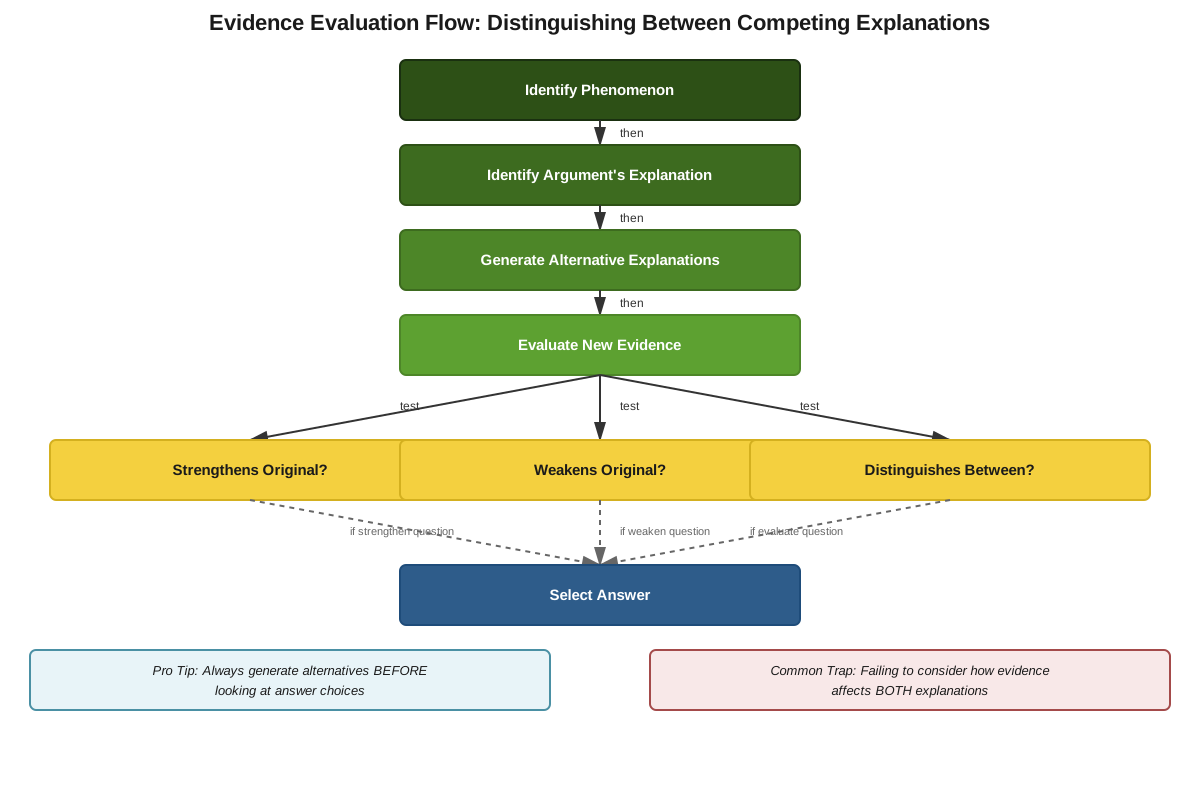
- Read the question stem first to know whether you're strengthening, weakening, or identifying flaws.
- Identify the conclusion and evidence clearly, paying special attention to causal claims.
- Actively generate 2-3 competing explanations before looking at answer choices. Ask yourself: "What else could explain these facts?"
- Evaluate each answer choice by asking:
- Does this introduce a plausible alternative explanation?
- Does this rule out an alternative explanation?
- Does this show the proposed mechanism actually operates?
- Is this actually relevant to distinguishing between explanations?
- Eliminate answers that:
- Are consistent with the argument but don't strengthen/weaken it
- Address tangential issues rather than the core causal claim
- Introduce irrelevant information
- Confuse necessary and sufficient conditions
Time Management
Competing explanations questions typically require 1:15-1:30 minutes because they demand:
- Careful identification of the causal claim
- Mental generation of alternatives
- Thoughtful evaluation of how answer choices affect the argument
Don't rush these questions—they reward systematic analysis. However, if you find yourself stuck between two answers, ask: "Which answer more directly addresses whether the proposed cause actually produced the effect?"
Exam Tip: In Weaken questions, the correct answer often introduces a competing explanation that is MORE plausible than the argument's explanation, not just equally plausible. Look for alternatives that better account for the evidence or require fewer assumptions.
Memory Techniques
RACE Acronym for Evaluating Competing Explanations:
- Recognize the causal claim being made
- Alternatives: Generate competing explanations
- Consider what evidence would discriminate between them
- Evaluate whether the argument addresses alternatives
The "What Else?" Technique: Whenever you see a causal conclusion, immediately ask "What else could explain this?" Train yourself to automatically generate alternatives:
- Reverse causation
- Common cause (confounding variable)
- Coincidence
- Self-selection
- Measurement error
Visualization Strategy: Picture a tree diagram where the trunk is the observed phenomenon and branches represent different possible explanations. Strong arguments provide evidence that prunes away alternative branches, leaving only one viable explanation.
The Correlation Mantra: "Together doesn't mean because." When you see two things occurring together, repeat this phrase to remind yourself that correlation requires additional evidence to establish causation.
Summary
Competing explanations represent a fundamental reasoning pattern on the LSAT where multiple theories could account for the same observed facts. Success requires recognizing that evidence consistent with one explanation may be equally consistent with alternatives, and that strong arguments must either rule out competing explanations or provide discriminating evidence. The LSAT tests this concept across multiple question types, most commonly in Weaken questions (where alternatives undermine arguments), Strengthen questions (where ruling out alternatives bolsters arguments), and Flaw questions (where failing to consider alternatives constitutes a logical error). Mastery involves systematically identifying causal claims, generating plausible alternatives, and evaluating which evidence would help distinguish between rival explanations. The key insight is that temporal sequence and correlation do not establish causation—only evidence that eliminates alternative explanations or demonstrates causal mechanisms can do so.
Key Takeaways
- Competing explanations arise whenever multiple theories could account for the same observed phenomenon, requiring discriminating evidence to determine which is correct.
- Evidence that is consistent with an explanation doesn't prove it unless competing explanations are ruled out—this distinction is central to LSAT Logical Reasoning.
- The most common LSAT pattern involves arguments that confidently assert one explanation while ignoring equally plausible alternatives; correct answers often identify these overlooked alternatives.
- Strengthen questions frequently require evidence that rules out competing explanations, while Weaken questions often introduce alternative explanations the argument failed to consider.
- Self-selection, reverse causation, confounding variables, and coincidence represent the most common competing explanations on the LSAT.
- Systematic analysis requires: (1) identifying the causal claim, (2) generating alternative explanations, (3) determining what evidence would discriminate between them, and (4) evaluating whether the argument or answer choices provide such evidence.
- Temporal sequence alone never establishes causation—always consider whether the correlation could result from alternative causal pathways.
Related Topics
Causation vs. Correlation: This foundational topic provides the basis for understanding why competing explanations arise and how to evaluate causal claims. Mastering competing explanations deepens understanding of when correlation does and doesn't suggest causation.
Necessary and Sufficient Conditions: Understanding these logical relationships helps evaluate whether a proposed cause is truly necessary or merely sufficient for an effect, which relates to whether alternative causes might exist.
Strengthen and Weaken Questions: These question types frequently test competing explanations, so mastering this topic directly improves performance on approximately 25-30% of all Logical Reasoning questions.
Flaw Question Types: Many flawed arguments fail to consider alternative explanations, making this a high-yield flaw pattern to recognize.
Assumption Questions: Arguments involving causation typically assume no better alternative explanation exists, making competing explanations central to identifying unstated assumptions.
Experimental Design and Studies: Understanding how controlled experiments rule out competing explanations through randomization and control groups provides context for evaluating scientific arguments on the LSAT.
Practice CTA
Now that you understand the reasoning patterns behind competing explanations, it's time to apply these concepts to actual LSAT questions. Work through the practice questions systematically, using the RACE framework to analyze each stimulus. Pay special attention to generating your own competing explanations before looking at answer choices—this active engagement builds the analytical flexibility that distinguishes top scorers. The flashcards will help reinforce the key patterns and trigger phrases you'll encounter on test day. Remember: every competing explanations question you practice strengthens your ability to think critically about causation, a skill that will serve you throughout the LSAT and in law school. You've got this!
Sign up free to keep reading
Create a free AnvayaPrep account to finish this LSAT guide on Competing explanations — plus flashcards and practice questions.