Overview
Explaining scientific findings is a critical reasoning pattern that appears frequently in LSAT Logical Reasoning sections. This question type presents students with an observed phenomenon, experimental result, or scientific discovery, then asks them to identify which answer choice best explains why that finding occurred. Unlike pure causation and explanation questions that may deal with everyday scenarios, these questions specifically involve scientific contexts—laboratory experiments, field studies, statistical correlations, or natural phenomena that require scientific reasoning to interpret.
The LSAT tests this skill because legal reasoning frequently requires attorneys to evaluate expert testimony, scientific evidence, and technical explanations. Lawyers must distinguish between competing explanations for observed facts, identify which hypothesis best accounts for available evidence, and recognize when an explanation is incomplete or flawed. Questions involving lsat explaining scientific findings assess whether test-takers can move beyond surface-level observations to identify underlying mechanisms, distinguish correlation from causation, and evaluate the logical sufficiency of proposed explanations.
Within the broader Logical Reasoning curriculum, explaining scientific findings sits at the intersection of several reasoning skills: causal reasoning, hypothesis evaluation, evidence assessment, and argument analysis. These questions connect to strengthen/weaken questions (where you might strengthen or weaken a scientific explanation), assumption questions (where you identify what a scientific explanation assumes), and inference questions (where you draw conclusions from scientific data). Mastering this topic builds foundational skills for approximately 15-20% of Logical Reasoning questions and strengthens overall analytical reasoning abilities essential for LSAT success.
Learning Objectives
- [ ] Identify how Explaining scientific findings appears in LSAT questions
- [ ] Explain the reasoning pattern behind Explaining scientific findings
- [ ] Apply Explaining scientific findings to solve LSAT-style problems accurately
- [ ] Distinguish between sufficient explanations and incomplete explanations for scientific phenomena
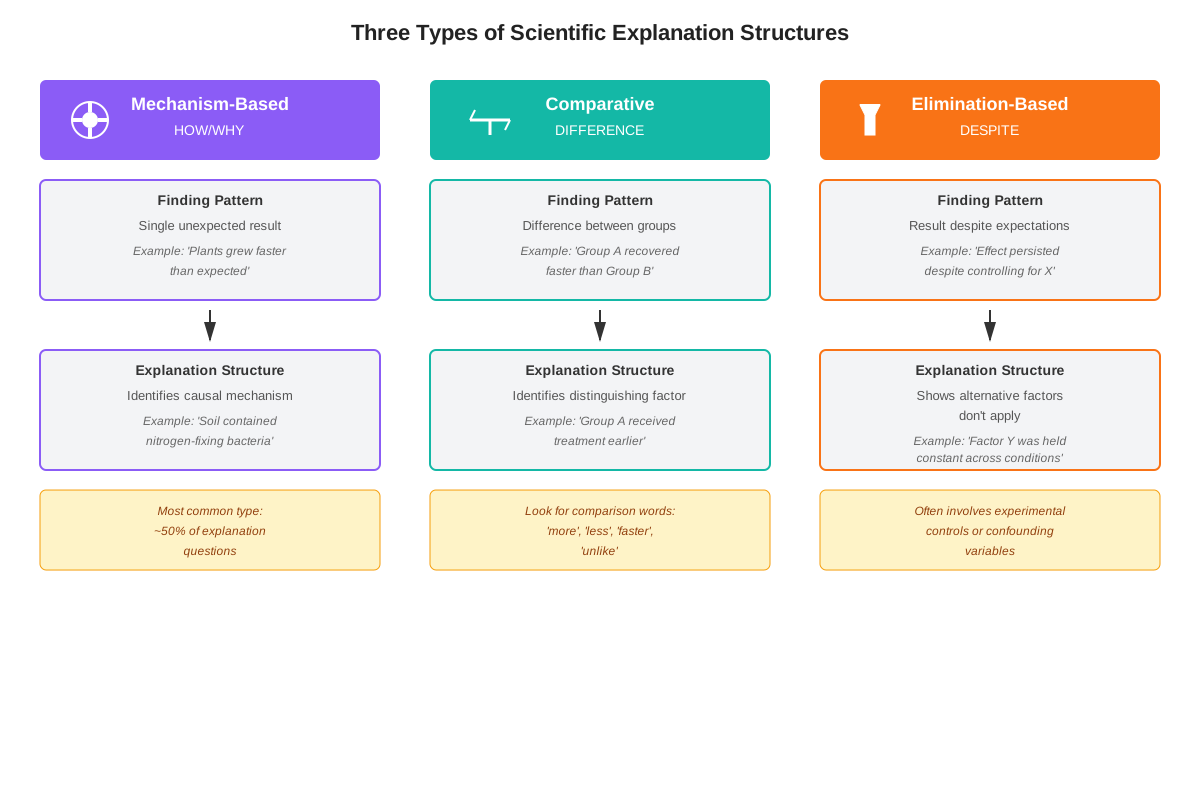
- [ ] Recognize common explanation structures in scientific contexts (mechanism-based, comparative, elimination-based)
- [ ] Evaluate competing explanations by identifying which best accounts for all observed data
- [ ] Identify when an explanation introduces unnecessary assumptions or fails to address key aspects of the finding
Prerequisites
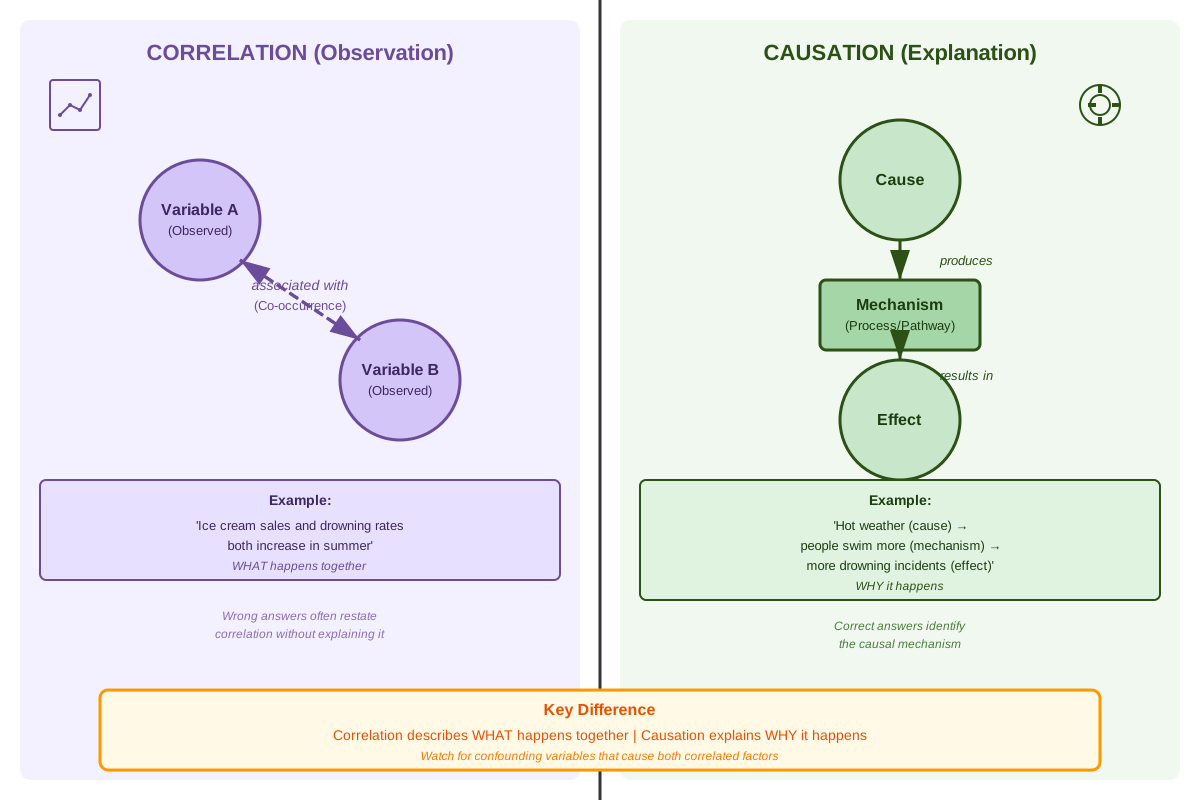
- Basic causal reasoning: Understanding the difference between correlation and causation is essential because scientific findings often present correlational data that requires causal explanation.
- Argument structure analysis: Recognizing premises, conclusions, and evidence helps identify what needs to be explained versus what serves as the explanation.
- Conditional logic fundamentals: Many scientific explanations involve "if-then" relationships that require understanding necessary and sufficient conditions.
- Evidence evaluation skills: Assessing whether evidence supports a claim is foundational to determining whether an explanation adequately accounts for a finding.
Why This Topic Matters
Scientific explanation questions appear in virtually every LSAT administration, typically comprising 2-4 questions per Logical Reasoning section. These questions test critical thinking skills that extend far beyond the exam itself. In legal practice, attorneys regularly encounter expert witnesses presenting scientific findings—from DNA evidence in criminal cases to economic data in antitrust litigation to medical testimony in personal injury suits. The ability to evaluate whether an expert's explanation adequately accounts for observed data is fundamental to effective advocacy.
On the LSAT, explaining scientific findings questions most commonly appear as:
- "Which one of the following, if true, most helps to explain..." questions
- "Which one of the following best accounts for..." questions
- "Which one of the following, if true, most helps to resolve the apparent discrepancy..." questions (when the discrepancy involves scientific data)
These questions test whether students can move beyond memorizing facts to engage in genuine scientific reasoning. The LSAT doesn't require scientific knowledge—all necessary information appears in the stimulus—but it does require the ability to think like a scientist: generating hypotheses, testing them against evidence, and selecting the explanation that best fits all available data. Students who master this topic gain significant advantages not only on these specific questions but also on strengthen/weaken questions involving scientific arguments, which are even more common.
Core Concepts
The Structure of Scientific Explanation Questions
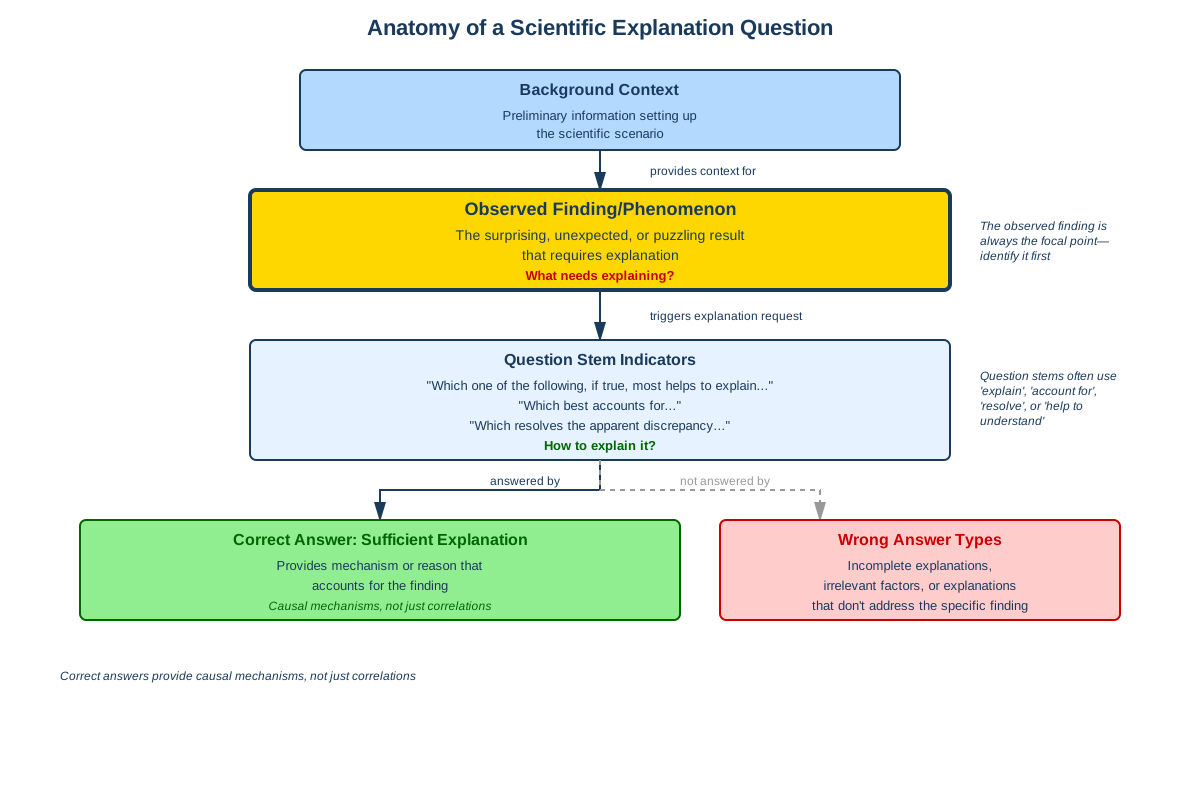
Explaining scientific findings questions follow a predictable structure that, once recognized, becomes a powerful tool for efficient problem-solving. The stimulus presents an observed phenomenon—typically an experimental result, statistical correlation, or natural occurrence that seems surprising, counterintuitive, or simply requires explanation. The question stem then asks which answer choice best explains this finding.
The key distinction is that these questions don't ask you to strengthen an existing argument or identify an assumption. Instead, they present a fact pattern without a proposed explanation and ask you to supply the missing explanatory mechanism. The correct answer will provide information that, if true, makes the observed finding unsurprising or expected.
Types of Scientific Findings Requiring Explanation
Scientific findings on the LSAT fall into several categories:
Unexpected experimental results: A study produces results that contradict predictions or common assumptions. For example, a drug designed to lower blood pressure instead raises it in certain patients, or plants grow faster in lower light conditions than higher light conditions.
Paradoxical correlations: Two variables show a relationship opposite to what theory predicts. For instance, regions with more hospitals have higher mortality rates, or students who study less perform better on exams.
Differential outcomes: The same treatment or condition produces different results in different groups. A medication works for some patients but not others, or a teaching method succeeds in one school but fails in another.
Surprising natural phenomena: Observations from nature that seem to contradict expectations. Certain animals survive in environments that should be lethal, or geological formations appear where theory suggests they shouldn't exist.
The Anatomy of a Good Explanation
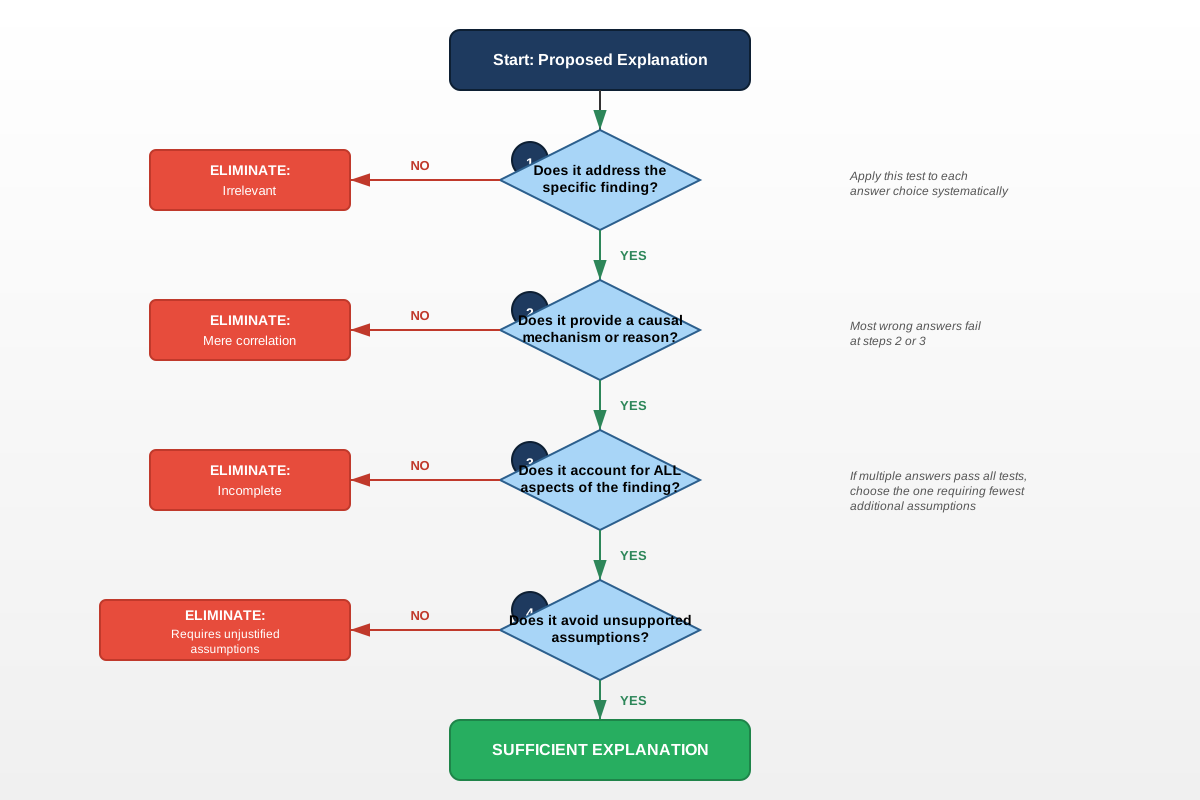
A correct explanation for a scientific finding must satisfy several criteria:
- Relevance: It must directly address the specific phenomenon described, not tangential issues
- Sufficiency: It must provide enough information to make the finding unsurprising
- Consistency: It must not contradict any information provided in the stimulus
- Parsimony: It should not introduce unnecessary complications or assumptions
Consider this framework for evaluating explanations:
| Criterion | What to Check | Red Flag |
|---|---|---|
| Relevance | Does it address the specific finding? | Explains something not mentioned in stimulus |
| Sufficiency | Does it fully account for the observation? | Leaves key aspects unexplained |
| Consistency | Does it contradict stimulus facts? | Requires ignoring given information |
| Completeness | Does it address all parts of the finding? | Only explains one aspect of multi-part finding |
Mechanism-Based Explanations
The most common type of correct answer provides a mechanism—a process or factor that causally produces the observed result. These explanations answer "how" or "why" the finding occurred by identifying an intermediate step or hidden variable.
For example, if the finding is "patients who take vitamin C supplements have higher rates of heart disease," a mechanism-based explanation might reveal that people who take vitamin C supplements are more likely to have pre-existing health concerns that prompted supplement use—the supplements don't cause heart disease; rather, underlying health issues cause both supplement use and heart disease.
Mechanism-based explanations often involve:
- Hidden variables that affect both observed factors
- Intermediate causal steps not initially apparent
- Background conditions that enable or prevent certain outcomes
- Selection effects that create non-representative samples
Comparative Explanations
Some scientific findings involve comparisons between groups, conditions, or time periods. The correct explanation must account for the difference between the compared items, not just describe each independently.
If a study finds that Method A produces better results than Method B, the explanation must identify what's different about Method A that makes it superior. An answer that describes a benefit of Method A without explaining why Method B lacks this benefit is incomplete.
Elimination-Based Explanations
Occasionally, the correct answer explains a finding by eliminating an alternative explanation or removing an apparent obstacle. These explanations work by showing why something that seemed to prevent the finding actually doesn't apply.
For instance, if the finding is "desert plants survive months without water," an elimination-based explanation might reveal that these plants have specialized root systems that access deep groundwater—eliminating the assumption that they truly go without water.
The Role of Scope in Scientific Explanations
Scope matching is crucial. The explanation must match the scope of the finding in several dimensions:
- Temporal scope: If the finding describes a recent change, the explanation should identify something that changed recently
- Population scope: If the finding applies to a specific group, the explanation should address characteristics of that group
- Magnitude scope: If the finding describes a large effect, the explanation should identify a factor capable of producing such an effect
Scope mismatches are common wrong answer traps. An explanation might be factually true and even relevant but fail because it's too narrow (doesn't explain the full extent of the finding) or too broad (would predict outcomes not observed).
Concept Relationships
The concepts within explaining scientific findings form an interconnected reasoning framework. The structure of scientific explanation questions provides the foundation—recognizing this structure allows quick identification of what needs to be explained. This connects directly to types of scientific findings, which categorizes the specific patterns you'll encounter, enabling faster pattern recognition during timed conditions.
The anatomy of a good explanation establishes evaluation criteria that apply across all question types. These criteria then inform how to assess mechanism-based explanations, comparative explanations, and elimination-based explanations—the three primary explanation structures. Each structure represents a different logical pathway to accounting for observed data, but all must satisfy the same fundamental criteria of relevance, sufficiency, and consistency.
Scope matching operates as a meta-concept that applies to all explanation types, serving as a filter to eliminate answers that might seem plausible but don't align with the specific parameters of the finding.
This topic connects to prerequisite knowledge of causal reasoning by applying those principles specifically to scientific contexts. It extends to related topics like strengthen/weaken questions (where you might strengthen an explanation by providing supporting evidence) and assumption questions (where you identify what an explanation takes for granted). The relationship map flows:
Basic Causal Reasoning → Explaining Scientific Findings → Strengthening/Weakening Scientific Arguments → Evaluating Scientific Methodology
High-Yield Facts
⭐ The correct explanation must make the finding unsurprising or expected, not merely consistent with it—many wrong answers are compatible with the finding but don't explain why it occurred.
⭐ Scope mismatches are the most common wrong answer trap—an explanation that's too narrow, too broad, or addresses the wrong time period will be incorrect even if otherwise plausible.
⭐ When a finding involves a comparison, the explanation must account for the difference between the compared items, not just describe one side of the comparison.
⭐ Hidden variables that affect multiple observed factors are extremely common in correct answers—look for third factors that explain apparent correlations.
⭐ The explanation must address all parts of a multi-part finding—if the stimulus describes two surprising results, the correct answer must explain both.
- Mechanism-based explanations that identify intermediate causal steps appear more frequently than any other explanation type.
- Selection bias explanations (where the sample is non-representative) are particularly common when findings involve human subjects or voluntary participation.
- Temporal sequence matters—if the finding describes a recent change, look for explanations identifying something that changed at the relevant time.
- Elimination-based explanations often work by revealing that an apparent obstacle doesn't actually apply to the specific case described.
- Pre-existing differences between compared groups frequently explain differential outcomes in experimental findings.
- The correct explanation should not require additional assumptions beyond what's stated in the answer choice itself.
- When multiple answers seem plausible, the one that most directly and completely addresses the specific finding is correct.
Quick check — test yourself on Explaining scientific findings so far.
Try Flashcards →Common Misconceptions
Misconception: Any answer that's consistent with the finding is correct. → Correction: Consistency is necessary but not sufficient. The correct answer must actively explain why the finding occurred, not merely fail to contradict it. Many wrong answers describe facts that could coexist with the finding without explaining it.
Misconception: The correct explanation must be the only possible explanation. → Correction: The LSAT asks for the best explanation among the choices provided, not the only conceivable explanation. The correct answer must adequately account for the finding, but alternative explanations might exist outside the answer choices.
Misconception: Scientific explanation questions require outside scientific knowledge. → Correction: All necessary information appears in the stimulus and answer choices. The LSAT tests reasoning ability, not science knowledge. If an answer requires you to know specific scientific facts not provided, it's wrong.
Misconception: Longer, more detailed answers are more likely to be correct. → Correction: Length doesn't correlate with correctness. Some correct answers are concise and direct, while some wrong answers are verbose but irrelevant. Evaluate based on logical sufficiency, not word count.
Misconception: If an explanation identifies a cause for one observed factor, it's correct. → Correction: The explanation must account for the relationship between factors or the specific surprising aspect of the finding. Explaining why X exists doesn't explain why X correlates with Y in an unexpected way.
Misconception: Explanations that introduce new scientific concepts are too complex to be correct. → Correction: Correct answers frequently introduce new information—that's how they explain the finding. The question is whether this new information adequately accounts for what was observed, not whether it's familiar.
Misconception: The explanation must describe something that always produces the observed result. → Correction: The explanation must account for why the result occurred in the specific case described, not establish an invariable law. Context-specific explanations are often correct.
Worked Examples
Example 1: Unexpected Experimental Result
Stimulus: "A recent study found that office workers who took frequent short breaks throughout the day reported higher stress levels than those who took fewer, longer breaks, despite the fact that total break time was identical between the two groups. This finding surprised researchers, who had hypothesized that more frequent breaks would reduce stress."
Question: Which one of the following, if true, most helps to explain the unexpected finding?
Answer Choices:
(A) Workers who took frequent short breaks often felt they couldn't fully disengage from work during such brief periods
(B) Some workers in the study worked in more stressful positions than others
(C) Taking breaks has been shown in other studies to reduce workplace stress
(D) The study included workers from various industries and job types
(E) Workers who took longer breaks sometimes felt guilty about being away from their desks
Analysis:
First, identify what needs explanation: Why do frequent short breaks correlate with higher stress despite equal total break time?
(A) provides a mechanism: frequent short breaks don't allow full disengagement, potentially creating frustration or preventing genuine stress relief. This directly explains why more frequent breaks would be less effective despite equal duration. This accounts for the surprising finding.
(B) introduces variation in baseline stress but doesn't explain the relationship between break frequency and stress levels. Even if true, it doesn't tell us why break frequency matters.
(C) contradicts the finding rather than explaining it—this is a classic wrong answer that ignores the specific result we need to explain.
(D) describes sample diversity but doesn't explain the break frequency effect. This is too general and doesn't address the mechanism.
(E) addresses longer breaks, but we need to explain why frequent short breaks produce higher stress. This doesn't account for the direction of the effect.
Correct Answer: (A)
This exemplifies a mechanism-based explanation that identifies why the expected relationship reversed. The key insight is recognizing that the explanation must account for why frequency matters when duration doesn't.
Example 2: Paradoxical Correlation
Stimulus: "Epidemiological data shows that countries with higher chocolate consumption per capita have significantly more Nobel Prize winners per capita. This correlation holds even when controlling for GDP and education spending."
Question: Which one of the following, if true, most helps to account for the correlation described above?
Answer Choices:
(A) Chocolate contains flavonoids that some studies suggest may improve cognitive function
(B) Nobel Prizes are awarded for achievements in science, literature, and peace
(C) Countries with higher chocolate consumption tend to be wealthier nations
(D) Both chocolate consumption and Nobel Prize success are more common in countries with strong scientific research infrastructure and cultural emphasis on intellectual achievement
(E) Some Nobel Prize winners have publicly stated they enjoy chocolate
Analysis:
The finding requires explanation: Why does chocolate consumption correlate with Nobel Prizes even after controlling for wealth and education?
(A) suggests a direct causal mechanism (chocolate → cognitive improvement → Nobel Prizes), but this would require chocolate consumption to causally produce the effect. This is possible but requires strong assumptions about chocolate's cognitive effects.
(B) describes what Nobel Prizes are but doesn't explain the correlation. This is irrelevant information.
(C) is explicitly ruled out by the stimulus, which states the correlation holds "when controlling for GDP." This answer ignores key information.
(D) identifies a hidden variable (scientific culture and infrastructure) that could cause both high chocolate consumption and Nobel Prize success without either causing the other. This is a classic third-variable explanation that accounts for the correlation without requiring a direct causal link.
(E) reverses the potential causal direction (Nobel Prize → chocolate consumption) but doesn't explain the country-level correlation and involves too few individuals to account for population-level patterns.
Correct Answer: (D)
This demonstrates how hidden variable explanations work. The correct answer identifies a factor that independently causes both observed phenomena, explaining their correlation without requiring one to cause the other. This is more parsimonious than answer (A) because it doesn't require assuming chocolate has significant cognitive effects.
Exam Strategy
Identifying Scientific Explanation Questions
Watch for these trigger phrases in question stems:
- "Which one of the following, if true, most helps to explain..."
- "Which one of the following best accounts for..."
- "Which one of the following, if true, most helps to resolve the apparent discrepancy..."
- "The information above provides the most support for which one of the following explanations..."
Exam Tip: If the stimulus presents data or findings without offering an explanation, and the question asks you to explain it, you're dealing with a scientific explanation question.
Systematic Approach
- Read the stimulus carefully and identify exactly what needs explanation: What's surprising, unexpected, or requires accounting for? Be precise about what the finding is.
- Note any comparisons or contrasts: If the finding involves "more than," "less than," "despite," or "although," the explanation must address the comparative or contrastive element.
- Predict the type of explanation needed: Is this likely a hidden variable, a mechanism, a selection effect, or an elimination of an apparent obstacle?
- Evaluate each answer for relevance first: Eliminate answers that don't address the specific finding, even if they're related to the general topic.
- Check scope matching: Does the answer's scope (temporal, population, magnitude) align with the finding's scope?
- Apply the "unsurprising test": If the answer choice were true, would the finding become expected rather than surprising?
Process of Elimination Tips
Eliminate answers that:
- Explain something not mentioned in the stimulus
- Only address one part of a multi-part finding
- Require additional assumptions to work as explanations
- Have scope mismatches (wrong time period, wrong population, wrong magnitude)
- Merely restate the finding in different words
- Contradict information in the stimulus
Be suspicious of answers that:
- Introduce complex causal chains requiring multiple steps
- Rely on extreme or absolute language ("always," "never," "only")
- Describe general principles without connecting to the specific finding
Time Management
Allocate approximately 1:20-1:30 for scientific explanation questions. They typically require:
- 30-40 seconds to read and understand the stimulus
- 10-15 seconds to identify what needs explanation
- 40-50 seconds to evaluate answer choices
If you find yourself spending more than 2 minutes, you may be overthinking. Return to the basics: What exactly needs explanation? Which answer most directly provides it?
Memory Techniques
SCREAM - Criteria for evaluating explanations:
- Sufficient (fully accounts for the finding)
- Consistent (doesn't contradict stimulus)
- Relevant (addresses the specific finding)
- Expected (makes the finding unsurprising)
- Appropriate scope (matches temporal, population, and magnitude parameters)
- Mechanism-focused (identifies how/why, not just what)
The Three H's - Common explanation types:
- Hidden variables (third factors affecting both observed phenomena)
- How it works (mechanism-based explanations)
- Hurdles removed (elimination-based explanations)
COMPARE - For comparative findings:
- Check that the explanation addresses the difference
- Observe both sides of the comparison
- Match the direction of the effect
- Population characteristics matter
- Avoid answers explaining only one side
- Remember: the contrast is what needs explanation
- Evaluate whether the answer accounts for the gap
Visualization Strategy: Picture the finding as a puzzle with a missing piece. The correct explanation is the piece that fits perfectly into the gap, making the complete picture coherent. Wrong answers are pieces from different puzzles—they might be interesting, but they don't complete this specific picture.
Summary
Explaining scientific findings questions present observed phenomena, experimental results, or correlations that require explanation, then ask test-takers to identify which answer choice best accounts for the finding. Success requires distinguishing between answers that merely describe related facts and those that genuinely explain why the finding occurred. The correct explanation must be relevant to the specific finding, sufficient to account for it fully, consistent with all provided information, and appropriately scoped to match the temporal, population, and magnitude parameters described. Common explanation types include mechanism-based answers (identifying how or why something occurs), hidden variable explanations (revealing third factors that cause both observed phenomena), and elimination-based explanations (removing apparent obstacles). The most frequent wrong answer traps involve scope mismatches, explanations that address only part of the finding, and answers that are consistent with but don't explain the observation. Mastering this question type requires careful identification of exactly what needs explanation, systematic evaluation of whether each answer provides that explanation, and recognition that the best explanation makes the surprising finding expected or unsurprising.
Key Takeaways
- Scientific explanation questions ask you to account for observed findings, not to strengthen arguments or identify assumptions—recognize this distinct task
- The correct explanation must make the finding unsurprising or expected; mere consistency with the finding is insufficient
- Scope matching is critical: the explanation's temporal, population, and magnitude scope must align with the finding's parameters
- For comparative findings, the explanation must account for the difference between compared items, not just describe one side
- Hidden variables that independently cause both observed phenomena are extremely common in correct answers
- Mechanism-based explanations that identify intermediate causal steps appear most frequently
- Eliminate answers that explain something not mentioned in the stimulus or that require additional assumptions to work
Related Topics
Strengthening and Weakening Scientific Arguments: Once you can explain scientific findings, the next step is evaluating how additional evidence strengthens or weakens proposed explanations. This builds directly on explanation skills by adding the dimension of argument evaluation.
Causal Reasoning and Confounding Variables: Deeper exploration of how to identify alternative causal explanations and confounding factors that complicate causal claims. This extends the hidden variable concept central to many explanation questions.
Resolving Paradoxes: A specialized type of explanation question where two apparently contradictory facts must be reconciled. Mastering basic explanation questions provides the foundation for these more complex scenarios.
Evaluating Scientific Methodology: Understanding how study design affects the validity of scientific findings helps you recognize when methodological factors explain unexpected results.
Necessary and Sufficient Conditions in Scientific Contexts: Applying formal logic to scientific explanations, distinguishing between factors that must be present (necessary) versus those that guarantee an outcome (sufficient).
Practice CTA
Now that you understand the reasoning patterns behind explaining scientific findings, it's time to apply these concepts to actual LSAT questions. Work through the practice questions systematically, using the SCREAM criteria to evaluate each answer choice. Pay special attention to scope matching and identifying what specifically needs explanation. The flashcards will help reinforce the distinction between explanation types and common wrong answer patterns. Remember: these questions reward careful analysis of exactly what the finding is and precise evaluation of whether each answer accounts for it. With practice, you'll develop the pattern recognition that makes these questions efficient scoring opportunities. You've built the framework—now strengthen it through application!
Sign up free to keep reading
Create a free AnvayaPrep account to finish this LSAT guide on Explaining scientific findings — plus flashcards and practice questions.