Overview
Mechanism evidence represents one of the most powerful and frequently tested forms of causal reasoning on the LSAT. When an argument claims that X causes Y, mechanism evidence provides the "how"—it explains the intermediate steps, processes, or pathways through which the cause produces its effect. Understanding mechanism evidence is crucial because the LSAT regularly tests whether test-takers can distinguish between mere correlation and genuine causation, and mechanism evidence serves as one of the strongest indicators that a causal relationship is legitimate rather than coincidental.
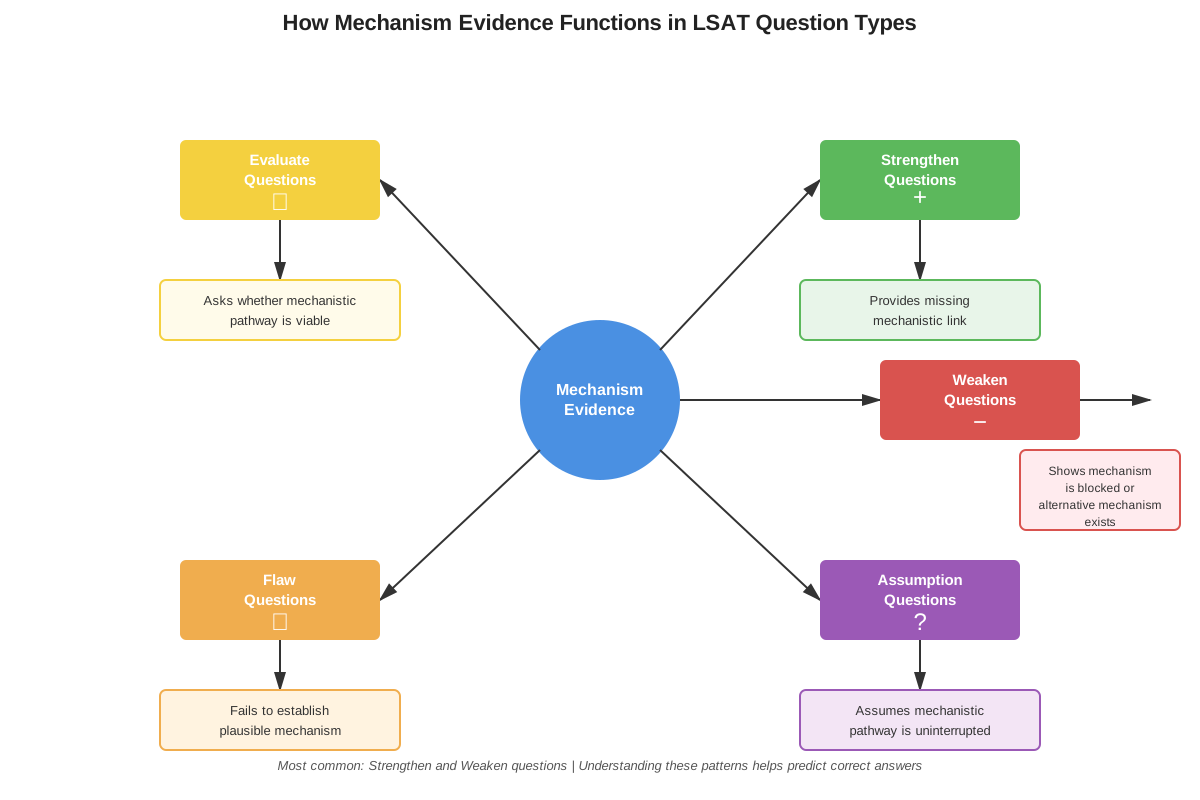
On the LSAT's Logical Reasoning section, questions involving causation and explanation frequently hinge on recognizing when an argument has established (or failed to establish) a plausible mechanism connecting cause to effect. Test-makers design questions that require students to identify missing mechanistic links, evaluate whether proposed mechanisms are sufficient, or recognize when mechanism evidence strengthens or weakens a causal claim. This topic appears across multiple question types, including Strengthen, Weaken, Assumption, Flaw, and Evaluate questions.
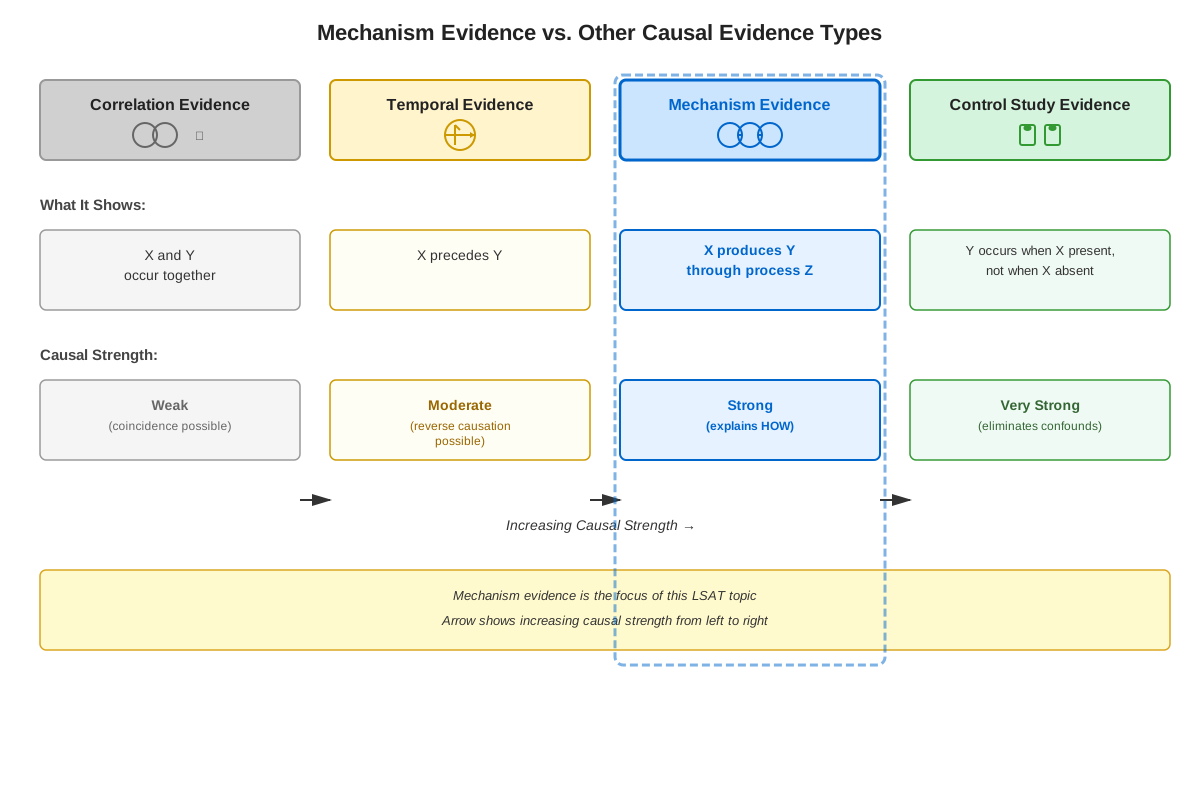
The relationship between mechanism evidence and broader LSAT mechanism evidence patterns extends throughout logical reasoning. While correlation evidence merely shows that two phenomena occur together, and temporal evidence shows that one precedes the other, mechanism evidence provides the explanatory bridge that makes a causal claim credible. Mastering this concept enables test-takers to evaluate arguments more rigorously, distinguish between strong and weak causal reasoning, and predict what information would make causal arguments more or less convincing—skills that are fundamental to achieving a competitive LSAT score.
Learning Objectives
- [ ] Identify how Mechanism evidence appears in LSAT questions
- [ ] Explain the reasoning pattern behind Mechanism evidence
- [ ] Apply Mechanism evidence to solve LSAT-style problems accurately
- [ ] Distinguish mechanism evidence from other types of causal evidence (correlation, temporal sequence, control studies)
- [ ] Evaluate whether a proposed mechanism is sufficient to establish causation
- [ ] Predict what mechanistic information would strengthen or weaken a causal argument
- [ ] Recognize when the absence of mechanism evidence constitutes a logical flaw
Prerequisites
- Basic causal reasoning: Understanding the difference between correlation and causation is essential because mechanism evidence specifically addresses how to move from observing a correlation to establishing genuine causation
- Argument structure analysis: The ability to identify conclusions, premises, and assumptions allows students to recognize where mechanism evidence fits within an argument's logical framework
- Strengthen and Weaken question types: Familiarity with these question types is necessary because mechanism evidence most frequently appears as answer choices that either support or undermine causal claims
- Conditional reasoning fundamentals: Understanding necessary and sufficient conditions helps in evaluating whether a proposed mechanism is adequate to produce the claimed effect
Why This Topic Matters
Mechanism evidence appears in approximately 15-20% of all Logical Reasoning questions on the LSAT, making it one of the highest-yield topics for test preparation. This frequency reflects the exam's emphasis on evaluating causal arguments, which are among the most common argument types in both academic and professional contexts. Questions involving mechanism evidence typically appear as Strengthen questions (where mechanism evidence supports a causal claim), Weaken questions (where alternative mechanisms or blocked mechanisms undermine causation), Assumption questions (where the argument depends on an unstated mechanistic link), and Flaw questions (where the argument fails to establish a plausible mechanism).
In real-world applications, mechanism evidence is fundamental to scientific reasoning, policy analysis, and legal argumentation—all domains that law school and legal practice require. Medical researchers must establish mechanisms to prove that drugs cause therapeutic effects; policy analysts must identify mechanisms through which interventions produce outcomes; and attorneys must demonstrate mechanisms connecting defendants' actions to alleged harms. The LSAT tests this reasoning pattern because it reflects the type of analytical thinking essential for legal practice.
Common manifestations in LSAT passages include arguments that propose causal relationships in scientific contexts (e.g., "Chemical X causes disease Y"), policy recommendations based on causal claims (e.g., "Implementing policy A will reduce problem B"), and explanations for observed phenomena (e.g., "The decline in population C occurred because of factor D"). Test-makers consistently create questions where the correct answer either provides missing mechanistic information, identifies a flaw in mechanistic reasoning, or evaluates whether a proposed mechanism is adequate.
Core Concepts
What is Mechanism Evidence?
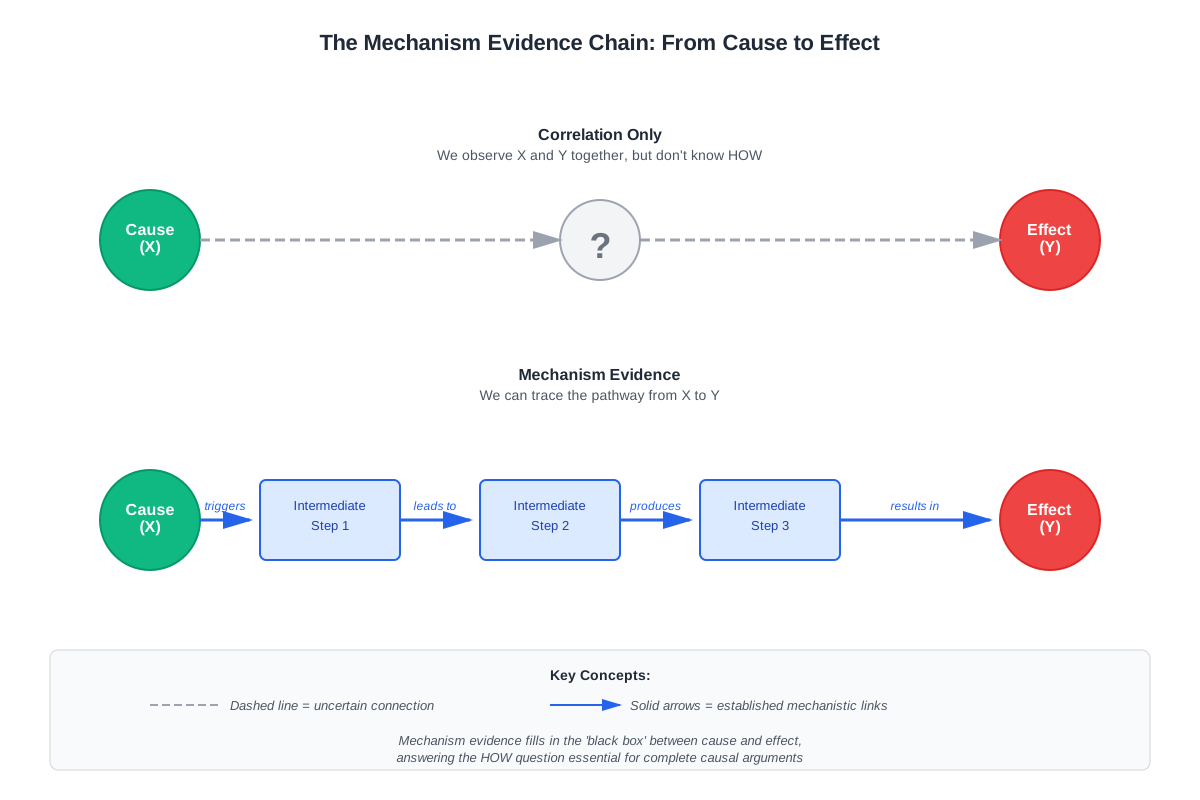
Mechanism evidence refers to information that explains the intermediate steps, processes, or pathways through which a cause produces its effect. Rather than merely observing that two events occur together or that one precedes the other, mechanism evidence describes the "causal chain" connecting them. This type of evidence answers the question: "How exactly does X bring about Y?"
For example, consider the claim: "Smoking causes lung cancer." Mechanism evidence would include information about how carcinogens in tobacco smoke damage DNA in lung cells, how this damage leads to uncontrolled cell division, and how this proliferation forms tumors. This mechanistic explanation makes the causal claim far more credible than simply observing that smokers develop lung cancer at higher rates than non-smokers.
On the LSAT, mechanism evidence typically appears in one of three forms:
- Complete mechanisms: Detailed explanations of all intermediate steps
- Partial mechanisms: Descriptions of some (but not all) steps in the causal chain
- Plausible mechanisms: Reasonable explanations that could connect cause and effect, even without complete scientific verification
The Logical Structure of Mechanistic Arguments
Arguments involving mechanism evidence follow a predictable logical pattern:
Premise 1: Observation of correlation or temporal sequence (X and Y occur together, or X precedes Y)
Premise 2: Mechanism evidence (X produces intermediate effect M, which produces Y)
Conclusion: Therefore, X causes Y
The strength of such arguments depends critically on the quality and completeness of the mechanism evidence. A well-established mechanism makes the causal conclusion highly credible, while a speculative or incomplete mechanism leaves the argument vulnerable to alternative explanations.
Types of Mechanism Evidence on the LSAT
| Type | Description | Example | Strength |
|---|---|---|---|
| Direct mechanism | Explains the immediate pathway from cause to effect | "The medication blocks enzyme X, which prevents inflammation" | Strongest |
| Indirect mechanism | Explains a multi-step pathway with intermediate causes | "Policy A reduces income inequality, which improves social cohesion, which decreases crime" | Moderate to Strong |
| Analogical mechanism | Draws on similar mechanisms in comparable situations | "Just as pesticide X harms bees by disrupting navigation, pesticide Y likely harms them similarly" | Moderate |
| Theoretical mechanism | Proposes a mechanism based on established principles | "Based on economic theory, reducing taxes should increase investment" | Weak to Moderate |
How Mechanism Evidence Strengthens Arguments
Mechanism evidence strengthens causal arguments by:
- Eliminating alternative explanations: When a specific mechanism is established, it becomes less plausible that the correlation is coincidental or due to a third factor
- Providing predictive power: A well-understood mechanism allows predictions about when and how the causal relationship will manifest
- Establishing sufficiency: Demonstrating that the proposed cause is adequate to produce the observed effect
- Creating coherence: Connecting the causal claim to broader scientific or theoretical frameworks
How Absence of Mechanism Evidence Weakens Arguments
Arguments lacking mechanism evidence are vulnerable because:
- Alternative mechanisms remain viable: Without explaining how X causes Y, the possibility remains that Z actually causes both X and Y
- The causal claim appears speculative: Mere correlation without mechanistic explanation provides weak support for causation
- The argument commits the correlation-causation fallacy: Observing that two things occur together doesn't establish that one causes the other
Mechanism Evidence vs. Other Causal Evidence
Understanding how mechanism evidence differs from other types of causal evidence is crucial for LSAT success:
Correlation evidence shows that two phenomena occur together but doesn't explain why. Mechanism evidence provides the explanatory link that correlation lacks.
Temporal evidence shows that the alleged cause precedes the effect, which is necessary but not sufficient for causation. Mechanism evidence explains how the earlier event produces the later one.
Experimental evidence (control studies) demonstrates causation through manipulation and control groups. Mechanism evidence complements experimental findings by explaining how the manipulation produces the observed results.
Statistical evidence quantifies the strength of association between variables. Mechanism evidence explains why that association exists.
Concept Relationships
The concepts within mechanism evidence form an interconnected logical framework. Mechanism evidence serves as the central concept that bridges the gap between correlation and causation. When an argument observes a correlation, mechanism evidence transforms that observation into a credible causal claim by explaining the pathway connecting cause and effect.
This relationship flows as follows: Correlation observation → Mechanism evidence → Causal conclusion. Each step depends on the previous one, and the strength of the final conclusion depends on the quality of the mechanism evidence.
Mechanism evidence connects to prerequisite causal reasoning by providing the "how" that basic causal reasoning requires. While basic causal reasoning teaches that correlation doesn't prove causation, mechanism evidence provides one of the primary tools for establishing when causation is actually present.
The relationship to argument structure is equally important: mechanism evidence typically appears as a premise supporting a causal conclusion, or as an unstated assumption that the argument requires. When analyzing arguments, identifying where mechanism evidence appears (or is missing) reveals the argument's logical strengths and vulnerabilities.
Mechanism evidence also relates to alternative explanations in a complementary way. Strong mechanism evidence makes alternative explanations less plausible, while the absence of mechanism evidence leaves room for alternative causal pathways. This relationship appears frequently in Weaken questions, where correct answers often propose alternative mechanisms that could explain the observed correlation.
Finally, mechanism evidence connects to conditional reasoning through the concept of sufficiency. A complete mechanism demonstrates that the cause is sufficient to produce the effect, establishing a conditional relationship: if the cause occurs and the mechanism operates, then the effect will follow.
High-Yield Facts
⭐ Mechanism evidence explains the intermediate steps or processes through which a cause produces its effect, answering "how" rather than just "whether" causation occurs
⭐ On Strengthen questions, answer choices providing mechanism evidence are frequently correct when the argument makes a causal claim
⭐ On Weaken questions, answer choices that block the proposed mechanism or suggest alternative mechanisms often weaken causal arguments
⭐ The absence of mechanism evidence does not disprove causation, but it makes causal arguments significantly weaker and more vulnerable to criticism
⭐ Arguments that jump from correlation to causation without providing mechanism evidence commit a logical flaw
- Mechanism evidence can be direct (immediate pathway) or indirect (multi-step pathway), with direct mechanisms providing stronger support
- Analogical mechanism evidence (drawing on similar mechanisms in comparable situations) provides moderate support for causal claims
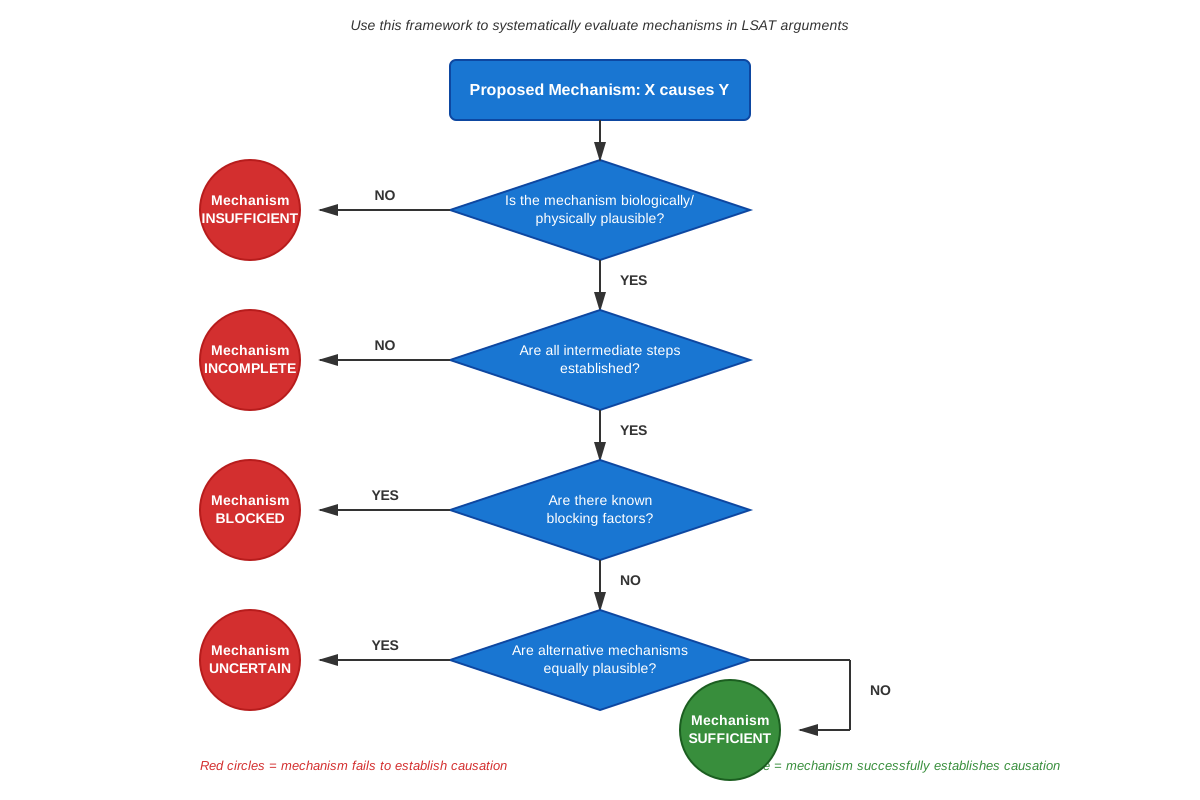
- When evaluating mechanism evidence, consider whether the proposed mechanism is sufficient to produce the observed effect
- Multiple mechanisms can produce the same effect; identifying one mechanism doesn't exclude others
- Theoretical mechanisms based on established principles provide weaker support than empirically demonstrated mechanisms
- Mechanism evidence is particularly important in scientific and medical contexts, which appear frequently on the LSAT
- Blocking or interrupting a proposed mechanism provides strong evidence against a causal claim
- The specificity and detail of mechanism evidence correlates with its persuasive strength
- Mechanism evidence can be tested through intervention: if blocking the mechanism prevents the effect, this supports the causal claim
- On Assumption questions, the argument often assumes that a particular mechanism operates or that no alternative mechanism exists
Quick check — test yourself on Mechanism evidence so far.
Try Flashcards →Common Misconceptions
Misconception: Mechanism evidence is required to prove causation → Correction: While mechanism evidence strengthens causal arguments significantly, causation can be established through other means, such as well-designed experimental studies. However, on the LSAT, mechanism evidence is one of the strongest forms of support for causal claims.
Misconception: Any plausible mechanism is sufficient to establish causation → Correction: A mechanism must be both plausible and actually operative. Just because a mechanism could theoretically connect X and Y doesn't mean it actually does. The LSAT tests the ability to distinguish between speculative mechanisms and well-established ones.
Misconception: Correlation plus mechanism evidence always proves causation → Correction: Even with mechanism evidence, alternative explanations may exist. For example, a third factor might cause both the alleged cause and the effect through separate mechanisms. Strong causal arguments require ruling out alternatives, not just establishing one possible mechanism.
Misconception: Mechanism evidence and temporal evidence are the same thing → Correction: Temporal evidence shows that the cause precedes the effect, which is necessary but not sufficient for causation. Mechanism evidence goes further by explaining how the earlier event produces the later one. The LSAT frequently tests whether students confuse these distinct concepts.
Misconception: If a mechanism is complex or involves multiple steps, it's less credible → Correction: Complexity doesn't undermine mechanism evidence; many genuine causal relationships involve multi-step pathways. What matters is whether each step in the mechanism is plausible and supported. The LSAT sometimes includes wrong answers that dismiss complex mechanisms simply because they're complex.
Misconception: Mechanism evidence must be scientifically proven to strengthen an argument → Correction: On the LSAT, even a plausible or theoretically sound mechanism can strengthen a causal argument, even if it hasn't been empirically verified. The standard is reasonableness and plausibility, not scientific certainty.
Misconception: Blocking one mechanism disproves causation entirely → Correction: If multiple mechanisms can produce the same effect, blocking one mechanism doesn't eliminate causation—it only eliminates that particular pathway. The LSAT tests whether students recognize that alternative mechanisms may still operate.
Worked Examples
Example 1: Strengthen Question with Mechanism Evidence
Argument: "Studies show that people who drink green tea regularly have lower rates of heart disease. Therefore, drinking green tea prevents heart disease."
Question: Which of the following, if true, most strengthens the argument?
Answer Choices:
(A) Green tea consumption is more common in countries with lower heart disease rates
(B) People who drink green tea also tend to exercise more frequently
(C) Green tea contains antioxidants that prevent the oxidation of LDL cholesterol, a key factor in arterial plaque formation
(D) Green tea has been consumed for centuries in many cultures
(E) Heart disease rates have declined in populations that have increased green tea consumption
Analysis:
The argument observes a correlation (green tea drinkers have lower heart disease rates) and concludes causation (green tea prevents heart disease). This is a classic causal argument that would be strengthened by mechanism evidence.
Let's evaluate each choice:
(A) This merely restates the correlation at a population level. It doesn't explain how green tea might prevent heart disease, so it doesn't provide mechanism evidence. This is a correlation restatement, not a strengthener.
(B) This actually weakens the argument by suggesting an alternative explanation. If green tea drinkers exercise more, perhaps exercise (not green tea) prevents heart disease. This introduces a confounding variable rather than providing mechanism evidence.
(C) This is the correct answer. It provides explicit mechanism evidence by explaining the pathway: green tea contains antioxidants → antioxidants prevent LDL oxidation → preventing LDL oxidation reduces arterial plaque → reducing plaque prevents heart disease. This mechanistic explanation makes the causal claim much more credible.
(D) Historical information about consumption patterns doesn't explain how green tea prevents heart disease. This is irrelevant to the causal mechanism.
(E) This provides additional correlation evidence (temporal correlation), but not mechanism evidence. It shows that changes in tea consumption correlate with changes in heart disease, but doesn't explain how tea produces this effect.
Key Takeaway: When a causal argument needs strengthening, look for answer choices that explain the intermediate steps connecting cause and effect. Choice (C) is correct because it provides the mechanistic "how" that transforms correlation into credible causation.
Example 2: Weaken Question Targeting Mechanism
Argument: "City officials claim that installing speed cameras reduces traffic accidents by causing drivers to slow down. However, this policy should be reconsidered."
Question: Which of the following, if true, most weakens the city officials' reasoning?
Answer Choices:
(A) Speed cameras are expensive to install and maintain
(B) Drivers slow down abruptly when approaching speed cameras, causing rear-end collisions that offset any safety benefits
(C) Some drivers are unaware that speed cameras have been installed
(D) Speed cameras also generate revenue for the city through fines
(E) Traffic accidents have multiple causes beyond speeding
Analysis:
The officials' argument contains an implicit mechanism: speed cameras → drivers slow down → fewer accidents. To weaken this argument, we need to either block this mechanism or show that it doesn't produce the claimed effect.
(A) Cost considerations don't address whether the mechanism works. This is about implementation feasibility, not the causal mechanism itself.
(B) This is the correct answer. It directly attacks the mechanism by showing that while the first step occurs (drivers slow down), the mechanism produces an unintended consequence that undermines the desired effect. The mechanism is: speed cameras → abrupt slowing → rear-end collisions → accidents aren't reduced (or are even increased). This blocks the proposed causal pathway from achieving its goal.
(C) If some drivers are unaware, the mechanism might work less effectively, but this doesn't fundamentally challenge whether the mechanism operates for those who are aware. This is a weak weakener.
(D) Revenue generation is irrelevant to whether the safety mechanism works. This might suggest an alternative motive but doesn't address the causal claim about accident reduction.
(E) While true, this doesn't specifically address whether the speed camera mechanism works. Multiple causes can exist simultaneously; this doesn't show that the proposed mechanism fails.
Key Takeaway: To weaken a causal argument with mechanism evidence, look for answer choices that show the mechanism is blocked, interrupted, or produces unintended consequences that undermine the conclusion. Choice (B) succeeds by showing that the mechanism creates a countervailing effect.
Exam Strategy
Identifying Mechanism Evidence Questions
Watch for these trigger phrases that signal mechanism evidence is relevant:
- "How does X cause Y?"
- "By what process..."
- "Through what means..."
- "The pathway by which..."
- "X causes Y by..."
- Arguments that jump from correlation to causation without explanation
Approaching Strengthen Questions
When a causal argument needs strengthening:
- Identify the causal claim: What does the argument claim causes what?
- Look for the gap: Is there an explanation of how the cause produces the effect?
- Predict mechanism evidence: What intermediate steps would connect cause and effect?
- Evaluate answer choices: Prioritize choices that provide mechanistic explanations over those that merely add correlation evidence
Exam Tip: On Strengthen questions with causal arguments, mechanism evidence is often correct, but beware of answer choices that provide correlation evidence disguised as mechanism evidence. True mechanism evidence explains the process, not just additional observations of co-occurrence.
Approaching Weaken Questions
When attacking a causal argument:
- Identify the proposed mechanism: How does the argument claim the cause produces the effect?
- Look for vulnerabilities: Are there steps in the mechanism that could be blocked or interrupted?
- Consider alternative mechanisms: Could something else produce the observed effect?
- Evaluate answer choices: Prioritize choices that block the mechanism, propose alternatives, or show the mechanism produces countervailing effects
Process of Elimination Tips
Eliminate answer choices that:
- Merely restate the correlation without explaining it
- Provide irrelevant background information
- Address practical considerations (cost, feasibility) rather than the logical mechanism
- Confuse temporal sequence with mechanistic explanation
Favor answer choices that:
- Explain intermediate steps in a causal process
- Describe how one event produces another
- Reference specific processes, pathways, or mechanisms
- Connect cause to effect through a logical chain
Time Allocation
Mechanism evidence questions typically require 1:15-1:30 to solve effectively. Allocate time as follows:
- 20-30 seconds: Read and understand the argument, identifying the causal claim
- 10-15 seconds: Predict what mechanism evidence would strengthen or weaken the argument
- 30-40 seconds: Evaluate answer choices, eliminating those that don't address the mechanism
- 10-15 seconds: Confirm the correct answer addresses the mechanistic gap
Memory Techniques
The MECHANISM Acronym
Means by which cause produces effect
Explains the pathway, not just correlation
Connects intermediate steps
How does X lead to Y?
Answers process questions
Necessary for strong causal claims
Intermediate effects matter
Strengthens by eliminating alternatives
Multiple mechanisms possible
Visualization Strategy
Picture a causal argument as a bridge spanning a river. The cause is one riverbank, the effect is the other riverbank, and mechanism evidence is the bridge structure connecting them. Correlation evidence merely observes that both riverbanks exist, but mechanism evidence explains how you can actually get from one side to the other. When evaluating arguments, visualize whether the bridge is complete, partially built, or missing entirely.
The "How Chain" Technique
When analyzing causal arguments, write out the "how chain":
Cause → [HOW?] → Effect
Then fill in the mechanism:
Cause → Step 1 → Step 2 → Step 3 → Effect
If you can't fill in the steps, the argument lacks mechanism evidence. If an answer choice fills in the steps, it likely provides mechanism evidence.
Summary
Mechanism evidence represents one of the most powerful tools for evaluating causal arguments on the LSAT. It explains the intermediate steps, processes, or pathways through which a cause produces its effect, transforming mere correlation into credible causation. On the LSAT, mechanism evidence appears most frequently in Strengthen questions (where providing the mechanism supports a causal claim), Weaken questions (where blocking or proposing alternative mechanisms undermines causation), and Assumption questions (where the argument depends on an unstated mechanistic link). Strong mechanism evidence includes specific, detailed explanations of how each step in the causal chain operates, while weak mechanism evidence offers only speculative or incomplete pathways. To master this topic, students must learn to distinguish mechanism evidence from other types of causal support (particularly correlation and temporal evidence), recognize when arguments lack necessary mechanistic explanations, and predict what mechanistic information would strengthen or weaken causal claims. Success requires understanding that mechanism evidence answers "how" rather than just "whether," and that the quality and completeness of mechanistic explanations directly determine the strength of causal arguments.
Key Takeaways
- Mechanism evidence explains the "how" of causation, providing the intermediate steps connecting cause to effect rather than merely observing correlation
- On Strengthen questions with causal arguments, answer choices providing mechanism evidence are high-probability correct answers
- Mechanism evidence differs fundamentally from correlation evidence: correlation shows co-occurrence, while mechanism explains the process producing that co-occurrence
- Blocking or interrupting a proposed mechanism effectively weakens causal arguments, making this a common pattern in Weaken questions
- The absence of mechanism evidence constitutes a logical flaw when arguments jump from correlation to causation without explanation
- Multiple mechanisms can produce the same effect, so identifying one mechanism doesn't exclude alternatives
- Evaluate mechanism evidence by asking whether the proposed pathway is sufficient to produce the observed effect and whether each step is plausible
Related Topics
Alternative Explanations: Understanding mechanism evidence enables deeper analysis of alternative explanations, as alternative mechanisms represent competing causal pathways that could explain observed correlations. Mastering mechanism evidence provides the foundation for evaluating whether alternative explanations are more or less plausible than the proposed mechanism.
Necessary and Sufficient Conditions: Mechanism evidence connects to conditional reasoning by establishing whether a cause is sufficient to produce an effect. A complete mechanism demonstrates sufficiency, while an incomplete mechanism leaves questions about whether additional conditions are necessary.
Experimental Design and Control Studies: While mechanism evidence explains how causation works, experimental evidence demonstrates that causation exists through manipulation and control. These complementary forms of evidence work together to establish robust causal claims.
Correlation vs. Causation: Mechanism evidence provides one of the primary tools for distinguishing genuine causation from mere correlation, making it essential for avoiding the correlation-causation fallacy that appears throughout LSAT Logical Reasoning.
Practice CTA
Now that you understand mechanism evidence and its critical role in evaluating causal arguments, it's time to apply this knowledge to practice questions. Focus on identifying where mechanism evidence appears (or is missing) in arguments, predicting what mechanistic information would strengthen or weaken causal claims, and distinguishing mechanism evidence from other types of support. The more you practice recognizing mechanistic reasoning patterns, the more automatic and efficient your analysis will become. Remember: mechanism evidence is one of the highest-yield topics on the LSAT, appearing in 15-20% of Logical Reasoning questions. Mastering this concept will directly improve your score. Attempt the practice questions with confidence, knowing that you now have the conceptual framework to tackle even the most challenging mechanism evidence questions!
Sign up free to keep reading
Create a free AnvayaPrep account to finish this LSAT guide on Mechanism evidence — plus flashcards and practice questions.