Overview
Sufficient cause is a foundational concept in LSAT Logical Reasoning that appears frequently across multiple question types, particularly in causation and explanation problems. Understanding sufficient cause means recognizing when one factor is enough, by itself, to bring about a particular effect or outcome. On the LSAT, this concept tests your ability to analyze causal relationships, evaluate arguments that make causal claims, and distinguish between conditions that guarantee an outcome versus those that merely contribute to it. Mastering sufficient cause is essential because the LSAT regularly presents arguments where test-makers exploit common reasoning errors about what truly causes what.
The concept of sufficient cause sits at the intersection of conditional reasoning and causal analysis. While conditional logic deals with "if-then" relationships in abstract terms, sufficient cause applies this framework specifically to real-world causal scenarios. When an argument claims that X is a sufficient cause of Y, it asserts that whenever X occurs, Y will inevitably follow—X alone is enough to produce Y. This differs critically from necessary causes (which must be present for an effect to occur) and contributing causes (which increase the likelihood of an effect without guaranteeing it). The LSAT exploits these distinctions relentlessly, crafting wrong answer choices that confuse sufficient causes with other types of causal relationships.
Understanding sufficient cause enables you to tackle Strengthen, Weaken, Assumption, Flaw, and Evaluate questions that involve causal reasoning. These questions constitute a substantial portion of the Logical Reasoning sections, making this topic high-yield for score improvement. The ability to identify whether an argument properly establishes a sufficient causal relationship—or merely assumes one without adequate support—is a skill that separates high scorers from average performers on the LSAT.
Learning Objectives
- [ ] Identify how sufficient cause appears in LSAT questions
- [ ] Explain the reasoning pattern behind sufficient cause
- [ ] Apply sufficient cause to solve LSAT-style problems accurately
- [ ] Distinguish sufficient cause from necessary cause and contributing factors
- [ ] Recognize common argument flaws involving sufficient cause claims
- [ ] Evaluate whether evidence adequately supports a sufficient cause conclusion
- [ ] Predict how LSAT questions will test sufficient cause reasoning in various question types
Prerequisites
- Basic conditional logic (if-then statements): Understanding conditional relationships provides the logical framework for analyzing sufficient causes, as sufficient causes follow an "if X, then Y" structure.
- Argument structure identification: Recognizing premises and conclusions is essential because sufficient cause claims typically appear as conclusions that must be evaluated against the supporting evidence.
- Correlation versus causation: Distinguishing mere correlation from genuine causation is foundational, as sufficient cause represents a specific type of strong causal claim that goes beyond simple correlation.
- Basic logical operators (and, or, not): These operators frequently appear in complex causal scenarios where multiple factors interact to produce effects.
Why This Topic Matters
In real-world reasoning, understanding sufficient cause helps evaluate everything from medical diagnoses (does this symptom alone indicate this disease?) to policy decisions (will this single intervention solve the problem?) to legal arguments (does this evidence alone prove guilt?). The ability to assess whether a single factor truly guarantees an outcome is fundamental to critical thinking across professional fields, particularly law, where establishing causation is often central to liability and responsibility.
On the LSAT, sufficient cause appears in approximately 15-20% of Logical Reasoning questions, making it one of the most frequently tested concepts. It appears most commonly in:
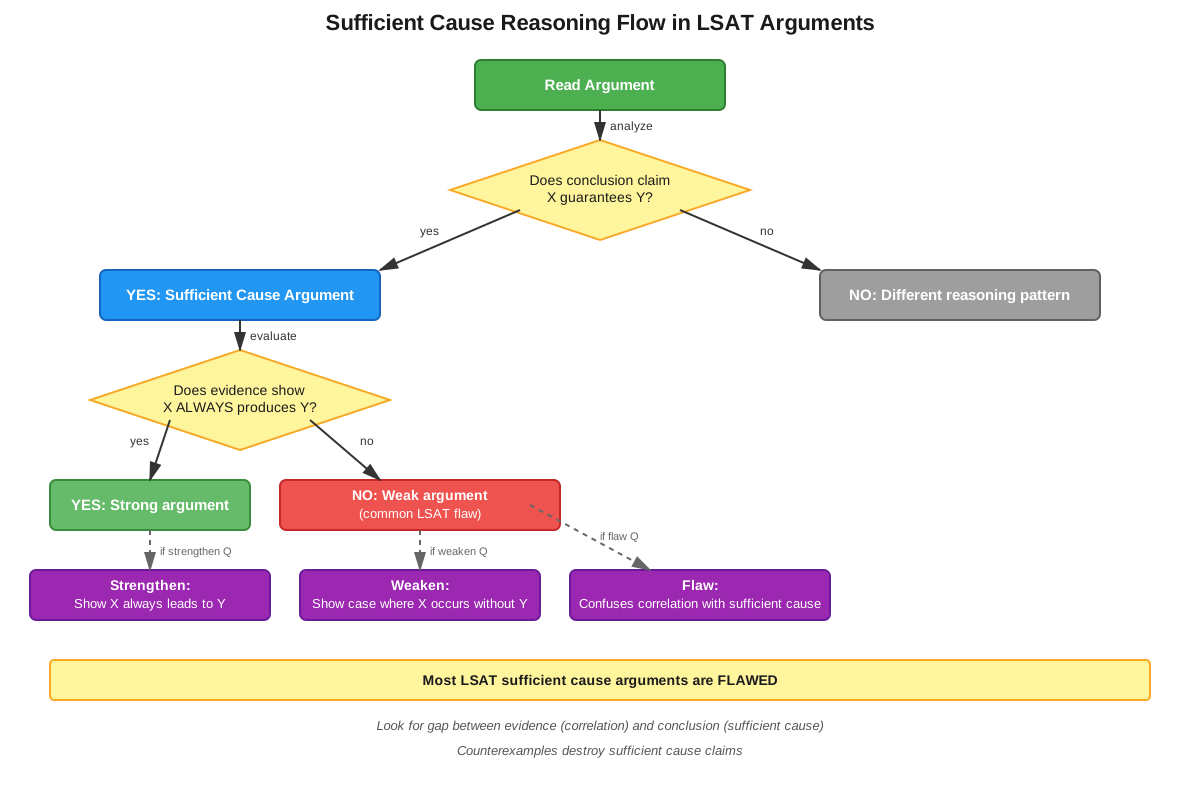
- Weaken questions: where you must identify evidence showing the alleged sufficient cause doesn't always produce the effect
- Strengthen questions: where you must support the claim that a factor is indeed sufficient
- Flaw questions: where arguments incorrectly assume a factor is sufficient when evidence only shows correlation or contribution
- Assumption questions: where the argument depends on assuming no other factors prevent the sufficient cause from producing its effect
The LSAT particularly favors scenarios involving scientific studies, policy proposals, historical explanations, and behavioral predictions—contexts where causal claims are common but often inadequately supported. Test-makers design wrong answers that appeal to students who cannot precisely distinguish sufficient causes from other causal relationships.
Core Concepts
Defining Sufficient Cause
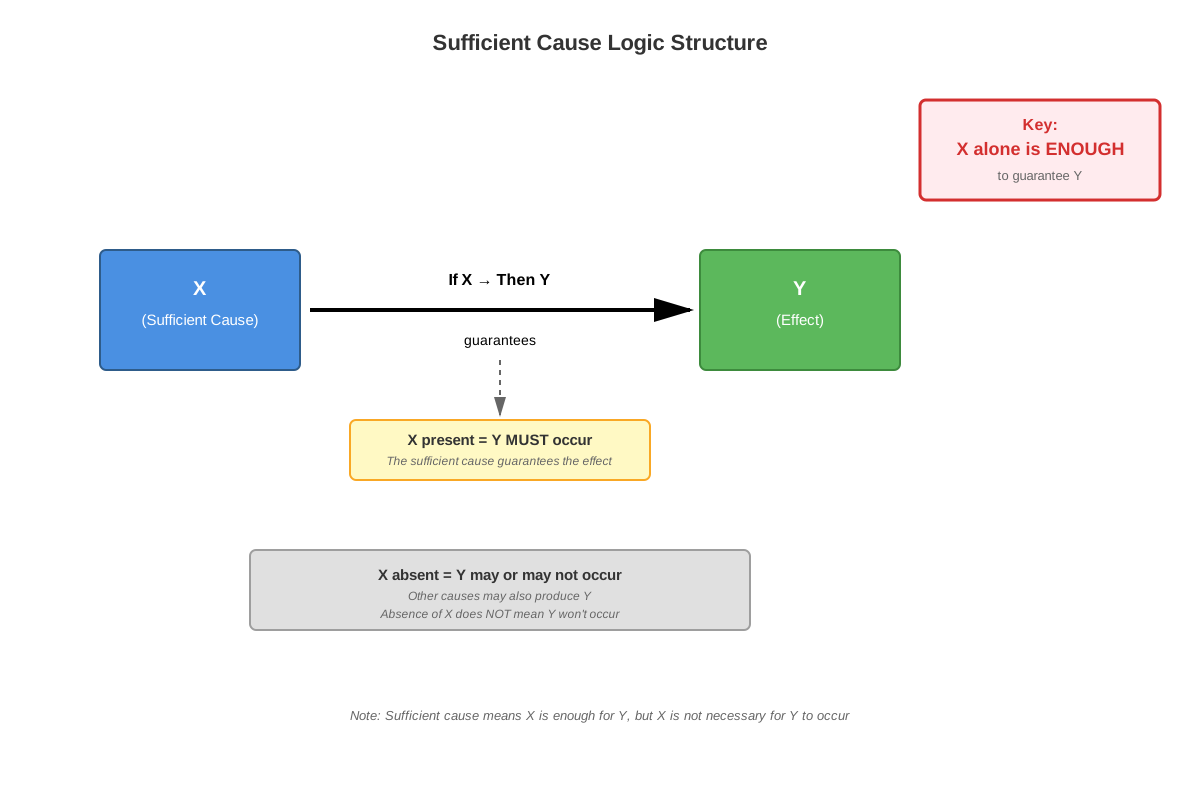
A sufficient cause is a condition or factor that, by itself, is enough to guarantee a particular outcome or effect. In formal terms, if X is a sufficient cause of Y, then whenever X occurs, Y must occur. The relationship follows the logical structure: If X, then Y. Importantly, a sufficient cause doesn't need to be the only way to produce the effect—other factors might also cause Y independently—but when the sufficient cause is present, the effect is inevitable.
Consider this example: Decapitation is a sufficient cause of death. Whenever decapitation occurs, death follows with certainty. This doesn't mean decapitation is the only cause of death (obviously many other factors can cause death), nor does it mean death requires decapitation (death is not necessary for decapitation to be possible, though that's a strange way to think about it). It simply means that decapitation alone guarantees the outcome.
Sufficient Cause vs. Necessary Cause
The distinction between sufficient and necessary causes is crucial for LSAT sufficient cause questions. These concepts are converses of each other:
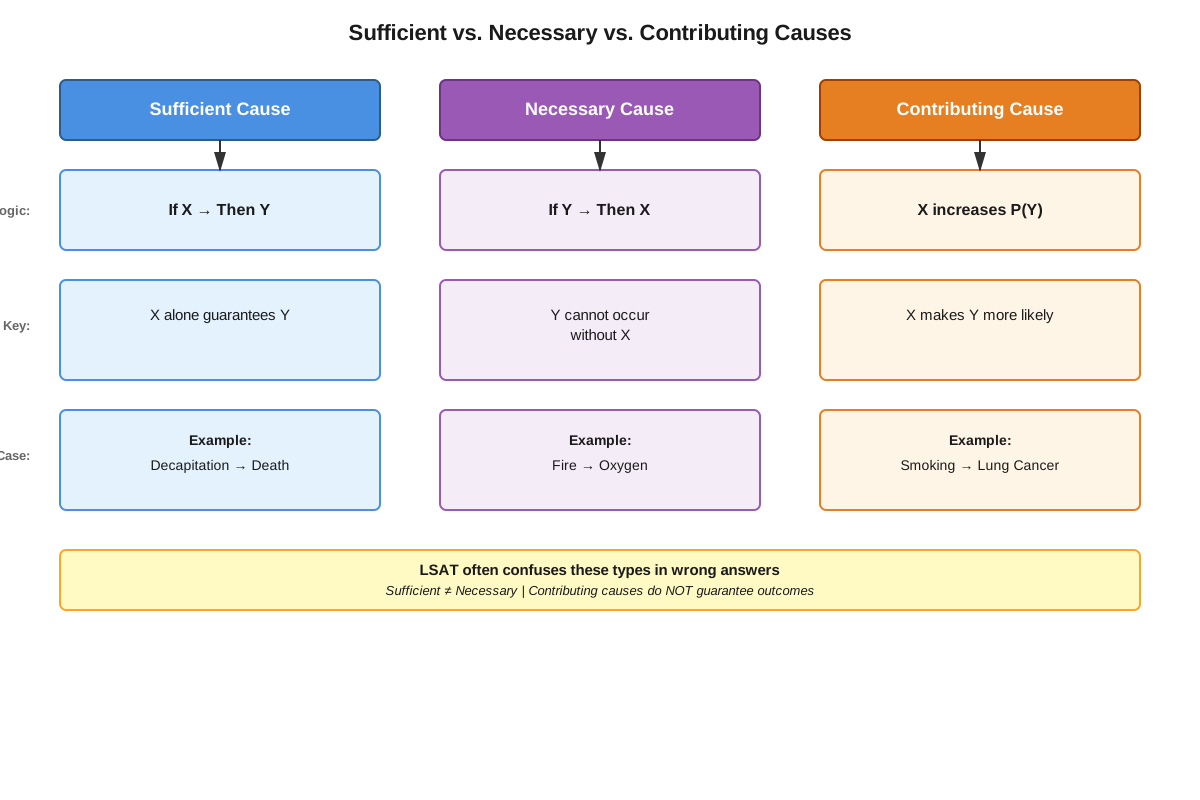
| Aspect | Sufficient Cause | Necessary Cause |
|---|---|---|
| Definition | Enough to guarantee the effect | Required for the effect to occur |
| Logical form | If X, then Y | If Y, then X (or: If not X, then not Y) |
| Presence | When present, effect must occur | Must be present for effect to occur |
| Absence | When absent, effect may still occur | When absent, effect cannot occur |
| Example | Scoring 180 is sufficient for admission | Taking the LSAT is necessary for admission |
Many LSAT wrong answers exploit confusion between these concepts. An argument might establish that X is necessary for Y, but the conclusion incorrectly claims X is sufficient for Y. Recognizing this switch is essential for eliminating flawed reasoning.
Sufficient Cause in Causal Arguments
In causation and explanation questions, arguments often move from observational data to causal conclusions. A typical pattern involves:
- Observation: Two phenomena occur together (correlation)
- Causal claim: One phenomenon causes the other
- Implicit assumption: The cause is sufficient to produce the effect
The logical gap here is substantial. Correlation alone never establishes sufficient causation. Even strong correlation might reflect:
- Reverse causation (Y causes X, not X causes Y)
- Common cause (Z causes both X and Y)
- Coincidence (no causal relationship)
- Contributing factor (X increases likelihood of Y but doesn't guarantee it)
For X to be a sufficient cause of Y, the argument must establish that X alone, without any other factors, invariably produces Y. This requires ruling out alternative explanations and demonstrating the relationship holds universally, not just in observed cases.
Multiple Sufficient Causes
A single effect can have multiple sufficient causes. Death can result from decapitation, heart failure, severe trauma, or numerous other causes—each sufficient on its own. This creates important logical implications:
- Non-exclusivity: Establishing that X is sufficient for Y doesn't mean other factors aren't also sufficient
- Overdetermination: Sometimes multiple sufficient causes occur simultaneously
- Causal complexity: In real-world scenarios, effects often have numerous potential sufficient causes
LSAT questions exploit this by presenting arguments that assume only one sufficient cause exists, when evidence only establishes that one particular cause is sufficient. The argument fails to consider alternative sufficient causes.
Sufficient Cause vs. Contributing Factors
Many LSAT arguments confuse sufficient causes with mere contributing factors. A contributing factor increases the probability or magnitude of an effect without guaranteeing it. Consider:
- Contributing factor: Smoking increases lung cancer risk (but doesn't guarantee it)
- Sufficient cause: Certain genetic mutations guarantee specific diseases
The distinction matters because:
- Contributing factors work probabilistically; sufficient causes work deterministically
- Contributing factors may require other conditions; sufficient causes work alone
- Absence of contributing factors reduces likelihood; absence of sufficient causes doesn't prevent the effect (other sufficient causes may exist)
LSAT wrong answers frequently present evidence of contribution and ask you to accept conclusions about sufficiency, or vice versa.
Conditional Reasoning and Sufficient Cause
The relationship between conditional logic and sufficient cause is direct. Every sufficient cause statement can be expressed as a conditional:
- Sufficient cause form: "X is a sufficient cause of Y"
- Conditional form: "If X, then Y"
- Contrapositive: "If not Y, then not X"
This connection allows you to apply conditional reasoning tools to causal arguments. When an argument claims X is sufficient for Y, you can:
- Test it by looking for cases where X occurs without Y (counterexamples)
- Use the contrapositive: if Y didn't happen, X couldn't have been present
- Identify necessary conditions for X that become necessary for Y
Establishing Sufficient Cause
For an argument to validly conclude that X is a sufficient cause of Y, it must provide evidence that:
- Universal correlation: Every instance of X is accompanied by Y (no exceptions)
- Temporal priority: X precedes Y in time
- Mechanism: There's a plausible causal pathway from X to Y
- No confounding factors: Other variables don't better explain the relationship
- Experimental manipulation: Ideally, introducing X produces Y (though observational evidence can suffice with proper controls)
Most LSAT arguments fail to meet these standards, providing only correlation or limited observations. Recognizing these gaps is key to answering Flaw, Assumption, and Weaken questions correctly.
Concept Relationships
The concept of sufficient cause connects to broader logical reasoning frameworks in several ways:
Sufficient cause → Conditional logic: Every sufficient cause claim translates to a conditional statement, allowing application of conditional reasoning rules (contrapositive, transitive property, etc.).
Sufficient cause ↔ Necessary cause: These are logical converses. If X is sufficient for Y, then Y is necessary for X. Understanding one requires understanding the other, and LSAT questions frequently test whether students confuse them.
Correlation → Sufficient cause: Arguments often move from observed correlation to causal claims. The gap between these requires additional assumptions about ruling out alternative explanations and establishing universality.
Sufficient cause + Sufficient cause → Multiple causal pathways: When multiple sufficient causes exist for the same effect, arguments must account for this complexity rather than assuming a single causal pathway.
Contributing factors + Contributing factors → Sufficient cause: Sometimes multiple contributing factors together become sufficient. For example, neither match nor oxygen alone causes fire, but together they're sufficient. This creates complex causal scenarios LSAT questions exploit.
Sufficient cause → Predictions: If X is truly sufficient for Y, then we can predict with certainty that introducing X will produce Y. Arguments that make predictions implicitly claim sufficient causation.
High-Yield Facts
⭐ A sufficient cause guarantees its effect—whenever the cause is present, the effect must occur.
⭐ Correlation alone never establishes sufficient causation; additional evidence is required to move from "X and Y occur together" to "X is sufficient for Y."
⭐ An effect can have multiple sufficient causes; establishing one sufficient cause doesn't exclude others.
⭐ If X is sufficient for Y, then the contrapositive holds: if Y doesn't occur, X didn't occur.
⭐ Most LSAT causal arguments claim sufficient causation but provide only evidence of correlation or contribution.
- A sufficient cause need not be necessary—the effect can occur through other means.
- Temporal sequence (X before Y) is necessary but not sufficient to establish that X causes Y.
- Eliminating alternative explanations strengthens claims of sufficient causation.
- Experimental evidence (manipulating X and observing Y) is stronger than observational evidence for establishing sufficient cause.
- A factor can be sufficient in some contexts but not others (context-dependent sufficiency).
- Sufficient cause claims are vulnerable to counterexamples—a single instance of X without Y disproves sufficiency.
- Arguments often confuse "X is sufficient for Y" with "X is the only cause of Y" (sufficiency vs. exclusivity).
- The phrase "enough to cause" typically signals a sufficient cause claim.
- Necessary conditions for a sufficient cause become necessary conditions for the effect.
Quick check — test yourself on Sufficient cause so far.
Try Flashcards →Common Misconceptions
Misconception: If X causes Y, then X is a sufficient cause of Y.
Correction: Causation exists on a spectrum. X might contribute to Y, increase the probability of Y, or be one of several factors required for Y, without being sufficient by itself. Sufficient cause is a specific, strong type of causal relationship where X alone guarantees Y.
Misconception: If X is sufficient for Y, then X is necessary for Y.
Correction: Sufficient and necessary are distinct concepts. X can be sufficient for Y (guaranteeing Y when present) while Y can occur through other means (making X unnecessary). For example, a perfect LSAT score is sufficient for admission to most law schools but not necessary—many students are admitted with lower scores.
Misconception: Establishing that X sometimes causes Y proves X is a sufficient cause of Y.
Correction: Sufficient cause requires that X always causes Y, without exception. If X only sometimes produces Y, then X is at most a contributing factor or probabilistic cause, not a sufficient cause. The LSAT frequently presents evidence of occasional causation and asks whether it supports sufficient cause conclusions (it doesn't).
Misconception: If studies show a strong correlation between X and Y, X is a sufficient cause of Y.
Correction: Even perfect correlation doesn't establish sufficient causation. The correlation might reflect reverse causation, common cause, or other confounding factors. Additionally, correlation in observed cases doesn't guarantee the relationship holds universally—there might be unobserved cases where X occurs without Y.
Misconception: Disproving one sufficient cause for an effect means the effect cannot occur.
Correction: Effects typically have multiple potential sufficient causes. Showing that X is not sufficient for Y (or didn't occur in a particular case) doesn't mean Y cannot happen—other sufficient causes might be present. LSAT wrong answers often suggest that eliminating one causal pathway eliminates the possibility of the effect.
Misconception: If X is sufficient for Y, and Y is sufficient for Z, then X is sufficient for Z.
Correction: This is actually correct—sufficient cause relationships are transitive. However, students sometimes incorrectly apply this transitivity when the relationships are mixed (e.g., X is sufficient for Y, but Y is only necessary for Z), leading to invalid conclusions.
Misconception: A sufficient cause must be the most important or primary cause.
Correction: Sufficiency is about guarantee, not importance or magnitude. A minor factor could be sufficient if it alone guarantees the effect, while a major contributing factor might not be sufficient if it requires other conditions to produce the effect.
Worked Examples
Example 1: Identifying Sufficient Cause in a Weaken Question
Stimulus: "Recent studies show that all patients who received Treatment X recovered from Disease D within two weeks. Therefore, Treatment X is sufficient to cure Disease D."
Question: Which of the following, if true, most weakens the argument?
Answer Choices:
(A) Some patients recovered from Disease D without receiving Treatment X.
(B) Treatment X is expensive and not widely available.
(C) All patients in the study also received standard supportive care that alone cures Disease D in most cases.
(D) Disease D is relatively rare in the general population.
(E) Treatment X has some minor side effects.
Analysis:
First, identify the argument structure:
- Premise: All patients who received Treatment X recovered from Disease D
- Conclusion: Treatment X is sufficient to cure Disease D
The argument moves from correlation (Treatment X and recovery occurred together) to sufficient causation (Treatment X alone guarantees recovery). This is a classic lsat sufficient cause reasoning pattern.
For Treatment X to be a sufficient cause, it must be true that Treatment X alone, without other factors, guarantees recovery. The argument assumes no other factors were responsible for the recovery.
Evaluating each choice:
(A) This shows that Treatment X is not necessary for recovery (other paths to recovery exist), but doesn't challenge whether Treatment X is sufficient. When Treatment X is given, recovery might still be guaranteed. This doesn't weaken the argument.
(B) Cost and availability are irrelevant to whether Treatment X is causally sufficient. This is out of scope.
(C) CORRECT. This reveals a confounding factor: all patients received supportive care that alone cures the disease in most cases. This means we cannot conclude Treatment X is sufficient—the recovery might have resulted from the supportive care instead. This directly attacks the causal inference by showing an alternative explanation wasn't ruled out.
(D) The prevalence of the disease doesn't affect whether Treatment X is sufficient to cure it. This is irrelevant to the causal relationship.
(E) Side effects don't impact whether the treatment is causally sufficient for recovery. This is out of scope.
Key takeaway: To weaken a sufficient cause claim, show that the alleged cause doesn't always produce the effect, or that other factors better explain the observed correlation. Choice (C) does the latter by revealing a confounding variable.
Example 2: Sufficient Cause in an Assumption Question
Stimulus: "Whenever the central bank raises interest rates, the stock market declines within the following month. The central bank raised interest rates yesterday. Therefore, the stock market will decline within the next month."
Question: The argument depends on assuming which of the following?
Answer Choices:
(A) The central bank's interest rate increases are the only factor that can cause stock market declines.
(B) No factors that would prevent the usual effect of interest rate increases will be present this time.
(C) The stock market has never declined without a preceding interest rate increase.
(D) Interest rate increases are necessary for stock market declines.
(E) The central bank should not have raised interest rates.
Analysis:
Identify the argument structure:
- Premise 1: Whenever interest rates rise, the stock market declines (establishing a pattern)
- Premise 2: Interest rates just rose
- Conclusion: The stock market will decline
This argument treats interest rate increases as a sufficient cause of stock market decline. The logical form is:
- If interest rates rise → stock market declines
- Interest rates rose
- Therefore, stock market will decline
This is valid conditional reasoning IF the conditional relationship holds universally. The argument assumes the pattern observed in the past will continue—that nothing will interfere with the usual causal relationship.
Evaluating each choice:
(A) The argument doesn't require that interest rate increases are the ONLY cause of stock market declines. Multiple sufficient causes can exist. The argument only requires that interest rate increases are sufficient, not exclusive. This is too strong.
(B) CORRECT. For the sufficient cause relationship to produce its usual effect, no interfering factors can be present. The argument assumes that this time will be like past times—the causal mechanism will operate normally. If some unusual factor (like a major technological breakthrough or policy change) prevents the usual effect, the conclusion fails. This assumption is necessary for the argument.
(C) This would make interest rate increases necessary for stock market declines, but the argument only claims they're sufficient. The argument doesn't depend on this. This confuses necessary and sufficient conditions.
(D) Same error as (C)—this states a necessary condition when the argument is about sufficiency.
(E) This is a normative claim about what should happen, but the argument is descriptive/predictive. The argument doesn't depend on whether the rate increase was good policy.
Key takeaway: Arguments that apply sufficient cause reasoning to make predictions assume no interfering factors will prevent the usual causal mechanism from operating. This is a common assumption pattern in causation and explanation questions.
Exam Strategy
Trigger Words and Phrases
Watch for language that signals sufficient cause claims:
- "enough to cause/produce/guarantee"
- "ensures that," "guarantees that"
- "whenever X occurs, Y follows"
- "X alone causes Y"
- "sufficient to bring about"
- "inevitably leads to"
- "X is responsible for Y"
Also recognize when arguments move from weaker causal language to sufficient cause conclusions:
- Premise: "associated with," "correlated with," "linked to"
- Conclusion: "causes," "produces," "is sufficient for"
This shift signals a logical gap you'll likely need to address.
Approaching Different Question Types
Weaken Questions: Look for answer choices that:
- Provide counterexamples (X occurred without Y)
- Reveal confounding variables (Z better explains the correlation)
- Show reverse causation (Y actually causes X)
- Demonstrate the relationship is merely probabilistic, not deterministic
Strengthen Questions: Look for answer choices that:
- Rule out alternative explanations
- Provide experimental evidence (manipulating X produces Y)
- Show the relationship holds across diverse contexts
- Eliminate potential confounding variables
Flaw Questions: Identify when arguments:
- Conclude sufficient causation from mere correlation
- Assume a contributing factor is sufficient
- Confuse sufficient and necessary conditions
- Fail to consider alternative sufficient causes
- Overgeneralize from limited observations
Assumption Questions: The argument often assumes:
- No interfering factors will prevent the causal mechanism
- The observed pattern will continue
- Alternative explanations have been ruled out
- The correlation reflects causation rather than coincidence
Process of Elimination
Eliminate answer choices that:
- Confuse sufficient and necessary conditions (very common trap)
- Address whether the cause is the ONLY cause (sufficiency doesn't require exclusivity)
- Discuss the importance or magnitude of the cause (irrelevant to sufficiency)
- Are out of scope (don't address the causal relationship)
- Strengthen when you need to weaken, or vice versa
Time Allocation
Sufficient cause questions typically require careful analysis of the logical structure. Allocate:
- 30-40 seconds: Reading and understanding the stimulus
- 20-30 seconds: Identifying the conclusion and causal claim
- 40-50 seconds: Evaluating answer choices
- Total: 90-120 seconds per question
Don't rush the initial analysis—correctly identifying the causal claim and its logical structure makes answer choice evaluation much faster.
Memory Techniques
The GUARANTEE Mnemonic
For remembering what sufficient cause means:
- Guarantees the effect
- Universal (no exceptions)
- Alone is enough
- Requires no other factors
- Always produces the effect
- Not necessarily the only cause
- Testable by counterexamples
- Expressed as "If X, then Y"
Visualization Strategy
Picture sufficient cause as a vending machine: when you insert the correct coins (sufficient cause), the snack (effect) always comes out. You don't need to do anything else—the coins alone are sufficient. However, there might be other ways to get snacks (other sufficient causes), and the machine might work even if you use different payment methods (multiple sufficient causes).
The Sufficient vs. Necessary Distinction
Remember: "Sufficient = Enough; Necessary = Need"
- Sufficient: "I have ENOUGH money" (guarantees I can buy it)
- Necessary: "I NEED money" (required, but might need other things too)
Correlation to Causation Bridge
Visualize the gap between correlation and sufficient cause as a bridge with missing planks:
- Plank 1: Rule out reverse causation
- Plank 2: Rule out common cause
- Plank 3: Establish temporal priority
- Plank 4: Show universal relationship (no exceptions)
- Plank 5: Identify causal mechanism
Arguments that jump from correlation to sufficient cause without these planks are vulnerable.
Summary
Sufficient cause represents a specific, strong type of causal relationship where one factor alone guarantees a particular outcome. On the LSAT, understanding sufficient cause means recognizing when arguments claim that X is enough by itself to produce Y, and evaluating whether the evidence supports this strong claim. The key distinction is between sufficient causes (which guarantee effects), necessary causes (which are required for effects), and contributing factors (which increase probability without guaranteeing outcomes). Most LSAT arguments fail to adequately establish sufficient causation, instead providing only correlation or evidence of contribution. Success on sufficient cause questions requires identifying the logical gap between the evidence presented and the causal conclusion drawn, then selecting answer choices that either exploit this gap (in Weaken and Flaw questions) or fill it (in Strengthen and Assumption questions). The formal connection to conditional logic—sufficient cause as "If X, then Y"—provides powerful tools for analysis, including the use of contrapositives and identification of counterexamples. Mastering sufficient cause is essential for high performance on Logical Reasoning sections, as these concepts appear across multiple question types and constitute a significant portion of causation-based questions.
Key Takeaways
- Sufficient cause means one factor alone guarantees an outcome—whenever the cause is present, the effect must follow without exception
- Correlation never establishes sufficient causation—arguments that move from "X and Y occur together" to "X is sufficient for Y" contain a logical gap requiring additional support
- Sufficient and necessary are distinct concepts—sufficient means "enough to guarantee," while necessary means "required for"; confusing these is a common LSAT trap
- Multiple sufficient causes can exist for the same effect—proving X is sufficient for Y doesn't mean X is the only way to produce Y
- Counterexamples disprove sufficient cause claims—a single instance where X occurs without Y demonstrates that X is not sufficient for Y
- Sufficient cause translates to conditional logic—"X is sufficient for Y" means "If X, then Y," allowing application of conditional reasoning tools
- Most LSAT causal arguments are vulnerable because they assume sufficient causation without adequate evidence—recognizing this pattern is key to success on Weaken, Flaw, and Assumption questions
Related Topics
Necessary Cause: Understanding necessary causes (conditions required for an effect) complements sufficient cause knowledge and is essential for avoiding confusion between these concepts. Mastering sufficient cause makes learning necessary cause more efficient since they're logical converses.
Conditional Logic: Sufficient cause is a specific application of conditional reasoning to causal scenarios. Deepening your understanding of conditional logic more broadly will strengthen your ability to analyze sufficient cause arguments.
Correlation vs. Causation: This foundational distinction underlies most sufficient cause questions. Further study of how to evaluate causal claims from correlational evidence will enhance your performance on these questions.
Causal Chains and Complex Causation: Many LSAT arguments involve multiple causal steps or interactions between causes. Understanding sufficient cause provides the foundation for analyzing these more complex causal scenarios.
Experimental Design and Evidence Evaluation: Learning how different types of evidence (experimental vs. observational, controlled vs. uncontrolled) support or fail to support causal claims will deepen your ability to evaluate sufficient cause arguments.
Practice CTA
Now that you've mastered the core concepts of sufficient cause, it's time to apply this knowledge to actual LSAT questions. The practice questions and flashcards will help you recognize sufficient cause patterns quickly, distinguish them from other causal relationships, and select correct answers with confidence. Remember: understanding the theory is just the first step—consistent practice with real LSAT questions is what transforms knowledge into points on test day. Challenge yourself to identify the sufficient cause claim in each argument, evaluate whether the evidence supports it, and predict the correct answer before looking at the choices. You've built a strong foundation—now strengthen it through deliberate practice!
Sign up free to keep reading
Create a free AnvayaPrep account to finish this LSAT guide on Sufficient cause — plus flashcards and practice questions.