Overview
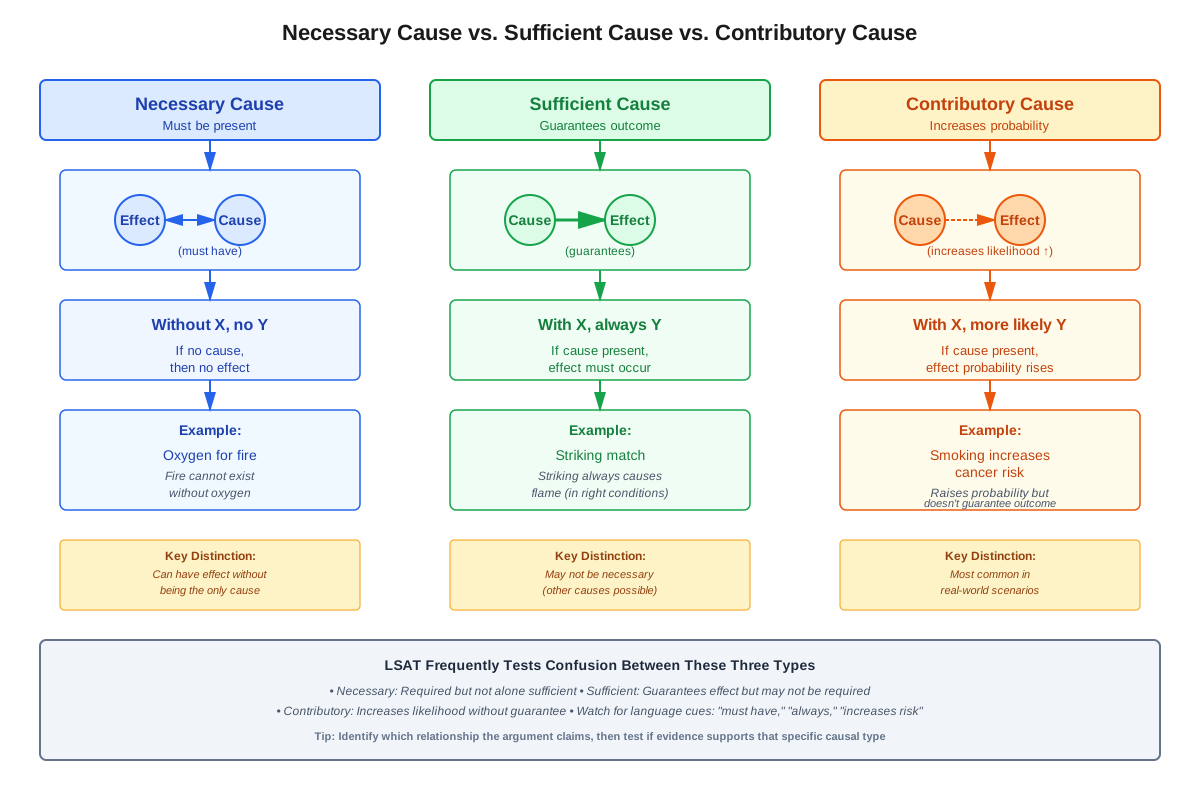
Necessary cause is a fundamental concept in LSAT Logical Reasoning that appears frequently in questions involving causation and explanation. Understanding necessary causes is critical for success on the LSAT because it represents one of the most commonly tested causal reasoning patterns. A necessary cause is a condition that must be present for an effect to occur—without it, the effect cannot happen. This differs from sufficient causes (which guarantee an effect) and contributory causes (which merely increase the likelihood of an effect).
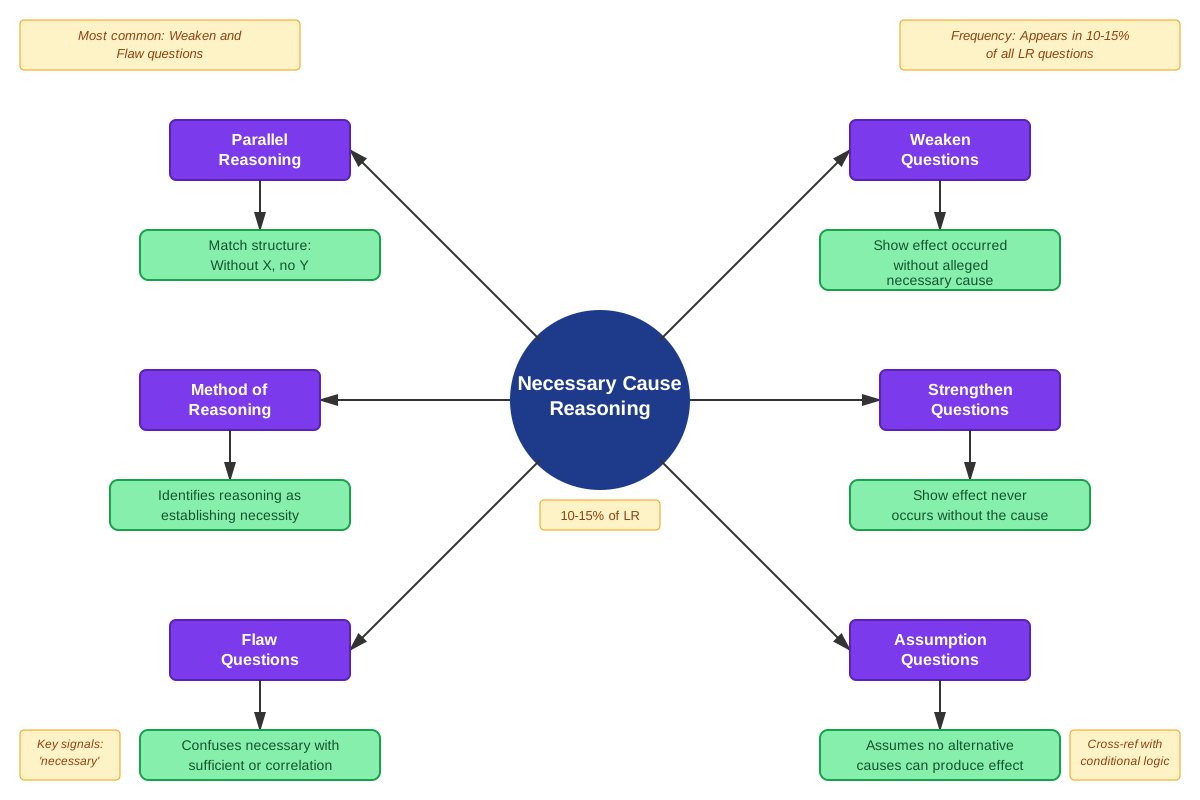
The concept of LSAT necessary cause reasoning appears across multiple question types, including Strengthen, Weaken, Assumption, Flaw, and Method of Reasoning questions. Test-makers frequently construct arguments that confuse necessary and sufficient conditions, or that incorrectly assume a factor is necessary when it is merely contributory. Students who master necessary cause reasoning gain a significant advantage in identifying logical gaps, evaluating evidence, and predicting how arguments can be attacked or supported.
Within the broader framework of causation and explanation, necessary cause reasoning sits alongside sufficient cause, contributory cause, and correlation-versus-causation reasoning. These concepts form an interconnected web of causal logic that underlies approximately 15-20% of all Logical Reasoning questions. Mastering necessary causes provides the foundation for understanding more complex causal chains, joint causation scenarios, and the distinction between conditions that enable effects versus those that trigger them. This topic directly connects to conditional reasoning (necessary and sufficient conditions) and strengthens overall analytical skills essential for LSAT success.
Learning Objectives
- [ ] Identify how Necessary cause appears in LSAT questions
- [ ] Explain the reasoning pattern behind Necessary cause
- [ ] Apply Necessary cause to solve LSAT-style problems accurately
- [ ] Distinguish necessary causes from sufficient causes and contributory factors in argument structures
- [ ] Recognize common logical flaws involving necessary cause reasoning
- [ ] Predict how arguments involving necessary causes can be strengthened or weakened
- [ ] Evaluate whether evidence supports a claim that a factor is necessary for an outcome
Prerequisites
- Basic conditional logic: Understanding "if-then" statements is essential because necessary causes function similarly to necessary conditions in conditional reasoning
- Correlation versus causation: Distinguishing between mere association and causal relationships provides the foundation for understanding different types of causal claims
- Argument structure identification: Recognizing premises, conclusions, and assumptions enables students to locate where necessary cause reasoning appears in arguments
- Basic logical operators: Familiarity with terms like "all," "some," "only," and "unless" helps identify necessary cause language in stimulus passages
Why This Topic Matters
Necessary cause reasoning appears in real-world contexts ranging from medical diagnosis (identifying conditions required for disease development) to legal reasoning (establishing elements required for liability) to policy analysis (determining prerequisites for social outcomes). Professionals in law, medicine, and public policy regularly evaluate whether certain factors are truly necessary for outcomes or merely correlated with them. The ability to distinguish necessary causes from other causal relationships prevents flawed decision-making and supports rigorous analytical thinking.
On the LSAT, necessary cause reasoning appears in approximately 10-15% of Logical Reasoning questions, making it one of the highest-yield topics for test preparation. This concept most commonly appears in Weaken questions (where students must show a factor isn't necessary), Strengthen questions (where students must provide evidence that a factor is necessary), Assumption questions (where the argument assumes something is necessary), and Flaw questions (where arguments incorrectly treat factors as necessary). The concept also appears in Parallel Reasoning and Method of Reasoning questions that test understanding of causal argument structures.
Common manifestations in LSAT passages include arguments claiming that eliminating a factor will eliminate an effect, arguments that assume a factor must be present for an outcome, and arguments that confuse necessary causes with sufficient causes. Test-makers frequently present scenarios where multiple factors contribute to an outcome, then construct arguments that incorrectly identify one factor as necessary. Recognizing these patterns enables students to quickly identify logical vulnerabilities and select correct answer choices.
Core Concepts
Definition of Necessary Cause
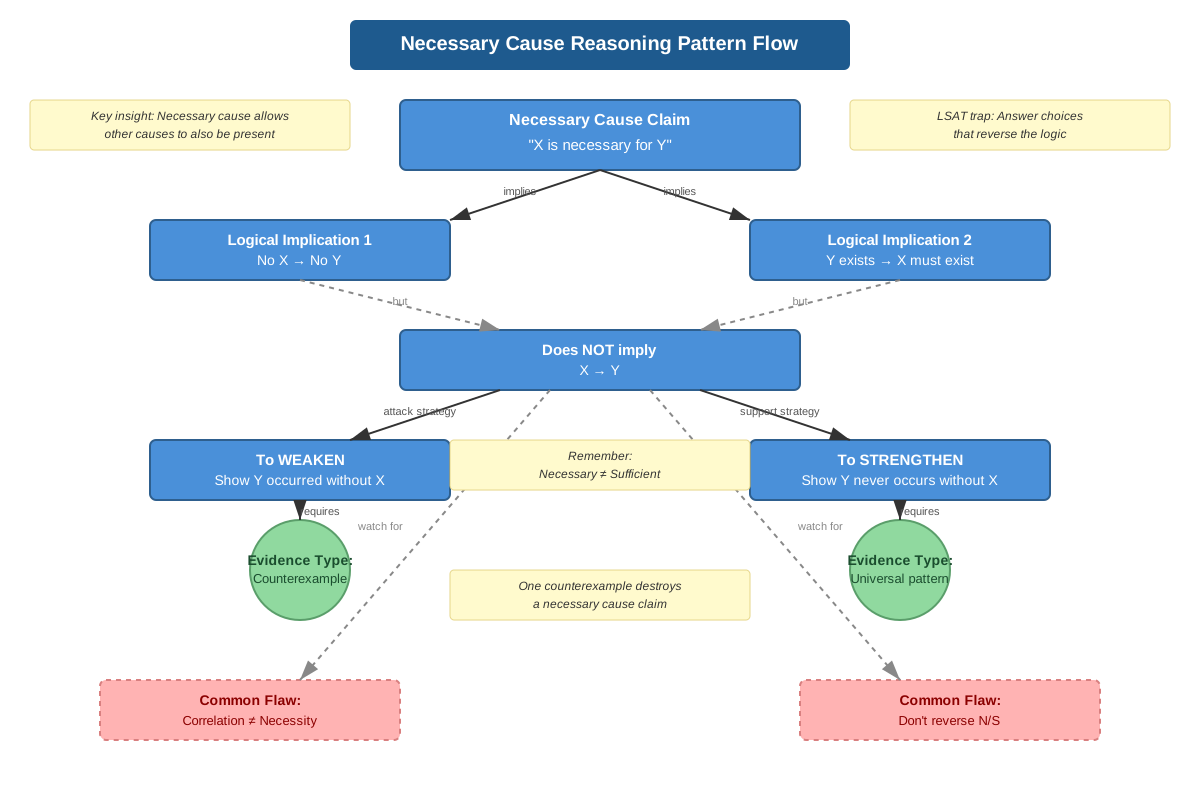
A necessary cause is a factor that must be present for an effect to occur. In logical terms, if X is a necessary cause of Y, then Y cannot occur without X. This creates a conditional relationship: if Y occurs, then X must have occurred. Conversely, if X is absent, Y cannot occur. The key insight is that necessary causes work backward from effect to cause—the presence of the effect guarantees the presence of the necessary cause.
The formal logical structure of necessary cause can be expressed as:
- If Effect → Necessary Cause must be present
- If Necessary Cause absent → Effect cannot occur
This differs fundamentally from sufficient causes, which work forward from cause to effect. A sufficient cause guarantees an outcome, but the outcome might occur through other means. A necessary cause doesn't guarantee the outcome (other factors may also be required), but the outcome cannot occur without it.
Distinguishing Necessary from Sufficient Causes
Understanding the distinction between necessary and sufficient causes is crucial for LSAT success. This comparison appears frequently in wrong answer choices and logical flaws:
| Aspect | Necessary Cause | Sufficient Cause |
|---|---|---|
| Definition | Must be present for effect | Guarantees the effect |
| Logical direction | Effect → Cause | Cause → Effect |
| Absence | No cause = no effect | No cause = effect might still occur |
| Presence | Cause present = effect might occur | Cause present = effect must occur |
| Example | Oxygen is necessary for fire | Striking a match is sufficient for fire (in right conditions) |
Many LSAT arguments commit the flaw of treating a sufficient cause as if it were necessary, or vice versa. For example, an argument might observe that education improves economic outcomes (sufficient) and conclude that without education, economic improvement is impossible (treating it as necessary). Recognizing this confusion is essential for identifying flawed reasoning.
Multiple Necessary Causes and Joint Causation
Effects often require multiple necessary causes working together. Fire requires oxygen, fuel, and heat—all three are individually necessary, and together they are sufficient. This concept of joint causation frequently appears in complex LSAT arguments.
When multiple factors are each necessary:
- The absence of any single factor prevents the effect
- The presence of all factors together may be sufficient
- Arguments that focus on only one necessary factor may overlook others
LSAT questions often exploit this by presenting arguments that identify one necessary cause while ignoring others, or by providing answer choices that introduce additional necessary factors that weaken or strengthen the argument.
Necessary Cause Language Patterns
Recognizing how necessary causes are expressed in LSAT language is critical for quick identification:
Strong necessary cause indicators:
- "required for"
- "essential to"
- "prerequisite for"
- "cannot occur without"
- "only if"
- "depends on"
- "impossible without"
Weaker or conditional language:
- "needed for"
- "necessary for"
- "must have"
- "relies on"
The word "only" is particularly important. "X only if Y" means Y is necessary for X. This translates to: If X → Y, and contrapositive: If not Y → not X.
Testing Whether Something Is a Necessary Cause
To evaluate whether a factor is truly necessary for an outcome, apply this test:
- Can the effect occur without the factor?
- If yes, the factor is not necessary (it may be sufficient or contributory)
- If no, the factor is necessary
LSAT questions frequently test this by providing scenarios where:
- The effect occurred without the alleged necessary cause (weakens necessity claim)
- The effect never occurs without the factor (strengthens necessity claim)
- Alternative pathways to the effect exist (weakens necessity claim)
Common Argument Patterns Involving Necessary Causes
Several recurring argument structures involve necessary cause reasoning:
Pattern 1: Claiming Elimination Prevents Effect
- Premise: Factor X is necessary for Effect Y
- Conclusion: Eliminating X will prevent Y
- Vulnerability: Other necessary factors might still produce Y through different mechanisms
Pattern 2: Assuming Necessity from Correlation
- Premise: X and Y always occur together
- Conclusion: X is necessary for Y
- Flaw: Correlation doesn't establish necessity; Y might cause X, or both might share a common cause
Pattern 3: Confusing Necessary with Sufficient
- Premise: X is present whenever Y occurs
- Conclusion: X causes Y (treating X as sufficient)
- Flaw: X might be necessary but not sufficient; other factors might be required
Concept Relationships
Necessary cause reasoning connects intimately with conditional logic—the statement "X is necessary for Y" translates directly to the conditional "If Y, then X." This connection means that skills in diagramming and manipulating conditional statements transfer directly to necessary cause analysis. The contrapositive relationship is particularly important: if X is necessary for Y, then the absence of X guarantees the absence of Y.
Within causation and explanation, necessary causes form one vertex of a triangle with sufficient causes and contributory causes. Sufficient causes guarantee outcomes, contributory causes increase likelihood, and necessary causes establish prerequisites. Many complex LSAT arguments involve factors that play multiple roles—something might be both necessary and sufficient, or necessary but not sufficient.
The relationship map flows as follows:
Conditional Logic → provides logical framework → Necessary Cause Reasoning → combines with → Sufficient Cause Reasoning → together form → Complete Causal Analysis → enables evaluation of → Complex Causal Arguments → which appear in → Strengthen/Weaken/Assumption Questions
Understanding necessary causes also connects to assumption identification because unstated necessary causes often function as assumptions. If an argument concludes that eliminating X will prevent Y, it assumes X is necessary for Y. Recognizing this pattern enables quick identification of assumption questions involving causal reasoning.
High-Yield Facts
⭐ A necessary cause must be present for an effect to occur; without it, the effect cannot happen
⭐ If a factor is necessary for an outcome, the outcome's presence guarantees the factor's presence (If Effect → Necessary Cause)
⭐ Showing that an effect can occur without a factor proves that factor is not necessary
⭐ "Only if" introduces a necessary condition: "X only if Y" means Y is necessary for X
⭐ Necessary causes work backward from effect to cause, while sufficient causes work forward from cause to effect
- Multiple factors can each be necessary for a single effect (joint causation)
- A factor can be necessary without being sufficient—its presence doesn't guarantee the effect
- Eliminating a necessary cause will prevent the effect, but eliminating a non-necessary factor may not
- The contrapositive of necessary cause reasoning is: if the necessary cause is absent, the effect cannot occur
- Arguments often confuse factors that are merely present when an effect occurs with factors that are necessary for the effect
Quick check — test yourself on Necessary cause so far.
Try Flashcards →Common Misconceptions
Misconception: If something is always present when an effect occurs, it must be a necessary cause.
Correction: Constant presence suggests correlation but doesn't prove necessity. The factor might be an effect rather than a cause, or both might share a common cause. To establish necessity, one must show the effect cannot occur without the factor.
Misconception: Necessary causes are more important than sufficient causes in causal reasoning.
Correction: Neither is inherently more important; they serve different logical functions. Necessary causes establish prerequisites, while sufficient causes establish guarantees. LSAT questions test both equally, and many arguments involve confusion between the two.
Misconception: If multiple factors are each necessary, then any one of them alone is sufficient.
Correction: When multiple factors are each necessary, all must be present for the effect. Each individual factor is necessary but not sufficient. Only the combination of all necessary factors becomes sufficient.
Misconception: Eliminating a contributory cause will prevent an effect.
Correction: Contributory causes increase the likelihood of an effect but aren't required for it. Eliminating a contributory cause may reduce the frequency or intensity of an effect, but only eliminating a necessary cause guarantees prevention.
Misconception: The word "necessary" in an argument always signals necessary cause reasoning.
Correction: Context matters. "Necessary" might refer to necessary conditions in conditional logic, practical necessity, or moral necessity. Evaluate the logical structure, not just keyword presence.
Misconception: If X is necessary for Y, then X causes Y.
Correction: Necessity establishes a prerequisite relationship, not necessarily a causal one. Oxygen is necessary for fire, but oxygen doesn't cause fire—it enables it. The distinction between enabling conditions and triggering causes is subtle but important.
Worked Examples
Example 1: Identifying Necessary Cause Reasoning
Stimulus: "The recent decline in urban crime rates cannot be attributed to increased police presence alone. After all, several cities that reduced their police forces also experienced declining crime rates during the same period."
Question: Which of the following principles underlies the reasoning above?
Analysis:
The argument structure involves necessary cause reasoning. The conclusion states that increased police presence alone cannot explain (is not necessary for) declining crime rates. The evidence shows that the effect (declining crime rates) occurred without the alleged cause (increased police presence) in some cities.
Step-by-step reasoning:
- Identify the causal claim being challenged: "Increased police presence causes declining crime rates"
- Recognize the argument treats this as a necessary cause claim: "Declining crime rates require increased police presence"
- Note the evidence: Cities with reduced police forces had declining crime rates
- Apply the necessary cause test: If the effect (declining crime) occurred without the factor (increased police), the factor is not necessary
- The principle: If an effect can occur without a factor, that factor is not necessary for the effect
Connection to learning objectives: This example demonstrates how to identify necessary cause reasoning in LSAT passages (Objective 1) and shows the logical pattern where evidence of the effect occurring without the alleged cause disproves necessity (Objective 2).
Example 2: Applying Necessary Cause to Weaken a Claim
Stimulus: "Vitamin D supplementation is essential for preventing bone density loss in adults over 50. Studies show that adults over 50 with adequate vitamin D levels consistently maintain better bone density than those with deficient levels."
Question: Which of the following, if true, most weakens the argument?
Correct Answer: "Many adults over 50 who maintain excellent bone density obtain sufficient vitamin D through sun exposure and diet without taking supplements."
Analysis:
The argument claims vitamin D supplementation is essential (necessary) for preventing bone density loss. The evidence shows correlation between vitamin D levels and bone density, but the conclusion specifically claims supplementation is necessary.
Step-by-step reasoning:
- Identify the necessary cause claim: "Supplementation is essential (necessary) for preventing bone density loss"
- Recognize what would weaken this: showing the effect (maintained bone density) can occur without the alleged necessary cause (supplementation)
- Evaluate the answer: It shows people achieving the desired outcome (preventing bone density loss) without supplementation
- This proves supplementation is not necessary—adequate vitamin D is necessary, but supplementation is just one way to achieve it
- The argument confused a specific means (supplementation) with the general requirement (adequate vitamin D)
Common trap answers:
- "Vitamin D supplementation also provides other health benefits" (irrelevant to whether it's necessary for bone density)
- "Some people over 50 take vitamin D supplements but still experience bone density loss" (this would show it's not sufficient, not that it's not necessary)
Connection to learning objectives: This example shows how to apply necessary cause reasoning to solve LSAT problems (Objective 3) and demonstrates distinguishing necessary causes from specific means of achieving them (Objective 4).
Exam Strategy
When approaching LSAT questions involving necessary cause reasoning, follow this systematic process:
Step 1: Identify the causal claim (10-15 seconds)
Look for language indicating something is required, essential, or prerequisite for an outcome. Flag words like "necessary," "required," "essential," "cannot occur without," "only if," and "depends on."
Step 2: Determine the direction of reasoning (5-10 seconds)
Ask: Is the argument claiming that X is necessary for Y, or that X is sufficient for Y? Remember that necessary causes work backward (effect → cause), while sufficient causes work forward (cause → effect).
Step 3: Apply the appropriate test (varies by question type)
For Weaken questions: Look for answers showing the effect can occur without the alleged necessary cause, or showing the cause can be absent when the effect occurs.
For Strengthen questions: Look for answers showing the effect never occurs without the factor, or showing that whenever the cause is absent, the effect is absent.
For Assumption questions: Identify what necessary cause the argument takes for granted. Often the argument assumes no alternative pathways exist to the effect.
For Flaw questions: Look for confusion between necessary and sufficient, or for treating a contributory factor as if it were necessary.
Trigger phrases to watch for:
- "Cannot occur without" → strong necessary cause claim
- "Only if" → introduces necessary condition
- "Required for" / "Essential to" → necessary cause language
- "Depends on" / "Relies on" → suggests necessity
- "Whenever X, then Y" → might be confused with necessity (actually suggests sufficiency)
Process of elimination tips:
- Eliminate answers that address sufficient causes when the argument concerns necessary causes
- Eliminate answers that show the factor is merely correlated with the outcome
- Eliminate answers that address the frequency or intensity of the effect rather than whether it can occur at all
- Keep answers that provide alternative pathways to the effect (these weaken necessity claims)
Time allocation:
Spend 15-20 seconds on initial reading to identify the causal structure, then 30-40 seconds evaluating answer choices. If you correctly identify the necessary cause reasoning pattern, you can often predict the correct answer before reading choices, saving 10-15 seconds.
Memory Techniques
NEED Acronym for Necessary Cause:
- No effect without it
- Effect guarantees its presence
- Eliminating it prevents effect
- Direction: effect → cause
Visualization Strategy:
Picture a necessary cause as a foundation or platform. The effect (a building) cannot exist without the foundation. You can have a foundation without a building (necessary but not sufficient), but you cannot have a building without a foundation. This image helps distinguish necessary from sufficient causes.
"Only If" Memory Device:
Remember: "X only if Y" = "Y is necessary for X"
Mnemonic: "Only If" = "Outcome Needs It First"
The condition after "only if" must come first (is necessary) for the condition before it.
Contrapositive Connection:
Link necessary cause to conditional logic with: "Necessary = Negate and Flip"
If X is necessary for Y: Y → X
Contrapositive: No X → No Y (eliminating necessary cause prevents effect)
Sufficient vs. Necessary Quick Check:
- Sufficient = "Sure thing" (guarantees outcome)
- Necessary = "Need it" (required for outcome)
Summary
Necessary cause reasoning represents a critical pattern in LSAT Logical Reasoning that appears across multiple question types. A necessary cause is a factor that must be present for an effect to occur—without it, the effect cannot happen. This creates a logical relationship where the presence of the effect guarantees the presence of the necessary cause (If Effect → Necessary Cause), and the absence of the necessary cause guarantees the absence of the effect. Understanding necessary causes requires distinguishing them from sufficient causes (which guarantee effects) and contributory causes (which merely increase likelihood). LSAT arguments frequently confuse these categories or incorrectly assume factors are necessary when they are merely correlated with outcomes. To weaken a necessary cause claim, show the effect can occur without the factor; to strengthen it, show the effect never occurs without the factor. Mastering this reasoning pattern enables students to quickly identify argument structures, predict vulnerabilities, and select correct answers in Strengthen, Weaken, Assumption, and Flaw questions involving causation.
Key Takeaways
- A necessary cause must be present for an effect to occur; the effect's presence guarantees the necessary cause's presence
- Necessary causes work backward (effect → cause), while sufficient causes work forward (cause → effect)
- To disprove that something is necessary, show the effect can occur without it
- "Only if" introduces a necessary condition: "X only if Y" means Y is necessary for X
- Multiple factors can each be necessary for a single effect; all must be present for the effect to occur
- LSAT arguments frequently confuse necessary causes with sufficient causes or treat contributory factors as if they were necessary
- Recognizing necessary cause language patterns ("required for," "essential to," "cannot occur without") enables quick identification of this reasoning type
Related Topics
Sufficient Cause Reasoning: Understanding factors that guarantee outcomes complements necessary cause knowledge and enables recognition of arguments that confuse the two categories. Mastering necessary causes provides the foundation for distinguishing sufficient conditions.
Conditional Logic: The formal structure of necessary and sufficient conditions underlies necessary cause reasoning. Advanced conditional logic skills enhance the ability to diagram and manipulate necessary cause relationships.
Correlation versus Causation: Distinguishing mere association from causal relationships builds on necessary cause understanding. Many arguments incorrectly infer necessity from correlation.
Causal Chains and Complex Causation: After mastering necessary causes, students can tackle arguments involving multiple causal steps, feedback loops, and interactive effects where several factors jointly produce outcomes.
Assumption Questions: Many assumptions in LSAT arguments involve unstated necessary causes. Mastering necessary cause reasoning dramatically improves performance on assumption questions.
Practice CTA
Now that you understand necessary cause reasoning, apply these concepts to practice questions and flashcards. Focus on identifying the causal structure quickly, distinguishing necessary from sufficient causes, and predicting how arguments can be strengthened or weakened. Each practice question reinforces pattern recognition and builds the speed essential for LSAT success. Remember: mastering necessary cause reasoning provides a significant advantage across 10-15% of Logical Reasoning questions—this investment in practice will yield substantial score improvements. Start with untimed practice to build accuracy, then gradually increase speed as the patterns become automatic.
Sign up free to keep reading
Create a free AnvayaPrep account to finish this LSAT guide on Necessary cause — plus flashcards and practice questions.