Overview
Temporal sequence evidence is a foundational concept in LSAT Logical Reasoning that addresses one of the most common reasoning patterns tested on the exam: the relationship between events that occur in sequence and the causal claims drawn from that sequence. At its core, temporal sequence evidence involves observing that Event A occurred before Event B and then inferring that A caused B. This reasoning pattern appears frequently in LSAT questions because it represents a fundamental logical vulnerability—the confusion between correlation and causation based solely on temporal ordering.
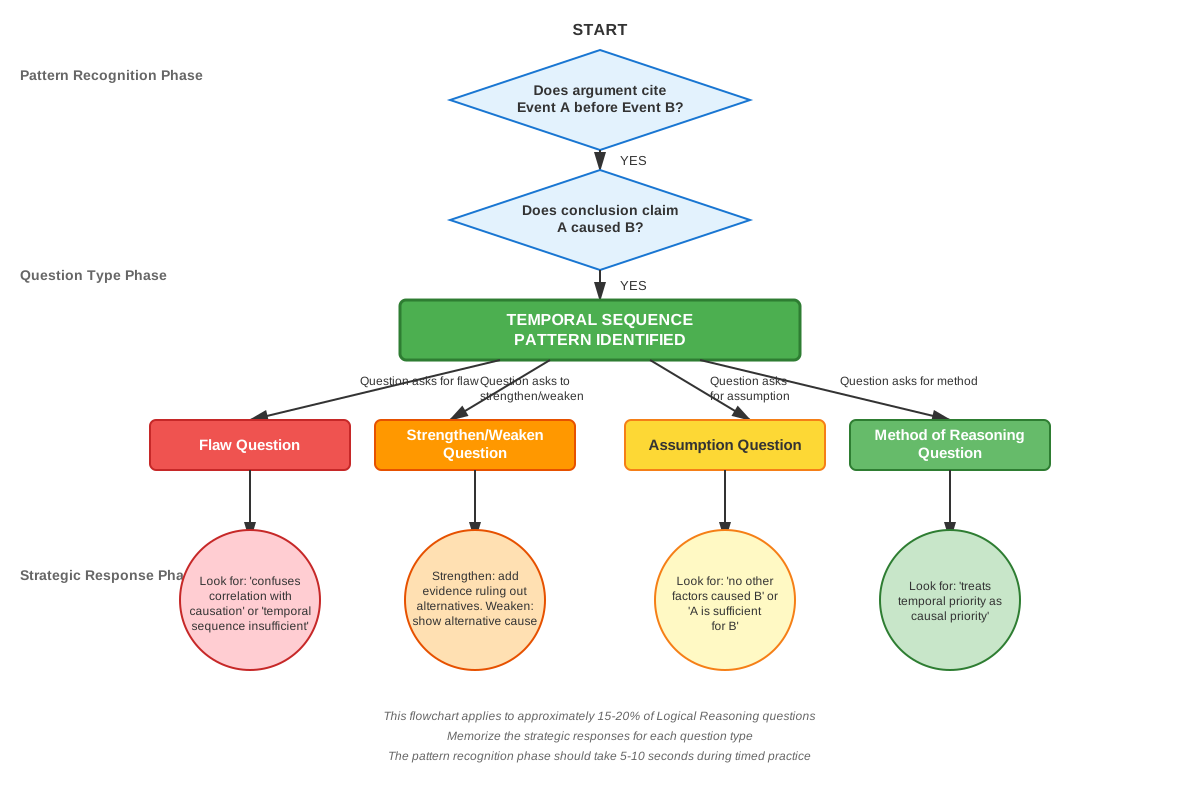
Understanding LSAT temporal sequence evidence is essential for success on the exam because it underlies numerous question types, including Flaw questions, Strengthen/Weaken questions, Assumption questions, and Method of Reasoning questions. The LSAT tests whether students can recognize when an argument inappropriately relies on temporal sequence alone to establish causation, and whether they can identify what additional evidence would be needed to support or undermine such causal claims. This concept sits at the heart of the broader Causation and Explanation unit, which examines how arguments establish, challenge, and reason about causal relationships.
The relationship between temporal sequence and causation represents a critical thinking skill that extends beyond the LSAT into legal reasoning, scientific methodology, and everyday decision-making. On the exam, mastering this topic enables students to quickly identify argument structures, predict correct answers, and eliminate trap choices that exploit common logical errors. Because temporal sequence reasoning appears in approximately 15-20% of Logical Reasoning questions, developing expertise in this area provides significant score improvement potential.
Learning Objectives
- [ ] Identify how Temporal sequence evidence appears in LSAT questions
- [ ] Explain the reasoning pattern behind Temporal sequence evidence
- [ ] Apply Temporal sequence evidence to solve LSAT-style problems accurately
- [ ] Distinguish between valid and invalid uses of temporal sequence as causal evidence
- [ ] Recognize the additional assumptions required to move from temporal sequence to causal conclusion
- [ ] Evaluate answer choices that strengthen or weaken temporal sequence arguments
- [ ] Predict common wrong answer patterns in questions involving temporal sequence evidence
Prerequisites
- Basic understanding of argument structure: Recognizing premises and conclusions is essential because temporal sequence evidence typically appears as a premise supporting a causal conclusion.
- Familiarity with causation concepts: Understanding what constitutes a causal relationship helps distinguish between mere temporal ordering and genuine causal connections.
- Knowledge of correlation versus causation: This foundational distinction underlies the logical gap in temporal sequence reasoning.
- Ability to identify argument flaws: Many temporal sequence questions ask students to recognize the logical weakness in reasoning from sequence to cause.
Why This Topic Matters
Temporal sequence evidence represents one of the most practical and frequently tested reasoning patterns in both legal thinking and LSAT questions. In legal contexts, attorneys must constantly evaluate whether the timing of events supports causal claims—did the defendant's action cause the plaintiff's injury, or did other factors intervene? Understanding the limitations of temporal evidence prevents faulty reasoning in case analysis, contract disputes, and tort claims.
On the LSAT specifically, temporal sequence evidence appears in approximately 3-5 questions per test, distributed across multiple question types. Students encounter this concept most frequently in:
- Flaw questions (identifying the error of reasoning from temporal sequence to causation)
- Strengthen/Weaken questions (evaluating evidence that supports or undermines temporal-causal claims)
- Assumption questions (identifying what must be true for temporal evidence to support a causal conclusion)
- Method of Reasoning questions (describing how an argument uses temporal information)
The LSAT tests temporal sequence evidence through various scenarios: medical treatments followed by health improvements, policy implementations followed by social changes, business decisions followed by financial outcomes, and historical events followed by cultural shifts. Recognizing the common structure across these diverse contexts enables rapid question analysis and accurate answer selection. Students who master this topic typically see improvement in their overall Logical Reasoning scores because the skills transfer to related causation questions.
Core Concepts
The Basic Pattern of Temporal Sequence Evidence
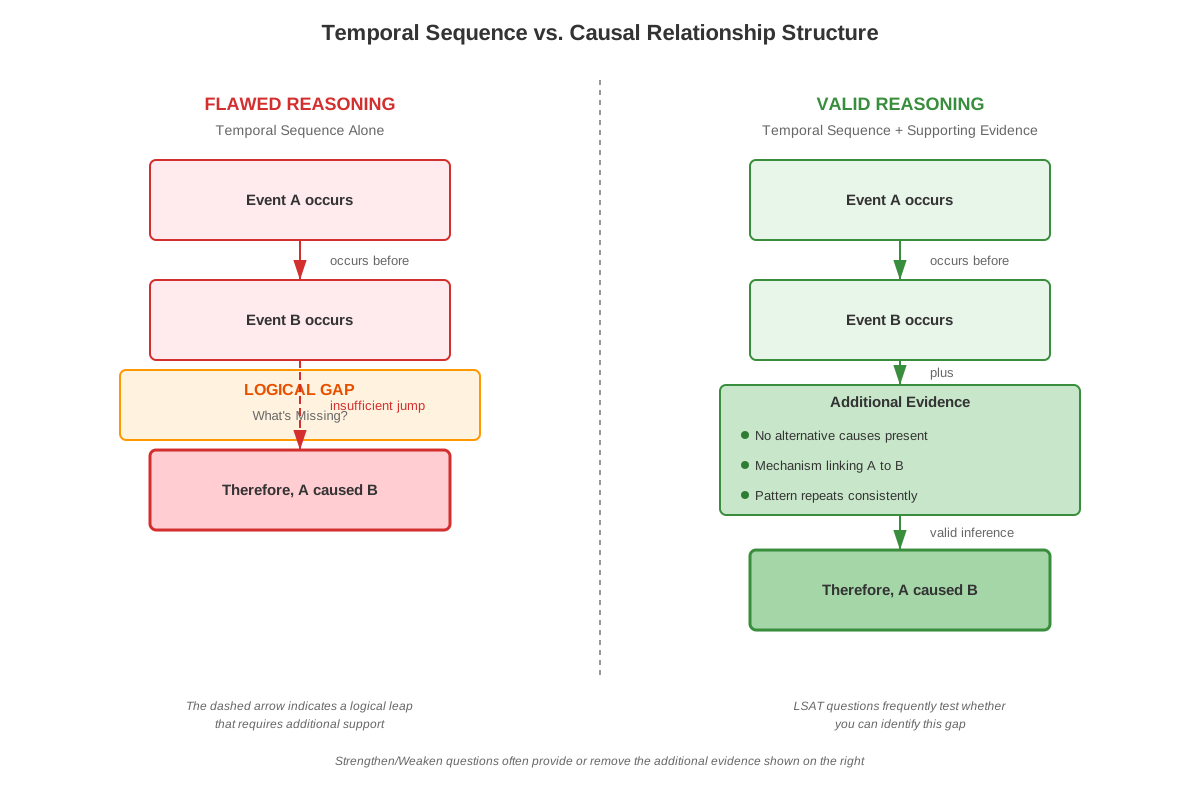
Temporal sequence evidence refers to information about the chronological ordering of events used to support a causal claim. The fundamental pattern follows this structure:
- Event A occurred at Time 1
- Event B occurred at Time 2 (after Time 1)
- Therefore, Event A caused Event B
This reasoning pattern is so intuitive that humans naturally employ it in everyday thinking. When someone takes a medication and then feels better, the temporal sequence suggests the medication caused the improvement. However, this reasoning contains a logical gap: temporal priority is necessary but not sufficient for causation. The Latin phrase "post hoc ergo propter hoc" (after this, therefore because of this) describes this common logical fallacy.
The Logical Gap in Temporal Sequence Reasoning
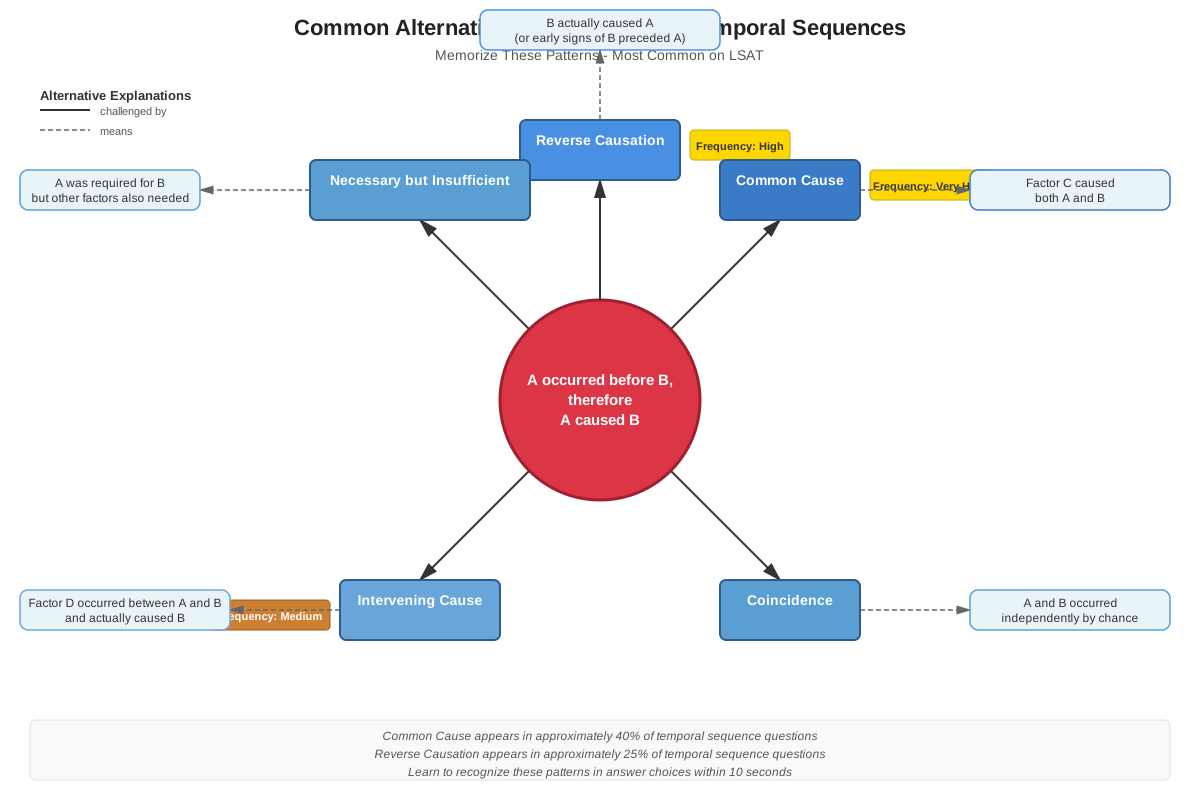
The critical weakness in arguments based solely on temporal sequence is that correlation does not equal causation. Several alternative explanations can account for the temporal sequence without A actually causing B:
| Alternative Explanation | Description | Example |
|---|---|---|
| Coincidence | Events occurred in sequence by chance | Stock market rose after new CEO wore red tie |
| Common Cause | Third factor C caused both A and B | Economic growth caused both increased employment and increased consumer spending |
| Reverse Causation | B actually caused A, despite apparent sequence | Illness caused medication-seeking behavior, not vice versa |
| Intervening Cause | Factor C occurred between A and B and caused B | Policy change followed by economic improvement, but technological innovation was the actual cause |
Necessary Conditions for Valid Causal Inference
For temporal sequence evidence to legitimately support a causal conclusion, several additional conditions must be satisfied:
- Temporal priority: The cause must precede the effect (temporal sequence provides this)
- Correlation: The cause and effect must occur together with regularity
- No plausible alternative explanations: Other potential causes must be ruled out
- Mechanism: A plausible explanation for how A causes B should exist
- Dose-response relationship: Variations in A should correspond to variations in B
LSAT questions frequently test whether arguments acknowledge these additional requirements or inappropriately leap from temporal sequence alone to causal conclusion.
How Temporal Sequence Evidence Appears in Arguments
In LSAT Logical Reasoning questions, temporal sequence evidence typically appears in the premises, with the conclusion making a causal claim. Common linguistic markers include:
Temporal indicators: "after," "following," "subsequently," "then," "before," "prior to," "since"
Causal conclusion indicators: "caused," "resulted in," "led to," "brought about," "responsible for," "due to," "because of"
Example argument structure:
Premise: After the city implemented the new traffic policy, accident rates decreased by 30%. Conclusion: Therefore, the new traffic policy caused the reduction in accidents.
The temporal sequence (policy implementation before accident reduction) serves as the primary evidence for the causal claim, but the argument assumes no other factors explain the decrease.
Strengthening Temporal Sequence Arguments
LSAT Strengthen questions often require identifying evidence that makes a temporal-causal argument more convincing. Effective strengtheners typically:
- Rule out alternative causes: Show that other potential explanations don't account for the effect
- Establish mechanism: Explain how the proposed cause produces the effect
- Show correlation: Demonstrate the cause and effect occur together consistently
- Provide comparative evidence: Show the effect doesn't occur without the cause
- Address timing: Confirm appropriate temporal relationship between cause and effect
Weakening Temporal Sequence Arguments
Conversely, Weaken questions require identifying evidence that undermines temporal-causal reasoning. Effective weakeners typically:
- Introduce alternative causes: Present other factors that could explain the effect
- Show the effect preceded the cause: Reverse the temporal sequence
- Demonstrate the pattern doesn't hold generally: Provide counterexamples
- Identify confounding variables: Introduce factors that complicate the causal relationship
- Question the mechanism: Show the proposed cause couldn't produce the effect
The Role of Control Groups and Comparison
Strong causal arguments based on temporal evidence often include comparison groups or baseline data. The LSAT frequently tests whether students recognize the importance of:
- Before-and-after comparisons: Establishing that the effect wasn't already occurring
- Control groups: Showing that groups without the cause don't experience the effect
- Trend analysis: Determining whether the effect represents a change from previous patterns
Arguments lacking these comparative elements remain vulnerable to alternative explanations, even when temporal sequence is clear.
Concept Relationships
Temporal sequence evidence serves as a specific type of evidence within the broader category of Causation and Explanation reasoning. The relationship flows as follows:
Causation (general concept) → requires → Evidence types → includes → Temporal sequence evidence → can be evaluated through → Strengthening/Weakening evidence → which addresses → Alternative explanations
Within the topic itself, understanding the basic pattern of temporal sequence reasoning enables recognition of its logical gap, which in turn allows students to identify what assumptions the argument makes and what evidence would strengthen or weaken it. This progression mirrors the typical LSAT question sequence: identify the reasoning pattern, recognize its vulnerability, and evaluate answer choices accordingly.
Temporal sequence evidence connects to prerequisite knowledge of correlation versus causation by providing a specific instance of this general principle. While correlation refers to any co-occurrence of events, temporal sequence represents a specific type of correlation where events occur in chronological order. The same logical gap exists: neither correlation nor temporal sequence alone establishes causation.
The concept also relates to other causation topics including:
- Causal chains: Temporal sequence often appears in arguments about multi-step causal processes
- Necessary and sufficient conditions: Temporal priority is necessary but not sufficient for causation
- Statistical evidence: Temporal data often combines with statistical information in LSAT arguments
High-Yield Facts
⭐ Temporal sequence alone never proves causation—additional evidence ruling out alternative explanations is always required.
⭐ The post hoc fallacy (reasoning from "after this" to "because of this") is one of the most common flaws tested on the LSAT.
⭐ Alternative causes are the most common way to weaken temporal sequence arguments on Strengthen/Weaken questions.
⭐ Reverse causation (B actually caused A) is a frequent trap answer and legitimate weakener in temporal sequence questions.
⭐ Control groups or comparison data significantly strengthen temporal sequence arguments by ruling out coincidence and alternative explanations.
- Temporal sequence is necessary but not sufficient for establishing causation in logical arguments.
- Arguments using temporal sequence evidence typically assume no other factors explain the observed effect.
- The LSAT tests temporal sequence evidence across diverse contexts: medical, economic, social, and historical scenarios.
- Strengthening temporal sequence arguments requires evidence that eliminates plausible alternative explanations.
- Common cause scenarios (where factor C causes both A and B) frequently appear as correct answers in Weaken questions.
- Intervening causes (factors occurring between A and B) can break the causal chain even when temporal sequence exists.
- Mechanism explanations (describing how A causes B) strengthen temporal sequence arguments by making the causal relationship more plausible.
- Temporal sequence arguments often confuse correlation with causation, making this distinction critical for LSAT success.
Quick check — test yourself on Temporal sequence evidence so far.
Try Flashcards →Common Misconceptions
Misconception: If Event A always occurs before Event B, then A must cause B.
Correction: Consistent temporal sequence still doesn't prove causation. Dawn always precedes sunrise, but dawn doesn't cause the sun to rise. Both are effects of Earth's rotation. Consistent correlation requires ruling out common causes and coincidence.
Misconception: Temporal sequence evidence is always flawed and should be rejected.
Correction: Temporal sequence is a necessary component of causal reasoning—causes must precede effects. The flaw occurs only when temporal sequence is the sole evidence offered, without addressing alternative explanations. Well-supported causal arguments include temporal sequence plus additional evidence.
Misconception: On Strengthen questions, any evidence showing A occurred before B strengthens the argument.
Correction: Merely confirming the temporal sequence doesn't strengthen an argument that already assumes this sequence. Strengtheners must provide new information that makes the causal connection more likely, such as ruling out alternatives or establishing a mechanism.
Misconception: Reverse causation means the temporal sequence was observed incorrectly.
Correction: Reverse causation doesn't dispute the observed temporal sequence. Instead, it suggests that B's impending occurrence caused A, or that early stages of B caused A. For example, declining health (early stage of illness B) might cause someone to seek medical treatment (A), even though the diagnosis (later stage of B) comes after treatment begins.
Misconception: If no alternative cause is mentioned in the stimulus, the argument is valid.
Correction: Arguments are evaluated based on logical structure, not just stated information. An argument that reasons from temporal sequence to causation without addressing alternatives contains a logical gap, even if the stimulus doesn't explicitly mention other possible causes. The LSAT tests whether students recognize unstated assumptions.
Misconception: Statistical correlation combined with temporal sequence proves causation.
Correction: Even strong statistical correlation occurring in temporal sequence doesn't eliminate the possibility of common causes, confounding variables, or coincidence. Additional evidence about mechanism, control groups, or elimination of alternatives remains necessary.
Worked Examples
Example 1: Flaw Question
Stimulus: "In the year following the introduction of the new reading curriculum, standardized test scores in the district increased by 15%. Clearly, the new curriculum caused the improvement in student performance."
Question: Which one of the following describes a flaw in the reasoning above?
Analysis:
- Identify the reasoning pattern: The argument observes a temporal sequence (new curriculum introduced, then test scores increased) and concludes a causal relationship (curriculum caused the increase).
- Recognize the logical gap: The argument assumes no other factors explain the test score improvement. This is classic post hoc reasoning—inferring causation solely from temporal sequence.
- Predict the answer: The correct answer will describe the flaw of reasoning from temporal sequence to causation without ruling out alternative explanations.
- Evaluate answer choices:
- (A) "The argument fails to consider that test scores might have increased even without the new curriculum" ✓ CORRECT - This identifies the core flaw: assuming the curriculum caused the increase without considering whether scores would have risen anyway (perhaps due to demographic changes, increased funding, better teachers, or natural variation).
- (B) "The argument doesn't specify which subjects showed improvement" ✗ This is irrelevant detail, not a logical flaw.
- (C) "The argument assumes all students benefited equally" ✗ The argument doesn't make this assumption, and even if it did, this wouldn't address the causal reasoning flaw.
- (D) "The argument relies on statistical evidence" ✗ Using statistics isn't a flaw; the flaw is in the causal inference.
Connection to learning objectives: This example demonstrates how to identify temporal sequence evidence in LSAT questions (the "following" and "caused" language), explain the reasoning pattern (post hoc fallacy), and apply this understanding to select the correct answer.
Example 2: Weaken Question
Stimulus: "After the company implemented its new employee wellness program, productivity increased by 20% over the next six months. The wellness program has clearly been effective in boosting worker productivity."
Question: Which one of the following, if true, most weakens the argument?
Analysis:
- Identify the reasoning pattern: Temporal sequence (wellness program implemented, then productivity increased) used to support causal conclusion (program caused productivity increase).
- Identify assumptions: The argument assumes the wellness program, rather than other factors, explains the productivity increase.
- Predict effective weakeners: Evidence suggesting alternative causes, reverse causation, or that the effect would have occurred anyway.
- Evaluate answer choices:
- (A) "Some employees chose not to participate in the wellness program" ✗ This doesn't weaken the causal claim; the program could still cause increased productivity among participants.
- (B) "The company simultaneously upgraded its manufacturing equipment, which typically increases productivity by 25%" ✓ CORRECT - This introduces a strong alternative cause that better explains the productivity increase, directly undermining the causal claim about the wellness program.
- (C) "Employee satisfaction surveys showed increased morale after the program began" ✗ This might actually strengthen the argument by suggesting a mechanism (wellness program → morale → productivity).
- (D) "The wellness program cost less than anticipated" ✗ Cost is irrelevant to whether the program caused productivity increases.
- (E) "Other companies have implemented similar wellness programs" ✗ This doesn't address whether this company's program caused its productivity increase.
Connection to learning objectives: This example shows how to apply temporal sequence evidence understanding to Weaken questions by recognizing that alternative causes effectively undermine arguments based primarily on temporal sequence.
Exam Strategy
Recognizing Temporal Sequence Questions
Develop a mental trigger for temporal sequence evidence by watching for these linguistic markers:
Temporal indicators: after, following, subsequently, since, before, prior to, when, once, then
Causal indicators: caused, resulted in, led to, brought about, responsible for, explains, due to, because of
When these appear together (temporal indicator in premise, causal indicator in conclusion), immediately recognize the temporal sequence pattern and anticipate the logical gap.
Question Type Strategies
For Flaw Questions:
- Predict the answer before reading choices: "The argument assumes no other factors explain the effect"
- Eliminate answers that describe valid reasoning or irrelevant issues
- Select answers describing the post hoc fallacy or failure to rule out alternatives
For Strengthen Questions:
- Prioritize answers that rule out alternative causes
- Look for evidence of mechanism, control groups, or consistent correlation
- Eliminate answers that merely restate the temporal sequence already given
For Weaken Questions:
- Prioritize answers introducing plausible alternative causes
- Consider reverse causation possibilities
- Look for evidence that the effect occurs without the supposed cause
For Assumption Questions:
- The argument assumes no relevant alternative explanations exist
- The argument assumes the temporal sequence is correctly observed
- The argument assumes the correlation is not coincidental
Time Management
Temporal sequence questions should be among the faster questions to answer once the pattern is recognized:
- Spend 15-20 seconds identifying the reasoning pattern
- Spend 10-15 seconds predicting the answer type
- Spend 30-40 seconds evaluating answer choices
- Total time: 55-75 seconds per question
The pattern recognition becomes automatic with practice, allowing rapid elimination of wrong answers.
Process of Elimination Tips
Eliminate answers that:
- Merely restate information already in the stimulus
- Address irrelevant details (cost, popularity, implementation difficulty)
- Strengthen when you need to weaken, or vice versa
- Introduce factors that don't affect the causal relationship
- Confuse necessary and sufficient conditions
Keep answers that:
- Introduce or eliminate alternative causes
- Address the logical gap between temporal sequence and causation
- Provide comparative or control group information
- Establish or undermine causal mechanisms
Memory Techniques
The POST HOC Acronym
Remember the key vulnerability in temporal sequence reasoning:
Premise shows sequence
Omission of alternatives
Sequence doesn't prove causation
Temporal order necessary but insufficient
Hypothesis needs more support
Other causes must be ruled out
Correlation isn't causation
Visualization Strategy
Picture a timeline with Event A and Event B marked on it. Now visualize multiple arrows pointing at Event B from different directions—each arrow represents a potential cause. The temporal sequence argument only highlights one arrow (from A to B) while ignoring all others. This mental image helps recognize the logical gap.
The "Three Questions" Method
When encountering temporal sequence evidence, automatically ask:
- What else could explain this? (alternative causes)
- Does the cause actually precede the effect? (temporal verification)
- How would the cause produce this effect? (mechanism)
These questions guide prediction of correct answers across question types.
Mnemonic for Strengtheners and Weakeners
RACE strengthens temporal sequence arguments:
- Rule out alternatives
- Add mechanism explanation
- Control group comparison
- Establish consistent correlation
ACID weakens temporal sequence arguments:
- Alternative causes
- Coincidence possibility
- Intervening factors
- Different timing (reverse causation)
Summary
Temporal sequence evidence represents one of the most frequently tested reasoning patterns on the LSAT Logical Reasoning section. The core concept involves recognizing when arguments inappropriately infer causation from temporal sequence alone—observing that Event A preceded Event B and concluding that A caused B. This reasoning contains a fundamental logical gap: temporal priority is necessary but not sufficient for establishing causation. Alternative explanations including coincidence, common causes, reverse causation, and intervening factors must be ruled out before temporal sequence can support a causal conclusion. The LSAT tests this concept across multiple question types, particularly Flaw, Strengthen, Weaken, and Assumption questions. Success requires recognizing the temporal sequence pattern through linguistic markers, identifying the logical gap, and predicting how answer choices will address alternative explanations. Strengthening temporal sequence arguments requires evidence that eliminates alternatives, establishes mechanisms, or provides comparative data. Weakening such arguments involves introducing plausible alternative causes or demonstrating that the proposed cause-effect relationship doesn't hold consistently. Mastering temporal sequence evidence provides significant score improvement because the pattern appears in 15-20% of Logical Reasoning questions and the recognition skills transfer to related causation topics.
Key Takeaways
- Temporal sequence alone never establishes causation—additional evidence ruling out alternatives is always required for valid causal reasoning.
- The post hoc fallacy (after this, therefore because of this) is the most common flaw in temporal sequence arguments and appears frequently on the LSAT.
- Alternative causes are the primary tool for weakening temporal sequence arguments, while ruling out alternatives strengthens them.
- Recognize temporal sequence patterns through linguistic markers: temporal indicators (after, following, since) in premises combined with causal indicators (caused, resulted in, led to) in conclusions.
- Control groups, comparison data, and mechanism explanations significantly strengthen temporal sequence arguments by addressing the logical gap between sequence and causation.
- Multiple question types test temporal sequence evidence: Flaw, Strengthen, Weaken, Assumption, and Method of Reasoning questions all incorporate this concept.
- Efficient question approach: Identify the pattern (15-20 seconds), predict the answer type (10-15 seconds), eliminate wrong answers systematically (30-40 seconds).
Related Topics
Causal Chains and Complex Causation: Building on temporal sequence evidence, this topic examines arguments involving multiple causal steps (A causes B, which causes C). Understanding temporal sequence provides the foundation for analyzing whether each link in the chain is properly supported.
Necessary and Sufficient Conditions: This topic explores the logical relationships between conditions and outcomes. Temporal sequence relates because temporal priority is a necessary but not sufficient condition for causation—mastering this distinction enhances understanding of both topics.
Statistical and Survey Evidence: Many LSAT arguments combine temporal sequence with statistical data. Understanding how temporal sequence evidence works enables more sophisticated analysis of arguments that use both temporal and quantitative information.
Correlation and Causation: This broader topic encompasses temporal sequence as one specific type of correlational evidence. Mastering temporal sequence provides concrete examples of the general principle that correlation doesn't prove causation.
Alternative Explanations and Confounding Variables: This advanced topic examines the various ways that factors other than the proposed cause might explain observed effects. Temporal sequence evidence provides the foundation for understanding why alternative explanations matter in causal reasoning.
Practice CTA
Now that you understand temporal sequence evidence and its role in LSAT Logical Reasoning, you're ready to apply these concepts to practice questions. The patterns you've learned—recognizing temporal sequence indicators, identifying the logical gap, predicting strengtheners and weakeners—become automatic only through repeated application. Challenge yourself with the practice questions to reinforce your understanding and build the speed necessary for test day success. Each question you practice strengthens your ability to recognize these patterns instantly, giving you a significant advantage on one of the most frequently tested concepts in Logical Reasoning. Your investment in mastering temporal sequence evidence will pay dividends across multiple question types and contribute meaningfully to your overall LSAT score. Begin practicing now to transform this knowledge into test-taking skill.
Sign up free to keep reading
Create a free AnvayaPrep account to finish this LSAT guide on Temporal sequence evidence — plus flashcards and practice questions.