Overview
Alternative sufficient conditions represent a critical pattern in conditional logic that appears frequently throughout the LSAT's logical reasoning sections. This concept involves situations where multiple different conditions can each independently trigger the same necessary outcome. Rather than having a single pathway to a result, alternative sufficient conditions create multiple "if-then" relationships that all lead to the same conclusion. Understanding this pattern is essential because the LSAT regularly tests whether students can recognize when several different scenarios each guarantee the same result, and whether they can properly manipulate these logical relationships.
The importance of mastering lsat alternative sufficient conditions cannot be overstated. This reasoning pattern appears in assumption questions, strengthen/weaken questions, must-be-true questions, and formal logic questions. Students who fail to recognize alternative sufficient conditions often make critical errors in identifying what must follow from a set of premises, what assumptions are necessary for an argument, or what would strengthen or weaken a conclusion. The pattern is particularly challenging because it requires tracking multiple conditional relationships simultaneously while understanding that any one of them being satisfied is enough to trigger the necessary condition.
Within the broader landscape of conditional logic on the LSAT, alternative sufficient conditions sit at an intermediate level of complexity. They build upon basic "if-then" reasoning but add the complication of multiple pathways. This concept connects directly to understanding contrapositives, necessary versus sufficient conditions, and the logic of "or" statements. Mastering this topic provides the foundation for tackling more complex logical structures, including conditional chains and nested conditionals that frequently appear in the most challenging LSAT questions.
Learning Objectives
- [ ] Identify how alternative sufficient conditions appears in LSAT questions
- [ ] Explain the reasoning pattern behind alternative sufficient conditions
- [ ] Apply alternative sufficient conditions to solve LSAT-style problems accurately
- [ ] Translate natural language statements containing "or" into proper alternative sufficient condition structures
- [ ] Recognize the contrapositive form of alternative sufficient conditions and apply it correctly
- [ ] Distinguish between alternative sufficient conditions and other conditional patterns (such as compound sufficient conditions)
- [ ] Evaluate answer choices by testing whether they properly respect alternative sufficient condition relationships
Prerequisites
- Basic conditional logic ("if-then" statements): Understanding simple sufficient and necessary conditions is essential because alternative sufficient conditions build upon these fundamental relationships by adding multiple sufficient condition pathways.
- Contrapositive formation: The ability to form contrapositives is necessary because alternative sufficient conditions have specific contrapositive patterns that differ from simple conditionals.
- Logical operators (AND/OR): Familiarity with how "and" and "or" function in logical statements is crucial because alternative sufficient conditions inherently involve "or" relationships among sufficient conditions.
- Symbolic notation for conditional logic: Basic comfort with representing conditionals symbolically (A → B) helps in diagramming and manipulating alternative sufficient condition statements efficiently.
Why This Topic Matters
Alternative sufficient conditions appear in real-world reasoning constantly. Legal arguments often involve showing that multiple different circumstances each independently establish liability or guilt. Scientific reasoning frequently identifies several different causal pathways that each lead to the same outcome. Policy analysis regularly considers multiple sufficient justifications for the same course of action. Understanding this logical structure enables clearer thinking about complex situations where outcomes can be reached through different routes.
On the LSAT specifically, alternative sufficient conditions appear in approximately 15-20% of logical reasoning questions across all question types. They are particularly common in Must Be True questions (where recognizing that any one of several conditions guarantees an outcome is crucial), Sufficient Assumption questions (where the correct answer often provides one of several possible sufficient conditions), and Parallel Reasoning questions (where matching the logical structure of alternative sufficient conditions is essential). The pattern also appears frequently in Strengthen/Weaken questions, where understanding that multiple pathways exist to a conclusion affects how additional evidence impacts an argument.
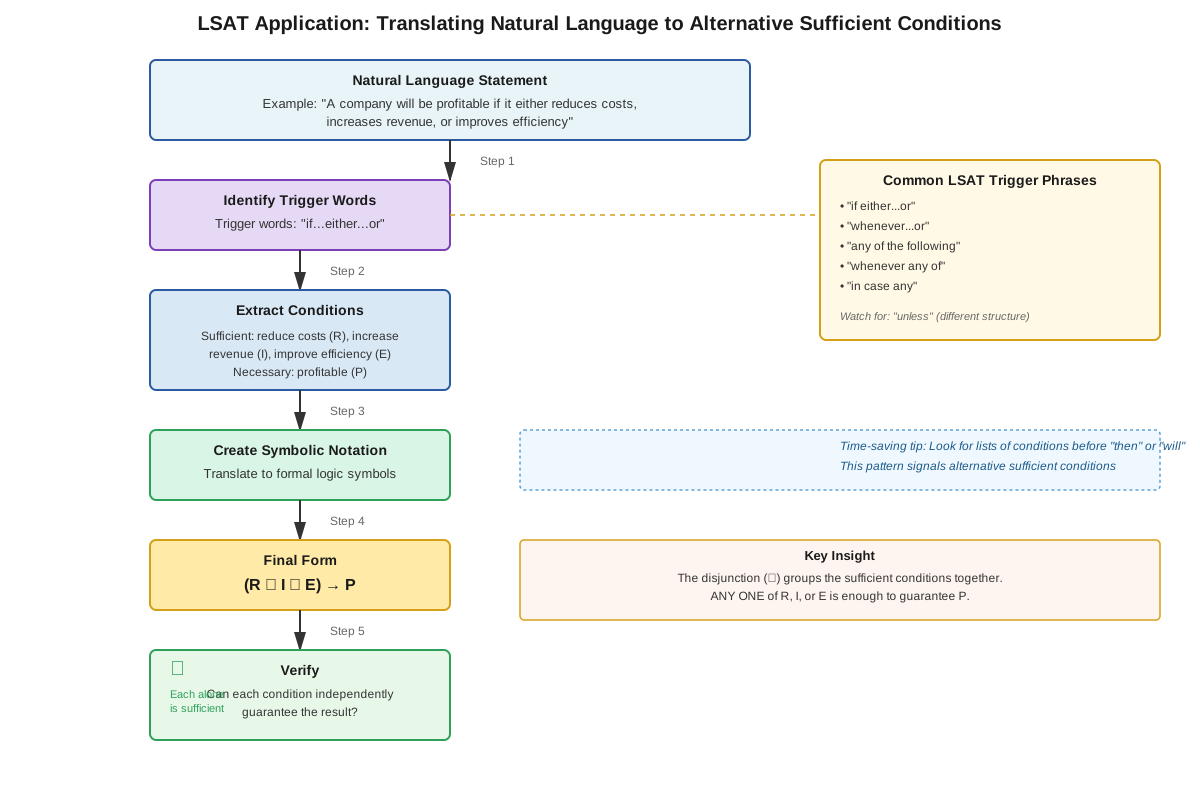
This topic commonly appears in LSAT passages through several linguistic markers. Phrases like "if either...or," "whenever...or when," and "any of these conditions would result in" signal alternative sufficient conditions. The LSAT also tests this concept more subtly by presenting multiple conditional statements that share the same necessary condition, requiring students to recognize the pattern without explicit linguistic cues. Questions may ask what must be true if we know the necessary condition occurred (answer: we cannot determine which sufficient condition occurred), or what must be true if we know none of the sufficient conditions occurred (answer: the necessary condition did not occur).
Core Concepts
The Basic Structure of Alternative Sufficient Conditions
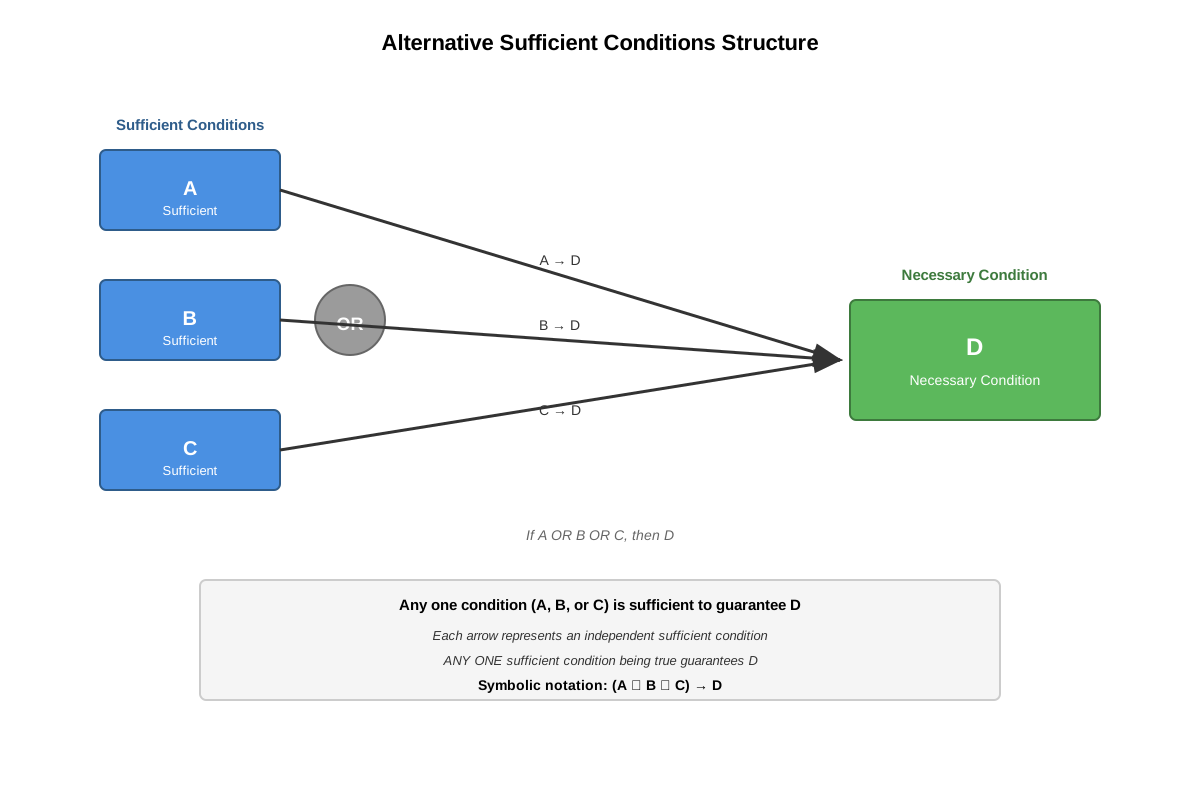
Alternative sufficient conditions occur when two or more different conditions each independently guarantee the same result. The fundamental structure can be represented as: "If A or if B, then C." This means that A alone is sufficient for C, B alone is sufficient for C, and if either A or B occurs, C must occur. Critically, this does NOT mean that both A and B must occur for C to happen—either one is enough.
The symbolic representation uses the "or" operator: (A ∨ B) → C. This reads as "If A or B, then C." The parentheses are important because they group the alternative sufficient conditions together. Without proper grouping, the logical relationship becomes ambiguous.
Consider this example: "If a student scores above 170 on the LSAT or has a 4.0 GPA, they will be admitted to the law school." Here, scoring above 170 is sufficient for admission, and having a 4.0 GPA is also sufficient for admission. A student needs only one of these conditions to guarantee admission, not both.
Distinguishing Alternative from Compound Sufficient Conditions
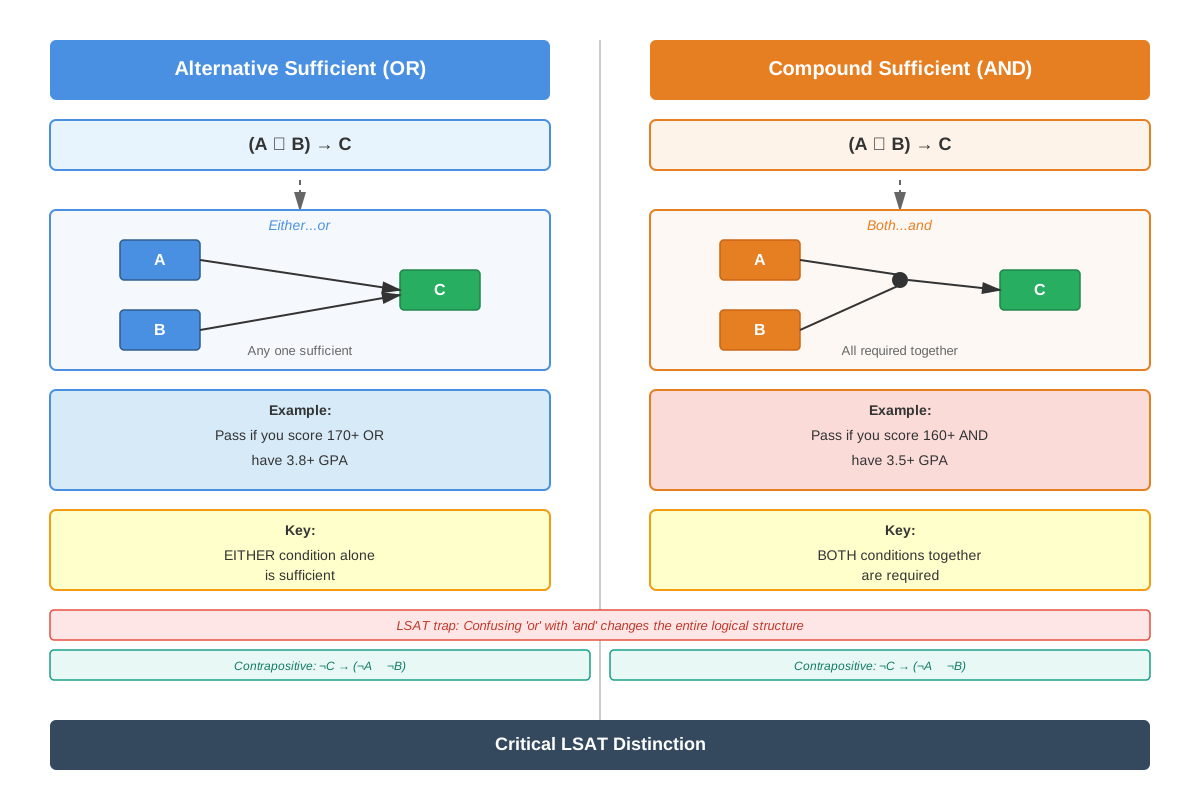
A crucial distinction exists between alternative sufficient conditions and compound sufficient conditions. Alternative sufficient conditions use "or" (either condition alone is enough), while compound sufficient conditions use "and" (both conditions together are required). The structure (A ∧ B) → C means "If both A and B, then C," where neither A alone nor B alone is sufficient—both must be present.
| Feature | Alternative Sufficient | Compound Sufficient |
|---|---|---|
| Connector | OR (∨) | AND (∧) |
| Structure | (A ∨ B) → C | (A ∧ B) → C |
| Requirement | Either condition works | Both conditions needed |
| Example | "Pass the exam OR complete the project → Graduate" | "Pass the exam AND complete the project → Graduate" |
The LSAT frequently tests whether students can distinguish these patterns. An answer choice might subtly shift from "or" to "and," completely changing the logical relationship. Recognizing this distinction is essential for accuracy.
The Contrapositive of Alternative Sufficient Conditions
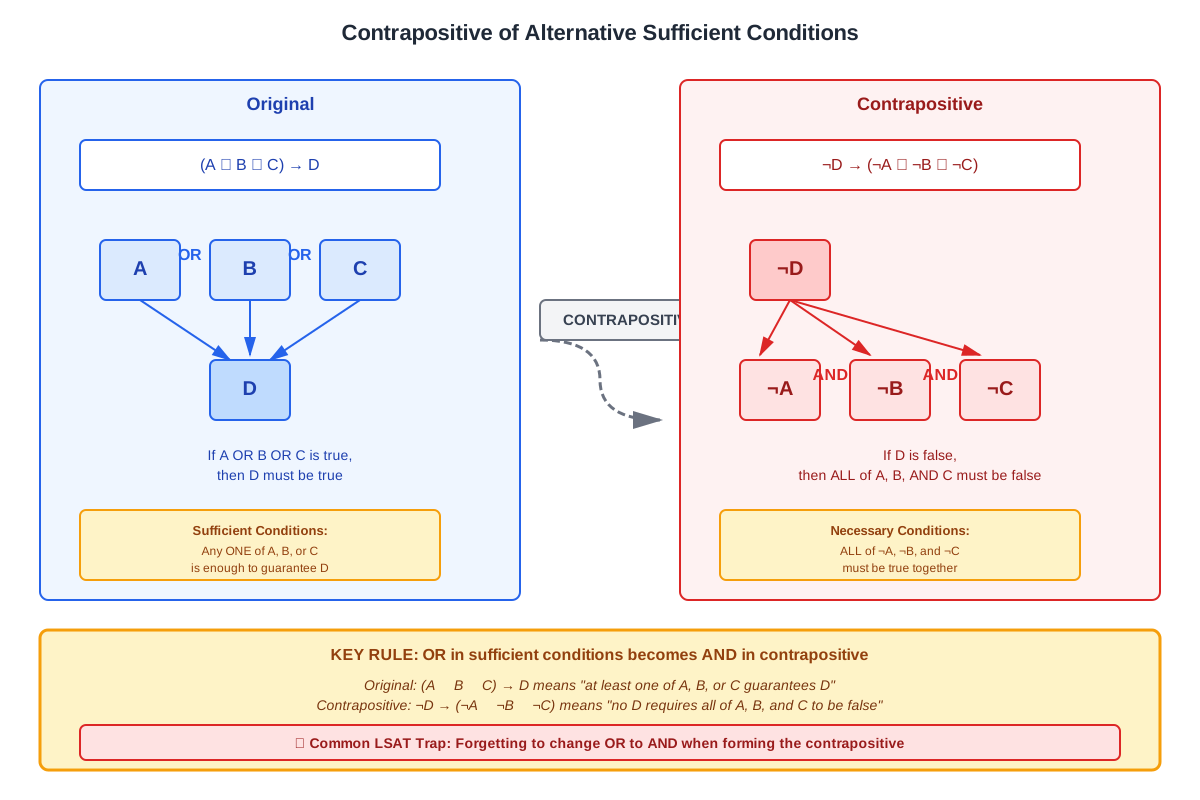
The contrapositive of alternative sufficient conditions follows a specific pattern that students must master. Starting with (A ∨ B) → C, the contrapositive is: ¬C → (¬A ∧ ¬B). This reads as "If not C, then not A and not B."
This transformation follows the rule that when taking the contrapositive, "or" becomes "and" and vice versa. If we know the necessary condition (C) did not occur, then we know that BOTH alternative sufficient conditions failed to occur. Neither A nor B happened.
Using our earlier example: "If a student scores above 170 or has a 4.0 GPA, they will be admitted." The contrapositive is: "If a student is not admitted, then they did not score above 170 AND they do not have a 4.0 GPA." The student failed to meet both criteria—if they had met either one, they would have been admitted.
Multiple Alternative Sufficient Conditions
Alternative sufficient conditions can involve more than two options. The structure (A ∨ B ∨ C ∨ D) → E means that any one of A, B, C, or D is sufficient to guarantee E. The contrapositive becomes: ¬E → (¬A ∧ ¬B ∧ ¬C ∧ ¬D), meaning if E did not occur, then none of the sufficient conditions occurred.
Example: "If a company experiences a data breach, or fails an audit, or violates regulations, or misses earnings targets, then its stock price will decline." Any single one of these four events guarantees a stock price decline. The contrapositive: "If the stock price did not decline, then the company did not experience a data breach, and did not fail an audit, and did not violate regulations, and did not miss earnings targets."
Common Linguistic Expressions
The LSAT expresses alternative sufficient conditions through various phrasings that students must recognize:
- "If either A or B, then C"
- "Whenever A or when B, then C"
- "A or B is sufficient for C"
- "C occurs if A or if B"
- "Should A occur, or should B occur, C will result"
- "Any of the following would result in C: A, B"
- "C happens when A, and C also happens when B"
The last phrasing is particularly subtle—presenting two separate conditional statements that share the same necessary condition implicitly creates alternative sufficient conditions. "C happens when A" means A → C, and "C happens when B" means B → C. Together, these create the alternative sufficient condition structure (A ∨ B) → C.
What We Can and Cannot Conclude
Understanding what follows from alternative sufficient conditions is crucial for LSAT success. Given (A ∨ B) → C:
Valid inferences:
- If A occurs, then C occurs
- If B occurs, then C occurs
- If C does not occur, then neither A nor B occurred
- If we know C occurred, we cannot determine whether A occurred, whether B occurred, or whether both occurred
Invalid inferences:
- If A occurs, then B does not occur (the conditions are not mutually exclusive unless stated)
- If C occurs, then A occurred (C could have resulted from B instead)
- If A does not occur, then C does not occur (B might still trigger C)
- If both A and B occur, then C occurs twice or with greater certainty (C simply occurs)
The LSAT frequently tests these distinctions, particularly the error of assuming that knowing the necessary condition occurred tells us which sufficient condition triggered it.
Concept Relationships
Alternative sufficient conditions connect to several other conditional logic concepts in important ways. The foundation is basic conditional logic—understanding simple "if-then" relationships (A → B) is prerequisite to understanding multiple conditions leading to the same result. Alternative sufficient conditions represent an expansion of this basic structure.
The relationship to contrapositives is bidirectional and essential. Every alternative sufficient condition statement has a contrapositive where the "or" relationship transforms into an "and" relationship. Mastering contrapositives enables proper manipulation of alternative sufficient conditions: (A ∨ B) → C transforms to ¬C → (¬A ∧ ¬B).
Alternative sufficient conditions contrast with compound sufficient conditions, where multiple conditions must all be present together. These represent opposite approaches to combining conditions: (A ∨ B) → C versus (A ∧ B) → C. Understanding both patterns and their differences is crucial for LSAT success.
The concept also connects to conditional chains. Alternative sufficient conditions can appear as links within longer chains. For example: (A ∨ B) → C → D creates a chain where either A or B ultimately leads to D through C. Similarly, alternative sufficient conditions can have alternative necessary conditions: (A ∨ B) → (C ∨ D), meaning if either A or B occurs, then at least one of C or D must occur.
Relationship map:
Basic Conditionals (A → B) → expands to → Alternative Sufficient Conditions (A ∨ B) → C → contrasts with → Compound Sufficient Conditions (A ∧ B) → C → both connect to → Contrapositive Formation → all combine in → Conditional Chains → all tested through → LSAT Logical Reasoning Questions
High-Yield Facts
⭐ Alternative sufficient conditions use "or" to connect multiple conditions that each independently guarantee the same result: (A ∨ B) → C.
⭐ The contrapositive of (A ∨ B) → C is ¬C → (¬A ∧ ¬B)—when taking the contrapositive, "or" becomes "and."
⭐ If the necessary condition occurs, we CANNOT determine which sufficient condition (or whether multiple sufficient conditions) caused it.
⭐ If ANY ONE of the alternative sufficient conditions occurs, the necessary condition MUST occur.
⭐ Alternative sufficient conditions differ from compound sufficient conditions: "or" means either alone works; "and" means both together are required.
- If the necessary condition does NOT occur, then NONE of the alternative sufficient conditions occurred.
- Multiple separate conditional statements sharing the same necessary condition (A → C and B → C) create alternative sufficient conditions.
- Alternative sufficient conditions are not mutually exclusive unless explicitly stated—both can occur simultaneously.
- The LSAT commonly tests alternative sufficient conditions in Must Be True, Sufficient Assumption, and Parallel Reasoning questions.
- Phrases like "if either...or," "whenever...or when," and "any of these would result in" signal alternative sufficient conditions.
- With three or more alternatives (A ∨ B ∨ C) → D, the contrapositive requires negating ALL alternatives: ¬D → (¬A ∧ ¬B ∧ ¬C).
- Knowing that one sufficient condition did NOT occur tells us nothing about whether the necessary condition occurred (another sufficient condition might have triggered it).
Quick check — test yourself on Alternative sufficient conditions so far.
Try Flashcards →Common Misconceptions
Misconception: If the necessary condition occurs, then all the sufficient conditions must have occurred.
Correction: When C occurs in (A ∨ B) → C, we know that at least one of A or B occurred, but we cannot determine which one, and we cannot conclude that both occurred. The necessary condition can result from just one sufficient condition.
Misconception: Alternative sufficient conditions are mutually exclusive—if one occurs, the others cannot.
Correction: Unless explicitly stated, alternative sufficient conditions can occur simultaneously. The "or" in (A ∨ B) → C is inclusive, meaning both A and B could occur together, and C would still occur (just once, not twice). The conditions are alternatives in the sense that either alone is sufficient, not that they exclude each other.
Misconception: If one of the sufficient conditions does not occur, then the necessary condition does not occur.
Correction: In (A ∨ B) → C, if A does not occur, C might still occur because B could trigger it. Only when ALL alternative sufficient conditions fail to occur can we conclude the necessary condition did not occur (via the contrapositive).
Misconception: Alternative sufficient conditions and compound sufficient conditions are interchangeable.
Correction: These represent fundamentally different logical structures. (A ∨ B) → C means either A or B alone guarantees C, while (A ∧ B) → C means both A and B together are required for C. Confusing "or" with "and" completely changes the logical relationship and leads to incorrect inferences.
Misconception: The contrapositive of (A ∨ B) → C is (¬A ∨ ¬B) → ¬C.
Correction: The correct contrapositive is ¬C → (¬A ∧ ¬B). When forming the contrapositive, the logical operator flips: "or" becomes "and" and vice versa. The incorrect version would mean "if not A or not B, then not C," which is invalid—C could still occur if one of the conditions is met.
Misconception: If we have A → C and B → C as separate statements, these are unrelated conditionals.
Correction: Two separate conditional statements sharing the same necessary condition create alternative sufficient conditions. Together, A → C and B → C form the pattern (A ∨ B) → C, with all the logical implications of alternative sufficient conditions, including the contrapositive ¬C → (¬A ∧ ¬B).
Worked Examples
Example 1: Identifying and Applying Alternative Sufficient Conditions
Problem: Consider this argument: "The museum will extend its hours if either attendance increases by 20% or if a major donor provides additional funding. Attendance did not increase by 20%, and the museum did not extend its hours."
What can we validly conclude?
Step 1: Identify the logical structure
The first sentence presents alternative sufficient conditions:
- Let A = attendance increases by 20%
- Let D = major donor provides additional funding
- Let E = museum extends hours
Structure: (A ∨ D) → E
Step 2: Identify what we know
We're told:
- ¬A (attendance did not increase by 20%)
- ¬E (museum did not extend hours)
Step 3: Apply the contrapositive
The contrapositive of (A ∨ D) → E is: ¬E → (¬A ∧ ¬D)
Since we know ¬E is true, we can conclude (¬A ∧ ¬D) must be true. This means both ¬A and ¬D are true.
Step 4: State the conclusion
We can validly conclude: A major donor did NOT provide additional funding.
We already knew attendance didn't increase by 20%, but the contrapositive allows us to conclude that the other sufficient condition (donor funding) also did not occur. This is the power of the contrapositive with alternative sufficient conditions—if the necessary condition fails, ALL the alternative sufficient conditions must have failed.
Connection to learning objectives: This example demonstrates identifying alternative sufficient conditions in natural language, explaining the reasoning pattern (using the contrapositive), and applying it to reach a valid conclusion.
Example 2: Distinguishing Valid from Invalid Inferences
Problem: "A company's stock will be delisted if it trades below $1 for 30 consecutive days or if it fails to file required financial reports. The company's stock was delisted."
Evaluate these potential conclusions:
- The stock traded below $1 for 30 consecutive days
- The company failed to file required financial reports
- Either the stock traded below $1 for 30 consecutive days or the company failed to file required reports (or both)
- The stock did not trade below $1 for 30 consecutive days
Step 1: Identify the structure
- Let T = stock trades below $1 for 30 consecutive days
- Let F = company fails to file required reports
- Let D = stock is delisted
Structure: (T ∨ F) → D
Step 2: Identify what we know
We know: D (the stock was delisted)
Step 3: Evaluate each conclusion
Conclusion 1: "The stock traded below $1 for 30 consecutive days"
Invalid. Knowing D occurred tells us that at least one of the sufficient conditions occurred, but not which one. T might have occurred, but F alone could have caused the delisting.
Conclusion 2: "The company failed to file required financial reports"
Invalid. Same reasoning as conclusion 1. F might have occurred, but T alone could have caused the delisting.
Conclusion 3: "Either the stock traded below $1 for 30 consecutive days or the company failed to file required reports (or both)"
Valid. This is exactly what we can conclude from (T ∨ F) → D when we know D is true. At least one of the sufficient conditions must have occurred (possibly both, but at least one).
Conclusion 4: "The stock did not trade below $1 for 30 consecutive days"
Invalid. We cannot conclude this. Even though we don't know for certain that T occurred, we also cannot conclude that it didn't occur. It might have occurred along with F, or it might have been the sole cause of the delisting.
Step 4: Key insight
When the necessary condition of alternative sufficient conditions occurs, we can only conclude that the disjunction (the "or" statement) of the sufficient conditions is true. We cannot pinpoint which specific sufficient condition(s) occurred.
Connection to learning objectives: This example demonstrates applying alternative sufficient conditions to evaluate multiple answer choices, a common LSAT task, and highlights the critical distinction between what we can and cannot conclude from these logical structures.
Exam Strategy
Recognition Triggers
When approaching LSAT logical reasoning questions, watch for these linguistic markers that signal alternative sufficient conditions:
- "If either...or" constructions
- "Whenever...or when" phrasings
- "Any of the following would" followed by a list
- Multiple separate conditionals with the same necessary condition
- "Should...or should" constructions
Exam Tip: If you see two or more conditions connected by "or" before a "then" or comma, immediately diagram it as alternative sufficient conditions and write out the contrapositive before reading the question stem.
Systematic Approach
Step 1: Diagram immediately
As soon as you identify alternative sufficient conditions in the stimulus, write: (A ∨ B) → C and its contrapositive ¬C → (¬A ∧ ¬B). This takes 5 seconds and prevents errors.
Step 2: Identify what you know
Determine which elements (A, B, or C) the stimulus tells you occurred or did not occur.
Step 3: Apply the logic
- If you know A or B occurred → conclude C occurred
- If you know C did not occur → conclude neither A nor B occurred
- If you know C occurred → you CANNOT conclude which sufficient condition triggered it
- If you know only one sufficient condition didn't occur → you CANNOT conclude anything about C
Step 4: Eliminate wrong answers
Wrong answers typically make one of these errors:
- Conclude a specific sufficient condition occurred when only the necessary condition is known
- Fail to recognize that all sufficient conditions must fail for the necessary condition to fail
- Confuse "or" with "and" (treating alternative sufficient conditions as compound)
- Incorrectly form the contrapositive
Time Management
Alternative sufficient conditions questions should take 60-90 seconds once you've identified the pattern. Spend:
- 10 seconds: Diagramming the structure and contrapositive
- 20 seconds: Identifying what you know from the stimulus
- 30-50 seconds: Evaluating answer choices using your diagram
If a question involves alternative sufficient conditions but you're struggling after 90 seconds, mark it and return later. These questions reward systematic diagramming, so if you're stuck, you likely need to restart with a clearer diagram rather than continuing to stare at answer choices.
Process of Elimination
Eliminate answers that:
- Conclude a specific sufficient condition occurred when only the necessary condition is known (most common wrong answer)
- State that if one sufficient condition didn't occur, the necessary condition didn't occur
- Confuse the direction of the conditional (treating C → A or C → B as valid)
- Incorrectly form the contrapositive (keeping "or" instead of changing to "and")
Keep answers that:
- Properly apply the contrapositive when the necessary condition didn't occur
- Recognize that knowing one sufficient condition occurred means the necessary condition occurred
- Acknowledge uncertainty about which sufficient condition occurred when only the necessary condition is known
- Correctly identify that all sufficient conditions must fail for the necessary condition to fail
Memory Techniques
The "Multiple Doors" Visualization
Visualize alternative sufficient conditions as multiple doors leading into the same room. Each door (sufficient condition) independently opens into the room (necessary condition). You only need to go through one door to enter the room—you don't need to go through all doors. If you find yourself in the room, you know you came through at least one door, but you don't know which one unless you remember your path. If you're NOT in the room, you know you didn't go through ANY of the doors.
The "OR-AND Flip" Mnemonic
Remember: "OR flips to AND"
When forming the contrapositive of alternative sufficient conditions, the "or" connecting sufficient conditions becomes "and" in the contrapositive. Create a mental image of the letters "OR" physically flipping over to reveal "AND" on the back.
The "CONE" Acronym
Contrapositive Of Necessary Eliminates all
When the necessary condition doesn't occur (using the contrapositive), ALL alternative sufficient conditions are eliminated. This reminds you that ¬C → (¬A ∧ ¬B) means both sufficient conditions failed.
The "Either Works" Phrase
For alternative sufficient conditions (A ∨ B) → C, remember the phrase: "Either works alone, both work together, neither means no result."
This captures three key facts:
- Either A or B alone is sufficient for C
- Both A and B together still produce C (not mutually exclusive)
- If neither A nor B occurs, C doesn't occur
Summary
Alternative sufficient conditions represent a fundamental pattern in conditional logic where multiple conditions each independently guarantee the same outcome. The structure (A ∨ B) → C means that either A alone or B alone is sufficient to produce C, and the contrapositive ¬C → (¬A ∧ ¬B) means that if C doesn't occur, neither A nor B occurred. This pattern appears frequently on the LSAT across multiple question types, particularly Must Be True, Sufficient Assumption, and Parallel Reasoning questions. The key to mastering this concept lies in recognizing the linguistic markers that signal alternative sufficient conditions, properly diagramming the structure including the contrapositive, understanding what can and cannot be concluded from the pattern, and distinguishing alternative sufficient conditions from compound sufficient conditions. When the necessary condition occurs, we cannot determine which sufficient condition caused it; when the necessary condition doesn't occur, we know all sufficient conditions failed. Success with alternative sufficient conditions requires systematic diagramming, careful attention to "or" versus "and," and rigorous application of the contrapositive.
Key Takeaways
- Alternative sufficient conditions (A ∨ B) → C mean either A or B alone is enough to guarantee C—you don't need both
- The contrapositive flips "or" to "and": ¬C → (¬A ∧ ¬B), meaning if C doesn't occur, neither A nor B occurred
- Knowing the necessary condition occurred tells you at least one sufficient condition occurred, but not which one
- If any single alternative sufficient condition occurs, the necessary condition must occur
- Alternative sufficient conditions ("or") differ fundamentally from compound sufficient conditions ("and")—confusing these leads to wrong answers
- Multiple separate conditionals sharing the same necessary condition (A → C and B → C) create alternative sufficient conditions
- Systematic diagramming prevents errors—always write out both the original statement and its contrapositive before evaluating answer choices
Related Topics
Compound Sufficient Conditions: Understanding conditions that must occur together (A ∧ B) → C provides essential contrast to alternative sufficient conditions and appears in similar LSAT question types. Mastering alternative sufficient conditions makes compound sufficient conditions easier to recognize and manipulate.
Conditional Chains: Alternative sufficient conditions often appear as components within longer conditional chains, such as (A ∨ B) → C → D. Understanding how alternative sufficient conditions function within chains is crucial for advanced LSAT logical reasoning questions.
Formal Logic in Logic Games: The principles of alternative sufficient conditions apply directly to LSAT Logic Games, particularly in rules that establish multiple ways to satisfy a condition. Mastering this topic in Logical Reasoning strengthens Logic Games performance.
Necessary vs. Sufficient Conditions: Deepening understanding of the fundamental distinction between necessary and sufficient conditions enhances the ability to work with alternative sufficient conditions and recognize when the LSAT tests this distinction.
Disjunctive Syllogisms: This related logical form involves reasoning with "or" statements and connects to alternative sufficient conditions, particularly in understanding what follows when one disjunct is eliminated.
Practice CTA
Now that you've mastered the core concepts of alternative sufficient conditions, it's time to cement your understanding through active practice. Attempt the practice questions designed specifically for this topic, focusing on applying the systematic approach outlined in the exam strategy section. Use flashcards to drill the contrapositive transformations until they become automatic—speed and accuracy with alternative sufficient conditions will significantly boost your LSAT Logical Reasoning score. Remember: this pattern appears in 15-20% of logical reasoning questions, making it one of the highest-yield topics you can master. Every minute spent practicing alternative sufficient conditions translates directly into points on test day. You've built the foundation—now build the fluency that leads to a top score.
Sign up free to keep reading
Create a free AnvayaPrep account to finish this LSAT guide on Alternative sufficient conditions — plus flashcards and practice questions.