Overview
Conditional chains represent one of the most powerful and frequently tested concepts in LSAT Logical Reasoning. A conditional chain occurs when multiple conditional statements link together in sequence, where the sufficient condition of one statement becomes (or relates to) the necessary condition of another. These chains allow test-takers to draw extended inferences by following a logical pathway from an initial trigger through multiple connected statements to reach a distant conclusion. For example, if "A → B" and "B → C," then we can conclude "A → C" through the transitive property of conditional logic.
Understanding conditional chains is essential for LSAT success because they appear across multiple question types, including Must Be True, Sufficient Assumption, Necessary Assumption, and Strengthen/Weaken questions. The LSAT frequently constructs complex arguments that require students to recognize how multiple conditional relationships interact, combine, and produce valid inferences. Students who master conditional logic and can efficiently navigate chains gain a significant competitive advantage, as these questions often separate high scorers from average performers.
Conditional chains build directly upon foundational lsat conditional chains concepts including basic conditional statements (if-then relationships), contrapositives, and the distinction between sufficient and necessary conditions. They represent an intermediate-to-advanced application of conditional reasoning that integrates multiple logical relationships simultaneously. Mastery of conditional chains also provides the foundation for understanding more complex logical structures, including formal logic games in the Analytical Reasoning section and sophisticated argument structures throughout the exam.
Learning Objectives
- [ ] Identify how Conditional chains appears in LSAT questions
- [ ] Explain the reasoning pattern behind Conditional chains
- [ ] Apply Conditional chains to solve LSAT-style problems accurately
- [ ] Construct valid conditional chains from multiple premises in argument passages
- [ ] Recognize invalid chain formations and common logical errors in chain reasoning
- [ ] Efficiently diagram conditional chains using standard notation to visualize relationships
- [ ] Determine when contrapositive chains are necessary to reach valid conclusions
Prerequisites
- Basic conditional statements (if-then logic): Understanding simple sufficient and necessary conditions is essential because chains are built from multiple basic conditionals linked together
- Contrapositive formation: Recognizing that "A → B" is logically equivalent to "~B → ~A" is critical because chains often require contrapositive manipulation to connect statements
- Logical operators and connectors: Familiarity with "and," "or," "unless," and other logical terms enables accurate translation of complex statements into conditional form
- Sufficient vs. necessary conditions: Distinguishing which element triggers the relationship and which element must follow is fundamental to correctly linking chain elements
Why This Topic Matters
Conditional chains appear in approximately 15-20% of all Logical Reasoning questions on the LSAT, making them one of the highest-yield topics for focused study. They are particularly prevalent in Must Be True questions, where test-takers must identify what necessarily follows from a set of premises, and in Sufficient Assumption questions, where the correct answer completes a conditional chain to make an argument valid. Understanding chains also proves invaluable in Parallel Reasoning questions, where recognizing the underlying conditional structure helps identify structurally similar arguments.
In real-world applications, conditional chain reasoning underlies legal analysis, policy evaluation, and logical argumentation. Attorneys regularly construct chains of legal precedent and statutory interpretation, where one rule triggers another in sequence. Contract law, in particular, relies heavily on conditional chains to determine when obligations arise and what consequences follow from specific triggering events.
On the LSAT, conditional chains typically appear in several distinct formats: (1) explicit chains where multiple conditional statements are clearly presented in sequence, (2) implicit chains where the test-taker must recognize that separate statements can be linked, (3) incomplete chains where a missing link must be identified to complete the reasoning, and (4) contrapositive chains where statements must be reversed and negated before linking. The exam also tests whether students can recognize when apparent chains are actually invalid due to reversed terms, affirming the consequent, or other logical fallacies.
Core Concepts
Basic Chain Structure
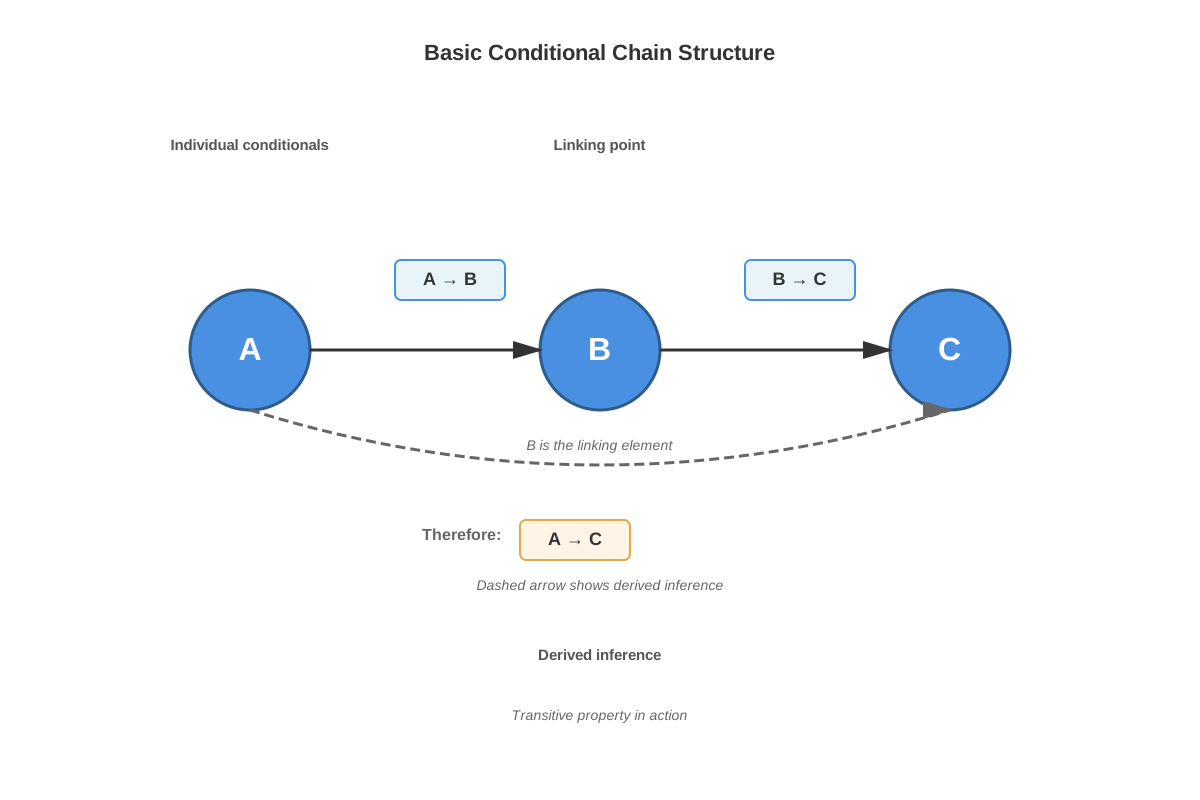
A conditional chain forms when two or more conditional statements connect such that the necessary condition of one statement matches (or relates to) the sufficient condition of another. The fundamental structure follows this pattern:
- Statement 1: A → B (If A, then B)
- Statement 2: B → C (If B, then C)
- Valid conclusion: A → C (If A, then C)
This transitive property allows us to "skip" the middle term (B) and establish a direct relationship between the first sufficient condition (A) and the final necessary condition (C). The chain can extend indefinitely: A → B → C → D → E, allowing us to conclude A → E.
The critical requirement for valid chain formation is that terms must match precisely. If Statement 1 concludes with B and Statement 2 begins with B, they link. However, if Statement 1 concludes with B but Statement 2 begins with "not B" (~B), they do not form a standard forward chain (though they may form a contrapositive chain, discussed below).
Diagramming Conditional Chains
Effective diagramming is essential for visualizing and manipulating conditional chains. The standard notation uses arrows to represent conditional relationships:
Standard notation:
- A → B (read as "if A, then B" or "A is sufficient for B" or "B is necessary for A")
- The arrow always points from sufficient to necessary
- Negation is shown with a tilde: ~A or a slash through the letter
Chain diagram example:
Honest → Trustworthy → Good Leader → Effective ManagerThis diagram immediately reveals that Honest → Effective Manager through the chain. It also shows that ~Effective Manager → ~Honest through the complete contrapositive chain.
Contrapositive Chains
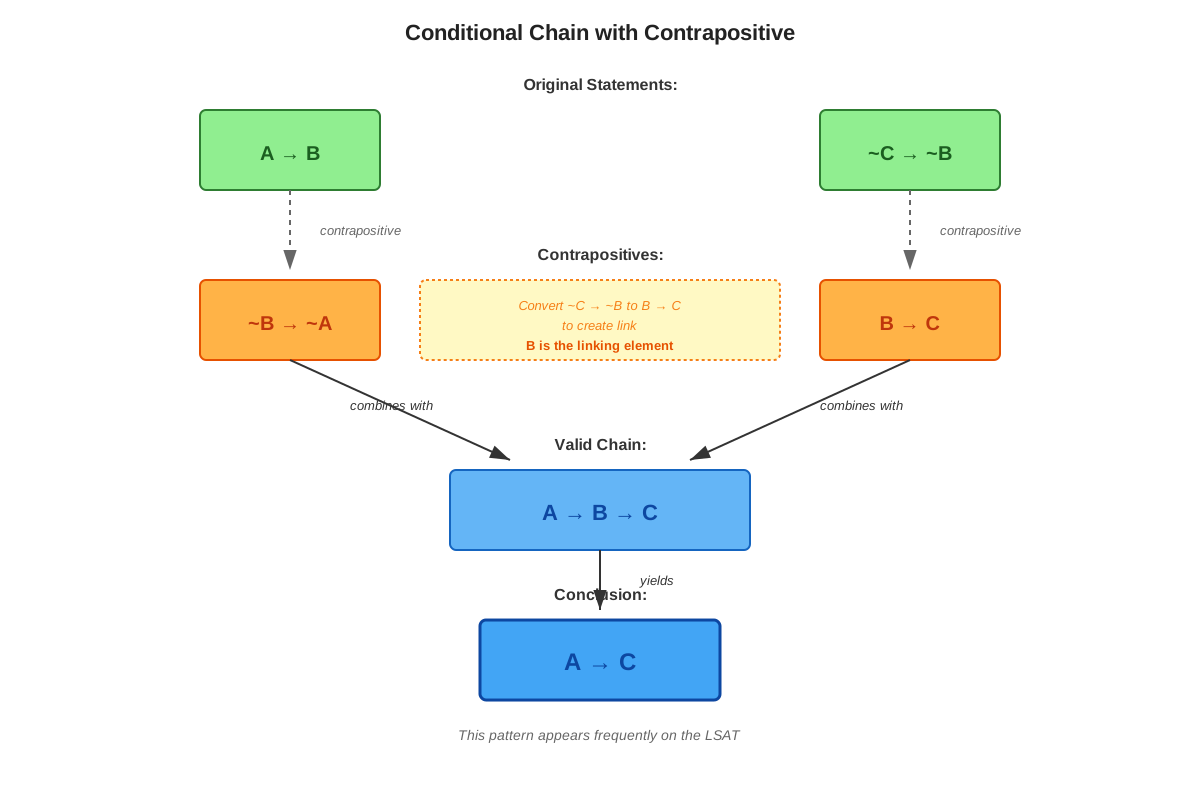
The contrapositive of a conditional statement is logically equivalent to the original. For "A → B," the contrapositive is "~B → ~A." Contrapositive chains form when we must reverse and negate statements to create connections.
Consider these statements:
- Statement 1: A → B
- Statement 2: C → ~B
These don't form a forward chain because Statement 1 ends with B but Statement 2 doesn't begin with B. However, taking the contrapositive of Statement 1 gives us: ~B → ~A. Now we can chain:
C → ~B → ~ATherefore, C → ~A is a valid conclusion.
Recognizing when contrapositive manipulation is necessary distinguishes advanced test-takers from beginners. The LSAT frequently presents statements that require contrapositive conversion before chaining becomes possible.
Multiple Chain Pathways
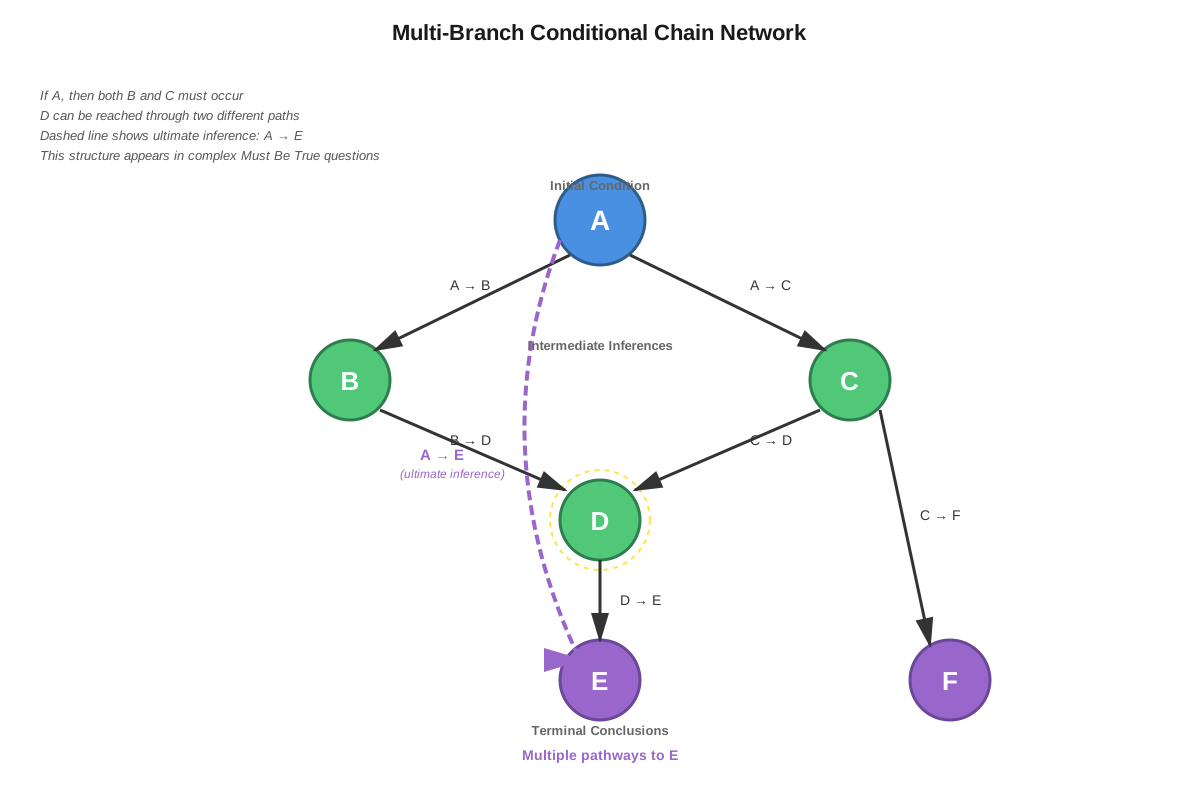
Complex LSAT problems may present multiple conditional statements that form a network rather than a single linear chain. Consider:
- A → B
- A → C
- B → D
- C → D
This creates a structure where A leads to D through two different pathways (A → B → D and A → C → D). Both pathways are valid, and the conclusion A → D is strongly supported. However, we cannot conclude that B → C or C → B simply because both follow from A; this would be an invalid inference.
Invalid Chain Formations
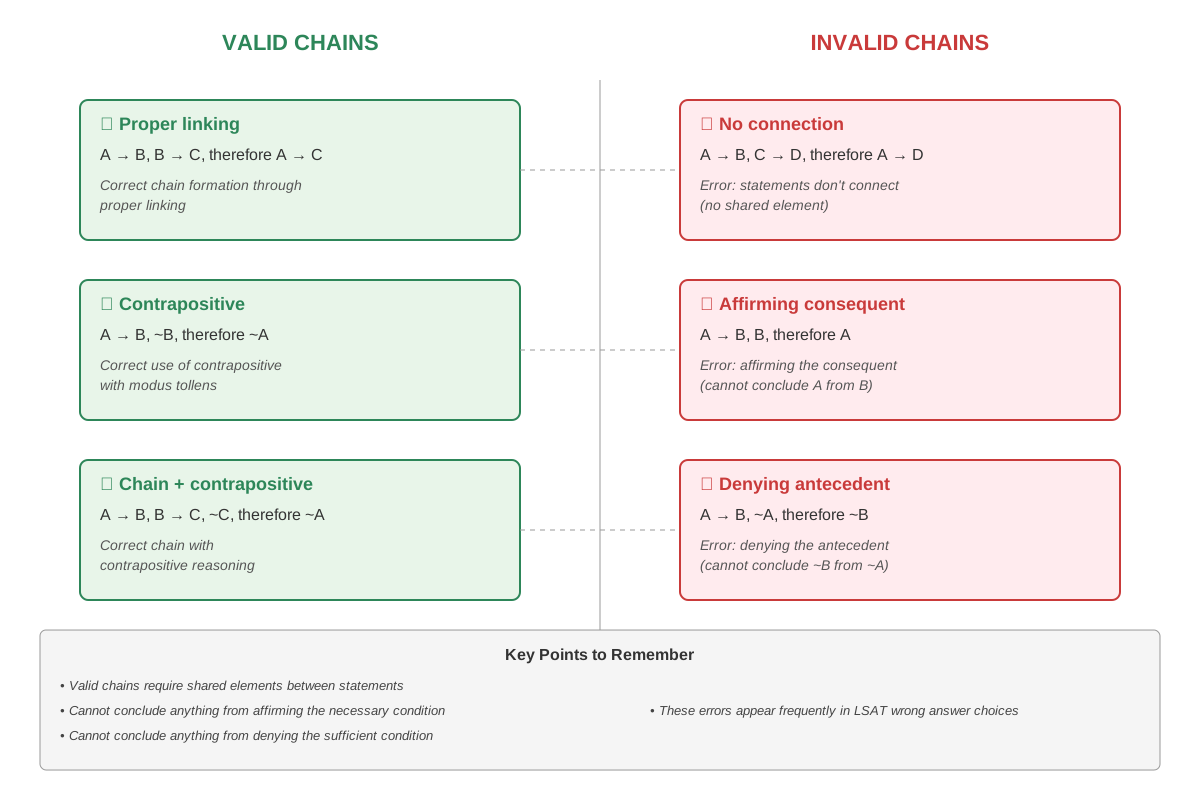
Several common errors prevent valid chain formation:
Reversed terms: If Statement 1 is "A → B" and Statement 2 is "A → C," these statements both begin with A but don't chain together. They represent two separate consequences of A, not a sequential chain.
Affirming the consequent: From "A → B" and "B is true," we cannot conclude "A is true." The chain only works in the forward direction from sufficient to necessary.
Denying the antecedent: From "A → B" and "A is false," we cannot conclude "B is false." B might be true for other reasons.
Chain Completion Problems
LSAT Sufficient Assumption questions often present incomplete chains and ask which answer choice would complete the logical connection. For example:
- Premise 1: A → B
- Premise 2: C → D
- Conclusion: A → D
The gap exists because B and C are unconnected. The sufficient assumption that completes this chain is "B → C," which allows: A → B → C → D, therefore A → D.
Recognizing the gap and identifying what specific link would bridge it is a high-value skill for these question types.
Conditional Chains with "And" and "Or"
Conditional statements may have compound sufficient or necessary conditions:
Compound sufficient (AND): "If A and B, then C" is diagrammed as: A + B → C
- Both A and B must be present to trigger C
- The contrapositive is: ~C → ~A or ~B (if not C, then either not A or not B or both)
Compound necessary (AND): "If A, then B and C" is diagrammed as: A → B + C
- A triggers both B and C
- The contrapositive is: ~B or ~C → ~A (if either B or C is absent, A cannot occur)
Compound necessary (OR): "If A, then B or C" is diagrammed as: A → B or C
- A triggers at least one of B or C
- The contrapositive is: ~B + ~C → ~A (only if both B and C are absent is A ruled out)
These compound conditions can appear within chains, requiring careful tracking of what combinations trigger subsequent conditions.
Concept Relationships
Conditional chains build directly upon basic conditional statements, which are the fundamental building blocks. Each link in a chain is itself a simple conditional relationship. The concept of contrapositives is inseparable from chains because many chain problems require contrapositive manipulation to reveal connections between statements.
The relationship flow follows this progression:
Basic Conditionals → Contrapositive Formation → Simple Chains (2-3 links) → Complex Chains (4+ links) → Chain Networks (multiple pathways) → Chain Completion (Sufficient Assumptions)
Conditional chains also connect to formal logic concepts in the Analytical Reasoning section, where game rules often form conditional chains that determine valid arrangements. Additionally, chains relate to argument structure analysis, as many LSAT arguments implicitly rely on unstated conditional links that must be identified to evaluate the reasoning.
The concept of necessary vs. sufficient conditions remains central throughout chain analysis. Each arrow in a chain represents a sufficient-to-necessary relationship, and maintaining the correct directionality is essential for valid inferences. Reversing the arrow direction, even once in a multi-step chain, invalidates the entire inference.
High-Yield Facts
⭐ A valid conditional chain requires that the necessary condition of one statement matches the sufficient condition of the next statement in sequence
⭐ The contrapositive of an entire chain is formed by reversing the direction and negating all terms: if A → B → C, then ~C → ~B → ~A
⭐ From a conditional chain A → B → C, you can validly conclude A → C, but you cannot conclude B → A or C → B (no reversal)
⭐ When statements don't immediately chain, check whether taking the contrapositive of one or more statements creates a valid connection
⭐ In Sufficient Assumption questions with conditional reasoning, the correct answer typically provides the missing link that completes a conditional chain
- Conditional chains can extend through any number of links, and the transitive property holds throughout the entire sequence
- Multiple conditional statements with the same sufficient condition (A → B and A → C) do not form a chain but rather show multiple consequences of a single trigger
- The presence of "and" or "or" in conditional statements affects how chains connect and what conclusions can be drawn
- Invalid chain reasoning (affirming the consequent or denying the antecedent) is a common wrong answer trap in Must Be True questions
- Recognizing when a conclusion requires a chain versus when it requires a different logical operation (such as combining conditions) is essential for accuracy
Quick check — test yourself on Conditional chains so far.
Try Flashcards →Common Misconceptions
Misconception: If A → B and C → D, then A → D is a valid conclusion.
Correction: These statements are completely independent and do not form a chain. For A → D to be valid, there must be a connection between B and C (either B → C or taking appropriate contrapositives to create a link).
Misconception: If A → B → C, then C → A is valid because they're in the same chain.
Correction: Conditional chains only work in the forward direction from sufficient to necessary. To go backward, you must use the contrapositive: ~C → ~B → ~A. You cannot simply reverse the chain without negating the terms.
Misconception: If A → B and B is true, then A must be true.
Correction: This is the fallacy of affirming the consequent. B is necessary for A, but B can be true for other reasons. The conditional only tells us what happens when A is true, not what must be true when B is true.
Misconception: Taking the contrapositive of just one statement in a chain is sufficient to solve most problems.
Correction: Complex chain problems often require taking the contrapositive of multiple statements or even the entire chain. Each statement must be evaluated individually to determine whether contrapositive manipulation is needed to create connections.
Misconception: In a chain A → B → C, if A is false, then C must be false.
Correction: This is the fallacy of denying the antecedent. If A is false, we know nothing about B or C from this chain alone. C could still be true for other reasons not captured in these conditional statements.
Misconception: Longer chains are always more complex and difficult than shorter chains.
Correction: Chain length is less important than the clarity of connections. A five-link chain with clearly matching terms may be easier to navigate than a two-link chain requiring contrapositive manipulation and careful attention to compound conditions.
Worked Examples
Example 1: Basic Chain with Contrapositive
Problem: Consider the following statements:
- All effective teachers are patient.
- Anyone who is patient is empathetic.
- No empathetic person is cruel.
Which of the following must be true?
(A) All cruel people are ineffective teachers.
(B) Some patient people are not empathetic.
(C) All effective teachers are not cruel.
(D) Some empathetic people are effective teachers.
(E) All patient people are effective teachers.
Solution:
Step 1: Translate each statement into conditional form.
- Statement 1: Effective Teacher → Patient
- Statement 2: Patient → Empathetic
- Statement 3: Empathetic → ~Cruel (if empathetic, then not cruel)
Step 2: Identify the chain.
Effective Teacher → Patient → Empathetic → ~CruelStep 3: Determine what must be true.
From the complete chain: Effective Teacher → ~Cruel
This means: All effective teachers are not cruel.
Step 4: Evaluate answer choices.
- (A) requires the contrapositive: Cruel → ~Empathetic → ~Patient → ~Effective Teacher. This is valid! "Cruel → ~Effective Teacher" means all cruel people are not effective teachers, which is equivalent to saying all cruel people are ineffective teachers.
- (C) directly states our chain conclusion: Effective Teacher → ~Cruel. This is valid!
Both (A) and (C) are logically valid, but (C) is the more direct statement of the chain conclusion. However, if this were an actual LSAT question, only one would be offered or the question would ask for what "must be true," and both would qualify. For this example, (C) is the most direct answer, though (A) is also valid through the complete contrapositive chain.
Key takeaway: This example demonstrates how to build a forward chain and recognize that the conclusion connects the first sufficient condition to the final necessary condition.
Example 2: Chain Completion (Sufficient Assumption)
Problem:
Argument: "All members of the city council are elected officials. Therefore, all members of the city council are accountable to voters."
Which of the following, if assumed, would make the conclusion follow logically?
(A) Some elected officials are accountable to voters.
(B) All people accountable to voters are elected officials.
(C) All elected officials are accountable to voters.
(D) Most members of the city council are accountable to voters.
(E) Some members of the city council are elected officials.
Solution:
Step 1: Identify the conditional structure.
- Premise: City Council Member → Elected Official
- Conclusion: City Council Member → Accountable to Voters
- Gap: We need to connect "Elected Official" to "Accountable to Voters"
Step 2: Determine what link completes the chain.
For the chain to work: City Council Member → Elected Official → Accountable to Voters
The missing link is: Elected Official → Accountable to Voters
Step 3: Evaluate answer choices.
- (A) "Some elected officials are accountable to voters" - This is too weak. "Some" doesn't create a conditional chain that applies to all city council members.
- (B) "All people accountable to voters are elected officials" - This reverses the needed relationship. We need Elected Official → Accountable, not Accountable → Elected Official.
- (C) "All elected officials are accountable to voters" - This is exactly the missing link: Elected Official → Accountable to Voters. This is correct.
- (D) "Most members of the city council are accountable to voters" - This doesn't provide the logical link; it just restates a weaker version of the conclusion.
- (E) "Some members of the city council are elected officials" - This weakens the premise rather than completing the chain.
Answer: (C)
Key takeaway: In Sufficient Assumption questions with conditional reasoning, identify the gap in the chain by comparing the premise's necessary condition with the conclusion's necessary condition. The missing link connects these two terms in the correct direction.
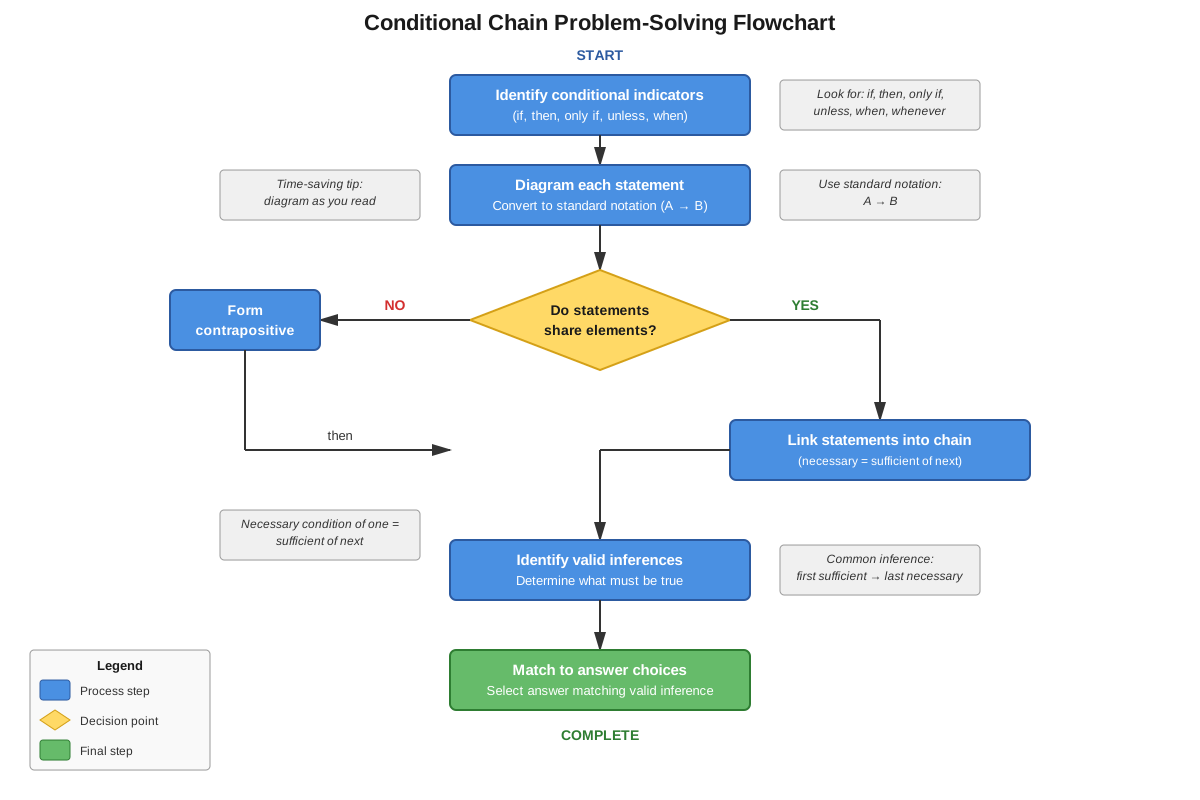
Exam Strategy
When approaching LSAT questions involving conditional chains, follow this systematic process:
Step 1: Identify conditional indicators
Watch for trigger words: "if," "when," "whenever," "all," "any," "every," "only," "unless," "without," "requires," "depends on," "necessary," "sufficient." These signal conditional relationships that may form chains.
Step 2: Diagram immediately
Don't try to track chains mentally. Write out each conditional statement using arrow notation. This external representation prevents errors and reveals connections that might otherwise be missed.
Step 3: Look for matching terms
Scan your diagrammed statements for terms that appear as the necessary condition of one statement and the sufficient condition of another. These are your chain connection points.
Step 4: Check for contrapositive needs
If terms don't immediately match, consider whether taking the contrapositive of one or more statements would create a connection. Look especially for negated terms that might link to positive terms in other statements.
Step 5: Trace the complete chain
Once you've identified connections, trace the full path from the initial sufficient condition to the final necessary condition. This is your valid inference.
Step 6: Eliminate wrong answers systematically
- Eliminate any answer that reverses the chain without proper contrapositive formation
- Eliminate any answer that affirms the consequent or denies the antecedent
- Eliminate any answer that connects unrelated statements
- Eliminate any answer that goes beyond what the chain establishes (adding information not present)
Time-saving tip: In Must Be True questions, if you see three or more conditional statements, immediately check for chain formation. This is often the fastest path to the correct answer.
Red flag: If an answer choice seems to connect the first and last terms of a chain but uses different language or adds qualifiers ("some," "most," "usually"), it's likely a trap answer that goes beyond what the chain strictly establishes.
Memory Techniques
Mnemonic for chain validity: "MATCH"
- Matching terms required (necessary of one = sufficient of next)
- Arrow direction matters (sufficient → necessary)
- Transitive property applies (A → B → C means A → C)
- Contrapositive creates reverse chain (~C → ~B → ~A)
- Halt at gaps (incomplete chains need assumptions)
Visualization strategy: Picture a chain of dominoes. Each domino (conditional statement) must touch the next one to continue the chain reaction. If there's a gap, the chain breaks. The contrapositive is like viewing the domino chain from the opposite direction—each domino still touches the next, but you're moving backward through the sequence.
Acronym for common errors: "RADAR"
- Reversing without contrapositive
- Affirming the consequent
- Denying the antecedent
- Assuming connections between unrelated statements
- Repeating terms without checking direction
Memory aid for compound conditions: "AND is demanding, OR is forgiving"
- AND in the sufficient position means you need both conditions to trigger the result (demanding)
- OR in the necessary position means at least one outcome must occur (forgiving—easier to satisfy)
Summary
Conditional chains represent a critical reasoning pattern on the LSAT where multiple conditional statements link together through matching terms, allowing test-takers to draw extended inferences from sufficient conditions to distant necessary conditions. Valid chain formation requires that the necessary condition of one statement matches the sufficient condition of the next, creating a transitive relationship where A → B and B → C yields A → C. The contrapositive of an entire chain reverses the direction and negates all terms, providing an equally valid inference path. LSAT questions test chain recognition across multiple question types, particularly Must Be True and Sufficient Assumption questions, where identifying gaps in chains or completing logical connections separates high scorers from average performers. Common errors include reversing chains without proper contrapositive formation, connecting unrelated statements, and committing the fallacies of affirming the consequent or denying the antecedent. Mastery requires systematic diagramming, careful attention to term matching, and recognition of when contrapositive manipulation is necessary to reveal hidden connections between statements.
Key Takeaways
- Conditional chains link multiple if-then statements through matching terms, where the necessary condition of one statement becomes the sufficient condition of the next
- Valid chain inferences follow the transitive property: if A → B → C, then A → C is necessarily true
- The contrapositive of a chain reverses direction and negates all terms: A → B → C becomes ~C → ~B → ~A
- Chains only work in the forward direction (sufficient to necessary) or through proper contrapositive formation—never by simple reversal
- In Sufficient Assumption questions, the correct answer typically provides the missing link that completes an incomplete conditional chain
- Systematic diagramming using arrow notation is essential for visualizing chains and avoiding errors in complex problems
- Watch for contrapositive manipulation needs when terms don't immediately match between statements
Related Topics
Formal Logic in Analytical Reasoning: Conditional chains appear extensively in Logic Games, where rules often form chains that determine valid arrangements and trigger cascading consequences. Mastering chains in Logical Reasoning directly transfers to improved performance in the Analytical Reasoning section.
Necessary vs. Sufficient Assumptions: Understanding chains deepens comprehension of assumption questions, as necessary assumptions often involve recognizing that a chain exists but is incomplete, while sufficient assumptions provide the specific link that completes the chain.
Parallel Reasoning: Recognizing conditional chain structures helps identify parallel arguments, as the underlying logical form (chain length, contrapositive usage, compound conditions) must match between the stimulus and correct answer.
Strengthen and Weaken Questions: Some strengthen/weaken questions involve conditional reasoning where adding or removing a link in a chain significantly impacts the argument's force.
Practice CTA
Now that you understand the mechanics and strategy behind conditional chains, it's time to cement your mastery through active practice. Attempt the practice questions associated with this topic, focusing on systematic diagramming and careful term matching. Work through the flashcards to reinforce recognition of chain patterns and common error types. Remember that conditional chains appear in 15-20% of Logical Reasoning questions—mastering this topic will directly improve your LSAT score. Each practice problem you complete builds the pattern recognition and diagramming speed that will serve you on test day. You've learned the concepts; now make them automatic through deliberate practice.
Sign up free to keep reading
Create a free AnvayaPrep account to finish this LSAT guide on Conditional chains — plus flashcards and practice questions.