Overview
Common conditional traps represent one of the most frequently tested and challenging aspects of logical reasoning on the LSAT. These traps exploit predictable errors that test-takers make when working with conditional logic statements, particularly when translating, diagramming, or applying conditional relationships. The LSAT deliberately constructs answer choices that appear correct to students who fall into these reasoning pitfalls, making mastery of this topic essential for achieving a competitive score.
Understanding common conditional traps is crucial because conditional logic appears in approximately 25-30% of all Logical Reasoning questions and forms the backbone of many Logic Games scenarios. The test-makers consistently design wrong answer choices that capitalize on specific logical errors: confusing sufficient and necessary conditions, illegally reversing conditional statements, negating conditions incorrectly, and misapplying contrapositive reasoning. Students who cannot identify and avoid these traps will consistently select attractive but incorrect answer choices, even when they understand the basic mechanics of conditional statements.
This topic sits at the intersection of foundational conditional logic knowledge and advanced critical reasoning skills. While prerequisite understanding of basic conditional statements, contrapositives, and logical operators provides the foundation, recognizing common conditional traps requires pattern recognition, metacognitive awareness, and the ability to spot subtle logical fallacies embedded in complex argument structures. Mastering these traps not only improves performance on explicit conditional logic questions but also enhances overall logical reasoning ability across Strengthen, Weaken, Flaw, and Assumption question types.
Learning Objectives
- [ ] Identify how Common conditional traps appears in LSAT questions
- [ ] Explain the reasoning pattern behind Common conditional traps
- [ ] Apply Common conditional traps to solve LSAT-style problems accurately
- [ ] Distinguish between valid and invalid conditional inferences in complex argument structures
- [ ] Recognize the specific language patterns that signal conditional trap answer choices
- [ ] Construct accurate contrapositives and identify when answer choices present illegal logical operations
- [ ] Evaluate argument structures to determine which conditional relationships can and cannot be legitimately derived
Prerequisites
- Basic conditional logic notation and translation: Understanding "if...then" statements and their symbolic representation (A → B) is essential because conditional traps build upon these foundational structures
- Contrapositive formation: Knowing how to correctly form contrapositives (A → B becomes ~B → ~A) is necessary because many traps involve incorrect contrapositive reasoning
- Logical operators (and, or, not): Familiarity with how these operators function in logical statements is required because traps often involve misapplying these operators
- Sufficient vs. necessary conditions: Distinguishing between these two types of conditions is fundamental because the most common traps involve confusing them
- Basic argument structure: Recognizing premises and conclusions helps identify where conditional relationships appear in LSAT arguments
Why This Topic Matters
Common conditional traps matter because they represent the difference between a good LSAT score and an exceptional one. The LSAT is fundamentally a test of precise logical reasoning, and conditional logic serves as the formal framework for much of that reasoning. Test-makers invest considerable effort in crafting wrong answer choices that exploit specific, predictable errors in conditional reasoning. Students who master trap recognition can eliminate 2-3 answer choices immediately on many questions, dramatically improving both accuracy and speed.
From an exam statistics perspective, conditional logic appears in multiple question types across both Logical Reasoning sections. Must Be True questions frequently test conditional reasoning, as do Sufficient Assumption questions (which explicitly ask for a conditional statement that guarantees the conclusion). Flaw questions often identify conditional reasoning errors, while Parallel Reasoning questions may require matching conditional structures. In Logic Games, conditional rules form the backbone of most game setups, and trap answers in game questions exploit the same logical errors tested in Logical Reasoning.
On the LSAT, common conditional traps typically appear in several ways: (1) answer choices that present the illegal reverse of a conditional statement as if it were valid; (2) answer choices that present the illegal inverse (negating both terms without switching them); (3) statements that confuse sufficient conditions with necessary conditions; (4) complex conditional chains where one link is subtly invalid; and (5) statements that misapply "some" or "most" statements as if they were conditional absolutes. Recognizing these patterns allows test-takers to work efficiently and confidently through challenging questions.
Core Concepts
The Illegal Reverse (Affirming the Consequent)
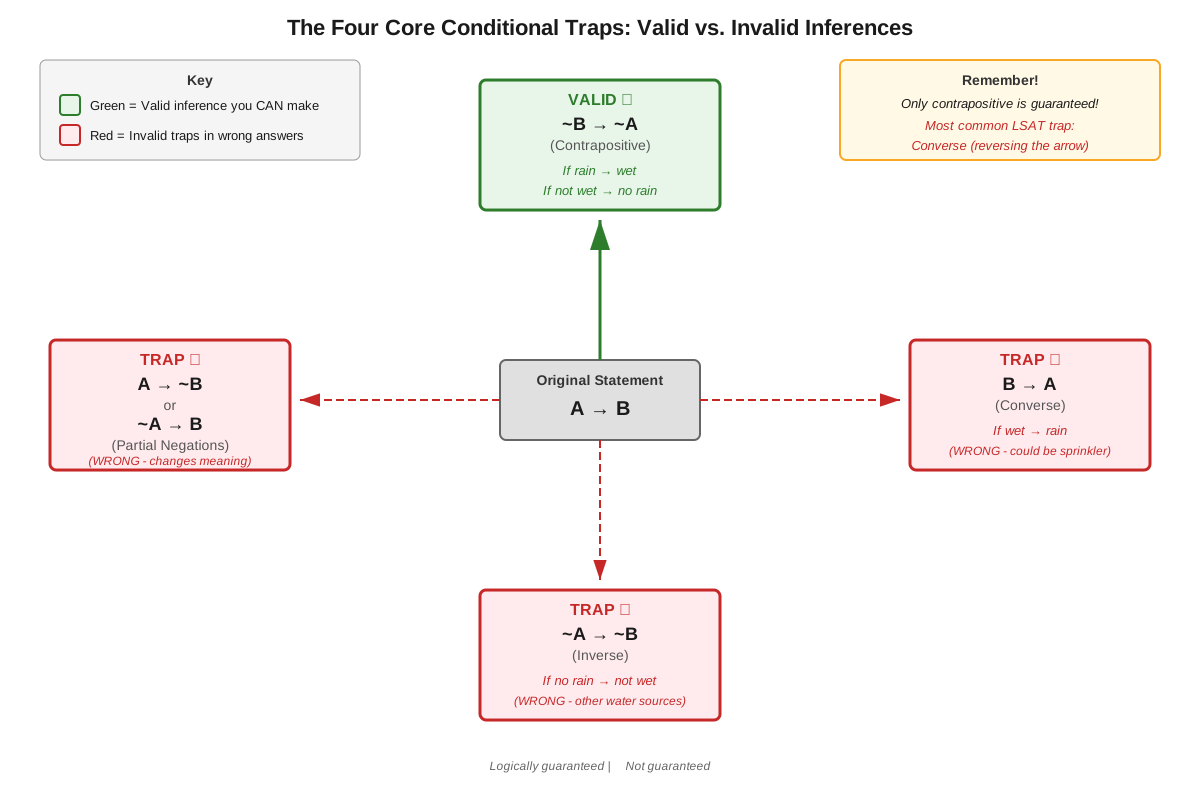
The illegal reverse represents the most common conditional trap on the LSAT. This error occurs when test-takers assume that a conditional statement works in both directions. Given the statement "If A, then B" (A → B), the illegal reverse assumes "If B, then A" (B → A). This is logically invalid because the original statement only tells us what happens when A occurs, not what happens when B occurs.
Consider this example: "If someone is a lawyer, then they passed the bar exam" (Lawyer → Passed Bar). The illegal reverse would claim: "If someone passed the bar exam, then they are a lawyer." This is clearly false—many people pass the bar but choose not to practice law, or they may have passed but been disbarred. The LSAT frequently presents answer choices that commit this error, especially in Must Be True and Inference questions.
The illegal reverse is particularly dangerous because it feels intuitively correct to many test-takers. The human brain naturally wants to see relationships as bidirectional, but conditional logic is explicitly unidirectional unless stated otherwise. On the LSAT, trap answers will often use the same vocabulary and structure as the stimulus, making them appear valid when they actually represent this fundamental logical error.
The Illegal Inverse (Denying the Antecedent)
The illegal inverse occurs when test-takers negate both the sufficient and necessary conditions without switching their positions. Given "If A, then B" (A → B), the illegal inverse assumes "If not A, then not B" (~A → ~B). This is invalid because the original statement makes no claim about what happens when A is absent.
Using our previous example: "If someone is a lawyer, then they passed the bar exam" does not allow us to conclude "If someone is not a lawyer, then they did not pass the bar exam." Many non-lawyers have passed the bar exam—they simply chose different careers or are between jobs. The LSAT exploits this error by presenting answer choices that negate both terms, which appears to be a logical operation but actually represents invalid reasoning.
The illegal inverse is especially prevalent in Flaw questions, where the correct answer may describe the argument as "failing to consider that the absence of the sufficient condition does not guarantee the absence of the necessary condition." Recognizing this pattern allows test-takers to quickly identify both the flaw in arguments and the trap in wrong answer choices.
Confusing Sufficient and Necessary Conditions
Many LSAT trap answers exploit confusion between sufficient conditions (what is enough to guarantee something) and necessary conditions (what is required for something). In the statement A → B, A is sufficient for B (A is enough to guarantee B), while B is necessary for A (you cannot have A without B). However, B is not sufficient for A, and A is not necessary for B.
The LSAT tests this distinction by presenting answer choices that claim a necessary condition is sufficient, or vice versa. For example, if the stimulus establishes "Winning the election requires getting 50% of the vote" (Win → 50%), a trap answer might claim "Getting 50% of the vote ensures winning the election" (50% → Win). This reverses the relationship—50% is necessary but not sufficient (there might be other requirements, like not being disqualified).
This trap appears frequently in Sufficient Assumption questions, where wrong answers provide necessary conditions when the question asks for sufficient conditions. It also appears in Flaw questions, where arguments incorrectly treat necessary conditions as if they were sufficient.
Mistaking "Some" or "Most" for Conditional Absolutes
The LSAT frequently includes statements using quantifiers like "some" or "most," and trap answers treat these as if they were absolute conditional statements. A statement like "Most lawyers are wealthy" does not create a conditional relationship. It cannot be diagrammed as Lawyer → Wealthy, nor does it allow any definite conclusions about individual cases.
Trap answers will take "most" or "some" statements and draw absolute conclusions as if they were universal conditionals. For example, from "Most successful entrepreneurs took risks," a trap answer might conclude "If someone is a successful entrepreneur, they definitely took risks." This is invalid—"most" means more than half, but not all, so we cannot make absolute predictions about individuals.
This trap is particularly insidious in Must Be True questions, where the correct answer must be absolutely guaranteed by the stimulus. Any answer that converts a "some" or "most" statement into an absolute conditional claim is incorrect, yet these answers often appear compelling because they seem to follow naturally from the stimulus.
Misapplying Contrapositive Logic
While forming the contrapositive is a valid logical operation (A → B becomes ~B → ~A), the LSAT creates traps by presenting statements that look like contrapositives but contain subtle errors. Common errors include: switching the terms without negating them, negating without switching, or incorrectly negating compound conditions.
For compound conditions, the contrapositive requires applying De Morgan's Laws. If the original statement is "If A and B, then C" (A ∧ B → C), the contrapositive is "If not C, then not A or not B" (~C → ~A ∨ ~B). A trap answer might present "If not C, then not A and not B" (~C → ~A ∧ ~B), which is logically invalid. Similarly, for "If A or B, then C" (A ∨ B → C), the contrapositive is "If not C, then not A and not B" (~C → ~A ∧ ~B), not "If not C, then not A or not B."
These errors appear in Must Be True questions, Parallel Reasoning questions (where you must match logical structures), and Sufficient Assumption questions (where you need to identify what would make an argument valid).
Conditional Chain Errors
Many LSAT questions present conditional chains where multiple conditional statements link together: A → B, B → C, therefore A → C. This is valid reasoning. However, trap answers introduce chains with one invalid link, often an illegal reverse or inverse embedded within a longer chain of reasoning.
For example, a stimulus might establish: "All doctors are educated (Doctor → Educated)" and "All educated people read regularly (Educated → Read)." The valid conclusion is "All doctors read regularly (Doctor → Read)." A trap answer might present a chain like: "All people who read regularly are educated (Read → Educated), and all educated people are doctors (Educated → Doctor), therefore all people who read regularly are doctors (Read → Doctor)." This chain contains two illegal reverses, but the chain structure makes it appear valid to test-takers who aren't carefully checking each link.
Recognizing conditional chain errors requires checking each link individually to ensure it's valid, then verifying that the links connect properly (the necessary condition of one statement must match the sufficient condition of the next).
Concept Relationships
The concepts within common conditional traps are hierarchically related, with basic conditional logic errors forming the foundation for more complex traps. The illegal reverse and illegal inverse represent the two fundamental errors in conditional reasoning—both involve incorrectly manipulating the original conditional statement. These basic errors then manifest in more sophisticated ways through confusion of sufficient and necessary conditions (which is essentially a conceptual reframing of the illegal reverse) and misapplication of contrapositive logic (which involves performing invalid operations that resemble valid contrapositive formation).
The relationship flows as follows: Basic Conditional Statement (A → B) → Two Invalid Operations (Illegal Reverse: B → A; Illegal Inverse: ~A → ~B) → Conceptual Confusion (Treating Necessary as Sufficient) → Complex Applications (Chain Errors, Compound Condition Errors, Quantifier Misapplication).
These conditional trap concepts connect directly to prerequisite knowledge of basic conditional logic and contrapositive formation. Without understanding what makes a conditional statement valid, students cannot recognize what makes it invalid. The concepts also connect forward to more advanced topics like formal logic in Logic Games, where conditional chains become more complex, and to argument evaluation in Logical Reasoning, where recognizing these errors helps identify flaws and strengthen arguments.
The relationship to quantifier logic ("some," "most," "all") represents a parallel track—while conditional statements deal with absolute relationships, quantifiers deal with proportional relationships. The trap occurs at the intersection: when test-takers incorrectly convert quantifier statements into conditional absolutes. This connection is crucial for Must Be True questions, where precision about what can and cannot be concluded is essential.
High-Yield Facts
⭐ The illegal reverse (B → A from A → B) is the single most common conditional trap on the LSAT, appearing in approximately 40% of questions involving conditional logic.
⭐ A conditional statement A → B tells you nothing definite about what happens when A is absent or when B is present—only what happens when A is present.
⭐ The only valid inference from a single conditional statement A → B is its contrapositive ~B → ~A; all other manipulations are invalid.
⭐ Necessary conditions can never be used to make sufficient claims—if B is necessary for A (A → B), you cannot conclude that B is sufficient for A (B → A).
⭐ "Most" and "some" statements cannot be converted into conditional statements and do not allow definite conclusions about individual cases.
- The illegal inverse (~A → ~B from A → B) appears most frequently in Flaw questions and wrong answers to Must Be True questions.
- When forming the contrapositive of compound conditions, "and" becomes "or" and "or" becomes "and" (De Morgan's Laws).
- Conditional chains are only valid if each link is valid and the necessary condition of one statement matches the sufficient condition of the next.
- Language like "only if," "unless," and "without" creates conditional relationships but with reversed positions compared to "if...then" statements.
- Wrong answers in Sufficient Assumption questions often provide necessary conditions when sufficient conditions are required, or vice versa.
Quick check — test yourself on Common conditional traps so far.
Try Flashcards →Common Misconceptions
Misconception: If A → B is true, then B → A must also be true because the two things are related.
Correction: Conditional relationships are unidirectional unless explicitly stated otherwise. A → B only tells you what happens when A occurs, not what happens when B occurs. The relationship is not symmetric.
Misconception: The contrapositive and the inverse are the same thing.
Correction: The contrapositive (~B → ~A from A → B) is valid and logically equivalent to the original statement. The inverse (~A → ~B from A → B) is invalid and commits a logical error. The contrapositive both negates AND switches the terms; the inverse only negates.
Misconception: If most As are Bs, then being an A makes it likely you're a B, so A → B is approximately true.
Correction: Conditional logic deals with absolute guarantees, not probabilities. "Most" statements cannot be converted into conditional statements at all. On the LSAT, "must be true" means 100% guaranteed, not "probably true."
Misconception: In a conditional chain, you can work backwards as easily as forwards.
Correction: Conditional chains only work in one direction—from sufficient to necessary. Given A → B → C, you can conclude A → C, but you cannot conclude C → A. Working backwards requires using contrapositives: ~C → ~B → ~A.
Misconception: If the LSAT says "If A, then B" and later says "B occurred," I can conclude A occurred.
Correction: This is the illegal reverse (affirming the consequent). B could occur for many reasons other than A. The conditional only tells you that A is sufficient for B, not that A is necessary for B.
Misconception: Necessary conditions are less important than sufficient conditions.
Correction: Both are equally important but serve different logical functions. Necessary conditions are actually more restrictive in some ways—if a necessary condition is absent, the sufficient condition absolutely cannot occur. Understanding both is essential for LSAT success.
Worked Examples
Example 1: Identifying the Illegal Reverse in a Must Be True Question
Stimulus: "All members of the debate team have strong critical thinking skills. Every student with strong critical thinking skills excels in philosophy courses. Therefore, all debate team members excel in philosophy courses."
Question: Which of the following can be properly inferred from the statements above?
Answer Choices:
(A) Anyone who excels in philosophy courses is a member of the debate team.
(B) If someone does not excel in philosophy courses, they are not on the debate team.
(C) Strong critical thinking skills are necessary for being on the debate team.
(D) Most people with strong critical thinking skills are on the debate team.
(E) Some people who excel in philosophy courses have strong critical thinking skills.
Solution Process:
First, diagram the conditional relationships in the stimulus:
- Debate Team → Critical Thinking Skills
- Critical Thinking Skills → Excel in Philosophy
- Valid chain: Debate Team → Critical Thinking Skills → Excel in Philosophy
- Therefore: Debate Team → Excel in Philosophy
Now evaluate each answer choice:
(A) "Anyone who excels in philosophy courses is a member of the debate team" translates to: Excel in Philosophy → Debate Team. This is the illegal reverse of our conclusion (Debate Team → Excel in Philosophy). Many people might excel in philosophy for reasons other than being on the debate team. INCORRECT—this is a trap answer exploiting the illegal reverse.
(B) "If someone does not excel in philosophy courses, they are not on the debate team" translates to: ~Excel in Philosophy → ~Debate Team. This is the contrapositive of our conclusion (Debate Team → Excel in Philosophy), which is logically valid. This must be true. CORRECT.
(C) "Strong critical thinking skills are necessary for being on the debate team" translates to: Debate Team → Critical Thinking Skills. While this is actually stated in the stimulus, the answer choice claims critical thinking is necessary, which is correct. However, let's verify this is what the statement says. Yes, "All debate team members have critical thinking skills" means Debate Team → Critical Thinking, making critical thinking necessary for debate team. This is actually true, but (B) is more directly inferable from the complete chain.
(D) "Most people with strong critical thinking skills are on the debate team" introduces a quantifier ("most") that isn't supported by the stimulus. The stimulus tells us all debate team members have critical thinking skills, but not what proportion of people with critical thinking skills are on the debate team. INCORRECT—this confuses the direction and introduces unsupported quantifiers.
(E) "Some people who excel in philosophy courses have strong critical thinking skills" translates to: Some (Excel in Philosophy) → Critical Thinking Skills. We know Debate Team → Critical Thinking Skills → Excel in Philosophy, so we know at least some people who excel in philosophy (the debate team members) have critical thinking skills. This is actually valid, but (B) is stronger and more directly inferable.
Best Answer: (B) because it represents the valid contrapositive of the conclusion.
Key Lesson: This example demonstrates how the LSAT places the illegal reverse (A) as a trap answer that will appeal to students who don't carefully check the direction of conditional relationships. The correct answer (B) requires recognizing and applying the contrapositive, which is always valid.
Example 2: Recognizing Sufficient vs. Necessary Confusion in a Flaw Question
Stimulus: "To be admitted to the graduate program, applicants must have a GPA above 3.5. Jennifer has a GPA of 3.8. Therefore, Jennifer will be admitted to the graduate program."
Question: The reasoning in the argument is flawed because it:
Answer Choices:
(A) assumes that having a high GPA is the only factor in graduate admissions
(B) treats a necessary condition for admission as if it were a sufficient condition
(C) fails to consider that Jennifer might not want to attend the graduate program
(D) confuses a sufficient condition with a necessary condition
(E) relies on a sample size that is too small to draw a general conclusion
Solution Process:
First, identify the conditional logic in the argument:
- Stated: "To be admitted, applicants must have GPA > 3.5"
- This translates to: Admitted → GPA > 3.5
- The GPA requirement is a necessary condition for admission (you can't be admitted without it)
- The argument then observes: Jennifer has GPA > 3.5
- The argument concludes: Jennifer will be admitted
The flaw: The argument treats the necessary condition (GPA > 3.5) as if it were sufficient for admission. Just because Jennifer has the required GPA doesn't mean she'll definitely be admitted—there might be other requirements (test scores, letters of recommendation, etc.).
In conditional logic terms, the argument illegally reverses the relationship:
- Given: Admitted → GPA > 3.5
- Argument assumes: GPA > 3.5 → Admitted (illegal reverse)
(A) "assumes that having a high GPA is the only factor in graduate admissions" describes the flaw in everyday language but isn't as precise as (B). This is close but not the best answer.
(B) "treats a necessary condition for admission as if it were a sufficient condition" CORRECT. This precisely identifies the logical error. The GPA is necessary (required) but not sufficient (not enough by itself to guarantee admission).
(C) "fails to consider that Jennifer might not want to attend" is irrelevant to the logical structure of the argument. The conclusion is about whether she'll be admitted, not whether she'll attend.
(D) "confuses a sufficient condition with a necessary condition" has the relationship backwards. The argument treats a necessary condition as sufficient, not the other way around.
(E) "relies on a sample size that is too small" is irrelevant—this isn't a statistical argument about samples.
Best Answer: (B)
Key Lesson: This example illustrates how the LSAT tests understanding of the sufficient/necessary distinction. The trap answer (D) uses the right terminology but reverses the relationship. Recognizing that necessary conditions cannot guarantee outcomes (only sufficient conditions can) is crucial for avoiding this trap.
Exam Strategy
When approaching LSAT questions involving conditional logic, implement a systematic process to avoid common traps. First, identify and diagram all conditional relationships in the stimulus using consistent notation (A → B). This visual representation makes it easier to spot invalid manipulations in answer choices. Take the extra 10-15 seconds to write out the relationships—this investment prevents costly errors.
Watch for trigger language that signals conditional relationships: "if," "when," "all," "every," "any," "only," "only if," "unless," "without," "requires," "necessary," "sufficient," "depends on," and "must." Each of these creates or describes a conditional relationship, though some (like "only if" and "unless") reverse the expected order. When you see these triggers, immediately translate the statement into conditional form.
For process of elimination, actively look for the illegal reverse and illegal inverse in wrong answer choices. In Must Be True questions, approximately 60% of wrong answers commit one of these two errors. If an answer choice reverses the direction of a conditional relationship from the stimulus, eliminate it immediately. If it negates both terms without switching them, eliminate it. This strategy alone can often narrow choices to 1-2 remaining options.
Time allocation is crucial for conditional logic questions. Spend more time upfront accurately diagramming the stimulus (30-45 seconds) rather than rushing through it. This initial investment pays dividends when evaluating answer choices, which becomes much faster when you have clear diagrams to reference. For questions with conditional chains, verify each link before moving to answer choices—finding an error in your chain after evaluating answers wastes significant time.
When stuck between two answer choices, check the contrapositive. If an answer choice claims something must be true, verify whether it's the contrapositive of a statement in the stimulus. The contrapositive is always valid, while similar-looking statements (reverse, inverse) are not. This technique is especially powerful in Must Be True and Inference questions.
For Sufficient Assumption questions, remember that wrong answers often provide necessary conditions when sufficient conditions are required. The correct answer must guarantee the conclusion—ask yourself "If this answer choice is true, does the conclusion absolutely have to follow?" If not, eliminate it.
Memory Techniques
RINO Mnemonic for invalid conditional operations:
- Reverse is Invalid (B → A from A → B)
- Inverse is Invalid (~A → ~B from A → B)
- Negating without switching is Invalid
- Only the contrapositive is valid (~B → ~A from A → B)
"Sufficient Starts, Necessary Needs" - In A → B, A is the sufficient condition (it starts/triggers the relationship), and B is the necessary condition (it's needed when A occurs). This helps remember which is which.
"Most is Not Must" - Quantifier statements with "most" or "some" cannot create "must be true" conclusions. If you see "most" in the stimulus and "must" in an answer choice, it's likely wrong.
The Contrapositive Flip-and-Negate Dance - Visualize physically flipping the two conditions (switching their positions) and then negating both. This kinesthetic memory aid helps ensure you perform both operations when forming contrapositives.
"Necessary is Never Sufficient" (NiNS) - A necessary condition alone can never be sufficient to guarantee an outcome. This reminds you that necessary conditions cannot be used to make definite predictions.
De Morgan's Laws Mnemonic: "And/Or Switch at the Door" - When forming contrapositives of compound conditions, "and" and "or" switch places as you go through the "door" of negation. (A and B) → C becomes ~C → (~A or ~B).
Summary
Common conditional traps represent systematic errors in conditional reasoning that the LSAT deliberately exploits through carefully crafted wrong answer choices. The most prevalent traps—the illegal reverse, illegal inverse, and confusion of sufficient with necessary conditions—account for the majority of wrong answers in conditional logic questions. Mastering these traps requires understanding that conditional statements are unidirectional (A → B does not imply B → A), that only the contrapositive represents valid manipulation of a conditional statement, and that necessary conditions cannot be used to make sufficient claims. Additional traps involve misapplying quantifiers like "most" or "some" as if they were conditional absolutes, and introducing subtle errors into conditional chains or compound conditions. Success on LSAT conditional logic questions depends on systematic diagramming, careful verification of each logical step, and active elimination of answer choices that commit these predictable errors. Students who internalize these patterns and apply consistent checking procedures will dramatically improve both accuracy and efficiency on Logical Reasoning questions and Logic Games involving conditional relationships.
Key Takeaways
- The illegal reverse (B → A from A → B) and illegal inverse (~A → ~B from A → B) are the two most common conditional traps, appearing in the majority of wrong answer choices for conditional logic questions
- Conditional statements are strictly unidirectional—A → B tells you only what happens when A occurs, nothing about when A is absent or when B is present
- The contrapositive (~B → ~A from A → B) is the only valid manipulation of a conditional statement and is logically equivalent to the original
- Necessary conditions cannot be used to make sufficient claims—just because something is required doesn't mean it's enough to guarantee an outcome
- "Most" and "some" statements cannot be converted into conditional statements and do not support "must be true" conclusions about individual cases
- Systematic diagramming of conditional relationships and careful verification of each logical step are essential strategies for avoiding traps
- Recognizing trigger language and checking answer choices for illegal reverses and inverses enables rapid elimination of wrong answers
Related Topics
Advanced Conditional Logic in Logic Games - Building on trap recognition, this topic covers complex conditional chains, conditional blocks, and conditional game boards where multiple conditional rules interact. Mastering common traps provides the foundation for handling these more sophisticated applications.
Formal Logic and Quantifiers - This topic explores the relationship between conditional statements and quantified statements ("all," "some," "most," "none"), including how to properly translate between them and when such translations are valid versus when they represent traps.
Argument Flaws and Conditional Reasoning - Many LSAT Flaw questions involve conditional reasoning errors. Understanding common conditional traps enables quick identification of flaws like "treating a necessary condition as sufficient" or "confusing correlation with causation" (which often involves implicit conditional claims).
Sufficient and Necessary Assumption Questions - These question types explicitly test understanding of what's sufficient versus necessary to make an argument work. Mastery of conditional traps is essential for distinguishing between these question types and selecting correct answers.
Practice CTA
Now that you understand the common conditional traps that appear throughout the LSAT, it's time to put this knowledge into practice. Work through the practice questions and flashcards to reinforce your ability to spot illegal reverses, illegal inverses, and sufficient/necessary confusion in real LSAT contexts. Remember: recognizing these patterns becomes automatic only through repeated, deliberate practice. Each question you analyze strengthens your pattern recognition and builds the confidence you need to navigate conditional logic questions efficiently on test day. You've built the foundation—now apply it!
Sign up free to keep reading
Create a free AnvayaPrep account to finish this LSAT guide on Common conditional traps — plus flashcards and practice questions.