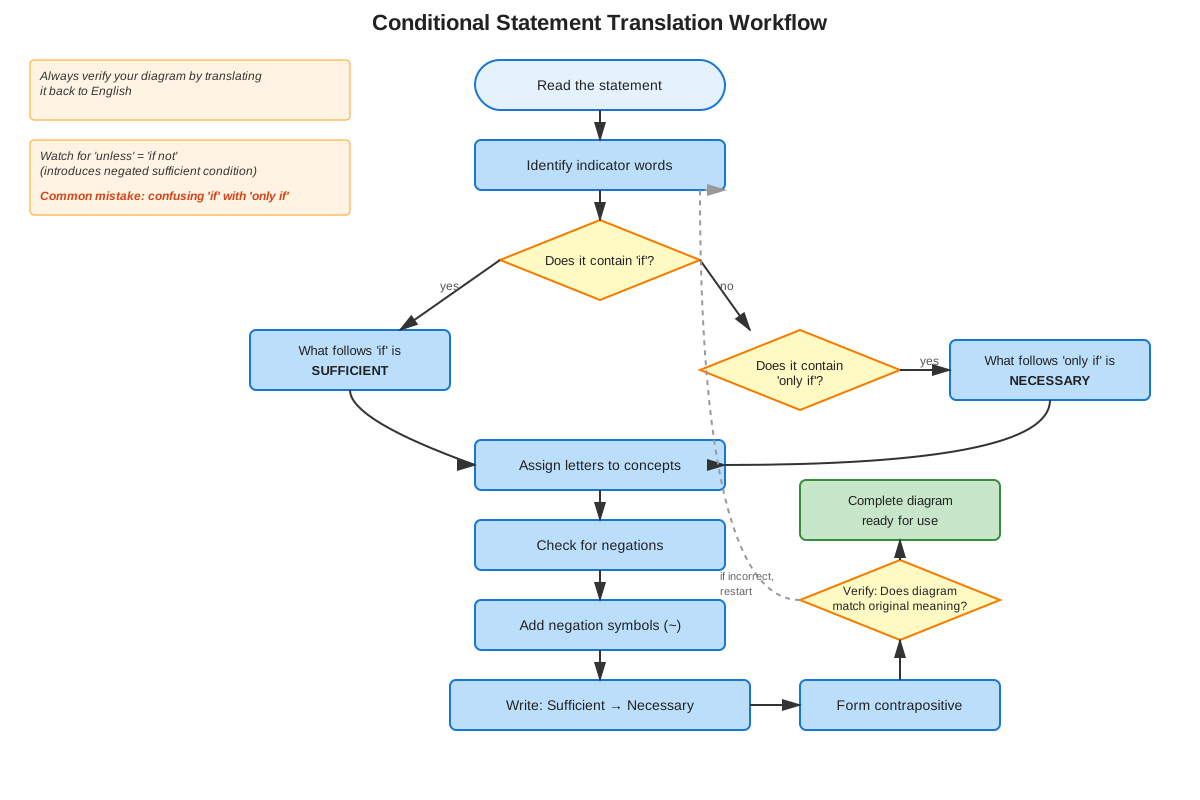
Overview
Conditional diagramming is one of the most powerful and frequently tested skills in LSAT Logical Reasoning sections. This systematic method allows test-takers to translate complex verbal statements into clear, symbolic representations that reveal logical relationships and their implications. Mastering conditional diagramming transforms seemingly complicated argument structures into manageable visual formats, enabling rapid identification of valid inferences and logical flaws. The technique serves as a bridge between natural language and formal logic, making it indispensable for anyone seeking a competitive LSAT score.
The importance of conditional logic on the LSAT cannot be overstated. Conditional statements appear in approximately 25-30% of Logical Reasoning questions and form the backbone of many Logic Games scenarios. Questions involving sufficient and necessary conditions, contrapositive reasoning, and logical chains require fluency in conditional diagramming to solve efficiently and accurately. Without this skill, test-takers often fall into traps designed to exploit common logical errors, such as confusing necessary and sufficient conditions or illegally reversing conditional statements.
Within the broader landscape of LSAT conditional diagramming, this topic connects directly to argument structure analysis, formal logic operations, and inference-drawing skills. Conditional diagramming provides the foundation for understanding more complex logical patterns, including conditional chains, bi-conditionals, and compound conditional statements. It also supports critical skills in identifying assumptions, strengthening and weakening arguments, and evaluating logical validity—all core competencies tested throughout the LSAT Logical Reasoning sections.
Learning Objectives
- [ ] Identify how Conditional diagramming appears in LSAT questions
- [ ] Explain the reasoning pattern behind Conditional diagramming
- [ ] Apply Conditional diagramming to solve LSAT-style problems accurately
- [ ] Construct accurate contrapositives from conditional statements
- [ ] Recognize and avoid common conditional reasoning errors (affirming the consequent, denying the antecedent)
- [ ] Chain multiple conditional statements together to derive valid inferences
- [ ] Distinguish between sufficient and necessary conditions in complex sentence structures
Prerequisites
- Basic logical connectors (and, or, not): Understanding these fundamental operators is essential because conditional statements often incorporate compound conditions that require proper interpretation of logical relationships.
- Argument structure identification: Recognizing premises and conclusions provides the framework for identifying where conditional relationships function within arguments.
- Reading comprehension at college level: Conditional statements appear in varied linguistic forms, requiring the ability to parse complex sentence structures and extract logical meaning.
- Basic symbolic notation comfort: Familiarity with using letters and symbols to represent concepts enables efficient diagramming without cognitive overload.
Why This Topic Matters
Conditional diagramming represents a fundamental skill that extends far beyond standardized testing. In legal reasoning—the very domain the LSAT prepares students for—conditional logic governs contract interpretation, statutory analysis, and case law application. Attorneys regularly work with "if-then" relationships when analyzing legal rules, determining when obligations arise, and predicting case outcomes. The ability to diagram these relationships accurately prevents costly logical errors in legal practice.
On the LSAT itself, conditional diagramming appears with remarkable frequency and variety. Approximately 8-12 questions per test directly test conditional reasoning, appearing in question types including Must Be True, Sufficient Assumption, Necessary Assumption, Strengthen/Weaken, and Flaw questions. Additionally, entire Logic Games (particularly Grouping and In/Out games) often hinge on conditional rules. Test-takers who master conditional diagramming gain significant time advantages, often solving questions in 30-45 seconds that might otherwise require 90+ seconds of verbal reasoning.
Common manifestations in LSAT passages include explicit conditional indicators ("if," "only if," "unless"), embedded conditionals within complex sentences, and implicit conditional relationships that require inference. The test frequently presents conditional statements in their most confusing linguistic forms—using "unless," "without," "until," or "only"—specifically to challenge test-takers who lack systematic diagramming skills. Questions may also present conditional chains requiring multiple inference steps, or they may test whether students can recognize invalid conditional reasoning patterns.
Core Concepts
The Basic Conditional Statement
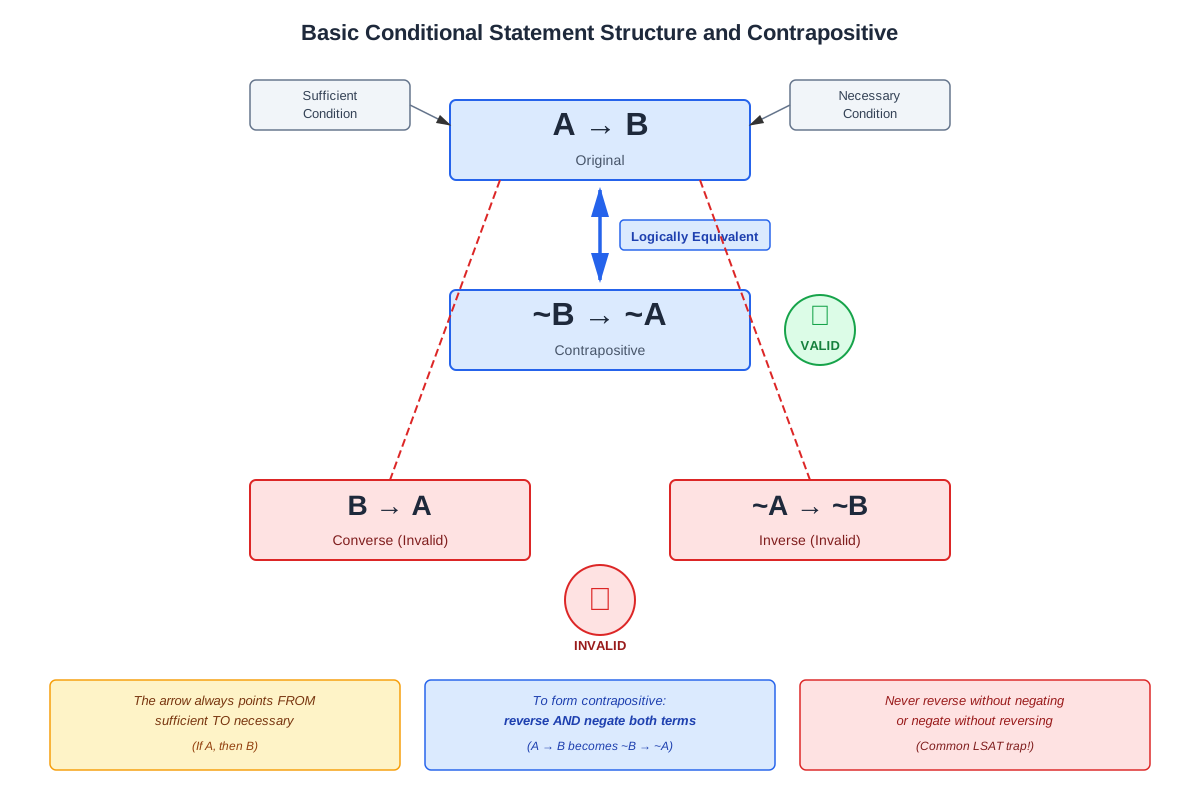
A conditional statement establishes a relationship between two conditions where one condition (the sufficient condition) guarantees the occurrence of another condition (the necessary condition). The standard form follows the pattern: "If A, then B," which diagrams as A → B. The sufficient condition (A) is sufficient—meaning enough by itself—to guarantee the necessary condition (B). Conversely, B is necessary—meaning required—whenever A occurs.
Understanding the directional nature of conditional relationships is crucial. The arrow (→) represents logical flow, not causation or temporal sequence. When we diagram A → B, we assert only that whenever A is true, B must also be true. This says nothing about what happens when A is false, nor does it tell us anything about what happens when B is true.
Sufficient vs. Necessary Conditions
The distinction between sufficient conditions and necessary conditions forms the conceptual foundation of all conditional reasoning. A sufficient condition is a condition that, when satisfied, guarantees the result. Think of it as "enough" to produce the outcome. A necessary condition is a condition that must be present for the result to occur, though it alone may not guarantee the result. Think of it as "required" for the outcome.
Consider the statement: "If you score 180 on the LSAT, you will be admitted to Harvard Law School." Here, scoring 180 is presented as sufficient for admission (though this oversimplifies reality). However, admission to Harvard requires many necessary conditions: a completed application, an undergraduate degree, letters of recommendation, etc. Each necessary condition must be present, but no single one guarantees admission.
| Condition Type | Role | Test Question | Example |
|---|---|---|---|
| Sufficient | Guarantees the result | "Is this enough to make it happen?" | Having oxygen is sufficient for combustion (given fuel and heat) |
| Necessary | Required for the result | "Can it happen without this?" | Having oxygen is necessary for combustion |
Conditional Indicators and Translation
The LSAT presents conditional relationships using diverse linguistic structures. Recognizing conditional indicators enables accurate translation into diagram form:
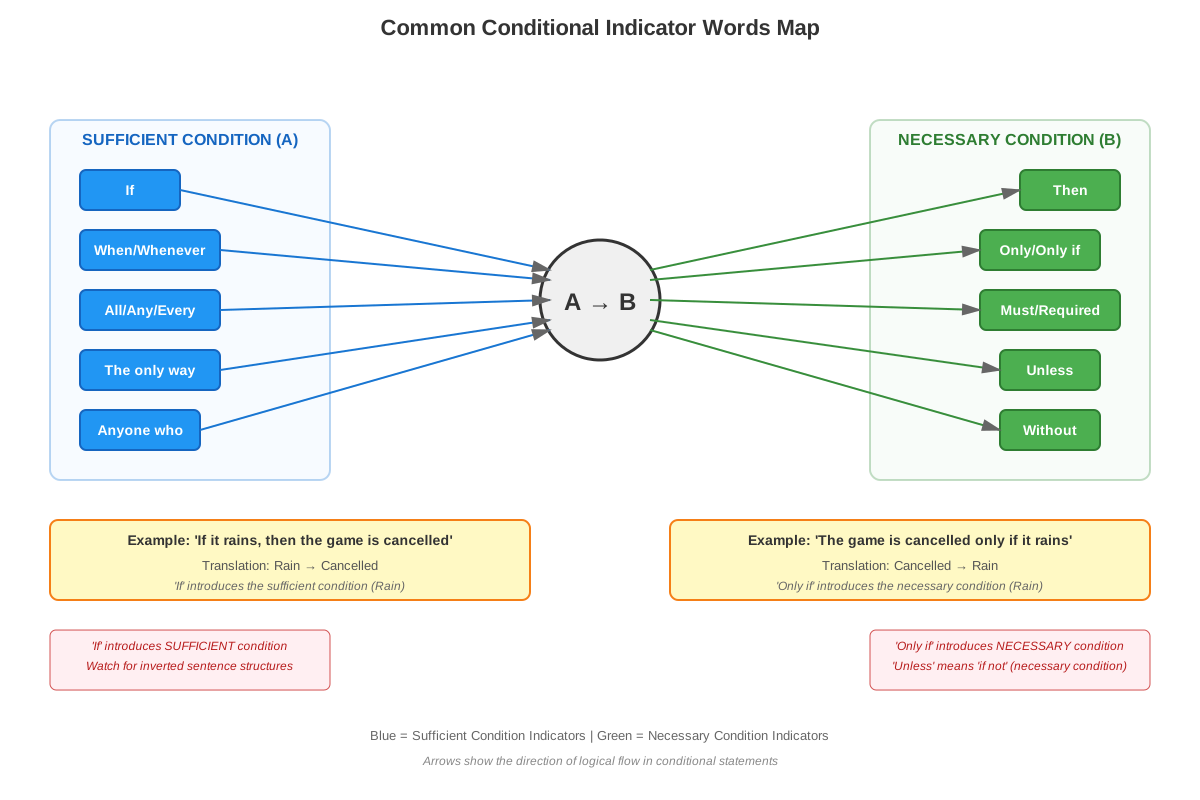
Sufficient condition indicators (what comes after these phrases goes before the arrow):
- If
- When
- Whenever
- All
- Any
- Every
- Each
- People who
- In order to
Necessary condition indicators (what comes after these phrases goes after the arrow):
- Then
- Only
- Only if
- Only when
- Must
- Required
- Necessary
- Depends on
- Unless (special case)
For example:
- "If it rains, the game is cancelled" → Rain → Cancelled
- "The game is cancelled only if it rains" → Cancelled → Rain
- "All lawyers passed the bar exam" → Lawyer → Passed Bar
The Contrapositive
The contrapositive represents the logical equivalent of any conditional statement, formed by reversing and negating both conditions. If the original statement is A → B, the contrapositive is ~B → ~A (read as "not B, then not A"). The contrapositive is always logically valid and provides the only guaranteed inference from a conditional statement.
Understanding why the contrapositive works requires grasping the logical relationship: if A guarantees B, then the absence of B must mean A was absent (otherwise B would have occurred). This logical equivalence makes the contrapositive an essential tool for LSAT questions, as correct answers frequently require contrapositive reasoning.
For the statement "If you study diligently, you will improve your score" (Study → Improve), the contrapositive is "If you do not improve your score, you did not study diligently" (~Improve → ~Study). Both statements convey identical logical information.
Invalid Conditional Inferences
Two common logical errors plague test-takers who lack systematic diagramming skills:
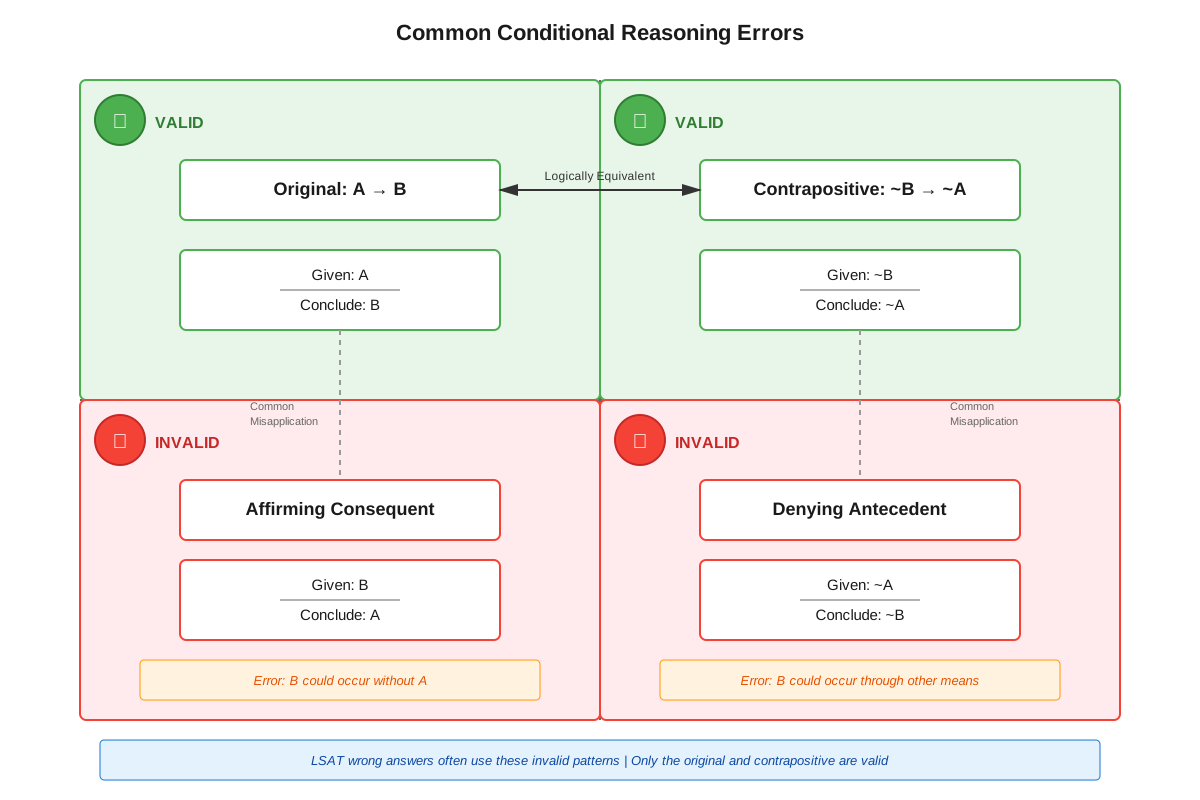
Affirming the consequent (invalid): From A → B and knowing B is true, incorrectly concluding A must be true. This reverses the conditional without negating, creating the illegal inference B → A. Just because B occurred doesn't mean A caused it; other sufficient conditions might exist.
Denying the antecedent (invalid): From A → B and knowing A is false, incorrectly concluding B must be false. This creates the illegal inference ~A → ~B. The absence of one sufficient condition doesn't preclude B from occurring through other means.
These errors appear frequently in LSAT incorrect answer choices, designed to trap test-takers who reason intuitively rather than systematically.
Conditional Chains
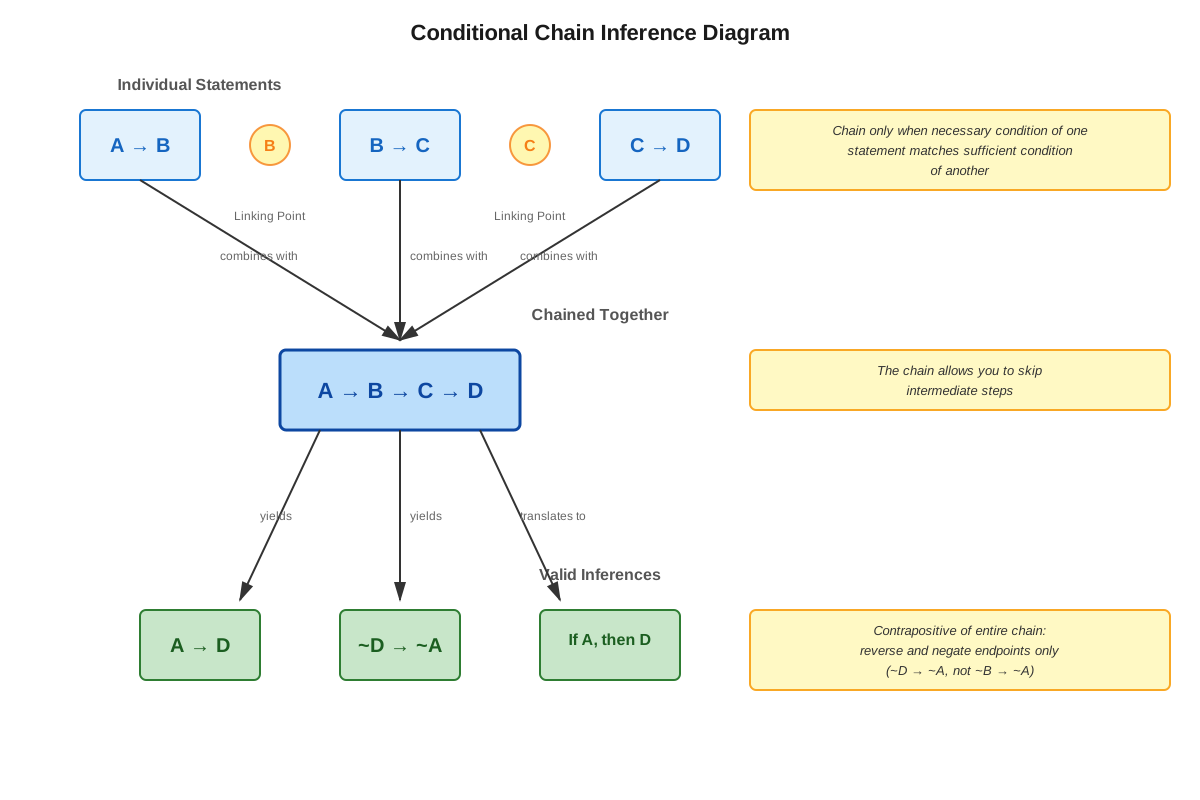
Conditional chains occur when the necessary condition of one statement serves as the sufficient condition of another, allowing multiple statements to link together. If we have A → B and B → C, we can validly infer A → C. This transitive property enables complex inference chains.
The process for working with chains:
- Diagram each conditional statement separately
- Identify where the necessary condition of one statement matches the sufficient condition of another
- Connect the statements by linking the matching conditions
- Derive the complete chain showing the full inference path
- Form the contrapositive of the entire chain for additional inferences
For example:
- "All doctors are college graduates" → Doctor → College Grad
- "All college graduates completed high school" → College Grad → High School
- Chain: Doctor → College Grad → High School
- Valid inference: Doctor → High School
- Contrapositive chain: ~High School → ~College Grad → ~Doctor
Special Conditional Structures
Unless statements require special attention because they create conditional relationships in a non-intuitive way. The word "unless" means "if not" and creates a conditional where the negation of what follows "unless" becomes the sufficient condition, and what comes before "unless" becomes the necessary condition.
Formula: "A unless B" translates to ~B → A (and its contrapositive ~A → B)
Example: "The concert will be cancelled unless ticket sales improve"
- Translation: ~Improve → Cancelled
- Contrapositive: ~Cancelled → Improve
Only/Only if statements also cause confusion. "Only" and "only if" introduce necessary conditions, not sufficient ones. "A only if B" means A → B (B is necessary for A). This reverses many test-takers' intuitive reading.
Bi-Conditional Statements
A bi-conditional exists when two conditions are both necessary and sufficient for each other, creating a two-way relationship: A ↔ B. This means A → B AND B → A. Bi-conditionals are relatively rare on the LSAT but appear with indicators like "if and only if" or "exactly when."
Concept Relationships
Conditional diagramming serves as the foundational skill that enables all advanced conditional reasoning on the LSAT. The relationship flow proceeds as follows:
Basic conditional structure (sufficient → necessary) → leads to → Contrapositive formation (~necessary → ~sufficient) → enables → Conditional chain reasoning (linking multiple conditionals) → supports → Complex inference derivation (multi-step logical conclusions)
The distinction between sufficient and necessary conditions underpins every other concept in this topic. Without clearly understanding this relationship, students cannot accurately translate verbal statements into diagrams, form valid contrapositives, or avoid invalid inferences. The contrapositive, in turn, doubles the inferential power of each conditional statement, as it provides a logically equivalent statement that often appears in correct answer choices.
Conditional chains build upon both basic diagramming and contrapositive formation, as chains frequently require using the contrapositive of one statement to connect with another. Recognition of invalid inferences (affirming the consequent, denying the antecedent) depends on understanding what the original conditional does and does not tell us, which circles back to the sufficient/necessary distinction.
Special structures like "unless" and "only if" statements represent linguistic variations that ultimately translate into the same basic conditional form, connecting back to the fundamental A → B structure. These connections mean that mastering the core concepts enables handling all variations that appear on the test.
Quick check — test yourself on Conditional diagramming so far.
Try Flashcards →High-Yield Facts
⭐ The contrapositive is the only guaranteed valid inference from a conditional statement; it is formed by reversing and negating both conditions.
⭐ Sufficient conditions appear before the arrow (→); necessary conditions appear after the arrow.
⭐ "Unless" translates to "if not": "A unless B" becomes ~B → A.
⭐ "Only if" introduces a necessary condition: "A only if B" means A → B.
⭐ Affirming the consequent (B → A from A → B) is always invalid.
- Denying the antecedent (~A → ~B from A → B) is always invalid.
- Conditional statements say nothing about what happens when the sufficient condition is absent.
- Conditional statements say nothing about what happens when the necessary condition is present.
⭐ Conditional chains work through the transitive property: if A → B and B → C, then A → C.
- The contrapositive of a chain reverses the entire sequence and negates all elements.
- "All," "every," "any," and "each" introduce sufficient conditions.
- "Must," "required," and "necessary" introduce necessary conditions.
- A bi-conditional (A ↔ B) means both A → B and B → A are true.
- Multiple sufficient conditions can lead to the same necessary condition without creating any relationship among the sufficient conditions themselves.
Common Misconceptions
Misconception: If A → B, then B → A (reversing the conditional).
Correction: Reversing a conditional without negating creates an invalid inference. The only valid reversal involves negating both terms to form the contrapositive: ~B → ~A. Just because A is sufficient for B doesn't mean B is sufficient for A.
Misconception: "Only" and "if" mean the same thing when introducing conditions.
Correction: "If" introduces a sufficient condition (what follows goes before the arrow), while "only" and "only if" introduce necessary conditions (what follows goes after the arrow). "If A then B" diagrams as A → B, but "A only if B" also diagrams as A → B, despite the different word order.
Misconception: If the sufficient condition doesn't occur, the necessary condition won't occur either.
Correction: The absence of one sufficient condition tells us nothing about whether the necessary condition will occur. Other sufficient conditions might exist. From A → B and ~A, we cannot conclude ~B (this is the fallacy of denying the antecedent).
Misconception: Conditional statements describe causal relationships.
Correction: Conditional statements describe logical relationships, not necessarily causal ones. A → B means that whenever A is true, B is also true, but this doesn't mean A causes B. The relationship might be correlational, definitional, or based on rules rather than causation.
Misconception: "Unless" means "or" and creates an "either/or" relationship.
Correction: "Unless" creates a conditional relationship meaning "if not." "A unless B" translates to ~B → A, not to "A or B." This conditional structure is much more specific than a simple disjunction and enables different inferences.
Misconception: When multiple conditions are sufficient for the same result, they must all be present together.
Correction: Multiple sufficient conditions operate independently. If A → C and B → C, then either A alone or B alone is enough to guarantee C. They don't need to occur together, and the presence of one doesn't tell us anything about the presence of the other.
Worked Examples
Example 1: Basic Conditional with Contrapositive
Problem: "All students who score above 170 on the LSAT receive scholarship offers. Maria did not receive a scholarship offer. What can we conclude?"
Step 1 - Identify and diagram the conditional statement:
"All students who score above 170 receive scholarship offers"
- "All" introduces a sufficient condition
- Diagram: Score > 170 → Scholarship Offer
Step 2 - Form the contrapositive:
Original: Score > 170 → Scholarship Offer
Contrapositive: ~Scholarship Offer → ~Score > 170
(If no scholarship offer, then did not score above 170)
Step 3 - Apply the given information:
We're told Maria did not receive a scholarship offer (~Scholarship Offer)
This matches the sufficient condition of our contrapositive
Step 4 - Draw the valid conclusion:
Using the contrapositive: ~Scholarship Offer → ~Score > 170
Since Maria has ~Scholarship Offer, we can conclude ~Score > 170
Therefore: Maria did not score above 170 on the LSAT
Step 5 - Identify invalid inferences to avoid:
- We CANNOT conclude that everyone who receives a scholarship scored above 170 (that would be affirming the consequent)
- We CANNOT conclude anything about students who scored 170 or below (the original statement doesn't tell us what happens when the sufficient condition is absent)
This example demonstrates the core learning objective of applying conditional diagramming to solve LSAT-style problems by using the contrapositive to derive valid inferences.
Example 2: Conditional Chain with Multiple Inferences
Problem: Consider these three statements:
- "Anyone admitted to the program must have completed the prerequisite course."
- "Completing the prerequisite course requires passing the entrance exam."
- "John was admitted to the program."
What must be true about John?
Step 1 - Diagram each conditional statement:
Statement 1: "Anyone admitted must have completed the prerequisite"
- "Must have" indicates a necessary condition
- Admitted → Completed Prerequisite
Statement 2: "Completing the prerequisite requires passing the entrance exam"
- "Requires" indicates a necessary condition
- Completed Prerequisite → Passed Exam
Statement 3: "John was admitted" = Admitted (John)
Step 2 - Build the conditional chain:
The necessary condition of Statement 1 (Completed Prerequisite) is the sufficient condition of Statement 2
Chain: Admitted → Completed Prerequisite → Passed Exam
Step 3 - Apply the given information:
John was admitted (sufficient condition of the chain is satisfied)
Step 4 - Derive valid conclusions:
Following the chain: If John was admitted, he must have completed the prerequisite
Following further: If he completed the prerequisite, he must have passed the exam
Therefore: John passed the entrance exam
Step 5 - Form the contrapositive chain for additional insights:
Original chain: Admitted → Completed Prerequisite → Passed Exam
Contrapositive chain: ~Passed Exam → ~Completed Prerequisite → ~Admitted
This tells us: Anyone who didn't pass the exam couldn't have completed the prerequisite and therefore couldn't have been admitted.
Step 6 - Identify what we CANNOT conclude:
- We cannot conclude that everyone who passed the exam was admitted (affirming the consequent)
- We cannot conclude that passing the exam is sufficient for admission (we only know it's necessary)
- We cannot conclude anything about people who weren't admitted (denying the antecedent)
This example illustrates how conditional chains enable multi-step inferences and demonstrates the importance of distinguishing between what we can and cannot conclude from conditional relationships.
Exam Strategy
When approaching LSAT questions involving conditional diagramming, follow this systematic process:
Step 1 - Scan for conditional indicators: Before reading in detail, quickly identify words like "if," "only if," "unless," "all," "must," and "required." These signal that diagramming will be valuable.
Step 2 - Diagram as you read: Don't wait until after reading to diagram. Create your symbolic representation simultaneously with reading to prevent memory overload and ensure accuracy. Use consistent notation (letters, abbreviations, or symbols) throughout.
Step 3 - Immediately form contrapositives: As soon as you diagram a conditional, write its contrapositive directly below. This doubles your available information and prevents missing inferences that require contrapositive reasoning.
Step 4 - Look for chain opportunities: When you have multiple conditional statements, actively search for matching conditions that enable chaining. Circle or highlight matching terms to visualize connections.
Exam Tip: In Must Be True questions, the correct answer almost always follows directly from either a contrapositive or a conditional chain. If you've diagrammed correctly, the answer should be mechanical, not intuitive.
Trigger words and phrases to watch for:
- "Unless" - Immediately translate to "if not" and diagram accordingly
- "Only"/"Only if" - Remember these introduce necessary conditions (after the arrow)
- "Without" - Functions like "unless"; "A without B" means ~B → A
- "The only" - Creates a necessary condition; "A is the only way to B" means B → A
- "No"/"None" - Creates a conditional with negation; "No A are B" means A → ~B
Process of elimination tips:
- Eliminate any answer choice that reverses a conditional without negating (affirming the consequent)
- Eliminate any answer choice that negates the sufficient condition and concludes the necessary condition is negated (denying the antecedent)
- Eliminate answer choices that make claims about what happens when the necessary condition is present (the original conditional doesn't tell us this)
- Eliminate answer choices that introduce new conditions not mentioned in the stimulus
Time allocation advice:
Conditional diagramming questions should take 60-90 seconds once you're proficient. Spend 20-30 seconds diagramming and forming contrapositives, 20-30 seconds identifying chains or relevant inferences, and 20-30 seconds evaluating answer choices. If you find yourself spending more than 90 seconds, you likely haven't diagrammed completely or are trying to reason verbally rather than using your diagrams. Trust your diagrams—they're more reliable than intuition.
Memory Techniques
SCAN mnemonic for conditional translation:
- Sufficient comes before the arrow
- Contrapositive reverses and negates
- Arrow shows logical flow (→)
- Necessary comes after the arrow
"Unless = If Not" visualization: Picture the word "unless" with a slash through it (ØUnless) to remind yourself to negate what follows it. "A unless B" becomes "A if not B" → ~B → A
The "Flip and Negate" contrapositive rule: Use both hands to remember contrapositive formation. Your left hand represents the original statement (point left to right for the arrow direction). To form the contrapositive, flip both hands over (reverse) and cross your arms (negate). This physical motion reinforces the mental operation.
SONIC acronym for sufficient condition indicators:
- Suppose
- Only when (wait—this is actually necessary!)
- Note: This acronym is intentionally flawed to teach you to verify rather than memorize blindly
Actually, use SWEAT for sufficient indicators:
- Suppose
- When/Whenever
- Every/Each
- All/Any
- Those who
NORM acronym for necessary condition indicators:
- Necessary
- Only/Only if
- Required
- Must
Chain visualization: Picture conditional chains as a line of dominoes. When the first domino (sufficient condition) falls, all subsequent dominoes (necessary conditions) must fall. But if a domino in the middle is missing (necessary condition doesn't occur), you can trace backward to know the first domino never fell (contrapositive reasoning).
Summary
Conditional diagramming represents an essential LSAT skill that transforms complex verbal logical relationships into clear, manipulable symbolic forms. The foundation rests on understanding sufficient conditions (which guarantee results and appear before the arrow) and necessary conditions (which are required for results and appear after the arrow). Every conditional statement A → B has a logically equivalent contrapositive ~B → ~A, which provides the only guaranteed valid inference. Test-takers must avoid two common invalid inferences: affirming the consequent (incorrectly inferring B → A from A → B) and denying the antecedent (incorrectly inferring ~A → ~B from A → B). Conditional chains enable multi-step inferences through the transitive property, connecting statements where one's necessary condition matches another's sufficient condition. Special linguistic structures like "unless" (meaning "if not") and "only if" (introducing necessary conditions) require careful translation but ultimately follow the same logical principles. Mastery of conditional diagramming enables rapid, accurate solution of 25-30% of LSAT Logical Reasoning questions and provides the foundation for Logic Games success.
Key Takeaways
- Conditional diagramming translates "if-then" relationships into symbolic form (A → B), where sufficient conditions guarantee necessary conditions
- The contrapositive (~B → ~A) is always valid and often appears in correct LSAT answers; form it by reversing and negating both conditions
- Sufficient conditions come before the arrow; necessary conditions come after—this distinction is tested relentlessly on the LSAT
- "Unless" means "if not" and creates a conditional where the negation of what follows "unless" is the sufficient condition
- Conditional chains enable powerful multi-step inferences but require careful attention to matching conditions and proper contrapositive formation
- Invalid inferences (affirming the consequent, denying the antecedent) appear frequently in wrong answer choices designed to trap intuitive reasoners
- Systematic diagramming is faster and more accurate than verbal reasoning for conditional logic questions, typically enabling 60-90 second solution times
Related Topics
Formal Logic in Logic Games: Conditional diagramming skills transfer directly to Logic Games, where conditional rules govern game setup and enable key inferences. Mastering conditional diagramming in Logical Reasoning provides the foundation for efficiently solving Grouping, In/Out, and Hybrid games.
Sufficient and Necessary Assumptions: These question types explicitly test understanding of conditional relationships. Sufficient Assumption questions ask what condition would guarantee the conclusion (what sufficient condition would complete a conditional chain), while Necessary Assumption questions ask what must be true for the argument to work (what necessary condition is required).
Formal Logic Translations: Advanced conditional reasoning includes translating complex quantified statements ("most," "some," "few") and understanding how these interact with conditional logic, particularly in Must Be True and Cannot Be True questions.
Conditional Probability in Logic Games: Some advanced Logic Games combine conditional rules with numerical constraints, requiring integration of conditional diagramming with quantitative reasoning about possible scenarios.
Practice CTA
Now that you've mastered the fundamentals of conditional diagramming, it's time to cement your understanding through active practice. The difference between knowing these concepts and scoring points on test day lies in repeated application under timed conditions. Challenge yourself with the practice questions and flashcards designed specifically for this topic—each problem will strengthen your pattern recognition and increase your diagramming speed. Remember: every conditional statement you diagram correctly is one more point secured on your LSAT. Your investment in mastering this high-yield skill will pay dividends across multiple question types and significantly boost your Logical Reasoning score. Start practicing now, and watch conditional logic transform from a challenge into one of your greatest strengths on test day.
Sign up free to keep reading
Create a free AnvayaPrep account to finish this LSAT guide on Conditional diagramming — plus flashcards and practice questions.