Overview
Necessary assumptions form the invisible backbone of arguments on the LSAT. These are unstated premises that must be true for an argument's conclusion to follow logically from its evidence. Unlike sufficient assumptions (which guarantee the conclusion), necessary assumptions are the minimum requirements—the essential building blocks without which the entire argument collapses. Understanding necessary assumptions is fundamental to mastering LSAT necessary assumptions questions, which consistently appear in every Logical Reasoning section and represent one of the highest-yield question types for score improvement.
On the LSAT, assumption questions test the ability to identify gaps in reasoning—the logical leaps an argument makes between its premises and conclusion. Every LSAT argument contains these gaps intentionally, and recognizing what must be true to bridge them separates high scorers from average performers. Necessary assumption questions ask test-takers to identify what the argument depends upon, what it takes for granted, or what must be true for the reasoning to work. These questions appear with remarkable frequency, typically comprising 4-6 questions per test across both Logical Reasoning sections.
The concept of necessary assumptions connects intimately with other logical reasoning skills including sufficient assumptions, strengthen/weaken questions, and flaw identification. Mastering necessary assumptions provides the foundation for understanding argument structure more broadly, as it trains students to see not just what arguments say explicitly, but what they require implicitly. This skill translates directly to evaluating strengthen and weaken answer choices, identifying logical flaws, and understanding the scope and limitations of conclusions.
Learning Objectives
- [ ] Identify how Necessary assumptions appears in LSAT questions
- [ ] Explain the reasoning pattern behind Necessary assumptions
- [ ] Apply Necessary assumptions to solve LSAT-style problems accurately
- [ ] Distinguish necessary assumptions from sufficient assumptions in argument analysis
- [ ] Use the Negation Test to verify whether a statement is a necessary assumption
- [ ] Recognize common gap patterns between premises and conclusions that signal necessary assumptions
- [ ] Evaluate answer choices efficiently by identifying scope mismatches and extreme language
Prerequisites
- Basic argument structure: Understanding premises, conclusions, and how to identify each component is essential because necessary assumptions bridge the gap between these elements
- Conditional reasoning fundamentals: Recognizing "if-then" relationships helps identify what must be true versus what could be true
- Scope and degree concepts: Distinguishing between what an argument addresses versus what it ignores enables recognition of assumption gaps
- Causal reasoning basics: Understanding cause-and-effect claims is relevant because many necessary assumptions involve ruling out alternative causes or affirming causal connections
Why This Topic Matters
Necessary assumption questions represent approximately 12-15% of all Logical Reasoning questions on the LSAT, making them one of the most frequently tested question types. In a typical LSAT with two Logical Reasoning sections containing 25-26 questions each, students can expect to encounter 6-8 necessary assumption questions. This frequency alone makes mastery essential for competitive scoring, but the importance extends beyond mere question count.
The reasoning skills developed through necessary assumption practice transfer directly to other high-frequency question types. Strengthen and weaken questions require understanding what an argument assumes to determine what would support or undermine it. Flaw questions often identify problematic assumptions. Inference questions test the ability to recognize what must be true based on given information. Therefore, mastering necessary assumptions creates a multiplier effect across the entire Logical Reasoning section.
In real-world applications, identifying necessary assumptions is fundamental to critical thinking in legal reasoning, policy analysis, scientific evaluation, and everyday decision-making. Lawyers must recognize unstated assumptions in opposing arguments to effectively challenge them. Policy makers must identify assumptions underlying proposed solutions to evaluate their viability. This skill represents the core of analytical thinking that law schools seek in applicants.
On the LSAT, necessary assumptions appear in various forms: direct assumption questions ("Which one of the following is an assumption required by the argument?"), negation-based questions ("The argument depends on assuming which one of the following?"), and vulnerability questions ("The argument is most vulnerable to criticism on the grounds that it fails to consider..."). Recognizing these variations ensures students can identify and approach these questions regardless of their specific wording.
Core Concepts
Definition and Nature of Necessary Assumptions
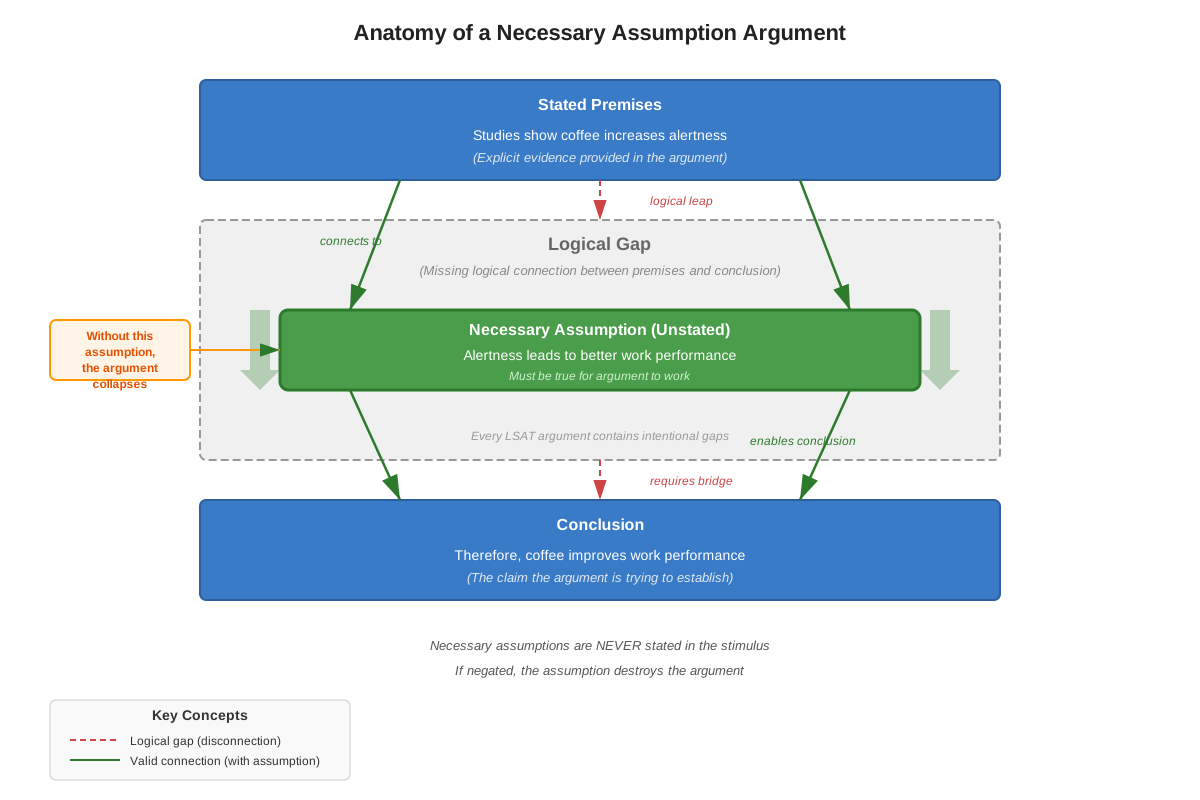
A necessary assumption is an unstated premise that must be true for an argument's conclusion to be properly drawn from its stated evidence. The defining characteristic of necessary assumptions is that if the assumption were false, the argument would fall apart—the conclusion would no longer follow from the premises. This creates a dependency relationship: the argument depends on the assumption being true.
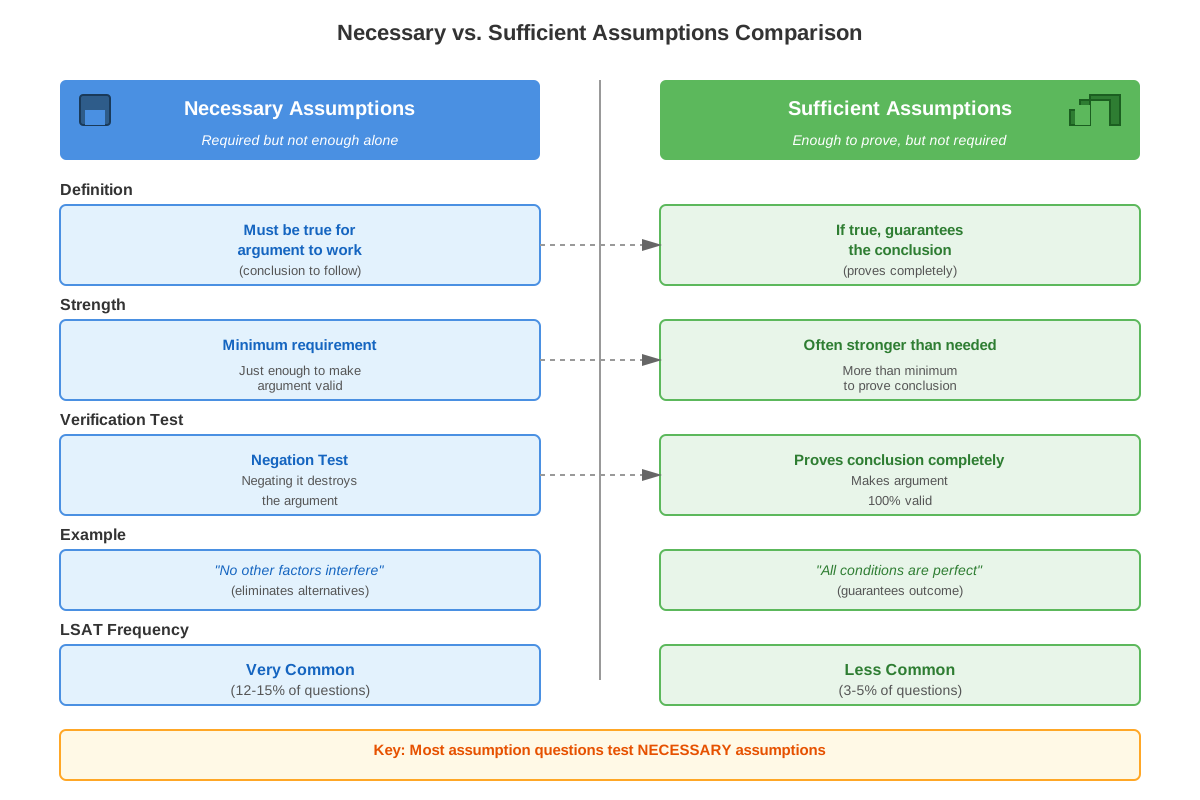
Necessary assumptions differ fundamentally from sufficient assumptions. While a sufficient assumption, if true, guarantees the conclusion follows, a necessary assumption represents only the minimum requirement. An argument may have multiple necessary assumptions, each of which must be true, but no single necessary assumption needs to be strong enough to prove the conclusion by itself. Think of necessary assumptions as the individual support beams of a structure—remove any one beam, and the structure collapses, but no single beam holds up the entire structure alone.
The Negation Test
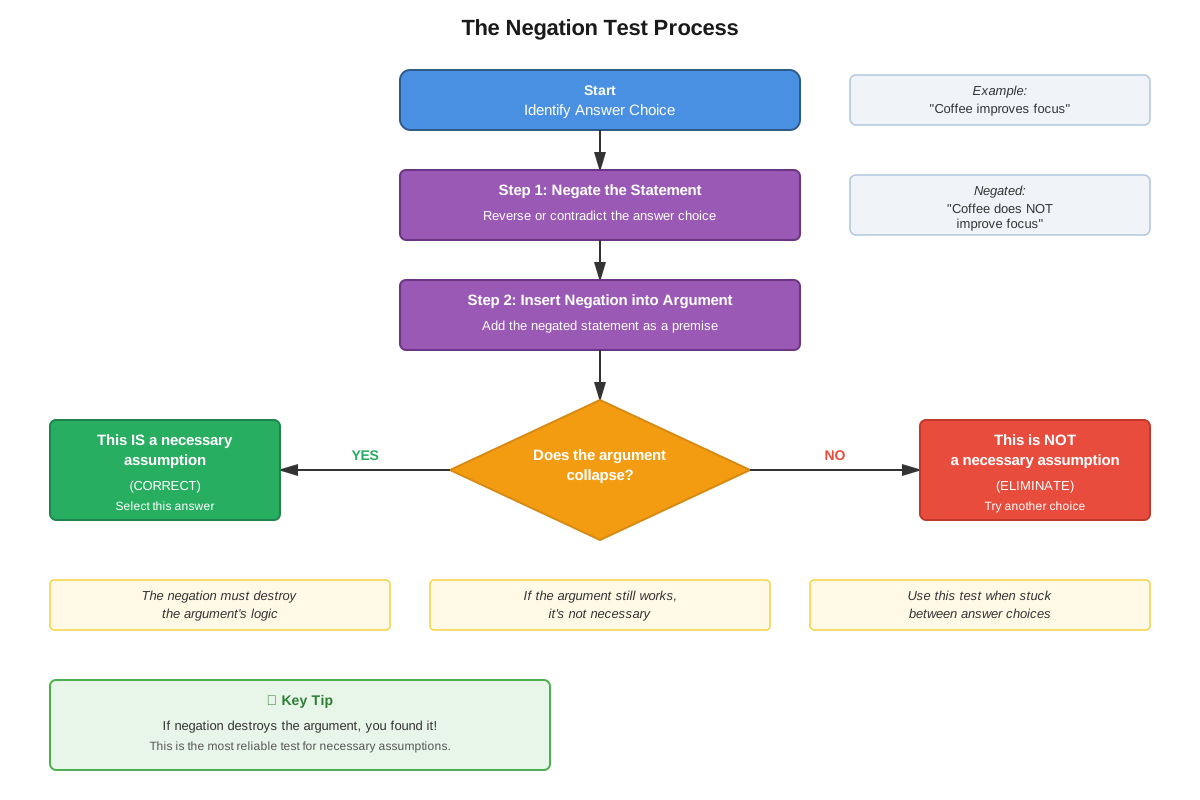
The Negation Test serves as the gold standard for verifying necessary assumptions. This technique involves negating (stating the opposite of) an answer choice and asking: "If this negated statement were true, would the argument fall apart?" If the answer is yes—if the negated assumption destroys the argument—then the original statement is a necessary assumption. If the argument could still work even with the negation, then the statement is not necessary.
Applying the Negation Test requires careful attention to logical opposites rather than extreme opposites. The negation of "all" is "not all" (which means "some are not"), not "none." The negation of "some" is "none." The negation of "will happen" is "will not happen" or "might not happen." Students must practice identifying precise logical negations to apply this test effectively.
Common Gap Patterns
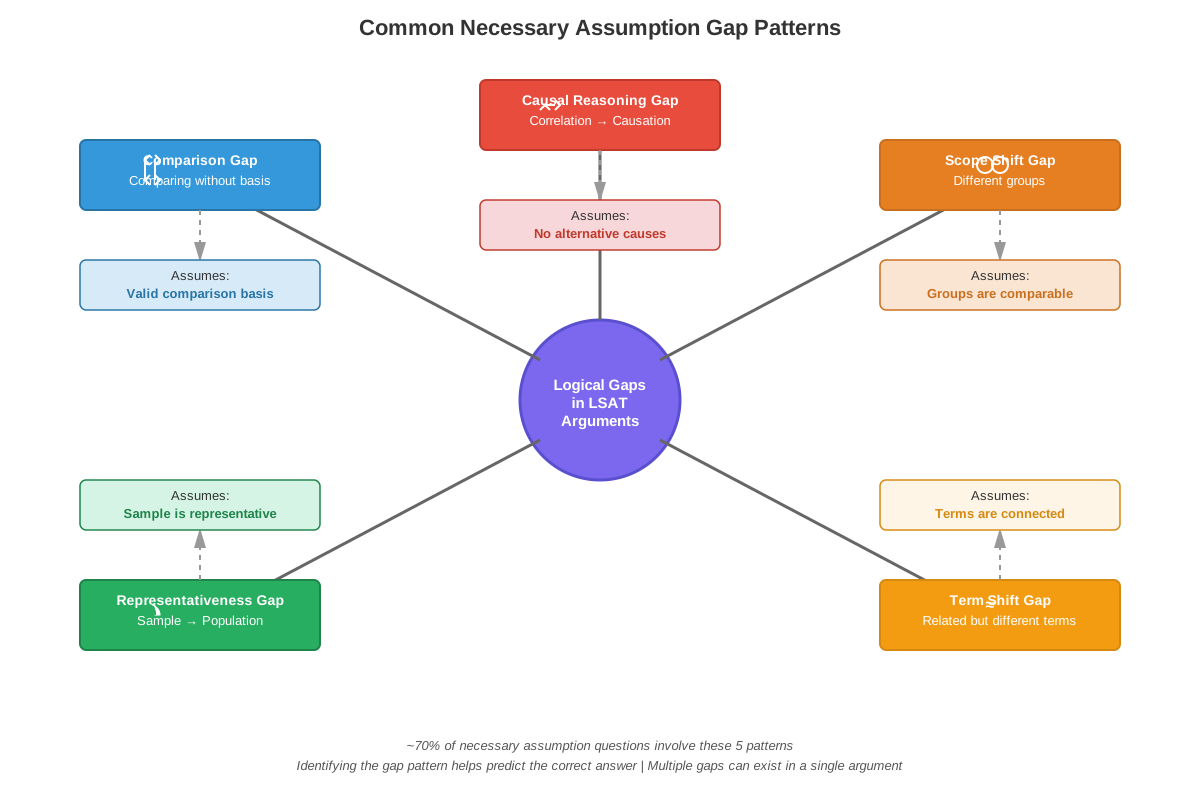
LSAT arguments exhibit recurring patterns in the gaps between premises and conclusions. Recognizing these patterns accelerates assumption identification:
Causal Gaps: When an argument concludes that X causes Y based on correlation or temporal sequence, it assumes no alternative causes exist and that the relationship is genuinely causal rather than coincidental.
Representativeness Gaps: When an argument draws a conclusion about a whole group based on a sample, it assumes the sample is representative and not biased or anomalous.
Comparison Gaps: When an argument compares two things and concludes one is better or preferable, it assumes the comparison is valid—that relevant factors are similar and the basis for comparison is appropriate.
Scope Shifts: When terms or concepts in the conclusion differ from those in the premises (even subtly), the argument assumes these concepts are connected or equivalent in the relevant way.
Feasibility Gaps: When an argument proposes a plan or predicts an outcome, it assumes no obstacles will prevent implementation and that necessary conditions will be met.
Scope and Degree in Assumptions
Necessary assumptions must match the scope and degree of the argument precisely. An assumption that is too broad (covering more than the argument requires) or too strong (claiming more certainty than needed) is not necessary—the argument could work without it. Conversely, an assumption that is too narrow or too weak may not be sufficient to bridge the gap.
Consider this distinction: If an argument concludes "This policy will improve education," a necessary assumption might be "This policy will not make education worse." This is minimal—just enough to allow improvement. An assumption like "This policy will dramatically transform education" is too strong; the argument doesn't require dramatic transformation, just improvement. An assumption like "Education can be improved" is too weak and general; it doesn't connect specifically to this policy.
Defender Assumptions vs. Connector Assumptions
Necessary assumptions fall into two functional categories:
Connector assumptions link concepts that appear in the conclusion but not in the premises, or bridge gaps between premise concepts and conclusion concepts. These assumptions establish relationships between ideas.
Defender assumptions protect the argument from potential objections by ruling out alternative explanations, counterexamples, or undermining factors. These assumptions ensure nothing prevents the conclusion from following.
Both types are necessary, but they serve different roles. An argument about a new medication might need a connector assumption linking the medication's chemical properties to its therapeutic effects, and a defender assumption ruling out dangerous side effects.
The Relationship Between Evidence and Assumptions
Every LSAT argument presents explicit evidence (premises) and reaches a conclusion. The necessary assumptions occupy the logical space between these elements. Visualizing this relationship helps:
[Premises] + [Necessary Assumptions] → [Conclusion]If the premises alone were sufficient to prove the conclusion, no assumption would be necessary. The existence of necessary assumptions reveals that arguments are incomplete—they rely on unstated premises. Skilled test-takers learn to see these gaps immediately upon reading an argument.
Concept Relationships
The concept of necessary assumptions serves as a central hub connecting multiple logical reasoning skills. Understanding argument structure (identifying premises and conclusions) → enables recognition of gaps → which reveals necessary assumptions. Once necessary assumptions are identified → they can be tested using the Negation Test → which confirms their necessity.
Necessary assumptions connect directly to sufficient assumptions through a complementary relationship: necessary assumptions are required but not alone sufficient, while sufficient assumptions are sufficient but not required. Both involve unstated premises, but they differ in strength and function.
The relationship to strengthen/weaken questions is particularly important: identifying what an argument assumes → reveals what would strengthen it (evidence supporting the assumption) or weaken it (evidence undermining the assumption). Similarly, flaw questions often identify problematic assumptions → which are necessary assumptions that are questionable or likely false.
Causal reasoning and necessary assumptions intersect frequently: causal arguments assume no alternative causes exist, assume correlation indicates causation, and assume the causal mechanism operates as claimed. Recognizing these standard causal assumptions accelerates analysis of causal arguments.
Scope concepts underlie assumption identification: when conclusion scope exceeds premise scope → an assumption must bridge the gap. This relationship makes scope analysis a prerequisite skill for assumption mastery.
High-Yield Facts
⭐ A necessary assumption, if negated, must destroy the argument's reasoning—this is the defining test of necessity
⭐ Necessary assumptions are minimally sufficient—they represent the least that must be true, not the most
⭐ Every LSAT argument contains unstated assumptions; the question is identifying which one the question asks for
⭐ Scope shifts between premises and conclusion always signal necessary assumptions connecting the shifted concepts
⭐ Causal arguments assume no alternative causes and assume correlation indicates causation
- Necessary assumptions can be defender assumptions (ruling out objections) or connector assumptions (linking concepts)
- The correct answer to a necessary assumption question will often seem obvious or weak—it's the minimum requirement
- Extreme language (all, none, only, must, never) in answer choices usually indicates the choice is too strong to be necessary
- Necessary assumptions must match the argument's scope precisely—neither broader nor narrower
- Multiple necessary assumptions can exist for a single argument, but the question asks for one specific assumption
- If an answer choice introduces entirely new concepts not mentioned in the argument, it's rarely the necessary assumption
- Necessary assumptions often address potential objections or alternative explanations the argument hasn't explicitly ruled out
- The argument's conclusion determines what must be assumed—focus on what the conclusion claims specifically
- Conditional reasoning in arguments creates necessary assumptions about the conditions being met
- Representative sample arguments assume the sample accurately reflects the larger population
Quick check — test yourself on Necessary assumptions so far.
Try Flashcards →Common Misconceptions
Misconception: Necessary assumptions must be strong statements that prove the conclusion → Correction: Necessary assumptions are minimal requirements that must be true but don't need to prove the conclusion alone. They're often surprisingly weak statements that simply prevent the argument from falling apart.
Misconception: The correct answer will introduce important new information that strengthens the argument → Correction: While necessary assumptions are unstated, they should connect directly to concepts already in the argument. Answers introducing entirely new topics are usually incorrect. Necessary assumptions bridge existing gaps rather than adding new support.
Misconception: If an assumption seems too obvious or weak, it can't be correct → Correction: Necessary assumptions often seem obvious precisely because they're minimal requirements. The LSAT tests whether students can identify these fundamental dependencies even when they appear trivial.
Misconception: Negating an answer means making it extremely opposite (changing "some" to "all" or "good" to "terrible") → Correction: Proper negation means logical opposite. The negation of "some" is "none," not "all." The negation of "will improve" is "will not improve," not "will devastate." Extreme negations lead to incorrect application of the Negation Test.
Misconception: Necessary and sufficient assumptions are just different names for the same thing → Correction: These are fundamentally different concepts. Necessary assumptions must be true but don't guarantee the conclusion. Sufficient assumptions, if true, guarantee the conclusion but aren't required. An argument can work without a sufficient assumption but cannot work without a necessary assumption.
Misconception: The correct answer will address the most important or interesting aspect of the argument → Correction: The correct answer addresses whatever gap the question asks about, which may involve a technical or seemingly minor point. Students must follow the argument's logic rather than their intuitions about importance.
Misconception: If an answer choice would strengthen the argument, it must be a necessary assumption → Correction: Many statements would strengthen an argument without being necessary. Necessary assumptions are a specific subset of strengtheners—those without which the argument fails entirely.
Worked Examples
Example 1: Causal Reasoning Gap
Argument: "City traffic congestion has decreased by 15% since the new subway line opened six months ago. Therefore, the new subway line has successfully reduced traffic congestion."
Question: Which one of the following is an assumption required by the argument?
Analysis Process:
First, identify the argument structure:
- Premise: Traffic decreased 15% since subway opened
- Conclusion: The subway caused the traffic reduction
This is a classic causal argument based on temporal correlation. The argument observes that two things happened in sequence (subway opened, then traffic decreased) and concludes causation.
Gap identification: The argument assumes no other factors caused the traffic decrease. It also assumes the correlation isn't coincidental.
Applying the Negation Test to potential answers:
(A) "The subway line has not operated at full capacity during these six months"
- Negation: "The subway has operated at full capacity"
- Does this destroy the argument? No—the subway could still have reduced traffic even at full capacity
- Not necessary
(B) "No other significant changes that would affect traffic occurred during this period"
- Negation: "Other significant changes that would affect traffic did occur"
- Does this destroy the argument? Yes—if other factors caused the decrease, we can't conclude the subway was responsible
- This is necessary (defender assumption ruling out alternative causes)
(C) "Traffic congestion will continue to decrease as more people use the subway"
- Negation: "Traffic will not continue to decrease"
- Does this destroy the argument? No—the argument only claims the subway has reduced traffic, not that it will continue to do so
- Too strong and future-focused; not necessary
(D) "The subway line is the most effective method of reducing traffic congestion"
- Negation: "The subway is not the most effective method"
- Does this destroy the argument? No—the subway could have reduced traffic without being the most effective method
- Too strong; not necessary
Answer: (B) is the necessary assumption. This example demonstrates a defender assumption that rules out alternative explanations.
Example 2: Scope Shift Gap
Argument: "The new employee wellness program has increased worker satisfaction scores by an average of 12 points. Therefore, the program has been successful in improving workplace productivity."
Question: The argument depends on assuming which one of the following?
Analysis Process:
Identify the structure:
- Premise: Wellness program increased satisfaction scores
- Conclusion: Program improved productivity
Gap identification: Notice the scope shift from "satisfaction" in the premise to "productivity" in the conclusion. These are different concepts. The argument assumes a connection between them.
Applying the Negation Test:
(A) "Worker satisfaction and workplace productivity are related such that increased satisfaction contributes to increased productivity"
- Negation: "Worker satisfaction and productivity are not related in this way"
- Does this destroy the argument? Yes—if satisfaction doesn't affect productivity, we can't conclude that increased satisfaction means the program improved productivity
- This is necessary (connector assumption linking the shifted concepts)
(B) "The wellness program is the best method available for improving productivity"
- Negation: "The program is not the best method"
- Does this destroy the argument? No—it could still have improved productivity without being the best method
- Too strong; not necessary
(C) "All workers participated in the wellness program"
- Negation: "Not all workers participated"
- Does this destroy the argument? No—the program could still have improved productivity even with partial participation
- Too strong; not necessary
(D) "Productivity has increased since the program began"
- This seems tempting, but notice it's not actually an assumption—it's essentially restating the conclusion
- The argument concludes the program improved productivity; this would be circular
- Not the assumption being tested
Answer: (A) is the necessary assumption. This example demonstrates a connector assumption that bridges a scope shift between premise and conclusion concepts.
Exam Strategy
Identifying Necessary Assumption Questions
Necessary assumption questions use specific language patterns. Watch for these trigger phrases:
- "Which one of the following is an assumption required by the argument?"
- "The argument depends on assuming..."
- "The argument relies on which one of the following?"
- "Which one of the following is an assumption on which the argument depends?"
- "The conclusion follows logically if which one of the following is assumed?"
The key words are "required," "depends," "relies," and "necessary." These distinguish necessary assumptions from sufficient assumptions (which use "if assumed, allows the conclusion to be properly drawn" or "enables the conclusion to be properly inferred").
Systematic Approach
- Read the question stem first to confirm it's asking for a necessary assumption
- Identify the conclusion precisely—underline or mentally note the exact claim
- Identify the premises that support this conclusion
- Spot the gap—what concept appears in the conclusion but not premises? What alternative explanations exist? What could undermine the reasoning?
- Predict the assumption before looking at answers—even a vague prediction helps
- Evaluate each answer using the Negation Test on contenders
- Confirm the correct answer by verifying its negation destroys the argument
Process of Elimination Tips
Eliminate answers that:
- Introduce completely new concepts unrelated to the argument's scope
- Use extreme language (all, none, only, must, never) unless the conclusion itself is extreme
- Are too strong—remember, necessary assumptions are minimal requirements
- Would strengthen the argument but aren't required for it to work
- Reverse the argument's logic or contradict the premises
- Address future predictions when the conclusion is about the present
- Are too narrow or specific when the conclusion is broader
Keep answers that:
- Connect concepts that shift between premises and conclusion
- Rule out obvious alternative explanations
- Seem almost too obvious or weak—this often indicates a necessary assumption
- Match the scope and degree of the conclusion precisely
- Address potential objections the argument hasn't explicitly ruled out
Time Management
Allocate approximately 1:15-1:30 per necessary assumption question. These questions reward careful analysis but don't require extensive time. If stuck between two answers, apply the Negation Test to both—this usually takes only 15-20 additional seconds and dramatically improves accuracy.
Exam Tip: If an answer choice seems too obvious to be correct, it might actually be the necessary assumption. The LSAT tests whether you can identify fundamental dependencies, which often seem self-evident once recognized.
Common Trap Answers
The LSAT includes predictable wrong answer types:
- Sufficient but not necessary: Statements that would prove the conclusion but aren't required
- Strengtheners: Statements that support the argument without being essential
- Reversals: Statements that flip the argument's logic
- Out of scope: Statements addressing topics the argument doesn't discuss
- Too strong: Extreme versions of the necessary assumption
Memory Techniques
The SCAN Acronym for Gap Identification
Scope shifts - Do concepts change between premises and conclusion?
Causal claims - Does the argument assert causation from correlation?
Alternative explanations - What else could explain the evidence?
Necessary conditions - What must be true for the conclusion to work?
The Negation Test Mnemonic: "FLIP IT"
Find the answer choice to test
Logically negate it (not extremely)
Imagine this negation is true
Pose the question: Does the argument fall apart?
If yes, you've found the necessary assumption
Test other contenders the same way
Visualization: The Bridge Metaphor
Picture the premises as one side of a canyon and the conclusion as the other side. The necessary assumption is the bridge connecting them. If you remove the bridge (negate the assumption), you can't get from premises to conclusion—you fall into the gap. This mental image helps remember that necessary assumptions bridge gaps.
The Minimum Requirement Reminder
Remember "NEC = NECESSARY = MINIMUM" - necessary assumptions are the minimum required, not the maximum support. When an answer seems too weak, remind yourself that weak might be exactly right for a necessary assumption.
Summary
Necessary assumptions represent unstated premises that must be true for LSAT arguments to work. These assumptions bridge gaps between premises and conclusions, and if negated, they cause arguments to fall apart. Mastering necessary assumptions requires understanding their minimal nature—they're requirements, not proof. The Negation Test serves as the definitive verification method: negate the assumption and check if the argument collapses. Common gap patterns include scope shifts, causal leaps, representativeness issues, and unaddressed alternative explanations. Necessary assumptions differ fundamentally from sufficient assumptions in that they're required but not alone adequate to prove conclusions. Success on these high-frequency questions demands recognizing that correct answers often seem obvious or weak, matching the argument's scope precisely, and avoiding trap answers that are too strong, out of scope, or merely strengthening without being essential. The skill of identifying necessary assumptions transfers directly to strengthen/weaken questions and flaw identification, making it a cornerstone of Logical Reasoning mastery.
Key Takeaways
- Necessary assumptions must be true for an argument to work; their negation destroys the argument's reasoning
- The Negation Test is the gold standard for verifying necessary assumptions—negate the statement and see if the argument falls apart
- Necessary assumptions are minimal requirements, not strong proof, so correct answers often seem weak or obvious
- Common gaps include scope shifts, causal leaps, unaddressed alternatives, and representativeness issues
- Distinguish necessary assumptions (required but not sufficient) from sufficient assumptions (sufficient but not required)
- Scope and degree must match precisely—answers that are too broad, narrow, strong, or weak are incorrect
- Necessary assumption questions appear 6-8 times per LSAT and mastering them improves performance on related question types
Related Topics
Sufficient Assumptions: Understanding the complementary concept of assumptions that, if true, guarantee the conclusion helps distinguish what's required versus what's merely helpful. Mastering necessary assumptions provides the foundation for recognizing sufficient assumptions.
Strengthen and Weaken Questions: These question types directly build on necessary assumption skills, as strengthening an argument often means supporting its assumptions while weakening means undermining them.
Flaw Questions: Many logical flaws involve problematic assumptions—assumptions that are necessary for the argument but are questionable or likely false. Identifying necessary assumptions enables recognition of when those assumptions constitute flaws.
Conditional Reasoning: Advanced necessary assumption questions often involve conditional statements, where understanding what must be true requires recognizing conditional relationships and their implications.
Causal Reasoning: A large subset of necessary assumption questions involves causal arguments, making deeper study of causal reasoning patterns valuable for assumption mastery.
Practice CTA
Now that you understand the mechanics and strategy of necessary assumptions, the crucial next step is application. Attempt the practice questions to reinforce these concepts through active problem-solving. Each practice question provides an opportunity to apply the Negation Test, identify gap patterns, and build the pattern recognition that separates good LSAT performance from great performance. The flashcards will help cement the key distinctions and trigger phrases that enable rapid question identification. Remember: understanding necessary assumptions intellectually is the first step, but mastery comes through repeated, deliberate practice. You've built the foundation—now strengthen it through application. Your improved performance on these high-frequency questions will directly impact your overall Logical Reasoning score.
Sign up free to keep reading
Create a free AnvayaPrep account to finish this LSAT guide on Necessary assumptions — plus flashcards and practice questions.