Overview
Conditional must be true questions represent one of the most frequently tested and high-value question types in LSAT Logical Reasoning. These questions require test-takers to identify what necessarily follows from a set of conditional statements presented in the stimulus. Unlike inference questions that allow for broader interpretive leaps, conditional must be true questions demand strict logical deduction based on the rules of conditional logic. Mastering this question type is essential because it appears in approximately 15-20% of all Logical Reasoning questions and serves as the foundation for more complex reasoning patterns tested throughout the exam.
The core challenge of lsat conditional must be true questions lies in recognizing conditional relationships, properly diagramming them, and then applying the rules of contraposition and chain reasoning to derive what must logically follow. These questions test whether students can distinguish between what could be true, what is likely true, and what absolutely must be true given the conditional framework established in the stimulus. The LSAT rewards precision in this distinction, making it critical to understand not just the mechanics of conditional logic but also the subtle ways the test writers craft answer choices to trap unwary test-takers.
Within the broader landscape of Logical Reasoning, conditional must be true questions bridge foundational conditional logic skills with more advanced question types like sufficient assumption, necessary assumption, and formal logic questions. Success with this topic creates a multiplier effect across the entire Logical Reasoning section, as conditional reasoning appears not only in dedicated conditional must be true questions but also embedded within strengthen/weaken questions, parallel reasoning questions, and even some reading comprehension passages. The investment in mastering this topic yields returns far beyond the specific question type itself.
Learning Objectives
- [ ] Identify how Conditional must be true appears in LSAT questions
- [ ] Explain the reasoning pattern behind Conditional must be true
- [ ] Apply Conditional must be true to solve LSAT-style problems accurately
- [ ] Diagram complex conditional statements using standard notation
- [ ] Recognize and apply the contrapositive correctly in multi-step reasoning chains
- [ ] Distinguish between what must be true versus what could be true from conditional premises
- [ ] Identify common trap answers that confuse sufficient and necessary conditions
Prerequisites
- Basic conditional logic notation: Understanding "if...then" statements and their symbolic representation (A → B) is essential because conditional must be true questions require rapid translation of English statements into logical form
- Contrapositive formation: Knowing how to form and apply contrapositives (A → B becomes ~B → ~A) is fundamental since many correct answers require contrapositive reasoning
- Logical operators: Familiarity with "and," "or," "not," and their logical properties enables proper interpretation of compound conditional statements
- Sufficient vs. necessary conditions: Distinguishing between these two types of conditions prevents the most common errors in conditional reasoning
- Basic inference skills: The ability to draw simple conclusions from premises provides the foundation for the more rigorous deductions required in conditional must be true questions
Why This Topic Matters
Conditional must be true questions appear with remarkable consistency on every LSAT administration, typically comprising 3-5 questions per test across both Logical Reasoning sections. This frequency, combined with the topic's moderate difficulty level, makes it a high-priority target for score improvement. Students who master this question type can reliably secure these points, creating a stable foundation for their overall Logical Reasoning performance.
Beyond the LSAT itself, conditional reasoning skills have profound real-world applications in legal practice, contract interpretation, statutory analysis, and logical argumentation. Attorneys regularly work with conditional language in contracts ("if the buyer fails to pay, then the seller may terminate"), statutes ("if a person knowingly possesses controlled substances, then they are guilty of a felony"), and case law. The precision required to navigate these conditional frameworks in law school and legal practice makes this LSAT topic directly relevant to future professional success.
On the exam, conditional must be true questions typically appear in several distinct formats. The most common presentation includes a stimulus with 2-4 conditional statements followed by a question stem asking "If the statements above are true, which one of the following must also be true?" or "Which one of the following can be properly inferred from the statements above?" These questions may also appear embedded within more complex scenarios involving rules, constraints, or formal logic systems. The LSAT frequently tests this topic by presenting conditional chains that require multiple steps of reasoning, by including contrapositives that must be recognized and applied, or by creating scenarios where students must combine multiple conditional statements to reach a necessary conclusion.
Core Concepts
Understanding Conditional Statements
A conditional statement establishes a relationship between two events, facts, or conditions where one (the sufficient condition) guarantees the occurrence of another (the necessary condition). In standard logical notation, this relationship is expressed as A → B, read as "if A, then B" or "A is sufficient for B" or "B is necessary for A." The fundamental truth of conditional logic is that whenever the sufficient condition occurs, the necessary condition must also occur, but the reverse is not necessarily true.
The anatomy of a conditional statement includes several key components. The sufficient condition (also called the antecedent) is the triggering event—when it occurs, it guarantees the consequent. The necessary condition (also called the consequent) is what must occur whenever the sufficient condition is present. Understanding this asymmetric relationship is crucial: the presence of the necessary condition tells us nothing definitive about whether the sufficient condition occurred, but the presence of the sufficient condition absolutely guarantees the necessary condition.
Contrapositive Reasoning
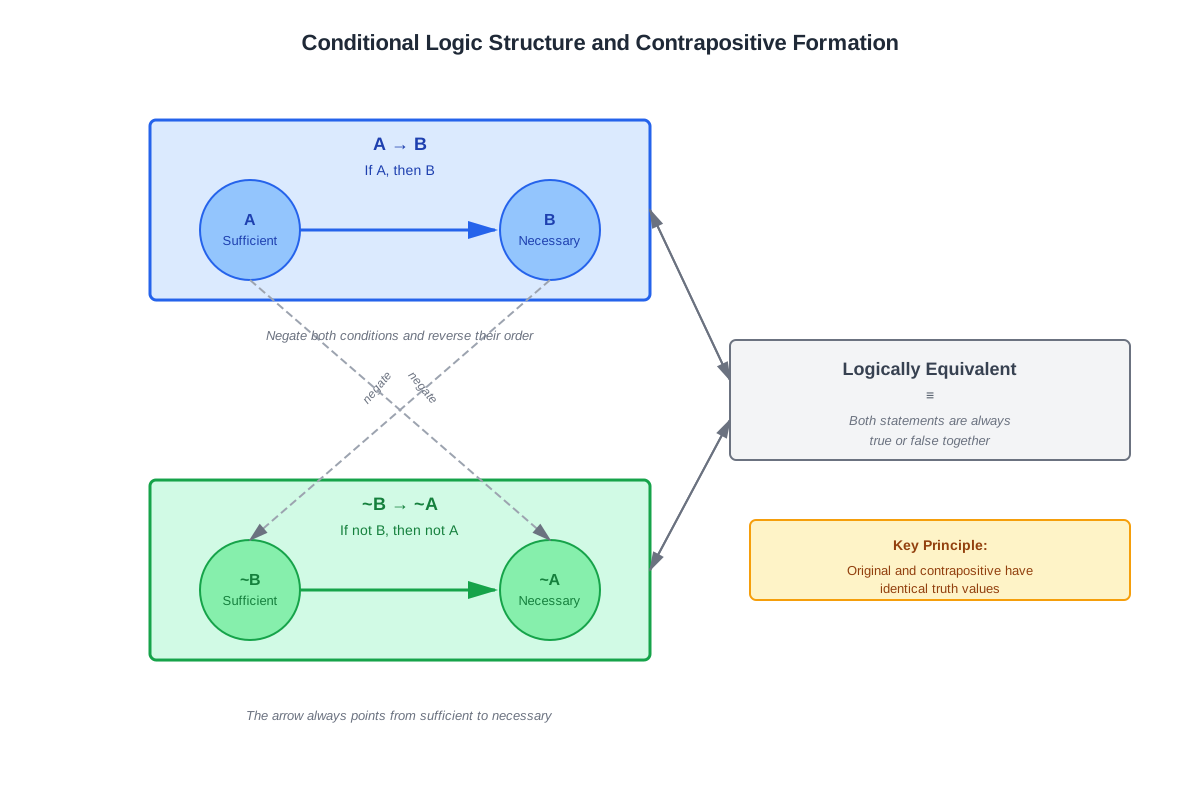
The contrapositive of a conditional statement is logically equivalent to the original statement and is formed by negating both conditions and reversing their order. If the original statement is A → B, the contrapositive is ~B → ~A (read as "if not B, then not A"). This equivalence is absolute: whenever the original conditional is true, its contrapositive is also true, and vice versa. Contrapositive reasoning is essential for conditional must be true questions because correct answers frequently require recognizing what must follow from the absence of a necessary condition.
Consider the statement "If someone is a lawyer, then they passed the bar exam" (L → P). The contrapositive is "If someone did not pass the bar exam, then they are not a lawyer" (~P → ~L). Both statements convey identical logical information. However, the LSAT often presents information that triggers the contrapositive rather than the original conditional, requiring test-takers to recognize this relationship to identify what must be true.
Conditional Chains
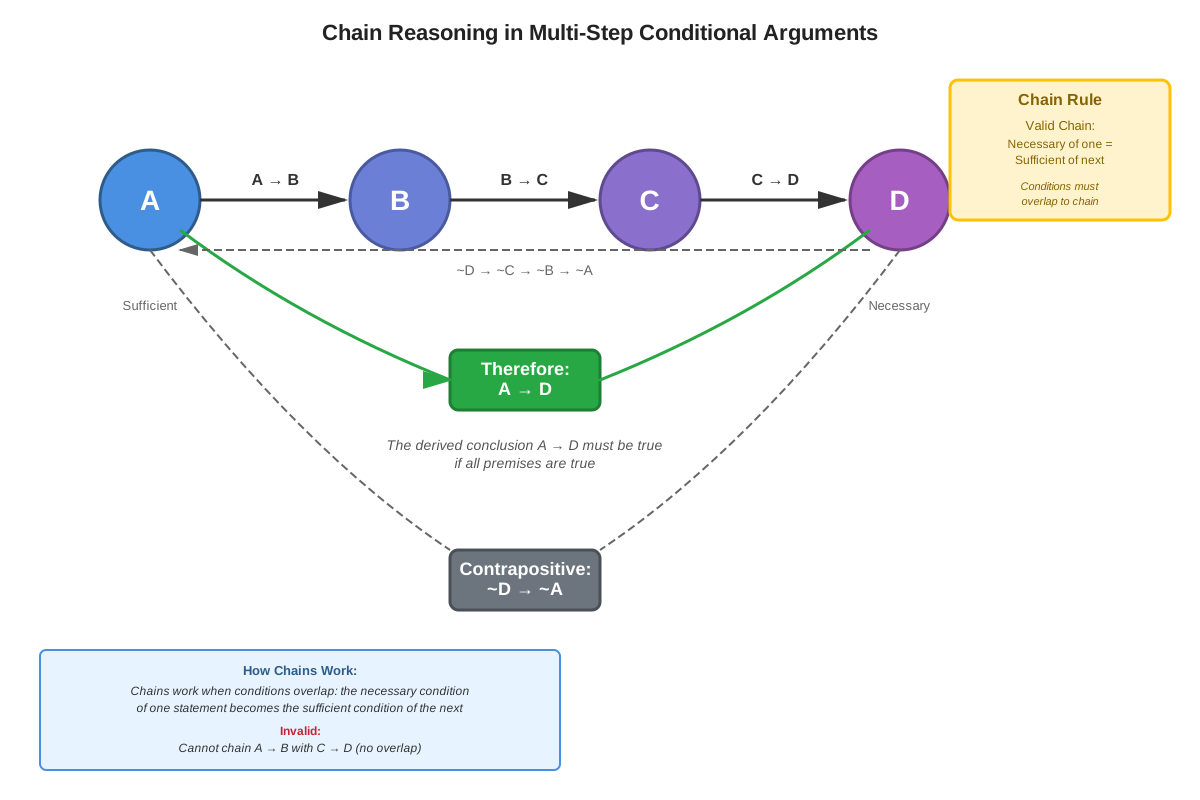
Conditional chains occur when the necessary condition of one statement serves as the sufficient condition of another, creating a transitive relationship. If A → B and B → C, then we can conclude A → C. These chains can extend through multiple links, and recognizing them is crucial for solving more complex conditional must be true questions. The LSAT frequently tests whether students can follow these chains forward (using the original conditionals) or backward (using contrapositives).
When working with conditional chains, it's essential to maintain proper directionality. The chain only flows in one direction: from sufficient to necessary conditions. A common error is attempting to reason backward through a chain without using contrapositives. For example, if A → B → C, knowing that C occurred does not allow us to conclude anything definitive about A or B without additional information.
Distinguishing Must Be True from Could Be True
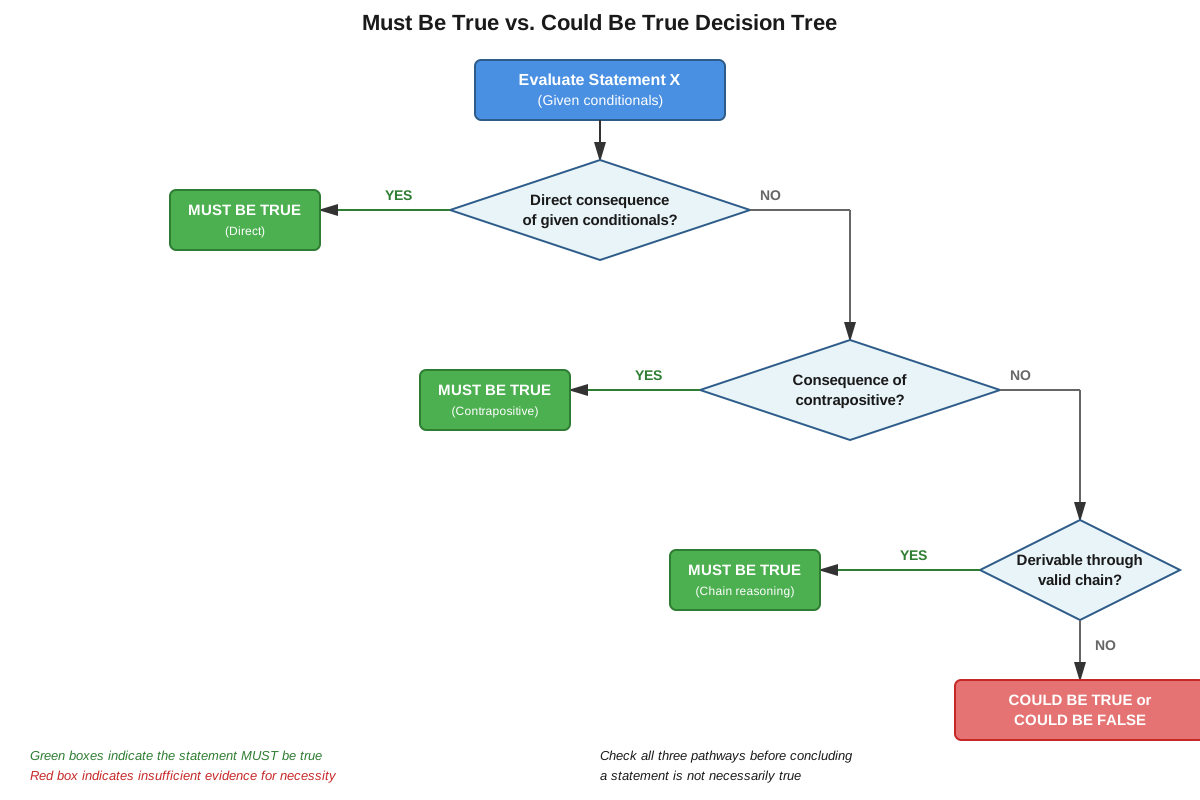
The critical distinction in conditional must be true questions is between logical necessity and logical possibility. Something must be true if it is logically required by the conditional framework—there is no possible scenario consistent with the given conditionals where it would be false. Something could be true if it is consistent with the conditionals but not required by them. The LSAT crafts wrong answers that are possible or even likely but not logically necessary.
| Relationship | Definition | Example |
|---|---|---|
| Must be true | Logically required by the conditionals; no consistent scenario where it's false | If A → B and A is true, then B must be true |
| Could be true | Consistent with the conditionals but not required | If A → B and B is true, then A could be true |
| Cannot be true | Logically inconsistent with the conditionals | If A → B and A is true, then ~B cannot be true |
Conditional Indicators in Natural Language
The LSAT presents conditional relationships using diverse linguistic constructions, and recognizing these conditional indicators is essential for accurate diagramming. Common sufficient condition indicators include "if," "when," "whenever," "all," "any," "every," "each," and "the only way." Common necessary condition indicators include "then," "only," "only if," "must," "required," "necessary," "unless," and "until."
The phrase "only if" is particularly treacherous because it introduces a necessary condition despite containing the word "if." "A only if B" means A → B (B is necessary for A), not B → A. Similarly, "unless" introduces a necessary condition and means "if not," so "A unless B" translates to ~B → A (or equivalently, ~A → B). Mastering these linguistic variations prevents misdiagramming, which is the most common source of errors in conditional must be true questions.
Combining Multiple Conditionals
Many conditional must be true questions require combining information from multiple conditional statements to reach a conclusion. This process involves identifying common terms that appear in different conditionals and determining whether they can be linked into chains or whether they provide independent pieces of information that must be considered together. The key is systematic analysis: diagram each conditional separately, identify potential connections, and then determine what must follow from the complete set of conditionals.
When combining conditionals, watch for statements that provide categorical information (e.g., "John is a lawyer") that can trigger conditional chains. If the stimulus establishes that A → B and separately states that A is true, then B must be true. This combination of conditional rules with categorical facts is a frequent testing pattern.
Concept Relationships
The concepts within conditional must be true questions form an integrated logical system. Conditional statements serve as the foundation, establishing the basic relationships that all other reasoning builds upon. These statements inherently contain their contrapositives, which are not separate pieces of information but rather alternative expressions of the same logical relationship. When multiple conditional statements share common terms, they can form conditional chains, which represent extended logical pathways from initial sufficient conditions to ultimate necessary conditions.
The relationship between these concepts and the broader Logical Reasoning curriculum is hierarchical and interconnected. Conditional must be true questions directly build upon foundational conditional logic skills, requiring fluency in diagramming and contrapositive formation. They connect forward to sufficient assumption questions (which ask what conditional would make an argument valid) and necessary assumption questions (which ask what must be true for an argument to work). The precision required to distinguish must be true from could be true also appears in inference questions, strengthen/weaken questions, and even some parallel reasoning questions.
The conceptual flow follows this pattern: Basic conditional statements → Contrapositive formation → Conditional chains → Application to specific scenarios → Distinguishing necessary from possible conclusions. Each step depends on mastery of the previous steps, making this a cumulative skill set where weaknesses in foundational concepts cascade into errors on more complex applications.
High-Yield Facts
⭐ A conditional statement A → B means that whenever A occurs, B must occur, but B can occur without A
⭐ The contrapositive of A → B is ~B → ~A, and these two statements are logically equivalent
⭐ Conditional chains are transitive: if A → B and B → C, then A → C
⭐ "Only if" introduces a necessary condition: "A only if B" means A → B
⭐ "Unless" means "if not": "A unless B" means ~B → A (or equivalently ~A → B)
- The presence of a necessary condition tells you nothing definitive about whether the sufficient condition occurred
- Affirming the consequent (assuming A is true because B is true when A → B) is a logical fallacy
- Denying the antecedent (assuming B is false because A is false when A → B) is a logical fallacy
- Multiple conditionals with the same sufficient condition can all be triggered simultaneously
- The absence of a sufficient condition tells you nothing about whether the necessary condition occurs
- Conditional statements do not establish causation, only logical relationships
- "If and only if" creates a biconditional relationship where A → B and B → A both hold
Quick check — test yourself on Conditional must be true so far.
Try Flashcards →Common Misconceptions
Misconception: If A → B and B is true, then A must be true → Correction: The presence of a necessary condition does not guarantee the sufficient condition occurred. B could be true for other reasons. This is the fallacy of affirming the consequent. Only the contrapositive (~B → ~A) allows you to reason from the necessary condition.
Misconception: "If A then B" and "If B then A" mean the same thing → Correction: These are completely different logical relationships. A → B means A is sufficient for B, while B → A means B is sufficient for A. Confusing the direction of conditionals is one of the most common and costly errors. Always pay careful attention to which condition is sufficient and which is necessary.
Misconception: If A → B and A is false, then B must be false → Correction: The absence of a sufficient condition tells you nothing about the necessary condition. This is the fallacy of denying the antecedent. B could still be true for other reasons unrelated to A.
Misconception: "Only if" means the same as "if" → Correction: "Only if" introduces a necessary condition, not a sufficient condition. "A only if B" means A → B (B is necessary for A), while "If A then B" also means A → B. The confusion arises because "only if" contains the word "if" but functions differently than "if" alone.
Misconception: In conditional must be true questions, the most likely or most reasonable answer is correct → Correction: These questions require strict logical deduction, not plausibility reasoning. The correct answer must be logically guaranteed by the conditionals, regardless of whether it seems likely or reasonable in the real world. An answer that is highly probable but not logically necessary is wrong.
Misconception: You can chain conditionals in any direction as long as they share common terms → Correction: Conditional chains only work in one direction: from sufficient to necessary conditions. You cannot chain A → B with C → A to conclude C → B without using the contrapositive. The proper chain would be C → A → B, yielding C → B.
Worked Examples
Example 1: Basic Conditional Chain with Contrapositive
Stimulus: All members of the debate team are honor students. No honor students participate in varsity athletics. Anyone who participates in varsity athletics must maintain at least a 2.5 GPA.
Question: If the statements above are true, which one of the following must also be true?
Solution Process:
Step 1: Diagram each conditional statement
- "All members of the debate team are honor students" → Debate Team → Honor Student (DT → HS)
- "No honor students participate in varsity athletics" → Honor Student → ~Varsity Athletics (HS → ~VA)
- "Anyone who participates in varsity athletics must maintain at least a 2.5 GPA" → Varsity Athletics → 2.5 GPA (VA → 2.5)
Step 2: Identify potential chains
- DT → HS → ~VA (members of debate team do not participate in varsity athletics)
Step 3: Consider contrapositives
- The contrapositive of HS → ~VA is VA → ~HS (anyone in varsity athletics is not an honor student)
- This can chain with the contrapositive of DT → HS, which is ~HS → ~DT
- Therefore: VA → ~HS → ~DT (anyone in varsity athletics is not on the debate team)
Step 4: Evaluate what must be true
- No member of the debate team participates in varsity athletics (from the forward chain)
- Anyone who participates in varsity athletics is not on the debate team (from the contrapositive chain)
- We cannot conclude anything definitive about whether debate team members maintain a 2.5 GPA, because the conditional about GPA only applies to those in varsity athletics
Correct Answer: No member of the debate team participates in varsity athletics.
Connection to Learning Objectives: This example demonstrates how to identify conditional relationships in natural language, diagram them systematically, form and apply contrapositives, and distinguish what must be true from what could be true or is unknown.
Example 2: Complex Conditional with "Unless" and "Only If"
Stimulus: The company will expand into international markets only if it secures additional funding. The company will not secure additional funding unless the board approves the financial plan. The board will approve the financial plan if the projected returns exceed 15%.
Question: If the projected returns exceed 15%, which one of the following must be true?
Solution Process:
Step 1: Carefully diagram each statement, paying attention to conditional indicators
- "The company will expand into international markets only if it secures additional funding" → Expand → Funding (E → F)
- "The company will not secure additional funding unless the board approves the financial plan" → This means "if the board does not approve, then no funding," or ~Approve → ~Funding, which is equivalent to Funding → Approve (F → A)
- "The board will approve the financial plan if the projected returns exceed 15%" → Returns > 15% → Approve (R → A)
Step 2: Create the conditional chain
- R → A → F → E (if returns exceed 15%, then approve, then funding, then expand)
- Wait—this chain is incorrect! Let's reconsider.
- We have R → A (returns lead to approval)
- We have F → A (funding requires approval)
- We have E → F (expansion requires funding)
Step 3: Correct analysis
- The chain E → F → A tells us what's necessary for expansion
- The statement R → A tells us that high returns guarantee approval
- But approval (A) is necessary for funding (F → A), not sufficient
- So R → A does not guarantee F or E
Step 4: Apply the given information
- We're told returns exceed 15%, so R is true
- From R → A, we can conclude A must be true (the board will approve)
- We cannot conclude F is true (funding might not be secured for other reasons)
- We cannot conclude E is true (expansion might not happen)
Correct Answer: The board will approve the financial plan.
Connection to Learning Objectives: This example illustrates the critical importance of correctly interpreting "unless" and "only if," the danger of confusing sufficient and necessary conditions, and the need to carefully trace what must follow from a given fact through the conditional framework.
Exam Strategy
When approaching conditional must be true questions on the LSAT, begin by identifying the question type through trigger phrases in the question stem. Look for language like "must be true," "must also be true," "can be properly inferred," "follows logically," or "is supported by the statements above." These phrases signal that you need strict logical deduction, not plausibility reasoning.
Systematic Diagramming Process: Immediately diagram all conditional statements in the stimulus using consistent notation. Write sufficient conditions on the left, necessary conditions on the right, and use arrows to show the relationship. Don't try to solve the question in your head—the LSAT deliberately makes these questions too complex for reliable mental processing. As you diagram, watch especially carefully for "only if" (necessary condition), "unless" (means "if not"), and "all/every/any" (sufficient condition indicators).
Trigger Words and Phrases:
- Sufficient condition indicators: if, when, whenever, all, any, every, each, people who, the only way
- Necessary condition indicators: then, only if, must, required, necessary, depends on, unless, until, without
- Biconditional indicators: if and only if, all and only
Process of Elimination Strategy: After diagramming, evaluate each answer choice systematically. Eliminate answers that:
- Confuse sufficient and necessary conditions (affirming the consequent or denying the antecedent)
- State something that could be true but isn't required by the conditionals
- Reverse the direction of a conditional without using the contrapositive
- Make claims about terms that don't appear in any conditional chain
- Require additional assumptions beyond what the conditionals provide
Exam Tip: If an answer choice seems reasonable but you can't trace a clear logical path from the conditionals to that conclusion, it's wrong. Conditional must be true questions reward mechanical application of logical rules, not intuitive reasoning.
Time Allocation: Spend 1:15-1:30 on these questions. Invest 30-45 seconds in careful diagramming upfront—this investment pays dividends by making answer evaluation faster and more accurate. If you find yourself spending more than 2 minutes, you're likely overcomplicating the logic or misdiagrammed initially. Make your best guess and move on.
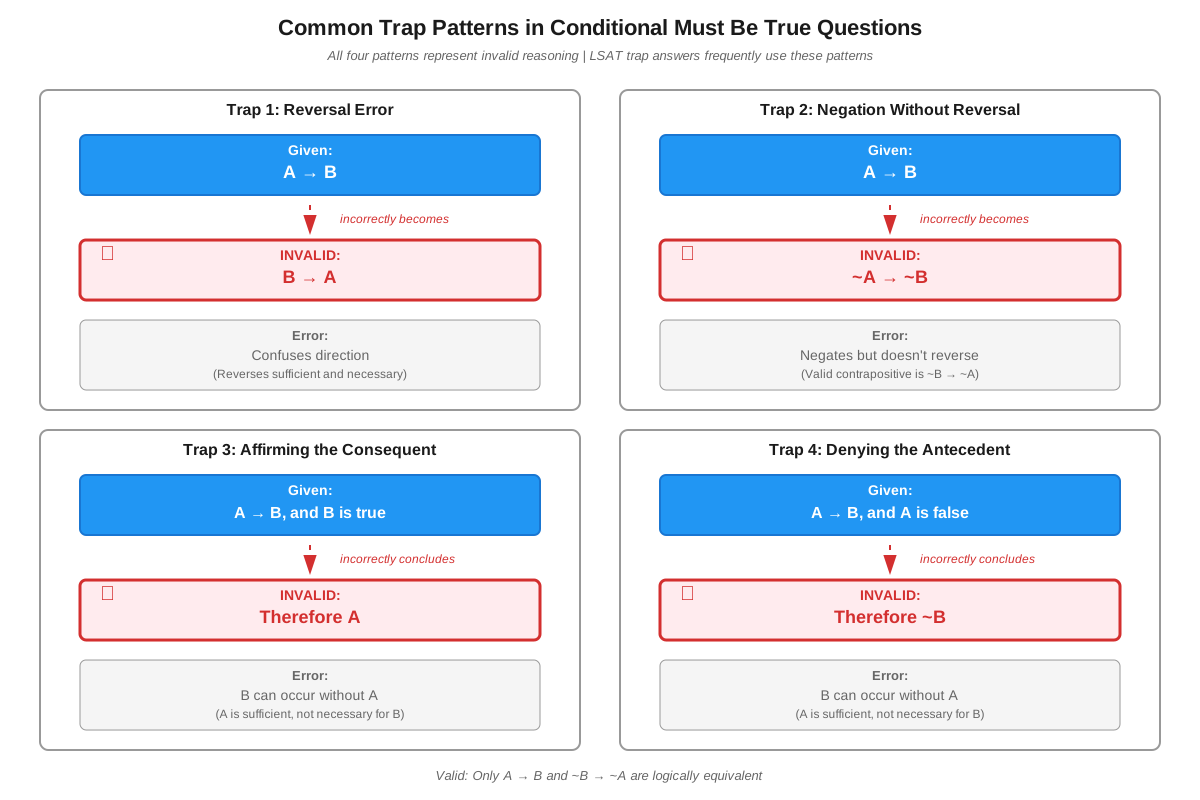
Common Trap Patterns: The LSAT frequently includes wrong answers that:
- State the converse (B → A when the stimulus gives A → B)
- Affirm the consequent (claiming A must be true because B is true when A → B)
- Combine conditionals incorrectly (chaining in the wrong direction)
- State something possible but not necessary
- Use extreme language ("always," "never," "only") that goes beyond what the conditionals support
Memory Techniques
Mnemonic for Contrapositive Formation: "Negate and Reverse" (NR) - To form a contrapositive, Negate both conditions and Reverse their order. If you remember NR, you'll never forget the two-step process.
Visualization Strategy: Picture conditional statements as one-way streets with gates. The sufficient condition is the entrance gate—when you pass through it, you must travel down the street to the necessary condition. You can't travel backward up the street (that would be affirming the consequent). However, if you find the exit gate closed (the necessary condition is absent), you know the entrance gate must also be closed (contrapositive reasoning).
Acronym for "Only If": ONION - "Only if" introduces a Necessary condition, It's On the right side of the arrow, Not the left. This reminds you that despite containing "if," the phrase "only if" introduces what's necessary, not what's sufficient.
Mnemonic for "Unless": "Unless means If Not" (UIN) - Whenever you see "unless," mentally replace it with "if not" to correctly diagram the conditional. "A unless B" becomes "A if not B," which is ~B → A.
Chain Visualization: Think of conditional chains as dominoes falling. Each domino (sufficient condition) knocks down the next domino (necessary condition). If you know the first domino fell, you know all subsequent dominoes must fall. If you know a domino didn't fall, you know all previous dominoes must not have fallen (contrapositive reasoning backward through the chain).
Summary
Conditional must be true questions test the ability to recognize conditional relationships, diagram them accurately, and apply the rules of conditional logic to determine what necessarily follows. Success requires mastering the distinction between sufficient and necessary conditions, forming and applying contrapositives correctly, recognizing conditional chains, and distinguishing between logical necessity and mere possibility. The LSAT presents these relationships using varied linguistic constructions, making it essential to recognize conditional indicators like "only if" (necessary condition) and "unless" (means "if not"). The key to excellence is systematic diagramming, careful attention to the direction of conditional relationships, and strict adherence to logical rules rather than intuitive reasoning. Students must avoid common fallacies like affirming the consequent (assuming the sufficient condition occurred because the necessary condition is present) and denying the antecedent (assuming the necessary condition is absent because the sufficient condition is absent). By mastering these skills, test-takers can reliably secure points on this high-frequency question type and build a foundation for success across the entire Logical Reasoning section.
Key Takeaways
- Conditional must be true questions require strict logical deduction—only answers that are logically guaranteed by the conditionals are correct, regardless of plausibility
- Always diagram conditional statements systematically using consistent notation (sufficient → necessary) before attempting to answer
- The contrapositive (~necessary → ~sufficient) is logically equivalent to the original conditional and is essential for solving most questions
- "Only if" introduces a necessary condition, and "unless" means "if not"—misinterpreting these phrases leads to incorrect diagrams and wrong answers
- Conditional chains are transitive and flow in one direction only: from sufficient to necessary conditions
- The presence of a necessary condition never allows you to conclude the sufficient condition occurred (that's affirming the consequent)
- Invest time in accurate upfront diagramming to make answer evaluation faster and more reliable
Related Topics
Sufficient Assumption Questions: These questions ask what conditional statement, if added to an argument, would make the conclusion follow logically. Mastering conditional must be true questions provides the logical foundation for identifying what conditional would complete an argument's reasoning chain.
Necessary Assumption Questions: These questions require identifying what must be true for an argument to work. The skills developed in conditional must be true questions—particularly distinguishing between what must be true versus what could be true—transfer directly to necessary assumption questions.
Formal Logic Questions: These questions involve complex conditional frameworks with multiple variables and rules. Success with conditional must be true questions builds the diagramming and chain-reasoning skills essential for formal logic questions.
Parallel Reasoning Questions: Some parallel reasoning questions involve matching conditional structures between arguments. The ability to recognize and diagram conditional relationships developed through conditional must be true questions enables faster and more accurate matching.
Practice CTA
Now that you've mastered the core concepts of conditional must be true questions, it's time to put your knowledge into practice. Work through the practice questions and flashcards to reinforce your understanding and build the speed and accuracy needed for test day. Remember: conditional logic is a skill that improves dramatically with deliberate practice. Each question you work through strengthens your pattern recognition and makes the next question easier. You've built the foundation—now it's time to make these skills automatic through consistent application. Your investment in mastering this high-yield topic will pay dividends across the entire Logical Reasoning section!
Sign up free to keep reading
Create a free AnvayaPrep account to finish this LSAT guide on Conditional must be true — plus flashcards and practice questions.