Overview
Parallel reasoning questions represent one of the most distinctive and challenging question types on the LSAT Logical Reasoning section. These questions require test-takers to identify an argument that mirrors the logical structure of a given stimulus, regardless of the subject matter or content. Unlike other question types that ask students to evaluate, strengthen, or weaken an argument, parallel reasoning questions demand a precise understanding of argumentative form and the ability to abstract logical patterns from their concrete contexts.
The fundamental challenge of LSAT parallel reasoning questions lies in their requirement for structural analysis rather than content evaluation. Students must learn to see beyond the surface-level topics—whether the stimulus discusses economics, biology, or social policy—and identify the underlying logical skeleton. This skill tests the core competency that law schools value: the ability to recognize patterns of reasoning and apply them across different contexts. A student might encounter a stimulus about restaurant regulations and need to match it with an answer choice about scientific research, recognizing that both follow the same conditional reasoning pattern or employ identical logical moves.
Within the broader landscape of logical reasoning, parallel reasoning questions occupy a unique position. They synthesize skills from multiple question types: the structural analysis required for assumption questions, the pattern recognition needed for method of reasoning questions, and the precision demanded by formal logic questions. Mastering parallel reasoning questions not only improves performance on this specific question type but also strengthens the foundational analytical skills that underpin success across the entire Logical Reasoning section and even the Analytical Reasoning (Logic Games) section.
Learning Objectives
- [ ] Identify how parallel reasoning questions appear in LSAT questions
- [ ] Explain the reasoning pattern behind parallel reasoning questions
- [ ] Apply parallel reasoning questions to solve LSAT-style problems accurately
- [ ] Distinguish between parallel reasoning and parallel flaw questions
- [ ] Abstract the logical structure from an argument's content systematically
- [ ] Evaluate answer choices efficiently by identifying structural mismatches
- [ ] Recognize common argument structures that frequently appear in parallel reasoning questions
Prerequisites
- Basic argument structure: Understanding premises, conclusions, and how they connect is essential because parallel reasoning requires matching these structural elements across different arguments.
- Conditional logic fundamentals: Familiarity with if-then statements and their contrapositives enables recognition of conditional patterns that must be matched exactly.
- Argument forms: Knowledge of common reasoning patterns (causal, analogical, categorical) provides the framework for identifying what needs to be paralleled.
- Quantifier logic: Understanding terms like "all," "some," "most," and "none" is crucial because parallel arguments must match quantifier strength precisely.
Why This Topic Matters
Parallel reasoning questions appear with consistent regularity on every LSAT administration, typically comprising 2-4 questions per test across both Logical Reasoning sections. This frequency translates to approximately 4-8% of the total LSAT score, making them a high-value question type that cannot be ignored. Unlike some question types that may vary in frequency, parallel reasoning questions are virtually guaranteed to appear, making them a reliable target for score improvement.
Beyond their direct impact on LSAT scores, parallel reasoning questions assess a fundamental legal skill: the ability to apply precedent. In legal practice, attorneys constantly identify how the reasoning in one case applies to another, even when the factual circumstances differ dramatically. A contract dispute involving a software company may follow the same legal reasoning as a historical case about agricultural equipment. This pattern-matching ability—seeing structural similarity across different contexts—is precisely what parallel reasoning questions measure.
On the exam, these questions typically appear in a standard format with the question stem containing phrases like "Which one of the following arguments is most similar in its reasoning to the argument above?" or "The pattern of reasoning in which one of the following is most parallel to that in the argument above?" The answer choices are usually longer than average, often containing complete mini-arguments of 2-4 sentences each, which makes these questions more time-intensive than many other Logical Reasoning question types.
Core Concepts
The Structure of Parallel Reasoning Questions
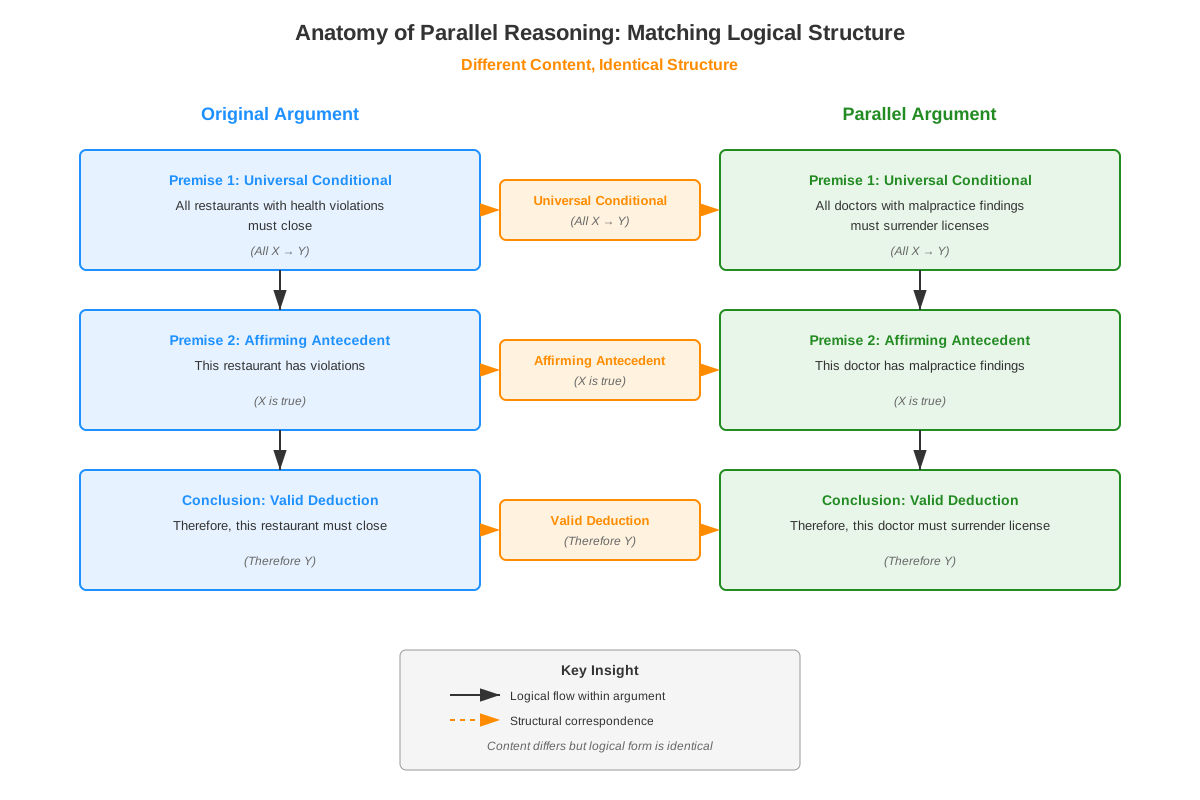
Parallel reasoning questions ask test-takers to identify an argument that matches the logical structure of the stimulus argument. The key word here is "structure"—not content, not topic, not vocabulary, but the underlying pattern of reasoning. The stimulus presents an argument with a specific logical form, and the correct answer choice will replicate that form using entirely different subject matter.
These questions test the ability to perform logical abstraction, the process of stripping away the concrete details of an argument to reveal its underlying logical skeleton. For example, an argument might state: "All lawyers must pass the bar exam. Sarah passed the bar exam. Therefore, Sarah is a lawyer." The logical structure here is: All A are B. X is B. Therefore, X is A. This represents a flawed pattern (affirming the consequent), and a parallel argument might say: "All roses are flowers. This plant is a flower. Therefore, this plant is a rose."
Key Components to Match
When solving parallel reasoning questions, students must ensure that several structural elements align between the stimulus and the correct answer:
Argument Structure: The number and relationship of premises to the conclusion must match. If the stimulus has two independent premises leading to a conclusion, the correct answer must also have two independent premises, not a chain of reasoning where one premise depends on another.
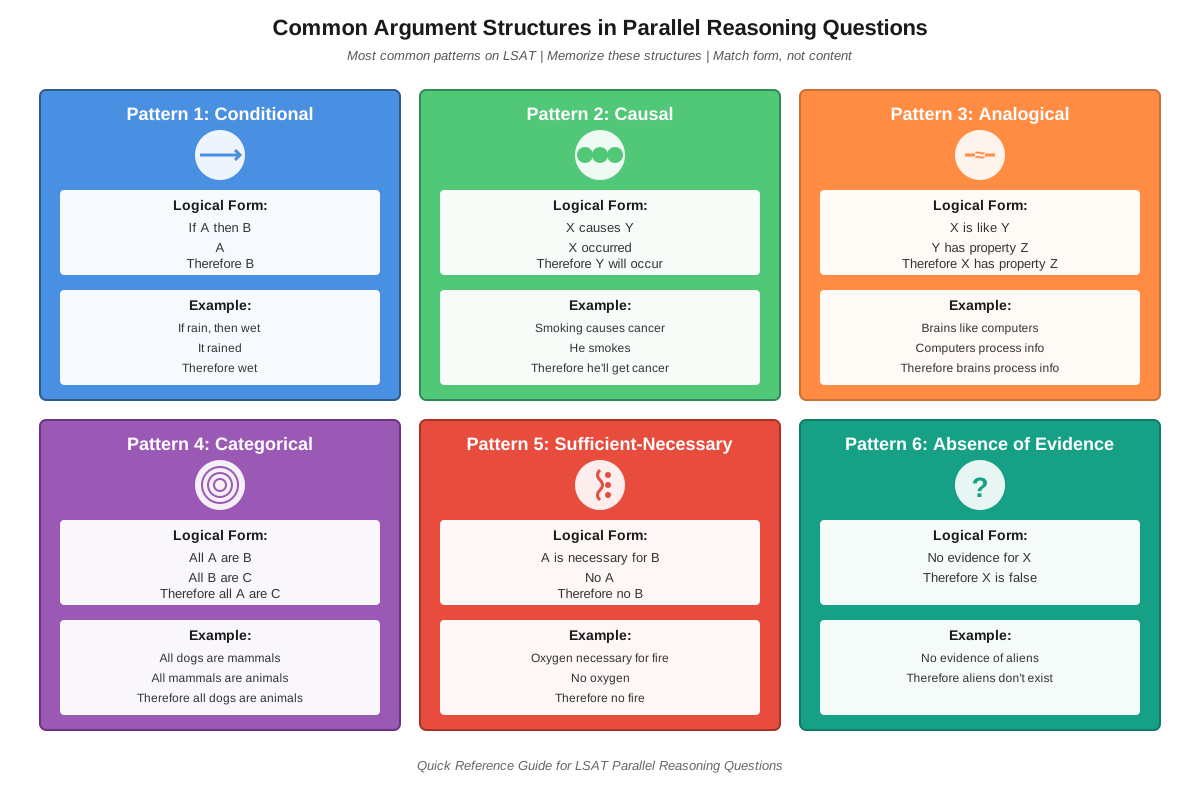
Logical Form: The specific type of reasoning must be identical. Common forms include:
- Conditional reasoning (if-then statements)
- Categorical reasoning (all, some, none statements)
- Causal reasoning (X causes Y)
- Analogical reasoning (X is like Y in certain ways, so probably alike in another way)
- Disjunctive reasoning (either-or statements)
Quantifier Strength: The scope and strength of claims must match precisely. If the stimulus uses "all," the correct answer must use "all" or an equivalent universal quantifier, not "most" or "some." Similarly, "some" cannot be matched with "many" or "most" because these represent different logical strengths.
Validity or Invalidity: If the stimulus argument is logically valid, the correct answer must also be valid. If the stimulus contains a logical flaw, the correct answer must contain the same flaw. This is crucial: parallel reasoning questions can feature either valid or invalid arguments, and the parallel must match this characteristic.
The Abstraction Process
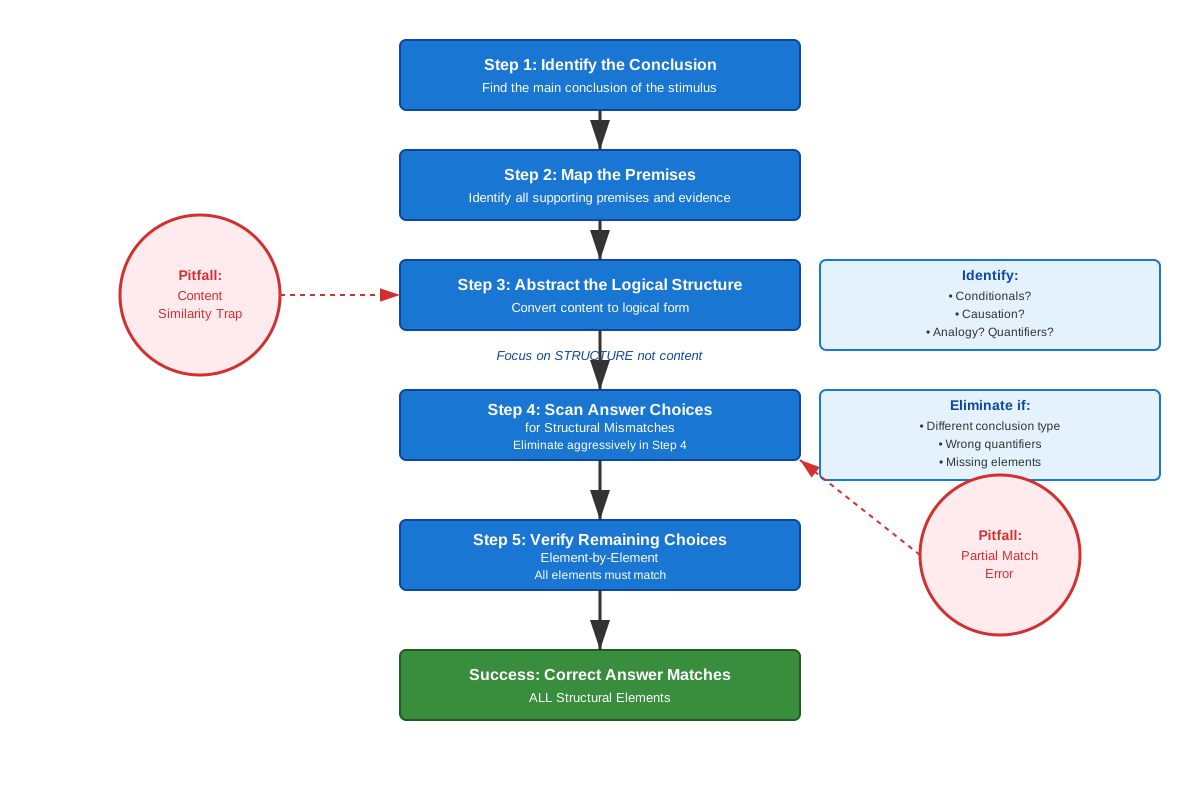
The systematic approach to abstracting logical structure involves several steps:
- Identify the conclusion: Determine what the argument is trying to prove. Look for conclusion indicators like "therefore," "thus," "consequently," or "so."
- Identify the premises: Determine what evidence or reasons support the conclusion. Look for premise indicators like "because," "since," "given that," or "for."
- Map the logical relationships: Determine how the premises connect to the conclusion. Are they independent supports? Does one premise depend on another? Is there a chain of reasoning?
- Abstract to variables: Replace specific content with variables (A, B, C, etc.) or generic placeholders to reveal the pure logical form.
- Note special features: Identify any distinctive logical moves, such as contrapositive reasoning, analogies, elimination of alternatives, or appeals to authority.
Common Argument Patterns
Several argument structures appear frequently in parallel reasoning questions:
| Pattern Type | Structure | Example |
|---|---|---|
| Modus Ponens | If A, then B. A. Therefore, B. | If it rains, the game is cancelled. It's raining. So the game is cancelled. |
| Modus Tollens | If A, then B. Not B. Therefore, not A. | If she studied, she passed. She didn't pass. So she didn't study. |
| Affirming Consequent (Flaw) | If A, then B. B. Therefore, A. | If it's a dog, it's a mammal. It's a mammal. So it's a dog. |
| Denying Antecedent (Flaw) | If A, then B. Not A. Therefore, not B. | If it rains, I'll stay home. It's not raining. So I won't stay home. |
| Universal to Particular | All A are B. X is A. Therefore, X is B. | All senators are politicians. Jones is a senator. So Jones is a politician. |
| Causal Reasoning | X correlates with Y. Therefore, X causes Y. | Crime dropped after the policy. So the policy reduced crime. |
Parallel Flaw vs. Parallel Reasoning
While standard parallel reasoning questions can feature either valid or invalid arguments, parallel flaw questions specifically ask students to match a flawed argument with another argument containing the same flaw. These questions explicitly state "flawed" or "questionable" in the question stem. The approach is similar, but students must specifically identify the logical error and find an answer choice that commits the identical error, not just any error.
Efficiency Strategies for Matching
Given that parallel reasoning questions feature lengthy answer choices, efficiency is crucial. Rather than fully analyzing each answer choice, students should:
Use elimination markers: Identify the most distinctive or unusual feature of the stimulus argument and scan answer choices for this feature first. If the stimulus uses a contrapositive, immediately eliminate any answer choice that doesn't use one.
Check conclusion type first: The conclusion's logical form is often the easiest element to check quickly. If the stimulus concludes with a conditional statement, eliminate any answer choice with a categorical conclusion.
Verify quantifiers: Once an answer choice seems promising, verify that all quantifiers match in strength and scope.
Confirm premise relationships: Finally, ensure that the premises relate to each other and to the conclusion in the same way as in the stimulus.
Concept Relationships
The concepts within parallel reasoning questions form a hierarchical relationship. At the foundation lies logical abstraction—the ability to see beyond content to structure. This skill enables pattern recognition, which allows students to identify the specific type of reasoning employed (conditional, causal, analogical, etc.). Pattern recognition then facilitates structural matching, where students compare the stimulus to answer choices. Finally, structural matching enables efficient elimination, where students quickly discard non-parallel options.
Parallel reasoning connects to prerequisite topics in essential ways. Basic argument structure provides the framework for identifying premises and conclusions that must be matched. Conditional logic supplies the tools for recognizing and matching if-then patterns, which appear frequently in these questions. Argument forms give students a catalog of common patterns to recognize and replicate.
The relationship to other Logical Reasoning question types is also significant. Method of reasoning questions ask students to describe how an argument proceeds, which requires similar structural analysis but focuses on description rather than matching. Assumption questions require understanding argument structure to identify gaps, a skill that helps in parallel reasoning by revealing what makes arguments structurally complete or incomplete. Flaw questions develop the ability to recognize invalid reasoning patterns, which directly applies to parallel flaw questions.
The progression flows: Argument Structure → Logical Abstraction → Pattern Recognition → Structural Matching → Answer Selection. Each step depends on the previous one, and weakness at any stage undermines performance on parallel reasoning questions.
Quick check — test yourself on Parallel reasoning questions so far.
Try Flashcards →High-Yield Facts
⭐ Parallel reasoning questions require matching logical structure, not content or topic matter.
⭐ The correct answer must match the validity or invalidity of the stimulus argument exactly.
⭐ Quantifier strength must be identical: "all" cannot match with "most" or "some."
⭐ The number of premises and their relationship to the conclusion must be the same in both arguments.
⭐ Conditional statements must match in form: sufficient and necessary conditions must align.
- Parallel reasoning questions typically appear 2-4 times per LSAT administration.
- Answer choices in parallel reasoning questions are usually longer than in other question types, making time management crucial.
- The most distinctive or unusual logical feature of the stimulus is often the most efficient elimination tool.
- Parallel flaw questions explicitly mention the flaw in the question stem, while standard parallel reasoning questions may or may not involve flawed reasoning.
- Causal reasoning patterns are among the most common structures in parallel reasoning questions.
- The conclusion's logical form (conditional, categorical, causal, etc.) is often the quickest element to check for matching.
- Arguments using analogical reasoning must match not just in using analogy, but in the specific structure of the analogy.
- Contrapositive reasoning, when present in the stimulus, must appear in the correct answer choice.
- Arguments with intermediate conclusions (sub-conclusions) must be matched with answers containing the same multi-layered structure.
- The presence or absence of counterexamples or alternative explanations must be matched between stimulus and answer.
Common Misconceptions
Misconception: Parallel reasoning questions require matching the topic or subject matter of the stimulus.
Correction: These questions require matching logical structure only. The correct answer will almost always discuss a completely different topic than the stimulus. A stimulus about economics might correctly match with an answer about biology if the logical structure is identical.
Misconception: If both the stimulus and an answer choice are flawed, they must be parallel.
Correction: The specific type of flaw must match, not just the presence of any flaw. An argument that affirms the consequent is not parallel to an argument that denies the antecedent, even though both are invalid.
Misconception: "Most" and "some" are interchangeable in parallel reasoning because both are less than "all."
Correction: Quantifiers must match precisely. "Most" means more than half, while "some" means at least one. These represent different logical strengths and cannot be matched in parallel reasoning questions.
Misconception: The correct answer will use similar vocabulary or terminology to the stimulus.
Correction: The LSAT deliberately uses different vocabulary to test whether students can see past surface features to underlying structure. Similar wording might actually indicate a trap answer that matches content but not structure.
Misconception: Parallel reasoning questions are primarily about formal logic and symbolic notation.
Correction: While formal logic skills help, these questions test the ability to recognize reasoning patterns in natural language arguments. Students don't need to translate everything into symbols; they need to understand structural relationships.
Misconception: The longest answer choice is usually correct because it has more detail to match the stimulus.
Correction: Length is irrelevant to correctness. Some correct answers are concise; some incorrect answers are verbose. Focus on structural matching, not word count.
Misconception: If the stimulus uses an example or illustration, the correct answer must also use an example.
Correction: While major structural elements must match, minor rhetorical features like examples, illustrations, or rhetorical questions don't need to be paralleled unless they play a logical role in the argument.
Worked Examples
Example 1: Conditional Reasoning Pattern
Stimulus: "If the museum extends its hours, it will attract more visitors. The museum has decided to extend its hours. Therefore, it will attract more visitors."
Analysis:
- Conclusion: The museum will attract more visitors
- Premises: (1) If extended hours → more visitors; (2) The museum will extend hours
- Logical form: If A, then B. A. Therefore, B. (Modus Ponens - valid reasoning)
- Key features: Valid conditional reasoning, affirming the antecedent
Correct Answer: "If the company increases advertising, sales will improve. The company has increased advertising. Therefore, sales will improve."
Why it's correct: This matches the exact structure: If A (increased advertising), then B (sales improve). A (company increased advertising). Therefore, B (sales will improve). Both arguments use valid modus ponens reasoning with the same number of premises and identical logical form.
Wrong Answer Example: "If the company increases advertising, sales will improve. Sales have improved. Therefore, the company increased advertising."
Why it's wrong: This commits the fallacy of affirming the consequent (If A, then B. B. Therefore, A.), which is invalid reasoning. The stimulus uses valid reasoning, so this cannot be parallel despite discussing a similar topic.
Example 2: Causal Reasoning with Quantifiers
Stimulus: "Most successful entrepreneurs take significant risks. Chen is a successful entrepreneur. Therefore, Chen probably takes significant risks."
Analysis:
- Conclusion: Chen probably takes significant risks
- Premises: (1) Most successful entrepreneurs take risks; (2) Chen is a successful entrepreneur
- Logical form: Most A are B. X is A. Therefore, X is probably B.
- Key features: Probabilistic conclusion (note "probably"), uses "most" quantifier, valid statistical reasoning
Correct Answer: "Most professional athletes maintain strict diets. Rodriguez is a professional athlete. Therefore, Rodriguez probably maintains a strict diet."
Why it's correct: Perfect structural match. Uses "most" (not "all" or "some"), applies a general statistical claim to a specific instance, and reaches a probabilistic conclusion with "probably." The reasoning is valid in both cases—when most of a category has a property and something belongs to that category, it's reasonable to conclude it probably has that property.
Wrong Answer Example: "All professional athletes maintain strict diets. Rodriguez is a professional athlete. Therefore, Rodriguez maintains a strict diet."
Why it's wrong: This uses "all" instead of "most" and reaches a definite conclusion without "probably." The logical strength is different—this is deductively certain rather than probabilistic. The quantifier mismatch alone disqualifies this answer.
Wrong Answer Example: "Most professional athletes maintain strict diets. Rodriguez maintains a strict diet. Therefore, Rodriguez is probably a professional athlete."
Why it's wrong: This reverses the logical direction. The stimulus goes from category membership to property (entrepreneur → takes risks), but this answer goes from property to category membership (strict diet → athlete). This is a structural mismatch even though it uses the correct quantifier.
Exam Strategy
Approaching Parallel Reasoning Questions
When encountering a parallel reasoning question, follow this systematic approach:
Step 1: Identify the question type by looking for keywords like "parallel," "similar in reasoning," or "most closely conforms to the pattern of reasoning." This signals that content is irrelevant and structure is everything.
Step 2: Analyze the stimulus argument by identifying the conclusion first, then the premises, then the logical relationship between them. Ask: Is this valid or flawed? What type of reasoning is used? What are the quantifiers?
Step 3: Abstract the structure by mentally replacing specific content with variables or generic terms. "All lawyers must pass the bar" becomes "All A must be B."
Step 4: Identify the most distinctive feature of the argument. Is there a contrapositive? An unusual quantifier combination? A specific type of flaw? This becomes your primary elimination tool.
Trigger Words and Phrases
Watch for these question stem indicators:
- "Most similar in its reasoning"
- "Pattern of reasoning most closely parallels"
- "Most closely conforms to the principle illustrated"
- "Employs which one of the following reasoning techniques"
- "Flawed pattern of reasoning" (indicates parallel flaw variant)
In the stimulus and answer choices, pay special attention to:
- Quantifiers: all, most, some, many, few, none
- Conditional indicators: if, then, only if, unless, when, whenever
- Causal language: causes, leads to, results in, because of
- Conclusion indicators: therefore, thus, so, consequently, hence
- Premise indicators: since, because, given that, for
Process of Elimination Strategy
Exam Tip: Don't fully analyze all five answer choices. Use distinctive features to eliminate quickly.
First pass: Scan all five answer choices for the most distinctive feature of the stimulus. If the stimulus uses a contrapositive, eliminate any answer without one. If it has three premises, eliminate any answer with two or four. This often eliminates 2-3 answers in seconds.
Second pass: Among remaining answers, check the conclusion type. Does it match the logical form of the stimulus conclusion (conditional, categorical, causal, etc.)?
Third pass: Verify quantifier matching in the remaining answer(s). Ensure "all" matches "all," "most" matches "most," etc.
Final verification: Confirm that the premise-to-conclusion relationship matches exactly.
Time Allocation
Parallel reasoning questions typically require more time than average Logical Reasoning questions due to lengthy answer choices. Budget approximately:
- 30-45 seconds: Analyzing the stimulus and abstracting its structure
- 60-90 seconds: Evaluating answer choices using elimination strategy
- Total: 90-135 seconds (1.5 to 2.25 minutes)
If a parallel reasoning question is taking longer than 2.5 minutes, make your best guess and move on. These questions can become time traps if you get stuck comparing similar-looking answers.
Memory Techniques
The MATCH Acronym
Use MATCH to remember what must be identical between stimulus and answer:
- Method of reasoning (conditional, causal, analogical, etc.)
- Amount of premises (same number and relationship)
- Type of conclusion (categorical, conditional, probabilistic, etc.)
- Correctness (valid matches valid, flaw matches same flaw)
- Heft of quantifiers (all, most, some must match exactly)
The Skeleton Visualization
Visualize arguments as skeletons: the bones (logical structure) remain constant even when you change the flesh (content). When reading the stimulus, imagine stripping away all the specific content to reveal just the bones—the pure logical form. The correct answer is the same skeleton wearing different flesh.
The "If-Then-Check" Sequence
For conditional reasoning patterns, use this memory device:
- If you see "if-then" in the stimulus
- Then the answer must also use "if-then"
- Check whether it affirms the antecedent (valid) or consequent (flaw)
Quantifier Hierarchy
Remember quantifier strength from strongest to weakest:
ALL → MOST → MANY → SOME → FEW
Visualize this as a staircase: you can't match a step on the top with a step on the bottom. Each quantifier must match its exact position on the staircase.
Summary
Parallel reasoning questions test the fundamental skill of logical abstraction—the ability to recognize and match argument structures independent of their content. These questions appear consistently on every LSAT, typically 2-4 times per test, making them a high-value target for score improvement. Success requires systematically identifying the conclusion, premises, and logical relationships in the stimulus, then abstracting this structure to its essential form. The correct answer will replicate this exact structure using different subject matter, matching the validity or invalidity of the reasoning, the number and relationship of premises, the type of conclusion, and the strength of all quantifiers. Efficient solving depends on identifying the most distinctive structural feature of the stimulus and using it to eliminate answer choices quickly, rather than fully analyzing all five options. Common patterns include conditional reasoning (modus ponens, modus tollens), categorical reasoning with various quantifiers, and causal reasoning. The key insight is that content is irrelevant—an argument about economics can be perfectly parallel to one about biology if the logical skeleton is identical. Mastering parallel reasoning questions strengthens the broader analytical skills essential for success across all Logical Reasoning question types and develops the pattern-matching ability that underlies legal reasoning itself.
Key Takeaways
- Parallel reasoning questions require matching logical structure, not content, topic, or vocabulary
- The correct answer must match the validity/invalidity of the stimulus exactly, including matching the specific type of flaw if one exists
- Quantifiers must match precisely in strength: "all," "most," and "some" are not interchangeable
- Efficient solving depends on identifying the most distinctive structural feature and using it to eliminate answers quickly
- Common patterns include conditional reasoning (if-then), categorical reasoning (all/some/none), and causal reasoning
- The number of premises and their relationship to the conclusion must be identical between stimulus and answer
- Time management is crucial because answer choices are longer than in most question types—budget 1.5-2.5 minutes per question
Related Topics
Parallel Flaw Questions: A specialized variant where the stimulus contains flawed reasoning and the correct answer must contain the identical flaw. Mastering standard parallel reasoning provides the foundation for this more specific question type.
Method of Reasoning Questions: These ask students to describe how an argument proceeds rather than match its structure. The analytical skills developed for parallel reasoning—identifying argument structure and reasoning patterns—directly transfer to method of reasoning questions.
Formal Logic and Conditional Reasoning: Deeper study of conditional logic, including complex conditional chains, contrapositives, and formal logic notation, enhances the ability to recognize and match conditional patterns in parallel reasoning questions.
Argument Structure and Diagramming: Advanced techniques for visually mapping argument structure help students see logical relationships more clearly, making the abstraction process in parallel reasoning more systematic and reliable.
Flaw Question Types: Understanding common logical fallacies (affirming the consequent, denying the antecedent, false dichotomy, etc.) is essential for parallel flaw questions and helps recognize invalid reasoning patterns that may appear in standard parallel reasoning questions.
Practice CTA
Now that you understand the structure and strategy behind parallel reasoning questions, it's time to put these concepts into practice. Work through the practice questions systematically, applying the MATCH acronym and elimination strategies you've learned. Start by analyzing each stimulus carefully, abstracting its structure before looking at answer choices. With each practice question, you're building the pattern-recognition skills that will make these questions faster and more intuitive on test day. Remember: parallel reasoning questions are highly learnable—consistent practice with the right approach yields significant score improvements. Challenge yourself with the flashcards to reinforce key concepts, and track which structural patterns you recognize most easily and which require more attention. Your investment in mastering this question type will pay dividends across your entire LSAT performance.
Sign up free to keep reading
Create a free AnvayaPrep account to finish this LSAT guide on Parallel reasoning questions — plus flashcards and practice questions.